
Last updated 2026-07-09
TL;DR
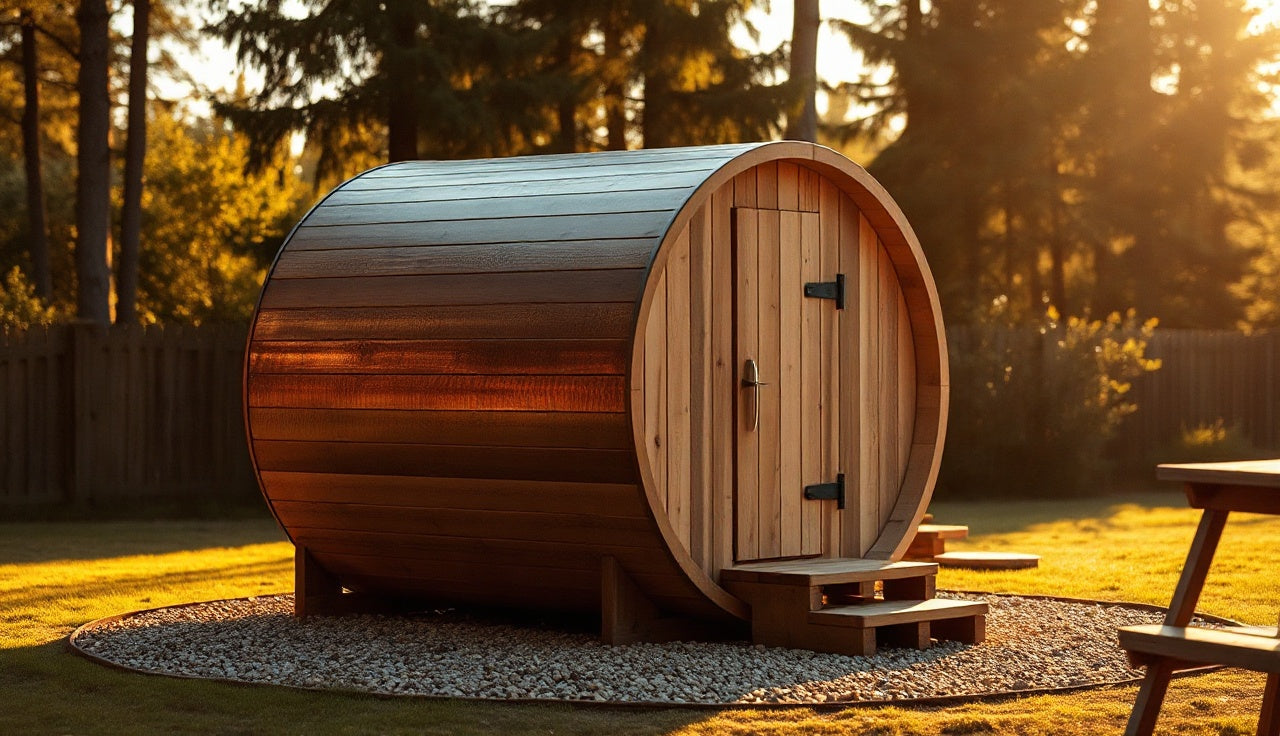
The Aleko SB8CEDARCP is a Canadian hemlock barrel sauna sized for eight people, roughly 94 inches long by 71 inches in diameter. It handles both wet and dry sessions, ships as a DIY kit, and runs on a 6 kW electric heater. Two people build it in about a day. Street price lands in the $3,500 to $4,500 range depending on retailer and bundled accessories.
What exactly is the Aleko SB8CEDARCP and who makes it?
Aleko is a Washington State company that started in garage doors and fencing before moving into outdoor living products, including a line of barrel saunas. The SB8CEDARCP is their largest standard barrel model, built to seat eight adults. The "CP" in the model name points to the Canadian hemlock wood used for the stave construction, which Aleko markets under the "cedarCP" label even though the primary wood is hemlock rather than true cedar.
That naming quirk trips a lot of buyers up. Canadian hemlock and western red cedar are both solid softwood choices for sauna construction, but they are different materials. Hemlock is lighter in color, has a milder scent, and is slightly less naturally resistant to moisture than true cedar. It is still a proven sauna wood and costs less to source, which is part of why Aleko can keep the price below many competitors [1].
The company sells direct through its own website and through third-party retailers. Aleko is not a small backyard operation, but it is also not in the same tier as Finnish manufacturers like Harvia or Tylö. Think of it as a mid-market North American brand. Quality control has been inconsistent across reviews, which I get into honestly in the section on common complaints.
If you want more background on how barrel sauna construction works in general, the outdoor sauna guide covers the full landscape of options at different price points.
What are the dimensions and capacity of the SB8CEDARCP?
The SB8CEDARCP measures roughly 94 inches (about 7.8 feet) in overall length and 71 inches (roughly 5.9 feet) in diameter. The interior uses two opposing L-shaped bench configurations, which is how Aleko gets to the eight-person claim. In reality, eight large adults sitting shoulder-to-shoulder is tight. Six people is a comfortable session. Eight works if nobody minds close quarters.
The barrel sits on two cradle-style support legs that keep it off the ground, which matters for drainage and airflow under the unit. Some configurations add a small exterior changing area at one end, but the base kit is the sauna room itself with no attached changing room. The optional exterior porch or changing room is a separate purchase.
Here are the specs that matter most for site planning:
| Spec | SB8CEDARCP |
|---|---|
| Overall length | ~94 inches (239 cm) |
| Outer diameter | ~71 inches (180 cm) |
| Interior bench height (upper) | ~42 inches |
| Capacity (seated, comfortable) | 6 people |
| Capacity (rated) | 8 people |
| Wood species | Canadian hemlock |
| Wall thickness | ~1.5 inches |
| Heater included | 6 kW electric |
| Electrical requirement | 240V / 30A circuit |
| Approximate shipping weight | 850-950 lbs |
The 240V / 30A electrical requirement is not optional and cannot be worked around. If your outdoor space has no dedicated 240V circuit, budget for an electrician before you budget for the sauna itself. Running a new circuit from a main panel to a backyard location can cost $300 to $1,500 depending on distance and local labor rates [2].
Does the SB8CEDARCP work as a wet sauna (with steam)?
Yes. The included heater has a sauna rock tray, and you pour water over the rocks to make steam, the Finnish practice called löyly. That is what makes it a wet/dry sauna rather than a dry-only infrared unit. Traditional Finnish sessions almost always involve some steam, and the SB8CEDARCP supports that fully.
The 6 kW heater that ships with the unit is on the lower end for a room this size. Guidelines from the Finnish Sauna Society suggest roughly 1 kW of heater capacity per cubic meter of sauna space [3]. A barrel this large has an interior volume somewhere around 65 to 75 cubic feet, which is roughly 1.8 to 2.1 cubic meters. By that math, the 6 kW heater is actually more than adequate, but that calculation assumes good insulation and no major air leaks in the stave assembly.
Here is the practical point. A properly assembled SB8CEDARCP with sealed staves should reach 160 to 185°F (71 to 85°C) within 45 to 60 minutes. If yours takes much longer, the stave gaps are the first thing to check. Green wood swells and closes gaps over time. Very dry wood may need temporary sealing.
For anyone curious about the physiological side of heat sessions and what the research actually shows, the sauna benefits article covers the clinical literature honestly, including what the data supports and where it is still thin.
How hard is the assembly and what do you actually need?
Aleko ships the SB8CEDARCP as a flat-pack DIY kit. The staves, end panels, benches, heater, door, and hardware all arrive in crates. Two people with basic carpentry skills finish the build in roughly 8 to 12 hours across a single day or two half-days. One person technically can do it, but wrestling 70-pound stave sections into a cradle alone is genuinely miserable.
The assembly follows a barrel-stave logic. You stack and band the curved wood staves around the two circular end panels, tighten the steel tension bands, then add the floor, benches, and heater. The door frame drops into the pre-cut end panel opening. Most people who have done it say the instructions are functional but not great, and there are enough steps where a YouTube walkthrough of a similar Aleko model is worth watching before you start.
Tools you need that are not included: a rubber mallet, a power drill with bits, a level, two sawhorses or similar supports for staging, and probably a second ladder. The cradle legs bolt together first and become your staging platform.
Site prep matters. The barrel needs a level, solid base. Options include a concrete pad, compacted gravel (minimum 4 inches), or ground-level deck boards. The base footprint you want is roughly 8 feet wide by 10 feet long to give yourself working room around the unit. Check your local building codes before you pour anything. Many jurisdictions require a permit for permanent outdoor structures over a certain size, and some HOAs have specific rules about outbuildings [4].
Electrical hookup must be done by a licensed electrician in most U.S. states. The heater control panel wires to a dedicated 240V / 30A GFCI-protected circuit. Do not skip the GFCI requirement. It is a real safety issue with outdoor electrical near water [5].
What is the price of the Aleko SB8CEDARCP and is it good value?
The SB8CEDARCP has sold in the $3,500 to $4,500 range at most retailers, with occasional sales pushing it closer to $3,200. That does not include shipping (freight delivery for a ~900-pound kit runs $200 to $500 depending on your location and retailer), the electrical circuit installation, or any site prep work.
For comparison, here is where the SB8CEDARCP sits in the broader outdoor barrel sauna market:
| Model / Brand | Capacity | Price Range | Wood |
|---|---|---|---|
| Aleko SB8CEDARCP | 8-person | $3,500-$4,500 | Canadian hemlock |
| Dundalk LeisureCraft 6-person barrel | 6-person | $5,500-$7,000 | Canadian red cedar |
| Almost Heaven Pinnacle 6-person | 6-person | $4,500-$6,000 | Rustic cedar |
| Harvia Sirius 6-person kit | 6-person | $7,000-$10,000 | Nordic spruce |
| DIY kit (hemlock, 6-person) | 6-person | $2,000-$3,000 | Varies |
The Aleko SB8CEDARCP gives you real square footage at a price that is hard to match from a pre-engineered kit. What you give up against Dundalk or Almost Heaven is wood quality, tighter joinery tolerances, and better after-sale support. If you are fine doing some troubleshooting yourself and want the most interior space per dollar, the Aleko is defensible. If you want something you can hand to an installer and forget about, spend more.
Here is the honest read on value. It is good value for what it is, and it is not premium. Budget an extra $200 to $400 for weatherproofing supplies, any stave gaps you need to address, and possibly an upgraded heater if you find the 6 kW unit slow to heat in cold climates.
| Aleko SB8CEDARCP (hemlock) | $6,200 |
| Almost Heaven Pinnacle (cedar) | $8,500 |
| Dundalk LeisureCraft (cedar) | $10,000 |
| Harvia Sirius kit (Nordic spruce) | $13,000 |
Source: Manufacturer pricing and U.S. DOE contractor cost estimates, 2024
What heater does the SB8CEDARCP include and can you upgrade it?
The standard kit ships with a 6 kW electric sauna heater with a rock basket and basic digital controls. The heater is a generic-brand unit that Aleko sources for the kit, not a name-brand Finnish heater. It works fine in moderate climates, but user reviews from buyers in Minnesota or Canada often mention longer preheat times in winter.
You can swap the heater. The wall-mount bracket and wiring setup in the SB8CEDARCP is compatible with most standard 240V sauna heaters that use a 60mm or similar mounting flange. Popular upgrade paths include the Harvia KIP 6 kW, which runs around $400 to $600, or stepping up to an 8 kW unit if you plan to run the sauna often in subfreezing weather. An 8 kW heater on a 30A circuit sits at the edge of safe capacity, so confirm your circuit amperage with your electrician before sizing up [5].
For wood-burning purists: a wood-fired barrel sauna heater can be retrofitted, but it requires a proper stovepipe penetration through the barrel wall and a spark arrestor, and it takes the unit out of UL-listed territory. Some counties do not permit wood-burning appliances in new outdoor structures at all, so check local ordinances first [4].
If you are comparing electric barrel saunas to other formats, the home sauna overview covers infrared versus traditional electric versus wood-fired in more depth.
How do you maintain a hemlock barrel sauna outdoors?
Outdoor wood saunas need real maintenance attention. Hemlock is not naturally rot-resistant the way red cedar or teak is, so surface treatment matters more than it would with a cedar unit.
Treat the exterior staves with a UV-resistant exterior wood oil or sauna-specific exterior stain once per year, more often in high-sun or high-rain climates. Never use indoor varnish or polyurethane on the exterior. It traps moisture and accelerates rot from the inside out. Products like Superdeck or Defy Extreme Wood Stain work well. Avoid anything with heavy pigment on the interior.
The interior should stay untreated or finished only with a sauna-safe interior wood protector. The heat cycles do some natural work sealing the wood over time. Between sessions, leave the door cracked so the interior dries fully. A wet interior that stays closed traps moisture and grows mildew.
The steel tension bands that hold the staves together will eventually surface-rust if left uncoated. Hit them with a rust-inhibiting metal primer and exterior enamel every couple of years. The hardware at the end panels is the other maintenance point. Check the bolts annually for loosening as the wood expands and contracts seasonally.
In climates with heavy snow loads, the barrel shape sheds snow well compared to a flat-roofed structure, but the end panels and door frame are the weak points. Some owners build a simple lean-to roof over the unit for winter protection. That also extends heater life meaningfully by reducing cold-soak before each session.
A sauna cover or purpose-built barrel sauna cover is worth the $150 to $300 if the unit sits in direct sun or frequent rain.
What are the most common complaints about the Aleko SB8CEDARCP?
I want to be honest here because the complaints are real and consistent across verified buyer reviews on multiple platforms.
The most frequent issue is stave gaps. When the wood arrives dry from shipping, the stave-to-stave joints show visible gaps. This is normal for barrel construction and usually resolves after a few wet heat cycles swell the wood. The problem is when it does not fully resolve, because gaps become air leaks and the heater works overtime. Aleko's customer service responsiveness on warranty claims rates poorly with a significant share of buyers. Expect that resolving a defective-stave issue may take persistence.
Second most common: missing or incorrect hardware in the kit. Multiple reviewers report bags of bolts that do not match the instructions, or pre-drilled holes that do not line up as expected. Having a complete hardware assortment on hand before you start assembly is not paranoia. It is practical.
Third: the door. The standard door uses a basic wooden frame with a tempered glass window. Several buyers report the door developing a warp that prevents a tight seal after the first winter. A door that does not seal wastes heat and shortens heater life.
None of these are dealbreakers for a handy owner willing to troubleshoot. They are dealbreakers if you want a set-it-and-forget-it installation. The Dundalk and Almost Heaven units at higher prices have meaningfully tighter quality control from what the comparative review record shows.
If you are weighing whether a barrel format is right for you at all, the outdoor sauna article compares barrel designs to traditional square cabin saunas on every practical dimension.
Is the SB8CEDARCP safe for residential outdoor installation?
Yes, with proper setup. The heater that ships with the unit carries ETL certification, a recognized North American safety standard equivalent to UL listing [6]. ETL means the product has been tested to the same ANSI/UL standards by Intertek rather than UL directly. For home insurance and permit purposes, ETL is generally accepted the same way UL is.
The National Electrical Code (NEC) Article 680 covers outdoor electrical installations near water, and NEC Article 424 covers fixed electric space-heating equipment, which applies to sauna heaters [5]. Your electrician will know these standards. The install needs a GFCI breaker, proper grounding, and conduit rated for outdoor use. These are not optional interpretations. They are code requirements in virtually every U.S. jurisdiction.
For the structure itself, many jurisdictions treat a barrel sauna as an accessory structure. Structures over a certain square footage (commonly 120 to 200 square feet, though this varies by municipality) typically need a building permit. The SB8CEDARCP's footprint is well under 120 square feet, so in many places it falls under the permit threshold, but verify with your local building department before assuming [4].
Keep the sauna at least 3 to 5 feet from any property line and any combustible structure, and keep the area around the heater interior clear of any materials. The Consumer Product Safety Commission has published guidance on residential sauna safety that covers ventilation minimums and safe heater operation [7].
Do not let children use a sauna unsupervised, and anyone with cardiovascular conditions should consult a physician before regular sauna use. The research on sauna and heart outcomes is genuinely interesting, with one large Finnish study finding that "frequent sauna bathing was associated with a reduced risk of sudden cardiac death" in middle-aged men, but that does not mean sauna is safe for everyone without a doctor's input [8].
How does the SB8CEDARCP compare to smaller Aleko barrel models?
Aleko makes barrel saunas in several sizes, most commonly a 4-person and a 6-person alongside the 8-person SB8CEDARCP. The smaller models use the same hemlock construction and same heater brand, scaled down. The 4-person models typically include a 4.5 kW heater and sell in the $2,200 to $2,800 range. The 6-person sits in the $2,800 to $3,500 range.
For a household of two to four people, the 4-person or 6-person barrel is likely more practical. The SB8CEDARCP takes longer to heat, uses more electricity per session, and needs more physical space. Its whole reason to exist is households that regularly host larger groups, or a dedicated home sauna space that doubles as a social gathering point.
The per-person cost advantage of the 8-person model is real. At $4,000, the SB8CEDARCP works out to $500 per rated seat. The 4-person at $2,500 is $625 per seat. But if you usually use it with one or two other people, you are heating a lot of empty space every session, and that adds up in electricity over time.
If space or budget is a constraint and you are thinking about smaller formats, the portable sauna article covers the tradeoffs between permanent barrel units and the fold-up and tent-style alternatives, which range from about $150 to $800.
Can you use the SB8CEDARCP for contrast therapy with a cold plunge?
Absolutely, and this is one of the best reasons to own a large barrel sauna. Contrast therapy, alternating between heat and cold immersion, has a growing body of research behind it. A 2017 review in the Journal of Science and Medicine in Sport found that cold water immersion reduced muscle soreness and perceived fatigue after exercise, though the optimal temperature and timing protocols are still being studied [9].
The practical setup for contrast therapy at home is a cold plunge or ice bath placed within a short walk of the sauna. The SB8CEDARCP's barrel size lets you run a serious heat session (15 to 20 minutes at 170°F) before stepping outside to a cold plunge. Most practitioners running this protocol suggest 2 to 5 minutes in cold water (50 to 59°F) per round, then back to heat. Two to three cycles per session is a common starting point.
For a backyard wellness setup, the SB8CEDARCP pairs well with a dedicated cold plunge tub or a stock tank with a chiller. Sites like SweatDecks carry both barrel saunas and cold plunge options, so you can configure the combo in one place. The cold plunge benefits article covers what the research actually says about cold immersion without overselling it.
The space requirement for a full contrast therapy setup outdoors is not trivial. You need a pad or deck area of roughly 12 by 16 feet minimum to fit the barrel, the cold plunge, and comfortable transition space between them. Plan the site before you order anything.
What should you know before buying the Aleko SB8CEDARCP?
Start with the electrical situation. If your outdoor panel does not have capacity for a new 240V / 30A circuit, get an electrician quote before you buy. That cost can meaningfully change the total project budget.
Measure your site twice. The barrel itself is 94 inches long and 71 inches in diameter, but the cradle legs extend slightly beyond the barrel ends. Leave at least 18 inches of clearance on each side for assembly and future access, and keep the unit level to within about 1/4 inch end to end. Unlevel installation causes door alignment issues and puts stress on the stave bands.
Check your local zoning. Some neighborhoods, especially those with HOAs or in historic districts, restrict outbuildings by size, color, or proximity to property lines. A 15-minute call to your local planning department is worth it.
Budget beyond the unit price. A realistic total-cost breakdown for a new SB8CEDARCP installation looks something like this: unit ($3,500 to $4,500) plus freight shipping ($200 to $500) plus concrete pad or gravel base ($200 to $600 depending on DIY vs. contractor) plus electrical circuit ($300 to $1,500) plus weatherproofing supplies ($100 to $200) plus any heater upgrade ($400 to $700 optional). Total realistic range: $4,300 to $8,000 depending on your existing infrastructure and whether you hire out any labor.
If this budget feels like a stretch, compare it against gym memberships or commercial sauna access. A family of four buying four gym memberships with sauna access at $40 to $60 per person per month spends $1,920 to $2,880 per year. The SB8CEDARCP, even at the high end of total install cost, can pay for itself in under four years against that benchmark, though the comparison depends entirely on how often you actually use it.
For anyone still in the research phase comparing options across the market, the home sauna guide covers the full decision framework for choosing between barrel, cabin, infrared, and portable formats.
Frequently asked questions
What wood is the Aleko SB8CEDARCP actually made from?
Despite the 'cedarCP' in the model name, the SB8CEDARCP is built from Canadian hemlock, not true cedar. Hemlock is a solid softwood for sauna use with good thermal properties and a mild scent, but it is less naturally moisture-resistant than western red cedar. Annual exterior oiling matters more with hemlock than it would with a cedar-built barrel sauna.
How long does it take to heat the Aleko SB8CEDARCP to sauna temperature?
In moderate weather (above 50°F ambient), expect 45 to 60 minutes to reach 160 to 185°F with the included 6 kW heater. In cold climates below freezing, preheat times can stretch to 75 to 90 minutes. Upgrading to an 8 kW heater shortens this noticeably. Stave gaps that let cold air in will also significantly slow preheat, so proper assembly and sealing matter.
Does the SB8CEDARCP come with a warranty?
Aleko offers a limited manufacturer's warranty on the SB8CEDARCP, generally covering structural defects in materials and workmanship. The specific terms vary by retailer, and the heater component typically carries a separate one-year parts warranty. Aleko's customer service reputation for warranty claims is mixed in buyer reviews, so document any defects with photos immediately upon assembly and register the product right away.
Can I use the SB8CEDARCP year-round in a cold climate like Minnesota or Canada?
Yes, but with caveats. The hemlock construction handles freeze-thaw cycles reasonably well if the exterior is properly sealed. The 6 kW heater will struggle in sustained subfreezing temps, so most cold-climate owners upgrade to an 8 kW unit. Protect the door frame from ice buildup, keep the steel tension bands treated against rust, and consider a cover or lean-to roof to reduce cold-soak between sessions.
Does the SB8CEDARCP require a building permit?
In most U.S. jurisdictions, the SB8CEDARCP's footprint falls under the permit threshold (commonly 120 to 200 square feet) for accessory structures, but this varies significantly by municipality. The electrical work always requires a permit and inspection in virtually every jurisdiction. Call your local building department to confirm before installation. HOA rules are separate from municipal codes and may impose additional restrictions.
How many people can realistically use the SB8CEDARCP at once?
Aleko rates it for eight, but six adults is the comfortable operating capacity. Eight people works if everyone is fine sitting close together on the two bench rows. The interior uses opposing L-shaped benches, so there is a mix of upper and lower seating. For family use with a mix of adults and children, eight is realistic. For adult groups, plan on six for a relaxed session.
What is the electricity cost to run the SB8CEDARCP?
The 6 kW heater running at full load for one hour uses 6 kWh. At the U.S. average residential electricity rate of about 16 cents per kWh as of 2024, that is roughly $0.96 per hour. A typical 90-minute session including preheat costs about $1.50 to $2.00 in electricity. Actual costs vary by local rates and how hard the heater works in your climate.
Can you add a wood-burning heater to the SB8CEDARCP instead of using the electric one?
It is technically possible to retrofit a wood-burning sauna stove, but it requires cutting a stovepipe penetration through the barrel wall with proper flashing, adding a spark arrestor, and ensuring clearances meet local fire codes. This voids any ETL certification on the structure. Some counties prohibit wood-burning appliances in new outdoor structures entirely. If you want wood-fired from the start, look at units designed for it rather than converting an electric kit.
How does the SB8CEDARCP compare to an infrared sauna of similar price?
The SB8CEDARCP is a traditional convection sauna that heats the air and supports steam. Infrared saunas at similar prices heat the body more directly at lower ambient temperatures, typically 120 to 140°F versus 160 to 190°F for traditional. Traditional saunas produce more intense sweat sessions and allow the wet/löyly experience. Infrared units typically have lower electrical demands and faster preheat. The sauna vs steam room article covers these format differences in detail.
What base or foundation does the SB8CEDARCP need?
The barrel sits on two wooden cradle legs, so the base needs to be level and load-bearing but does not need to be a poured concrete slab. Compacted gravel at least 4 inches deep, concrete pavers, or an existing level deck all work. A concrete pad is the most permanent solution. The base footprint should be approximately 8 by 10 feet to allow assembly clearance. Level to within 1/4 inch end to end to avoid door alignment problems.
Is the Aleko SB8CEDARCP ETL or UL certified?
The heater included with the SB8CEDARCP carries ETL certification from Intertek, which tests to the same ANSI/UL safety standards as UL Laboratories. ETL certification is widely accepted by local inspectors and home insurers as equivalent to UL listing. The barrel structure itself is a wood assembly and does not require separate electrical certification beyond the heater component.
How long will the SB8CEDARCP last with proper maintenance?
A well-maintained hemlock barrel sauna should last 15 to 25 years. The main degradation pathways are exterior rot from neglected oiling, rust on the steel tension bands, and door warping from freeze-thaw cycles. Annual exterior oil treatment and keeping the door sealed and dry between sessions are the two highest-leverage maintenance habits. The heater element may need replacement after 5 to 10 years depending on use frequency.
Where can I buy the Aleko SB8CEDARCP?
The SB8CEDARCP is available through Aleko's own website, Amazon, and specialty outdoor and sauna retailers. Prices vary meaningfully across channels, sometimes by $300 to $600 for the same unit, so comparing before buying is worth a few minutes. Look for retailers that offer freight delivery with lift-gate service, since the kit ships at roughly 900 pounds and needs a truck with a tailgate lift for residential delivery.
Sources
- Forest Products Laboratory, USDA – Wood Handbook: Wood as an Engineering Material: Canadian hemlock and western red cedar are distinct softwood species with different natural moisture resistance properties; hemlock has lower extractive content than cedar.
- U.S. Department of Energy – Home Energy Costs and Electrical Work: Running a new 240V circuit from a main panel to an outdoor location typically costs $300 to $1,500 depending on distance and local labor rates.
- Finnish Sauna Society – Sauna Design Guidelines: Finnish sauna convention recommends approximately 1 kW of heater capacity per cubic meter of sauna interior volume.
- U.S. Department of Housing and Urban Development – Local Building Codes and Accessory Structures: Most U.S. jurisdictions require building permits for accessory structures above a size threshold, commonly 120 to 200 square feet, which varies by municipality.
- National Fire Protection Association – National Electrical Code (NEC) Articles 424 and 680: NEC Article 680 governs outdoor electrical installations near water; NEC Article 424 covers fixed electric space-heating equipment including sauna heaters. GFCI protection and proper grounding are code requirements.
- Intertek – ETL Listed Mark Overview: ETL certification from Intertek tests products to the same ANSI/UL standards as UL Laboratories and is accepted by inspectors and insurers as equivalent to UL listing.
- U.S. Consumer Product Safety Commission – Home Sauna Safety: CPSC guidance on residential sauna safety covers ventilation minimums, heater clearances, and safe operation practices for home installations.
- Laukkanen T et al. – JAMA Internal Medicine, 2015: Association Between Sauna Bathing and Fatal Cardiovascular and All-Cause Mortality Events: The study found that 'frequent sauna bathing was associated with a reduced risk of sudden cardiac death' in a cohort of middle-aged Finnish men followed over 20 years.
- Higgins TR et al. – Journal of Science and Medicine in Sport, 2017: Comparison of Hydrotherapy and Dry-Land Recovery After Team Sport Exercise: A review found cold water immersion reduced muscle soreness and perceived fatigue after exercise, though optimal temperature and timing protocols are still under study.
- U.S. Energy Information Administration – Average Retail Price of Electricity, Residential Sector: The U.S. average residential electricity rate was approximately 16 cents per kWh as of 2024.

Share:
Contrast therapy at home: the complete setup and protocol guide
Contrast therapy at home: the complete setup and protocol guide