
Last updated 2026-07-11
TL;DR
A cold plunge tub filled with water and a user typically weighs 800 to 2,000+ pounds depending on size. Most residential floors are rated for 40 to 50 pounds per square foot, which is often enough for a small tub on a load-bearing wall but may need a structural review for large or barrel-style units. Calculate total weight, divide by footprint, and compare to your floor's live-load rating before you buy.
What is the total weight of a cold plunge tub when full?
Figure on 800 to 2,000-plus pounds for most home cold plunge setups. The exact number comes down to three things: the shell weight, the gallons of water it holds, and the person sitting in it.
Water weighs 8.34 pounds per gallon [1]. A compact personal tub holding around 75 gallons adds roughly 625 pounds of water by itself. A larger barrel or stock-tank unit holding 150 gallons brings about 1,250 pounds of water before you count the shell or yourself.
Here's what each component adds:
| Component | Typical range |
|---|---|
| Tub shell (acrylic, fiberglass, or wood) | 60 to 300 lbs |
| Water (75 gal, small unit) | ~625 lbs |
| Water (150 gal, large unit) | ~1,250 lbs |
| User body weight | 130 to 250 lbs |
| Chiller unit (if integrated) | 30 to 80 lbs |
| Total, small tub | ~815 to 1,055 lbs |
| Total, large tub | ~1,500 to 1,880 lbs |
Those ranges assume one user. Run a plunge at a gym or shared space with two people in it, and you add another body's worth.
Buyers miss the chiller. Many home cold plunge tubs bolt a refrigeration unit to the side or tuck it underneath. That adds 30 to 80 pounds, and it lands in one spot instead of spreading across the tub's footprint. Check where the chiller mounts and whether that corner sits over a joist.
How do I calculate the pounds per square foot my cold plunge will put on the floor?
Divide the gross weight by the tub's contact footprint. That number, pounds per square foot, is what building codes and structural engineers actually care about. The total weight alone tells you almost nothing.
The formula is short:
Load (psf) = Total weight (lbs) ÷ Footprint area (sq ft)
A 900-pound load spread across 20 square feet (roughly 4 ft x 5 ft) works out to 45 psf. A 1,500-pound load on a 12-square-foot footprint (a round barrel about 4 feet across) is 125 psf. Same house. Wildly different structural problem.
Measure the actual contact area, not the outer dimensions of the surround. If the tub sits on four legs or a sled base, the load concentrates under those legs, and the local pressure runs far higher than the average suggests. A single leg carrying 300-plus pounds on a few square inches creates a point load that can punch through a subfloor or crack a tile long before the average psf number looks scary.
For legged tubs, ask the manufacturer how many legs there are and how wide each base is, then calculate each leg's point load on its own. Can't get that data? Spreading the load with a rubber mat or a sheet of 3/4-inch plywood under the tub is a practical fix that pushes pressure across more of the subfloor.
What is the standard residential floor load rating, and is it enough?
The International Residential Code requires floors in living areas to carry a live load of at least 40 pounds per square foot [2]. Bedrooms get the same 40 psf minimum. Decks attached to homes have to support at least 40 psf too, though many jurisdictions push that to 60 psf for larger decks.
The IRC splits "live load" (people and movable objects) from "dead load" (the weight of the structure itself). When someone says your floor is rated for 40 psf, they almost always mean live load, the extra weight the floor carries on top of its own framing.
So where does that leave your cold plunge?
A compact tub at 45 psf sits right at the residential limit. Technically within spec, but there's no cushion. A slightly bigger tub, a heavier user, or an older home with joists that already sag a little can push you past safe.
A large barrel tub at 125 psf is three times the standard residential live load. That tub is not going on a typical wood-frame floor without reinforcement, unless you put it in a basement on a concrete slab, which is usually the right answer anyway.
Basement and garage slabs typically handle 100 psf or more depending on thickness and reinforcement [3]. A 4-inch slab on grade is generally rated for 40 psf uniform load per ACI guidance, but a 6-inch slab can often carry well over 100 psf. Down in the basement on concrete, you probably have far more headroom than you think. Just confirm the slab isn't cracked or undermined.
Grade-level concrete patios are often the easiest outdoor placement: no joist deflection, no subfloor, good capacity if the slab is sound. Most decks are not rated for this kind of concentrated weight without a structural review.
| IRC residential minimum (40 psf) | 40 |
| Compact acrylic tub, 75 gal, wide base | 45 |
| Stock tank style, 120 gal | 58 |
| Barrel tub, 150 gal, 4 ft diameter | 75 |
| Large commercial plunge, 200+ gal | 125 |
Source: IRC Table R301.5 (ICC); water weight per USGS; tub capacity from manufacturer specs
Does the floor rating change for outdoor decks and patios?
Yes, and decks are where people get burned most often. Wood decks attached to homes are usually built to residential code minimums, 40 psf in most jurisdictions, with some areas requiring 60 psf. The deck can look rock solid and still have joists and a ledger connection that were never sized for a concentrated 1,500-pound load parked in one corner.
The American Wood Council's span tables show that a common 2x10 joist at 16 inches on center spanning 12 feet carries roughly 50 psf as a uniform load, but a concentrated point load in the middle of that span is a completely different calculation [4]. Point loads dump bending stress right at midspan, where the joist is weakest.
Want a cold plunge on a wood deck? Have a licensed structural engineer review the framing before you buy the tub. That inspection runs $300 to $600, and it's the one expense in this whole process you should not skip. A failed deck costs far more than a review, in money and in people.
Grade-level concrete patios are a much safer outdoor bet. If the slab is at least 4 inches thick and in good shape, most smaller cold plunge units (under 100 psf) will be fine. For heavier barrel-style units, bring in a local contractor to assess the slab and the soil under it.
Our guide to cold plunge options covers what to look for in weather-exposed setups.
Which cold plunge tub styles put the most weight on the floor?
Design changes the math. The same 150 gallons of water lands very differently depending on the shape it sits in. Here's how the main categories compare.
Compact acrylic or fiberglass plunge tubs (bathtub-sized, 60 to 100 gallon capacity) weigh 700 to 1,100 pounds full. They have a wide footprint relative to their depth, so the load usually runs 30 to 60 psf. This is the most floor-friendly option for indoor installs.
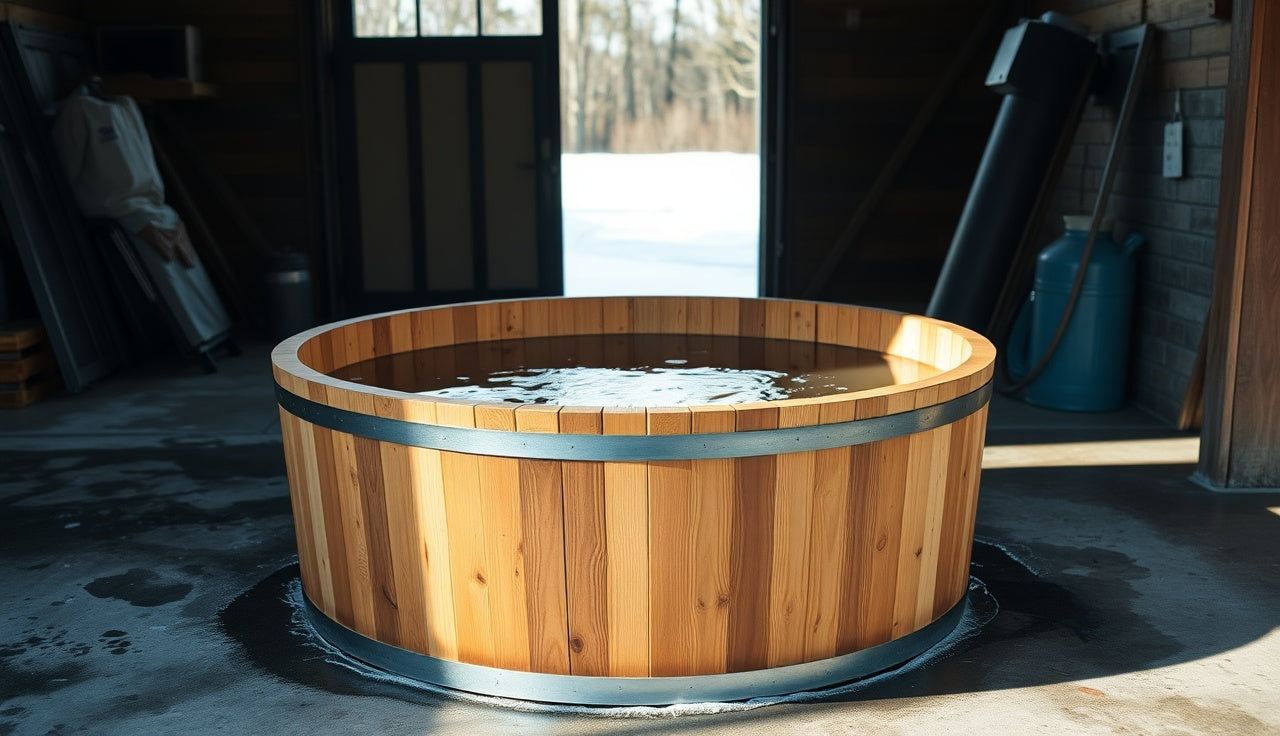
Barrel or round wooden tubs (red cedar, larch, or pine stave, 100 to 200 gallon capacity) run heavier per square foot because they're deep and round. A 65-inch-diameter barrel holding 160 gallons weighs 1,400 to 1,700 pounds total across a footprint of roughly 23 square feet, putting load at 60 to 75 psf. Manageable on a reinforced slab. Borderline on a wood-frame floor.
Stock tank-style steel or galvanized tubs (100 to 150 gallons) are light themselves, usually 30 to 60 pounds for the shell, but the water load matches any other tub. The flat bottom spreads weight evenly, so these tend to run 40 to 65 psf, close to compact acrylic units.
Large commercial-style cold plunges (200-plus gallons, with built-in filtration, lighting, and chiller systems) can top 2,000 pounds full. These need a structural engineering assessment before you place them indoors or on any elevated surface. No exceptions.
If floor load is your main constraint, a compact acrylic unit with the widest practical footprint always gives you the lowest psf for a given water volume.
How does a cold plunge compare to other heavy household items by weight?
Context helps. A filled bathtub with a person in it weighs around 700 to 900 pounds, and residential floors are built to take that. A grand piano runs 700 to 1,200 pounds. A fully loaded refrigerator is 250 to 400 pounds. A waterbed mattress held 1,500 to 2,000 pounds of water, and waterbeds were common enough in the 1980s that floor-load adequacy got studied specifically for them [5].
What sets a cold plunge apart is footprint. A waterbed spread 1,500 pounds across 40 or 50 square feet, landing at 30 to 38 psf. A barrel cold plunge might cram that same weight into 12 to 20 square feet, doubling or tripling the psf.
The total weight is rarely the scary number. The concentration is. A round tub with a small diameter sitting on hardwood over a basement is a much harder structural situation than a rectangular tub of identical weight spread across the floor.
What does a structural assessment for a cold plunge installation actually involve?
A structural engineer's assessment covers three things: reviewing the existing framing or slab, calculating the proposed load, and telling you whether you need reinforcement.
For wood-frame floors, the engineer wants joist size, spacing, span length, and species. They calculate the existing capacity and compare it against your tub's total weight and footprint. If the numbers don't clear, they specify a fix, usually sister joists (new joists added alongside the existing ones) or a steel beam below.
Sister-joist reinforcement for a single tub location typically costs $500 to $2,000 in labor and materials, depending on access and how many joists are involved. A full beam install can run $2,000 to $5,000 or more.
For concrete slabs, the engineer checks thickness and condition, sometimes with core samples if the slab's history is a mystery.
Expect $300 to $800 for the assessment itself. Some engineers do a desk review from photos and rough measurements for $150 to $300 when access is tight. Either way, it's cheap next to a tub that's cracked your subfloor.
You usually don't need a permit for a standalone cold plunge tub. But if the install involves electrical work for a chiller (typically a 20-amp or 30-amp dedicated circuit), that wiring has to be permitted and inspected in most jurisdictions [6]. Ask your local building department.
Where in the home is the safest place to put a cold plunge tub?
The basement slab is the gold standard for indoor placement. Concrete on grade has no joists to worry about, no subfloor to rot, and typically excellent load capacity. Your main concerns are drain access (the water has to go somewhere during maintenance drains) and humidity (a cold tub in a basement throws off condensation).
Garage slabs work just as well for the same reasons. Plenty of people prefer the garage because spills don't matter, ventilation is easy, and the tub stays out of the living space.
First-floor rooms over a basement are the next safest bet in a wood-frame home. Joists span shorter distances to the basement below, and you can sister-joist from underneath with decent access. First-floor bathrooms often work well because the floor already handles water exposure and the plumbing is right there.
Upper floors are the hard case. Joists span farther, deflection matters more, and reinforcement access gets invasive. Set on an upper-floor install? Get the structural assessment done first.
Grade-level concrete patios are excellent for weather-rated tubs. Wood decks need an engineering review, as covered above. If you already have a well-built deck and want to look at outdoor cold water recovery, our overview of ice bath setups covers portable alternatives that carry far less structural load.
One factor people forget: slope. Cold plunge tubs have to drain. If your surface doesn't slope toward a drain, you'll be pumping the water out during maintenance. Plan for that before the tub shows up.
What happens if a floor is overloaded by a cold plunge tub?
Overloaded floors rarely fail all at once. It's usually gradual, and the warning signs show up well before anything collapses.
The first sign is deflection: a noticeable bounce or sag near the tub. Tile floors start to crack. Hardwood cups or squeaks more than usual. Nearby doors begin to stick because the framing has shifted.
Over time, sustained overloading causes joist creep, permanent deformation that stays even after you remove the load. In severe cases, the subfloor sheathing delaminates or the joist cracks at midspan.
Sudden failure, the floor actually giving way, is less common but not impossible. Older homes with smaller joists or spans that predate modern codes are the higher-risk cases, especially where wood rot has already eaten into the framing.
Spot any of these signs after placing a tub? Stop using it and get a structural engineer in immediately. Don't wait to see if it gets worse. It won't.
Does water damage risk change the floor placement decision?
It does. The load calculation is only half the problem. The other half is what happens when water eventually reaches your subfloor, because it will.
Cold plunge tubs sweat. A tub holding 50-degree water in a 70-degree room condenses moisture on the outside, and that moisture runs down. Over months and years, it can soften a wood subfloor, feed mold, and weaken the same structural members you calculated were strong enough to begin with.
A waterproof mat or tray under the tub is the baseline precaution. Many installers lay down a rubber equipment mat (the kind used under washing machines) and then a leak-containment tray on top, especially for indoor tubs.
On a basement concrete slab, moisture is less of a structural concern, but mold is still real if the room doesn't get ventilated. A bathroom exhaust fan or a dehumidifier running in the space makes a real difference.
Placing a tub on an outdoor wood deck? Water damage to the deck framing is a serious long-term problem. Water-resistant finishes on the planks, good drainage, and keeping the tub slightly elevated for airflow underneath all extend the life of the structure.
For the recovery payoff that makes all this worth it, see our piece on cold plunge benefits.
Are there weight limits published by cold plunge manufacturers, and how reliable are they?
Some manufacturers publish a maximum user weight, usually 300 to 400 pounds for residential units. That number is about the tub's own structural integrity (will it crack or deform under a heavy person?), not a floor load recommendation. Two different questions, and buyers conflate them constantly.
Manufacturer specs should give you the dry weight and the water capacity in gallons. From there you calculate total load yourself: 8.34 lbs per gallon for water, plus the shell weight, plus your body weight. If the spec lists capacity in liters, convert (1 liter = 0.264 gallons). If it lists no capacity at all, measure the dimensions and calculate volume by hand.
Be skeptical of any brand that calls its tub "safe for residential floors" without saying what floor construction they assume. A tub that's fine on a basement slab may not be safe on an upper-floor bathroom in a 1960s ranch.
SweatDecks lists product specs (dry weight, water capacity) for every cold plunge unit we carry, so you can run the floor load calculation before you buy instead of after delivery.
One quick reality check: look for an installation guide or owner's manual online. Companies that engineer their products well usually publish detailed install requirements, floor load guidance included. If that documentation doesn't exist, treat it as a signal about the product's overall quality.
What if I want a cold plunge tub but my floor can't handle the full load?
You have more options than you'd guess.
First, look at portable inflatable or soft-sided cold plunges. These hold 60 to 100 gallons and weigh 600 to 900 pounds total, which keeps you in the 30 to 50 psf range on a wide footprint. Not pretty, but they work and they need zero structural modifications.
Second, move the tub. If your main living level can't take it, your garage slab or basement almost certainly can. Walking to another part of the house is a minor annoyance next to the cost of reinforcement.
Third, add reinforcement. Sister-joisting is a reasonably affordable fix with basement access. It won't solve every situation, but a competent contractor can often double up the joists under the planned tub location in a weekend for under $2,000.
Fourth, pick a wider-footprint tub. Same water volume, bigger base, lower psf. Rectangular Japanese soaking-style tubs and rectangular plunge pools distribute weight far better than barrel designs.
Fifth, consider a partial fill. If you're 50 pounds over your floor's calculated capacity, filling to 80% instead of 100% may bring you under the line. This only works for tubs big enough that a shallower fill still gets you a real immersion.
For how these cold plunge setups fit into a wider recovery routine alongside heat, the sauna benefits article explains the contrast therapy logic that makes the whole install worth the hassle.
Frequently asked questions
How much does a typical cold plunge tub weigh when full of water?
Most residential cold plunge tubs weigh 800 to 1,800 pounds full, depending on water capacity and material. A compact 75-gallon acrylic unit holds roughly 625 pounds of water plus 80 to 150 pounds for the shell, plus your body weight. Larger barrel-style tubs holding 150 gallons can top 1,500 pounds before you get in.
Can a standard residential floor support a cold plunge tub?
Sometimes, but not always. The IRC requires residential floors to handle at least 40 psf live load. A compact tub on a wide footprint may land at 35 to 50 psf, which is borderline. A large barrel tub can reach 100 to 125 psf, which exceeds typical residential floor capacity and needs either a concrete slab or structural reinforcement.
How do I calculate the floor load of my cold plunge tub?
Take the total weight (shell weight plus water at 8.34 lbs per gallon plus your body weight) and divide by the tub's contact footprint in square feet. That gives you pounds per square foot. Compare it to your floor's rated live load, typically 40 psf for residential spaces. If the number exceeds the rating, consult a structural engineer.
Is a concrete basement slab safe for a cold plunge tub?
In most cases, yes. A 4-inch residential basement slab typically handles 40 to 100 psf depending on thickness and reinforcement, and a 6-inch slab is generally rated higher. Most cold plunge tubs fall inside this range. Still check for existing cracks or voids in the slab, which can point to settlement or undermining that cuts actual capacity.
Can I put a cold plunge on a wood deck?
Not without checking first. Residential wood decks are typically designed for 40 psf, the same as interior floors, but concentrated loads from a cold plunge can blow past that. The point loads at the tub's legs or base corners are usually the real issue. Have a structural engineer review the deck framing before you place any tub over 900 pounds total.
How much does it cost to reinforce a floor for a cold plunge tub?
A structural engineering assessment runs $300 to $800. If reinforcement is needed, sister-joisting from a basement costs roughly $500 to $2,000 depending on the number of joists and access. Bigger solutions like adding a steel beam can run $2,000 to $5,000 or more. For most people, moving the tub to a concrete slab is cheaper than reinforcing a wood-frame floor.
What is a point load and why does it matter for cold plunge placement?
A point load is weight concentrated in a small area, like a tub leg or a narrow base. Even if the average psf looks fine, the local pressure under each leg can be dramatically higher and exceed what the subfloor or an individual joist can take. Spreading load with a plywood sheet or rubber mat under the tub helps push point loads across a larger area.
Do I need a permit to install a cold plunge tub at home?
Usually not for the tub itself, but the electrical work often does. Integrated chiller units typically need a dedicated 20-amp or 30-amp circuit, and that wiring must be permitted and inspected in most U.S. jurisdictions. Check with your local building department before starting any electrical work.
How does a cold plunge tub's weight compare to a waterbed or bathtub?
A filled bathtub with a person inside runs 700 to 900 pounds, close to a compact cold plunge. A waterbed held 1,500 to 2,000 pounds of water but spread it across 40 to 50 square feet, roughly 30 to 38 psf. A cold plunge may carry a similar total weight in half the footprint, doubling the psf and making floor assessment more important.
What are the warning signs that a floor is being overloaded by a cold plunge tub?
Watch for bouncing or visible sag near the tub, cracking tiles, cupping or unusual squeaking in hardwood, and doors near the tub that start sticking. Any of these means the floor structure is deforming under the load. Remove the tub and contact a structural engineer before returning to normal use.
Can moisture from a cold plunge tub damage my floor even if the load is within limits?
Yes. A cold tub in a warm room produces condensation on the exterior that drips to the floor. Over months, this can rot a wood subfloor, feed mold, and weaken the framing you calculated was strong enough. A waterproof mat and containment tray under the tub, plus good ventilation, cuts this risk substantially.
How much water does a cold plunge tub hold, and how much does that water weigh?
Compact personal cold plunge tubs hold 60 to 100 gallons. Mid-size barrel units hold 100 to 160 gallons. Large commercial-style units can hold 200 or more gallons. Water weighs 8.34 pounds per gallon, so 100 gallons adds 834 pounds of water alone, before the shell or the user.
Which type of cold plunge tub is easiest on a residential floor?
Compact rectangular acrylic or fiberglass units with a wide, flat base spread load most favorably. They typically hold 60 to 100 gallons and produce 30 to 55 psf depending on exact dimensions. Round barrel tubs concentrate the same water weight into a smaller footprint, producing higher psf. If your floor is a concern, choose the widest rectangular base you can find.
Is a garage floor a good place for a cold plunge tub?
Usually yes. Garage slabs are typically 4 to 6 inches thick and sit on grade, giving good load capacity, easy drainage, and no subfloor moisture worry. Ventilation is generally good, and spills don't matter. The main downside is temperature: in cold climates the chiller works harder (and uses more electricity) in an unheated garage in winter.
Sources
- USGS Water Science School, Water Density and Weight: Water weighs approximately 8.34 pounds per gallon at typical temperatures
- International Residential Code (IRC) 2021, Table R301.5, Minimum Uniformly Distributed Live Loads: IRC requires residential floor live load capacity of at least 40 psf for sleeping rooms and other living areas
- American Concrete Institute (ACI), ACI 360R Guide to Design of Slabs-on-Ground: Concrete slabs on grade capacity varies by thickness and reinforcement; a 4-inch slab typically handles 40-100 psf depending on design
- American Wood Council, Span Tables for Joists and Rafters: 2x10 joists at 16-inch on-center spacing have rated uniform load capacities that differ significantly from point load capacities at midspan
- U.S. Consumer Product Safety Commission, Structural Safety Considerations for Waterbeds: Waterbed mattresses typically hold 1,500 to 2,000 pounds of water and prompted studies of residential floor load adequacy in the 1980s
- National Electrical Code (NEC) NFPA 70, Article 210.11 Branch Circuits Required: Dedicated branch circuits are required for appliances drawing significant continuous loads; chiller units typically require a 20-amp or 30-amp dedicated circuit
- International Code Council (ICC), International Residential Code Overview: IRC specifies minimum live load requirements for decks attached to dwellings and residential living spaces
- American Society of Civil Engineers, ASCE 7 Minimum Design Loads for Buildings and Other Structures: ASCE 7 provides the basis for minimum live load requirements referenced in IRC and other model building codes
- U.S. Forest Products Laboratory, Wood Handbook: Wood as an Engineering Material: Wood joist deflection and creep under sustained loads are documented structural concerns for floor systems
- National Association of Home Builders (NAHB), Residential Structural Design Guidelines: Sistering joists is a recognized remediation technique for increasing floor load capacity in existing residential construction

Share:
Running an outdoor cold plunge in below-zero temperatures
Cold plunge tub on a second floor deck: structural requirements explained