
Last updated 2026-07-09
TL;DR
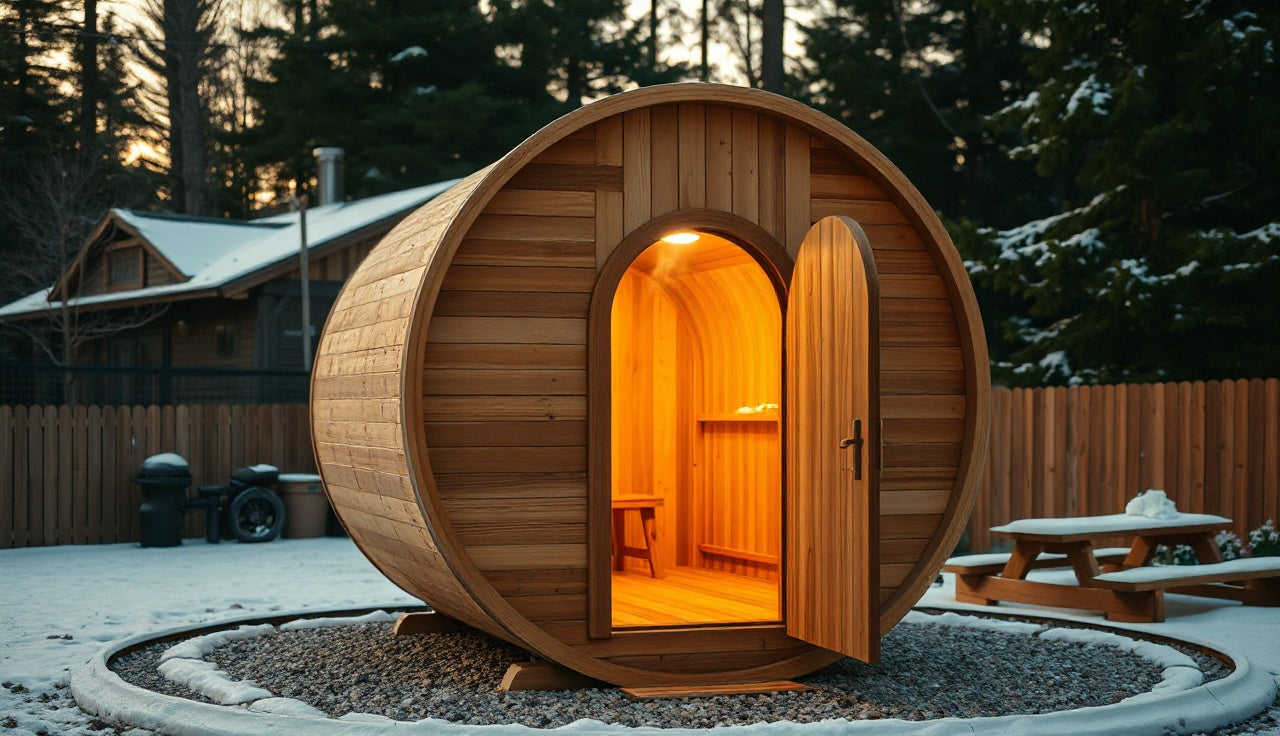
A cedar barrel sauna is a round, stave-built outdoor sauna made almost entirely from western red cedar. People pick it for natural rot resistance, low thermal mass, and a clean resinous smell. Prices run from about $1,500 for a bare-bones kit to over $8,000 for a fully assembled, plug-in-ready unit. Most homeowners set one up in one to two days on a flat surface, and many jurisdictions need no building permit. Check your local code first.
What exactly is a cedar barrel sauna?
A barrel sauna is exactly what the name says: a sauna built in the shape of a barrel, with curved, tongue-and-groove staves bound by galvanized or stainless steel hoops. The round profile is not a gimmick. It shrinks the interior air volume relative to the wall surface compared to a square box of the same footprint, so the space heats faster and you burn less electricity or wood doing it.
Western red cedar (Thuja plicata) is the standard wood, and for good reason. It resists decay and insect damage on its own because of its natural extractives, principally thujaplicins, with no chemical treatment [1]. The USDA Forest Service Wood Handbook puts western red cedar in the top tier of natural decay resistance among North American softwoods [1]. That matters outdoors, where ground moisture and rain never stop working on untreated wood.
The stave construction behaves like a wine barrel. As the wood swells with heat and humidity, the staves press tighter together, so the seal improves over time instead of loosening. Cedar barrel saunas are designed to live outside year-round.
For a wider look at how the sauna types stack up, see our guide to home saunas.
How does a cedar barrel sauna compare to other sauna types?
The comparison that matters most for buyers is barrel versus traditional indoor box sauna. Here is a side-by-side of the variables that actually change your decision.
| Feature | Cedar Barrel Sauna | Traditional Box Sauna | Portable Sauna |
|---|---|---|---|
| Typical price range | $1,500, $8,000+ | $3,000, $20,000+ | $100, $600 |
| Install location | Outdoors, any flat surface | Indoors or covered patio | Indoors, any room |
| Permit requirement | Often none (check local code) | Usually requires permit | None |
| Heat-up time | 30 to 45 min (electric) | 30 to 60 min | 10 to 20 min |
| Wood material | Western red cedar | Cedar, hemlock, or spruce | Fabric/frame |
| Typical capacity | 2 to 6 people | 1 to 8 people | 1 person |
| Lifespan with care | 20 to 30+ years | 20 to 30+ years | 2 to 5 years |
| Heater options | Electric or wood-burning | Electric, gas, or wood | Electric (low watt) |
Barrel saunas sit in a comfortable middle. They are more durable and more effective than a portable sauna, and cheaper and easier to install than a full custom indoor build. The catch is weather exposure, so they ask for occasional maintenance (more on that below).
The other comparison worth flagging is barrel sauna versus steam room. A traditional Finnish-style sauna runs at 150 to 195°F (65 to 90°C) with low relative humidity, usually 10 to 30% [11]. A steam room runs at roughly 110 to 120°F with humidity near 100%. They feel like two different worlds and appeal to different people. Want dry Finnish heat? A barrel sauna is the right call. Want steam? Read our sauna vs steam room breakdown.
What are the real health benefits of using a barrel sauna regularly?
Here is the honest version: the evidence is good, not airtight. Most of the strongest research comes from Finland, where sauna use is woven into daily life, so pulling the sauna effect apart from the wider lifestyle is hard.
Even so, the data is more than suggestive. A 2018 study in Mayo Clinic Proceedings tracked 1,688 middle-aged Finnish men over 20 years. Men who used a sauna 4 to 7 times per week had a 63% lower risk of sudden cardiac death and a 40% lower risk of all-cause mortality than once-weekly users [2]. The authors flagged that the study is observational, not a randomized trial, so causation is not proven. The dose-response pattern across frequency tiers is still hard to wave away.
Other work shows sauna heat raises core body temperature in ways that look like moderate aerobic exercise, driving cardiovascular changes including higher plasma volume and better arterial compliance [3]. Researchers call this passive heating, and it is getting real attention for people who cannot train hard because of injury or illness.
For recovery after exercise, heat exposure may speed muscle repair by raising heat shock protein expression and pushing more blood into skeletal muscle [4]. That is one reason endurance athletes park themselves in saunas between training blocks.
Nobody has good data on whether a barrel sauna beats any other sauna type on health outcomes. The wood and the shape do not change the mechanism. Heat exposure is the active ingredient. A barrel sauna just makes that heat easier to reach and more pleasant to sit in.
For a fuller read on what the research actually says, see our article on sauna benefits.
| Budget kit (2-person, basic heater) | $2,000 |
| Mid-range kit (4-person, digital heater) | $4,000 |
| Premium assembled (4–6 person, stainless hoops) | $6,500 |
| Luxury/custom (porch, glass door, wood stove) | $8,500 |
Source: SweatDecks market survey of active cedar barrel sauna listings, 2024–2025
How much does a cedar barrel sauna cost?
Cedar barrel saunas cost about $1,500 to $8,000+, driven by size, heater type, whether the unit ships assembled or as a kit, and who builds it.
At the low end, a 2-person kit (around 5 feet in diameter, 6 feet long) runs $1,500, $2,500. These ship flat-packed and need a full weekend to build. Quality here is a coin flip: wood thickness, hoop gauge, and the included heater all vary, and some cheap imports label wood as cedar when it is not western red cedar.
The $3,000, $5,000 range buys larger units (6-foot diameter, 7 to 8 feet long, seating 4 to 6), thicker staves (usually 1.75 inches versus 1.5 inches on budget units), and better electric heaters with digital controls. Most family buyers get the best value here.
Above $5,000, you pay for pre-assembled or nearly pre-assembled units and premium extras: a changing-room vestibule, a wood-burning stove instead of electric, tempered glass door panels, or a covered porch section. Units from well-known North American makers (many based in Canada) often land in the $5,000, $8,000 range at a mid-large size.
Shipping is a real variable. A large barrel sauna can weigh 800 to 1,200 lbs assembled, and freight delivery adds $300, $800 depending on where you live. Get the freight quote before you finalize anything.
Installation beyond the unit is usually cheap. Already have a 240V outlet outside? You may spend nothing extra. Need an electrician to run a new 240V, 40 to 60 amp circuit? Budget $500, $1,500 depending on your panel and the run length.
You can browse cedar outdoor barrel sauna options, including several of the configurations above, at SweatDecks.
What size cedar barrel sauna do I actually need?
Barrel saunas are sized by diameter and length. Diameter sets how many people fit. The common builds:
- 4-foot diameter: 2 people lying down or 2 seated, very tight. A solo option, really.
- 5-foot diameter: comfortable for 2, tight for 3. The most popular size for couples and solo buyers.
- 6-foot diameter: 4 comfortably, 5 to 6 if nobody minds close contact. The best family pick.
- 7-foot diameter: less common, usually commercial. Seats 6 to 8.
Length matters too. Standard lengths run from 6 feet (changing vestibule only, no porch) to 9 feet (a 6-foot sauna room plus a 3-foot covered porch or changing area). If you want somewhere to cool down between rounds without going inside, the porch earns its keep.
Here is the mistake I see most: buyers pick the smallest size to save money, then wish they had more room by session three. If budget allows, go one size up from your first instinct. The interior feels smaller than you expect once the walls curve in and the bench eats half the floor.
Electric heater vs wood-burning stove: which is better for a barrel sauna?
This is a preference question with real practical stakes. For most buyers, electric wins. For people chasing the full traditional ritual with the space and wood to support it, a wood-burning stove is worth the extra work.
An electric heater is plug-and-play. Set a temperature, come back in 30 to 45 minutes, get in. Most units in the $3,000, $6,000 range come with a 6 to 9 kW electric heater with a built-in thermostat and sometimes a timer. The downside is your power bill. Running a 9 kW heater for one hour costs about $1.08 at the US average residential rate of roughly 12 cents per kWh [5]. Not ruinous, but it adds up with daily use.
A wood-burning sauna stove (a steel or cast-iron löyly stove with a rock bed) delivers the authentic Finnish experience: slower heat-up (60 to 90 minutes), higher peak temperatures, and real löyly, the steam burst you get from throwing water on hot rocks. Building the fire is part of the appeal for a lot of people. The costs are real too. You need dry firewood on hand, you cannot set it and forget it, and some municipalities restrict wood-burning appliances, especially in high-fire-risk areas or air quality management districts [6].
Live somewhere with fire restrictions? Check your local air quality management district rules before you buy a wood-burning unit. California's South Coast AQMD, for example, has run seasonal wood-burning curtailments since the 1990s [6]. A sauna stove is a small burner, but it is still a combustion appliance.
Do you need a permit to install a cedar barrel sauna in your backyard?
Usually not for the structure, but almost always for the electrical. Most barrel saunas skip the building permit because they are freestanding, non-permanent structures below the size that triggers permit rules. The 240V connection is a different story.
Many jurisdictions set that structure threshold at 120 to 200 square feet. The International Residential Code (IRC), which most US states and localities adopt with local amendments, exempts small freestanding accessory structures from building permits; the IRC generally reserves permit requirements for larger or permanently founded structures [7]. A barrel sauna on gravel or pavers usually clears both bars.
The electrical work is the exception. Running a new 240V circuit is a permitted electrical job in nearly every US jurisdiction. Your electrician should pull that permit. If they offer to skip it, hire someone else.
HOA rules are their own animal. In a community with a homeowners association, you may need approval no matter what the building department says. Some HOAs restrict visible outdoor structures by size, material, or placement. Read your CC&Rs before you order.
Zoning setbacks are worth checking too. Most local codes require accessory structures to sit a minimum distance from property lines, commonly 3 to 10 feet, and sometimes from the main house. A barrel sauna is typically classified as an accessory structure [7].
How do you install a cedar barrel sauna, and how hard is it really?
Easier than most people fear. Two people can assemble a typical 2-person kit in 4 to 8 hours. A larger 4 to 6 person unit takes a full day, sometimes two.
The basic sequence:
1. Prepare the base. The sauna needs a flat, level surface that drains well: a concrete pad, pressure-treated deck boards, compacted gravel over landscape fabric, or concrete pavers. It does not need to be fancy, but it must be level to within about 1/4 inch or the staves will not align.
2. Assemble the cradle brackets. Most kits ship with two curved wooden or metal cradle supports the barrel rests in. Anchor these to your base.
3. Stack and align the floor staves. The floor goes in first, curved to the barrel shape.
4. Raise the wall staves one by one around a center support, sliding them together tongue-and-groove.
5. Fit and tighten the steel hoops. Now it starts looking like a barrel. Most kits use threaded rod and nuts to tension the hoops. Snug them evenly all the way around.
6. Install the benches, interior walls, and door frame.
7. Connect the heater and wire it to your 240V circuit.
The hardest parts for most DIYers are getting the base dead level and wrangling the weight of the staves, which are awkward to handle in pairs. Get a mallet and a good level. Do not improvise on either.
What maintenance does a cedar barrel sauna actually need?
Cedar is durable, but outdoor exposure means you are not fully off the hook. Plan on a few hours a year.
The exterior needs treatment. Raw western red cedar weathers to silver-gray over one to two years if you leave it alone. That is not structural damage, but many owners want to keep the warm red-brown color. A penetrating oil sealer or exterior wood oil (not a film-forming finish like paint or varnish, which peels) on the outside every 12 to 18 months holds the color and adds a little moisture protection. Never seal the interior. The interior wood needs to breathe and off-gas, and a sealed interior traps heat unevenly.
The hoops need occasional tightening. In the first year, as the wood cycles wet and dry, expect to re-tension them two or three times. After the wood settles, it drops to once a year.
The interior floor is the most vulnerable surface because it stays wet. Lift the floor boards and let them dry after each use when you can. Inspect the floor staves once a year for soft spots or discoloration that signals rot.
The heater rocks need replacing every 2 to 3 years of regular use. After thousands of heat-and-cool cycles they fracture and lose their ability to hold and release heat. New sauna rocks cost $20, $60 for a 25-lb bag.
Here is the payoff. A well-built cedar barrel sauna with basic annual maintenance should last 20 to 30 years. Neglected units, the ones left with standing water on the floor or set on a poorly draining base, tend to rot out at the floor and door frame within 5 to 10 years.
Is a cedar barrel sauna worth pairing with a cold plunge?
Yes, if you have the space and the budget. Contrast therapy, alternating heat and cold, is popular for good reason. The protocol is simple: 10 to 20 minutes in the sauna, then a cold immersion of 2 to 5 minutes, then recover and repeat 2 to 3 rounds.
The physiological case rests on alternating vasodilation in the heat and vasoconstriction in the cold, which some researchers believe creates a pumping effect that clears metabolic waste from muscle tissue faster [4]. A meta-analysis in the European Journal of Applied Physiology found cold water immersion after exercise reduced delayed-onset muscle soreness (DOMS) compared to passive recovery, though the effect sizes were moderate [8].
Practically, a cedar barrel sauna and an outdoor cold plunge pair well because both live outside. You do not need a big yard. A 6-foot-diameter barrel sauna and a 100-gallon cold plunge tub fit comfortably in a 10x12-foot patio area. If a dedicated cold plunge blows the budget, a stock tank or a well-insulated ice bath setup is a fine starting point.
Want the evidence on cold exposure before you commit? Our breakdown of cold plunge benefits covers the research straight, including where it is weak.
The combination is not mandatory. The sauna delivers on its own. But if you are already spending on an outdoor recovery setup, planning the contrast option from day one is the smart move.
What should you look for when buying a cedar barrel sauna?
A handful of details reliably separate the good units from the regrettable ones.
Wood species verification. Demand clear labeling that the wood is western red cedar (Thuja plicata), not eastern white cedar, Chinese cedar, or an unlabeled mixed softwood. The natural decay resistance is specific to the species; substitutes range all over [1]. Reputable makers name the species. A listing that just says "cedar" with no species is a flag.
Stave thickness. Thicker staves hold heat better and crack less in freeze-thaw cycles. The sweet spot is 1.75 inches. Budget units often use 1.5 inches, which works but shows its limits over time in cold climates.
Hoop material and count. Galvanized steel is acceptable; stainless steel is better and worth paying for in high-humidity or coastal environments. Count the hoops: a 7-foot barrel should have at least 5, ideally 6.
Heater origin and certification. Look for a heater with UL listing (UL 875) or equivalent ETL certification for wet/sauna environments. These certifications are specific to sauna-grade equipment [9]. A cheap uncertified heater inside a wood enclosure is a fire hazard.
Warranty terms. A confident manufacturer offers 3 to 5 years on the structure and 1 to 2 years on the heater. A 90-day warranty tells you what the maker really thinks of the unit.
Support and parts. You will eventually need a replacement door gasket, hoop hardware, or heater rocks. Can you get those two years from now, or will the company have vanished? Buy from an established retailer with a North American presence.
SweatDecks carries a selected set of cedar outdoor barrel saunas, including the Lodge Sauna cedar barrel line, chosen for stave thickness, hoop quality, and heater certification. Browse them in the outdoor sauna collection.
How cold-climate friendly is a cedar barrel sauna?
Very. This is one of the overlooked strengths of the barrel design, and it comes down to shape and low thermal mass.
The curved profile sheds snow load on its own. A flat-roofed box sauna can hold heavy snow safely only if it is engineered for the load; a barrel just lets snow slide off the sides. In regions that regularly see 12+ inches of accumulation, that is a real advantage.
Cold air barely slows heat-up in a well-insulated barrel. The wood has low thermal mass (it does not soak up much heat before radiating it back), and the round shape cuts down on corner-to-corner air mixing. A quality barrel sauna can hit 170°F in under 45 minutes even at 0°F outside, as long as the heater is sized for the volume.
The one cold-climate caution is drainage. Let water sit in the bottom of the sauna or under the floor boards and freeze, and it can crack the floor staves over repeated cycles. Good drainage under and through the base, plus letting the interior dry between sessions, kills the problem. In brutal cold (consistently below -20°F), some owners pull the floor boards for winter storage. It takes 15 minutes and adds years to the floor's life.
Frequently asked questions
How long does it take to heat up a cedar barrel sauna?
With a properly sized electric heater (6 to 9 kW for a standard 5- or 6-foot diameter unit), a cedar barrel sauna reaches 160 to 180°F in 30 to 45 minutes. A wood-burning stove takes 60 to 90 minutes but hits higher peak temperatures. The barrel's small interior volume and low-mass cedar walls are why heat-up beats a comparable box sauna.
Can a cedar barrel sauna stay outside year-round?
Yes. Western red cedar's natural extractives give it real decay resistance with no chemical treatment, and the barrel shape sheds snow load efficiently. In climates below -20°F, some owners remove floor boards between sessions to prevent freeze-thaw cracking, but the structure handles winter exposure well. Apply an exterior oil sealer every 12 to 18 months to slow weathering.
How many people fit in a cedar barrel sauna?
It depends on diameter. A 4-foot barrel seats 1 to 2. A 5-foot seats 2 comfortably, 3 tightly. A 6-foot seats 4 comfortably or 5 to 6 if people do not mind proximity. Length (typically 6 to 8 feet for the sauna room) allows lying-down benches, which are popular in traditional Finnish use.
What foundation does a cedar barrel sauna need?
The sauna rests in two curved cradle supports, not a slab. The ground under those cradles just needs to be flat, level within about 1/4 inch, and well-draining. Compacted gravel over landscape fabric, concrete pavers, or a pressure-treated deck all work. A full poured concrete pad is not required and can actually cause drainage problems if it is not sloped.
How do I keep the interior of my cedar barrel sauna clean?
Wipe benches with diluted white vinegar (about 1 part vinegar to 3 parts water) after sessions to cut bacteria and sweat buildup. Lift floor boards and let them dry between uses. Skip soap and chemical cleaners on the interior wood; they soak into the grain and off-gas during heating. A light sand with fine-grit paper restores the bench surface if staining shows.
How much electricity does a cedar barrel sauna use per session?
A typical 9 kW electric heater running one hour (including heat-up) uses roughly 9 kWh. At the US average residential rate near 12 cents per kWh, that is about $1.08 per session [5]. Daily use costs roughly $30 to $35 per month, though actual cost swings with local electricity rates and how long you run the heater.
Is western red cedar safe to breathe in a sauna at high temperatures?
Western red cedar off-gasses its natural oils (mainly thujaplicins and plicatic acid) more at high heat. For most people this is a pleasant cedar scent with no ill effect. But plicatic acid is a documented sensitizer, and some people with repeated occupational exposure develop occupational asthma [10]. For a home sauna used a few hours weekly, NIOSH treats exposure as low-risk for most adults; those with cedar sensitivity or asthma should ask a physician first [10].
Can I use a cedar barrel sauna if I have heart disease or high blood pressure?
Sauna use raises heart rate and causes temporary vasodilation. The 2018 Mayo Clinic Proceedings study linked frequent sauna use to lower cardiovascular mortality in a healthy Finnish cohort, but that population did not include people with active cardiac conditions [2]. Anyone with diagnosed heart disease, uncontrolled hypertension, or a recent cardiac event should get physician clearance first. This is conservative advice, not a scare: most stable patients get cleared.
What is the difference between a cedar barrel sauna and The Lodge Sauna cedar barrel sauna specifically?
The Lodge Sauna cedar barrel sauna is a specific product line inside the broader cedar barrel category. Lodge-branded units typically emphasize thicker western red cedar staves, pre-assembled or semi-assembled delivery, and stainless steel hoop hardware. As with any brand, verify the exact stave thickness, heater certification, and warranty terms for the specific model before buying, rather than trusting brand reputation alone.
Do cedar barrel saunas require a building permit?
Usually not for the structure. Most municipalities exempt freestanding accessory structures under 120 to 200 square feet from building permits, and most barrel saunas fall below that [7]. The 240V electrical connection almost always requires a permit and inspection. HOA approval and local zoning setbacks apply regardless of the building permit. Check all three before installation.
How does a cedar barrel sauna compare to a Costco sauna?
Costco periodically sells barrel and cabin sauna kits, typically $2,000 to $4,500, through seasonal inventory. These are generally made in China and vary in wood-species clarity and hoop quality. The value can be solid if the unit is in stock and you inspect the specs closely. The tradeoff is limited parts availability and support after the sale. For a full framework, see our guide on Costco saunas.
How often should I oil or seal the exterior of a cedar barrel sauna?
Apply a penetrating exterior wood oil or UV-stable sealer to the outside every 12 to 18 months. Go more often in high-UV climates (desert Southwest) or very wet ones (Pacific Northwest). Never use film-forming finishes like paint or varnish on the exterior; they peel as the wood expands and contracts. Never treat the interior. The wood needs to breathe.
Can two people realistically assemble a cedar barrel sauna without professional help?
Yes, for most standard kits. Two adults with basic tool skills (mallet, level, wrench, cordless drill) can assemble a 5-foot diameter, 7-foot kit in one full day. The heaviest single piece is usually 60 to 80 lbs. The electrical connection is the one step that legally needs a licensed electrician in most US jurisdictions. Budget $500 to $1,500 for that work depending on panel location and circuit requirements.
Sources
- USDA Forest Service, Forest Products Laboratory — Wood Handbook, Chapter 3: Structure and Function of Wood: Western red cedar (Thuja plicata) is classified in the highest natural decay resistance category among North American softwoods due to its extractive content including thujaplicins.
- Mayo Clinic Proceedings — Laukkanen et al. 2018, sauna bathing and cardiovascular and all-cause mortality in a Finnish cohort: Men who used a sauna 4–7 times per week had a 63% lower risk of sudden cardiac death and a 40% lower risk of all-cause mortality compared to once-weekly users in a 20-year cohort of 1,688 men.
- Journal of the American College of Cardiology — research on repeated passive heat therapy and arterial compliance: Repeated passive heat exposure triggers cardiovascular adaptations including increased plasma volume and improved arterial compliance, resembling the effects of moderate aerobic exercise.
- Journal of Science and Medicine in Sport — Leeder et al. 2012, cold water immersion and recovery from strenuous exercise: Heat and cold exposure influence recovery through changes in blood flow and, for heat, heat shock protein expression, potentially aiding muscle repair.
- U.S. Energy Information Administration — Electric Power Monthly, Average Retail Price of Electricity: The US average residential electricity rate used to estimate per-session sauna operating cost at approximately 12 cents per kWh.
- South Coast Air Quality Management District — Wood Burning Rules and Curtailments: California's South Coast AQMD has enforced seasonal wood-burning curtailments restricting combustion appliances including wood-burning stoves in applicable areas.
- International Code Council — International Residential Code (IRC), work exempt from permit provisions: The IRC generally exempts small freestanding accessory structures from building permit requirements; most barrel saunas fall below the size thresholds that trigger a permit.
- European Journal of Applied Physiology — meta-analysis on water temperature and recovery of delayed-onset muscle soreness: A meta-analysis found cold water immersion after exercise reduced delayed-onset muscle soreness compared to passive recovery, though effect sizes were moderate.
- Underwriters Laboratories — UL 875 Standard for Electric Dry-Bath Heaters: UL listing (UL 875) and equivalent ETL certification are the safety certifications applicable to electric sauna heaters for use in wet and sauna environments.
- National Institute for Occupational Safety and Health (NIOSH), CDC — western red cedar occupational exposure: Plicatic acid in western red cedar is a documented sensitizer that can cause occupational asthma with repeated high-level exposure; low-level home sauna exposure is considered low-risk for most adults.
- Finnish Sauna Society — traditional sauna guidelines and temperature parameters: Traditional Finnish sauna operates at 150–195°F (65–90°C) with relative humidity of 10–30%, distinct from steam room conditions.

Share:
Infrared sauna workout: how heat training actually works
Home saunas for sale: what you actually need to know before buying