
Last updated 2026-07-09
TL;DR
Home saunas for sale run from about $200 for a portable tent to $20,000 or more for a custom outdoor barrel or cabin build. The right pick comes down to your space, your heat preference (infrared vs. traditional Finnish steam), your budget, and whether you want a permanent install. Most buyers land between $2,000 and $8,000 for a solid indoor or outdoor unit.
What types of home saunas are actually for sale right now?
The market splits into four categories, and knowing which one you're staring at saves hours of pointless browsing.
Start with portable sauna tents. These are fabric enclosures, usually paired with a small personal steam generator, that fold flat and store under a bed. They run $100 to $400. They work, sort of. But the experience is nothing like a real sauna. Your head sticks out, the heat leaks fast, and they aren't built to survive years of daily use. Treat one as a cheap way to find out whether you'll actually use a sauna before you spend real money. Our portable sauna guide walks through what to expect.
Next, indoor infrared sauna cabins. These are prefab wood boxes, usually cedar or hemlock, that plug into a standard 120V or 240V outlet and use infrared panels instead of a rock heater. They seat one to six people and cost $1,500 to $8,000 depending on size and panel quality [1]. Assembly is DIY and takes two to four hours. This is the go-to category for apartment dwellers and homeowners with no outdoor space.
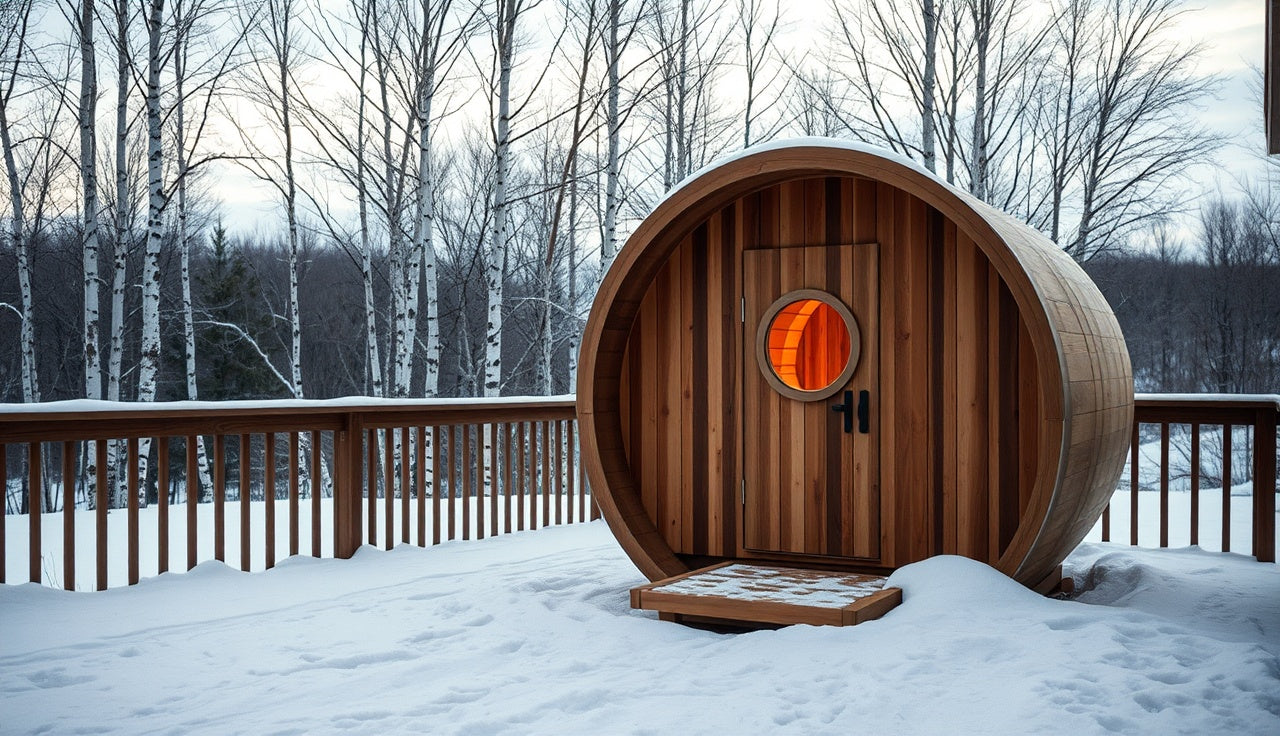
Third, outdoor barrel and cabin saunas. These are the units you see in Scandinavian-style backyards. A barrel is cylindrical, and the round interior heats efficiently because there's less dead air to warm. A cabin is a square or rectangular structure that looks like a small shed. Both run on electric heaters (most common in the US) or wood-burning stoves. Prices land between $3,500 and $20,000 or more, depending on size, wood species, and whether you pay someone to install it [2].
Fourth, steam rooms. These are tiled enclosures with a steam generator, and they're technically a different animal from a sauna. A sauna uses dry heat (10 to 30 percent humidity). A steam room runs at 100 percent humidity. The sauna vs steam room breakdown lays out the difference cleanly. Steam rooms cost about the same as a mid-range cabin sauna, but they demand waterproof construction and serious ventilation.
How much does a home sauna cost, really?
Here's an honest breakdown by category. These are 2024 retail ranges from established manufacturers and major retailers. The low end assumes a DIY install; the high end assumes professional installation for outdoor units [1][2].
| Type | Low end | Typical mid-range | High end |
|---|---|---|---|
| Portable tent | $100 | $250 | $400 |
| 1-2 person infrared (indoor) | $1,500 | $3,000 | $5,000 |
| 3-4 person infrared (indoor) | $2,500 | $4,500 | $7,000 |
| Outdoor barrel sauna (electric) | $3,500 | $6,000 | $10,000 |
| Outdoor cabin sauna (electric) | $5,000 | $9,000 | $20,000+ |
| Wood-burning outdoor sauna | $4,000 | $8,000 | $18,000 |
Two things move the price more than the name on the box. Wood species is one. Western red cedar resists moisture and warping better than basswood or hemlock, and it costs more. Heater quality is the other. A cheap infrared sauna uses carbon or ceramic panels rated for maybe 3,000 hours. A well-built unit uses full-spectrum or near-infrared panels rated above 10,000 hours. From the outside, the two cabins can look identical.
Installation adds real money for outdoor units. Running a 240V circuit from your electrical panel usually costs $300 to $800 depending on distance and local labor rates [3]. If your panel needs an upgrade, add $1,500 to $3,000. Permit fees vary by city and county. Some towns require a permit for any structure over 120 square feet. Others trigger permits on the electrical work alone. Call your building department before you buy, not after.
The cost people forget is electricity. A typical 2-person infrared sauna draws 1.5 to 2.0 kW and takes 15 to 30 minutes to preheat. Use it four times a week for 45-minute sessions and you're adding roughly 18 to 24 kWh a month. At the 2024 US average residential rate of about $0.17 per kWh, that's $3 to $4 a month [4]. A larger 6-kW traditional heater runs closer to $10 to $15 a month at the same usage.
Infrared sauna vs. traditional Finnish sauna: which should you buy?
This is the argument every buyer has, and there's no universally right answer. They're genuinely different products.
A traditional Finnish sauna (also called a steam sauna or löyly sauna) uses a heater packed with rocks. You pour water on the rocks to release a burst of steam called löyly, which spikes the perceived heat without raising the air temperature much. Temperatures run 150 to 195 degrees Fahrenheit (65 to 90 degrees Celsius). The experience is intense, social, and tied straight to Scandinavian custom [5]. The sauna overview covers the full history and science.
An infrared sauna heats your body directly with infrared wavelengths instead of heating the air. Temperatures run 110 to 150 degrees Fahrenheit, which many people who find traditional heat suffocating can tolerate. Some folks stay in longer as a result, and that matters more than it sounds. The sauna you'll actually use beats the one that intimidates you.
The research here is a mess, and I'll say so plainly. Most of the strong cardiovascular data comes from traditional sauna studies, especially the long-running Finnish cohort work. A 2018 paper in Mayo Clinic Proceedings tied frequent sauna use (four to seven sessions a week) to lower cardiovascular event risk in a 20-year Finnish cohort of 2,315 middle-aged men [6]. That study used traditional Finnish saunas, not infrared. Whether infrared produces the same physiological effects is not established.
So on the sauna benefits question: more of the good evidence points to traditional saunas. But infrared units are cheaper, easier to install indoors, and easier to use every day. Consistent infrared beats occasional traditional.
Want the full Scandinavian ritual, outdoor sessions, and water on the rocks? Get a traditional unit. Want something that fits in a spare bedroom and runs off a normal outlet? Infrared is the practical call.
| Portable tent sauna | $250 |
| 1-2 person infrared (indoor) | $3,000 |
| 3-4 person infrared (indoor) | $4,500 |
| Outdoor barrel sauna (electric) | $6,000 |
| Outdoor cabin sauna (electric) | $9,000 |
| Wood-burning outdoor sauna | $8,000 |
Source: HomeAdvisor/Angi Cost Guides, Consumer Reports 2024
What size home sauna do you actually need?
Size is easy to blow in both directions. People buy one-person units and can't lie down. Or they buy four-person units that take 40 minutes to heat and then sit unused.
Think about size in terms of how you'll actually use it. If you're the only regular user and you want to lie down (which spreads heat across your whole body), you need at least a 1-person unit with interior dimensions around 36 by 40 inches or longer. Most true lie-down sessions really need a 2-person unit.
For couples who want to session together, a 2-person unit is fine. For families or anyone chasing the social sauna experience, jump to a 3- or 4-person.
The dimension that ambushes people is ceiling height. Standard indoor infrared units have ceilings around 75 inches. If you're tall, check that number before you buy. Outdoor barrel saunas lose clearance toward the curved sides.
Now the room itself. A typical 2-person infrared footprint is about 47 by 47 inches. Leave at least 6 inches of clearance on any side that vents, and 18 to 24 inches in front of the door so it opens comfortably. A spare bedroom, garage, or basement all work. Check that the floor can carry the load: a 4-person cedar unit weighs 400 to 600 lbs.
Where can you buy a home sauna? What are the main sources?
The buying landscape shifted hard over the past five years. You have more options than ever, and the quality spread is wider than ever too.
Direct-to-consumer brands that ship flat-pack units are the dominant channel now. Clearlight, Dynamic, Sunlighten, and Health Mate ship straight from their own sites. You'll also find a curated set of vetted models at specialty retailers like SweatDecks, which sells only sauna and cold plunge gear and can help if you'd rather someone else had already checked the supplier relationships. Specialty retailer pricing often matches DTC because volume buying replaces the usual retail markup.
Big-box stores like Costco, Home Depot, and Sam's Club sell saunas seasonally. Our Costco sauna piece breaks down what Costco specifically stocks. Pricing is often good, but the selection is thin, and technical support is close to nonexistent. Returning a large item can turn into a fight.
Amazon carries saunas from a huge spread of brands, many of them white-label units from the same Chinese factories that supply the named ones. Price tells you a lot here. A 4-person infrared sauna for $1,800 on Amazon will not have the panel quality or wood grade of a $4,500 unit backed by a US support team. Read the warranty. Good brands offer 5 to 7 years on the heater; discount units offer a year or less.
Local contractors can build custom indoor or outdoor saunas. This is the priciest route, and it makes sense when you want something built into the architecture of your home. Budget $10,000 to $30,000 for a custom build, depending on materials and complexity.
Used saunas turn up on Facebook Marketplace and Craigslist. You can score a deal, but you're buying with no warranty, often no manual, and no way to know how much life is left in the heater. If you buy used, plug it in and run it at the seller's place before you haul it home.
What should you look for in a home sauna before you buy?
You need a checklist here because the marketing language is thick and not always honest.
Heater quality and type. For infrared, look for carbon panels for even, low-EMF heat, or full-spectrum panels if you care about near-infrared wavelengths. Check the claimed EMF rating. Good brands publish milligauss measurements, and some offer third-party test reports. For traditional heaters, Harvia, Finnleo, and Helo have long track records. A heater rated for the sauna's cubic footage is non-negotiable; undersized heaters never get the room hot enough.
Wood quality. Kiln-dried western red cedar is the standard for interior panels. It resists warping, doesn't splinter when it heats up, and smells good. Hemlock is a cheaper option that works fine. Avoid any sauna using OSB, particle board, or MDF in a structural component. Moisture will destroy them.
EMF and ELF levels. If you're going to sit inside a box full of electric heating elements, low EMF is a fair thing to ask about. The FCC sets no specific limit for appliance EMF, but many sauna buyers want readings under 3 milligauss at body distance. Reputable brands publish these numbers [7].
Warranty. A serious manufacturer covers the heater for 5 to 7 years and the cabin for at least 5. A one-year warranty on a $3,000 purchase is a yellow flag.
Certifications. Look for ETL or UL listing on the electrical components. That means the unit was tested to ANSI/UL standards by an accredited lab [8]. For wood treatments, confirm any finish is non-toxic when heated.
Return policy. Saunas are large, heavy freight items. Many retailers charge 15 to 25 percent restocking fees and make you cover return freight, which can run $300 to $600. Read the fine print before you order.
Do you need a permit to install a home sauna?
Sometimes. And it's a lot cheaper to find out before you buy than after the thing shows up on a pallet.
For freestanding indoor sauna cabins (not attached to walls, no new electrical work), most jurisdictions skip the building permit. But if you need a new 240V circuit, you almost certainly need an electrical permit, and in most states a licensed electrician has to do the work [9].
Outdoor saunas get more complicated. A prefab barrel on a gravel pad might be treated like a shed and slip under the permit threshold, commonly 120 square feet, though that number changes by city and county. Go bigger than that, add a permanent foundation, or tie in gas or plumbing, and you're usually looking at a building permit [9].
HOA rules are a separate question from local codes. If you're in a community with an HOA, read your CC&Rs before buying an outdoor sauna. Plenty of HOAs limit outbuildings by size, placement, street visibility, or material. Getting a refund on a delivered outdoor sauna because the HOA said no is a genuinely bad afternoon.
Some owners skip permits on small outdoor structures. That's a personal risk call. Just know that unpermitted structures can gum up a home sale and may not be covered by homeowner's insurance if something goes sideways. A 10-minute call to the building department clears it up.
How do home saunas affect your health? What does the research actually say?
The research on sauna use is genuinely interesting, and it's genuinely easy to oversell. Here's what the evidence holds as of 2024.
Cardiovascular effects. The most-cited work is a long-running study of Finnish men published in JAMA Internal Medicine in 2015. Men who used a sauna four to seven times a week had a 63 percent lower risk of sudden cardiac death than men who used it once a week, across a 20-year follow-up of 2,315 men [6]. This is observational data, so causation isn't proven. Healthier people use saunas more, which muddies everything. But the dose-response pattern across the three groups (1x, 2-3x, 4-7x per week) is at least suggestive.
Heat stress physiology. During a session, core temperature climbs, heart rate rises to 100 to 150 beats per minute, and cardiac output roughly doubles. The body reacts a lot like it does to moderate exercise, which is why some researchers think sauna could help people who can't exercise because of injury or illness [6]. Nobody has good head-to-head data on whether infrared produces the same cardiovascular response as traditional at the same subjective effort.
Recovery and muscle soreness. Some athletes pair sauna with a cold plunge in contrast therapy protocols. The theory is that alternating heat and cold cuts delayed-onset muscle soreness and speeds recovery. The evidence is mixed and mostly from small studies. It's popular among competitive athletes, but don't bank on a dramatic, provable payoff.
Risks. Dehydration is the big one. Drink water before and after. People with cardiovascular conditions, anyone pregnant, and anyone on medications that affect heat tolerance should talk to a doctor before regular sauna use [10]. The Finnish Sauna Society warns against using a sauna while intoxicated, which accounts for a meaningful share of sauna-related deaths in Finland [5].
The sauna benefits article goes deeper on each claim and what the evidence actually supports.
What's the best outdoor sauna for a backyard?
Outdoor saunas are the most satisfying long-term option if you have the space and the budget. The two main formats are barrels and cabins, and the differences run deeper than looks.
Barrel saunas heat faster. The rounded interior holds less air than a square room of the same floor space, so a 6-kW heater brings a barrel up to temperature in 20 to 30 minutes versus 30 to 45 for a cabin. Barrels also cost less for the same floor capacity. The tradeoffs: lower ceiling near the walls, less room to stand, and no easy way to bolt on a changing room or cold shower.
Cabin saunas (also called traditional sauna cabins or Finnish sauna rooms) are more flexible. Add a porch, a cold shower, a small changing area. They feel like a real building. They cost more for the same capacity, and you'll usually want a 6 to 9 kW heater to get a 2-4 person cabin to proper temperatures.
The full rundown on placement, foundations, and top models lives in the outdoor sauna guide. A few fast notes for backyard buyers: hang the door so it opens away from the prevailing wind. Keep the unit at least 5 to 10 feet from fences, structures, and anything combustible (your local fire code sets the exact number). A gravel pad with pressure-treated lumber borders is the most common and most code-friendly foundation.
Wood-burning outdoor saunas deserve their own note. They need no electricity beyond optional lighting, heat up fast with dry wood, and put out an authentic steam experience. The catch: you need a stock of dry firewood, you deal with ash cleanup, and some towns restrict wood-burning appliances. Check local air quality rules before you buy a wood-stove unit.
How does buying a home sauna affect your home's value?
Buyers ask this constantly, and the honest answer is full of uncertainty.
Appraisers generally don't assign a set dollar value to a sauna the way they do an extra bathroom or a finished basement. A built-in custom sauna room that's part of the architecture might earn some recognition. A prefab infrared cabin in a spare bedroom almost certainly won't. A large outdoor cabin sauna on a permanent foundation might count as a permanent improvement or might not, depending on how your local appraiser works.
What a sauna can do is set your listing apart in a hot market. A well-designed outdoor setup with good lighting, landscaping, and a cold plunge or shower nearby is a real draw for a certain buyer. In markets thick with that buyer (ski towns, Pacific Northwest cities, fitness-minded suburbs), it can help a home sell faster, if not necessarily for more.
On taxes, a home sauna generally isn't deductible as a medical expense unless a licensed physician prescribed it for a specific condition. The IRS allows deductions for equipment used mainly for medical care, but clearing that bar is hard and usually needs documentation [11]. Don't buy a sauna counting on a tax deduction without running it by a tax professional first.
How do you pair a home sauna with cold plunge for contrast therapy?
Contrast therapy, alternating heat and cold, is one of the top reasons people add a cold plunge alongside a sauna. The basic protocol is simple: sauna for 10 to 20 minutes, cold plunge or cold shower for 1 to 3 minutes, rest a few minutes, repeat two to three rounds.
The logic: heat causes vasodilation, cold causes vasoconstriction, and cycling between them creates a pumping effect through the vascular system. Some recovery research backs this for reducing muscle soreness, though the effect size is modest in most studies [6]. Plenty of users just report that the contrast makes both the heat and the cold hit harder and leaves them feeling sharper.
For home setups, the practical cold options are a cold plunge tub (a freestanding unit with a chiller that holds water around 50 to 59 degrees Fahrenheit), a chest freezer conversion, a plain cold shower, or an ice bath setup. A dedicated cold plunge unit runs $1,500 to $7,000 and beats hauling bags of ice. If you're building an outdoor sauna, the cold plunge can live on the same patio or deck.
The cold plunge benefits piece covers what the research actually supports on the cold side.
What are the most common mistakes people make buying a home sauna?
After watching this market closely, the same mistakes surface again and again.
Buying too small. The one-person unit feels like plenty until you want to stretch out, host a guest, or lie flat on the bench. Going one size up is almost always money well spent.
Ignoring electrical requirements. A 240V, 30-amp dedicated circuit is not something you run an extension cord to. Buyers who don't budget for the electrician before purchase get a rough surprise.
Buying on price alone. A $1,200 four-person infrared sauna from a no-name brand is almost certainly thin wood, low-grade heating elements, and no real support. The gap between a budget unit and a mid-range one is real, and it reflects real material differences.
Not measuring the delivery path. Large outdoor saunas ship as multiple pieces but still need clear paths through gates, around corners, and into the backyard. Some barrels are 7 to 8 feet in diameter. Measure your gate width and any tight turns before you order.
Skipping the ventilation question. A sauna in an enclosed space needs fresh air coming in near the floor and exhaust going out near the ceiling. Bad ventilation makes sessions miserable and can breed moisture problems in the surrounding room over time.
Expecting medical results. Sauna use has real physiological effects. It is not a treatment for any specific condition. Keep your expectations tied to the actual research, not any one brand's marketing.
Frequently asked questions
How much does a good home sauna cost?
A genuinely good home sauna starts around $2,500 for a 1-2 person infrared unit from a reputable brand. Mid-range 2-3 person units run $3,500 to $6,000. Outdoor barrel and cabin saunas typically cost $5,000 to $12,000 installed. Budget units under $1,500 exist but use cheaper wood and heating elements that often don't last more than a few years with regular use.
What is the best home sauna for the money?
For indoor infrared, Clearlight, Sunlighten, and Health Mate consistently earn good marks for build quality, EMF ratings, and warranty coverage. For outdoor traditional saunas, units using Harvia or Helo heaters in kiln-dried western red cedar have strong long-term track records. The best value is usually a mid-range 2-person unit from an established brand rather than any budget option.
Can you put a home sauna in an apartment?
Yes, with caveats. A 1-2 person indoor infrared sauna fits in a spare bedroom or large bathroom, and 120V plug-in models need no electrical work. You need landlord permission if you're renting. The main issues are ventilation (open a window or crack the door after sessions) and weight (most 1-2 person units run 200 to 350 lbs, well within normal floor ratings).
How long does it take to install a home sauna?
A prefab indoor infrared sauna takes 2 to 4 hours to assemble for two people following the manufacturer's instructions. An outdoor barrel sauna takes half a day to a full day. A custom-built outdoor cabin sauna with electrical work, foundation, and finishing typically takes a contractor 2 to 5 days. Electrical permit approval adds lead time depending on your municipality.
Do home saunas use a lot of electricity?
Less than most people expect. A typical 2-person infrared sauna drawing 1.5 to 2 kW, used four times a week, adds roughly $3 to $5 a month to your electric bill at the 2024 US average rate of about $0.17 per kWh. A larger 6-kW traditional heater with heavier use runs closer to $10 to $20 a month. Neither is a meaningful household expense.
Is an infrared sauna or a traditional sauna better?
It depends on what you want. Traditional Finnish saunas have more supporting cardiovascular research and deliver the authentic steam experience. Infrared saunas are cheaper, easier to install indoors, heat up faster, and run at lower temperatures many people tolerate better. If consistent daily use is the goal, the one you'll actually climb into regularly is the better buy.
Do I need a permit to put a sauna in my backyard?
Usually yes for outdoor structures, but the requirement depends on size, whether it has a permanent foundation, and local codes. Structures over 120 square feet typically need a building permit in most jurisdictions. Any new 240V electrical work needs an electrical permit in nearly all US states. Call your local building department; it's a five-minute conversation that heads off real problems later.
What is the difference between a home sauna and a steam room?
A sauna uses dry heat (typically 150 to 195 degrees Fahrenheit, 10 to 30 percent humidity) from a heater, with or without rock-and-water steam. A steam room uses a steam generator to hit 100 percent humidity at lower temperatures (around 110 to 115 degrees Fahrenheit). They feel completely different: saunas are intense and dry, steam rooms are wet and enveloping. Both have their fans, and the costs are comparable.
Are home saunas safe to use every day?
For healthy adults, daily sauna use appears safe and is common practice in Finland. The main risks are dehydration and overheating, both manageable by drinking water and respecting your heat tolerance. People with cardiovascular conditions, anyone pregnant, and anyone on medications that impair heat regulation should consult a physician before regular use. Alcohol and saunas are a dangerous mix.
Where is the best place to put a sauna in a house?
A spare bedroom, basement, or garage works well for indoor infrared units. The floor needs to carry 200 to 600 lbs depending on unit size. The room needs a standard outlet for 120V units or an electrician-installed 240V circuit for larger models. Basements handle moisture well; garages work if you don't mind preheating in a cold space. Outdoors on a gravel or concrete pad is ideal for traditional saunas.
Can a home sauna increase home resale value?
Probably not through formal appraisal, but it can help sell faster in the right market. Appraisers rarely add specific value for a prefab sauna. A custom-built integrated sauna room may get some recognition. In markets full of wellness-focused buyers, a well-designed outdoor sauna and cold plunge setup can be a differentiator. Don't buy one expecting a dollar-for-dollar return.
What brands of home sauna are the most reliable?
For infrared saunas, Clearlight, Sunlighten, Health Mate, and Dynamic have the longest track records and real US-based customer support. For outdoor traditional saunas, units with Harvia, Helo, or Finnleo heaters set in kiln-dried cedar get recommended consistently. Avoid unbranded or unknown-origin units priced well below market, since heater and wood quality are the first places corners get cut.
How do I maintain a home sauna?
Indoor infrared saunas need little upkeep: wipe benches with a damp cloth, sand any rough spots on the wood once a year, and vacuum the heater vents. Outdoor traditional saunas need bench scrubbing with a sauna brush and mild cleaner every few weeks, rock inspection and replacement every few years, and exterior staining or sealing every 2 to 3 years depending on climate. Wood-burning units need regular ash removal.
What's the difference between a home sauna kit and a prebuilt sauna?
A sauna kit ships as raw lumber, panels, a heater, and hardware you assemble yourself, sometimes with custom sizing. A prebuilt (prefab) sauna arrives as tongue-and-groove wall panels that interlock in an hour or two. Kits cost less but take more time and skill. Prefabs are ready faster and less prone to assembly errors. Most buyers without construction experience are better off with a prefab unit.
Sources
- Consumer Reports, Home Sauna Buying Guide: Indoor infrared sauna cabin prices ranging from $1,500 to $8,000 depending on size and panel quality
- HomeAdvisor (Angi), Sauna Installation Cost Guide: Outdoor barrel and cabin sauna price ranges from $3,500 to $20,000+ depending on size and installation
- HomeAdvisor (Angi), Electrical Circuit Installation Cost: Running a 240V circuit from an electrical panel typically costs $300 to $800 depending on distance and local labor
- U.S. Energy Information Administration, Electric Power Monthly: US average residential electricity rate of approximately $0.17 per kWh in 2024
- Finnish Sauna Society, Sauna Traditions and Safety Guidelines: Traditional Finnish sauna temperatures of 150 to 195 degrees Fahrenheit and caution against using a sauna while intoxicated
- Laukkanen et al., JAMA Internal Medicine 2015 / Mayo Clinic Proceedings 2018, Finnish Sauna Cohort Study: Men using sauna 4-7 times per week had 63% lower risk of sudden cardiac death vs. 1x/week; cardiac output roughly doubles during sauna session; 20-year Finnish cohort of 2,315 middle-aged men
- UL Standards & Engagement, ANSI/UL 875 Electric Dry-Bath Heaters: ETL and UL listing indicates electrical components have been tested to ANSI/UL standards by an accredited lab
- U.S. Department of Housing and Urban Development, Building Permits and Local Codes: Electrical permits required for new 240V circuit work; building permits often triggered for outdoor structures above 120 square feet
- Mayo Clinic, Sauna Health Information: People with cardiovascular conditions, pregnant individuals, and those on medications affecting heat tolerance should consult a doctor before regular sauna use
- Internal Revenue Service, Publication 502: Medical and Dental Expenses: Home sauna generally not tax-deductible as medical expense unless prescribed by a physician for a specific medical condition

Share:
Top rated home saunas: how to find the right one for your space
Plunge ice bath: everything you need to know before buying