
Last updated 2026-07-10
TL;DR
Building a home sauna costs roughly $3,000 for a prefab kit and $10,000 to $25,000+ for a custom build. The biggest variables are size, heater type, electrical requirements, and whether you hire out or DIY. Most homeowners finish a small barrel or indoor kit sauna in a weekend. A true custom cedar room takes two to four weeks of skilled labor.
What does it actually cost to build a home sauna?
The honest range is wide. A simple two-person indoor sauna kit from a reputable manufacturer runs $2,500, $5,000 for the unit itself, plus another $500, $1,500 to get it wired and installed. A custom-built outdoor barrel sauna sits in the $4,000, $9,000 range for materials and labor if you do some of the work yourself. A full custom cedar room with a high-end Harvia or Finnleo heater, proper vapor barrier, and professional electrical can push $15,000, $25,000 or more.
The single biggest cost lever is the heater. A basic 4 to 6 kW electric heater costs $300, $700. A premium 9 to 17 kW heater with digital controls costs $1,000, $2,500. Wood-burning heaters (kiuas) are $500, $1,500 for the unit but add flue, hearth, and chimney costs that can run another $1,000, $3,000 depending on your setup.
Labor is the other wild card. If you hire a general contractor who has never built a sauna, expect to pay for their learning curve. A specialty sauna installer charges $50, $100 per hour but works faster and makes fewer expensive mistakes. Most professional installs for a mid-size room run 20 to 40 labor hours.
Don't forget the hidden costs: building permits ($100, $500 in most jurisdictions), an electrical subpanel or dedicated circuit ($300, $800 installed), a GFCI breaker ($50, $150), and ventilation ($100, $400). Add a drain if you want one, which can mean cutting concrete.
| Build type | Materials estimate | Labor estimate | Typical total |
|---|---|---|---|
| Prefab indoor kit (2-person) | $2,500, $4,500 | $500, $1,200 | $3,000, $5,700 |
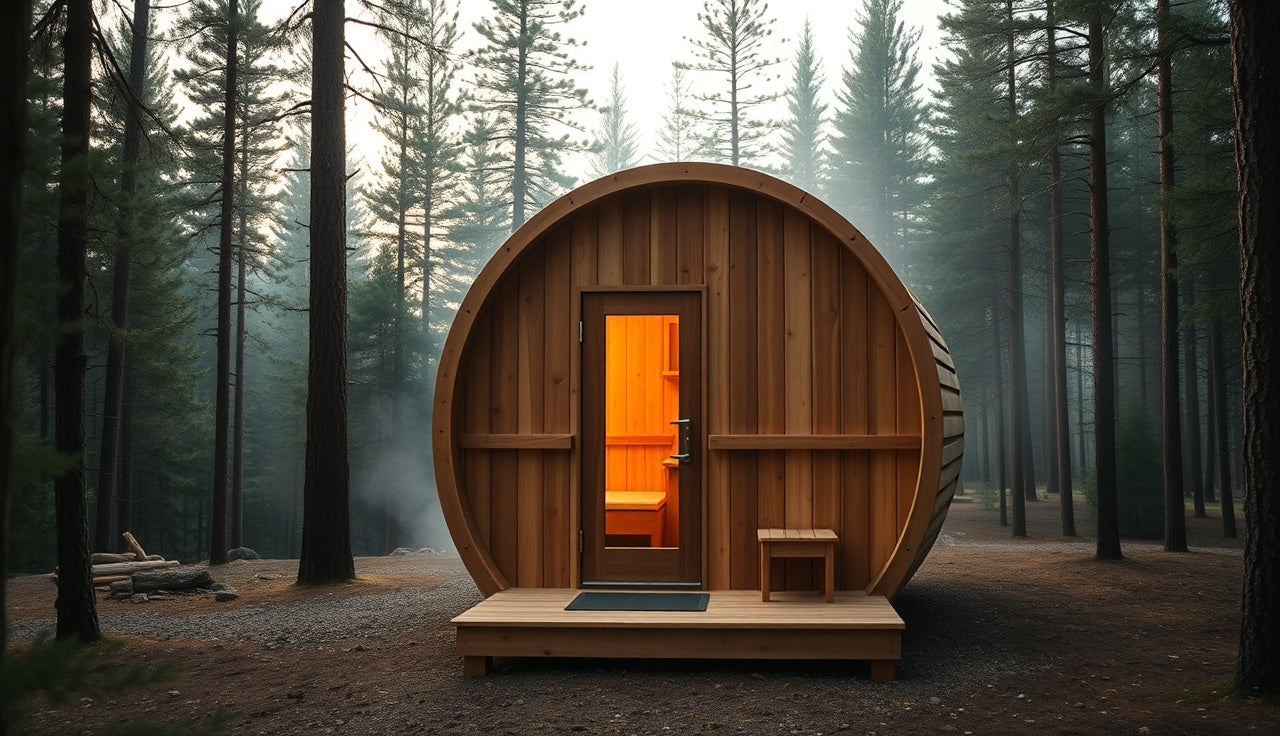
| Barrel sauna (outdoor) | $3,000, $6,000 | $1,000, $3,000 | $4,000, $9,000 |
| Custom indoor room (4-person) | $5,000, $12,000 | $3,000, $8,000 | $8,000, $20,000 |
| Full luxury build (6-person+) | $10,000, $18,000 | $5,000, $10,000 | $15,000, $28,000+ |
| Prefab indoor kit (2-person) | $4,350 |
| Barrel sauna (outdoor) | $6,500 |
| Custom indoor room (4-person) | $14,000 |
| Full luxury build (6-person+) | $21,500 |
Source: Industry cost data cross-referenced with U.S. EIA and contractor market rates, 2024
Kit sauna or custom build: which one should you choose?
Kits win on simplicity and cost. They arrive as precut, tongue-and-groove panels that slot together in a few hours. No framing knowledge required. The tradeoffs are that you get fixed dimensions (usually 4x4, 4x6, or 5x7 feet), limited wood options, and a look that reads as "sauna kit" rather than a room that belongs in your house.
Custom builds win on fit. You can use an odd corner of a basement, a garden shed conversion, or a purpose-built structure. You choose the wood species, bench height, heater position, and lighting. If you want a sauna that feels like a real room rather than a box inside a room, custom is the only path.
The middle ground is a custom-framed room using commercial sauna materials (T&G hemlock or cedar boards, pre-made benches, a commercial heater) but laid out to your exact dimensions. This approach costs 20 to 40% more than a kit but far less than a fully custom build with a specialty contractor.
For most homeowners doing their first sauna, a quality kit is the right call. You'll learn what you love and hate about the size, bench layout, and heater before committing to a $20,000 permanent room. You can also read more about your options in our home sauna guide.
If you're leaning toward an outdoor setup, outdoor sauna builds have their own site prep and weatherproofing considerations that a kit doesn't always account for.
What permits do you need to build a home sauna?
This depends entirely on your municipality, but here's the honest framework. Most building departments treat a sauna as a "room addition" or "accessory structure" if it's outdoors, and as a "residential improvement" if it's indoors. An outdoor sauna on a new foundation almost always needs a building permit. An indoor kit that plugs into an existing 240V circuit often does not, but you should call your local building department and ask directly rather than assume.
Electrical permits are a separate matter. The National Electrical Code (NEC), Article 426 and sections covering fixed electric space-heating equipment, requires a dedicated branch circuit and GFCI protection for sauna heaters [1]. Most jurisdictions adopt the NEC or a close variant. If you hire a licensed electrician, they will pull the electrical permit. If you DIY the electrical, you need to pull it yourself, and many jurisdictions will not allow unlicensed homeowners to do the electrical work on a 240V circuit.
Homeowner's associations add another layer. Check your CC&Rs before you pour a foundation or dig a trench for a conduit run.
Permit costs are usually modest ($100, $500) and the inspection protects you at resale. An unpermitted sauna can complicate a home sale and may void your homeowner's insurance coverage for fire or water damage. It is genuinely not worth skipping.
For reference, the International Residential Code (IRC) R302.7 addresses separation requirements between attached structures and living spaces, which applies to any sauna with combustion heating [2].
What electrical requirements does a home sauna have?
Almost every electric sauna heater over 3 kW requires a dedicated 240V circuit. The amperage depends on the heater: a 6 kW heater draws 25 amps at 240V; a 9 kW heater draws about 37.5 amps. The NEC requires the circuit be sized at 125% of the continuous load, so a 9 kW heater needs a 50-amp circuit [1].
The wiring runs from your main panel (or a subpanel) to the sauna location. If your main panel is nearby and has capacity, this is a straightforward 40 to 50 amp circuit with the appropriate wire gauge (typically 8 AWG for 40A, 6 AWG for 50A). If you're running the circuit 60 feet across a yard to an outdoor structure, the wire run cost climbs fast and you may need conduit burial, which adds $5, $15 per linear foot for trenching.
GFCI protection is required by NEC Section 680 for outdoor installations and recommended for all sauna circuits regardless [1]. Most modern heater controllers have a built-in contactor, but the breaker-level GFCI is still the code-compliant standard.
If your panel has no spare capacity (common in older homes with 100A service), you may need a panel upgrade before you can run a sauna circuit at all. That adds $1,500, $4,000 to the project.
Infrared saunas are the exception. Most two-person far-infrared units run on 120V at 15 to 20 amps and plug into a standard outlet. That's a legitimate advantage if your electrical situation is limited, though the heat experience is genuinely different from a traditional Finnish sauna.
What's the best wood for building a sauna?
The three most common choices are western red cedar, hemlock, and Nordic spruce (sometimes called white spruce). Each has real tradeoffs.
Western red cedar is the gold standard in North America. It's naturally resistant to moisture, has low density that means it stays cool to the touch even at high temperatures, and it smells incredible. The downside is cost: clear vertical-grain cedar runs $4, $8 per board foot, which adds up fast in a 6-foot-tall room. Cedar also contains natural oils that some people find irritating if they have sensitivities.
Hemlock is the budget alternative that many kit manufacturers use. It's lighter in color, has no strong smell, and is structurally stable in heat-cycle conditions. It costs roughly half what cedar costs. The tradeoff is that it doesn't have cedar's natural antimicrobial properties and it will show wear and darkening faster.
Nordic spruce is what traditional Finnish saunas use and it performs extremely well. It's dense, tight-grained, and holds up over decades of use. It's harder to source in the U.S. than cedar or hemlock, which is the main practical barrier.
One rule that applies to all species: never use pressure-treated lumber anywhere in the sauna interior. The chemicals off-gas at sauna temperatures and are a genuine health hazard. Avoid plywood for interior walls for the same reason. Use solid, kiln-dried T&G boards throughout.
For benches specifically, clear knot-free wood matters most. Knots contain resin that heats up, oozes out, and burns skin. Aspen is an underrated bench material because it's almost totally resin-free and stays cool even on the high bench.
How do you properly ventilate a home sauna?
Ventilation is where most DIY sauna builds go wrong. A sauna needs a continuous supply of fresh air to support the bathers and to allow the steam (löyly) to move properly through the room. Without it, the room feels stuffy, humidity becomes uncontrollable, and the wood starts to degrade from the inside.
The standard approach is an intake vent low on the wall (6 to 8 inches above the floor, near the heater) and an exhaust vent on the opposite wall, roughly 6 inches below the ceiling. The intake should be about the same size as the exhaust, typically 4 to 6 inches in diameter for a room up to 150 cubic feet. Some builders add a second exhaust vent at floor level to allow the room to fully dry out after each session.
The intake can be passive (just a vent opening) or use a small mechanical fan. The exhaust should be adjustable so you can fine-tune the humidity level. A simple adjustable louvered vent ($15, $40 at any hardware store) works well for both.
For outdoor saunas, the vapor barrier placement is critical. You want a vapor barrier on the warm side of the insulation (the interior face), so moisture cannot migrate into the wall assembly and rot the framing. Use foil-faced kraft paper or a dedicated sauna vapor barrier membrane, not standard house wrap, which is designed to be vapor-permeable.
Indoor saunas need a drain or at minimum a removable floor grate you can pull and dry. Pooling water under bench slats is how black mold starts.
What type of sauna heater should you buy?
Three categories worth seriously considering: electric resistance, wood-burning (kiuas), and infrared.
Electric resistance heaters are what most home saunas use. They heat rocks (kiuas stones), you pour water on the rocks to create steam, and the room reaches 160 to 195°F in 30 to 45 minutes. Brands like Harvia, Finnleo, and HUUM have strong reputations and 5 to 10 year warranties on their residential units. Size the heater at roughly 1 kW per 45 to 50 cubic feet of room volume, with an upward adjustment for concrete or tile walls (they absorb more heat than wood).
Wood-burning heaters give the most authentic experience. The heat is softer, the stone mass is typically larger, and there's no electricity running to the sauna room at all. The tradeoffs are real: you need to manage a fire, you need a flue and chimney, and you can't run one inside most urban homes due to fire codes and smoke. For an outdoor sauna on a rural or semi-rural property, a wood-burning kiuas is genuinely worth the added complexity.
Infrared heaters (both near and far infrared) work completely differently. They heat your body directly rather than heating the air, so the room air temperature stays lower (120 to 140°F) while you sweat heavily. The scientific literature on far-infrared specifically is thinner than for traditional Finnish sauna, but several studies suggest cardiovascular and recovery benefits at similar levels to traditional sauna [3]. If you want a sauna that heats up in 10 to 15 minutes and runs on a 120V outlet, far-infrared is the practical choice. Just know the experience is different, and many traditional sauna enthusiasts find it less satisfying.
A note on steam generators: a sauna is not a steam room. A sauna heats rocks that you splash with small amounts of water to create brief bursts of steam (löyly). A steam room runs at 100 to 120°F with near-100% humidity continuously from a boiler-style steam generator. They're different experiences with different equipment. If you're trying to decide between them, our sauna vs steam room breakdown covers the distinction in detail.
Can you build a sauna in a basement, bathroom, or garage?
Yes to all three, with different considerations for each.
Basements are actually ideal for sauna placement. The temperature is already controlled, the concrete walls handle moisture well, and you typically have easy access to the electrical panel. The main challenge is vapor management: you need the vapor barrier on the interior (warm) side and proper ventilation so the room dries fully after each session. A floor drain makes cleanup easy and is worth the concrete cutting cost.
Bathrooms are a popular choice because the plumbing is already there. The limitation is usually ceiling height (saunas need at least 7 feet for proper heat stratification, ideally 7.5 feet) and room size. A 5x7 foot bathroom can fit a functional two-person sauna if you build the sauna room inside it, but you lose the bathroom while the sauna is in place. Some people build a combined shower-sauna room, which works but requires careful waterproofing and material selection.
Garages offer the most space flexibility and the easiest construction access. The main issues are insulation (garages are often poorly insulated, which drives up heating time and energy cost) and the need to run a dedicated electrical circuit. If the garage is attached, check your local fire code for separation requirements.
For any interior location, the sauna room itself should be built inside the existing space as a freestanding or semi-freestanding structure. You frame a new room inside the existing room, insulate it heavily (R-13 to R-19 in the walls, R-19 to R-26 in the ceiling), apply the vapor barrier, then install T&G boards over that. The exterior of the sauna room (facing the garage or basement) can be drywall or left as framing.
If you're not ready to commit to a permanent installation, a portable sauna is worth looking at as a starting point.
How long does it take to build a home sauna?
A prefab kit in an existing space: one weekend for two people who read the instructions. The electrical work adds time; if your electrician can come the same week, you're using the sauna in 7 to 10 days from ordering.
A barrel sauna on a concrete pad: two to three weekends. One weekend for the pad to cure and to assemble the barrel structure, a second weekend for the heater, flue (if wood-burning), benches, and finishing details. Add lead time for delivery, which runs 2 to 6 weeks depending on the manufacturer.
A custom indoor build: two to four weeks of active construction, assuming you're not doing the work yourself and the contractor has sauna experience. The framing, insulation, vapor barrier, and board installation go quickly once started. Electrical inspection scheduling is usually the pacing item.
A full custom outdoor structure with a poured foundation, post-and-beam framing, and premium finishes can take 6 to 12 weeks from breaking ground to first session.
The ordering and shipping timeline matters too. Most quality sauna heaters ship from Finland or Germany in 2 to 4 weeks. If you're sourcing a specific kiuas stone or a rare wood species, plan for 4 to 8 weeks. Order your heater before you start framing so you're not sitting in a finished sauna room waiting for the heater.
What are the real health benefits of home sauna use?
The evidence base for traditional Finnish sauna is genuinely solid, especially for cardiovascular outcomes. A prospective cohort study published in JAMA Internal Medicine in 2015 followed 2,315 Finnish men for 20 years and found that men who used the sauna 4 to 7 times per week had a 63% lower risk of sudden cardiac death compared to once-a-week users [3]. That's a large effect in a long-running study, though it's observational data so you can't rule out confounding.
The same research team from the University of Eastern Finland also reported associations between frequent sauna use and lower risk of fatal cardiovascular events and all-cause mortality, with dose-response relationships that strengthened with more sessions per week [4].
For recovery and exercise, a study in the Journal of Science and Medicine in Sport found that post-exercise sauna bathing extended time to exhaustion in competitive runners, likely through plasma volume expansion [5]. The effect wasn't enormous but it was real and repeatable.
The researchers from the University of Eastern Finland described their findings as showing that "sauna bathing is a safe activity for healthy adults" and noted that the frequency and duration (15 to 20 minutes at 174 to 212°F) used in Finnish tradition appeared optimal in their cohort [4].
Heat stress carries real risk for some people, including those with unstable angina, severe aortic stenosis, or a recent myocardial infarction [10]. The conservative and honest position: if you have a significant cardiovascular condition, talk to your doctor before building a sauna and certainly before using one regularly.
You can read more about the specific evidence in our sauna benefits deep look. And if you're interested in pairing sauna use with cold exposure, the cold plunge benefits research is worth reading alongside it.
How much does it cost to run a home sauna each month?
Running costs are lower than most people expect. A 6 kW electric heater running for one hour draws 6 kWh. At the U.S. average residential electricity rate of $0.16 per kWh (as of early 2024, per the U.S. Energy Information Administration) [6], that's about $0.96 per session. Four sessions per week for a month is roughly $15, $20 in electricity.
A larger 9 kW heater scales proportionally: about $1.44 per hour, or $23, $30 per month at four sessions per week.
Good insulation is the single biggest lever on operating cost. A well-insulated room (R-13 walls, R-19 ceiling) reaches temperature faster and holds it with less sustained power draw. A poorly insulated room heats slowly and the heater cycles harder, raising both your electricity bill and the wear on the heater elements.
Wood-burning saunas cost essentially nothing to operate if you have your own wood supply. If you buy cord wood at $200, $400 per cord and burn half a log per session, the cost is trivial. The time cost of fire management is the real variable.
Infrared saunas are the cheapest to run. A typical 2-person far-infrared unit draws 1.2 to 1.6 kW, meaning a one-hour session costs $0.19, $0.26 at average electricity rates.
Maintenance costs are low: replace heating elements every 5 to 10 years ($50, $200 depending on the unit), reseal or replace bench boards every 5 to 7 years if you have high use, and replace kiuas stones every 3 to 5 years ($30, $80 for a bag of proper sauna stones). Budget $100, $200 per year for routine maintenance on a mid-range setup.
Does adding a sauna increase your home's value?
The honest answer: maybe, but probably not dollar-for-dollar. There's limited real estate appraisal data on saunas specifically, and what exists is mostly anecdotal from real estate agents in markets where saunas are common (Minnesota, Michigan, parts of the Pacific Northwest).
The general principle from the National Association of Realtors is that specialty improvements recover roughly 50 to 80 cents on the dollar in resale value, and that's for broadly popular upgrades like kitchen remodels [7]. A sauna is a narrower preference item. In a market where buyers want them, a well-built indoor or outdoor sauna may add $3,000, $10,000 to your sale price. In a market where buyers see it as a liability (the space could be a bedroom), it may add nothing or slightly complicate the sale.
The best case for building a sauna is that you get years of personal use and recover some fraction of the cost at sale. Don't build a sauna as a financial investment. Build it because you will use it and enjoy it.
One practical consideration: a sauna built with permits, proper electrical, and professional installation is far more likely to add perceived value and survive buyer due diligence than an unpermitted DIY structure. A future buyer's home inspector will flag an unpermitted outbuilding or a DIY 240V circuit, which can kill a deal or force you to pull permits retroactively under less favorable terms.
SweatDecks has a range of home sauna options for people at different stages of this decision, from entry-level kits to fully custom builds.
What are the most common mistakes people make building a home sauna?
Undersizing the heater is the most common one. People look at the price difference between a 6 kW and a 9 kW heater and pick the cheaper one, then wonder why their room never gets above 160°F. Use the cubic footage calculation (1 kW per 45 to 50 cubic feet), add 20% if you have concrete or tile surfaces, and buy the right size heater the first time.
Using the wrong wood is the second most common mistake. Pressure-treated lumber, OSB, plywood with glues and binders, pine with heavy knots, all of these have problems at sauna temperatures. Stick to clear-grade, kiln-dried solid wood for everything the interior air contacts.
Skipping the vapor barrier or installing it on the wrong side ruins the wall assembly over time. The vapor barrier goes on the hot (interior) side of the insulation, not the outside of the framing. Get this wrong and you're pulling apart the room in 5 years to deal with mold and rot.
Over-ventilating is a lesser-known mistake. Builders sometimes install too large an exhaust vent, which makes it impossible to hold temperature. The exhaust should be adjustable and sized to the room, not overbuilt.
Buying a heater without checking the electrical capacity of the structure. A 9 kW heater on a 30-amp circuit will trip breakers and potentially damage the heater. Pull the sauna specifications before you plan the electrical run.
Not building a bench with enough depth. Standard sauna benches are 18 to 24 inches deep to allow lying down on the upper bench. A 12-inch bench forces you to sit upright the whole session, which gets uncomfortable fast. Build the benches 20 inches deep minimum if the room footprint allows it.
Last one: building a sauna in a location you'll never use. A sauna at the far end of a cold, dark yard that requires putting on shoes to reach sees maybe 10 sessions before it gets abandoned. Proximity to your bathroom, shower, or living space matters enormously for how often you actually use it.
Frequently asked questions
How much space do you need to build a home sauna?
A functional two-person sauna needs at least 4x4 feet of interior floor space and 7 feet of ceiling height. Four feet of depth lets one person lie down on the upper bench. A 4x6 room is more comfortable for two people sitting side by side. Ceiling height matters because heat stratifies: the top 18 inches of the room is where the best heat sits, so taller ceilings give you more usable hot zone.
Can I build an outdoor sauna without a concrete foundation?
Yes. A gravel pad with compacted crushed stone and pressure-treated skids works well for barrel saunas and smaller prefab structures. A concrete pad is more permanent and easier to keep level over time, but it costs $500, $2,000 for a slab depending on size. Helical piers are a third option for decked outdoor saunas. Avoid placing any sauna directly on bare soil: moisture wicks up and rots the bottom framing within a few years.
What's the difference between a traditional sauna and an infrared sauna for a home build?
Traditional saunas heat the air and rocks to 160 to 210°F; you add water to create steam (löyly). Infrared saunas use radiant panels to heat your body directly at 120 to 140°F room temperature with no steam. Traditional saunas have deeper long-term research behind them, including the 20-year Finnish cohort study. Infrared saunas are cheaper to build and run, heat up faster, and work on a standard 120V outlet. The experiences are genuinely different.
Do I need a building permit to add a sauna to my house?
Usually yes for electrical work, and often yes for the structure itself if it's outdoors or over a certain square footage. Indoor kit saunas plugged into a pre-existing 240V circuit sometimes fall below the permit threshold, but you should call your local building department and ask before starting. An electrical permit is almost always required when adding a new 240V dedicated circuit, regardless of what the sauna structure itself requires.
What insulation should I use in a home sauna?
Fiberglass batt insulation works well and is widely available. Target R-13 to R-19 in the walls and R-19 to R-26 in the ceiling. The critical detail is the vapor barrier: install foil-faced kraft paper or a dedicated sauna vapor barrier on the hot (interior) side of the insulation, stapled to the framing before you apply T&G boards. Spray foam can work but must be fully covered by interior paneling since it off-gasses at high temperatures.
How long does a home sauna last?
A well-built sauna with quality wood, proper vapor barrier, and good ventilation can last 20 to 30 years or more. The heater elements typically last 5 to 10 years before replacement. Kiuas stones should be replaced every 3 to 5 years as they crack and lose heat retention. The wood interior will darken and patina over time, which most people find attractive. Bench boards in high-use saunas may need replacement or sanding every 5 to 7 years.
Is it cheaper to buy a sauna kit or build a custom sauna from scratch?
Kits are cheaper by 30 to 50% for equivalent interior volume. A two-person kit runs $2,500, $4,500 installed; a custom-built two-person room of the same size runs $5,000, $9,000. The cost advantage of kits comes from factory-cut panels and standardized dimensions. You pay more for custom builds in labor time, custom wood orders, and the flexibility of non-standard sizes. For most first-time sauna owners, a kit is the smarter financial decision.
What temperature should a home sauna reach, and how long does it take to heat up?
Traditional Finnish sauna temperatures run 160 to 210°F (70 to 99°C), measured at upper bench height. A properly sized electric heater heats a well-insulated room to 180°F in 30 to 45 minutes. Wood-burning heaters take 45 to 75 minutes depending on fire management and stone mass. Infrared saunas reach operating temperature in 10 to 15 minutes but the room air stays much cooler. Preheat time is a real factor in how often you use the sauna, so bigger and colder is not always better.
Can I add a cold plunge or ice bath to my home sauna setup?
Absolutely, and many people find contrast therapy (alternating heat and cold) to be the most effective recovery protocol. You don't need dedicated plumbing: a chest freezer converted to a cold plunge, a purpose-built cold plunge tub, or even a large stock tank works outdoors. The key is proximity: if the cold plunge is more than 30 seconds from the sauna exit, you lose the contrast effect and the barrier to using it regularly gets too high. Our cold plunge and ice bath guides cover setup options in detail.
What are the best sauna stone types for a home build?
Olivine diabase and peridotite are the traditional Finnish choices. They hold heat well, resist cracking, and don't contain silica compounds that become hazardous when heated. Avoid river rocks or landscaping stones: they can crack explosively when water is poured on them. Most heater manufacturers specify a stone type and size for their units; following that spec is easier than researching alternatives. Plan to replace stones every 3 to 5 years as they lose density and start cracking.
How do I maintain a home sauna?
After each session, leave the door open and the ventilation fully open to dry the room completely. Wipe down benches with a damp cloth if needed; avoid harsh cleaners that soak into the wood. Sand the bench boards lightly every year or two to remove staining and keep the surface smooth. Check the heater element and stones annually. Inspect the vapor barrier and wall joints every few years for any signs of moisture intrusion. Total active maintenance time is maybe two hours per year for a basic setup.
Is a home sauna safe for kids or pregnant women?
For children, most medical guidance suggests keeping sessions short (under 10 minutes), temperatures moderate, and supervision constant. The American Academy of Pediatrics does not endorse specific sauna guidelines but cautions against prolonged heat exposure in young children. For pregnant women, most obstetric guidance recommends avoiding saunas entirely, particularly in the first trimester, due to the risk of hyperthermia affecting fetal development. Consult a physician for any specific health situation before use.
What's the best size sauna for a home build?
A 4x6 interior room is the most practical size for most households. It fits two to three people comfortably, is large enough for a proper upper and lower bench, and doesn't require a heater larger than 6 to 8 kW to heat efficiently. Larger rooms (6x8 or 8x8) work well for families or regular social use but cost significantly more to build and heat. Smaller 4x4 rooms are fine for solo use but feel cramped if two people try to use them at the same time.
Sources
- National Fire Protection Association, NFPA 70 (National Electrical Code) Article 426 and Section 680: NEC requires a dedicated branch circuit and GFCI protection for fixed electric sauna heaters; circuit must be sized at 125% of continuous load
- International Code Council, International Residential Code R302.7: IRC R302.7 addresses fire separation requirements between attached accessory structures and living spaces, applicable to combustion-heated saunas
- Laukkanen JA et al., JAMA Internal Medicine 2015, 'Association Between Sauna Bathing and Fatal Cardiovascular and All-Cause Mortality Events': 2,315 Finnish men followed 20 years; men using sauna 4-7 times/week had 63% lower risk of sudden cardiac death vs. once-per-week users
- University of Eastern Finland, research summary on sauna and cardiovascular health (Laukkanen et al. cohort studies): Researchers described sauna bathing as 'a safe activity for healthy adults' and identified 15-20 minutes at 174-212°F as the duration/temperature used in the Finnish cohort
- Scoon GS et al., Journal of Science and Medicine in Sport 2007, 'Effect of post-exercise sauna bathing on the endurance performance of competitive male runners': Post-exercise sauna bathing extended time to exhaustion in competitive runners, associated with plasma volume expansion
- U.S. Energy Information Administration, Electric Power Monthly, Average Retail Price of Electricity: U.S. average residential electricity rate approximately $0.16 per kWh as of early 2024
- National Association of Realtors, Remodeling Impact Report: Specialty home improvements typically recover 50-80 cents on the dollar at resale; saunas are a narrower preference item than broadly popular upgrades
- U.S. Consumer Product Safety Commission, Home Safety Information: CPSC guidance on heat-related hazards and home improvement safety, applicable to high-temperature residential installations
- U.S. Department of Energy, Office of Energy Efficiency, Insulation Guide: R-value recommendations for interior wall and ceiling insulation in residential structures; R-13 to R-19 walls and R-19 to R-26 ceiling cited for performance
- Hannuksela ML, Ellahham S, The American Journal of Medicine 2001, 'Benefits and Risks of Sauna Bathing': Review identifying contraindications to sauna use including unstable angina, severe aortic stenosis, and recent myocardial infarction due to heat stress risk

Share:
Steam Room Ceiling Slope: Requirements, Geometry, and Inspection
Steam room when sick: what actually helps and what to skip