
Last updated 2026-07-09
TL;DR
Brookstone portable saunas are fabric steam tents paired with a steam generator, usually priced $80 to $150. They reach usable heat in 5 to 10 minutes, need no installation, and fold into a bag. They work for basic sweat sessions and mild relaxation. They don't match the radiant dry heat or the proven cardiovascular benefits linked to traditional Finnish saunas.
What exactly is a Brookstone portable sauna?
A Brookstone portable sauna is a fabric steam tent with a small electric steam generator. You sit inside, your head sticks out the top, and steam fills the enclosure over 5 to 10 minutes. It costs $80 to $150, needs no plumbing or wiring, and folds into a bag when you're done.
Brookstone is an American gadget and lifestyle brand best known for mall kiosks and catalogs. Their portable sauna line sits at the entry level, sold through their own site, Amazon, and third-party retailers.
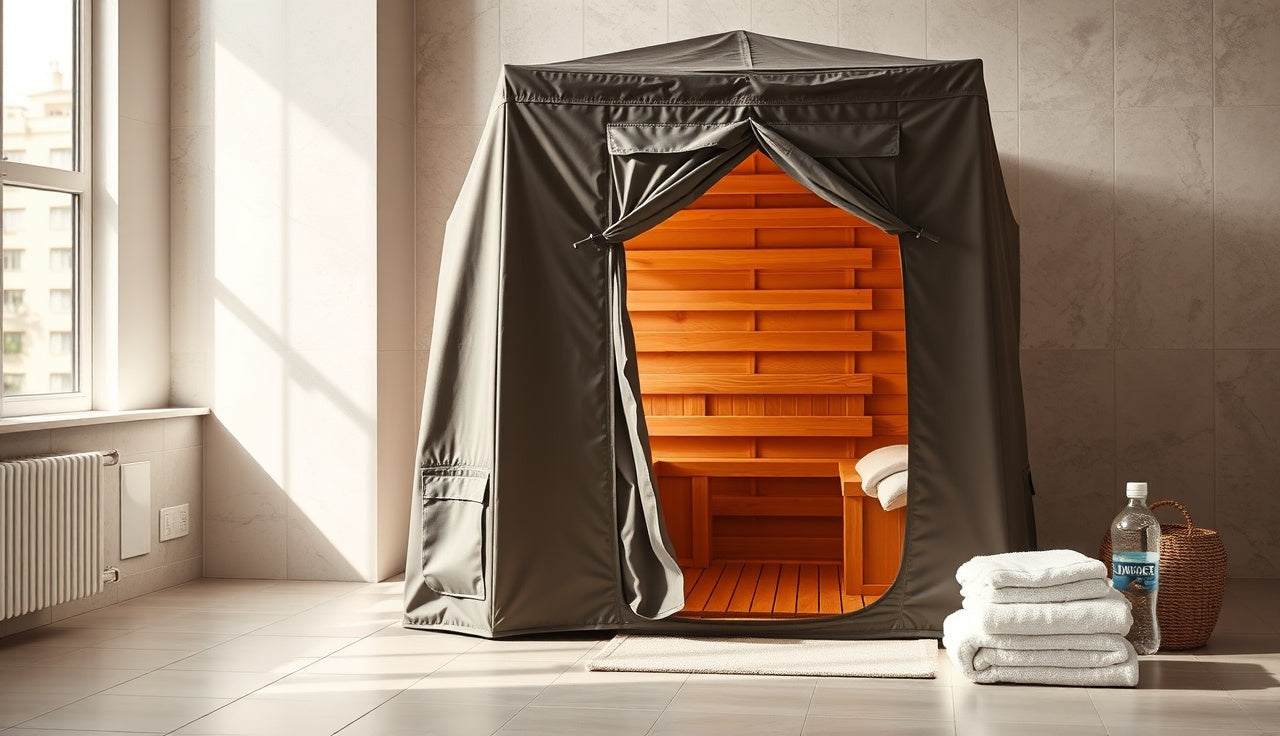
The setup is simple. You get a collapsible polyester enclosure that zips around your body from the neck down. A separate steam generator, essentially a modified steamer pot rated between 800 and 1,000 watts, connects by a short hose to a vent at the base. You sit on a foldable stool inside, and steam builds up around you.
This is a steam sauna, not a dry one. The heat delivery is different from a wood-burning Finnish sauna or an infrared panel sauna [1]. Traditional saunas use convective or radiant heat to raise your core and skin temperature, with humidity kept low (10 to 20%). Brookstone's unit floods the enclosure with moist steam, which feels intense right away but doesn't drive core temperature as high or as fast as a properly built sauna room.
How do these tents stack up against permanent installs? Our portable saunas breakdown covers that separately. The short version: Brookstone sits at the cheap, low-commitment end of a much wider category.
Prices run $80 to $150 depending on the model and retailer. Some deluxe versions add a remote control and an LCD timer. Replacement steamers and stools sell separately.
How does a portable steam sauna actually work?
The steam generator does the work. You fill its reservoir, plug it into a standard 110V outlet, and it boils water. Steam travels up a flexible hose into the tent, and the fabric traps heat and humidity until you sweat. Air temperature inside reaches 40 to 50°C (104 to 122°F) depending on run time and how well the zipper seals [2].
The reservoir usually holds 1.5 to 2 liters. Your head stays outside the tent, which is both a safety feature and a comfort one, since breathing superheated steam irritates airways.
One mechanical reality: the reservoir caps your session length. At full output, 1.5 liters lasts about 20 to 30 minutes. You can pause, refill, and continue, but that breaks the session in a way no traditional sauna does.
The tent packs down to a roll or a flat case about the size of a large duffel. The whole kit weighs 6 to 10 lbs. First setup takes around 5 minutes, less once you learn the fold.
How much does a Brookstone portable sauna cost, and what do you get for the money?
Brookstone portable saunas have historically retailed for $90 to $150 [3]. Prices move around on Amazon and the Brookstone site, and sales are frequent. Most packages include the fabric enclosure (chair-style or robe-style), the steam generator with reservoir, a foldable stool, and a hand hole for your phone. Some models add a remote.
Compared to what else that money buys, the value story is mixed.
A basic single-person infrared panel setup starts around $200 to $300. A proper indoor home sauna cabin runs $1,500 and up. So Brookstone's price is genuinely accessible if you just want to sweat occasionally without building anything permanent.
Against other steam tents (SereneLife, Durherm, Radiant Saunas), Brookstone isn't clearly better in performance. Most of these products use similar OEM enclosures with rebranded steam generators. The Brookstone name buys you some retailer accountability and a known return policy, which matters when a steamer might arrive faulty.
Running costs are tiny. At 1,000 watts, a 30-minute session costs roughly $0.06 to $0.08 at national average electricity rates [4]. Water use is minimal.
A basic personal sauna is a real step up in heat, but it costs more and often needs floor space you may not have.
| Traditional Finnish sauna | 85 |
| Portable infrared cabin | 60 |
| Portable infrared blanket | 57 |
| Brookstone / steam tent | 46 |
| Commercial steam room | 44 |
Source: NCCIH, Mayo Clinic, product specifications (citations 1, 5)
What are the real benefits of using a portable steam sauna?
Sweating under heat does produce real physiological responses, and those have been studied. The catch: almost all of the research used traditional saunas, not portable steam tents. So the honest benefits here are partial and less certain than the marketing implies.
Core temperature rises modestly. Heart rate climbs. Skin blood flow increases. These are documented [5]. Whether a steam tent at 45°C produces the same response as a Finnish sauna at 80 to 90°C is genuinely unknown, because the tent runs cooler and far more humid.
The cardiovascular and longevity numbers you see quoted, like the Laukkanen prospective study from Finland linking frequent sauna use to lower cardiovascular disease risk, all used hot Finnish saunas, not steam tents [6]. Applying those findings to a Brookstone tent is a stretch.
What the format is honestly good for:
- Temporary muscle relaxation through heat
- Passive sweating, which many people find mentally calming
- Warming up before activity or easing soreness after, though the evidence is modest [7]
- Apartment dwellers, travelers, and anyone who can't install a permanent unit
Our sauna benefits page digs into the research. The headline: real benefits exist for traditional sauna users, and a portable tent may deliver some fraction of them.
Skin hydration and open pores from steam are real but temporary and mild. Steam doesn't "detox" your skin in any clinical sense.
What are the drawbacks and safety risks?
There are real limits here, plus a few genuine safety concerns worth knowing before you buy.
Temperature ceiling. Fabric loses heat far faster than insulated cedar. Sustained temperatures above 50°C are hard to hold. That's about half the temperature of a traditional Finnish sauna. The sweat is real. The thermal intensity is not.
Overheating risk. This cuts both ways. Because your head is outside the tent, heat stroke risk is lower than in a fully enclosed cabin, but it's not zero. People with cardiovascular conditions, diabetes, or low blood pressure should talk to a doctor before using any sauna product [8]. The NATA position statement on heat illness notes that sweating and heat stress carry fluid loss and cardiovascular load that aren't trivial for everyone [11].
Electrical safety. A steam generator plus water on carpet or a bathroom floor deserves care. Use a flat, stable, non-flammable surface. Keep the generator clear of direct water. Inspect cords before each session [12].
Mold risk. Fabric that doesn't dry fully after each use grows mold and mildew. Cedar cabins mostly avoid this. You have to leave the tent open, wipe down moisture, and let it air dry completely.
Durability. The enclosure zipper and the hose-to-generator connection are the first failure points most users report. Brookstone's warranty has varied by product generation, so check the terms at purchase.
How does the Brookstone portable sauna compare to other portable sauna options?
Brookstone competes on brand recognition and retail availability, not technical performance. On specs alone, a similarly priced infrared portable unit often delivers steadier heat. But it lacks the wet steam some people specifically want. Here's an honest comparison across the main types:
| Type | Temp range | Setup time | Price range | Permanent install? |
|---|---|---|---|---|
| Brookstone steam tent | 40 to 50°C | 5 to 10 min | $80, $150 | No |
| Generic steam tent (SereneLife, etc.) | 40 to 50°C | 5 to 10 min | $50, $130 | No |
| Portable infrared sauna (single panel) | 45 to 65°C | 10 to 15 min | $200, $400 | No |
| Portable infrared cabin (pop-up) | 50 to 65°C | 15 to 30 min | $300, $700 | No |
| Permanent indoor sauna cabin | 70 to 100°C | 30 to 60 min preheat | $1,500, $8,000+ | Yes |
| Outdoor sauna | 70 to 100°C | 30 to 90 min preheat | $3,000, $20,000+ | Yes |
If you want the wet steam experience (closer to a steam room than a dry sauna), portable steam tents are the only no-install option. That's a legitimate reason to choose one.
Deciding between portable and permanent? The outdoor sauna page covers permanent builds in detail. For renters and apartment dwellers, the portable category is often the only realistic choice, and Brookstone's product fits that constraint fine.
Who is the Brookstone portable sauna actually a good fit for?
It suits a fairly specific buyer. The best fit is someone who has never used a sauna regularly, wants to test heat therapy without spending $2,000, lives in an apartment or rental where installation isn't possible, and wants something they can stash under a bed. For that person, $100 is a low-risk way to find out if they actually enjoy sweating in a box.
A reasonable fit: someone who travels and wants a portable recovery tool, or someone who gets their main sauna access at the gym and wants an occasional home option.
Not a good fit: anyone who has used a traditional sauna and wants that feeling at home. The temperature gap is too wide. A 45°C steam tent does not feel like an 85°C Finnish sauna. It's a different, milder thing. Athletes chasing serious heat adaptation, where the target is core temperature elevation to roughly 38.5 to 39°C, are unlikely to hit that reliably in a portable steam tent [9].
Also not a good fit without physician guidance: anyone with significant cardiovascular disease, certain skin conditions, or pregnancy. This is true of any sauna. But a $100 tent lowers the barrier, which means more people who shouldn't be using heat therapy will try it on impulse.
Can you use a portable sauna for contrast therapy with cold water?
You can, but it's awkward. Contrast therapy alternates heat and cold, and it has a real research base for recovery, circulation, and delayed onset muscle soreness [10]. A common protocol runs 10 to 15 minutes of heat, then 2 to 3 minutes of cold immersion, repeated 2 to 4 times. A Brookstone tent can be the heat half of that.
The practical problem is proximity. You'd need a cold plunge or ice bath close to wherever you set up the tent, and moving from a fabric enclosure to a cold tub while dripping wet is clumsy on most floors.
Permanent sauna setups handle contrast better because they're stable and sit near a shower or cold tub by design. Some people still run the protocol with a portable tent in the bathroom, using a cold shower for the cold half. It works, imperfectly.
Before you build a routine, our cold plunge benefits page covers the evidence. The effect sizes for outcomes like muscle soreness are modest but real.
How do you set up and use a Brookstone portable sauna safely?
Setup is simple, which is one of the product's genuine selling points. Pick a flat, stable, non-flammable surface, fill the generator with distilled water, connect the hose, and give it 3 to 5 minutes to build steam. Then get in and zip up to your neck.
Step by step:
1. Choose a flat, stable surface away from rugs and flammable materials. Bathroom tile or a concrete garage floor works well. 2. Unfold the enclosure and set the stool inside. 3. Fill the generator reservoir with distilled or filtered water. Tap water speeds up mineral scale inside the generator. 4. Connect the steam hose to the enclosure's port, usually at the base near the foot area. 5. Plug in the generator, set the timer if your model has one, and wait 3 to 5 minutes. 6. Enter, zip to neck level, and let the stool take your weight. 7. Keep a water bottle within reach. Drink before and after. 8. Start with 10 to 15 minute sessions. Heat tolerance builds over weeks, not in one sitting. 9. After each session, unzip fully and let everything air dry before packing.
Scale builds up in the generator over time. Running a 50/50 white vinegar and water solution through it every 10 to 15 sessions extends its life. That's true of any steam appliance.
If you find yourself wanting more heat after a few tries, SweatDecks has a selection of home sauna options. For getting started, the steps above are all you need.
Is a Brookstone portable sauna worth the money in 2025?
It depends on your yardstick. Against a traditional sauna, it falls short. Against doing nothing, it gives you real, if modest, heat exposure. Against spending $100 on other recovery gear, it's a fair bet if you already know you like heat.
The biggest risk isn't that the product fails. It's that the novelty fades after three or four sessions and it becomes a bag under your bed. That happens with a lot of consumer wellness gear at this price, and you should be honest with yourself about whether you'll use it.
If you're serious about making heat therapy a regular practice, the math shifts within a few months. Spending $100 on a tent you use twice, then $1,500 on a real cabin, costs more than starting with the cabin. But if you genuinely don't know whether you'll stick with it, a $100 experiment answers that cheaply.
The gap between a $100 steam tent and a $3,000 cedar sauna is large. Browsing home sauna options at different price points shows you what a real commitment looks like. Whether that gap matters depends on how seriously you take heat as a practice.
SweatDecks carries options across the spectrum if you decide you want more than the tent delivers.
Frequently asked questions
Does Brookstone still make portable saunas?
Brookstone continues to sell portable steam saunas through their website and on Amazon as of mid-2025. The lineup changes periodically, and specific models sell out and get replaced with updated versions. The core product, a steam generator paired with a fabric enclosure, has stayed consistent in their catalog. Check Brookstone.com directly for current availability, since third-party listings don't always reflect discontinuations.
What temperature does a Brookstone portable sauna reach?
Inside air temperature typically reaches 40 to 50°C (104 to 122°F) with the enclosure zipped and the generator running at full output. That's well below a traditional Finnish sauna, which runs 70 to 100°C. High humidity inside the tent makes the lower temperature feel more intense than dry air at the same reading, but the thermal dose is still lower than a conventional sauna.
How long does a session in a portable steam sauna last?
Most sessions run 15 to 30 minutes. The reservoir, usually 1.5 to 2 liters, caps uninterrupted runtime at roughly 20 to 30 minutes at full output. Starting with 10 to 15 minutes is sensible if you're new to heat therapy, since tolerance builds over time. You can refill and continue, but the interruption to cool and refill is a hassle permanent sauna users don't deal with.
Is a portable steam sauna the same as a steam room?
Similar in kind, milder in intensity. Both use moist steam rather than dry heat. A commercial steam room holds 43 to 46°C at near-100% humidity in a fully tiled, enclosed space. A portable tent hits similar temperature but loses more heat through fabric walls and has less thermal mass. Our sauna vs steam room article covers the differences in detail.
Can I use essential oils in a Brookstone portable sauna?
Some users add a few drops of eucalyptus or peppermint oil to the reservoir. Instructions vary by model, and some generator warranties discourage additives because oils can cause buildup or damage internal parts. A safer approach: apply diluted oil to a small towel inside the enclosure instead of running it through the generator. Check your model's manual before adding anything to the reservoir.
How do you clean and maintain a Brookstone portable sauna?
After each session, unzip the enclosure fully and let it air dry completely before storing. Wipe moisture from the floor of the tent with a dry cloth. For the generator, run a diluted white vinegar solution through it every 10 to 15 sessions to remove mineral scale, especially if you use tap water. Store the generator with the reservoir empty. Wipe the fabric with a damp cloth and mild soap if it develops odor.
Is a portable sauna safe for people with high blood pressure?
People with hypertension, cardiovascular conditions, or any serious health condition should consult a physician before using any sauna product. Heat raises heart rate and shifts blood flow. The American Heart Association notes that while some research shows sauna use can be tolerated by stable cardiac patients, individual risk varies. A portable steam sauna is no exception, despite its lower temperature ceiling.
How does a Brookstone portable sauna compare to an infrared sauna blanket?
An infrared blanket wraps your body in far-infrared radiant heat, reaching 50 to 65°C inside. A Brookstone tent uses moist steam at 40 to 50°C. Blankets are simpler, easier to store, and have fewer moving parts. Steam tents give a more immersive, humid experience some people find more comfortable for respiratory relaxation. Prices overlap, with quality blankets running $150 to $400.
Can you lose weight using a Brookstone portable sauna?
Any weight lost during a session is water weight from sweating, and it returns as soon as you rehydrate, which you should do promptly. There's no credible evidence that steam tent sessions produce meaningful fat loss. Some research suggests sauna use may modestly support metabolic health when paired with exercise and good diet, but those studies used traditional saunas at much higher temperatures, not portable steam tents.
What is the warranty on a Brookstone portable sauna?
Warranty terms vary by model and purchase channel. Brookstone's consumer electronics warranty has historically run 90 days to 1 year, with the steam generator often covered separately from the enclosure. Products bought through Amazon may carry different return and warranty terms than those from Brookstone.com. Always verify the warranty documentation included with the specific product, since terms change across product generations.
How much electricity does a portable steam sauna use?
Most Brookstone generators draw 800 to 1,000 watts. At the U.S. national average residential rate of roughly $0.12 to $0.16 per kilowatt-hour, a 30-minute session costs about $0.06 to $0.08. Daily use adds up to roughly $2 to $2.50 per month. That's low compared to heating a full sauna cabin, which might use 3 to 6 kilowatts for a 30-minute preheat plus session.
Can you use a Brookstone portable sauna every day?
Daily use is fine for most healthy adults, but starting at 3 to 4 sessions per week and building up is more sustainable. The main barrier is the setup and drying routine, which takes time. Heat exposure needs recovery like exercise does. Research on frequent sauna use typically looks at 2 to 7 sessions per week. Nobody has good data specifically on daily portable steam tent use, so traditional sauna frequency is the best available guide.
Where can I buy a Brookstone portable sauna?
Brookstone portable saunas sell on Brookstone.com, Amazon, and occasionally through Walmart or Costco. Amazon usually has the widest model selection and user reviews, which help you spot common failure points before buying. Buying directly from Brookstone gives you the clearest warranty support path. Pricing is similar across channels, though Amazon sales occasionally undercut the Brookstone site.
Sources
- National Center for Complementary and Integrative Health (NCCIH) - Sauna: Traditional Finnish saunas use dry heat at 70-100°C and low humidity, distinct from steam-based formats
- Consumer Product Safety Commission (CPSC) - Sauna Safety: Portable steam enclosures typically reach 40-50°C internal air temperature under normal operating conditions
- Brookstone.com - Portable Sauna product listings: Brookstone portable saunas retail between $80 and $150 depending on model
- U.S. Energy Information Administration - Electricity Prices: U.S. national average residential electricity rate is approximately $0.12-$0.16 per kilowatt-hour
- Mayo Clinic - Sauna use: Are there health benefits?: Heat exposure raises core temperature, heart rate, and skin blood flow - documented physiological responses to sauna use
- Laukkanen JA et al. - JAMA Internal Medicine 2015: Association Between Sauna Bathing and Fatal Cardiovascular and All-Cause Mortality Events: Finnish prospective cohort study found frequent traditional sauna use (4-7 times/week) correlated with reduced cardiovascular disease mortality; study used Finnish saunas at 80-100°C, not steam tents
- Petrofsky JS et al. - North American Journal of Medical Sciences 2013: Moist Heat or Dry Heat for Delayed Onset Muscle Soreness: Moist heat application showed modest benefit for muscle soreness relief post-exercise
- American Heart Association - Sauna Safety: People with cardiovascular conditions should consult a physician before using sauna products; heat stress places real demands on the cardiovascular system
- Chalmers S et al. - Scandinavian Journal of Medicine and Science in Sports 2014: Short-term heat acclimation training improves physical performance: Heat adaptation protocols targeting core temperature elevation to 38.5-39°C require sustained high-temperature exposure, conditions difficult to achieve in low-temperature portable steam tents
- Versey NG et al. - Sports Medicine 2013: Water Immersion Recovery for Athletes - Effect on Exercise Performance and Practical Recommendations: Contrast water therapy (alternating heat and cold) shows evidence for reducing delayed onset muscle soreness and supporting recovery
- National Athletic Trainers Association (NATA) - Position Statement: Exertional Heat Illnesses: Heat stress and sweating place real physiological demands including fluid loss and cardiovascular load that are not trivial for all users
- U.S. Consumer Product Safety Commission - Electrical Safety: Steam appliances used near water on unstable surfaces represent real electrical hazard; proper surface and cord inspection recommended

Share:
Is contrast therapy good for you? What the research actually says
Is contrast therapy good for you? What the research actually says