
Last updated 2026-07-09
TL;DR
The most evidence-backed contrast therapy protocol is 10-20 minutes of heat (sauna or hot bath at 80-100°C / 176-212°F) followed by 2-5 minutes of cold (10-15°C / 50-59°F), repeated for 2-3 rounds. End on cold for recovery, end on heat for relaxation. Total session: 30-60 minutes. Most of the meaningful data comes from post-exercise recovery studies in athletes.
What is contrast therapy and how does it actually work?
Contrast therapy is the deliberate alternation between heat and cold, usually a sauna or hot bath followed by a cold plunge or ice bath. Heat opens blood vessels, cold clamps them down, and cycling between the two creates a pumping effect on circulation. Some coaches call it "vascular gymnastics."
The physiology is messier than the marketing. Heat raises core temperature, speeds up your heart rate, and widens peripheral blood vessels. Cold does the reverse: it constricts vessels, fires the sympathetic nervous system, and pulls tissue temperature down. Researchers think the back-and-forth between those two states drives the recovery and cardiovascular effects, though the exact mechanisms are still being worked out [1].
One thing the research shows clearly is a real drop in delayed onset muscle soreness (DOMS) and perceived fatigue after hard exercise. A 2022 meta-analysis in PLOS ONE pooled 32 studies and found contrast water therapy beat passive recovery on soreness and fatigue in the 24-72 hour window after training [2]. That is not a claim that it fixes everything, and no sauna-cold plunge session replaces medical care.
At home, contrast therapy almost always means moving between a sauna or home sauna and a cold plunge or ice bath. You can rough it with a hot shower and a cold shower, but the temperature gap is usually too soft to produce the same effect.
What temperature should the sauna and cold plunge be?
For the heat side, most protocols in the literature use 38-40°C (100-104°F) for hot water immersion, or 80-100°C (176-212°F) for a traditional Finnish-style dry sauna. The Finnish Sauna Society recommends 80-100°C at bench level for a proper sauna [3]. If you are using a portable sauna or infrared unit, actual air temperature runs lower, usually 50-65°C (122-149°F), though radiant heat makes up some of the difference.
For the cold side, research protocols sit between 10-15°C (50-59°F). A 2016 systematic review in the International Journal of Sports Physiology and Performance found cold water immersion at or below 15°C was consistently effective for reducing DOMS [4]. Colder is not automatically better. Drop below 10°C (50°F) and the cold shock response climbs sharply, which raises the stakes if you have any cardiovascular condition.
Practically speaking:
| Component | Target Range | Notes |
|---|---|---|
| Traditional sauna (air) | 80-100°C / 176-212°F | Humidity matters: low humidity feels less intense |
| Infrared sauna (air) | 50-65°C / 122-149°F | Longer sessions often needed for similar core temp rise |
| Hot bath / tub | 38-42°C / 100-108°F | Easier to control; higher cardiovascular load |
| Cold plunge / tank | 10-15°C / 50-59°F | Evidence-backed sweet spot |
| Ice bath | 5-15°C / 41-59°F | Below 10°C: shorter duration, more caution needed |
Starting out? Aim for the warm end of the cold range (13-15°C) and the moderate end of the heat range. Build tolerance over weeks, not days.
What is the best contrast therapy protocol for timing and rounds?
The most studied protocol runs like this: heat for 10-20 minutes, cold for 1-5 minutes, rest 1-2 minutes if you need it, then repeat for 2-3 rounds. A full session lands between 30 and 60 minutes depending on how many rounds you do.
The 2022 PLOS ONE meta-analysis cited protocols ranging from 1 to 6 cycles, with the best DOMS results coming from roughly 3-4 cycles at a heat-to-cold ratio near 3:1 or 4:1 by time [2]. So 12 minutes of heat to 3-4 minutes of cold is a fair approximation of what worked in those trials.
Here is a beginner-friendly sequence:
1. Enter sauna or hot bath: 10-15 minutes 2. Cold plunge or ice bath: 2-3 minutes 3. Rest at room temperature: 2-3 minutes 4. Repeat steps 1-3: 2 more times 5. Finish as described below
More acclimated? Push the sauna portion to 20 minutes and the cold to 4-5 minutes. Going past 5 minutes of cold immersion does not appear to add benefit on current data, and it raises the hypothermia risk if the water is very cold.
One honest caveat: most of the research uses water immersion (hot tubs and cold tanks), not saunas and cold plunges. The principles almost certainly carry over, but there is less direct sauna-specific contrast data than the wellness industry lets on.
| Contrast water therapy | 72 |
| Cold water immersion only | 65 |
| Active recovery | 40 |
| Passive recovery (rest) | 18 |
Source: PLOS ONE meta-analysis, 2022 (citation 2)
Should you end on hot or cold?
This one is genuinely debated, and the answer hinges on what you want out of the session.
End on cold if you are chasing post-exercise recovery. Finishing cold keeps tissue temperatures lower, which is linked to less inflammation and less DOMS in the hours after exercise. Most sports medicine protocols end on cold for exactly this reason.
End on heat if you want relaxation, sleep, or general calm. A warm finish raises skin temperature, nudges the melatonin cascade along, and feels far more pleasant to most people. Doing contrast therapy on a rest day or in the evening? Ending in the sauna and heading straight to rest is a smart call.
Doing contrast therapy right before a competition or hard session? Ending on cold is probably a mistake. Cold water immersion can acutely cut strength and power output in the short term [5]. Save the cold-finish sessions for after hard training, never before.
End on cold for recovery. End on heat for relaxation. Not sure which camp you are in? End on cold and watch how your body responds over a few sessions.
How soon after exercise should you do contrast therapy?
Sooner is better for acute recovery. Most studies showing DOMS reductions applied contrast water therapy within 30-60 minutes of finishing exercise [2]. Wait more than a few hours and the effect on muscle damage and inflammation markers starts to fade.
There is a catch, and it is a real one. A 2015 study in the Journal of Physiology found that cold water immersion after strength training blunted long-term muscle hypertrophy and strength gains compared to active recovery, with smaller satellite cell and muscle fiber responses after 12 weeks [6]. In the authors' words, cold water immersion "attenuated long-term gains in muscle mass and strength."
That matters in practice. In a hard hypertrophy or strength phase, aggressive post-lift cold may cost you some of your adaptation. Running, cycling, or doing sport-specific work where recovery speed beats raw muscle growth? Contrast therapy right after training is probably fine and may genuinely help.
The compromise a lot of practitioners land on: do contrast therapy right after endurance or cardio, and shift it to rest days (not right after lifting) during strength blocks.
What are the benefits of contrast therapy that research actually supports?
Here is what the evidence says, with honest notes on how big the effects are.
Reduced DOMS: the strongest signal. The 2022 PLOS ONE meta-analysis of 32 studies found contrast water therapy cut muscle soreness at 24 and 48 hours post-exercise compared to passive recovery [2]. Effect sizes were moderate, not enormous.
Reduced perceived fatigue: the same meta-analysis found improvements in self-reported fatigue. Subjective outcomes are harder to read, but athletes in those trials felt meaningfully less wiped out.
Cardiovascular adaptations: repeated sauna use, independent of cold, has a strong evidence base for heart health. A 2018 study in JAMA Internal Medicine followed over 2,300 Finnish men and found frequent sauna use (4-7 sessions per week) was tied to significantly lower cardiovascular mortality [7]. The cold side adds acute sympathetic activation, and some researchers think repeated cycles train vascular reactivity, but the long-term contrast-specific heart data is thinner than the sauna-only data.
Mood and mental state: heat and cold each raise norepinephrine on their own. Cold water immersion has raised norepinephrine by up to 300% in some studies [8]. Whether stacking them amplifies the effect is not clearly established.
For a fuller look at sauna benefits and cold plunge benefits on their own, both are worth reading alongside this.
What contrast therapy probably does not do: cure chronic disease, replace sleep, or torch fat on its own. The marketing version of this practice runs well ahead of the science.
Who should not do contrast therapy, and what are the risks?
Contrast therapy is not for everyone. The cardiovascular demand of jumping between hot and cold is real, and the cold transition is the sharpest part. Cold shock can trigger an involuntary gasp, hyperventilation, and a fast spike in heart rate and blood pressure.
These groups should get medical clearance first:
- Anyone with a history of cardiovascular disease, arrhythmia, or hypertension
- People with Raynaud's disease or cold urticaria (an allergic reaction to cold)
- Pregnant women (sauna heat is the main concern; guidelines vary, but most physicians advise avoiding high-heat environments)
- People with peripheral neuropathy who cannot accurately feel temperature
- Anyone on medications that affect circulation, heart rate, or temperature regulation
The American College of Sports Medicine notes that cold water immersion carries a risk of sudden cardiac events in susceptible people, mostly from the initial cold shock response [5]. Enter cold water slowly and in control, especially when you are new.
Practical safety: never do contrast therapy alone while you are still learning. Keep your head above water until you are well-acclimated. Make sure you can climb out of the cold plunge fast if you need to. Skip alcohol before or during a session.
Hypothermia is a real risk if you stay in very cold water too long. Watch for uncontrolled shivering, confusion, and slurred speech. Get out of the cold immediately if any of those show up, then warm back up gradually.
Can you do contrast therapy at home without a sauna or cold plunge?
Yes, with trade-offs.
The hot shower / cold shower method works and is open to everyone. It does not hit the same extremes as a traditional sauna and cold plunge, which limits the stimulus. Shower water tops out around 43-44°C (110°F) on the hot side and maybe 10-15°C (50-59°F) on the cold side if your tap runs cold, which happens to sit right in the target cold range.
A bathtub with ice is a legitimate stand-in for a cold plunge tank. Fill it with cold water, add ice to hit 10-15°C (50-59°F), and check it with a cheap thermometer that costs a few dollars. On the heat side, a hot bath at 40-42°C (104-108°F) works, though it warms the body differently than dry sauna air.
Want to step up from improvised gear? An outdoor sauna paired with a dedicated cold plunge tank gets you closest to what the research protocols actually use. SweatDecks carries a range of cold plunge and sauna setups if you are at that point in the decision.
The honest hierarchy for home contrast therapy: 1. Traditional sauna + dedicated cold plunge tank 2. Infrared sauna + cold plunge tank 3. Hot bath + ice bath 4. Hot shower + cold shower
All of them produce some effect. What separates them is how big a temperature gap you can build and how long you can hold it.
How often should you do contrast therapy each week?
There is no agreed-upon frequency. Most studies that found real recovery benefits used contrast therapy after each training session, typically 3-5 times per week for athletes in active training blocks [2].
For general wellness, 2-4 sessions per week is a fair starting point. The Finnish sauna research behind the cardiovascular benefits used 4-7 sauna sessions per week [7], but those were sauna-only sessions averaging around 14 minutes, not full contrast protocols.
Beginners: once or twice a week is plenty while your body adjusts to the temperature swings. After a month or so, build toward 3-4 sessions. More than daily contrast therapy has not been studied enough to call it better than 4-5 times per week, and there is a real case for keeping some days free of thermal stress.
Listen to what your body tells you. Sleeping poorly, chronically tired, or finding the cold more punishing than energizing? Back off the frequency. More is not always better with thermal stress, same as it is not with training.
Does contrast therapy help with sleep?
This is one of the more interesting corners, though the contrast-specific sleep research is thinner than people assume.
Sauna before bed has a legitimate mechanism: it raises core temperature, which then drops during cooling, and that drop signals the brain to start sleep. A 2019 systematic review in Sleep Medicine Reviews found that passive body heating (via hot bath or shower) in the 1-2 hours before bed improved both sleep quality and how fast people fell asleep [9]. Sauna likely runs on the same mechanism.
Cold exposure raises norepinephrine and cortisol acutely, both alerting signals. That is why so many morning cold plungers report feeling wide awake and focused. The same alerting effect makes late-evening cold potentially disruptive for some people.
Using contrast therapy for sleep? End on heat and finish at least 60-90 minutes before bed. That gives your core temperature time to slide into the sleep zone without cold-induced alertness fighting your wind-down.
Individual variation is big here. Some people find cold before bed relaxing and sleep fine. Others get wired for hours. Try both and track your own sleep for a week or two.
Is contrast therapy better than cold water immersion alone?
The comparison studies suggest contrast therapy is about as good as, or slightly better than, cold water immersion alone for DOMS reduction, and consistently better than passive recovery. A 2021 review in the European Journal of Sport Science found both cold water immersion and contrast water therapy beat passive recovery, with no statistically significant difference between the two methods for most outcomes [10].
What contrast therapy adds over cold-only is the heat, which carries its own evidence base for cardiovascular health, heat shock protein production, and relaxation. If you have access to both heat and cold, combining them is no worse than cold alone and likely adds benefit through separate mechanisms.
Cold-only (ice bath or cold plunge) is simpler, faster, and has the strongest acute DOMS data. If all you can manage is 10-15 minutes in an ice bath after training, that is a completely legitimate recovery tool. Adding sauna makes the session richer, not mandatory.
For a closer look at ice bathing on its own, the ice bath guide covers the standalone protocol in depth.
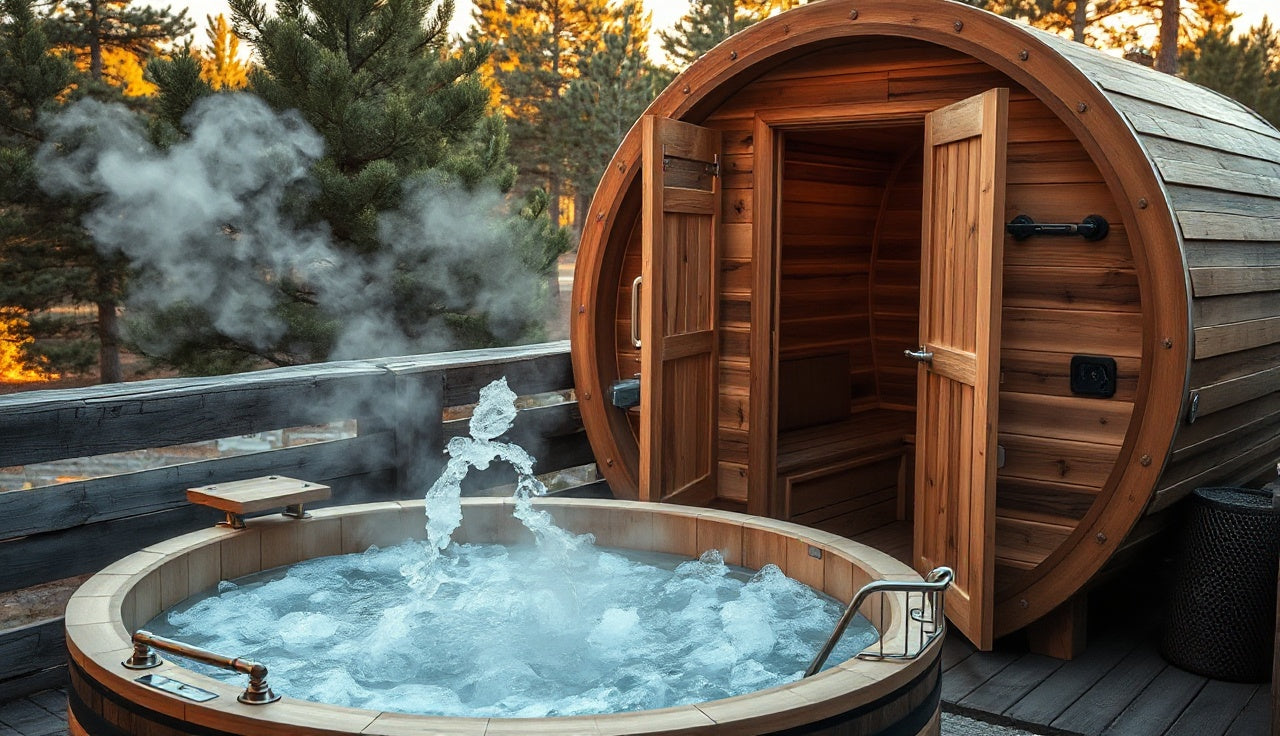
At SweatDecks, the setup people ask about most is a barrel sauna or outdoor sauna paired with a freestanding cold plunge tank, because that combo gives you full control over both temperatures without rigging up your bathroom.
What equipment do you actually need to set up contrast therapy at home?
The minimum viable setup is whatever gives you a real temperature gap, held long enough for your body to respond. You do not need a Finnish barrel sauna and a $5,000 chiller to get started.
Here is an honest cost breakdown of home setups, using approximate 2024-2025 US market pricing:
| Setup | Approximate Cost | Temperature Control |
|---|---|---|
| Hot shower + cold shower | $0 additional | Limited; depends on water heater and tap |
| Hot bath + DIY ice bath (tub + ice) | $0-$20/session (ice cost) | Moderate; messy |
| Portable sauna + tub ice bath | $200-$600 | Moderate sauna, decent cold |
| Infrared sauna + chest freezer cold plunge conversion | $1,500-$4,000 | Good, but chest freezer needs a chiller or inline cooler |
| Barrel/traditional sauna + dedicated cold plunge | $5,000-$20,000+ | Excellent temperature control on both sides |
Pricing ranges are approximate and swing hard on brand, size, and installation. Electrical and permitting costs for traditional saunas are a real extra that varies by location.
For most people who are serious about contrast therapy but not ready to install a permanent unit, a mid-range portable sauna and a purpose-built cold plunge tub is the sweet spot for cost versus capability. You get real temperature gaps without hiring a contractor.
Frequently asked questions
How long should each round of contrast therapy last?
A standard round is 10-20 minutes of heat followed by 2-5 minutes of cold. Most evidence-backed protocols use a heat-to-cold ratio of roughly 3:1 or 4:1 by time. A 12-minute sauna to 3-minute cold plunge is a good starting point. Add a 1-2 minute rest between rounds if needed. Total session: 2-3 rounds over 30-60 minutes.
Can you do contrast therapy every day?
Daily contrast therapy has not been formally studied enough to call it optimal. Research on Finnish sauna use shows cardiovascular benefits at 4-7 sessions per week, but those are shorter standalone sauna sessions. For most people, 3-5 sessions per week is a practical target. If you are a beginner, start at 1-2 times per week and build over a month before going daily.
Does contrast therapy help with inflammation?
Cold water immersion reduces markers of acute exercise-induced inflammation, and contrast therapy produces similar effects. A 2022 meta-analysis in PLOS ONE found contrast water therapy significantly reduced DOMS and fatigue at 24-72 hours post-exercise compared to passive recovery. Whether it helps with chronic systemic inflammation is a separate question with much less data.
Is contrast therapy safe during pregnancy?
Most physicians advise against high-heat sauna exposure during pregnancy because of the risk of elevated core temperature. The cold shock response from cold plunging also raises safety concerns. The evidence is limited and the risks are not fully quantified. If you are pregnant, get explicit guidance from your OB before doing any contrast therapy, even modified versions.
What is the difference between contrast therapy and just taking a cold shower after a sauna?
A cold shower after a sauna is a simplified version of contrast therapy. The limitation is temperature control: shower cold water rarely holds a consistent low temperature, and the immersion effect of a cold plunge (surrounding the whole body) is physiologically different from a shower. Contrast therapy protocols in research almost always use full-body immersion on both sides for that reason.
Does contrast therapy boost testosterone or growth hormone?
Sauna use does acutely raise growth hormone. A 1987 study in Acta Physiologica Scandinavica found growth hormone rose significantly after sauna sessions. Cold exposure raises norepinephrine. But the idea that contrast therapy produces lasting hormonal changes that translate to muscle growth or body composition improvement is not well supported. The strength adaptation attenuation data is actually a reason for caution if hypertrophy is your goal.
Can you do contrast therapy without a sauna, using just a hot tub or bath?
Yes. Hot water immersion at 40-42°C (104-108°F) is what many research protocols actually use on the heat side. A hot bath followed by a cold plunge or ice bath is a legitimate contrast therapy setup. You lose some of the dry sauna experience (the air temperature, the steam, the ritual) but the physiological temperature gap can be equal or greater.
How cold does the water need to be for contrast therapy to work?
Research protocols consistently use water between 10-15°C (50-59°F) on the cold side. A 2016 systematic review in the International Journal of Sports Physiology and Performance found cold water immersion at or below 15°C was effective for reducing DOMS. Colder is not necessarily more effective. The 10-15°C range appears to be the physiological sweet spot without disproportionate risk.
Should you do contrast therapy before or after a workout?
After. Doing contrast therapy before training, especially ending on cold, can acutely reduce strength and power output. The post-exercise window, ideally within 30-60 minutes of finishing, is when contrast therapy has the strongest evidence for reducing DOMS and perceived fatigue. A morning sauna for mental clarity before a workout is a different use case and does not carry the same pre-workout concerns.
Does the type of sauna matter for contrast therapy?
Traditional Finnish dry saunas reach 80-100°C (176-212°F), producing a strong heat stimulus. Infrared saunas run at 50-65°C (122-149°F) but heat the body via radiant energy, and longer sessions (30+ minutes) can reach comparable core temperature rises. For contrast therapy purposes, either works. The key variable is how much your core temperature rises, not the air temperature alone.
Can contrast therapy help with anxiety or mental health?
Both heat and cold independently raise norepinephrine and endorphins, which are linked to improved mood. Cold water immersion studies have shown norepinephrine increases of up to 300%. Some researchers are studying deliberate cold exposure for depression and anxiety, but the clinical evidence is early-stage. Contrast therapy may support mood as a side effect, but treating diagnosed anxiety or depression requires clinical care.
Does contrast therapy interfere with muscle building?
Potentially, if done right after strength training. A 2015 study in the Journal of Physiology found cold water immersion after resistance training attenuated muscle hypertrophy and strength gains over 12 weeks compared to active recovery. If maximizing muscle growth is your primary goal, consider limiting post-lifting cold exposure or doing contrast therapy on rest days instead of immediately after strength sessions.
What should you eat or drink before and after contrast therapy?
Avoid heavy meals within 1-2 hours before a session. Hydrate well beforehand, since sauna exposure causes real fluid loss through sweat. Electrolyte replacement after is worth considering for longer or more frequent sessions. Alcohol before contrast therapy is genuinely dangerous, since it impairs thermoregulation and masks the warning signs of overheating or hypothermia. Water or electrolyte drinks during and after are the safe default.
Sources
- National Institutes of Health, National Library of Medicine: Vaile et al., 'Effect of hydrotherapy on recovery from fatigue': Contrast water therapy causes alternating vasodilation and vasoconstriction, affecting peripheral circulation and perceived recovery from exercise.
- PLOS ONE, 2022: Moore et al., 'Contrast water therapy and exercise-induced muscle damage': A 2022 meta-analysis of 32 studies found contrast water therapy significantly reduced DOMS and perceived fatigue at 24-72 hours post-exercise compared to passive recovery.
- Finnish Sauna Society, official sauna usage guidelines: The Finnish Sauna Society recommends 80-100°C at bench level for a traditional sauna experience.
- International Journal of Sports Physiology and Performance, 2016: Bleakley et al., systematic review of cold water immersion: Cold water immersion at or below 15°C was consistently effective for reducing DOMS in a 2016 systematic review.
- American College of Sports Medicine, position stand on exercise and cold water immersion: Cold water immersion carries risk of sudden cardiac events in susceptible individuals due to the cold shock response; ACSM advises medical clearance for at-risk populations. Cold immersion can acutely reduce strength and power output.
- Journal of Physiology, 2015: Roberts et al., 'Post-exercise cold water immersion attenuates acute anabolic signalling': Cold water immersion after resistance training attenuated long-term gains in muscle mass and strength, with smaller satellite cell and muscle fiber responses over 12 weeks compared to active recovery.
- JAMA Internal Medicine, 2018: Laukkanen et al., 'Association between sauna bathing and fatal cardiovascular and all-cause mortality events': Frequent sauna use (4-7 sessions per week) was associated with significantly reduced cardiovascular mortality in a study of over 2,300 Finnish men.
- European Journal of Applied Physiology, 2000: Srámek et al., 'Human physiological responses to immersion into water of different temperatures': Cold water immersion has been shown to raise norepinephrine by up to 300% in research subjects.
- Sleep Medicine Reviews, 2019: Haghayegh et al., 'Before-bedtime passive body heating and sleep': A 2019 systematic review found passive body heating (hot bath or shower) 1-2 hours before bed improved sleep quality and shortened sleep onset latency.
- European Journal of Sport Science, 2021: Higgins et al., 'The efficacy of contrast water therapy versus cold water immersion': Both cold water immersion and contrast water therapy outperformed passive recovery for DOMS reduction, with no statistically significant difference between the two methods for most outcomes.
- Acta Physiologica Scandinavica, 1987: Kauppinen et al., 'Growth hormone and sauna exposure': Sauna exposure acutely and significantly raised growth hormone levels in study participants.
Share:
Morozko Forge cold plunge tub: honest review and buyer's guide
Contrast therapy benefits for athletes: what the research actually shows