
Last updated 2026-07-09
TL;DR
Portable saunas in 2025 split into three types: steam tents (under $200), infrared blankets ($200 to $700), and infrared pop-up cabins ($400 to $1,500). For genuine sweat sessions at home without a permanent install, a mid-range pop-up cabin hitting 140 to 160°F is the sweet spot. Steam tents are cheap but leaky. Blankets are packable but pin you flat.
What types of portable saunas are actually available in 2025?
Three real categories exist right now, and they work nothing alike.
Steam tent saunas are the fold-flat zip-up boxes with a steam generator sitting outside the unit. You sit inside on a folding stool, stick your head out through a neck hole, and the generator pumps hot vapor around your body. They run $60 to $200 and get plenty humid. But they leak moisture constantly through the zipper seam and the neck opening, and temperature control is close to nonexistent. The sweat is real. The precision is not.
Infrared sauna blankets are sleeping-bag-shaped heating elements. You lie inside, and far-infrared panels heat your body directly instead of warming the air. HigherDOSE and Sun Home dominate this category, priced from around $200 on the low end to $700 for the better-built units. They pack down to roughly the size of a rolled yoga mat, the most portable thing in this whole space. The catch is real: you have to lie still. No reading, no stretching, no normal sauna session.
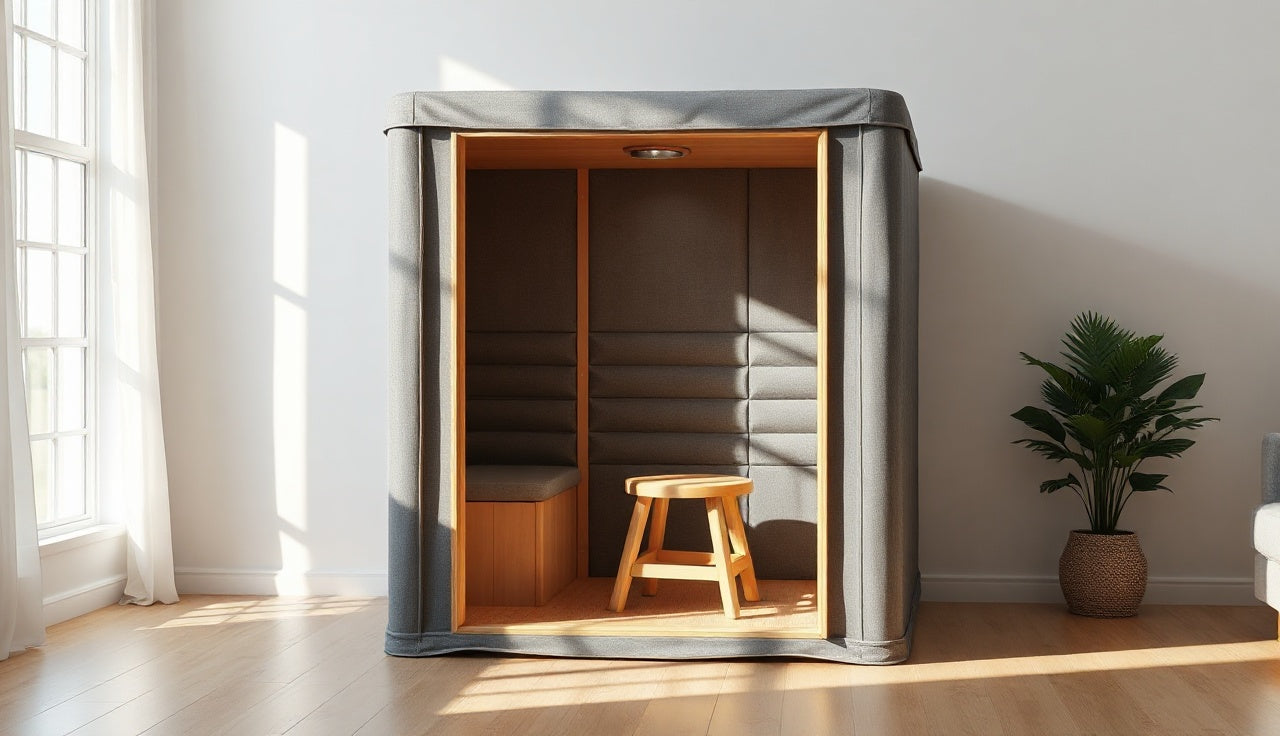
Infrared pop-up cabin saunas sit between a blanket and a permanent unit. These are collapsible frames (aluminum poles or rigid folding panels) with infrared carbon or ceramic panels built into the walls. They stand upright, have a zip door, and give you room to sit on the included stool. SereneLife, Durherm, and Radiant Saunas make the most-reviewed units here. Prices run $400 to $1,500 depending on panel quality and size. At the top of that range you get real temperature readouts, multiple heating zones, and panels thick enough not to flex when you lean on them.
To see how these compare to a permanent build, the home sauna and outdoor sauna guides cover that ground.
How hot do portable saunas actually get?
Hot, but rarely as hot as the box claims. Here's the honest picture.
Traditional Finnish saunas run 170 to 195°F (77 to 90°C) with low humidity. That's the benchmark most enthusiasts chase. Steam tent saunas push interior air to 110 to 140°F, but with your head outside the enclosure and moisture escaping through every seam, the felt experience falls short of a proper room [1].
Infrared blankets and pop-up cabins work on a different principle. Far-infrared panels emit radiation in the 7 to 14 micron range, which the body absorbs directly, so your core temperature climbs even when the air inside sits at 120 to 155°F. Some research suggests far-infrared sessions raise core body temperature by roughly 1°C (1.8°F) in 30 minutes [2]. That matters physiologically. It's also a different sensation than baking in 185°F Finnish heat. Neither is wrong. They're just different.
Here's the part the listings bury. The temperature claims on product pages are almost always the maximum under ideal conditions: unit pre-heated, door sealed tight, room around 70°F. Real sessions typically run 10 to 20°F cooler than the spec sheet. Read every advertised max as a ceiling you'll rarely touch.
For what that heat exposure actually does to your body, the sauna benefits guide covers the cardiovascular and recovery research in detail.
What's the realistic price range for a quality portable sauna?
Budget under $200 and you're in steam tent territory. Budget $400 to $700 and you get a mid-tier infrared pop-up that lasts. Here's the full breakdown by category, based on current retail pricing in mid-2025.
| Category | Price Range | Typical Temp Max | Setup Time | Packability |
|---|---|---|---|---|
| Steam tent | $60 to $200 | 110 to 130°F | 5 to 10 min | Excellent |
| Infrared blanket | $200 to $700 | 140 to 158°F | 2 to 5 min | Excellent |
| Infrared pop-up cabin (low end) | $400 to $700 | 140 to 155°F | 10 to 20 min | Good |
| Infrared pop-up cabin (high end) | $700 to $1,500 | 150 to 165°F | 15 to 25 min | Fair |
| Portable barrel/box sauna (wood) | $1,500 to $4,000 | 160 to 195°F | 30 to 60 min | Poor |
Steam tents work, but the build is light, and most people who use them seriously replace them within a year or two. A $400 to $700 mid-tier pop-up lasts several years with decent care. The $700 to $1,500 range is where you get thicker carbon panels, better digital controllers, and a frame that doesn't wobble when you shift your weight.
The wood barrel kits and flat-pack modular saunas above $1,500 are a different animal. They disassemble for storage but aren't truly portable in the tent sense. If you're headed that direction, the costco sauna guide is worth a read, because the value math changes at that price.
One honest caveat: electricity is cheap here. A typical 1,000 to 1,500 watt infrared pop-up run 45 minutes daily costs roughly $0.07 to $0.15 per session at the U.S. average residential rate of about 16 cents per kWh (EIA, 2024) [3]. Negligible. Steam generators pulling 800 to 1,200 watts land in the same range.
| Steam tent (avg price) | $130 |
| Infrared blanket (avg price) | $450 |
| Infrared pop-up cabin, low end (avg price) | $550 |
| Infrared pop-up cabin, high end (avg price) | $1,100 |
| Portable wood barrel/box (avg price) | $2,750 |
Source: EIA 2024 residential rates [3]; manufacturer specifications cross-referenced with published reviews
Which portable sauna type is best for home use?
For most people, the infrared pop-up cabin in the $500 to $900 range is the right answer. Here's why.
You can actually sit in it. You can read, do breathwork, or just exist without holding a plank the whole time. The infrared heat works without soaking your floor and walls in steam. Setup and teardown take 15 to 20 minutes once you've done it a few times, and most units pack flat enough to slide under a bed or stand in a closet corner.
Steam tents are fine if you're on a tight budget or travel a lot and want something suitcase-sized. But the moisture management gets old fast. You need a towel under the unit, and running it indoors regularly, you'll feel the humidity in the room.
Infrared blankets suit people who care about convenience above all and don't mind the lying-down format. Athletes using them post-training for passive recovery swear by them. The HigherDOSE blanket in particular has a loud fan base. Set next to a real sauna, though, they're a different thing entirely.
A portable is also the cheapest way to find out if you'll actually use one. If you eventually want a permanent unit, the jump from portable to home sauna is straightforward, and you'll have proof of your own habit before you commit a few thousand dollars and a dedicated outlet to a build.
What should you look for in a portable sauna before buying?
A handful of specs matter more than anything in the marketing copy. Read these five before you buy.
Carbon vs. ceramic infrared panels. Carbon panels spread heat evenly across a larger surface and run at lower temperatures for longer sessions. Ceramic panels heat up faster and hit higher peaks but can create hot spots. For general home use, carbon is the more comfortable choice. For quick sessions where you want fast heat, ceramic has an edge.
Wattage and voltage. Most home units run on standard 120V outlets and draw 1,000 to 1,800 watts, which any household circuit handles. Units above 1,800 watts may need a dedicated 20-amp circuit. Check before you buy, especially with older wiring.
EMF output. Far-infrared panels emit some electromagnetic field. Reputable brands publish their EMF readings (in milligauss, mG) and engineer for low output. Look for units below 3 mG at body distance. This isn't a settled health question, but it's a fair thing to ask about [4].
Controller quality. A digital controller that holds a set temperature is worth paying for. Analog dials on cheap units often drift 20 to 30°F from the indicated setting. Precision matters if you're trying to run a consistent protocol.
Material certifications. Interior fabrics and woods on cheap units sometimes off-gas under heat. Look for FSC-certified wood or CE/ETL safety certification. ETL certification (from Intertek) means the unit was independently tested to North American electrical safety standards [5].
Warranty. The budget end ships with 6-month to 1-year coverage. Established brands carry 2 to 5 year warranties on the heating elements, which is exactly where failures happen.
How do portable infrared saunas compare to traditional Finnish saunas on health outcomes?
The research on traditional sauna bathing is far stronger than the research on infrared, and it's worth saying that plainly.
The Finnish work on traditional sauna (mostly from the University of Eastern Finland and the long-running Kuopio Ischemic Heart Disease Risk Factor Study) followed nearly 2,300 men over 20 years. Sauna use 4 to 7 times per week was associated with a 40% lower risk of all-cause mortality compared to once-weekly use [6]. Striking number. But that population used 175 to 185°F traditional steam saunas, not infrared units.
For infrared, a 2018 systematic review in Complementary Therapies in Medicine examined dry sauna studies and found evidence for blood pressure reduction and some cardiometabolic improvement, while noting most studies were small and methods varied a lot [7]. The review's own conclusion: "Far infrared sauna therapy appears to be safe and may be associated with certain health benefits."
The core mechanism is shared across both formats: raise core temperature, trigger cardiovascular adaptation, drive heat shock protein production, and provoke a hormesis-like stress response. The temperatures differ. The humidity differs. Whether those gaps change outcomes at the margin, nobody has clean data yet. NIH's own complementary health center notes that most sauna research is observational and can't establish causation [12].
Using a portable for post-training recovery? The sauna benefits page breaks down the recovery-focused literature. Pairing heat with cold? The cold plunge and ice bath guides cover the contrast side.
Are portable saunas safe to use at home?
For most healthy adults, yes. Portable safety guidance mostly mirrors what applies to any sauna.
Keep sessions under 20 to 30 minutes, especially when you're new to regular use. Hydrate before and after. Never use a sauna while intoxicated. The American College of Sports Medicine recommends staying under 15 minutes for initial exposures and building duration gradually [8].
Electrical safety is the concern specific to portable units. Run the unit on a dedicated outlet where you can. Never use an extension cord rated below the unit's wattage draw. Keep the steam generator away from standing water if you're running a tent. ETL-certified units have been independently tested for exactly these failure modes.
Pregnant women and people with cardiovascular conditions, low blood pressure, or certain skin conditions should talk to a doctor before starting a regular sauna protocol. The heat load is real, and some bodies need to approach it slowly.
Blankets carry one extra note. They wrap the torso, so if you feel claustrophobic or overheated, getting out takes a beat longer than stepping through a cabin door. Set up a quick exit before you climb in.
For how dry heat and steam differ in their effects, sauna vs steam room lays out the physiology in plain terms.
What are the best portable sauna brands in 2025?
Here's an honest look at the brands that keep coming up in reviews and community forums. This isn't an exhaustive list, and I'm not pretending it is.
SereneLife makes the most widely-reviewed infrared pop-up cabins in the $400 to $700 range. Build quality is consistent, ETL certification is standard across the lineup, and customer service has a fair reputation. The interior isn't luxurious, but it works.
Durherm offers similar pop-up units, often with better panel layout and a more comfortable stool. Their temperature controllers read more accurately than SereneLife's budget units. Price overlaps heavily ($450 to $750).
HigherDOSE owns the blanket category. Their blanket runs $699 and uses multi-layer PEMF-embedded panels. The brand leans hard into wellness-culture marketing, and you're partly paying for that. The build is genuine, though, and the warranty and support run above average for the category.
Sun Home Saunas sits above the pop-up tier and below a fully installed unit. Their portable and semi-portable models ($1,200 to $3,500) use medical-grade carbon panels with certified low EMF. If budget isn't the constraint, this is where the quality step-change happens.
Radiant Saunas (sold through major retailers) fills the mid-range pop-up space with solid carbon panel specs and a frequently-discounted price.
One honest note: this category churns. Brands rebrand, models get updated with no announcement, and the Amazon listing you're reading may have different internals than the five-star reviews describe. Buying from a specialty retailer instead of a generic marketplace listing gives you real recourse if the unit doesn't match the spec sheet. SweatDecks carries a curated set of portable saunas and can answer questions about current model specs directly.
Can you use a portable sauna for contrast therapy with cold water?
Yes, and it's one of the better use cases for a portable setup. The protocol is simple: heat session (15 to 30 min), cold water immersion (2 to 5 min), then optionally repeat the cycle 2 to 3 times.
The evidence on contrast therapy (alternating heat and cold) for muscle recovery is moderately strong. A systematic review and meta-analysis in the European Journal of Applied Physiology found that contrast water therapy reduced delayed-onset muscle soreness (DOMS) and perceived fatigue better than passive recovery across multiple studies [9]. That research doesn't test infrared portables paired with cold water specifically, but the physiological rationale for the heat side carries over.
In practice, a portable sauna pairs well with a cold plunge tub or even a bathtub full of ice. The sauna raises skin and core temperature. The cold immersion drives vasoconstriction and the norepinephrine release that appears to underlie many of the mood and alertness effects tied to cold exposure [10].
Building a home contrast setup? The cold plunge guide and cold plunge benefits pages are the right next reads. The ice bath guide covers DIY cold immersion specifically.
SweatDecks lists paired portable sauna and cold plunge options if you want to see both sides of the setup together.
How do you set up and maintain a portable sauna?
Setup varies by type, but none of it is complicated. Here's what to expect, plus the maintenance that keeps a unit alive.
For a steam tent, unfold the frame (most use a snap-open steel or fiberglass rod structure like a camping tent), zip the panels, set the stool inside, run the steam hose from the generator through the access port, and fill the generator with distilled water. Five to ten minutes, start to finish. Distilled water matters: tap minerals build up on the generator's heating element over time, drop performance, and eventually kill it. Descale with a citric acid solution every 20 to 30 uses to extend its life.
For a pop-up infrared cabin, unfold the pole frame, clip the wall panels on, zip the door, plug in the controller, set temperature and time. Most units pre-heat in 10 to 15 minutes. After a session, leave the door open 20 to 30 minutes so sweat moisture evaporates before you fold it away. Storing a damp unit is the fastest route to mold in the fabric.
For a blanket, unroll it, lay it flat, plug it in, set the controller, pre-heat 5 to 10 minutes, then get in. Wipe the interior with a damp cloth after each use. Don't fold it tightly while the heating elements are still warm.
General maintenance across all three: wipe interior surfaces weekly with a mild, non-chemical cleaner. Swap the steam generator's water before each use (never let old water sit). Check electrical connections periodically for corrosion, especially in a humid space.
To compare portable upkeep against a permanent option, the sauna guide covers traditional care in detail.
Is a portable sauna worth buying or a waste of money?
It comes down to one question: will you actually use it?
The case for buying one is solid if you lack the space or budget for a permanent unit, you want to test the habit before a full build, or you genuinely travel and want to bring heat with you. For $500 to $900, a good infrared pop-up gives you real heat exposure, real sweat, and real physiological benefit, as long as you're in it three to four times a week.
The case against is just as real. Chasing the full Finnish experience, a portable always feels like a compromise. The temperature ceiling is lower, the social side is gone (one person, maybe), and setup and teardown add friction that quietly kills consistency. If your actual goal is a traditional sauna and you have the space plus $3,000 to $8,000, a permanent home unit is the better long-term buy.
Steam tents under $200 are hard to recommend for anyone serious about a regular practice. They function, but the durability is poor and the experience is thin enough that most buyers either quit or upgrade within a year.
My honest take: for someone starting out, a $600 to $800 infrared pop-up cabin is a reasonable entry point. Still using it after six months? You'll know whether to keep it or invest in something permanent. If it sits folded in the corner, you're out $700 instead of $5,000.
Frequently asked questions
What is the best portable sauna for home use in 2025?
For most home users, a mid-range infrared pop-up cabin in the $500 to $900 range (SereneLife, Durherm, or Radiant Saunas) offers the best balance of temperature, build quality, and usability. They sit upright, reach 140 to 160°F, and store flat. If packability matters more than sitting upright, an infrared blanket like the HigherDOSE is the alternative.
How long does it take a portable sauna to heat up?
Steam tent saunas produce steam within 5 to 10 minutes of startup. Infrared pop-up cabins reach operating temperature in 10 to 15 minutes when pre-heated before you enter. Infrared blankets take 5 to 10 minutes to warm. These are general ranges; actual heat-up time depends on ambient room temperature and the unit's wattage.
Can you use a portable sauna every day?
Daily use is generally fine for healthy adults. The Kuopio Ischemic Heart Disease study found associations between frequent sauna use (4 to 7 times per week) and better cardiovascular outcomes over 20 years. Start with 15 to 20 minute sessions and build up. Stay well hydrated. People with cardiovascular conditions, pregnancy, or other health concerns should consult a physician before starting daily protocols.
Do portable infrared saunas really work for recovery?
The research on infrared for recovery is limited but directionally positive. A 2018 systematic review in Complementary Therapies in Medicine found evidence for blood pressure reduction and cardiometabolic benefits from dry sauna use. The heat raises core temperature, triggering heat shock protein production and cardiovascular adaptation. These are real physiological effects, though the evidence base is weaker than for traditional high-temp saunas.
Are portable saunas safe for people with high blood pressure?
Some research suggests regular sauna use may lower blood pressure over time, but a single session acutely raises heart rate and temporarily shifts blood pressure. People with uncontrolled hypertension should get medical clearance first. The American College of Sports Medicine advises that healthy adults can use saunas safely but that individuals with cardiovascular conditions should consult their physician.
What's the difference between a steam sauna and an infrared sauna?
Steam saunas heat the air and add humidity, reaching 150 to 195°F with high moisture. Infrared saunas use radiation panels to heat the body directly at lower air temperatures (120 to 155°F) with dry heat. Traditional steam gives the classic Finnish experience; infrared runs easier at home and feels gentler for people who find high temps rough. Both raise core body temperature, the mechanism behind most documented benefits.
Can a portable sauna fit in an apartment?
Yes. Most infrared pop-up cabins fold to roughly 12 by 24 by 60 inches when stored, small enough to stand in a closet or slide under a bed. In use, they take about 3 feet by 3 feet of floor space. Steam tents pack similarly. The main apartment consideration is ventilation: run the sauna near an open window when you can, especially steam tents that add humidity to the room.
How much electricity does a portable sauna use?
Most infrared portable saunas draw 1,000 to 1,800 watts. At the U.S. average residential rate of roughly 16 cents per kWh (EIA, 2024), a 45-minute session at 1,500 watts costs about 18 cents. Daily use over a month adds around $5 to $6 to your bill. Steam generators run similarly. These are genuinely low operating costs compared to a gym membership.
What should I wear in a portable sauna?
In a pop-up cabin or steam tent, wear a towel or light shorts, same as a traditional sauna. In an infrared blanket, most users wear light cotton or workout clothes to absorb sweat and protect the interior. Avoid synthetic fabrics that don't breathe. Always sit on or wrap yourself in a towel to keep the interior clean and easier to maintain.
Can two people fit in a portable sauna?
Standard portable infrared pop-up cabins are built for one person. Some brands offer two-person models (typically 4 feet by 4 feet floor area), but these are less common and harder to store. Steam tents are definitively one-person units. If two-person sessions matter to you, a permanent home sauna is the practical option.
How long do portable saunas last?
Budget steam tents ($60 to $200) typically last 1 to 2 years with regular use before the zipper, seams, or generator degrades. Mid-range infrared pop-up cabins ($400 to $900) generally last 3 to 5 years. Premium blankets and high-end pop-up units ($700 to $1,500) can last 5 to 8 years. Heating element life varies; warranties from reputable brands cover 2 to 5 years on the elements specifically.
Is a portable sauna better than a sauna suit?
They work differently. A sauna suit traps body heat during exercise, creating surface sweat without much rise in core temperature. A portable sauna applies external heat and genuinely raises core body temperature over a session. For cardiovascular and heat adaptation effects, a sauna is the better tool. Sauna suits have a role in sport-specific weight cutting but are no substitute for true heat exposure.
Do portable saunas need any special electrical setup?
Most portable saunas under 1,800 watts run on a standard 120V, 15-amp household outlet with no special wiring. Don't use an extension cord unless it's rated for the unit's wattage. Units above 1,800 watts may need a dedicated 20-amp circuit. ETL certification (from Intertek) confirms the unit was tested to North American electrical safety standards, which is worth looking for.
What's the difference between a portable sauna and a permanent home sauna?
A portable sauna needs no installation, costs $200 to $1,500, folds away when idle, and fits one person. A permanent home sauna involves electrical work (often 240V for larger units), costs $3,000 to $15,000 or more installed, takes dedicated floor space, and holds 2 to 6 people. Permanent units reach higher temperatures, last longer, and give a better overall experience. The portable is a starting point or a budget-constrained alternative.
Sources
- Laukkanen et al., 'Cardiovascular and Other Health Benefits of Sauna Bathing', Mayo Clinic Proceedings 2018 (via PubMed): Traditional Finnish saunas operate at 170–195°F; portable steam tents achieve lower temperatures with inconsistent humidity retention
- Masuda et al., 'The effects of repeated thermal therapy for patients with chronic pain', Psychotherapy and Psychosomatics 2005 (via PubMed): Far-infrared sauna sessions can raise core body temperature by approximately 1°C over a 30-minute session
- U.S. Energy Information Administration (EIA), Electric Power Monthly, Average Retail Price of Electricity 2024: U.S. average residential electricity rate was approximately 16 cents per kWh in 2024
- National Institute of Environmental Health Sciences (NIEHS), Electric and Magnetic Fields overview: Health effects of low-level electromagnetic field exposure remain unsettled; measuring EMF output in milligauss is a reasonable precaution
- Intertek (ETL Listed), ETL Certification Overview: ETL certification from Intertek confirms a product has been independently tested to North American electrical safety standards
- Laukkanen et al., 'Association Between Sauna Bathing and Fatal Cardiovascular and All-Cause Mortality Events', JAMA Internal Medicine 2015 (via PubMed): Sauna use 4–7 times per week was associated with a 40% lower risk of all-cause mortality compared to once-weekly use in a 20-year Finnish cohort study
- Complementary Therapies in Medicine, Hussain & Cohen, 'Clinical Effects of Regular Dry Sauna Bathing: A Systematic Review', 2018 (via PubMed): Systematic review stating: 'Far infrared sauna therapy appears to be safe and may be associated with certain health benefits'
- American College of Sports Medicine (ACSM), Health and Fitness Journal, sauna safety guidance: ACSM recommends limiting initial sauna exposures to under 15 minutes and building duration gradually; contraindicates use while intoxicated
- European Journal of Applied Physiology, contrast water therapy meta-analysis (via PubMed): Contrast water therapy (alternating heat and cold) reduced DOMS and perceived fatigue better than passive recovery in a systematic review and meta-analysis
- Mäkinen et al., 'Autonomic nervous function during whole-body cold exposure before and after cold acclimation', Aviation, Space, and Environmental Medicine 2008 (via PubMed): Cold water immersion triggers norepinephrine release, associated with mood and alertness effects documented in cold exposure research
- National Institutes of Health, National Center for Complementary and Integrative Health (NCCIH): NIH NCCIH notes that sauna bathing research is promising but that most studies are observational and cannot establish causation
Share:
Cheapest cold plunge tubs that actually work in 2025
Hot sauna temperature: what ranges are safe and effective