
Last updated 2026-07-09
TL;DR
A barrel shower sauna is an outdoor barrel sauna with a built-in shower stall or attached shower fixture, so you can rinse between heat rounds without walking back into the house. Installed, they run roughly $10,000 to $16,000 with electric heat and a plumbed shower, or $5,000 to $8,000 with a simple cold hose-bib rinse. They make sense for tight yards where a separate shower or plunge won't fit.
What exactly is a barrel shower sauna?
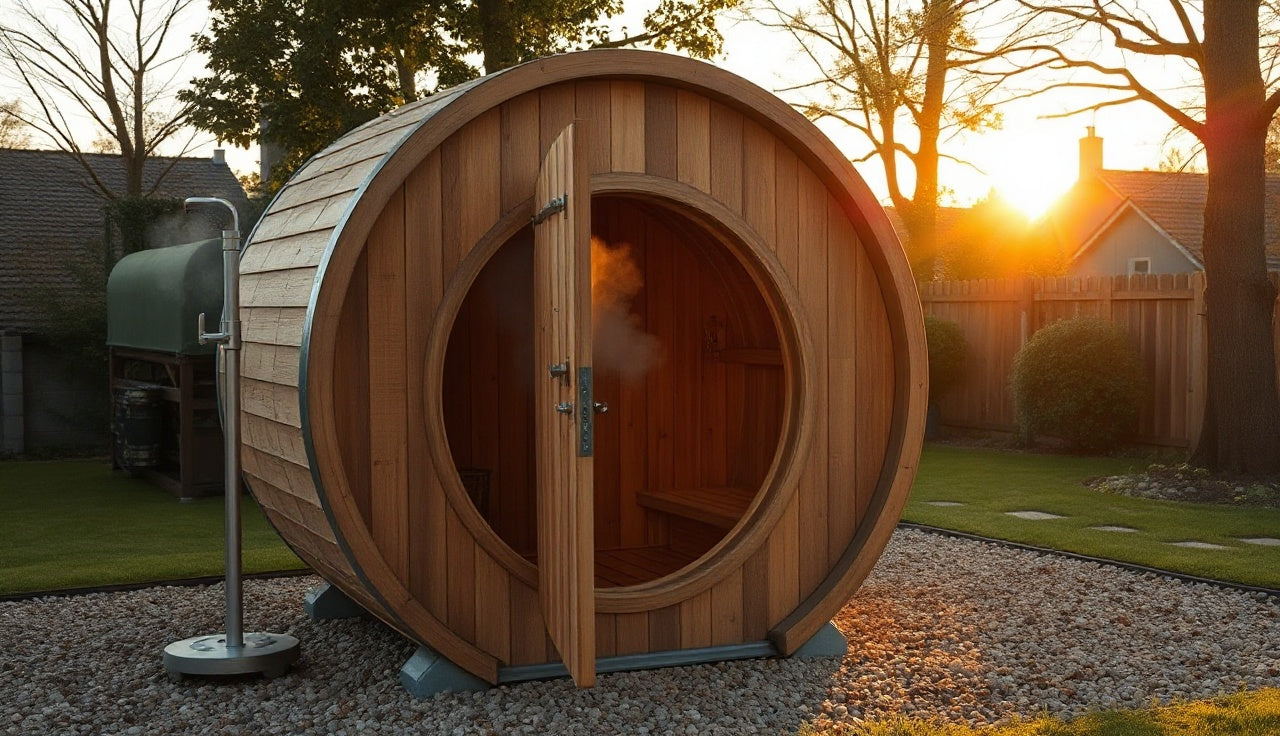
A barrel shower sauna is a round, horizontal barrel sauna that includes a shower area in the same structure. The classic version adds a partitioned wet room at one end of the barrel, plumbed with a showerhead and drain, so you rinse off before you go in hot or cool down after a round without dripping back into your house.
The barrel shape comes from cooperage tradition, and it holds up outdoors better than you'd guess. The curved staves pull tighter as the wood expands with heat and moisture, which cuts down on warping and gapping compared to flat-panel box saunas [1]. Adding a shower to that barrel is a factory or custom build decision. It is not a weekend retrofit.
Builders handle the shower two ways. Some put it inside the barrel on the end opposite the heater, split off by a partial wall. Others bolt a small vestibule to one circular end, a short extension that holds the shower pan and plumbing. The difference is real: an interior partition eats into your hot room, while an end vestibule stretches your footprint.
This is a niche product. Most barrel sauna brands sell it as an add-on or premium model rather than a default, so you'll find fewer reviews and less head-to-head data than for a plain barrel. Do more homework than usual before you buy.
How does the shower integration actually work?
Barrel shower saunas use one of two plumbing setups. The simple one is an outdoor shower fixture fed by a garden hose or hose bib, mounted to the exterior end of the barrel, with a basic pan and curtain. No permit in most places, minimal install. The involved one runs a cold supply line (sometimes hot too) into a partitioned stall inside or attached to the barrel, with a floor drain tied into your home's drainage.
The hose-bib version is cheap and quick. You won't get a hot shower out of it. You get a cool or cold rinse, which is what sauna tradition asks for anyway. Finnish practice has always paired heat with a cold plunge or cold rinse, so a cold outdoor shower does exactly the job [2].
The fully plumbed interior version costs more and needs a licensed plumber to run supply and drain to an outdoor structure. Depending on local code, an outdoor shower with a real drain may need a permit. Some states require a permit for any new plumbing connection to a structure, no matter how small. Check with your building department before you order the unit.
Here's something the marketing copy skips: the shower compartment in most barrel saunas is small. Often 24 to 30 inches square. If you're a bigger person or you want an actual comfortable shower, know that going in.
What does a barrel shower sauna cost?
Price tracks size, wood species, heater type, and whether the shower is a simple outdoor fixture or a plumbed stall. Here's what you'll actually pay:
| Configuration | Barrel size | Approx. price (unit only) |
|---|---|---|
| Hose-bib outdoor shower, cedar | 6 ft diameter, 6 ft long | $4,000, $6,000 |
| Hose-bib outdoor shower, thermowood | 6 ft diameter, 7 ft long | $5,500, $7,500 |
| Interior partitioned shower, cedar | 6 ft diameter, 8 ft long | $6,500, $9,000 |
| Interior partitioned shower, red cedar + electric heater | 7 ft diameter, 8 ft long | $8,000, $12,000 |
| Custom or premium brands with full plumbing vestibule | 7+ ft diameter | $12,000, $18,000+ |
Those are unit prices only. Add $500 to $2,000 for delivery and assembly depending on your region and how easy the site is to reach. Running a 240V circuit for an electric heater adds $800 to $2,500 for a licensed electrician. Plumbing a full shower adds $1,500 to $4,000 depending on how far the barrel sits from your supply and drain lines.
A mid-range barrel shower sauna with electric heat and a properly plumbed interior shower runs $10,000 to $16,000 installed. Not cheap. It's in the same range as a quality home sauna built separately.
Wood species drives cost more than most buyers expect. Western red cedar is the baseline. Thermowood (heat-treated pine or spruce) costs more upfront but shrugs off rot and dimensional swings better in wet climates. Nordic spruce shows up in European barrels and tends to be the cheapest. Skip barrels made from hemlock or unspecified "wood" at suspiciously low prices. Those warp and delaminate within a few seasons.
| Hose-bib cold shower, cedar barrel | $7,000 |
| Hose-bib cold shower, thermowood barrel | $8,500 |
| Interior partitioned shower, cedar + electric | $13,000 |
| Interior partitioned shower, premium cedar + electric | $16,000 |
| Custom vestibule shower, large diameter barrel | $20,000 |
Source: SweatDecks market survey of manufacturer pricing and installation contractor estimates, 2025
Is a barrel sauna with a shower better than buying them separately?
It depends on your yard and your budget. The case for a combined unit is footprint: one structure instead of two, one electrical connection if you go electric, a cleaner look, and usually a lower total cost than a barrel sauna plus a standalone outdoor shower enclosure.
The case against it is that you compromise on both. The shower compartment in a barrel is always smaller than a standalone outdoor shower you'd design yourself. And the hot room shrinks, or the barrel grows longer and heavier to make room for the shower end.
If your real goal is contrast therapy, alternating hot and cold, a cold plunge or ice bath is a stronger cold stimulus than a rinse [3]. Full immersion hits the body differently than a shower. So if contrast is why you want the shower, a plunge tub serves you better, and you can bolt a garden-hose shower nozzle to the side of your barrel for rinsing without paying for an integrated unit.
That said, if a plunge isn't in the budget or your yard can't hold a third structure, the integrated shower barrel earns its keep. A quick cold rinse before you go back in, or a cool-down after your last round without dripping through the kitchen, is genuinely handy. That daily friction matters more than people admit when they plan their setup.
What wood species holds up best in a shower sauna environment?
The shower end of the barrel takes more abuse than a standard sauna. Direct water contact, standing moisture, and temperature swings from hot to cold in one structure. That's a hard life for wood.
Western red cedar is the most common pick and it earns it. Natural tannins resist mold and decay, low density keeps it from cracking under repeated thermal expansion, and the scent wins most people over. The downsides: it's soft and dents easily, and clear-grain western red cedar has gotten pricier as supplies tighten [4].
Thermowood is heat-treated softwood, usually pine or spruce, kiln-processed to drive out sugars and resins. It stays dimensionally stable, resists moisture better than untreated wood, and needs no sealing. For the shower compartment specifically, it's a strong choice. The dark brown weathers to grey outdoors, which some people love and some don't.
Nordic spruce turns up in Scandinavian barrels. Lighter wood, tighter grain than North American spruce, good in sauna heat, usually cheaper than cedar. It's not as rot-resistant as cedar without treatment, so in very wet climates (Pacific Northwest, Southeast US, coastal areas) you'll need to stay on top of maintenance.
Alaskan yellow cedar (yellow cypress) is underrated. Denser than red cedar, more rot-resistant, takes heat well. You see it less because supply is limited, but if a builder offers it, the modest premium is worth it.
Whatever species you pick, the shower floor and lower walls need a proper drain and ideally a small gap at the base for airflow when the sauna sits idle. Standing water rots any wood, no exceptions.
Do barrel shower saunas need a permit?
Usually yes, but what the permit covers depends on your jurisdiction and what you're installing.
In most US states and counties, an outdoor accessory structure (which is what a barrel sauna is) below a set square footage can go in without a building permit. The threshold varies: 120 square feet in California [5] and several other states, 200 square feet in others, and some localities have no exemption at all. A 6-foot diameter, 7-foot-long barrel covers about 28 square feet, so it almost always slides under any square-footage exemption.
The electrical work is a different animal. Wiring a 240V circuit for an electric sauna heater requires an electrical permit in nearly every jurisdiction. No exemptions there. Budget for it and hire a licensed electrician.
Plumbing is where it gets messy. A drain that ties into your home's sewer system usually needs a plumbing permit. An outdoor shower draining to a dry well or gravel pit may or may not, depending on local rules. Some jurisdictions treat outdoor shower drains as grey water with their own reuse rules. California, for example, runs a grey water recycling standard under the California Plumbing Code covering how outdoor shower water gets discharged [6].
The practical move: call your building department before you order. Give them the dimensions, tell them you're adding an electric heater and a shower with a drain, and ask what permits apply. It's a 10-minute call that saves a real headache.
How do you set up and install a barrel shower sauna?
Most barrel saunas ship as pre-cut stave kits that assemble on-site. Two people with basic carpentry skills usually finish a standard barrel in 6 to 10 hours. The shower barrel is the same process, plus plumbing rough-in once the shell is up.
The foundation matters more than buyers realize. A barrel sauna needs a level surface with airflow underneath: pressure-treated 4x4 cradle runners, gravel pads, or poured concrete footings all work. Set it straight on soil and you trap moisture, which rots the contact points fast. That's the last place you want rot on a shower barrel.
For the electrical connection, most 6kW to 9kW electric heaters need a dedicated 240V/50A circuit. Some smaller 4.5kW heaters run on 240V/30A. The heater's installation instructions spell out the circuit requirements; follow them exactly and have a licensed electrician make the final connection. Running a sauna heater on an undersized circuit is a fire hazard [9].
Plumbing is the most variable piece. A cold-water-only shower off a hose bib is an afternoon job for a handy homeowner. A full hot-and-cold interior shower with a floor drain needs a licensed plumber in most states [10]. Tying the drain into your main line or a dry well is the technically tricky part.
Once the barrel is assembled and leveled, most manufacturers recommend curing it: run several sessions at moderate temperatures (150°F to 175°F) before you push to full heat. That lets the staves expand and the bands tighten before you put the structure under full thermal stress.
What are the real health benefits of sauna, and does adding a shower change them?
The research on sauna use is more solid than it is for most wellness gear. The most-cited work comes from Finnish cohort studies. A 2015 study in JAMA Internal Medicine tracked 2,315 middle-aged Finnish men over a median 20-year follow-up and found frequent sauna use (4 to 7 times a week) was associated with a 40% lower risk of all-cause mortality compared to once-weekly use [7]. That's a correlation in an observational study, not a controlled trial, so it doesn't prove cause. But it lines up with physiological work showing sauna exposure raises heart rate and cardiac output in a pattern similar to moderate exercise.
The shower changes the picture in a narrow way. The post-sauna cool-down matters: leaving the heat and cooling off is part of why sauna feels good and may drive some of the cardiovascular adaptation. A cold rinse or cold plunge speeds that cooling and sets off a separate response, including norepinephrine release [8]. Finnish tradition uses this contrast on purpose.
A shower rinse does not match a full cold plunge. Immersion fires the mammalian dive reflex and peripheral vasoconstriction more completely than a shower does [3]. But a cold shower after sauna is still meaningfully different from air-cooling, and it's what most barrel shower sauna owners are after.
Conservative bottom line: regular sauna use shows promising links to cardiovascular health. Pairing it with a cold rinse fits traditional practice and holds up physiologically. Neither treats or cures anything. If you have cardiovascular disease or another condition, talk to your physician before you start a routine.
For a wider look at the research, see sauna benefits.
How does a barrel shower sauna compare to other outdoor sauna options?
| Sauna type | Avg. installed cost | Shower included | Footprint | Best for |
|---|---|---|---|---|
| Barrel sauna (standard) | $5,000, $10,000 | No | Compact, round | Most homeowners, small yards |
| Barrel shower sauna | $10,000, $16,000 | Yes | Compact, slightly longer | Small yards, no space for separate shower |
| Cabin/pod sauna | $8,000, $20,000 | Sometimes | Larger rectangle | Families, more interior space |
| Portable/tent sauna | $150, $600 | No | Minimal | Renters, budget buyers |
| Custom wood sauna room (indoor) | $15,000, $40,000+ | Often | Interior room | High-end home integration |
The barrel shower sauna sits in a specific niche. Pricier than a plain barrel, cheaper than a full cabin build, more permanent than a portable sauna. If you want an outdoor sauna and you already know you'll want a rinse, the integrated version saves you from running hose or plumbing to a second structure later.
One comparison that doesn't get made often enough: barrel shower sauna vs. barrel sauna plus a freestanding cold plunge. For the same $10,000 to $16,000, you can buy a very good 4-person barrel sauna ($6,000 to $8,000) and a quality cold plunge ($3,000 to $6,000) and end up with a more functional contrast setup than an integrated shower gives you. Sweatdecks carries both categories if you want to line them up.
That said, a plunge tub needs more yard space and more upkeep than a shower, and not everyone wants to manage water chemistry in a cold plunge. The shower barrel is simpler to own.
What maintenance does a barrel shower sauna require?
More than a standard barrel, because the shower end adds standing water and humidity a regular sauna never sees.
The hot room side is standard care: keep the interior dry between uses (leave the door cracked), scrub the benches with a soft brush and plain water every few weeks, and sand and re-oil the interior wood once a year if it starts to look dry or grey. No chemical cleaners inside the hot room.
The shower end needs more attention. Pull the drain cover and clean it monthly to keep mold and debris down. The shower floor, usually a slatted teak or cedar grate, should come out and dry in the sun regularly. Leave water standing on that grate and it molds within weeks in warm climates.
Exterior care depends on climate. In dry regions, re-oil or re-stain the outside every two to three years to keep the wood looking sharp and sealed against UV. In wet regions, plan on every one to two years. Thermowood stretches the interval, but it still likes an occasional treatment.
The metal bands that hold the barrel together will surface-rust over time. Stainless steel bands are worth the upgrade over galvanized if your maker offers the choice. Surface rust on galvanized bands is cosmetic for years before it turns structural, but it bleeds stains into the wood underneath.
Check the cradle runners or footings every year for rot. This is the single most neglected item on barrel saunas. If the cradle goes, the barrel shifts and the staves rack, and that's expensive to fix.
Which brands make barrel shower saunas and are any worth buying?
The barrel sauna market is fragmented. A handful of established Scandinavian and North American makers, a growing pile of Chinese-manufactured barrels sold under various brand names, and some small custom builders.
Established North American names include Almost Heaven, Dundalk LeisureCraft, and SaunaLife. Almost Heaven is an American brand with broad distribution and mid-range pricing. Dundalk is a Canadian maker with a strong reputation for build quality and wood selection. SaunaLife (also sourced from overseas manufacturing) has grown quickly on its quality-to-price ratio.
For shower-specific barrels, Dundalk's catalogue has historically included shower vestibule options on some models. Almost Heaven has offered shower-compatible configurations. Several direct-from-factory importers on Amazon and through specialty retailers sell shower barrels at lower prices, but quality control swings wildly. Read the assembly instructions and customer reviews closely before you order from any brand you can't confirm has US-based support.
A few honest things to check before you buy from anyone: Does the barrel use kiln-dried wood? (Green or wet wood warps.) What's the stave wall thickness? (1.5 inches minimum for outdoor use, 2 inches is better.) Does the shower drain come with a trap installed, or do you add it during installation? What's the warranty on the wood structure vs. the heater? (Those two warranties are almost always separate.)
If you want to see current options in one place, sweatdecks.com carries a curated selection of outdoor barrel saunas and can help you compare specs.
Is a barrel shower sauna a good investment for resale value?
Sauna installations generally add some value to a home, but the numbers are genuinely uncertain and depend heavily on your market. There's no authoritative study that isolates sauna value the way one exists for kitchen remodels.
Real estate agents generally report, and this is anecdotal rather than data-backed, that an outdoor sauna in good shape is a positive selling point in markets where outdoor living matters, and roughly neutral where it's unusual. A barrel shower sauna reads as a premium amenity to buyers who know what it is, which is a narrower crowd than you'd think.
The more practical question is how long you plan to stay. If you'll be there 10-plus years and you'll use the sauna often, the personal utility is the return. If you're adding it to flip in two years, the math probably won't work in your favor.
One thing that does move resale is condition. A well-kept cedar or thermowood barrel, kept dry and still good-looking, adds to a property's appeal. A weathered, cracked, mold-stained barrel is a liability. The maintenance commitment is real.
Frequently asked questions
How much does a barrel shower sauna cost installed?
Expect $10,000 to $16,000 all-in for a mid-range barrel shower sauna with an electric heater and properly plumbed interior shower. That covers the unit ($6,500 to $9,000), electrical work ($800 to $2,500), plumbing ($1,500 to $4,000), and delivery. Simpler versions with a hose-bib cold shower instead of a plumbed stall run $5,000 to $8,000 total.
What is the difference between a barrel sauna with shower and a regular barrel sauna?
A barrel shower sauna has a built-in shower compartment, either partitioned inside the barrel or in an attached end vestibule. A regular barrel sauna has no shower and typically has a small changing area or none. The shower barrel runs longer or gives up hot-room space to fit the compartment, and it needs plumbing connections that a standard barrel does not.
Can you add a shower to an existing barrel sauna?
You can add an external outdoor shower fixture (a showerhead on a post, fed by a garden hose) to almost any barrel sauna without touching the structure. Adding an interior shower compartment after the fact isn't practical; you'd have to cut the staves and build a partition, which compromises structural integrity. Buy a shower model from the start if that's what you want.
Do you need a permit for a barrel shower sauna?
Probably at least one. The barrel itself often qualifies for an accessory structure exemption (usually under 120 to 200 square feet depending on your state). But the 240V electrical circuit needs an electrical permit almost everywhere. A plumbed drain connection typically needs a plumbing permit. Call your local building department with the specifics before you order.
What size barrel shower sauna do I need?
For one to two people, a 6-foot diameter barrel at 7 to 8 feet long is enough and the most common size. For three to four people who want comfortable bench seating plus a shower partition, go with a 7-foot diameter or longer barrel. The shower compartment takes 18 to 30 inches of length away from the hot room, so size up if bench space matters.
What wood is best for a barrel sauna with shower?
Western red cedar is the most common: rot-resistant, thermally stable, and it smells good. Thermowood (heat-treated pine or spruce) stays more dimensionally stable in consistently wet conditions and is a strong choice for the shower compartment. Nordic spruce shows up in European barrels and performs well. Skip unspecified softwoods at low prices; they warp within a few seasons.
Is a cold shower after sauna as effective as a cold plunge?
No. Full cold water immersion triggers a stronger physiological response than a cold shower, including more pronounced vasoconstriction and norepinephrine release. A cold shower after sauna helps and fits traditional practice, but it's not a substitute for immersion if you're specifically after the contrast therapy effect. If that's your goal, a dedicated cold plunge or ice bath does more.
How long does a barrel shower sauna last?
A well-maintained cedar or thermowood barrel sauna should last 15 to 25 years with regular upkeep. The shower compartment is the most vulnerable part because of constant direct water exposure; good drainage and regular cleaning of the drain and floor grates extend its life a lot. The heater has its own lifespan, typically 10 to 15 years for a quality electric unit.
Can a barrel shower sauna be used year-round in cold climates?
Yes. Barrel saunas suit cold climates well; the round shape and tight stave construction handle freeze-thaw better than box saunas. The shower plumbing is the issue in freezing temps. Winterize a hose-bib outdoor shower by disconnecting and draining the supply line before first freeze. A plumbed interior shower needs insulated or heat-taped supply lines, or you winterize it and skip showers in sub-freezing weather.
What foundation does a barrel shower sauna need?
Level, stable, and ventilated underneath. Pressure-treated 4x4 cradle runners on compacted gravel are the most common practical setup. Poured concrete piers or a gravel pad with pavers work too. Never set the barrel straight on soil or grass; trapped moisture rots the cradle and eventually the staves. The foundation must be level within a quarter-inch or the staves won't seal properly.
How do barrel shower saunas compare to cabin saunas with showers?
Cabin saunas (rectangular box structures) give you more headroom and bench space per square foot, and the shower integration is often more generous. Barrel saunas heat up faster (typically 30 to 45 minutes vs. 45 to 60 for a cabin), cost less for similar occupancy, and handle wet outdoor environments somewhat better because of their construction. Cabins are easier to customize. Both work for home use.
What heater type is best for a barrel shower sauna, wood-burning or electric?
Electric is easier in a shower barrel. Wood-burning heaters need a chimney and ash management, and a firebox inside a tight barrel that also holds a wet shower compartment adds ventilation complexity. Electric heaters are simpler, precisely controllable, and add no combustion byproducts. The trade-off is the 240V install cost and electricity per session, roughly $0.50 to $2.00 depending on heater size and local rates.
Sources
- University of Wisconsin Extension, Wood as a Building Material: The cylindrical barrel structure tightens under heat and moisture expansion, reducing warping compared to flat-panel construction.
- Finnish Sauna Society, Sauna and Health: Traditional Finnish sauna practice pairs heat sessions with a cold plunge or cold rinse as a deliberate contrast stimulus.
- Tipton MJ et al., Journal of Physiology, 2017 — Cold water immersion physiological response: Cold water immersion activates peripheral vasoconstriction and the mammalian dive reflex more completely than cold shower exposure.
- US Forest Service, Western Red Cedar Species Profile: Western red cedar has natural decay-resistant tannins and low density that reduce cracking under thermal cycling.
- California Building Code, Section R105.2, Accessory Structure Exemptions: In California, accessory structures under 120 square feet do not require a building permit under the state residential code exemption.
- California Department of Water Resources, Grey Water Regulation Overview: California has specific grey water recycling standards under the California Plumbing Code governing how outdoor shower water can be discharged.
- Laukkanen JA et al., JAMA Internal Medicine, 2015 — Sauna Bathing and Fatal Cardiovascular Disease: Frequent sauna use (4–7 times per week) was associated with a 40% lower risk of all-cause mortality over a 20-year follow-up in 2,315 Finnish men.
- Rhind SG et al., European Journal of Applied Physiology, 2004 — Norepinephrine response to cold exposure: Cold water exposure triggers norepinephrine release and sympathetic nervous system activation as part of the cold shock response.
- US Consumer Product Safety Commission, Sauna Heater Safety Guidelines: Electric sauna heaters require a dedicated 240V circuit; undersized circuits are a documented fire and electrical hazard.
- International Association of Certified Home Inspectors, Accessory Structure Permitting Standards: Electrical work for outdoor structures, including sauna heater wiring, requires an electrical permit in virtually all US jurisdictions.

Share:
Arcadia barrel sauna: what you actually need to know before buying
How contrast therapy works: the science behind heat and cold