
Last updated 2026-07-09
TL;DR
Arcadia barrel saunas are Canadian red cedar outdoor saunas sold at Costco and specialty retailers, usually priced $3,000 to $7,500 depending on size and heater. They run electric or wood-burning heaters, seat 4 to 8 people, and ship as flat-pack kits a handy homeowner can build in a day. Solid mid-range value. Not the cheapest, not the finest.
What is the Arcadia barrel sauna and who makes it?
Arcadia is a brand sold through big-box retailers, most often Costco, and it focuses almost entirely on outdoor barrel saunas made from Canadian red cedar or Nordic spruce. This is not a boutique Finnish shop with a 100-year heritage. It's a product line built for the North American mass market, which means the price is accessible and the quality sits square in the middle tier.
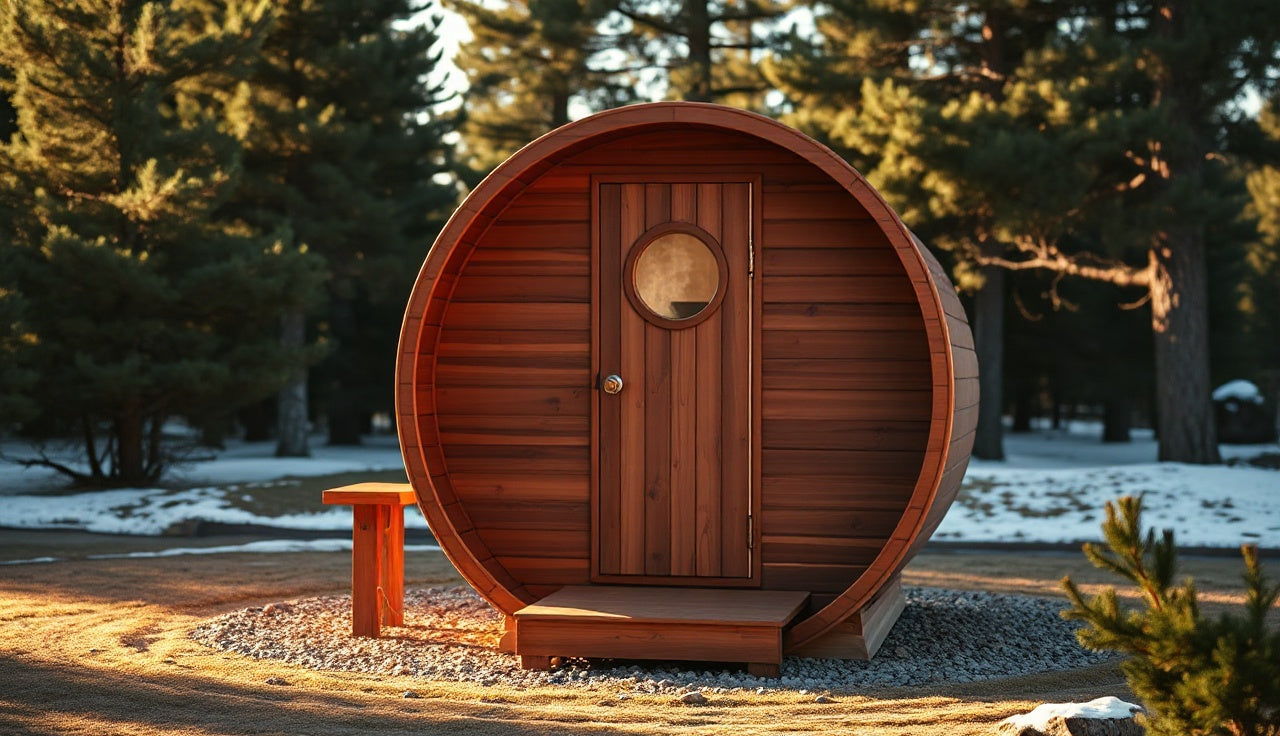
The barrel shape matters more than most buyers realize. A cylindrical body has no corners, so air circulates naturally from the curved floor up toward the crown, and no dead cold zones collect at the edges [1]. That passive convection means the heater works less hard to bring the room up to temperature. Heat-up times on a well-sealed barrel typically run 30 to 45 minutes, versus 45 to 60 minutes for a comparably sized rectangular cabin.
Arcadia's lineup runs from roughly 6-foot to 9-foot diameter barrels, with lengths from about 6 to 8 feet. The smaller units seat 4 comfortably. The larger ones claim 8, though 6 is the honest number if anyone plans to lie down. That distinction matters if your goal is recovery, where lying flat beats sitting upright every time.
How much does an Arcadia barrel sauna cost?
Price depends on where you buy and which heater package comes with the kit. At Costco, Arcadia barrel saunas have shown up in the $3,499 to $5,999 range, usually during seasonal promotions in late winter and spring [2]. Specialty retailers that stock Arcadia or comparable Canadian cedar barrels price similar builds between $4,500 and $7,500 once you add a higher-output electric heater or a premium wood stove.
Here's how the cost breaks down across the common configurations:
| Configuration | Approx. price (kit only) | Heater included? | Seats |
|---|---|---|---|
| 6 ft diameter, 6 ft long | $3,000, $4,200 | Sometimes electric 6 kW | 4 |
| 7 ft diameter, 7 ft long | $4,200, $5,800 | Often electric 8 kW | 4 to 6 |
| 8 ft diameter, 8 ft long | $5,500, $7,500 | Varies | 6 to 8 |
| Costco seasonal bundles | $3,499, $5,999 | Electric 6 to 8 kW | 4 to 6 |
Those prices skip delivery (often $200 to $500 for freight), electrical work if you need a 240V circuit run to the backyard (budget $300 to $800 for a licensed electrician, depending on distance from your panel), and a gravel or deck foundation, which can run $500 to $2,000.
So the real installed cost for most buyers lands between $4,500 and $9,000. That's not a throwaway purchase. Before you commit, confirm the specific model is still available, because Costco rotates inventory and Arcadia's product line has shifted year to year.
For a wider view of the home sauna market at different price points, the home sauna buying guide on this site is worth reading before you set a budget.
Is the Arcadia barrel sauna available at Costco right now?
Costco sells Arcadia barrel saunas as a seasonal item, not a permanent catalog product [2]. Availability shifts by year, region, and time of year. Costco has historically listed them between January and April, right when homeowners start planning outdoor projects. By summer, most models sell out or come off the site.
Costco model names have included the "Arcadia 6-Person Outdoor Barrel Sauna" and close variants. Pricing when last widely reported ran around $4,999 to $5,499 for the main kit with an electric heater included. Costco's satisfaction guarantee covers most items (electronics carry a tighter 90-day window), which makes these a lower-risk entry point than buying through an unfamiliar online retailer.
If Arcadia isn't in stock at Costco, the costco sauna category covers which comparable models tend to show up there.
One honest caveat. Don't assume Costco's model gets restocked. If you're reading this outside the January-through-April window and the product is gone, you may need to wait a year or buy through a different channel.
| Arcadia (Costco seasonal) | $4,750 |
| Arcadia (specialty retail) | $5,500 |
| Almost Heaven | $5,000 |
| SaunaLife | $6,250 |
| Dundalk Leisurecraft | $6,750 |
| Finnish luxury brands | $17,500 |
Source: Retailer listings and Costco.com historical pricing, 2023–2024
What wood is the Arcadia barrel sauna made from, and does it matter?
Most Arcadia models use Canadian Western red cedar (Thuja plicata), though some lower-priced variants use Nordic spruce. For outdoor durability, the difference is real.
Western red cedar carries natural oils that resist moisture, insects, and rot without any chemical treatment [3]. For a barrel that sits outside year-round in rain, snow, and UV, cedar beats spruce by a wide margin. A cedar barrel with light annual care (a quick sanding and a coat of exterior wood oil or UV-protective finish) can last 15 to 25 years. Spruce left unprotected outdoors starts checking and graying within 3 to 5 years, though it won't fail structurally for a good while longer.
Stave construction matters too. Barrel saunas use tongue-and-groove staves pulled together with steel or galvanized hoops, like a wine barrel. The tighter and more consistent the milling, the better the barrel seals against air infiltration and holds heat. Owners generally call Arcadia's stave quality adequate, with minor gaps that show up as the wood dries after installation, which is normal for any kiln-dried cedar barrel.
Never finish interior sauna surfaces with polyurethane or standard varnish. Those coatings off-gas at sauna temperatures. Leave the interior cedar raw, and use a sauna-safe wood oil sparingly on the exterior only.
What heater does the Arcadia barrel sauna use?
Arcadia barrel saunas ship with electric heaters in most configurations, sized 6 kW to 9 kW depending on barrel volume. A rough manufacturer rule is 1 kW per 50 cubic feet of sauna space [4]. A 7-foot-diameter barrel that is 7 feet long holds roughly 270 cubic feet, which points to a 5 to 6 kW heater as the floor, with 8 kW giving comfortable headroom on cold days.
Some Arcadia models sell as "heater-ready" with no unit included, so you can install a wood stove instead. Wood-burning stoves in barrel saunas are a genuinely different experience: fast heat once the fire catches, higher peak temperatures, and a feel and smell electric can't touch. The cost is a proper chimney thimble through the barrel wall, dry firewood stored nearby, and real attention to fire safety, especially if the barrel sits close to a fence or structure.
Electric heaters need a dedicated 240V circuit. Most residential panels handle it, but a licensed electrician has to wire it to code. The National Electrical Code (NEC) Article 424 covers fixed electric space heating equipment, and your local Authority Having Jurisdiction (AHJ) may add specifics for outdoor sauna installs [5].
If you want the traditional experience without managing a fire, a good electric heater with a full stone load (the lava rocks you pour water over for steam) gets you most of the way there.
How hard is it to assemble an Arcadia barrel sauna?
Assembly frustrates buyers more than anything else about these kits. Arcadia ships the barrel flat-packed: pre-cut cedar staves, the cradle base pieces, door and window frames, bench hardware, and the steel hoops. Two adults can do it in a full weekend, and a single day is realistic if both are comfortable with basic tools and the instructions read clearly.
The usual sequence: build the cradle base on your foundation, lay the first course of floor staves, assemble the two circular end rings, slide the wall staves into place while you tighten the hoops as you go, then set the door assembly and any window cutouts. Buyers have historically described Arcadia's instructions as functional but not great, with some ambiguity around the hoop-tensioning steps.
A few things trip people up. Staves need careful alignment so the tongue-and-groove joints seat without gaps. Hoops should be tightened progressively and evenly, never fully cranked on one side before the other. And the door frame has to be plumb before the surrounding staves lock it in, or the door will bind for good.
Not a confident DIYer? Budget $500 to $1,500 for a local contractor or handyman. That's money well spent against a poorly assembled barrel that bleeds heat or has a door that won't seal.
The foundation comes first. Arcadia recommends a level gravel pad or deck. Concrete works but creates condensation under the cradle unless you set rubber isolators. A compacted gravel base with good drainage is the practical choice for most backyards.
What permits do you need for an outdoor barrel sauna?
This varies by municipality and is one of the least researched parts of the whole process. Many jurisdictions treat a freestanding outdoor sauna as an accessory structure. Under the International Residential Code (IRC), accessory structures under 200 square feet often don't require a building permit, though electrical work always does [6].
Your city or county may set different thresholds. Some areas require a permit for any structure over 120 square feet, or any structure with a fixed electrical connection, regardless of size. The safest move is to call your local building department before you order. Ask three specific things: whether a freestanding outdoor sauna needs a permit, what the electrical connection requires, and the setback rules from property lines and other structures.
Setbacks matter in practice. Most residential zones require accessory structures to sit at least 5 feet from property lines and sometimes 10 feet from the main house. A 7-foot barrel takes up more room than it sounds like when you're staking out placement.
Homeowner's insurance is another angle. Some policies require notice when you add a permanent outdoor structure with electrical service. Skip that notice and a fire claim could get complicated.
How does the Arcadia barrel sauna compare to other barrel saunas?
The honest answer: Arcadia sits mid-range alongside Dundalk Leisurecraft, Almost Heaven, and SaunaLife. None of these are Harvia or Helo (the premium Finnish makers), and none are the $500 pop-up tents on Amazon.
| Brand | Price range | Wood | Heater brand | Assembly difficulty |
|---|---|---|---|---|
| Arcadia | $3,500, $7,500 | Cedar or spruce | Varies (Harvia sometimes) | Moderate |
| Dundalk Leisurecraft | $4,500, $9,000 | Canadian cedar | Harvia or Tylo | Moderate |
| Almost Heaven | $3,000, $7,000 | Hemlock or cedar | Harvia | Moderate |
| SaunaLife | $4,000, $8,500 | Nordic spruce or cedar | Harvia | Moderate, hard |
| Finnish luxury brands | $10,000, $25,000+ | Premium Nordic spruce | Harvia, Helo | Professional install |
Arcadia's edge is the Costco channel, which brings price competition and a return policy specialty retailers won't match. The drawback: parts availability and customer service for Arcadia-branded products has been inconsistent by owner reports, which is a fair concern for something you'll maintain for a decade.
Almost Heaven and Dundalk have longer track records in North America and more settled parts networks. If price drives the decision and Costco's timing lines up, Arcadia is a reasonable pick. If you're buying through a specialty retailer at a similar number, Dundalk or Almost Heaven may give you better long-term support.
SweatDecks carries a selection of outdoor sauna options if you want to compare what's currently available at similar price points.
Still early in your research? The sauna benefits guide covers the health rationale, which clarifies which features actually matter for how you plan to use it.
What temperature does the Arcadia barrel sauna reach, and how long does it take to heat up?
A properly installed, sealed barrel sauna should reach 160°F to 195°F (71°C to 91°C) within 30 to 60 minutes, depending on heater output, outside air temperature, and how tight the barrel seals [7]. Arcadia's electric heaters in the 6 to 9 kW range handle this in most climates.
In very cold climates (below 0°F / -18°C), heat-up time climbs and holding above 170°F gets hard with a 6 kW heater. If you're in Minnesota or Montana, size up to 8 or 9 kW from the start.
Traditional Finnish practice calls for 80°C to 100°C (176°F to 212°F) at bench level, with relative humidity kept low (10 to 20%) until you throw water on the stones [8]. The steam burst (löyly) spikes humidity and perceived heat for a moment without moving the thermometer much. That's why a sauna with a good stone load feels more intense than a dry room at the same reading.
Health research context: a 2018 study in Mayo Clinic Proceedings found that regular sauna use (4 to 7 times per week, around 174°F, 20-minute sessions) was associated with lower rates of cardiovascular events in a Finnish cohort tracked over 20 years [9]. That study looked at traditional Finnish saunas, not infrared. The temperatures an Arcadia barrel reaches match the ones used in that research.
What maintenance does a cedar barrel sauna actually need?
Less than people fear. More than zero.
The exterior needs attention once or twice a year. Clean off mold or mildew with a diluted oxygen bleach solution, let it dry fully, then apply a UV-protective exterior wood oil or a penetrating cedar finish. That keeps the wood from graying and cracking under UV. Skip it and the cedar still stands, but it weathers and starts checking (surface cracking) within a few seasons.
The interior stays raw. Wipe the benches after a heavy sweat. Once or twice a year, a light pass with 120-grit paper brightens the bench surface if it's gone grimy. No oils, no stains, no finishes inside.
Check the hoops seasonally. Cedar shrinks as it dries after installation, and the hoops will need re-tensioning, sometimes a lot, in the first year [10]. After that they stabilize. Neglect hoop tension and you get stave gaps and heat loss.
The door and its seal fail first. The rubber or silicone seal compresses over time and may need replacing every 3 to 5 years. That's a $20 to $50 fix that makes a real difference in heat retention.
Inspect the heater stones (if you run a traditional electric heater with a lava rock load) once a year. Replace cracked or crumbling stones. Water on a cracked stone can shatter it from thermal shock.
Can you use an Arcadia barrel sauna year-round in cold climates?
Yes, and this is one of the barrel sauna's real strengths. The curved geometry and typically thicker stave walls (many Arcadia models use 1.5-inch staves) insulate better than thin-wall rectangular cabins at similar prices.
In climates with sustained freezing weather, drain any steam water from the heater area after each session to prevent freeze damage to the element or its connections. The barrel itself is fine sitting in snow.
A common cold-climate move is to keep the sauna just above freezing between sessions (set the heater thermostat to 40°F) instead of letting it freeze and reheating from scratch each time. This extends element life and shortens heat-up. The energy cost of idling at 40°F is modest.
Some owners in the north add interior insulation, a foil-backed reflective barrier stapled to the walls before the cedar lining goes in, which can cut heat-up time by 10 to 15 minutes. Arcadia doesn't ship this as standard, so it's an aftermarket modification.
If contrast therapy appeals to you, winter is when a barrel sauna earns its keep. Stepping out of 185°F heat into -10°F air is about as dramatic a swing as you'll get without a cold plunge. Some people find that intense enough on its own to skip a dedicated tub.
Is the Arcadia barrel sauna worth the money?
For most buyers, yes, with conditions.
Get it through Costco at the $4,000 to $5,500 mark with a heater included and Costco's return policy behind you, and it's good value: a real cedar barrel sauna with an adequate electric heater and a design that performs well for 10 to 15 years on basic maintenance.
Buying through a third-party retailer at the same price as Dundalk or Almost Heaven? Look hard at those alternatives first, because their support histories are better documented.
The people who end up disappointed are the ones expecting a premium Finnish experience. This isn't that. The stave milling isn't flawless, the included heater isn't a top-tier Harvia, and the instructions could be better. Buyers who go in with clear eyes and treat it as a solid functional product rather than a luxury object tend to be happy.
For recovery specifically, pairing a barrel sauna with even a basic ice bath or cold plunge compounds the payoff. The heat-plus-cold combination is where most serious athletes find the value, not the sauna alone.
SweatDecks carries a range of both sauna and cold plunge setups if you're building out a full recovery station at home.
Frequently asked questions
What size Arcadia barrel sauna should I buy?
For 1 to 2 regular users, the 6-foot diameter by 6-foot length model is plenty. For a family of 4 or occasional group use, the 7-foot by 7-foot is the sweet spot. The 8-foot models are genuinely large and add real cost and foundation work. Lying down comfortably for recovery needs at least a 7-foot interior length, so keep that in mind if you're buying for athletic recovery rather than social sessions.
Does the Arcadia barrel sauna come with a heater?
Most Arcadia configurations sold through Costco include an electric heater, typically 6 kW to 8 kW. Some models sold as 'heater-ready' don't include one, which lets you pair it with a wood stove instead. Always confirm what's included before purchase, and budget $400 to $900 for a quality aftermarket electric heater if yours ships without one.
How long does the Arcadia barrel sauna take to assemble?
Two adults with basic tool skills can typically assemble an Arcadia barrel sauna in 6 to 10 hours. Budget a full weekend to be safe, especially on your first build. Foundation prep (leveling a gravel pad) adds time. If the instructions turn unclear or the staves or door frame fight you, don't rush. A crooked door frame is much harder to fix after the hoops are tensioned.
What foundation do I need for an Arcadia barrel sauna?
A compacted gravel pad 4 to 6 inches deep is the most practical and commonly recommended foundation. It drains well, levels easily, and avoids the condensation a solid concrete pad can trap under the cedar cradle. Pressure-treated deck framing also works. The ground must sit within about half an inch of level across the length of the barrel, or the cradle won't sit flat and the door may bind.
Can the Arcadia barrel sauna stay outside in winter?
Yes. Cedar barrel saunas are built for outdoor year-round use. In freezing climates, drain any water near the heater after sessions to protect electrical components, and check hoop tension seasonally as the wood contracts in cold dry air. Some owners in very cold regions keep the heater at a low 40°F idle between sessions to avoid full freeze-thaw cycling, which slightly extends element life.
Is a permit required for an Arcadia barrel sauna?
Usually yes for the electrical connection, and sometimes for the structure itself. Under the International Residential Code, accessory structures under 200 square feet may not need a building permit in many jurisdictions, but electrical work always requires a permit and a licensed electrician. Your local building department is the only reliable source for your municipality's rules. Setback rules from property lines also apply and vary by zone.
How does an Arcadia barrel sauna compare to an infrared sauna?
Arcadia barrel saunas are traditional convection saunas that heat air to 160°F to 195°F. Infrared saunas run at 120°F to 150°F and heat the body more directly through radiant energy. Traditional saunas produce more intense heat and allow steam (löyly). Most of the cardiovascular and longevity research, including the 20-year Finnish cohort study in Mayo Clinic Proceedings, was done on traditional saunas, not infrared.
What heater brands are compatible with Arcadia barrel saunas?
Harvia, Helo, and VEVOR heaters are commonly used in Arcadia barrels as replacements or upgrades. Harvia's KIP and M series are popular for barrel saunas in the 6 to 9 kW range and hold plenty of stone for steam. When sizing a replacement, calculate your barrel's cubic footage and use the 1 kW per 50 cubic feet guideline, then round up a size if you're in a cold climate.
How often do I need to maintain a cedar barrel sauna?
The exterior needs cleaning and a UV-protective oil or cedar finish once or twice a year. Hoop tension should be checked and adjusted seasonally through the first year as the wood dries, then annually after that. Inspect the door seal yearly and replace it every 3 to 5 years. The interior needs only occasional light sanding of the bench surfaces. Inspect heater stones annually for cracking and replace as needed.
Can I install an Arcadia barrel sauna myself, or do I need a contractor?
The barrel assembly is DIY-friendly for anyone comfortable with basic tools. The electrical connection is not a DIY job in most jurisdictions. A licensed electrician must run and connect the 240V circuit to code. For the barrel itself, two people who follow instructions carefully can handle it without a contractor. If you're unsure about getting the staves aligned and the door frame plumb, hiring a handyman for $500 to $1,000 is reasonable insurance.
How long will an Arcadia cedar barrel sauna last?
With annual exterior maintenance (cleaning and a UV-protective finish), 15 to 20 years is realistic for the cedar structure. The heater will likely need replacement in 10 to 15 years depending on use frequency and water quality if you run steam. The door seal and hoop hardware are the consumable parts with the shortest lifespan. Cedar left neglected outdoors can deteriorate meaningfully in 5 to 8 years.
Can I use my Arcadia barrel sauna for contrast therapy with cold plunging?
Yes, and it's one of the best use cases for a backyard barrel. Alternating between high heat (160°F to 195°F) and cold immersion is a common recovery protocol among athletes. If you don't have a dedicated cold plunge, even a cold shower or garden hose works as a starting point. A dedicated cold plunge tub near the sauna makes the transition faster and more controlled. There's limited high-quality human data on the exact optimal protocol, but 2 to 3 heat rounds of 10 to 20 minutes alternating with 1 to 3 minutes of cold is commonly used.
What is the electrical requirement for an Arcadia barrel sauna?
Most Arcadia electric heaters in the 6 to 9 kW range require a dedicated 240V, 30 to 40 amp circuit with a GFCI breaker. This is standard residential electrical infrastructure but must be run by a licensed electrician and permitted. The National Electrical Code Article 424 governs fixed electric heating equipment. Budget $300 to $800 for the electrical work depending on the distance from your main panel to the sauna.
Does sauna use actually have health benefits?
The strongest evidence comes from Finnish population studies. A 2018 paper in Mayo Clinic Proceedings, following over 2,300 Finnish men for 20 years, found that those who used a sauna 4 to 7 times per week had a significantly lower risk of fatal cardiovascular events than once-a-week users. The study is observational and can't prove causation. The conservative read: regular sauna use is associated with cardiovascular benefits, not guaranteed to deliver them. The sauna benefits guide covers the evidence in more detail.
Sources
- Costco.com, Arcadia Outdoor Barrel Sauna product listings (historical seasonal items): Arcadia barrel saunas have been listed on Costco.com in the $3,499 to $5,999 range during seasonal promotions
- USDA Forest Service, Wood Handbook: Wood as an Engineering Material (Chapter 4, Decay Resistance): Western red cedar has natural oils that provide resistance to moisture, insects, and decay without chemical treatment
- Finnish Sauna Society, Sauna Building Guidelines: General guideline of approximately 1 kW of heater output per 50 cubic feet of sauna volume for electric heaters
- NFPA, National Electrical Code (NEC) Article 424: Fixed Electric Space Heating Equipment: NEC Article 424 governs installation requirements for fixed electric heating equipment including sauna heaters
- International Code Council, International Residential Code (IRC) Section R105.2: Work Exempt from Permit: Under the IRC, accessory structures under 200 square feet are often exempt from building permits in many jurisdictions
- Finnish Sauna Society, Proper Sauna Temperature and Usage Guidelines: A properly installed sauna with adequate heater should reach 160°F to 195°F within 30 to 60 minutes
- Finnish Sauna Society, Traditional Finnish Sauna Bathing Practices: Traditional Finnish sauna practice uses temperatures between 80°C and 100°C at bench level with low ambient humidity and periodic steam bursts
- Mayo Clinic Proceedings, Laukkanen et al. 2018, Cardiovascular and Other Health Benefits of Sauna Bathing: 20-year Finnish cohort study found 4-7 sauna sessions per week at 174°F associated with significantly lower rates of fatal cardiovascular events compared to once-weekly use
- USDA Forest Products Laboratory, Drying and Moisture Content of Wood: Cedar staves shrink as moisture content drops after installation, requiring hoop re-tensioning in the first year
- U.S. Consumer Product Safety Commission, Sauna Safety Guidelines: CPSC provides safety guidance for sauna use including temperature limits and session duration recommendations

Share:
How contrast therapy works: the science behind heat and cold
Barrel shower sauna: what it is, costs, and whether it's worth it