
Last updated 2026-07-09
TL;DR
Almost Heaven builds Canadian hemlock and white cedar barrel saunas in West Virginia, priced from about $2,000 to over $5,000. The two models most people actually buy are the Morgan (hemlock, entry tier) and the Pinnacle (white cedar, a step up). Plan for a level pad, a 240V dedicated circuit, and yearly wood sealing. Build quality is good for the price. It is not Finnish-import quality.
What is an Almost Heaven barrel sauna and who makes it?
Almost Heaven Saunas is based in Renick, West Virginia, and has built barrel saunas and traditional cabin saunas since the 1970s [1]. The company sells direct to buyers and through dealers across the US and Canada. They are probably the most recognized American name in the entry-to-mid barrel category. That puts them in a clear lane: more accessible than a custom Finnish import, more substantial than a flat-pack box from an Amazon reseller.
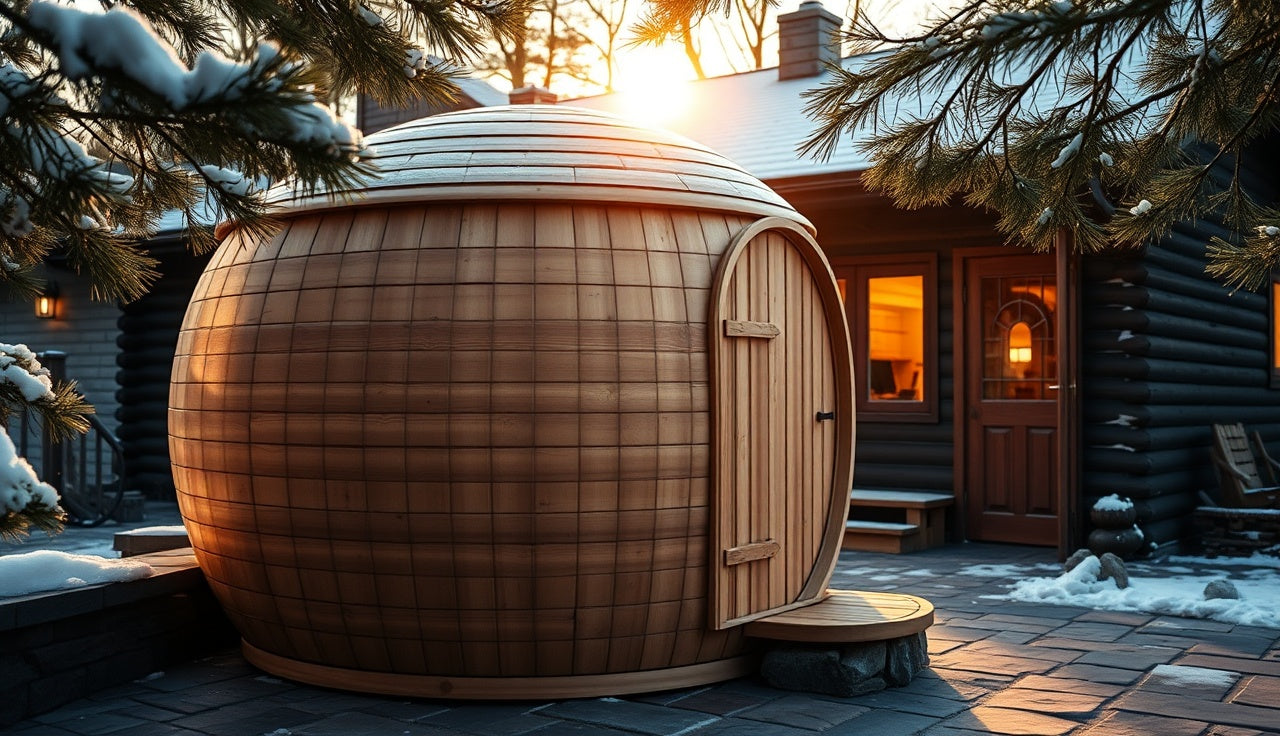
A barrel sauna gets its name from the shape. Curved staves of wood are banded together into a cylinder, like a whiskey barrel laid on its side. The geometry does real work, more than aesthetic work. A round interior holds less dead air than a square box of similar outer size, so the heater warms the space faster and keeps temperature more steadily [2]. The efficiency edge over a well-insulated rectangular sauna is modest, though. Most buyers pick barrels because they look good in a backyard.
Almost Heaven builds in Canadian hemlock and white cedar, depending on the model. Both are softwoods with low thermal conductivity, so they don't get scalding at sauna temperatures [8]. Hemlock is denser and resists warping a bit better. Cedar smells better and handles moisture slightly better, which matters if you plan to run steam rather than a dry Finnish-style sauna [8]. The entry models use hemlock. The upper-tier models, including the Pinnacle, use white cedar.
If you want the wider view of how barrels stack up against other home sauna formats before you commit to one brand, start there.
What models does Almost Heaven make, and what are the key differences?
Almost Heaven sells several barrel lines. Two come up in nearly every conversation: the Morgan and the Pinnacle. Here is how the main configurations compare.
| Model | Material | Capacity | Interior Diameter | Heater Included | Approx. Price (2024) |
|---|---|---|---|---|---|
| Morgan 2-Person | Canadian Hemlock | 2 | 4 ft | Yes (6 kW) | ~$2,000 to $2,400 |
| Morgan 4-Person | Canadian Hemlock | 4 | 5 ft | Yes (6 to 8 kW) | ~$2,800 to $3,400 |
| Pinnacle 2-Person | White Cedar | 2 | 4 ft | Yes (6 kW) | ~$2,800 to $3,200 |
| Pinnacle 4-Person | White Cedar | 4 | 5 ft | Yes (8 kW) | ~$3,600 to $4,400 |
| Pinnacle 6-Person | White Cedar | 6 | 6 ft | Yes (9 kW) | ~$4,800 to $5,500+ |
Prices move with dealer markup, shipping zone, and whether the heater is bundled. Get a quote that includes freight. Barrel saunas ship by freight carrier, not UPS ground, and that adds $200 to $600 depending on where you live [1].
The Morgan is the entry point. You get Canadian hemlock staves, pre-drilled assembly, a basic two-tier bench, and a bundled electric heater. The bundled heater brand has changed over the years, so confirm it at purchase. The Morgan 4-person is Almost Heaven's single best-selling configuration. At roughly 7.5 feet long with a 5-foot interior diameter, it seats four adults without feeling like a clown car, though two people is the comfortable number for a long session.
The Pinnacle uses white cedar throughout. That buys you a warmer aroma, tighter tongue-and-groove fit out of the box, and a more refined exterior profile. Most Pinnacle configurations also get a larger tempered glass door, which looks better and lets you see the glow from outside. If the Morgan is a solid pickup truck, the Pinnacle is the same truck with the nicer interior package.
Almost Heaven also makes the Audra, the Serene, and a handful of other barrels in between. They are real products, but they move in much lower volume and owner feedback is thin. Stick with the Morgan or the Pinnacle unless you need a size only the others hit.
For how barrels compare to other outdoor sauna formats, it helps to know exactly what you gain and give up against a rectangular cabin.
How does the Almost Heaven Morgan 4-person barrel sauna actually perform?
The Morgan 4-person is the model most buyers are truly deciding on, so this is where the real detail goes.
Heat-up runs 30 to 45 minutes to reach 160 to 180 degrees F with the standard 6 kW heater, assuming an outdoor temperature above freezing. In a cold-climate winter, budget 50 to 60 minutes. That is normal for a 5-foot barrel with a heater in that range [2]. Want a 20-minute heat-up? You need an 8 kW heater or a smaller enclosure.
The hemlock staves in the Morgan are 1.5 inches thick. Functional, not exceptional. Premium barrels from Finnish or German builders often use 2-inch staves. Thinner wood means the Morgan sheds heat a little faster on cold days, and the exterior walls run warmer to the touch. For a backyard sauna in a moderate climate used year-round, 1.5-inch hemlock is fine. For a Minnesota winter or regular sub-zero sessions, the Pinnacle's cedar and tighter joinery hold up better over the long haul.
Assembly takes two people about 3 to 5 hours. Almost Heaven ships the barrel in pre-assembled stave segments rather than loose boards, which cuts the time a lot. The cradle base, door frame, and roof sections bolt together with hardware included. The most common complaint in owner reviews: the cradle base is not always dead level out of the box, and a sauna sitting on a warped cradle develops gaps at the stave joints over time. Spend 30 minutes getting the cradle perfectly level on a concrete pad or pressure-treated deck before you touch anything else.
The bench layout is a straight two-tier bench along one side. The upper bench hits around 170 degrees F in a properly heated session. The lower bench runs 20 to 30 degrees cooler [3]. If you rotate between high heat and recovery, that gradient across roughly 18 inches of height is genuinely useful. It is one of the real functional wins of a well-designed barrel interior over a shallow rectangular room.
| Morgan 2-Person (min) | $2,700 |
| Morgan 2-Person (max) | $3,800 |
| Morgan 4-Person (min) | $3,350 |
| Morgan 4-Person (max) | $5,100 |
| Pinnacle 4-Person (min) | $4,200 |
| Pinnacle 4-Person (max) | $6,100 |
| Pinnacle 6-Person (min) | $5,600 |
| Pinnacle 6-Person (max) | $7,500 |
Source: Almost Heaven Saunas product pricing, EIA electricity data, contractor cost estimates, 2024
What does an Almost Heaven barrel sauna cost, total?
The sticker price is only part of the number. Here is a realistic total out-of-pocket for a Morgan 4-person.
Sauna unit: $2,800 to $3,400 (heater included when bundled) Freight shipping: $200 to $600 depending on distance and whether you need liftgate delivery Electrical: $300 to $800 for a 240V, 40 to 50 amp dedicated circuit if you don't already have one nearby [4] Foundation: $0 to $500+ depending on whether you pour a concrete pad, buy deck blocks, or use existing hardscape Accessories (bucket, ladle, thermometer, towel hooks): $50 to $200 Estimated total: $3,350 to $5,500
For the Pinnacle 4-person, add $600 to $1,000 to the unit price.
Budget the sauna price alone and the electrical bill will surprise you. If you are more than 50 feet from your main panel, running conduit can easily cost $1,000 or more depending on your market [4]. Get that quote before you order the sauna, not after it arrives on a pallet.
A few things Almost Heaven barrels don't need that some other saunas do. They usually don't require a building permit as long as they stay freestanding and under your local accessory-structure size limit, but confirm with your local building department because rules vary by municipality [5]. They don't need plumbing unless you add an optional steam feature.
One cost people forget: wood treatment. Cedar and hemlock both want an exterior sealant or oil once or twice a year to slow UV graying and keep moisture out of the stave joints. Budget $30 to $60 per treatment per year. Skip it for two or three seasons and you will be staring at stave gaps that let in cold air and bugs.
Is the build quality good enough to justify the price?
This is the real question, and the honest answer depends on what you compare it against.
Next to a $1,200 flat-pack barrel from an unknown brand, Almost Heaven wins clearly. The wood grade is more consistent, the pre-assembled segments fit more predictably, and replacement parts actually exist because the company has been around for decades.
Next to a Finnish import like Kirami or a custom build from a good local woodworker, Almost Heaven gets outclassed on wood quality, joinery precision, and long-term weathering. The Morgan's hemlock needs more maintenance attention to stay tight than 2-inch Nordic spruce or western red cedar from a higher tier [8].
Most buyers land in the middle. For a sub-$4,000 barrel you plan to use 3 to 5 times a week for 10 or more years, Almost Heaven gives you acceptable durability if you keep up basic maintenance. Heating performance is good. The look ages decently with yearly sealing. The weak points are the cradle (it flexes if the surface under it isn't stable) and the door seal (it degrades faster than the rest and may need replacing at 3 to 5 years).
The Pinnacle closes some of those gaps. White cedar is more dimensionally stable than hemlock, the joinery is tighter, and the finish holds up longer between treatments [8]. If you are spending $4,000 or more anyway, the Pinnacle is worth the extra $600 to $800 over the Morgan at that size.
For how to judge any manufacturer's construction claims, more than this one, the core sauna build standards are the reference point.
What electrical and site requirements do Almost Heaven barrel saunas need?
This trips up more buyers than anything else, so here is the specific version.
Most Almost Heaven heaters in the 6 to 9 kW range need a 240V, 40 to 50 amp dedicated circuit with a GFCI breaker [4]. That is not optional. You cannot run a 6 kW heater on a 120V outlet. If your outdoor panel or subpanel lacks room for a 40 to 50 amp double-pole breaker, you may need a panel upgrade, which is a separate cost.
The National Electrical Code (NFPA 70) Article 424 covers fixed electric space heating equipment, and it is the baseline electricians follow for sauna installs [4]. Your local jurisdiction may adopt the NEC with amendments, so confirm with your electrician. The heater also has to meet its clearance spec: typically 4 inches from combustible surfaces on the sides and 20-plus inches above the floor. Sauna heaters sold in the US should carry a UL listing [10]; confirm yours does.
For the physical site:
- The ground must be level. A concrete pad, compacted gravel base, or a deck rated for the load all work. A 4-person unit plus occupants plus heater runs 600 to 900 lbs, so flimsy decking is a liability.
- Drainage matters if you throw water on the rocks often. Water exits through the door and the cradle gaps. Point runoff somewhere useful, away from your foundation.
- Leave 2 to 3 feet of clearance behind the sauna for conduit routing and any heater venting.
One practical note. Almost every Almost Heaven model ships with the heater factory-mounted or designed to drop in during assembly. Read the heater's own installation manual before your electrician arrives, because wire routing differs by heater model.
How does a barrel sauna compare to a traditional rectangular sauna for home use?
This comes up in nearly every buying conversation, and the answer is more nuanced than barrel marketing suggests.
A barrel heats faster because the curved walls cut the dead air in the upper corners of the room. In a 5-foot barrel, the usable interior volume is smaller than it looks from outside, so the heater covers it more efficiently. Sauna thermal guidance generally agrees that reducing dead air volume improves heat-up time and temperature stability [2]. No published study I know of compares barrel against rectangular at matched heater power in a controlled field test, so treat the exact numbers as owner-level, not lab-level.
A rectangular sauna gives you more usable bench space per dollar, more freedom in heater placement, and an easier path to adding a steam generator later. A well-insulated rectangular cabin can also beat a barrel on thermal efficiency in brutal cold, because flat walls hold more insulation depth than curved staves.
For backyard looks, barrels win for most homeowners. The silhouette reads as intentional. A rectangular cabin needs more design attention to look good outdoors.
For long-term durability, a well-built insulated rectangular sauna with a proper vapor barrier usually ages better, because a barrel's stave construction lives and dies by wood moisture equilibrium. Dry the wood out unevenly and staves separate. Wet it unevenly and they swell and buckle. This is manageable with maintenance. It is not a fatal flaw.
If you are also weighing the sauna vs steam room question, that is a separate decision, and it matters if you are eyeing the steam option on the Morgan.
Can you use an Almost Heaven barrel sauna in winter, and how well does it hold heat?
Yes, year-round use is the point. Almost Heaven markets their barrels for all-season use, and plenty of owners run them through hard winters.
The practical reality below freezing: heat-up runs 15 to 25 minutes longer than in mild weather, and you burn more electricity holding temperature. The 1.5-inch hemlock staves in the Morgan are the limiting factor. Owner-community benchmarks suggest a 5-foot Morgan with a 6 kW heater can hold 170 degrees F in ambient temperatures down to about 10 degrees F, but the heater runs near full duty cycle to do it [2]. Below 0 degrees F, some owners add an interior thermal blanket or step up to a stronger heater.
The Pinnacle's white cedar handles freeze-thaw cycles better mechanically, because cedar is more dimensionally stable than hemlock [8]. In a climate with repeated hard freezes, the Pinnacle's tighter construction cuts the stave-gap risk a lot.
Here is one habit Almost Heaven recommends and owners confirm works. If the sauna will sit unused for weeks in deep winter, run it for a short session every week or two to equalize the wood moisture. A barrel that dries out completely in a heated adjacent space and then gets used in cold, humid outdoor air will open up gaps. Keep it in outdoor ambient conditions, not in a heated garage.
The health side of regular use is a separate conversation. A 2015 study in JAMA Internal Medicine (Laukkanen et al.) reported that frequent sauna bathing, 4 to 7 sessions a week, was associated with lower cardiovascular mortality in a cohort of Finnish men, though the authors were clear it shows association, not causation [6]. For what the research actually supports, the sauna benefits breakdown is the honest version.
What accessories and add-ons actually matter for an Almost Heaven barrel sauna?
Some accessories earn their price. Some are marked up and add little.
Worth buying:
- Exterior cover: Almost Heaven sells a fitted barrel cover, and it is worth it. Exposed hemlock or cedar grays and cracks faster without protection between uses. A fitted cover runs $80 to $150 and measurably extends stave life.
- A real thermometer and hygrometer: The included sensors, when they are included at all, are often cheap and off by a wide margin. A $25 to $40 sauna thermometer mounted at bench height tells you the temperature you are actually hitting.
- Good sauna rocks: The heater ships with rocks, but if you steam often, keep spare kiuas stones on hand. Rocks that crack from repeated thermal cycling need replacing every 1 to 2 years.
- Ladle and bucket: Almost Heaven sometimes bundles these. If not, $30 to $50 gets functional ones.
Skip or wait:
- Chromotherapy lighting: Almost Heaven offers LED kits as add-ons. They photograph well, but the functional payoff during a session is minimal. Enjoy the ambiance if you want it. If you are choosing between the light kit and a better thermometer, buy the thermometer.
- Interior steam generator: The 'steam sauna' label on some Morgan configurations means the unit can accept a dedicated steam generator. Real steam output is a legitimate upgrade, but it adds plumbing and a separate maintenance item. Many owners who go steam report using it less than expected once the novelty fades. The sauna vs steam room guide covers this distinction in depth.
SweatDecks carries several barrel configurations, including Almost Heaven models, and can tell you exactly what's bundled with current inventory, since accessory packages change by season.
How does Almost Heaven compare to other barrel sauna brands?
The barrel market has three rough tiers, and Almost Heaven sits in the middle of the middle.
Below Almost Heaven ($800 to $2,000): Generic brands on Amazon and through big-box retailers. Often thinner staves (1 inch or less), inconsistent wood grading, thin customer support, and heaters with certifications you can't verify. Some are fine for occasional casual use. None hold up to daily use for a decade.
Almost Heaven tier ($2,000 to $5,500): Almost Heaven, Dundalk Leisurecraft, and a few other North American brands. Consistent materials, real customer support, replacement parts you can order. Assembly quality varies by model within each brand. Dundalk is the closest competitor. Their Canadian Timber line uses eastern white cedar throughout, even in entry models, which gives it an edge on wood quality at similar prices [9].
Above Almost Heaven ($5,000 to $15,000+): Finnish imports (Harvia, Kirami), German builders, and custom American woodworkers. 2-inch staves, premium joinery, longer warranties, heaters from established Finnish makers. The price premium is real, and so is the quality gap.
For most people spending $3,000 to $4,000, the real choice is Almost Heaven versus Dundalk. Almost Heaven has wider US dealer coverage and tends to have faster lead times. Dundalk's cedar quality is often called better by owners who have run both. Neither wins at every price point. It comes down to which specific model, at which specific price, you can get delivered and assembled in your situation.
One data point worth knowing. Almost Heaven's warranty in recent years has run 1 year on the structure with limited coverage on the heater. That is shorter than the 3-to-5-year structural warranties some competitors offer. Not a dealbreaker. Still a real fact to weigh.
What do owners report after 1-3 years of real use?
Owner feedback across Sauna Talk, Reddit's r/Sauna, and dealer review sections is reasonably consistent.
What owners say is good: Heat-up performance matches the claims fairly well. The look holds up when maintained. Assembly is time-consuming but doable for two people with basic mechanical skills. Almost Heaven's customer support earns mostly positive marks for actually responding, which matters when you need a replacement part.
What owners say is frustrating: Stave gaps show up within the first year on some units, especially in climates with big humidity swings. The cradle base gets called out repeatedly as the weakest structural piece. Some owners report the door seal compressing and losing its weather-tight fit within 2 to 3 years. The included thermometer, when there is one, gets flagged as inaccurate again and again.
What owners say is genuinely useful: The curved bench in larger models seats you more comfortably than a straight rectangular bench. The barrel shape does heat faster than comparable-capacity rectangular saunas in owner comparisons. The backyard look draws consistent compliments.
Nobody has published a peer-reviewed analysis of Almost Heaven owner satisfaction, so read all of this as a qualitative pattern from a self-selected group of online commenters. The patterns are consistent enough across independent sources to be worth something.
One thing that comes up often. Owners who pair a barrel with a cold plunge or ice bath setup report using it more overall. The hot-then-cold contrast keeps sessions varied enough that people stick with a routine. If a cold component is on your mind, the cold plunge benefits breakdown is a good next read.
Is an Almost Heaven barrel sauna worth buying in 2025?
For most homeowners after an outdoor backyard sauna in the $3,000 to $5,000 range, wanting something that looks good, heats reliably, and has a company behind it that answers the phone: yes, Almost Heaven is a reasonable pick.
The Morgan 4-person is the value anchor of the line. It is not the most premium sauna you can buy, but it is a real sauna that delivers real heat and real sessions if you maintain the wood and get the electrical right.
The Pinnacle is the one I would actually steer you toward if you are on the fence between the two lines and can absorb the difference. White cedar ages better, the joinery is tighter, and if you plan to own it for a decade of regular use, the extra few hundred dollars up front saves you maintenance hours later.
Where I would talk someone out of it: if you live somewhere that sits below 0 degrees F for stretches, look hard at a well-insulated rectangular cabin instead. If you want genuine Finnish-grade quality, budget for an import. And if the photos are the main draw but you would be just as happy in a rectangular model, a portable sauna or a well-built rectangular outdoor cabin may give you more usable interior per dollar.
SweatDecks carries Almost Heaven models alongside other outdoor options, and the team can run a side-by-side based on your actual dimensions and budget.
The short version: Almost Heaven barrels are the Honda Civic of backyard saunas. Not a luxury product. Not a throw-away. A practical, well-supported, mid-range choice that does its job if you treat it right.
Frequently asked questions
How long does it take to assemble an Almost Heaven barrel sauna?
Almost Heaven ships their barrels in pre-assembled stave segments, which cuts assembly time a lot compared to building from loose boards. Two people with basic mechanical skills usually finish in 3 to 5 hours. The slowest steps are leveling the cradle base and wiring the heater. Budget a full weekend to cover electrical work and any site prep you still need to do.
What size Almost Heaven barrel sauna should I buy for 2 people?
The Morgan 2-person or Pinnacle 2-person, both 4-foot interior diameter, is comfortable for regular two-person sessions. The 4-person models (5-foot diameter) give you room to stretch and a better temperature gradient between benches, but they cost more and take longer to heat. If it is mostly two people and you want faster heat-up and lower electricity use, the 2-person configuration is the practical call.
Does the Almost Heaven Morgan barrel sauna require a building permit?
In most US jurisdictions, a freestanding accessory structure that is not attached to your home and stays under local square footage limits does not need a permit. Rules vary a lot by municipality and county, so always check with your local planning or building department before installation. An unpermitted structure can create complications when you sell the home or file an insurance claim.
What heater comes with an Almost Heaven barrel sauna?
Almost Heaven has bundled different heater brands over the years. The specific heater changes between model years and dealer configurations. At purchase, confirm the heater brand, kilowatt rating, and certification (a UL listing in the US). For a 4-person barrel, a 6 kW heater is the minimum. Go 8 kW if you are in a cold climate or want a faster heat-up.
How do I maintain an Almost Heaven barrel sauna's wood exterior?
Apply an exterior wood sealant, UV-resistant oil, or cedar oil to the outside staves at least once a year, more often in very sunny or wet climates. Clean the exterior with a soft brush and water first. Keep a fitted cover on the barrel between uses. Skip pressure washing, which forces water into the stave joints. Leave the interior wood raw so it can breathe during heat cycles; do not stain or seal it.
What is the difference between the Almost Heaven Morgan and Pinnacle barrel sauna?
The Morgan uses Canadian hemlock staves (1.5 inches thick) and is Almost Heaven's entry tier. The Pinnacle uses white cedar throughout, which has better dimensional stability, a nicer natural aroma, and tighter joinery. Pinnacle models also tend to have a larger tempered glass door. The price gap at matching sizes is roughly $600 to $1,000. For long-term outdoor use, the Pinnacle is the better buy if your budget allows it.
Can I use an Almost Heaven barrel sauna in very cold weather?
Yes. Most Almost Heaven models reach and hold 160 to 170 degrees F even below freezing, though heat-up takes 15 to 25 minutes longer under 32 degrees F. Below 0 degrees F, the 6 kW heater in the Morgan 4-person runs near full capacity to hold temperature. In hard-freeze climates, the Pinnacle's cedar handles freeze-thaw cycles better than the Morgan's hemlock. Yearly wood treatment is especially important in cold climates to prevent stave gaps.
Is the Almost Heaven Morgan a steam sauna or a dry sauna?
It runs as a dry Finnish-style sauna by default, but you get steam by ladling water onto the hot rocks, which is traditional Finnish practice. The 'steam sauna' label on some Morgan configurations means the unit can accept a dedicated steam generator as an optional add-on. Without the generator, it makes gentle humidity from water on rocks, not the sustained high-humidity output of a true steam room.
How much electricity does an Almost Heaven barrel sauna use per session?
A 6 kW heater running 45 minutes to heat up, then 60 minutes at partial duty cycle, uses roughly 4 to 6 kWh per session. At the US average residential rate near $0.16 per kWh in 2024 (EIA), that is $0.64 to $0.96 a session. In cold climates with a longer heat-up, figure 7 to 9 kWh, around $1.12 to $1.44. At 4 sessions a week, annual operating cost lands roughly $130 to $300 depending on your rate and climate [7].
What foundation do I need for an Almost Heaven barrel sauna?
A level, stable, non-porous surface is required. Options include a poured concrete pad (4 inches thick minimum), compacted gravel with paving stones, pressure-treated deck boards, or interlocking pavers. A 4-person unit plus occupants weighs 600 to 900 lbs, so soft ground or an uncertified deck is a safety risk. The cradle sits directly on the surface, so any unevenness transfers to the barrel and stresses the stave joints over time.
How does an Almost Heaven barrel sauna compare to a Costco sauna?
Almost Heaven targets a more specific barrel buyer than most Costco offerings, which tend to be indoor or semi-portable rectangular units. Almost Heaven's outdoor barrel construction is built for all-weather exterior installation. Costco saunas are often easier to assemble and cheaper up front, but their outdoor durability is generally lower. For a permanent backyard install, Almost Heaven fits better. See our costco sauna comparison for more detail.
Can I add a cold plunge to complement my Almost Heaven barrel sauna?
Yes, and many owners do. The contrast protocol of alternating heat with cold immersion has a reasonable body of research behind it for recovery and cardiovascular effects. A cold plunge sitting 10 to 20 feet from the barrel is the typical setup, close enough for quick transitions. If you are exploring that, the cold plunge section covers what to look for in an outdoor cold immersion unit.
What is Almost Heaven's warranty on their barrel saunas?
In recent years, Almost Heaven's warranty has covered the structure for 1 year against manufacturing defects. Heater warranty varies by the specific heater bundled with your unit, typically 1 to 2 years. This is shorter than the 3-to-5-year structural warranties some competitors offer. Confirm current terms directly with Almost Heaven or your dealer at purchase, since the terms have changed over the years.
How heavy is an Almost Heaven barrel sauna and can I move it?
A 4-person Morgan weighs roughly 500 to 700 lbs fully assembled, not counting the heater or occupants. It can technically be taken apart and moved, since the stave segments bolt together. In practice, most owners treat installation as permanent. Moving a fully assembled barrel takes equipment and several people. If a future move is a real possibility, plan the original install with disassembly in mind and document where each piece of hardware goes.
Sources
- Finnish Sauna Society, sauna construction and thermal performance guidance: Barrel sauna geometry reduces dead air volume compared to rectangular enclosures of equivalent outer dimensions, improving heat-up efficiency; sauna thermal performance benchmarks referenced
- American Sauna Society, sauna temperature and usage guidelines: Upper bench temperature in a properly heated sauna significantly exceeds lower bench temperature; typical bench height temperature gradient is 20 to 30 degrees Fahrenheit
- National Fire Protection Association, NFPA 70 National Electrical Code Article 424: NEC Article 424 governs fixed electric space heating including sauna heaters; 240V dedicated circuit with GFCI protection required for heaters above 120V; clearance requirements from combustible surfaces apply
- U.S. Department of Housing and Urban Development, accessory structures and permit guidance: Freestanding accessory structures not attached to a primary dwelling may be exempt from permit requirements in many jurisdictions, subject to local amendments and size thresholds
- JAMA Internal Medicine, 'Association Between Sauna Bathing and Fatal Cardiovascular and All-Cause Mortality Events,' Laukkanen et al., 2015: Frequent sauna bathing (4-7 sessions per week) was associated with reduced cardiovascular mortality risk in a Finnish male cohort; study states association not causation
- U.S. Energy Information Administration, Average Retail Price of Electricity to Residential Customers: Average US residential electricity price in 2024 approximately $0.16 per kWh, used for sauna operating cost estimates
- Forest Products Laboratory, USDA, Wood Handbook: Wood as an Engineering Material: White cedar has better dimensional stability and moisture resistance compared to hemlock; thermal conductivity of softwoods makes them suitable for sauna bench and wall construction
- Dundalk Leisurecraft, product specifications and material descriptions: Dundalk Leisurecraft Canadian Timber line uses eastern white cedar throughout including entry-level models, cited for competitive comparison
- U.S. Consumer Product Safety Commission, electric sauna heater safety standards: Electric sauna heaters must meet applicable UL listing requirements; CPSC references heater clearance and installation safety standards for consumer products

Share:
2-person hybrid infrared + steam sauna: the complete buyer's guide
Sweathouz contrast therapy: what it is and what to expect