
Last updated 2026-07-09
TL;DR
A 2-person outdoor barrel sauna runs 5 to 6 feet in diameter and 6 to 7 feet long, uses a wood-burning or electric heater between 6 and 9 kW, and costs $2,500 to $7,500 installed. Most quality setups land at $3,500 to $5,500. Western red cedar and Canadian hemlock hold up best outdoors.
What exactly is a 2-person outdoor barrel sauna?
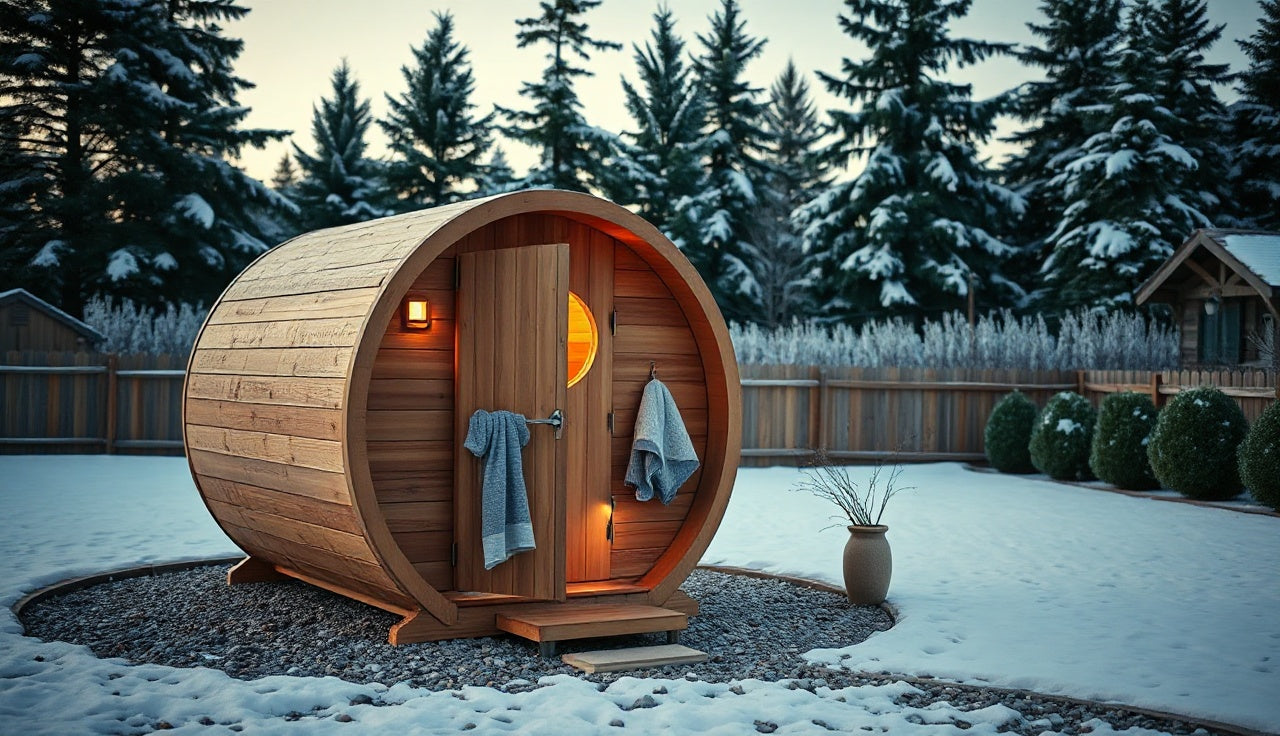
A barrel sauna is a cylindrical cabin built from staved wood, held together with hooped metal bands. Same basic construction as a wine barrel or a whiskey cask. The round shape isn't just for looks. It kills the flat wall panels and corner joints, and those are the two spots where moisture and structural movement start wrecking a traditional box sauna.
For two people, the interior diameter is almost always 4.5 to 5 feet, with a barrel length of 6 to 7 feet. That gives you roughly 14 to 18 square feet of floor space. Enough for two adults side by side on one bench, or one person stretched out on a longer bench run. Peak ceiling height is usually 4.5 to 5.5 feet, so tall users duck to get in but sit comfortably once they're settled.
The word "outdoor" does more work than it looks like. An outdoor barrel takes rain, UV, freeze-thaw cycles, snow load, and in humid climates, ground moisture creeping up from below. The wood species, the finish (or the deliberate lack of one), the roof overhang, and the metal banding decide whether your sauna still looks sharp at year five or starts checking and rusting at year two.
If you want to see how barrels stack up against other home options, the outdoor sauna guide covers cabin-style and pod designs side by side.
What size barrel sauna do two people actually need?
Get a 5-foot diameter, 6-foot barrel. That's the standard "2-person" configuration, and it fits two average adults sitting upright on a single bench.
If one of you is over 6 feet tall and wants to lie down, or you plan to cycle in and out for contrast therapy without feeling boxed in, a 6-foot diameter with a 7-foot length is meaningfully better. The jump from 5-foot to 6-foot usually adds $400 to $800 depending on the maker, and it's money well spent if you'll use the sauna hard. A 4-foot diameter barrel gets marketed as a 2-person unit too. It's tight for two adults and only makes sense when yard space forces your hand.
Here's how the common outdoor barrel sizes map to occupancy and heater requirements:
| Diameter | Length | Floor Area (approx.) | Practical Occupancy | Typical Heater Size |
|---|---|---|---|---|
| 4 ft | 6 ft | ~12 sq ft | 1-2 persons (snug) | 4-6 kW |
| 5 ft | 6 ft | ~14 sq ft | 2 persons | 6-8 kW |
| 5 ft | 7 ft | ~17 sq ft | 2-3 persons | 6-9 kW |
| 6 ft | 7 ft | ~20 sq ft | 3-4 persons | 8-10 kW |
| 6 ft | 8 ft | ~24 sq ft | 4-6 persons | 9-12 kW |
The floor area figures are approximate. Curved walls cut into usable bench width, and interior dimensions shift with wall thickness. Most stave walls are 1.5 to 2 inches thick, so a 5-foot exterior barrel has roughly a 4.5-foot interior diameter.
What are the best wood species for an outdoor barrel sauna?
Wood choice is the single biggest predictor of how long your barrel lasts outdoors. The wood has to take repeated heat cycling, rain, UV, and in a lot of climates, direct snow contact. It also has to ride out extreme humidity swings inside without warping enough to break the barrel geometry.
Nordic spruce (white spruce) is what you find in most Finnish-made and Finnish-inspired barrels. It's light, doesn't get burning-hot to the touch, and takes the expansion and contraction of sauna cycles well. Untreated Nordic spruce greys and weathers outdoors, which most sauna purists consider fine. If you want it to hold color, plan on an exterior oil once a year.
Canadian hemlock (Tsuga canadensis) is the most common species in North American barrels. It resists moisture absorption, handles heat, and triggers allergies in almost nobody, which matters when you're sitting 3 feet from hot wood. It runs slightly cheaper than Nordic spruce in North American supply chains.
Western red cedar (Thuja plicata) is the premium outdoor pick. Its natural oils fight rot, insects, and UV. A cedar barrel outlasts a hemlock barrel by years in a wet climate. USDA Forest Service data on western red cedar notes that its extractives give it real resistance to decay fungi and insects [12]. The catch is price: cedar barrels run $800 to $1,500 more than comparable hemlock units. In the Pacific Northwest, British Columbia, or anywhere it rains constantly, that premium pays for itself. In the dry Southwest, hemlock does nearly as well.
Thermo-treated aspen or alder shows up in some European units. Thermal modification heats the wood to around 400°F in an oxygen-free environment, which improves dimensional stability and rot resistance a lot [2]. Good options, just less common in the retail barrel market.
Skip pine for the exterior staves. Its high resin content bleeds sap under heat and UV. It sometimes appears on interior bench boards where temperatures are gentler, but even there it's not the best call.
Wood-burning vs. electric heater: which is right for an outdoor barrel sauna?
Here the answer really does depend on your situation. No diplomatic hedge.
Electric heaters are easier, faster, safer, and steadier. A 6 to 8 kW electric heater in a 5-foot barrel brings the cabin to 170-185°F in 30 to 45 minutes. You control it from a digital panel, and many newer units add a phone app. No wood storage, no ash, no sparks. If your site has 240V service within a sane cable run, electric is the default for most homeowners.
Wood-burning stoves (kiuas, in Finnish) put out what a lot of experienced sauna users call a different quality of heat. Combustion adds a little moisture to the air, the temperature ramps up slower, and firing the stove is part of the ritual for many people. Build around wood if you're genuinely into the Finnish tradition, or if your site has no practical 240V access.
The safety math is real. Wood-burning units need a proper flue with 3 feet of clearance above the roofline and 2 feet from any adjacent structure, per NFPA 211 for solid fuel appliances [3]. The barrel sits on a non-combustible pad, and you keep it clear of overhanging trees. Electric heaters still need a dedicated GFCI-protected circuit and code-compliant install, but the fire risk is far lower.
Propane heaters get marketed for outdoor barrels once in a while. They can work off-grid, but they demand strict ventilation design and tank management. Most buyers who go propane end up wishing they'd run electric.
For a closer look at the home sauna heater decision, that guide breaks down kW sizing and brand comparisons in more detail.
How much does a 2-person outdoor barrel sauna cost?
The honest range, as of mid-2025, is $2,500 to $7,500 for a complete 2-person outdoor barrel sauna including the heater. Most quality options land between $3,500 and $5,500.
At the low end ($2,500 to $3,200), you're looking at hemlock or spruce barrels from import-direct brands, often with a 4 to 5 kW heater that's undersized for the space. Stave quality varies, and the banding is sometimes galvanized steel that rusts in wet climates. Some of these hold up fine. Others become a regret by year three.
The $3,500 to $5,500 range is where most serious buyers end up. Well-built hemlock or cedar barrels from established makers, a properly sized 6 to 8 kW electric heater or a quality wood stove, plus accessories like an exterior changing vestibule (common on barrel designs), a thermometer, and a ladle set. The Dundalk Leisurecraft Canadian Timber and Almost Heaven barrel lines sit here [11].
Above $5,500 and up to about $7,500, you get Nordic spruce or premium cedar from Finnish or Canadian makers, often with thicker staves (2 inches rather than 1.5), heavier banding, and better ventilation design. These are the ones that look as good at year ten as they did on delivery.
Installation is separate. On a level gravel or paved surface, assembly is a weekend DIY job for two people with basic tools. An electrician for the 240V circuit runs $300 to $800 depending on panel distance. Gravel or paver base materials add $200 to $600. All-in for a quality 2-person setup: $4,500 to $7,000 for most buyers.
You can see current market pricing at SweatDecks, which carries outdoor barrel saunas with transparent pricing and sizing guides.
Budget shoppers sometimes eye mass-market options. The costco sauna article gives an honest rundown of what those units actually deliver.
| Budget (import hemlock, 4-5 kW heater) | $3,000 |
| Mid-range (hemlock/cedar, 6-8 kW electric) | $4,500 |
| Premium (cedar/Nordic spruce, 8 kW + vestibule) | $6,000 |
| High-end (Finnish-built, 2-in staves, top heater) | $7,500 |
Source: SweatDecks market survey of current retail listings, 2025
What permits and codes apply to an outdoor barrel sauna?
Most buyers underestimate this part, and it's the one thing to nail down before you pour a pad.
In the US, most jurisdictions treat a freestanding outdoor sauna as an accessory structure. The International Residential Code, adopted with local amendments across most US municipalities, exempts accessory structures under 120 square feet from a building permit [4]. A 2-person barrel has a footprint of 50 to 70 square feet, which lands under that line in most places. Some municipalities set lower thresholds (as low as 30 square feet for heated structures), so a call to your local building department before you order is mandatory, not optional.
The electrical install is a separate permit in nearly every US jurisdiction. A 240V, 20 to 40 amp dedicated circuit with GFCI protection is standard for an electric heater. NEC Article 680 covers electrical work in wet and special-environment spaces, including saunas, and calls for specific wire types and moisture-rated components [5]. An unpermitted DIY 240V install in an outdoor wet environment is a genuine liability and safety problem. Hire a licensed electrician.
Setbacks vary, but a common rule requires 5 to 10 feet from property lines and from the primary residence for accessory structures. HOA rules can be stricter than municipal code. Check both.
For wood-burning installs, you'll almost certainly need a permit for the solid fuel appliance, and it has to meet NFPA 211 clearance and flue specs [3].
Canada runs similar under provincial codes. Alberta and BC generally require permits for permanent outdoor structures regardless of size once electrical or heating is involved.
Nobody has built a clean national database of sauna permit thresholds. Your county or municipal building department is the only reliable source.
How do you install and set up a 2-person barrel sauna outdoors?
Most barrels ship as a kit on a pallet, typically 5 to 7 pallets for a complete 2-person unit. The sequence is logical but physical. You need at least two people, and three makes raising the barrel shell a lot easier.
Site prep comes first. You need a level surface that drains. Options, roughly cheapest to most permanent: compacted gravel (at least 4 inches deep, the standard for barrels), concrete paver pads, a poured slab, or pressure-treated decking. The barrel rides on two curved cradle runners that come in the kit. They spread the load and let air circulate under the barrel, which keeps the bottom staves alive longer.
Leveling matters. A barrel that's 2 or 3 degrees off will drain poorly and the door won't hang right. Run a 4-foot level and adjust the cradle runners with shims, or grade the gravel pad before assembly.
Assembly runs 4 to 8 hours for two adults following the included instructions. The staves fit tongue-and-groove or simple butted joints, the metal hoops cinch down with hardware, and the end walls (with door and window openings) bolt in. Most kits are engineered well for DIY. The most common mistake is under-tensioning the bands. Follow the maker's torque spec, or snug them with a wrench and recheck after the first few heat cycles, since the wood settles and the bands loosen a bit.
For electric heaters, fully assemble the sauna and mount the heater before you call the electrician for final connections. Don't wire the heater yourself unless you're a licensed electrician.
For wood stoves, the flue is the make-or-break step. The thimble (the fireproof penetration through the barrel wall) goes in before assembly finishes, and the chimney has to clear the roof and any nearby overhangs per NFPA 211 [3].
How long does a 2-person outdoor barrel sauna last?
A well-built cedar or quality hemlock barrel, sited and maintained right, should last 15 to 25 years. That range comes with real caveats.
The bottom staves decide most of it. They sit closest to ground moisture and rain splash-back. Gravel under the cradle runners, a generous roof overhang (12 inches minimum on each end), and good site drainage stretch their life a lot. Some makers sell replaceable bottom stave sets as an accessory, which tells you they've actually thought about real-world wear.
Banding quality is the second factor. Stainless steel or hot-dip galvanized bands last. Mild steel bands rust within 5 to 10 years in wet climates, stain the wood with rust streaks, and eventually loosen the structure. Ask exactly what the bands are made of before you buy.
Interior bench boards and floor slats take more abuse than people expect. They swing from room temperature to 180°F and back, over and over, and they soak up sweat. Cedar and hemlock handle it well. Softer, more porous woods develop surface checking within a few years. Interior boards are replaceable. Plan to refresh bench slats every 7 to 10 years depending on how hard you use it.
Heaters have their own curve. Quality electric heaters (Harvia, Finnleo, Helo, Tylo) carry 2 to 5-year warranties and realistically last 10 to 20 years with normal use [6]. Wood stoves, being simple mechanical objects, often outlast the barrel itself when they're cast iron or heavy steel.
The most common premature failures: cheap bands rusting, bottom staves rotting from pooled water, and door frames warping when the sauna isn't vented after each session.
What are the health benefits and risks of using an outdoor barrel sauna?
The research on sauna use has grown a lot in the past decade, driven mostly by Finnish epidemiology. A 2018 Mayo Clinic Proceedings review pulled together evidence from the Kuopio Ischemic Heart Disease Risk Factor Study, which followed more than 2,300 middle-aged Finnish men. Men who used a sauna 4 to 7 times a week had a 40% lower risk of all-cause mortality than once-weekly users [7]. The authors were careful about this: it's observational data, and this design can't prove cause.
The acute cardiovascular response is well documented. Core body temperature climbs 1 to 2°C during a typical 15 to 20-minute session at 80 to 100°C (176 to 212°F), heart rate rises to 100 to 150 bpm, and cardiac output roughly doubles [8]. For most healthy adults, that's a benign stress. For people with cardiovascular disease, uncontrolled hypertension, or certain arrhythmias, it gets more complicated, and a talk with your physician before regular use is the right move.
The Finnish Sauna Society recommends staying well-hydrated, keeping sessions to 15 to 20 minutes, and cooling down between rounds [9]. In a 2-person barrel, you're both drawing on the same air and the same steam from löyly (water on the stones), so ventilation design isn't a nice-to-have.
Sauna plus a cold plunge or cold shower gets studied under the label "contrast therapy." The mechanisms differ from sauna alone, running pronounced vasoconstriction and vasodilation cycles. This research is earlier-stage than the sauna-only data. The honest summary: the combination appears to reduce delayed-onset muscle soreness and most users report it as subjectively restorative. For the full picture, the sauna benefits guide covers the published literature.
The practical risks are real. Dehydration, overheating, a blood pressure drop when you stand up fast, and for wood-burning units, carbon monoxide if the flue clogs or the sauna runs sealed with no fresh air. None of these are exotic. Basic sense and proper design handle all of them.
How does a barrel sauna compare to a traditional box sauna for outdoor use?
This is a real trade-off, not a clear winner.
Barrels have two structural edges outdoors. The curved roof sheds snow and rain on its own, with no flat surface to accumulate load or pool water. And the cylinder has no 90-degree corners where moisture collects and where the wall-to-floor join usually fails first in cabin saunas. The round interior also moves air a little more evenly by convection, though the effect on how the heat feels is subtle.
Box saunas (the classic Finnish cabin with a gable roof) give you more headroom, more bench-layout options, and often more wall insulation. A well-built cabin with 3 to 4 inches of wall insulation holds heat better than a 1.5-inch stave barrel. That matters most in cold climates: a barrel takes longer to heat and drops temperature faster when the door opens at sub-zero.
For a backyard in a moderate climate used spring through fall, a barrel is the more practical and often the better-looking choice. For year-round use in Minnesota or northern Canada, an insulated cabin with a bigger heater has real functional advantages.
Price: a quality 2-person cabin runs $4,000 to $8,000 delivered, similar to or slightly above a barrel at the same quality. The barrel's assembly edge is real. Most need no specialized carpentry.
Still deciding on form factor? The broader outdoor sauna guide walks through cabin, barrel, and pod designs with honest trade-offs for each.
Can you use a 2-person barrel sauna year-round, including in winter?
Yes, with the right heater sizing and a few practical tweaks. A properly built cedar or hemlock barrel is designed to live outdoors in every season. The wood expands and contracts with temperature, and the metal bands take up the movement. Makers in Finland, Canada, and the northern US build these for hard winters.
Heat-up time is the main thing. Below 20°F, a 6 kW heater in a 5-foot barrel that hits temperature in 30 minutes in summer might need 50 to 60 minutes in deep winter. Size up to an 8 kW heater from the start, or plan longer preheats. Some owners keep a little residual heat in the barrel by running back-to-back sessions rather than letting it fully cool between uses.
Door seals matter more in winter. A poorly fitted door bleeds heat fast. Check the weatherstripping every year and replace it when you feel cold drafts.
Snow isn't a problem on the roof itself. The curve sheds it. But keep the entry door and the path to it clear. Running hot and barefoot to a snowy deck is both part of the Nordic tradition and a falling hazard, so build a non-slip entry surface in from day one.
For cold immersion after a winter session, a lot of owners pair the barrel with a cold plunge tub or an ice bath nearby. Contrast therapy works especially well when both the sauna and the cold vessel sit outdoors and swap easily.
What accessories does a 2-person barrel sauna actually need?
Some accessories are functionally necessary. Most are upsells that happen to be useful. A few are overpriced, and you can skip them.
Necessary: a proper thermometer and hygrometer (kits include a cheap one; a quality bimetallic thermometer runs $25 to $50 and earns it for dialing in heat and steam). A ladle and wooden bucket for löyly are non-negotiable if you have a stove with a stone tray. A birch whisk (vihta) is traditional and genuinely feels different, and it's cheap. Non-slip floor mats or grating inside, especially near the door, prevent burns from the hot floor and cut slipping.
Highly recommended: an exterior changing vestibule. Many 2-person kits offer a 2-foot or 4-foot changing room that attaches to the entry end. It's where you leave shoes, hang towels, and cool down briefly before stepping outside. In any climate that rains or snows, it changes how usable the sauna is. Budget $400 to $800 for a quality one.
Useful but optional: a sand timer (the traditional 15-minute kind), a headrest and backrest set, exterior LED lighting for evening sessions, and a cover or tarp for the whole barrel during long stretches of disuse (it protects UV-exposed wood in dry climates).
Skip or defer: built-in Bluetooth speakers inside the cabin. They're hard to service and often corrode in the humidity. A separate speaker outside the cabin is cheaper and better. Chromotherapy lighting kits get pushed hard at the mid-market price point. The evidence for their benefits is thin, and electronics don't love a 180°F wet box.
Frequently asked questions
How long does it take to heat up a 2-person outdoor barrel sauna?
With a properly sized 6 to 8 kW electric heater, a 5-foot diameter barrel reaches 170 to 185°F in 30 to 45 minutes in mild weather. Below 20°F, add 15 to 20 minutes. Wood-burning stoves take 45 to 75 minutes to hit full temperature depending on wood dryness and stove size, but they hold heat differently and many users prefer the slower ramp-up.
What foundation or base do I need for a 2-person barrel sauna outdoors?
Compacted gravel (4 inches deep, well-drained) is the standard and most practical base. The barrel rides on two curved cradle runners that spread the load, so you don't need a poured slab, though one works too. Keep the barrel off direct soil or grass. Level is critical: more than 2 degrees of tilt causes drainage and door-fit problems over time.
Does a 2-person outdoor barrel sauna need a building permit?
It depends on your municipality. The IRC exempts accessory structures under 120 square feet, and most 2-person barrels have a 50 to 70 square foot footprint, putting them below that line. But the electrical install for an electric heater almost always needs its own permit. Some municipalities set lower thresholds for heated structures. Call your local building department before ordering.
How much does it cost to run an outdoor barrel sauna per session electrically?
A 6 kW heater running 1.5 hours (including preheat) uses about 9 kWh. At the US average residential rate of roughly $0.17 per kWh as of 2024 [10], that's about $1.53 per session. In high-rate states like California or Hawaii, where rates top $0.30 per kWh, cost climbs toward $2.70 per session. Daily use runs $45 to $80 a month in most US markets.
What is the best wood for a 2-person outdoor barrel sauna?
Western red cedar is the most durable outdoor choice thanks to its natural rot-resistant oils. Canadian hemlock is the practical North American default, with good moisture resistance at a lower price. Nordic spruce is excellent and traditional in Finland; it needs annual exterior oiling to keep its look outdoors. Skip pine for the staves. Its high resin content causes trouble under heat and UV.
Can one person comfortably use a 2-person barrel sauna?
Yes, and a 2-person barrel makes a comfortable solo sauna. The bench layout in most 5-foot barrels lets one user stretch out partway or lie down with knees bent. Heating for solo use costs about the same as heating for two, so if you'll almost always go alone, sizing down is worth a thought. Most solo users still prefer the 5-foot barrel over a smaller unit.
How do I maintain a 2-person outdoor barrel sauna?
After each session, prop the door open for 30 to 60 minutes to dry the interior. Re-tighten the metal bands each spring, since seasonal wood movement loosens them. Apply exterior wood oil or sauna-safe sealant to the outer staves once a year in wet climates, twice in UV-intense ones. Inspect flue connections and door seals annually. Lightly sand the interior bench boards every year or two to refresh the surface.
What is the difference between a 2-person barrel sauna and a 2-person traditional box sauna?
Barrels have no corners where moisture collects, a curved roof that sheds snow on its own, and simpler DIY assembly. Box saunas give you more headroom, better insulation for cold climates, and more flexible bench layouts. For outdoor use in moderate climates, barrels are more practical. For year-round use in very cold climates, a properly insulated cabin holds heat more efficiently.
Is a wood-burning or electric heater better for a 2-person outdoor barrel sauna?
Electric is more convenient, faster, steadier, and safer for most homeowners. Wood-burning puts out a heat quality many experienced users strongly prefer, and it works where 240V isn't accessible. Wood stoves need proper flue installation per NFPA 211 and carry more fire responsibility. If you have easy electrical access and mostly want health and recovery benefits, choose electric.
How far does a barrel sauna need to be from my house and property line?
Setbacks vary by municipality, but a common rule under model codes is 5 feet minimum from property lines and from the primary structure for accessory buildings. Some jurisdictions require 10 feet. Wood-burning installs may need extra clearance. HOA rules can exceed municipal minimums. Confirm with your local building department and HOA before you lock in placement.
Can I put a 2-person barrel sauna on a deck?
Yes, but the deck has to handle the load. A 5-foot diameter, 6-foot barrel weighs roughly 800 to 1,200 lbs assembled and empty, plus two occupants and a full stone tray. Most standard residential decks can take it if the barrel sits over or near the main support beams. Have a contractor assess deck load capacity before installation if you have any doubt.
What temperature should a 2-person outdoor barrel sauna run at?
Traditional Finnish sauna temperature is 80 to 100°C (176 to 212°F) at bench level, with relative humidity around 10 to 20% before löyly and briefly higher after you pour water on the stones. Most barrel owners set the electric heater to 160 to 185°F. Lower settings (140 to 160°F) suit first-timers or longer sessions. The Finnish Sauna Society recommends 15 to 20-minute rounds with cooling breaks.
Can I use a 2-person barrel sauna for contrast therapy with a cold plunge?
Yes, and a backyard 2-person barrel pairs naturally with an outdoor cold plunge tub. A typical protocol is 10 to 20 minutes in the sauna, then 2 to 5 minutes in cold water (50 to 59°F), repeated 2 to 3 rounds. The cold plunge benefits guide covers what the research says. Physically, the two just need to sit close enough that you're not walking far between them.
How do I stop the interior of my outdoor barrel sauna from getting moldy?
Ventilation and drying handle it. After every session, prop the door open at least 30 minutes. Most quality barrels have an adjustable vent near the floor and one near the ceiling; leave both slightly open between sessions. Never seal the sauna airtight when it's idle. If surface mold keeps returning, treat interior bench boards with a sauna-safe sealant (not standard polyurethane). A well-ventilated barrel rarely molds.
Sources
- USDA Forest Products Laboratory, Wood Handbook Chapter 4: Moisture Relations: Thermal modification of wood at approximately 400°F improves dimensional stability and resistance to biological decay
- NFPA 211: Standard for Chimneys, Fireplaces, Vents, and Solid Fuel-Burning Appliances (2022 edition): Solid fuel appliances require 3 feet of clearance above the roofline and 2 feet from adjacent structures; non-combustible hearth pads required
- International Code Council, 2021 International Residential Code Section R105.2 Work Exempt from Permit: Under the model IRC, accessory structures under 120 square feet are typically exempt from building permit requirements, subject to local amendments
- NFPA 70 National Electrical Code, Article 680 Special Occupancies: NEC Article 680 governs electrical installations in wet and special-environment spaces including saunas, requiring specific wire types and GFCI protection
- Harvia Group, product warranty terms for electric sauna heaters: Quality electric sauna heaters typically carry 2 to 5-year manufacturer warranties
- Mayo Clinic Proceedings, 2018: Cardiovascular and Other Health Benefits of Sauna Bathing (Laukkanen et al.): Men using sauna 4-7 times per week had a 40% lower risk of all-cause mortality vs. once-weekly users in the Kuopio Ischemic Heart Disease study; authors note the observational design limits causal inference
- Harvard Health Publishing, Harvard Medical School: Sauna health benefits: During sauna exposure, heart rate increases to 100-150 bpm and cardiac output approximately doubles; core body temperature rises 1-2 degrees Celsius
- Finnish Sauna Society (Suomen Saunaseura), sauna bathing guidelines: Finnish Sauna Society recommends 15-20 minute sessions, adequate hydration, and cooling breaks between rounds; traditional Finnish sauna temperature is 80-100°C
- US Energy Information Administration, Electric Power Monthly, Average Retail Price of Electricity 2024: US average residential electricity rate approximately $0.17 per kWh as of 2024
- Dundalk Leisurecraft, Canadian Timber barrel sauna product specifications: Representative mid-market 2-person barrel sauna pricing and Canadian hemlock construction specifications
- USDA Forest Service, Wood as an Engineering Material: Properties of Western Red Cedar: Western red cedar has natural extractive oils that provide resistance to decay fungi, insects, and UV degradation, making it durable for outdoor exposed applications

Share:
Cheapest cold plunge tubs that actually work in 2025
Barrel sauna cost: what you'll actually pay in 2025