
Last updated 2026-07-09
TL;DR
A 1 person sauna is any enclosed sauna built for a single occupant, usually 3 to 4 feet wide and 4 to 5 feet long. Prices run from about $800 for a basic barrel or portable unit to $8,000 or more for a premium Finnish-style indoor cabin. Electric heaters dominate indoor use; wood-fired heaters suit outdoor setups. Most homeowners install one in a weekend.
What is a 1 person sauna and how is it different from larger models?
A 1 person sauna is a heat chamber built for a single user. The interior is small enough that one heater brings the space to temperature fast, usually 20 to 45 minutes depending on the type, and the thermal mass you have to maintain is low. That means lower running costs and quicker heat-up than a 4 person sauna barrel or a full-size cabin.
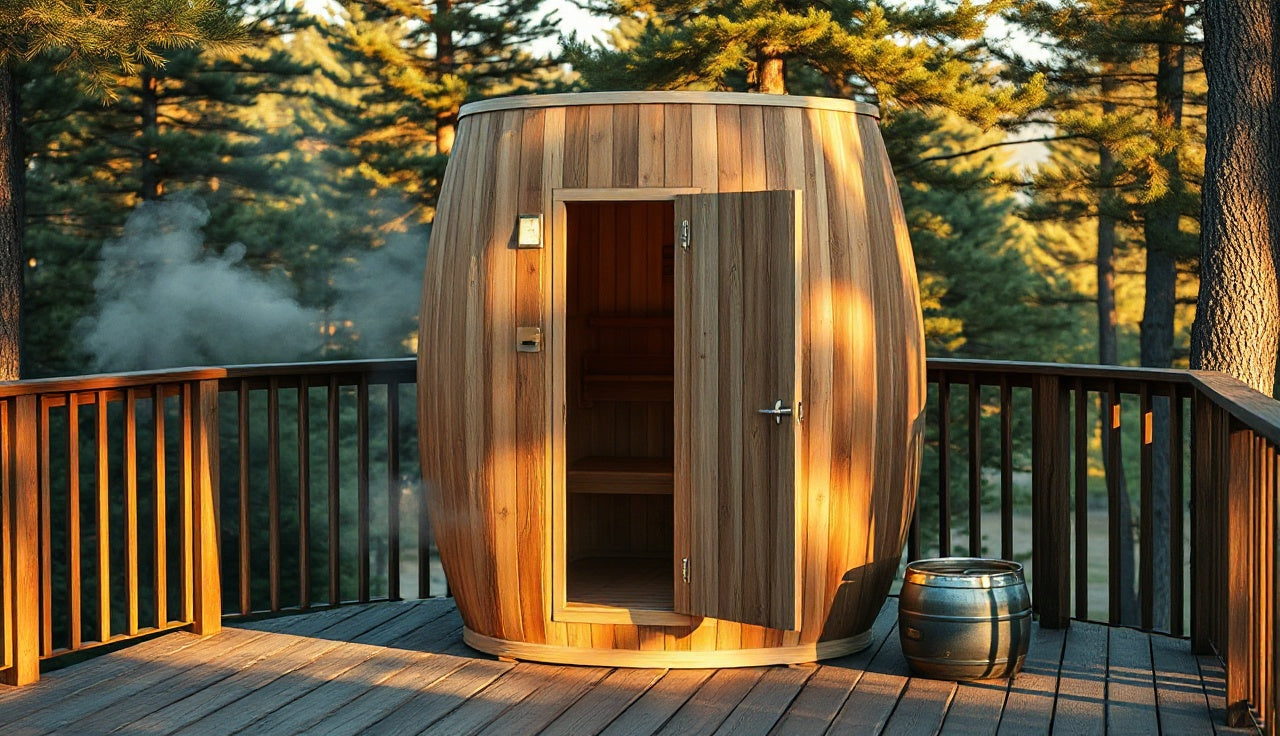
Size-wise, most solo units measure roughly 3 x 4 feet (36" x 48") on the floor and stand about 6 to 7 feet tall for upright cabins. Barrel models are compact in a different way: they're round, so a 1 person barrel sauna typically has an interior diameter of about 47 inches and a length of 5 to 6 feet. That shape holds heat well because the curved ceiling pushes hot air right back down on the occupant instead of collecting at a flat ceiling far above your head.
Larger units like a 4 person sauna barrel are simply bigger rooms. A 4 person barrel usually runs 6 to 7 feet in diameter and 8 feet or more in length [see sizing section below]. They cost more to buy, more to heat, and need more outdoor space. For a solo user, that extra cubic footage is pure waste. The smaller unit hits the same temperatures, just faster and cheaper.
If you're on the fence about whether you'll ever want to share, think honestly about how you actually use recovery tools. Most people sauna alone most of the time. A home sauna for one person is the right call for the vast majority of solo buyers.
What types of 1 person sauna are there?
There are five main categories, and picking the wrong one is the most common mistake buyers make.
Traditional Finnish-style cabin: A wooden room with an electric or wood-fired heater, rocks on top, and the option to pour water on the rocks for steam (called löyly). Temperatures typically run 150 to 200°F (65 to 93°C) at bench height. This is the gold standard if you want an authentic experience. Wood is usually cedar, hemlock, or Nordic spruce. These cost $1,500, $8,000 for a 1 person unit depending on wood grade and heater quality [1].
Barrel sauna: Same traditional heat, different shape. The round cross-section means less dead air volume, so a smaller heater can do the job. A 1 person barrel sauna is a genuinely good outdoor option and one of the better values in the category. Many buyers look at a 4 person sauna barrel for sale and assume bigger is better, but for solo use the single-person barrel is the smarter buy.
Infrared sauna (far-infrared or full-spectrum): Lower ambient temperatures, typically 120 to 150°F (49 to 65°C), but the infrared panels radiate heat directly into body tissue rather than heating the air first. Some users prefer this for joint comfort. The evidence base is thinner than for traditional saunas [2]. These are almost always electric and almost always indoor cabin style.
Portable sauna: A collapsible tent or bag structure with a steam generator or infrared panels. You sit in it with your head sticking out. Cheapest entry point, around $80, $400. Not comparable to a real cabin experience, but they work as a stopgap. Read more about them in our portable sauna guide.
Outdoor pod or prefab cabin: A fully finished unit delivered on a pallet, weather-resistant, sometimes with a small changing room attached. These overlap with traditional cabins in heat type but are purpose-built for outdoor installation. Good option if you don't want to build from scratch.
How much does a 1 person sauna cost?
Here's an honest breakdown, because prices online vary wildly and the low end of any category often signals corners cut on insulation, wood quality, or heater safety ratings.
| Type | Entry price | Mid-range | High-end |
|---|---|---|---|
| Portable / tent | $80 | $200 | $400 |
| Infrared cabin (1 person) | $800 | $1,800 | $4,000 |
| Traditional electric cabin (1 person) | $1,200 | $2,500 | $5,500 |
| 1 person barrel sauna | $1,500 | $2,800 | $5,000 |
| Outdoor pod / prefab | $2,500 | $4,500 | $8,000+ |
These are retail purchase prices and don't include installation, electrical work, or a concrete pad if you're going outside [3]. A licensed electrician to run a 240V circuit (which most real saunas need) adds $200, $800 depending on how far the panel is from your install location.
Compare that against a gym membership with sauna access, which runs $40, $80 per month at a mid-tier gym. At $60/month, that's $720 per year. A $2,000 home unit pays for itself in under three years if you use it consistently, and you can use it at 10 p.m. in a towel without driving anywhere.
For context on how 1 person sauna prices stack up against larger sizes: a 4 person sauna barrel kit typically runs $4,000, $9,000 for the kit alone before accessories, delivery, or installation. The per-person cost is similar, but the raw price tag is two to three times higher.
| 1-person infrared cabin (120V, 1.5 kW, 60 min) | $0.25 |
| 1-person traditional electric (3.5 kW, 60 min) | $0.57 |
| 4-person traditional electric (7 kW, 75 min) | $0.86 |
| Gym membership (pro-rated per visit, $60/mo, 8 uses) | $7.5 |
Source: U.S. Energy Information Administration, Electric Power Monthly 2024
What size is a 1 person sauna, and will it fit in my space?
Most 1 person indoor cabin saunas have interior floor dimensions of 35 to 47 inches wide and 35 to 47 inches deep. The exterior adds 2 to 4 inches per wall for insulation and framing. Ceiling height is usually 75 to 84 inches inside.
For a barrel sauna, the footprint is the diameter of the circle plus the length of the barrel. A common 1 person barrel is 47 inches in diameter and 5 feet long, so you need a space roughly 5 feet wide and 5 feet deep at minimum, plus 12 to 18 inches clearance on the sides and back for air circulation and wood stove clearances if applicable.
Indoor placement: most spare bedrooms, basement rooms, or bathroom additions fit a 1 person cabin. Ceiling clearance for a 6-foot interior is the more common constraint. Measure your ceiling before ordering.
Outdoor placement: you'll want a level pad (concrete, pavers, or a pressure-treated deck) sized at least 6 x 6 feet for a barrel, with clear access to an electrical outlet or the ability to run a new circuit. Many outdoor sauna installs also benefit from a small gravel drainage area in front of the door.
One thing that surprises people: even a small sauna is heavy. A 1 person barrel sauna can weigh 400 to 700 lbs assembled. Plan how you'll move it from the delivery point to the install location before the truck shows up.
What heater do you need for a 1 person sauna?
Heater sizing is usually stated in kilowatts (kW) for electric units. The standard rule of thumb from most manufacturers is 1 kW per 45 to 50 cubic feet of sauna volume, with a minimum of 3 kW for any occupied space [4]. A 1 person cabin with roughly 100 to 140 cubic feet of interior volume typically needs a 3 to 4.5 kW heater.
Electric heaters are the most popular choice for indoor 1 person saunas. They're clean, safe, controllable with a digital timer, and don't require a chimney or fuel storage. They need a dedicated 240V circuit, same as a clothes dryer. Most run on a 30 to 40 amp breaker.
Wood-fired heaters (kiuas) give the most traditional experience and smell, but they require a UL-listed chimney pipe, proper clearances from combustibles (usually 18 inches minimum per NFPA 211 [5]), and someone to manage the fire. For a 1 person barrel sauna outdoors, a small wood-burning sauna stove around 8,000 to 15,000 BTU is appropriate.
Infrared panels don't heat rocks or air to traditional sauna temperatures. They run on standard 120V in many cases, which makes installation easier, but the experience is genuinely different. Whether that difference matters to you depends on what you're after. For the cardiovascular and heat-stress adaptation effects studied in Finnish research, traditional high-temperature sauna is what the studies actually used [2].
Gas sauna heaters exist but are uncommon for residential single-person units. They show up mostly in commercial applications.
Is a 1 person sauna worth it for health benefits?
The honest answer: the health data for traditional saunas is encouraging but mostly observational. The most-cited work comes from Finland, where sauna use is deeply cultural and long-term population data exists.
A widely cited prospective study published in JAMA Internal Medicine in 2015 followed 2,315 Finnish men for an average of 20 years and found that men who used the sauna 4 to 7 times per week had a 40% lower risk of all-cause mortality compared to once-per-week users [2]. The study authors noted, "sauna bathing is a safe activity for healthy adults" and that "the cardiovascular effects of sauna bathing are similar to those of moderate-intensity physical exercise."
That's not a prescription and it doesn't tell you the sauna caused the benefit (people who sauna more may have other healthy habits). But it's real data from a real cohort, not a supplement company's press release.
For recovery specifically, heat exposure raises core temperature, triggers heat shock protein production, and causes temporary increases in growth hormone [6]. Some athletes use contrast therapy, alternating sauna and cold exposure, to reduce post-exercise soreness. The evidence is mixed on the soreness side, but subjectively most people who do it feel better afterward.
The conservative takeaway: regular sauna use is safe for most healthy adults, feels good, may support cardiovascular markers, and stacks well with cold plunge protocols. Don't buy one expecting it to replace medication or fix a diagnosis.
Read the full research breakdown in our sauna benefits guide.
How do you install a 1 person sauna at home?
Most pre-built 1 person indoor cabins arrive flat-packed in 5 to 12 panels and assemble with a cam-lock or tongue-and-groove system. Assembly time is typically 2 to 4 hours for two people. You do not need a contractor for the cabinet itself.
What you almost certainly do need a contractor for: the electrical. A 240V/30A dedicated circuit is not a DIY project in most jurisdictions. The National Electrical Code (NEC) Article 424 covers fixed electric space heating equipment, and sauna heaters fall under similar residential wiring requirements [7]. Running a new circuit from your panel runs $200, $800 in labor; costs vary by distance and local labor rates.
For a wood-burning outdoor sauna, the work involves building or pouring a pad, assembling the barrel or cabin, installing the stove with proper clearances, and running the chimney above the roofline (usually 2 feet above any part of the structure within 10 horizontal feet, per NFPA 211 [5]). That's a full weekend project.
Permits: some municipalities require a permit for a permanent structure or for new electrical work. Call your local building department before you pour a pad or pull wire. Many freestanding outdoor saunas under a certain square footage (commonly 120 sq ft) fall below the permit threshold in residential zones, but this varies by jurisdiction.
After install, let a new sauna run through 2 to 3 heat cycles before your first real session. This cures any residual moisture in the wood and lets the heater burn off any factory coatings.
What's the difference between a 1 person barrel sauna and a 1 person cabin sauna?
The barrel shape is more than looks. Because the interior is a cylinder, heated air circulates in a natural convective loop that keeps temperature more even from floor to bench. A flat-ceilinged box has a real temperature gradient: it can be 185°F at the ceiling and 140°F at bench height, which means some of the heater's energy is heating air you never sit in.
Barrels are also structurally stiff. The interlocking stave design (same concept as a wine barrel) handles outdoor temperature swings and moisture changes better than flat panels in many cases. A quality barrel uses kiln-dried Nordic spruce or Canadian red cedar with staves 1.5 to 2 inches thick.
The tradeoff: barrel saunas are almost always outdoor units. They're harder to move once assembled, and they require an outdoor pad. If you want your sauna inside, a cabin is your option.
For bench layout, a 1 person barrel has a single bench running the length of the interior, usually about 18 to 20 inches wide, enough to lie down in a 6-foot barrel. A 1 person cabin usually has a corner bench or a single short bench, sometimes with an upper and lower level.
If outdoor space is available and you want a traditional session, the 1 person barrel sauna is the better experience per dollar in most cases. If you're indoors or in a climate with harsh winters where trekking outside to use the sauna isn't appealing, a cabin wins.
How much does it cost to run a 1 person sauna per session?
Running cost is one of the most-asked questions and one of the least-answered in most buying guides. Here's the actual math.
A 3.5 kW electric heater running for 1 hour uses 3.5 kWh of electricity. The U.S. residential average electricity price in 2024 was approximately 16.4 cents per kWh according to the U.S. Energy Information Administration [8]. So one hour of sauna heat costs about 57 cents at that average rate. Heat-up time of 30 to 45 minutes plus a 30-minute session means roughly $0.50, $0.80 per session in electricity.
If your local rate is higher (California averages over 28 cents/kWh [8]), that same session runs closer to $0.90, $1.40. Still cheap.
Wood-burning heaters cost whatever your firewood costs. Expect to burn 2 to 5 lbs of dry hardwood per session in a small unit. At typical cord wood prices of $200, $400 per cord (roughly 2 tons of wood [9]), the per-session fuel cost is negligible, probably $0.50, $1.50 per session.
Infrared saunas often advertise lower energy use because they run at lower temperatures, but a session takes longer to feel comparable, and the lower thermal load isn't necessarily a health advantage.
Monthly cost for daily use: $15, $45 per month for a traditional electric 1 person sauna, depending on your electricity rate and session length. Compare to $40, $80/month for a gym membership. The home unit breaks even on operating cost alone within the first year if you use it daily.
How does a 1 person sauna compare to sharing with a 4 person sauna barrel?
If you're debating between a solo unit and a larger one, the variables that matter are: how often you'll actually have multiple people, your outdoor footprint, your budget, and your patience for long heat-up times.
A 4 person sauna barrel kit typically has an interior diameter of 6 to 7 feet and a length of 8+ feet. Interior volume is roughly 200 to 300 cubic feet, compared to 80 to 140 cubic feet for a solo barrel. That means you need a 6 to 8 kW heater minimum, and heat-up time stretches to 45 to 75 minutes. Running cost roughly doubles.
The 4 person sauna barrel is the right choice if you use the sauna with a partner or friends at least half the time, have the outdoor space (typically a 10 x 10 foot clear pad), and can budget $4,000, $9,000 for the kit plus delivery and installation.
For solo users: the bigger barrel almost never justifies itself. You'll be heating a room three times the size for the same one-person session. A 1 person barrel sauna at $1,500, $3,000 is the smarter call.
One honest caveat: if you plan to sell your home in the next five years and want the sauna to add value, a larger unit photographs better and appeals to more buyers. That's a real factor, not a vanity one.
SweatDecks carries both solo and multi-person barrel options if you want to compare specs side by side.
What safety rules should you follow using a 1 person sauna?
The Finnish Sauna Society and published clinical literature both point to the same basic precautions, and none of them are complicated [10].
Stay hydrated. Sauna sessions cause significant sweat loss, roughly 0.5 to 1 liter per 30-minute session at traditional temperatures. Drink water before and after. Alcohol before a sauna session meaningfully increases risk of hypotension and cardiac events; the 2015 Finnish cohort study specifically excluded sessions combined with alcohol consumption [2].
Limit session length. For new users, 10 to 15 minutes per round is appropriate. Experienced users commonly do 15 to 20 minutes per round, exit to cool down, and repeat 2 to 3 times. Total heat exposure above 30 minutes per round has no well-documented added benefit and increases dehydration risk.
Know who shouldn't sauna without checking with a doctor first: people with unstable angina, recent heart attack, severe aortic stenosis, or uncontrolled hypertension [11]. Pregnant women are commonly advised to avoid high-temperature saunas; the evidence on sauna and pregnancy is limited but the precaution is standard.
For a 1 person sauna specifically: tell someone you're using it, especially if you're solo and going for a longer session. There's no backup if you feel faint. Keep a timer. Keep a glass of water inside.
Ventilation matters too. Sauna cabins need fresh air intake near the floor and an exhaust vent near the ceiling. Most pre-built units come with this designed in; if you're building custom, don't skip it. CO buildup from a wood stove without adequate ventilation is a real risk.
Can you use a 1 person sauna with contrast therapy or cold plunge?
Yes, and this is one of the most popular use cases for a home sauna setup. Contrast therapy means alternating hot and cold exposure: sauna for 10 to 20 minutes, cold plunge or cold shower for 1 to 3 minutes, rest, repeat.
The physiological rationale: heat exposure causes vasodilation and increases heart rate. Cold exposure causes vasoconstriction and a rapid drop in skin temperature. Alternating the two creates what researchers sometimes call "vascular exercise," repeated pumping of the circulatory system [12]. Whether this translates to measurable recovery outcomes is debated; the subjective benefit is widely reported.
For a home setup, a 1 person sauna paired with an ice bath or dedicated cold plunge tub is a genuinely effective recovery station. The cold plunge doesn't need to be elaborate. A stock tank chiller setup or a purpose-built cold plunge pod works. The key is proximity: if the cold plunge is in a different building or requires a long walk in winter, you'll use the combination less.
Some people add a cold shower immediately outside the sauna door as a lower-cost alternative. It's not the same as full immersion but it works for the thermal contrast effect.
If you're curious about the broader science of cold exposure, see our cold plunge benefits guide.
Frequently asked questions
How long does it take to heat up a 1 person sauna?
Most 1 person electric cabin saunas reach 150 to 180°F in 20 to 45 minutes depending on heater power and starting room temperature. A 1 person barrel sauna with a wood-fired stove takes 30 to 60 minutes because you're building a fire from scratch. Infrared units reach operating temperature in 10 to 20 minutes but at lower ambient temps (120 to 150°F). Pre-heat time is one of the real practical advantages of a smaller unit over a 4 person sauna.
What wood is best for a 1 person sauna?
Canadian red cedar is the most popular choice: it's naturally resistant to moisture, has a pleasant smell, and stays cool enough to touch at sauna temperatures. Nordic spruce and hemlock are common lower-cost alternatives with similar performance. Avoid treated or painted woods entirely. For benches specifically, aspen or abachi are good options because they have very low resin content and don't get uncomfortably hot to sit on at high temperatures.
Does a 1 person sauna need a special electrical outlet?
Most traditional electric sauna heaters require a dedicated 240V circuit, typically 30 to 40 amps, wired directly to your breaker panel. This is the same type of circuit used for a clothes dryer or electric range. Infrared saunas with smaller panels sometimes run on 120V/20A, which is a standard household outlet. Check the heater's electrical spec sheet before assuming you can plug it in. Hire a licensed electrician for any new 240V circuit installation.
Can a 1 person sauna be used outdoors year-round?
Yes. Cedar and spruce barrel saunas are designed for outdoor use in all climates. In very cold regions (below 0°F regularly), a more powerful heater and thicker stave walls (2+ inches) help maintain temperatures efficiently. Wood-fired heaters are often preferred in cold climates because they're not dependent on electrical connections running through freezing temperatures. Protect the exterior with sauna-specific oil or stain annually to prevent weathering and cracking.
Do I need a building permit for a 1 person outdoor sauna?
It depends on your municipality. Many jurisdictions exempt freestanding accessory structures under 120 square feet from permit requirements, and a 1 person outdoor sauna usually falls well under that threshold. However, any new electrical work (running a circuit to the sauna) almost always requires an electrical permit regardless of structure size. Always call your local building department before installing. Rules vary enough that a general answer can be wrong for your specific address.
Is an infrared sauna or traditional sauna better for one person?
Depends on what you want from it. Traditional saunas (electric or wood-fired) reach 150 to 200°F and involve the high-heat stress response studied in most of the published Finnish research. Infrared runs cooler (120 to 150°F) and may be more comfortable for people who find high heat overwhelming. If health outcome data from peer-reviewed studies matters to you, traditional high-heat sauna is what those studies used. Infrared has a smaller evidence base but has devoted fans.
How often should you use a 1 person sauna?
The Finnish prospective study found associations between 4 to 7 sessions per week and the strongest cardiovascular outcomes, though the relationship was dose-dependent starting at 2 to 3 times per week. For most healthy adults, 3 to 5 sessions per week of 15 to 20 minutes each seems like a reasonable target based on available evidence. Daily use is common in Finland and not associated with harm in healthy individuals. Always rehydrate after each session and listen to how your body responds.
What is the smallest 1 person sauna you can buy?
The smallest cabin-style 1 person saunas have interior floor dimensions of about 35 x 35 inches, roughly the size of a closet. These are usually infrared models. Traditional electric cabins rarely go below 36 x 36 inches interior because the heater itself takes up floor space. Portable tent saunas are physically the smallest option and can fold to fit in a closet when not in use, though the experience is not comparable to a real cabin.
Can you put a 1 person sauna in an apartment?
Sometimes, but you'll face real constraints. Most apartment leases prohibit permanent modifications including new electrical circuits, which rules out most traditional electric saunas. Infrared models that run on standard 120V outlets are more viable. Weight is also a factor: assembled saunas can weigh 300 to 700 lbs, and upper-floor placement may require structural review. A portable infrared sauna tent is realistically the only apartment-friendly option in most buildings.
How do you maintain a 1 person sauna?
Wipe down benches with a damp cloth after each session. Let the sauna air out with the door open for 30 to 60 minutes after use. Sand the bench surface lightly once a year if it develops rough patches or stains. Never use soap or chemical cleaners on the interior wood. For outdoor units, apply a UV-protective sauna oil or stain to exterior surfaces once or twice per year. Check heater stones every 6 to 12 months and replace any that have cracked or crumbled.
Is a 1 person barrel sauna worth it compared to a larger barrel sauna?
For solo users, yes. A 1 person barrel sauna heats faster, uses less electricity per session, costs $1,500, $3,000 less than a 4 person sauna barrel, and takes up significantly less yard space. The sauna experience inside a well-built small barrel is not meaningfully different from a larger one. The only honest case for going bigger as a solo buyer is resale value or genuine expectation of regular multi-person use.
Where should you place a 1 person sauna in your home?
Indoors: a spare bedroom, finished basement, or mudroom all work. Basements are popular because they're often near the electrical panel and have concrete floors that handle moisture well. Make sure the room has adequate ceiling height (at least 84 inches recommended for a 75-inch interior sauna). Outdoors: a flat, level pad with good drainage, accessible to a power source, and with some privacy from neighbors. Avoid low-lying areas where water pools after rain.
Sources
- U.S. Consumer Product Safety Commission – home heating safety data: General safety and product category reference for residential sauna heaters and enclosures
- JAMA Internal Medicine – 'Association Between Sauna Bathing and Fatal Cardiovascular and All-Cause Mortality Events' (Laukkanen et al., 2015): Men using sauna 4–7 times per week had 40% lower all-cause mortality vs once weekly; authors stated 'sauna bathing is a safe activity for healthy adults' and cardiovascular effects are 'similar to those of moderate-intensity physical exercise'
- HomeAdvisor / Angi – sauna installation cost data: Licensed electrician costs of $200–$800 for new 240V circuit installation for residential sauna
- Finnleo / TyloHelo – sauna heater sizing guidelines: Industry standard of 1 kW per 45–50 cubic feet of sauna volume, minimum 3 kW for any occupied sauna space
- NFPA 211 – Standard for Chimneys, Fireplaces, Vents, and Solid Fuel-Burning Appliances (National Fire Protection Association): Minimum 18-inch clearance from combustibles for wood-burning sauna stoves; chimney must extend 2 feet above any part of the structure within 10 horizontal feet
- Scandinavian Journal of Medicine & Science in Sports – heat stress and heat shock protein research: Heat exposure triggers heat shock protein production and temporary increases in growth hormone as part of the physiological heat stress response
- National Fire Protection Association – NFPA 70 National Electrical Code (NEC) Article 424: NEC Article 424 covers fixed electric space heating equipment wiring requirements applicable to residential sauna heater installation
- U.S. Energy Information Administration – Electric Power Monthly, residential retail price data 2024: U.S. average residential electricity price approximately 16.4 cents per kWh in 2024; California average exceeds 28 cents per kWh
- U.S. Energy Information Administration – wood and wood waste fuel data: Cord of wood is approximately 2 tons (128 cubic feet); residential firewood prices typically $200–$400 per cord depending on region
- Finnish Sauna Society – sauna health and safety guidelines: Published precautions for safe sauna use including hydration, session length limits, and contraindications for certain cardiovascular conditions
- Mayo Clinic – sauna safety for heart patients: Contraindications for sauna use include unstable angina, recent myocardial infarction, severe aortic stenosis, and uncontrolled hypertension
- International Journal of Environmental Research and Public Health – 'Contrast Water Therapy and Exercise Induced Muscle Damage' review: Contrast therapy (alternating hot and cold exposure) described as creating repeated circulatory demand through vasodilation and vasoconstriction cycling
Share:
Benefits of a sauna after working out: what the research actually says
Ice Barrel 500 cold plunge tub: honest review and full breakdown