
Last updated 2026-07-09
TL;DR
Regular traditional sauna use is linked to lower cardiovascular mortality, reduced blood pressure, faster endurance recovery, and better sleep. The strongest evidence comes from long-running Finnish cohort studies that tracked thousands of men over decades. Most benefits show up at 4 or more sessions per week, each 15 to 20 minutes at 80 to 100°C.
What is a traditional sauna and how does it work?
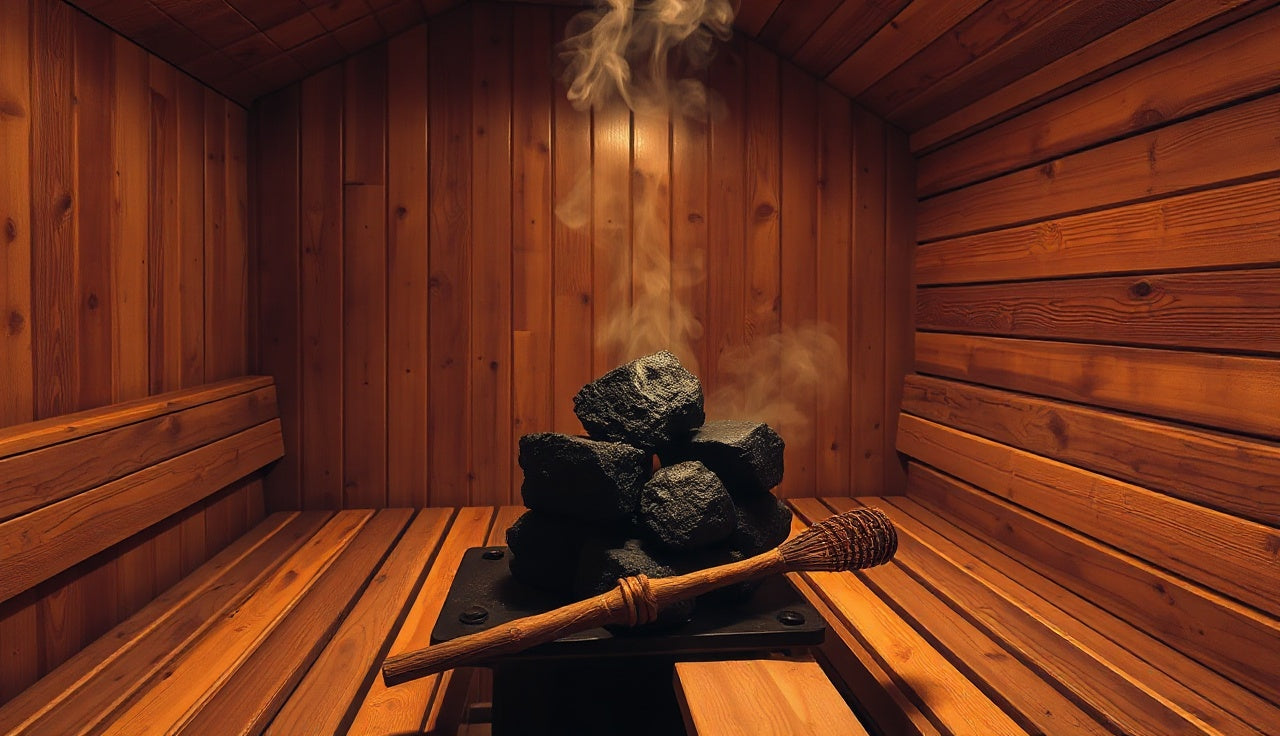
A traditional sauna is a wood-lined room heated to 80°C to 100°C (176°F to 212°F) by a stove, usually electric or wood-burning, topped with rocks. Humidity sits low, usually 10 to 20 percent, until you pour water on the rocks for a burst of steam the Finns call löyly. That steam spike raises the perceived temperature sharply. It is the heart of Finnish sauna culture.
The mechanism is straightforward. Your core temperature rises, your heart rate climbs to somewhere between 100 and 150 beats per minute, and your blood vessels dilate to push heat toward the skin [1]. Sweat output reaches 0.5 to 1 liter per session. That cardiovascular and thermoregulatory response drives most of the health effects researchers have measured.
A steam room is a different animal. It runs cooler (40 to 50°C) but at near-100 percent humidity. The physiological responses overlap, but they are not identical. The sauna vs steam room breakdown covers the practical differences.
A traditional sauna is also distinct from an infrared sauna. Infrared heats your body directly at lower air temperatures (50 to 65°C), which means a different heat exposure profile and, for now, a much thinner body of clinical research.
What does the research say about cardiovascular benefits?
Sauna use is linked to a 40 percent lower risk of all-cause mortality over 20 years in men who go 4 to 7 times a week. That number comes from the Finnish Kuopio Ischemic Heart Disease (KIHD) study, which followed 2,315 middle-aged men for an average of 20 years and compared frequent users to men who went once weekly [2]. Fatal cardiovascular disease risk dropped by 50 percent in the same frequent-use group.
The dose-response relationship held after adjusting for age, smoking, blood pressure, cholesterol, and physical activity. That last part matters. Skeptics reasonably ask whether sauna users are just healthier people to begin with. The KIHD authors adjusted for those confounders, and the association survived. That is not proof of causation. It is stronger than a simple correlation between wellness habits.
Proposed mechanisms include improved arterial compliance (stiff arteries relax with repeated heat exposure), lower systolic blood pressure over time, and an acute blood pressure drop during and right after a session [3]. A 2018 meta-analysis in BMC Medicine found a single sauna session cut systolic blood pressure by roughly 5 to 7 mmHg in the hours afterward [3].
High blood pressure is one of the most common modifiable cardiovascular risk factors, so even small, repeatable reductions matter at a population level. Sauna is no substitute for medication or lifestyle change. The signal is real anyway.
How does sauna use affect athletic recovery and muscle soreness?
Heat after exercise speeds the clearance of metabolic waste, lowers delayed-onset muscle soreness (DOMS), and may support training adaptations through heat shock protein (HSP) upregulation. A 2007 study in the Journal of Science and Medicine in Sport found post-exercise sauna bathing improved 5 km run time over a three-week training block compared to a control group, mostly through plasma volume expansion [4].
Plasma volume expansion is worth understanding. Heat-acclimatize repeatedly and your body expands total blood plasma, which means more fluid for cardiovascular function and for sweat. Endurance athletes get the most out of this. In some studies the effect on plasma volume rivals altitude training.
For strength athletes, the picture is murkier. HSP upregulation should protect muscle proteins from breakdown, but controlled human studies on hypertrophy from post-workout sauna are thin. Here is the honest read: the recovery signal is there, and the performance boost for strength work is plausible but unproven.
Contrast bathing is having a moment: alternating sauna with a cold plunge. Some evidence says the hot-cold cycle beats either one alone for perceived soreness, though the best protocol (temperatures, durations, number of rounds) is still getting sorted out [5].
| Once per week (reference) | 0% |
| 2-3 times per week | 24% |
| 4-7 times per week | 40% |
Source: Laukkanen T et al., JAMA Internal Medicine, 2015
Does sauna use improve mental health and reduce stress?
Anyone who uses a sauna regularly knows the feeling. You come out calmer. The research offers a few candidate explanations for why.
Sauna sessions trigger a real beta-endorphin release. Heat stress is stress, and the body answers with its own opioid system. A Finnish study from 1988, old but still widely cited, measured plasma beta-endorphin before and after a sauna and found a clear rise [6]. Newer work points to dynorphin (a kappa-opioid behind the discomfort during heat stress that may paradoxically feed the post-sauna calm) and to norepinephrine, which climbs sharply during heat exposure.
Sauna use also tracks with fewer depression symptoms in observational data. A 2018 prospective cohort study in Preventive Medicine found self-reported sauna use was inversely linked to diagnosed depression, though it was observational and causation is not established [7].
The sleep effect is real and well documented. Body temperature naturally drops before sleep onset, and the post-sauna cooling curve (core temperature rising, then falling back down) mimics and amplifies that signal. Plenty of users report deeper, more consolidated sleep on sauna nights. The mechanism lines up, even if large randomized trials on sauna and sleep have not landed yet.
Using sauna mainly for stress and mood? 15 to 20 minutes at a genuinely warm temperature (85°C or above) seems to be the dose that moves the needle physiologically.
Can traditional sauna use support longevity?
The KIHD mortality findings are the headline [2]. A 40 percent drop in all-cause mortality over 20 years in the highest-frequency group is a large effect by any standard, and even once-weekly use beat no use at all.
A follow-up from the same cohort looked at dementia. Men who used a sauna 4 to 7 times a week had a 66 percent lower risk of dementia and a 65 percent lower risk of Alzheimer's disease than once-weekly users [8]. The mechanism is speculative. Researchers lean on lower blood pressure, better endothelial function, and the broader cardiovascular pathway.
Remember what this is: a Finnish cohort of men. Applying it to women, to non-Finnish populations, and to other sauna types calls for caution. These men grew up sitting in saunas from childhood, often in a culture that also folds in cold water exposure, regular activity, and an outdoor life. You cannot cleanly isolate the sauna from all of that.
Still, the same signal shows up across cardiovascular mortality, all-cause mortality, dementia, and blood pressure in a cohort tracked for decades. That consistency beats any single short trial. The data is not perfect. It is the best we have, and it points one way.
What temperature and session length gets the best results?
Aim for 15 to 20 minutes at 85 to 95°C, two rounds with a cooling break between them. That mirrors the KIHD protocol, which used traditional Finnish saunas at the standard 80 to 100°C (176 to 212°F) range, with sessions averaging about 14 minutes [2]. Most cardiovascular research treats this as its baseline.
For the acute response (heart rate, blood pressure, peripheral blood flow), meaningful changes start around 80°C after 10 minutes. Hotter and longer amplifies the effect but also raises the risk of dehydration and orthostatic hypotension (the dizzy spell when you stand up). The practical sweet spot for most people stays in that 15-to-20-minute, 85-to-95°C window.
Frequency beats duration. The KIHD data shows a step-up in benefit at 2 to 3 sessions per week over once weekly, and another step-up at 4 to 7 sessions [2]. Going from zero to twice a week likely captures a big slice of the benefit.
Cooling between rounds is traditional and physiologically sound. It drives the vascular swing (vasodilation, then vasoconstriction) that researchers think powers some of the adaptation. A cold shower, a plunge, or 10 to 15 minutes in cool air between rounds is the standard move.
Building a home setup to hit these frequency targets? The home sauna guide covers what to look for and realistic cost ranges.
Does traditional sauna have any benefits for skin and immune function?
The skin benefits are real but modest. Regular heat raises surface blood flow, and sweating may help clear some pore-level debris. The evidence for dramatic skin improvement from sauna alone is thin. Anecdotes about better skin tone are everywhere. Controlled studies are not.
Immune function is the more interesting story. A German study published in 1990, again old but still referenced, found subjects who used a sauna twice weekly caught significantly fewer common colds over six months than a control group [9]. The proposed mechanism: mild hyperthermia making the respiratory tract a worse place for rhinovirus to replicate.
Heat shock protein upregulation, the same mechanism from the recovery section, has immune implications too. HSPs act as molecular chaperones and can shape immune cell signaling. It is an active research area, and the human trials are still early.
One caveat. If you are already sick, especially running a fever, a sauna works against you. You are piling thermal load onto a body already fighting to manage temperature. Finnish sauna guidance and plain common sense agree: sauna for prevention and recovery, not for acute illness.
Who should be careful or avoid traditional sauna use?
The contraindications are fairly settled. People with unstable cardiovascular conditions, including recent heart attack, unstable angina, or severe aortic stenosis, should skip the sauna until a physician clears them [10]. The cardiac demand during a session is real, roughly like moderate-intensity exercise, and a stressed heart may not handle it well.
Pregnancy comes up a lot. Most guidance, including from the American College of Obstetricians and Gynecologists, recommends avoiding prolonged heat exposure (above a 38.9°C core temperature) during the first trimester because of a theoretical neural tube risk [10]. Finnish women have used saunas through pregnancy for centuries without an obvious population-level harm signal, but the conservative clinical advice is short, cooler sessions, or none at all, during pregnancy.
Dehydration multiplies every risk. Going in dehydrated, or failing to rehydrate after, worsens the post-session blood pressure drop and the dizziness that comes with it. Alcohol and sauna is a genuinely dangerous mix. Finnish research found alcohol present in a large share of sauna-related deaths [11]. Impaired thermoregulation and impaired judgment on top of heat stress is a serious combination.
Older adults (70+) and children can use traditional saunas but may handle thermoregulation less well. Shorter sessions and a close eye on how they feel are the right call.
How does traditional sauna compare to infrared sauna for health benefits?
Traditional sauna runs at 80 to 100°C with low humidity. Infrared sauna runs at 50 to 65°C and warms the body with radiant infrared energy instead of hot air. Many people find infrared more tolerable because the air itself is not scorching.
The research bases are not in the same league. Traditional sauna has decades of large epidemiological studies behind it, including the KIHD cohort [2]. Infrared research is mostly small trials, often under 30 participants, with short follow-up. That does not mean infrared fails to work. It means we cannot say so with the same confidence.
For cardiovascular outcomes, the most-cited infrared study is a small Japanese trial showing benefits in chronic heart failure patients at very mild heat (60°C). Stretching that to healthy adults at higher temperatures is exactly that, a stretch.
My honest take: if you are buying a home sauna mainly for research-backed health benefits, traditional is the defensible pick. Infrared has a legitimate case for people who cannot tolerate high heat or want a lower-power setup. It is not a scam. It is just less studied. The sauna benefits overview goes deeper on both side by side.
What is the difference between traditional sauna and Finnish sauna?
In everyday use, Finnish sauna and traditional sauna mean the same thing. The traditional sauna grew up in Finland over thousands of years and sits so deep in the culture that Finland has around 3.3 million saunas for 5.5 million people, per Statistics Finland [12]. The word "sauna" is Finnish, one of only a handful of Finnish words adopted straight into English.
When a product listing splits "Finnish sauna" from "traditional sauna," it usually means a dry Finnish sauna, stressing the low humidity and the kiuas (the stove) with rocks for optional steam. Other traditions (Russian banya, Turkish hammam, Scandinavian variants) share the family resemblance but differ in temperature and humidity.
Here is the practical point. When cardiovascular and longevity research cites "sauna use," it nearly always means the Finnish-style traditional sauna. That is the thermal environment where the health data was generated. A sauna that runs at 60°C or pumps continuous steam is not a traditional Finnish sauna and may not produce the same physiological response.
How do you get started with traditional sauna at home?
Space and cost are the real barriers. A purpose-built outdoor barrel sauna or an indoor room conversion is the reliable way to hold the Finnish-protocol range of 80 to 100°C. Prices swing wide: a basic 2-person outdoor unit starts around $2,000 to $3,000, while a custom indoor room with quality Finnish-brand components runs $10,000 to $20,000 or more. An electric heater in the 6 to 9 kW range is the practical choice for most homes.
If money or space is tight, a portable sauna gets you started, though most portable units top out near 60°C, below the range used in the cardiovascular research. Better than nothing, not equivalent.
Frequency is the variable that matters most in the research, and a sauna at home beats a gym membership with a commute attached. Hitting 4 sessions a week realistically means the sauna has to be easy to reach. That is the main argument for the home investment.
SweatDecks carries traditional and barrel saunas sized for home use, worth a look once you know the footprint and wattage you need.
The protocol itself is simple. Preheat fully (30 to 45 minutes for most electric heaters), enter at 85 to 95°C, stay 15 to 20 minutes, cool down for 10 to 15 minutes, repeat one or two rounds, then rehydrate with water or electrolytes. That is the protocol the Finnish research rests on. Start conservatively if high heat is new to you and build from there.
Is combining sauna with cold plunge better than sauna alone?
Contrast therapy, alternating heat and cold, has run through Scandinavian and Eastern European traditions for centuries. The logic holds up: sauna drives vasodilation and a higher heart rate, cold plunge drives vasoconstriction and a fast heart rate swing, and the oscillation between them may train the vasculature harder than either alone.
The evidence for the combination specifically is thinner than the evidence for sauna alone, mostly because nobody has run large long-term studies on the combined protocol. What exists is short-term trial data showing better recovery markers (lower creatine kinase, lower perceived soreness) with contrast bathing than with a single modality [5].
One nuance worth flagging. Some exercise physiologists argue that cold right after a workout may blunt hypertrophy by suppressing the inflammatory signaling that drives muscle protein synthesis. If maximum muscle growth is the goal, a cold plunge immediately after lifting may not be ideal. Waiting a few hours, or saving cold for non-training days, is the common workaround. The cold plunge benefits article covers this trade-off.
For general cardiovascular and mental health goals, the combination feels good and probably adds value. The risks of cold plunge for healthy adults are low, and the added cold-water exposure seems to amplify the mood and energy lift that sauna produces on its own. If you are building a home recovery setup, a quality ice bath or cold plunge tub next to a traditional sauna is the configuration serious athletes actually run.
Frequently asked questions
How long should you stay in a traditional sauna for health benefits?
Most research, including the Finnish KIHD study, used sessions averaging 14 to 20 minutes per round at 80 to 100°C. Two rounds with a 10 to 15 minute cooling break between them is a common protocol. Beginners should start at 10 minutes and build up. Staying past 30 minutes in a single round raises dehydration and orthostatic hypotension risk without clear added benefit.
How many times a week should you use a sauna?
The KIHD study found a clear dose-response: once weekly showed some benefit, 2 to 3 times per week showed more, and 4 to 7 times per week was linked to the largest cuts in cardiovascular and all-cause mortality. Twice a week is a realistic starting target. Four or more sessions per week captures the larger share of the benefit seen in the research.
Does sauna use help with weight loss?
A session can produce 0.5 to 1 liter of sweat, which shows up as a temporary drop on the scale. That weight returns when you rehydrate, which you must do. There is no credible evidence that sauna use drives meaningful fat loss on its own. Some researchers note a modest bump in metabolic rate during a session, but the caloric effect is small and should not be sold as a weight loss tool.
Can sauna use lower blood pressure?
Yes, modestly. A 2018 meta-analysis in BMC Medicine found a single sauna session cut systolic blood pressure by roughly 5 to 7 mmHg in the hours afterward. Regular use is linked to longer-term gains in arterial compliance. These effects are real but not large enough to replace antihypertensive medications. Anyone managing blood pressure with medication should talk it over with their doctor.
Is sauna good for muscle recovery after exercise?
Post-exercise sauna sessions are linked to faster perceived recovery, lower DOMS ratings, and, in endurance athletes, plasma volume expansion that can improve later aerobic performance. A 2007 study found significant run-time improvements after a three-week post-workout sauna protocol. For strength athletes, the evidence is weaker. The recovery signal is real; the hypertrophy claim is not well supported yet.
What temperature should a traditional sauna be?
Traditional Finnish saunas run at 80 to 100°C (176 to 212°F), with humidity usually at 10 to 20 percent unless water is poured on the rocks. This is the range used in the major Finnish cardiovascular studies. Saunas that top out at 60 to 65°C fall below that research-validated range. For the full physiological response, aim for at least 80°C air temperature.
Can sauna use reduce the risk of dementia?
A Finnish cohort study following 2,315 men over roughly 20 years found men who used a sauna 4 to 7 times per week had a 66 percent lower risk of dementia than once-weekly users. The mechanism is not confirmed but likely involves cardiovascular pathways. This is observational data from one population and is no guarantee, but the effect size is large enough to be worth paying attention to.
Is it safe to use a sauna every day?
In Finnish culture, daily sauna use is common and has been for centuries without population-level harm signals. Physiologically, daily moderate-duration sessions (15 to 20 minutes) in healthy adults appear safe. The main risks are cumulative dehydration (easily managed with proper fluid intake) and, for people with cardiovascular conditions, the repeated hemodynamic load. Healthy adults with no contraindications can reasonably use a sauna daily.
Does sauna use improve sleep?
The thermal mechanism makes sense: your core temperature rises during a session, then falls during the cooling phase, and that drop mirrors the natural decline that precedes sleep onset. Many regular users report deeper, more consistent sleep on sauna nights. Formal clinical trials on sauna and sleep are limited, but the mechanistic logic and the subjective reports are consistent enough to make it a reasonable sleep-hygiene tool.
What is the difference between a traditional sauna and an infrared sauna?
Traditional sauna heats the room air to 80 to 100°C with a wood or electric stove. Infrared sauna uses radiant panels to heat your body at lower air temperatures of 50 to 65°C. The health research base for traditional sauna is far larger, including long-term epidemiological studies with thousands of participants over decades. Infrared research is mostly small short-term trials. Both have legitimate uses; the evidence bases are not comparable.
Can you use a sauna if you have heart disease?
It depends on the condition and its severity. Stable, well-managed cardiovascular disease is generally not a strict contraindication, and some Finnish research followed men with cardiovascular risk factors who used saunas regularly without harm. Unstable angina, recent myocardial infarction, severe heart valve disease, and uncontrolled arrhythmia are conditions where sauna is contraindicated until medically cleared. Always discuss it with your cardiologist first.
How much does a traditional home sauna cost?
Entry-level 2-person outdoor barrel or cabin saunas start around $2,000 to $3,000. Mid-range indoor or outdoor units with quality Finnish heaters run $4,000 to $8,000. Custom indoor sauna rooms with premium components can reach $10,000 to $20,000 or more depending on materials and labor. Installation and electrical work (most home saunas need a 240V, 30 to 60 amp circuit) add $500 to $2,000 depending on your existing setup.
What should you do after a sauna session?
Cool down gradually: a cold shower, a cold plunge, or 10 to 15 minutes in cool air. Rehydrate with water or a light electrolyte drink to replace sweat losses (0.5 to 1 liter per session is typical). Skip alcohol during and right after. If you are doing multiple rounds, the cooling break is the moment to rehydrate. Give yourself 20 to 30 minutes before strenuous exercise or driving if you feel lightheaded.
Does pouring water on the rocks make a traditional sauna more effective?
Pouring water on the rocks (löyly in Finnish) creates a burst of steam that spikes perceived heat without raising air temperature much. It lifts humidity briefly from around 10 percent to 30 to 40 percent. That makes the heat feel more intense and may raise sweat rate in the moment. Whether it changes long-term health outcomes versus dry use is not established, but it is central to the traditional experience and adds to the thermal stimulus.
Sources
- Laukkanen JA et al., Mayo Clinic Proceedings, 2018 – Cardiovascular and other health benefits of sauna bathing: a review: Heart rate rises to 100-150 bpm during sauna; blood vessels dilate; sweat output 0.5-1 liter per session
- Laukkanen T et al., JAMA Internal Medicine, 2015 – Association between sauna bathing and fatal cardiovascular and all-cause mortality events: 4-7 sauna sessions per week associated with 40% lower all-cause mortality and 50% lower fatal cardiovascular disease risk vs once weekly over 20 years in 2,315 Finnish men
- Podstawski R et al., BioMed Research International, 2018 – meta-analysis of sauna and blood pressure: Single sauna session reduces systolic blood pressure by approximately 5 to 7 mmHg in hours following
- Scoon GS et al., Journal of Science and Medicine in Sport, 2007 – effect of post-exercise sauna bathing on the endurance performance of competitive male runners: Post-exercise sauna bathing over 3 weeks significantly improved 5 km run time, attributed to plasma volume expansion
- Versey NG et al., Sports Medicine, 2013 – Water immersion recovery for athletes: effect on exercise performance and practical recommendations: Contrast water therapy (alternating hot and cold) reduces perceived soreness and recovery markers vs single modality alone
- Vescovi PP et al., Hormone Research, 1990 – Plasma beta-endorphin and cortisol levels after sauna exposure: Plasma beta-endorphin levels increase significantly after sauna exposure
- Kunutsor SK et al., Preventive Medicine, 2018 – Sauna bathing reduces the risk of respiratory diseases: a long-term prospective cohort study: Frequent sauna use inversely associated with depression and respiratory conditions in observational cohort data
- Laukkanen T et al., Age and Ageing, 2017 – Sauna bathing is inversely associated with dementia and Alzheimer's disease in middle-aged Finnish men: 4-7 sauna sessions per week associated with 66% lower dementia risk and 65% lower Alzheimer's risk vs once weekly
- Ernst E et al., Annals of Medicine, 1990 – Regular sauna bathing and the incidence of common colds: Subjects using sauna twice weekly had significantly fewer common cold incidences over 6 months vs controls
- American College of Obstetricians and Gynecologists – guidance on heat exposure during pregnancy: Avoiding prolonged heat exposure above 38.9°C core temperature recommended during pregnancy, particularly first trimester
- Hassi J et al., International Journal of Circumpolar Health, 2005 – Sauna-related deaths and alcohol: Alcohol present in significant portion of sauna-related fatalities in Finnish data
- Statistics Finland – sauna statistics for Finland: Finland has approximately 3.3 million saunas for a population of 5.5 million people
Share:
Buying a home sauna on Amazon: what to know before you order
Buying a home sauna on Amazon: what to know before you order