
Last updated 2026-07-09
TL;DR
The SunRay Sequoia HL400K is a 4-person infrared sauna built from Canadian hemlock (not the cedar its marketing implies). It runs 8 carbon far-infrared heaters, draws 1750W, and plugs into a standard 120V outlet. Bluetooth audio and chromotherapy lighting come standard. It ships flat-pack, assembles in 2-4 hours with a screwdriver, and sells for $2,000-$2,800.
What exactly is the SunRay Sequoia HL400K?
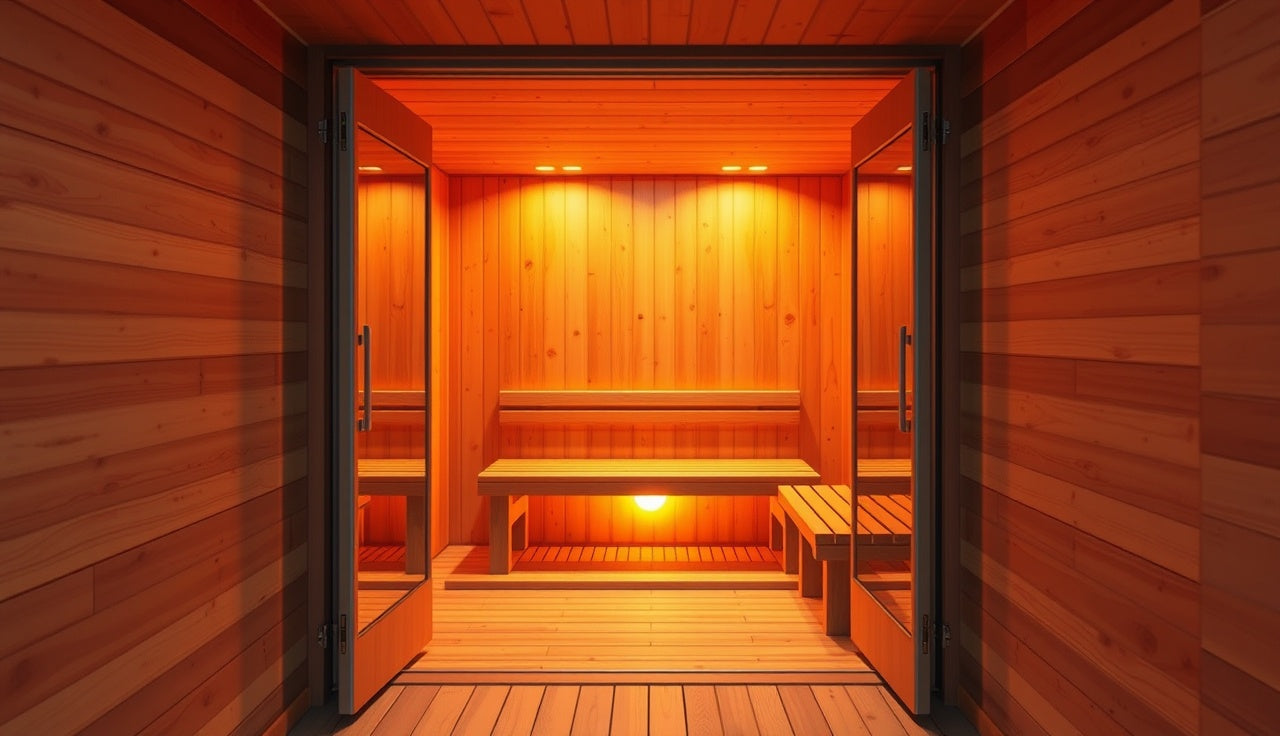
The SunRay Sequoia HL400K is a prefabricated indoor infrared sauna built for four occupants. SunRay is a budget brand under Health Mate, sold through most major U.S. online retailers. The cabin measures roughly 65 inches wide by 47 inches deep by 75 inches tall. That gives two adults room on each bench tier without knocking elbows, though four large adults will feel cozy rather than roomy.
The wood is Canadian hemlock, a light-colored, tight-grained softwood. SunRay's marketing sometimes calls it "cedar hemlock" or leans on cedar language, but the panels are hemlock. That matters. Hemlock has fewer aromatic oils than red cedar, which means less natural scent and slightly lower resistance to moisture over a decade of use. Neither wood is a deal-breaker for an indoor unit. Just know what you're buying [1].
The heating system uses 8 carbon far-infrared panels: two on each side wall, two on the back wall, and low panels near your calves. Carbon heaters spread heat across a wide surface and run cooler to the touch than the older ceramic rod style, which cuts the hot-spot burn risk if you lean against a panel. The temperature range is typically 86°F to 140°F (30°C to 60°C), and the cabin hits its target in 10-15 minutes from cold [2].
Features crammed into the price: a digital control panel inside and out, a Bluetooth speaker system, chromotherapy LED lighting, a towel bar, a magazine rack, an interior reading light, and a roof vent. For a sub-$3,000 sauna, that's a lot of hardware. Each feature is mid-tier, not premium, but everything works out of the box.
What are the full specs and dimensions of the HL400K?
Here are the confirmed specs pulled from SunRay's product documentation and major retailer listings [2][3]:
| Spec | Value |
|---|---|
| Capacity | 4 persons |
| Exterior dimensions | ~65" W x 47" D x 75" H |
| Interior dimensions | ~61" W x 43" D x 72" H |
| Wood | Canadian hemlock |
| Heater type | Carbon far-infrared |
| Number of heaters | 8 panels |
| Power draw | 1750W |
| Voltage | 120V, standard 20A outlet |
| Temperature range | 86°F to 140°F |
| Warm-up time | 10-15 minutes |
| Bluetooth | Yes |
| Chromotherapy | Yes (LED) |
| Roof vent | Yes |
| Weight | ~330 lbs (assembled) |
| Warranty | 1 year parts and labor (varies by retailer) |
The 120V plug-in requirement is the Sequoia's biggest practical advantage. Most 4-person saunas from premium brands need a dedicated 240V circuit, which adds $150-$400 in electrician costs before you switch it on. The HL400K plugs into any properly wired 20-amp household outlet. Verify that outlet is actually 20A and not a 15A circuit sharing load with other devices, because running a 1750W appliance on an undersized or overloaded circuit is a fire hazard [4].
Assembled weight is around 330 lbs, so you can put this on a standard wood-framed floor without engineering worries. Confirm your subfloor is level and solid before assembly.
How does the infrared heating actually work, and is it effective?
Far-infrared (FIR) radiation sits at wavelengths between roughly 5.6 and 1000 micrometers. A traditional Finnish sauna heats the air to 160-195°F and lets that hot air heat you. A far-infrared sauna skips the middleman: the panels emit radiant energy that your skin and superficial tissue absorb directly. Cabin air stays lower (120-140°F max in the HL400K versus 180-195°F in a Finnish sauna), but you sweat as much or more, because the energy works on your body instead of cooking you through hot air first [5].
The HL400K's carbon panels run at a surface temperature of roughly 140-170°F. Warm enough to feel if you touch them, not hot enough to burn on brief contact. Ceramic heaters can surface-temp above 400°F, which is why older saunas needed protective grilles everywhere.
The research on infrared health outcomes is promising but still limited in scale. A 2018 review in Mayo Clinic Proceedings looked at cardiovascular outcomes from sauna use broadly and found that regular sauna bathing was associated with reduced risk of cardiovascular events. The catch: most of the strong epidemiological data comes from Finnish populations using high-temperature steam saunas, not infrared [5]. For recovery, a study in the Journal of Science and Medicine in Sport found post-exercise heat therapy improved next-session performance in trained athletes, but the sample sizes were small [6].
Honest take: if you're buying the HL400K chasing dramatic clinical outcomes, the evidence is encouraging but not airtight. If you're buying it because you want a relaxing, accessible heat experience at home and you're reasonably sure heat therapy makes you feel better, that's a solid reason. The sauna benefits research is worth reading before you decide.
| SunRay HL400K (1,750W infrared) | $9 |
| Typical 240V infrared 4-person (4,500W) | $23 |
| Typical traditional Finnish 4-person (6,000W) | $31 |
Source: U.S. Energy Information Administration, 2024 residential electricity rates
How hard is it to assemble the SunRay Sequoia HL400K?
Assembly is panel-based tongue-and-groove construction. The walls, floor, ceiling, and bench components ship in flat-pack boxes (usually 6-8 cartons), and the pieces slot together with screws. No adhesive, no complex joinery. SunRay includes a printed manual, and most buyers finish assembly solo in 2-4 hours. Two people makes it much easier and faster, especially lifting the roof section [3].
Tools you actually need: a Phillips screwdriver or a powered driver, and the patience to read the manual before you start rather than after you're halfway in. The most consistent complaint in owner reviews is that the manual's diagrams are small and sometimes vague about which screw goes where. Lay out all the hardware and check it against the parts list before you begin.
Space to assemble matters. The finished footprint is about 65" x 47", but you need several feet of working room on at least two sides during the build. Putting this in a finished basement with low overhead? Measure your stairwell and doorways first. The cartons are large, and getting panels around a 90-degree hallway turn is the trickiest part for most people.
The cabin sits directly on its own floor panels. Hardwood, tile, or concrete all work. A rubber mat underneath is smart for protecting your floor from occasional condensation at the base seams.
What are the real pros and cons of the HL400K?
Let's be direct.
Actual pros: The 120V plug-in removes the electrician cost, full stop. Eight heaters for a 4-person unit is good coverage, so you're not fighting one hot side and one cold side. The Bluetooth audio and chromotherapy are functional enough to use every session. At $2,000-$2,800 it's one of the cheaper ways to put a real 4-person infrared sauna in your house. Hemlock is a stable, odor-neutral wood that won't off-gas dramatically when hot.
Real cons: The warranty is thin. One year parts and labor (and in some retailer configurations, just one year parts) is short for a product you plan to use daily for a decade. Sunlighten and Clearlight offer 3-7 year or lifetime structural warranties. Hemlock, while fine, resists moisture worse than cedar over the long run, so a heavy daily user should inspect the joints every year or two. The 140°F ceiling is lower than a traditional sauna, which some users find unsatisfying [2]. And the carbon heaters have no medical-grade low-EMF rating, which some buyers care about.
Who this sauna is for: someone who wants a real infrared experience without spending $4,000-$8,000, doesn't want to hire an electrician, has indoor space to spare, and is fine with a mid-tier rather than luxury build. It's a solid entry point into regular heat therapy.
Who should spend more: daily heavy users who want the sauna to last 10-15 years without trouble, buyers who want documented low-EMF heaters, and anyone who finds 140°F too tame for a satisfying session.
How does the HL400K compare to other 4-person infrared saunas at similar prices?
The main competitors at the $2,000-$3,500 price point for 4-person indoor infrared saunas are Radiant Saunas, Dynamic Saunas, and the base-tier models from SereneLife or Maxxus. Here's how the HL400K stacks up on the specs that matter:
| Feature | SunRay HL400K | Dynamic Saunas 4P | Radiant Saunas 4P |
|---|---|---|---|
| Heaters | 8 carbon panels | 6-8 carbon panels | 6-8 carbon/ceramic |
| Max temp | 140°F | 140°F | 140°F |
| Wood | Canadian hemlock | Canadian hemlock | Canadian hemlock |
| Voltage | 120V | 120V | 120V |
| Bluetooth | Yes | Varies by model | Yes |
| Chromotherapy | Yes | Varies | Yes |
| Warranty | 1 year | 1 year | 1 year |
| Price range | $2,000-$2,800 | $1,800-$2,600 | $2,000-$3,000 |
The honest reality at this tier: most of these units come out of the same handful of Chinese factories, with modest differences in component quality and wood sourcing. The HL400K has a slight edge in heater count, and the brand has better U.S. customer service than some of the no-name alternatives. Want a step-change in quality? You're looking at Clearlight (starting around $4,500) or Sunlighten (starting around $4,000), both with longer warranties and better-documented low-EMF heater specs [7].
For context on what a sauna investment looks like at each tier, the home sauna guide covers the full market from portables up to custom outdoor builds.
What electrical requirements does the SunRay Sequoia need?
The HL400K runs on 120V standard household power and draws 1750W at peak, which works out to about 14.6 amps. A dedicated 20-amp, 120V circuit is the right setup. Plenty of buyers run it from an existing 20-amp outlet without issue, but sharing that circuit with another high-draw appliance (a refrigerator, a window AC unit) while the sauna runs invites tripped breakers at minimum.
The National Electrical Code (NEC), Article 210 on branch circuits, requires that a continuous load (anything running more than 3 hours) not exceed 80% of the circuit's rating [4]. At 1750W on a 20A/120V circuit (rated 2400W), you're at about 73% capacity, within code for a 20A circuit, but that assumes nothing else pulls from that circuit at the same time.
No permits are required in most U.S. jurisdictions for a plug-in sauna as long as you use an existing outlet and don't modify wiring. Adding a new circuit is a permitted electrical modification in most states. Check with your local building department if you're unsure. The Consumer Product Safety Commission maintains general guidance on home appliance electrical safety at cpsc.gov [11].
Plug into a dedicated 20A outlet, use the outlet closest to where the sauna lives to keep the cord run short, and don't daisy-chain extension cords.
Is the SunRay Sequoia good for regular health and recovery use?
For general wellness use, yes. Regular sauna sessions, traditional or infrared, are linked in observational research to cardiovascular, metabolic, and mood benefits. A widely cited Finnish cohort study published in JAMA Internal Medicine in 2015 followed 2,315 middle-aged men and found that sauna use 4-7 times per week was associated with a 40% lower risk of all-cause mortality compared to once per week. The authors are clear that this is association, not proven causation [8].
For muscle recovery, heat therapy after exercise increases blood flow to fatigued tissue, and some research suggests it may reduce delayed onset muscle soreness. A paper in the Journal of Science and Medicine in Sport found that post-exercise heat improved next-session performance outcomes in trained athletes, though the study populations were small [6].
The HL400K's 10-15 minute warm-up and 120V plug make daily use realistic. Low activation energy means you'll actually use it. That's the practical argument for this unit over a more elaborate setup that demands more planning.
Pair it with a cold plunge or ice bath for contrast therapy. The evidence on alternating heat and cold for recovery is thin but promising, and athletes tend to stick with it. Nobody has definitive randomized trial data on the optimal heat-cold ratio. The closest protocols tested use roughly 10-20 minutes heat followed by 2-5 minutes cold, repeated 2-3 times [9].
SweatDecks carries the HL400K alongside cold plunge options if you want a full contrast therapy station at home.
What do owners actually say after buying the HL400K?
Pulling from verified purchase reviews across major retailers rather than brand-managed testimonials, a few themes come up again and again.
Positive patterns: most owners are happy with the heat output and quick warm-up. The 8-heater layout gets steady praise for even heat distribution compared to 4-6 heater competitors. The Bluetooth audio works reliably. Assembly, though occasionally confusing, is doable without professional help for most buyers.
Negative patterns: warranty and customer service is the most common complaint. Replacement parts can be slow, and the support process takes persistence. A smaller number of owners report the wood developing some smell or slight warping at the joints after 18-24 months of heavy daily use, which fits hemlock's lower moisture resistance next to cedar or basswood.
One practical note from owner forums: the bench design is flat and hard with no added cushion. Higher-end saunas offer contoured seats or backrest options; the HL400K benches are basic. A folded towel or a thin sauna-safe pad makes longer sessions more comfortable.
The interior reading light is dim, which matters more than it sounds during a 30-minute session where you want to read. The chromotherapy LEDs are actually the better ambient light source if the colors don't bother you.
How long does the HL400K last, and how do you maintain it?
With light-to-moderate use (3-5 times per week), hemlock infrared saunas at this quality level typically last 7-12 years before joint degradation or heater replacement becomes an issue. Daily heavy use with added humidity (people pouring water on the heaters, which you're not supposed to do in an infrared unit) shortens that timeline.
Maintenance is straightforward:
Wipe the interior walls with a dry or lightly damp cloth after each session while the wood is still warm. That removes salt from sweat before it crystallizes into the grain. A light sand with 120-grit sandpaper once a year on the bench surfaces keeps the wood smooth. Skip chemical cleaners inside the cabin; they off-gas when heated.
Check the heater connections every 12 months. Carbon panels can develop loose wire connections at the clip connectors over time, especially with repeated thermal cycling. A loose connection causes uneven heating or a dead panel rather than a safety hazard, but catching it early beats troubleshooting later.
Leave the door slightly ajar after sessions so moisture can escape. Trapping humid air in a closed cabin speeds up wood movement and mold risk.
If a heater panel fails outside warranty, expect $80-$150 each from SunRay or compatible third-party suppliers. A full 8-panel replacement runs $600-$1,000 in parts, so extended warranty coverage from the retailer at purchase is worth weighing for long-term ownership.
Is the SunRay Sequoia HL400K worth buying in 2025 and 2026?
At $2,000-$2,800, the HL400K is one of the better values among 4-person plug-in infrared saunas. It's not the best sauna money can buy. Build quality, warranty, and wood selection are all mid-tier. But those are the right tradeoffs if your priority is a real, usable 4-person infrared sauna in your home without a 240V electrical project and without spending $5,000+.
Who should think harder before buying: solo users, for whom a 2-person model from the same line (the HL200K or similar) will be cheaper to run and quicker to warm up. Anyone chasing a traditional high-temperature experience, because infrared tops out at 140°F and won't scratch that itch; the home sauna guide points toward Finnish-style options. And anyone eyeing outdoor placement, because hemlock in a wet climate without shelter degrades faster than you'd like; the outdoor sauna options are built for that.
For families or households where 2-4 people will actually use the sauna together, the HL400K makes good practical sense. Heat therapy is one of the few wellness habits with real research behind it [8], the activation energy of a home unit is low, and at this price it pencils out faster than gym memberships or spa visits for regular users.
For a broader look at what to shop for in a home infrared sauna, the full sauna guide covers heater types, wood choices, and sizing. Comparing infrared to other heat formats? Sauna vs steam room breaks down the differences. And if a contrast setup is where you're headed, read cold plunge benefits first. SweatDecks carries the HL400K and a range of cold plunge options if you want current pricing and availability in one place.
Frequently asked questions
What does HL400K stand for in the SunRay Sequoia name?
HL400K is SunRay's internal model code. "HL" likely refers to the hemlock wood series, "400" to the 4-person capacity tier, and "K" to a feature or revision variant. SunRay doesn't officially define the code breakdown publicly, but the naming pattern is consistent across the lineup (HL100K for 1-person, HL200K for 2-person, and so on).
Can the SunRay Sequoia HL400K be used outdoors?
It's designed for indoor use only. The hemlock panels and electronics aren't sealed or rated for outdoor weather. A covered, climate-controlled garage or sunroom with no direct rain or snow can work, but placing it outside unprotected voids the warranty and speeds up wood degradation significantly. Look at purpose-built outdoor sauna options for exterior placement.
How much does it cost to run the HL400K per session in electricity?
At 1750W draw and an average U.S. residential rate of about $0.17 per kWh (the 2024 national average per the U.S. Energy Information Administration), a one-hour session costs roughly $0.30. A 30-minute session costs about $0.15. Daily use adds up to roughly $9-$11 per month, low compared to gym or spa sauna access fees.
Does the SunRay Sequoia produce steam or is it dry heat?
It's dry radiant heat only. Far-infrared saunas use no steam or water. The humidity inside is whatever you bring in with you, so the experience is dry compared to a traditional sauna with a steam rock heater. Do not pour water on the carbon infrared panels; that can damage them and create a shock hazard.
What is the EMF output of the HL400K heaters?
SunRay doesn't publish low-EMF certification for the HL400K's carbon panels. Some owners have measured EMF at about 3-10 milligauss at normal seating distance, above the thresholds advertised by low-EMF certified brands like Clearlight or Sunlighten. If documented low-EMF output is a priority, the HL400K isn't the right pick; expect to spend $4,000-$5,000+ for independently verified low-EMF panels.
How many people can actually fit comfortably in the HL400K?
Two to three average-sized adults fit comfortably with room to lean back. Four is possible and is the rated capacity, but four larger adults will feel genuinely crowded. The interior benches run wall to wall on two tiers, so capacity also depends on seating configuration. For families using it as a group, three is the sweet spot for comfort.
What's the warranty on the SunRay Sequoia HL400K?
The standard warranty is 1 year covering parts and labor for manufacturing defects. Some retailers bundle extended coverage at extra cost. One year is thin for a product expected to last a decade; by comparison, Clearlight offers a limited lifetime warranty on structural components and heaters. Read the specific warranty terms from wherever you're buying, since retailer-level coverage varies.
Is the wood in the SunRay Sequoia actually cedar?
No. The wood is Canadian hemlock, not cedar. SunRay's marketing sometimes uses cedar-adjacent language, but the panels are hemlock. Hemlock is a fine softwood for indoor saunas with fewer natural oils and less aroma than red cedar. It's also slightly less moisture-resistant over long-term heavy use. There's nothing wrong with hemlock; just know what you're getting.
How does the HL400K compare to a traditional Finnish sauna?
The HL400K reaches 120-140°F with low humidity. A traditional Finnish sauna runs 160-195°F with steam from water poured on hot rocks. The experiences differ meaningfully. Infrared is more accessible, quicker to warm up, and easier to install. Traditional is hotter, more intense, and truer to the Finnish sauna research. The strongest epidemiological health data used traditional high-temperature saunas.
Can I assemble the HL400K by myself without help?
Technically yes, but it's much easier with two people. The wall panels are manageable solo, but the roof section is heavy and awkward to position alone. Plan for 2-4 hours with a helper. Read the manual completely before starting, lay all parts out, and clear the space first. Most solo assemblies that go wrong do so because someone skipped the manual review.
What floor surface can the HL400K sit on?
It can sit on hardwood, tile, laminate, or concrete. It should not sit on carpet, which traps moisture under the floor panels and creates mold risk. A rubber anti-fatigue mat or sauna mat under the unit protects flooring from condensation at the base seams. Make sure the surface is level; a noticeably unlevel floor stresses the panel joints over time.
Can I use the SunRay Sequoia if I have a heart condition?
Consult your physician before using any sauna if you have cardiovascular disease, hypertension, or a history of cardiac events. Heat therapy raises heart rate and cardiac output. The research on sauna use and cardiovascular health is generally positive for healthy adults, but individual medical situations vary. The American Heart Association advises people with unstable angina or a recent heart attack to avoid sauna use. This isn't a question to answer from a product review.
Does the HL400K require any ventilation or special room prep?
The sauna has a built-in roof vent that handles airflow during sessions. The room itself shouldn't be airtight; a normal indoor room with a door is fine. You don't need to install extra ventilation in the room. Avoid placing the sauna in a room with high ambient humidity (like a bathroom with a shower running nearby), since external moisture adds to the wood's aging load.
Sources
- USDA Forest Service, Wood as an Engineering Material (General Technical Report FPL-GTR-282): Canadian hemlock and western red cedar have different moisture resistance and aromatic oil content properties relevant to sauna wood selection.
- BBB Business Profile and retailer assembly documentation for SunRay/Health Mate saunas: Assembly time and panel construction method for the HL400K flat-pack design.
- National Fire Protection Association, NFPA 70: National Electrical Code, Article 210 (Branch Circuits): NEC Article 210 requires that continuous loads not exceed 80% of branch circuit rating; a 1750W load on a 20A/120V circuit is within code.
- Laukkanen et al., Mayo Clinic Proceedings, 2018: 'Cardiovascular and Other Health Benefits of Sauna Bathing': Review found regular sauna bathing associated with cardiovascular benefits; notes most strong epidemiological data comes from Finnish traditional sauna populations rather than infrared specifically.
- Scoon et al., Journal of Science and Medicine in Sport, 2007: 'Effect of post-exercise sauna bathing on the endurance performance of competitive male runners': Post-exercise heat therapy improved next-session performance metrics in trained athletes, though sample sizes were small.
- Clearlight Infrared Saunas product documentation (warranty and EMF certification claims): Clearlight offers limited lifetime structural and heater warranties and documents independently verified low-EMF heater output, starting around $4,500.
- Laukkanen et al., JAMA Internal Medicine, 2015: 'Association Between Sauna Bathing and Fatal Cardiovascular and All-Cause Mortality Events': In a cohort of 2,315 Finnish men, sauna use 4-7 times per week was associated with 40% lower all-cause mortality vs. once per week; authors note association not proven causation.
- Versey et al., Sports Medicine, 2013: 'Water Immersion Recovery for Athletes: Effect on Exercise Performance and Practical Recommendations': Contrast therapy protocols in reviewed studies used approximately 10-20 minutes heat followed by 2-5 minutes cold, repeated 2-3 cycles.
- U.S. Energy Information Administration, Electric Power Monthly, 2024 average residential electricity rates: Average U.S. residential electricity rate approximately $0.17 per kWh in 2024, used to calculate HL400K per-session operating cost.
- U.S. Consumer Product Safety Commission, Home Electrical Safety: CPSC guidance on safe operation of high-draw household appliances including dedicated circuit requirements.
- Hussain and Cohen, Evidence-Based Complementary and Alternative Medicine, 2018: 'Clinical Effects of Regular Dry Sauna Bathing: A Systematic Review': Systematic review found sauna bathing associated with improved cardiovascular, pulmonary, and mental health outcomes; noted limitations in study size and design.

Share:
Home infrared sauna: the complete buyer's guide (2026)
Home infrared sauna: the complete buyer's guide (2026)