
Last updated 2026-07-09
TL;DR
The Sun Home Luminar 5-person is a Canadian hemlock cabin built to live outside year-round. It runs full-spectrum infrared, claims under 3 mG EMF at body position, seats five (comfortably four), and retails between $7,000 and $9,000. It's one of the more credible large outdoor infrared options, but you'll need a dedicated 240V circuit and annual exterior maintenance.
What exactly is the Sun Home Luminar outdoor infrared sauna?
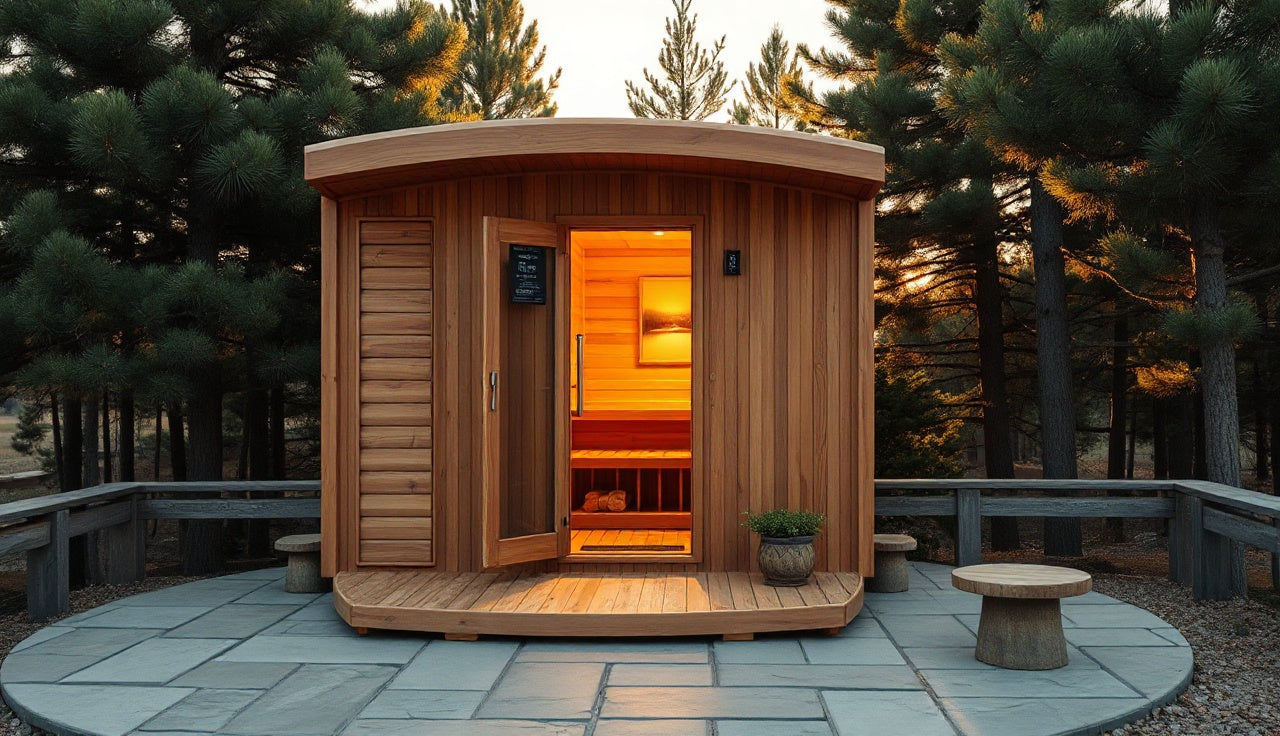
The Sun Home Luminar is a pre-built, outdoor-rated infrared sauna cabin from Sun Home Saunas, a brand that sits in the mid-to-premium slice of the home sauna market. The five-person version is their largest Luminar. It's designed to sit on a deck, patio, or concrete pad through all four seasons, not to get dragged indoors. It's not a barrel, not a pod, not a tent. It's a square cabin with a roof (pitched or flat, depending on your configuration), walls of Canadian hemlock, and full-spectrum infrared heaters built into the interior panels.
Full-spectrum means the unit puts out near, mid, and far infrared wavelengths at once. Near-infrared sits roughly between 700 and 1,400 nanometers, mid runs about 1,400 to 3,000 nm, and far extends from 3,000 nm up. Most cheap infrared saunas are far-infrared only, so the full-spectrum label actually means something here. The claimed benefits of each wavelength band are still getting sorted out by researchers, though. The strongest peer-reviewed work on sauna use comes from Finnish traditional saunas, where frequent use tracked with lower cardiovascular mortality [1]. Nobody has clean randomized data comparing full-spectrum against far-only in a home setting.
The Luminar is built for outdoor temperature swings. The wood is thicker than typical indoor panels and the electrical components are weatherproofed. Sun Home lists the exterior as suitable for four-season use, which matters if your climate runs from 100°F summers to below-freezing winters. Read the warranty language on that claim carefully. Outdoor wood saunas need seasonal maintenance no matter what the marketing says.
Here's how it fits the outdoor sauna category. Outdoor infrared cabins compete with wood-fired barrels, electric-heated cedar cabins, and steam rooms. Infrared heats your body directly at lower air temperatures (typically 120°F to 150°F) versus the 170°F to 195°F of a traditional Finnish-style sauna.
What are the exact specs of the 5-person Luminar model?
Sun Home doesn't publish one locked-down spec sheet, and figures have shifted a little across their site over time. Treat the numbers below as the best current estimates, not guaranteed final specs. Pull the official install documentation before you order.
| Spec | 5-Person Luminar (approximate) |
|---|---|
| Interior dimensions | ~72" W x 72" D x 78" H |
| Exterior dimensions | Adds roughly 4-5" per wall for framing |
| Wood species | Canadian hemlock |
| Heater type | Full-spectrum infrared (near, mid, far) |
| Heater count | 9-12 panels depending on layout |
| Wattage | ~4,000 to 4,800W total |
| Operating voltage | 240V, 20-30A dedicated circuit |
| Temperature range | ~100°F to 150°F |
| EMF at body position | Claimed under 3 mG |
| Weight | ~800-1,000 lbs assembled |
| Roof style | Pitched cedar shingle or flat (verify at order) |
| Warranty | 5 years structural, 1-3 years electrical (verify current terms) |
The 240V circuit is the first thing to plan around. If your house has no 240V line near the install spot, you're looking at an electrician visit and $500 to $2,000 in panel work before the sauna even shows up, depending on the run distance and local labor [2]. That cost rarely enters the buying decision. It should.
Heating to 140°F in mild outdoor temps takes roughly 30 to 45 minutes. Below 30°F, expect closer to an hour. The unit doesn't carry the thermal mass of a traditional sauna, so it won't hold heat after you cut power the way a wood-fired cabin does.
The Canadian hemlock is a sensible pick. It's stable, resists warping better than pine, and has a mild scent. Cedar is more aromatic and a touch more rot-resistant, but hemlock holds up fine outdoors when you seal it. Plan on treating the exterior every year or so, depending on your climate [10].
How much does the Sun Home Luminar outdoor 5-person sauna cost?
The five-person Luminar retails between $7,000 and $9,000, depending on promotions and add-ons. Prices have crept up with material costs, so the low end reflects 2023-2024 pricing and the 2025 number may sit closer to $8,500 or above. Sun Home runs periodic sales that can knock $500 to $1,500 off list.
That's the sauna unit alone. Installed cost is a different animal. Add the electrical work above, a concrete pad or reinforced deck if you don't have one (roughly $1,500 to $5,000 for a proper pad depending on size and region [3]), freight shipping (often $300 to $600), and accessories like a bucket and ladle, towel hooks, or a chromotherapy lighting upgrade if it isn't included. All-in, a properly installed unit lands around $9,000 to $14,000.
Against other outdoor infrared saunas at the same capacity, the Luminar sits mid-market. Budget outdoor cabins from lesser-known brands start around $3,000 to $4,500 for four-to-five person units, but those tend to run higher EMF, thinner wood, weaker weather sealing, and thin parts support. Clearlight and Sunlighten run $12,000 to $20,000 for comparable capacities. The Luminar lands at a price that's credible without being aspirational.
Running cost surprises some people. A 4,500W unit running 45 minutes at $0.15 per kWh (a reasonable mid-range U.S. rate [7]) costs roughly $0.56 per session. Daily use across a year works out to about $200 in electricity. Not alarming. Worth knowing.
| Budget brands (Dynamic, similar) | $4,000 |
| Sun Home Luminar 5-person | $8,000 |
| Clearlight Outdoor Series | $14,000 |
| Sunlighten mPulse (comparable) | $15,000 |
Source: Brand websites and SweatDecks market research, 2024-2025
Is the EMF level in the Luminar actually low, and does it matter?
Sun Home claims the Luminar produces under 3 milligauss (mG) of EMF at body position, the figure that shows up all over infrared sauna marketing. Here's the honest context. The World Health Organization has reviewed the epidemiological evidence on extremely low frequency EMF and, in its own words, concluded that "there is no convincing scientific evidence that the weak RF signals from base stations and wireless networks cause adverse health effects" and similarly finds the ELF evidence unconvincing at typical exposure levels [4]. That's where the science actually stands.
The 3 mG threshold comes from the Bioinitiative Report, a document several national health agencies have criticized for overstating the evidence. The Swedish MPR II standard, often name-dropped in sauna ads, was written for computer monitors and is not a health-based EMF limit for saunas. None of that means high-EMF saunas are proven dangerous and low-EMF ones proven better. It means the science won't hand you a clean answer, and any brand claiming it does is overselling.
What to do in practice: if low-EMF certification matters to you, ask Sun Home for the third-party test report on the five-person Luminar specifically. A serious company will have one. The heater panels in a five-person cabin sit farther from your body than in a two-person box, and that geometry alone tends to lower body-position readings even with identical heaters.
One more thing. If EMF worries you, remember you're already bathed in measurable fields from your home wiring, appliances, and power lines every hour of the day. The sauna is one more source, not the only one.
How does the Luminar compare to other outdoor infrared saunas?
The direct rivals are the Clearlight Outdoor Series, the Sunlighten mPulse, and a handful of Dynamic and Therasage models. Here's where the Luminar lands among them.
Clearlight's outdoor cabins are the benchmark for EMF transparency and build quality in this tier. They publish third-party EMF reports, use a patented True Wave heater system, and have a longer track record on parts availability. Their comparable five-to-six person outdoor cabin runs $12,000 to $18,000. You pay a real premium for that pedigree.
Sunlighten's mPulse models use proprietary SoloCarbon heaters, and the company has peer-reviewed studies run on its own panels, which is rare in this space. Read industry-funded research on a company's own product with some skepticism. The comparable capacity outdoor model also sits above $12,000.
Dynamic and similar brands sell outdoor infrared cabins in the $3,000 to $5,000 range for four-to-five person units. The wood is thinner (often 1-inch versus 1.5-inch in the Luminar), the heaters are usually far-infrared only, and the sealing is lighter. For a covered patio in a mild climate, they work. For year-round exposure in a harsh climate, they degrade faster.
The Luminar plants itself a step above budget brands without touching the Clearlight or Sunlighten price. Whether that math works for you depends on how long you plan to keep it and how much you value third-party documentation over sticker price. If you're weighing this against other home sauna types, read up on how infrared compares to traditional electric and steam before you commit to the technology.
SweatDecks carries several infrared and traditional models if you want to line up specs side by side.
What wood is the Luminar made from and will it hold up outside?
Canadian hemlock is the primary structural and interior wood. Hemlock is a softwood in the same family as fir and spruce. It's not as naturally rot-resistant as cedar or redwood, but it's dimensionally stable, easy to work, and doesn't off-gas resins the way some pines do under heat [10]. For outdoor use that stability matters, because wood that swells and shrinks hard with moisture will crack joints and loosen fasteners over time.
The exterior is the vulnerable part. Hemlock needs sealing, ideally with a penetrating oil or exterior-grade stain, to keep moisture out. Sun Home recommends periodic reapplication (roughly annually in wet climates, every 18 to 24 months in drier ones), though the marketing doesn't always say so plainly. Skip it and you'll see graying, checking (small cracks along the grain), and possibly mold in the joints within two to three years.
The roof is the detail people underestimate. A pitched cedar shingle roof sheds rain and snow far better than a flat one. If you get real snow, confirm with Sun Home that the roof is engineered for the load and get the snow load rating in writing before you order.
For comparison, traditional barrel saunas often use Nordic spruce, Western red cedar, or Thermo-aspen, each with its own trade-offs. Cedar is the most rot-resistant and aromatic. Hemlock is a reasonable, cheaper second choice. The outdoor sauna guide digs further into wood species trade-offs.
What electrical requirements does the Luminar need and who installs it?
The five-person Luminar runs on 240V and needs a dedicated circuit. Sun Home specifies the amperage (typically 20-30A) in the install documentation, so pull that sheet before you call an electrician. Don't assume your dryer outlet or hot tub disconnect can be repurposed. It might work electrically, but the National Electrical Code (NEC) Article 680 and related sections govern outdoor electrical equipment, and your inspector will expect a licensed electrician and a permit [5].
For most homeowners, the job means running a new circuit from the main panel to the install spot, adding a weatherproof disconnect or GFCI breaker, and possibly upgrading the panel if you're near capacity. Cost swings wide: $400 to $600 for a short run to a panel with room, $1,500 to $3,000 and up if the run is long or you need a sub-panel. Get two or three bids.
Assembling the sauna itself is doable for two people with basic tools. The panels come pre-cut and labeled, and most buyers report four to six hours for the build. The weight is the real challenge. Assembled, the unit approaches 1,000 pounds, so you won't be nudging it around once it's together. Set the foundation and location first.
Call your building department before you start. Some jurisdictions require a permit for a permanent outdoor structure this size, and permit rules affect both placement and electrical. Skipping permits can bite you at resale or during an insurance claim [9].
What health benefits does infrared sauna use actually support?
This is where honest writing means holding back. Infrared marketing swings for the fences. The real research is narrower but still interesting.
The most consistent evidence is cardiovascular. A 2018 review in Mayo Clinic Proceedings summarized a large Finnish cohort where frequent sauna use (four to seven times per week) tracked with lower risk of fatal cardiovascular events [6]. That's observational data, and it used traditional Finnish saunas, not infrared. A separate Sunlighten study on its own far-infrared panels reported blood pressure drops after a series of sessions, but industry research on the company's own product deserves a skeptical eye.
For muscle recovery, the evidence is suggestive but thin. A handful of trials found reduced soreness and faster return of strength after far-infrared sessions versus passive rest. The mechanism, if it holds, is probably more blood flow and heat-loosened tissue, nothing exotic. If recovery is your goal, the sauna benefits article covers the research in more depth.
Weight loss claims are mostly hot air. You burn some calories managing heat, but the water weight you sweat off comes right back when you rehydrate. Any real metabolic benefit is a slow, secondary effect of consistent use, not a per-session payoff.
Stress and sleep reports are positive and plausible. Heat exposure nudges the parasympathetic nervous system and bumps endorphins. Nobody has run a rigorous sleep trial on the Luminar specifically, and that's fine. The general physiology of heat-based relaxation isn't controversial [8].
Some users pair a session with cold exposure right after, which the contrast therapy literature suggests may amplify cardiovascular and mood effects. If that appeals, a cold plunge or an ice bath setup next to the Luminar is worth considering.
What do real owners say about the Sun Home Luminar, and what are the common complaints?
Sun Home doesn't have the review volume you'd find on a $400 gadget, which is normal for a premium home sauna. The reviews that exist (on their own site, on Reddit's r/sauna, and scattered across home improvement forums) cluster around a few recurring themes.
On the positive side, buyers say the build feels solid next to the cheap infrared cabins they tried before, the heat is even and comfortable, and the full-spectrum experience runs warmer at lower air temps than the far-only units they've used. The five-person footprint is genuinely roomy for three or four adults and a tight fit for five, which is standard for most saunas rated at five.
The complaints start with delivery. Getting an 800-pound freight item to a residential address is genuinely messy. Curbside delivery means you're on the hook for moving it from the truck to the pad, and buyers get caught off guard by that. Post-sale customer service reads as mixed, with some owners reporting slow replies to technical questions.
A smaller set of reviews mentions the exterior wood weathering faster than expected, which loops back to the maintenance point above. Apply a proper exterior finish before the first rainy season and this seems to mostly go away.
Don't expect factory-perfect joinery. Pre-built wooden sauna cabins at this price are not furniture. Small gaps, minor sanding marks, and the odd rough edge are normal. Expect cabinetry-grade finish and you'll be let down. Expect a sturdy outdoor sauna that heats well and looks good from five feet away, and the Luminar delivers.
Is the Sun Home Luminar worth it, or are there better options for the money?
The honest answer depends on what you're optimizing for.
Want the best-documented, most transparent infrared experience with money as a secondary concern? Clearlight or Sunlighten is probably your pick. Both have longer histories, more independent testing, and stronger parts and service networks. You'll pay $3,000 to $10,000 more for comparable capacity.
Want to stay under $5,000 in a mild climate with covered outdoor space? A budget infrared cabin or a traditional electric sauna is worth a look. The Luminar's edge over budget brands doesn't justify the gap for casual use on a sheltered patio.
The Luminar makes the most sense for buyers who want genuine full-spectrum infrared in a year-round outdoor-ready unit, at a price below the premium tier, and who will do the maintenance and pay for proper electrical. That's a reasonable value case. The brand has grown its reputation steadily, and newer models have cleaned up some of the quality-consistency issues buyers flagged in 2021 and 2022.
One honest note: the five-person label is marketing math. It physically fits five, but running it with five adults at once is a crowded affair. If you genuinely plan to use it as a social sauna for four or five people, the larger footprint pays off. If it's mostly solo and couples use, a three-person model gives you the same session quality at lower cost and easier placement.
SweatDecks carries a curated selection of outdoor saunas, including full-spectrum infrared models, if you want to stack the Luminar against alternatives before deciding.
How do you maintain the Luminar outdoor sauna long-term?
Owning an outdoor wood sauna is more hands-on than an indoor one. The exterior needs annual treatment with a penetrating wood oil or exterior stain, applied when the wood is clean and dry. Leave the interior unpainted and unsealed so the wood can breathe and manage humidity on its own. Wipe the interior down after sessions to keep mold away, and prop the door open for 15 to 20 minutes after each use so moisture can escape.
The heater panels usually need no maintenance, but inspect them once a year for damage. The heating elements inside are the priciest part to replace, and most warranties don't cover them past the first one to three years (check your terms at purchase). Keep small objects and fabric off the panels during use.
The exterior will gray over time even with treatment. That's normal weathering for hemlock, not structural damage [10]. To hold the original color, start applying UV-blocking exterior oil before the first sun exposure, not after you notice the graying.
Test the GFCI protection at the outdoor disconnect once a year. The NEC requires GFCI protection for outdoor electrical equipment, and a GFCI that's tripped repeatedly can degrade [5][9]. A licensed electrician can check it in under ten minutes during an annual inspection.
In freezing climates, the sauna needs no special winterization. The wood is fine below freezing. The one caution is snow on the roof. Know your load rating and clear heavy accumulation before it turns into structural stress.
Frequently asked questions
How many people can actually fit comfortably in the Sun Home Luminar 5-person outdoor sauna?
Three to four adults fit comfortably with room to move. Five can squeeze in, but it's tight with everyone seated. If you regularly host four-plus people at once, the five-person rating is realistic. For solo or couples use, a three-person Luminar would save money and space with no drop in session quality.
Does the Luminar outdoor sauna work in cold climates and below-freezing temperatures?
Sun Home rates the Luminar for four-season outdoor use. In sub-freezing weather, expect heat-up times of 45 to 60 minutes instead of the usual 30 to 35. The hemlock handles temperature swings fine, but the exterior needs proper sealing every year in wet or snowy climates. Clear heavy snow off the roof to avoid structural stress.
What is the EMF level in the Sun Home Luminar and is it safe?
Sun Home claims under 3 mG at body position. The World Health Organization's review of extremely low frequency EMF finds no convincing evidence of health effects at typical exposure levels. If it matters to you, request the third-party test report for the specific model. The larger cabin geometry of the five-person unit tends to produce lower body-position readings than smaller cabins.
What foundation do I need for the Luminar outdoor sauna?
A level, solid surface that supports roughly 800 to 1,000 pounds. A poured concrete pad is the most durable choice, typically 4 inches thick and slightly larger than the sauna footprint. A reinforced wood deck engineered for the load also works. The surface must be level within a tight tolerance or the door alignment and panel fit suffer. Check permit requirements with your local building department.
Does the Sun Home Luminar outdoor sauna require a permit?
In most jurisdictions, a permanent outdoor structure this size and the 240V circuit both require permits. Rules vary by municipality, so contact your building department before ordering. Unpermitted installs can cause problems at resale, during insurance claims, and if a neighbor complains. The electrical work must be done by a licensed electrician in most states regardless of permit status.
How does the Luminar's full-spectrum infrared compare to a traditional Finnish sauna?
Traditional Finnish saunas run 170°F to 195°F and heat you mostly through convection. The Luminar runs 100°F to 150°F and heats your body more directly through infrared radiation. Both make you sweat. Traditional saunas have the stronger epidemiological evidence base, mostly from Finnish population studies. Full-spectrum infrared has some supporting research but fewer large long-term studies. Neither is clearly better; they feel quite different.
Can I use the Sun Home Luminar sauna daily?
Daily use is reasonable for most healthy adults. Sessions of 15 to 45 minutes at 120°F to 150°F are what most infrared research has studied. Drink water before and after. People with cardiovascular conditions, blood pressure issues, or who are pregnant should ask a physician before regular sauna use. There's no evidence that daily infrared sauna use harms healthy individuals.
How long does it take to assemble the Sun Home Luminar 5-person outdoor sauna?
Most buyers report four to six hours for two people with basic hand tools. The panels come pre-cut and labeled. The main challenge is managing the weight of each section before it's secured. The electrical connection should be done by a licensed electrician after the cabin is assembled and set in its final spot. Don't start assembly until the location is finalized.
What is the warranty on the Sun Home Luminar outdoor sauna?
Sun Home offers roughly five years on structural components and one to three years on electrical and heater components, but terms change between model years. Verify the current warranty in writing at purchase. Extended warranty options may exist. Outdoor use can void or limit coverage on some components if the maintenance requirements listed in the documentation aren't followed.
How does the Luminar compare to the Clearlight outdoor sauna at a similar size?
Clearlight's comparable outdoor cabins cost roughly $12,000 to $18,000 versus the Luminar's $7,000 to $9,000. Clearlight has a longer track record, publishes third-party EMF reports routinely, and has an established parts network. The Luminar is a credible middle-market option. If documentation transparency and long-term parts support top your list, Clearlight's premium is defensible. For value-focused buyers who maintain the unit properly, the Luminar is competitive.
Does the Sun Home Luminar have chromotherapy lighting?
The Luminar models typically include or offer chromotherapy LED lighting, either standard or as an add-on depending on the configuration. Chromotherapy (colored LED light) has limited clinical evidence for specific health effects, but it does change the feel of a session. Confirm what's included in your order, since this has varied across model years.
Should I pair the Luminar with a cold plunge for contrast therapy?
Contrast therapy, alternating heat and cold, is popular and the physiology is sound: heat dilates blood vessels and cold contracts them, driving circulation. Research on contrast therapy for recovery is promising but mixed on effect size. If you have or plan to add a cold plunge or ice bath near the sauna, the Luminar's outdoor placement makes the hot-to-cold transition much easier than trekking back inside.
What accessories should I buy with the Sun Home Luminar outdoor sauna?
A thermometer and hygrometer let you actually know what's happening inside. Towels or seat covers protect the wood from sweat and stretch the time between cleanings. A bucket and ladle aren't needed for infrared but are nice for occasional steam. A weatherproof cover helps during long stretches of non-use, like a two-week vacation. An outdoor shower nearby makes post-session rinses easy.
Sources
- JAMA Internal Medicine, Laukkanen et al. 2015, 'Association Between Sauna Bathing and Fatal Cardiovascular and All-Cause Mortality Events': Frequent sauna use was associated with reduced risk of fatal cardiovascular events in a large Finnish cohort study
- HomeAdvisor / Angi, Electrician Cost Guide: Electrical circuit installation for outdoor appliances costs $500 to $2,000 depending on panel distance and local labor
- HomeAdvisor / Angi, Concrete Pad Cost Guide: Concrete pads for outdoor structures cost approximately $1,500 to $5,000 depending on size and region
- World Health Organization, Electromagnetic Fields and Public Health: Extremely Low Frequency Fields: WHO states the evidence for health effects from ELF EMF at typical environmental exposure levels is not convincing
- National Fire Protection Association, NFPA 70 National Electrical Code (NEC), Article 680: NEC Article 680 governs outdoor electrical equipment installation requirements including GFCI protection
- Mayo Clinic Proceedings, Laukkanen et al. 2018, 'Cardiovascular and Other Health Benefits of Sauna Bathing': Review article concluding sauna bathing is associated with cardiovascular benefits based on Finnish cohort data
- U.S. Department of Energy, Electricity Costs and Energy Efficiency: Average U.S. residential electricity cost is approximately $0.12 to $0.17 per kWh depending on region and year
- National Institutes of Health, PubMed Central, Hannuksela & Ellahham 2001, 'Benefits and Risks of Sauna Bathing': Sauna bathing review covering cardiovascular, musculoskeletal, and respiratory effects with safety considerations
- Consumer Product Safety Commission, Outdoor Electrical Safety: CPSC guidance on outdoor electrical safety including GFCI requirements for outdoor fixed appliances
- Forest Products Laboratory, USDA, Wood Handbook: Wood as an Engineering Material: Properties of hemlock and cedar as structural and finish wood including moisture stability and decay resistance

Share:
Cold plunge tank: what it is, how it works, and what to buy
Benefits of sitting in a sauna: what the research actually shows