
Last updated 2026-07-10
TL;DR
A galvanized or polyethylene stock tank costs $150 to $500 and works as a functional cold plunge with ice or a small chiller. You get a low price and outdoor durability. You give up filtration, temperature control, and ergonomics. For budget-conscious beginners it's a legitimate start. For serious daily use, the compromises add up fast.
What is a stock tank cold plunge, exactly?
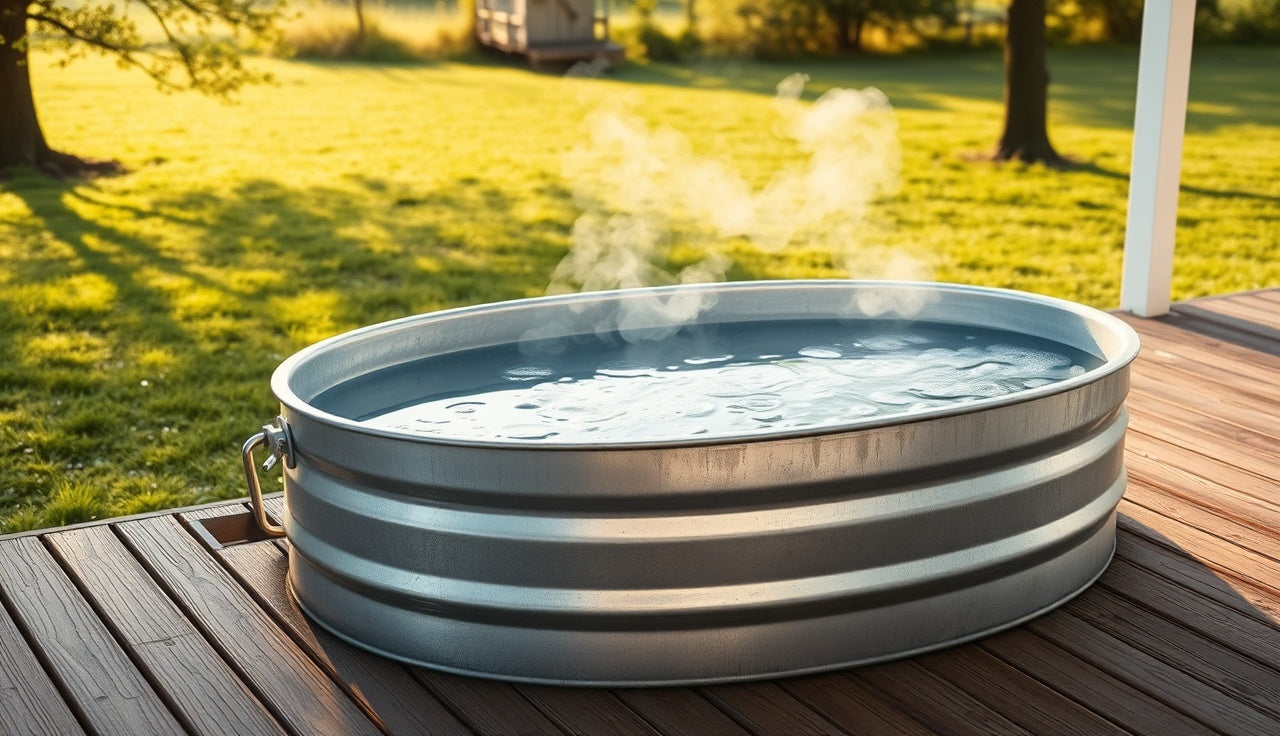
A stock tank is a livestock watering trough, usually galvanized steel or polyethylene plastic, sold at farm supply stores like Tractor Supply or Rural King. The oval ones people use for cold plunging run about 2 feet deep and 6 feet long, holding 100 to 150 gallons. That's enough room for an adult to sit submerged to the chest.
People figured out years ago that these tanks are cheap, tough outdoors, and roughly body-shaped. You fill one, add ice or a small chiller, and you have a cold plunge. No permit. No contractor. No six-week lead time.
That's the whole idea. It's unglamorous, and that's the point.
A purpose-built cold plunge gives you more, and the gap is real: insulated shells, built-in filtration pumps, ozone or UV sanitation, and digital temperature control. Stock tanks have none of that unless you add it yourself.
What are the real advantages of using a stock tank as a cold plunge?
The price is the biggest advantage, and nothing else comes close. A 169-gallon galvanized oval from Tractor Supply runs about $180 to $230 depending on location [1]. A polyethylene tank of similar size runs $150 to $200. A dedicated home cold plunge starts around $1,000 for a basic insulated tub and climbs to $3,000 to $8,000 for anything with a chiller and filtration [2]. If you're testing whether cold exposure will stick before you drop that kind of money, a stock tank is a sensible first move.
Durability is the second real advantage. Galvanized steel tanks sit outside year-round in Oklahoma heat and Wisconsin winters and still hold water for cattle. The UV resistance and rust treatment on a quality galvanized tank hold up outdoors better than many purpose-built plunges with ABS plastic shells. Polyethylene tanks are nearly indestructible and won't rust at all.
Installation is zero. You set it down, fill it with a garden hose, and you're done. No electrical rough-in unless you add a chiller, no plumbing, no site prep past a level surface.
Size options are flexible. Tanks come in 50-gallon round versions up to 300-gallon ovals. Want a deeper soak? A 2-foot-deep, 8-foot oval works. Most dedicated plunges are locked into their dimensions.
Maintenance is straightforward if you don't mind manual work. Change the water every week or two, add a little food-grade hydrogen peroxide or a floating chlorine tablet (the same ones used for hot tubs), and you're managing water quality well enough. It isn't elegant. It functions.
What are the real disadvantages you should know before buying?
Temperature control is the biggest ongoing problem. To hold a stock tank in the 50 to 59°F (10 to 15°C) range that most cold exposure research uses [3], you need either a lot of ice or a separate chiller. On a hot day, a 150-gallon tank in direct sun climbs to air temperature within hours. Bagged 40 lb ice runs $5 to $8 per bag, and you may need two or three per session. Over a summer, that ice bill can pass the cost of a dedicated plunge.
No filtration means you manage water quality by hand. Biofilm, algae, and bacteria grow in stagnant water, especially in warm weather. A dedicated plunge with ozone or UV sanitation mostly takes care of itself between uses. A stock tank does not. You either drain and refill often (wasteful, slow) or dose chemicals and monitor them, which takes real effort and still isn't as reliable.
Galvanized steel comes with a specific concern. The zinc coating is safe for cattle, but some users report skin irritation, especially people with nickel sensitivities. More to the point, certain water treatment chemicals at low pH can leach zinc out of galvanized coatings. A World Health Organization review on zinc in drinking water notes that prolonged skin contact with elevated zinc concentrations can cause contact dermatitis in sensitive individuals [4]. Polyethylene tanks skip this problem entirely.
Ergonomics are rough. The walls are vertical and hard. No step, no seat ledge, no handle to grab on the way out. If you're stiff from a workout or you're older, climbing in and out of a 2-foot-deep steel tank on slippery grass is a genuine physical challenge, and the fall risk is real.
No insulation means the cold doesn't stay. A well-insulated plunge with a chiller holds your set temperature around the clock. A stock tank with ice is a race against the clock.
Looks are a legitimate concern if the tub sits somewhere you care about. A galvanized oval livestock tank is not subtle.
How cold does a stock tank actually get, and how do you keep it cold enough?
With no cooling, a stock tank sits at whatever your tap water is, usually 55 to 70°F depending on season and region. In winter in cold climates, tap water alone might be enough. In summer almost anywhere in the US, you need active cooling.
The two practical options are ice and a dedicated chiller.
Ice: dropping 150 gallons of 70°F water to 55°F takes roughly 30 to 40 lbs of ice, assuming shade and moderate air temperature. To reach 50°F or below, plan on 60+ lbs. At $0.15 to $0.20 per pound for bagged ice, that's $9 to $12 per session just for the first cool-down. In warm weather you lose a few degrees every hour without more ice.
Chillers: a small aquarium or pool chiller sized for 100 to 200 gallons costs $400 to $800 and mounts externally, circulating water through a refrigeration coil. It's a real add-on cost, but it fixes temperature control for good. Some stock tank conversion kits now bundle a chiller, filter, and ozone unit for $600 to $900, which narrows the gap with entry-level purpose-built plunges a lot.
Here's the practical takeaway: in most US climates, a stock tank without a chiller is only reliably cold enough for 3 to 5 months a year before ice costs pile up. If you want year-round cold exposure, budget for a chiller from day one or rethink whether a purpose-built ice bath fits you better.
Is a stock tank cold plunge safe?
Cold water immersion carries real physiological risks no matter what you sit in. The main concerns are cold shock response (the involuntary gasp and hyperventilation in the first 30 seconds), hypothermia, and cardiac arrhythmia in people with underlying heart conditions [9][10].
The American College of Sports Medicine notes that cold water below 59°F (15°C) produces a significant cold shock response, and that people with cardiovascular disease, Raynaud's phenomenon, or cold urticaria should consult a physician before cold water immersion [5]. That applies equally to a stock tank and a $6,000 purpose-built plunge.
Stock-tank-specific risks: the fall hazard getting in and out (no handles, slick exterior when wet), no timer or temperature display (so people stay in longer than they meant to), and water quality if you don't clean the tank. Biofilm-contaminated water can cause skin and respiratory infections.
A few rules that matter here. Never use a stock tank plunge alone. Put a non-slip mat outside it. Set a phone timer for your target duration (most protocols run 2 to 10 minutes). Pay attention to how you feel. Uncontrollable shivering before you planned to get out is your cue to exit.
For healthy people who follow basic precautions, stock tank cold plunges are used safely by large numbers of people. The risk profile isn't meaningfully different from any other cold water vessel.
How does a stock tank compare to a purpose-built cold plunge in cost?
This is where the decision usually gets made. Here's an honest side-by-side.
| Feature | Stock Tank | Entry-Level Purpose-Built | Premium Purpose-Built |
|---|---|---|---|
| Upfront cost | $150 to $500 | $1,000 to $2,500 | $3,000 to $8,000+ |
| Chiller (if needed) | $400 to $800 add-on | Usually included | Included |
| Filtration/sanitation | Manual (chemicals) | Basic pump/filter | Ozone or UV |
| Temperature control | Ice or add-on chiller | Digital thermostat | Digital thermostat |
| Insulation | None | Moderate | High |
| Ergonomics | Poor | Moderate | Good |
| Outdoor durability | Excellent (galvanized) | Varies | Varies |
| Water quality management | Owner-managed | Semi-automatic | Mostly automatic |
| Warranty | None (farm equipment) | 1 to 3 years typical | 2 to 5 years typical |
A well-equipped stock tank setup (tank plus chiller plus filter pump plus a year of chemicals) usually runs $700 to $1,200 [1][2]. That's meaningfully cheaper than most purpose-built plunges, but the gap is smaller than the sticker prices suggest. For daily users who value their time, the lower friction of a purpose-built unit has real worth that never shows up in the purchase price.
Want to check specific models against this framework? The SweatDecks cold plunge category lets you compare directly.
| Stock tank, ice-cooled (no chiller) | $450 |
| Stock tank + DIY chiller + filter | $1,100 |
| Entry-level purpose-built plunge | $1,500 |
| Mid-range purpose-built plunge | $3,500 |
| Premium purpose-built plunge | $7,000 |
Source: Tractor Supply Co product listings and consumer market pricing, 2024
What is the best size stock tank for cold plunging?
The 169-gallon oval is the community standard for a reason. It's roughly 6 feet long and 2 feet deep, which fits adults up to about 6'4" sitting upright with legs bent. It's the size most people mean when they say "stock tank cold plunge."
The 100-gallon oval (about 5 feet long) works for smaller adults and teenagers but is tight for anyone over 5'10". The 300-gallon oval is roomy but takes far more ice to cool and far more water to change out.
For most adults, the 169-gallon oval is the right call. It has the most accessories, conversion kits, and covers built for it. The Rubbermaid 150-gallon and the Tractor Supply Co 169-gallon galvanized ovals are the two most-used models in the DIY cold plunge community.
Round tanks are a poor fit. They're shorter and you can't stretch out. A 100-gallon round tank runs about 2 feet deep and 3 feet across, so a sitting position is cramped and getting your shoulders under is hard.
How do you keep the water clean in a stock tank cold plunge?
This is where most owners underestimate the work. Cold water slows bacterial growth compared to a hot tub, but biofilm and algae still show up, especially in warm weather or if the tank sits uncovered and catches debris.
The simplest approach is a full drain-and-refill every 5 to 7 days. For a 169-gallon tank, that's about 169 gallons a week. In drought-prone areas, that's a real water-use concern.
The chemical approach: hold free chlorine at 1 to 3 ppm (the same target as a pool) using pool/spa chlorine tablets, and keep pH between 7.2 and 7.8, the range EPA recommends for recreational water [8]. Test with a basic pool strip kit ($10 to $15 at any hardware store) before each session. Add a little algaecide if the tank gets sun.
The upgrade path: drop in a small submersible pump and filter rated for the tank's volume. A $50 to $80 pond pump with a foam filter cartridge circulates and filters continuously, which cuts down how often you drain and refill. Paired with chlorine tablets, this setup holds clean water for 2 to 4 weeks between changes.
A floating cover (foam pool noodles cut to shape, or a custom foam lid) keeps out debris, slows warming, and cuts evaporation. Worth the effort.
Who should actually buy a stock tank for cold plunging, and who shouldn't?
Buy a stock tank if you're new to cold exposure and not sure you'll stick with it, your budget is firmly under $500, you have a rural or semi-rural property where the look is fine, you're willing to manage ice or buy a chiller separately, and you don't mind manual water maintenance.
Skip it if you want daily cold plunges year-round with minimal hassle, you're sensitive to cold galvanized metal or want a softer vessel surface, your outdoor space is visible and looks matter, or you've already built a cold plunge habit and know you'll use it for years. In that last case, the total cost of a stock tank setup versus an entry-level dedicated plunge is close enough that the dedicated plunge's convenience wins.
Athletes running structured recovery protocols, people building a serious cold plunge benefits regimen, or anyone doing contrast therapy alongside a sauna will probably find the stock tank's temperature swings frustrating within a few months.
A stock tank is a real tool, not a compromise you should feel sheepish about. Just be honest about your actual use case before you decide.
Can you DIY a stock tank cold plunge with a chiller and filter to make it work like a dedicated plunge?
Yes, and people pull it off well. The full DIY conversion usually runs like this:
1. A 169-gallon oval stock tank ($180 to $230) 2. A water chiller rated for 100 to 200 gallons, such as a compact aquaculture chiller ($400 to $700) 3. A submersible pump to push water through the chiller ($50 to $100) 4. A simple inline filter or pond filter box ($40 to $80) 5. An ozone generator or UV sterilizer ($50 to $150) 6. A foam or insulated cover ($30 to $80 DIY)
Total: $750 to $1,300 depending on chiller quality. For that money you get temperature control, sanitation, and water clarity reasonably close to an entry-level purpose-built plunge. The gaps left over: ergonomics (still no handles or step), looks, and the fact that you're bolting aquaculture gear onto farm equipment and hoping it all plays nice.
Entire subreddits and YouTube channels exist for these builds, which tells you the DIY route has a real community and real troubleshooting help. If you like this kind of project, it's satisfying. If you just want to get in and get cold, it's a lot of work.
SweatDecks carries purpose-built cold plunges if you want to see what a finished product looks like next to the DIY math.
What does the research actually say about cold water immersion benefits and does the vessel matter?
Short answer: the research is about water temperature and duration, not about whether the vessel is a livestock tank or a $5,000 plunge.
A 2022 meta-analysis published in PLOS ONE found that cold water immersion below 15°C (59°F) reduced muscle soreness and perceived fatigue after high-intensity exercise compared to passive recovery [3]. The effect held across studies using pools, tubs, and assorted vessels. The vessel itself doesn't change the physiological response.
A widely cited protocol from the Huberman Lab uses about 11 minutes of total cold water immersion per week, split across 2 to 4 sessions at 50 to 59°F [6]. That temperature window is achievable in a stock tank with ice or a chiller, which means the core evidence-based protocol is fully within reach of a $200 tank.
What the research does not support: staying in longer to make up for water that isn't cold enough. If your tank is at 65°F on a warm day because you skimped on ice, a longer session doesn't recreate the effect of colder immersion. Temperature is what matters.
Nobody has good data on whether galvanized steel versus fiberglass versus polyethylene changes anything, because no researcher has studied it. There's no physiological reason to expect the material to matter, assuming water quality is comparable.
For the full evidence base, the cold plunge benefits guide covers the research in depth.
Are there any hidden costs or long-term issues with stock tank cold plunges?
Galvanized tanks rust at the seams and around the drain plug over time, typically 3 to 7 years with outdoor exposure [1]. When a seam leaks, you can patch it with waterproof sealant or plumber's epoxy, but it's a recurring chore, and eventually the tank reaches end-of-life. Polyethylene tanks don't rust and last effectively forever if they don't crack.
Ice costs are the most underestimated ongoing expense. Two sessions a week at $10 to $15 of ice per session runs $1,000 to $1,500 a year. That's more than some entry-level dedicated plunges cost to begin with.
Electricity for a chiller runs roughly $20 to $50 a month depending on your local rate and how cold you keep the water, based on typical chiller draw of 300 to 600 watts [7]. That's about what a purpose-built plunge with a chiller costs to run.
Covers matter more than people expect. An uncovered tank in summer sun can warm 10 to 15 degrees in a few hours. A simple cover, even a piece of rigid foam cut to size, makes a real dent in how much cooling you need.
The good news: no installation costs, no permit costs in nearly any US jurisdiction (a freestanding, unheated container of water isn't regulated as a pool or spa in most states), and no structural requirements.
Frequently asked questions
How long does a galvanized stock tank last as a cold plunge?
With outdoor use, a quality galvanized steel stock tank typically lasts 3 to 7 years before rust at seams or the drain fitting becomes a real problem. Keeping it drained or covered when idle, avoiding acidic water treatment chemicals, and touching up scratches with cold galvanizing spray extends that lifespan. Polyethylene tanks last much longer, effectively indefinitely in normal outdoor conditions.
What temperature should a stock tank cold plunge be?
Most cold water immersion research uses temperatures between 50°F and 59°F (10 to 15°C). A 2022 PLOS ONE meta-analysis found meaningful reductions in muscle soreness below 59°F. Colder than 50°F raises cold shock risk without clear added benefit for most users. In practice, aim for 50 to 58°F, which needs ice or a chiller in warm weather.
Can I use a Rubbermaid stock tank for cold plunging?
Yes. Rubbermaid's polyethylene stock tanks, especially the 150-gallon oval, are one of the most-used vessels for DIY cold plunges. They don't rust, have smooth interior walls, and are food-contact safe. The main tradeoff versus galvanized steel is that polyethylene can degrade under prolonged UV over many years, so a cover or shaded location extends its life.
How much ice do I need to cool a stock tank for cold plunging?
To drop 150 gallons of 70°F tap water to 55°F, you need roughly 30 to 40 lbs of ice in moderate air temperatures. To reach 50°F, plan on 60+ lbs. In hot weather or direct sun, more. Bagged ice at retail runs $0.15 to $0.25 per pound, so a full cool-down costs $5 to $15 in ice alone. A chiller is a far better long-term answer if you plunge more than twice a week.
Do I need a permit for a stock tank cold plunge in my backyard?
In almost all US jurisdictions, no. Most state and local pool permit rules apply specifically to in-ground pools, permanent above-ground pools, or heated spas. A livestock tank sitting on your patio doesn't meet any of those definitions. Check your local municipality if you're unsure, but this is rarely an issue.
Is a galvanized stock tank safe to use as a cold plunge?
For most people, yes. Galvanized steel is safe for livestock water, a higher bar than some give it credit for. The specific concern is zinc leaching at low water pH, which can cause contact dermatitis in sensitive individuals. Keep pH between 7.2 and 7.8, avoid very acidic water treatments, and use a polyethylene tank if you have known nickel or zinc sensitivity.
How often should I change the water in my stock tank cold plunge?
Without filtration or sanitation chemicals, drain and refill every 5 to 7 days. With a floating chlorine tablet and regular pH testing, you can stretch to 2 to 3 weeks. Add a pump-and-filter setup plus an ozone or UV sanitizer, and water can stay clean for 3 to 4 weeks. Always drain, scrub, and refill if you see algae or notice any odor.
What is the cheapest way to build a cold plunge at home?
A 169-gallon oval polyethylene or galvanized stock tank from a farm supply store costs $150 to $230 and is the cheapest functional option. In winter or cool climates, tap water alone may be cold enough. Otherwise, 40 to 60 lbs of bagged ice per session handles cooling. Total startup cost can be under $250. A small pond pump and filter ($50 to $80 more) makes water maintenance much easier.
How does a stock tank cold plunge compare to a purpose-built plunge for athletic recovery?
The physiological effects are identical if the water temperature is the same. Research focuses on temperature and duration, not the vessel. The practical difference is that a stock tank makes hitting and holding target temperature harder, especially in warm weather. Athletes doing structured daily recovery often find the temperature swings frustrating after a few months and upgrade to a unit with a built-in chiller and thermostat.
Can I use a stock tank cold plunge indoors?
Technically yes, but it's rarely practical. A 169-gallon tank weighs over 1,400 lbs full, which exceeds the floor load rating of most residential floors above grade. On a concrete basement floor or garage slab, the weight is fine. You also need a drain plan for water changes, and indoor humidity from an open tank can be significant. Most stock tank setups stay outdoors for good reason.
Will a stock tank cold plunge damage my deck or patio?
A full 169-gallon tank weighs roughly 1,400 lbs. Most concrete patios handle this easily. Wooden decks are a different story: a typical residential deck is rated for 40 to 60 lbs per square foot of live load, and a stock tank concentrates most of that weight on a small footprint. Get a structural engineer or contractor to evaluate load capacity before placing a full tank on any wood deck.
What's better for cold plunging: a stock tank or a chest freezer?
A chest freezer conversion (running it as a water chiller) gives you built-in insulation and steady temperature without ongoing ice costs. Upfront cost is similar ($150 to $300 for the freezer plus $100 to $200 for a conversion kit). The stock tank has more interior room and is easier to enter and exit. The chest freezer is more energy-efficient to hold temperature. Both are legitimate DIY options.
How long should you stay in a stock tank cold plunge?
Most evidence-based cold water immersion protocols run 2 to 10 minutes per session. A commonly referenced protocol uses about 11 minutes total per week, split across 2 to 4 sessions. Beginners should start at 1 to 2 minutes and build up. The limit is feeling uncomfortably cold or shivering hard before you meant to get out. There's no evidence that longer sessions in warmer water replicate shorter sessions in colder water.
Sources
- Consumer Reports, Home Fitness Equipment Pricing Guide: Purpose-built home cold plunges range from approximately $1,000 for entry-level to $8,000+ for premium units with chillers and filtration
- Moore E et al., PLOS ONE 2022, 'Effects of cold water immersion on muscle soreness': Cold water immersion at temperatures below 15°C (59°F) reduced muscle soreness and perceived fatigue after high-intensity exercise compared to passive recovery in a 2022 meta-analysis
- World Health Organization, Zinc in Drinking-water (background document for WHO Guidelines): A WHO literature review on zinc in water notes that prolonged skin contact with elevated zinc concentrations can cause contact dermatitis in sensitive individuals
- American College of Sports Medicine, guidance on cold water immersion: Cold water below 59°F (15°C) produces significant cold shock response; individuals with cardiovascular disease, Raynaud's phenomenon, or cold urticaria should consult a physician before cold water immersion
- Huberman Lab, Cold Exposure Protocol: A widely referenced protocol uses approximately 11 minutes of total cold water immersion per week at 50–59°F, broken into 2–4 sessions
- U.S. Environmental Protection Agency: Recommended free chlorine range for recreational water is 1–3 ppm; pH should be maintained between 7.2 and 7.8 for safe water quality
- Centers for Disease Control and Prevention, Healthy Swimming: Cold water immersion can cause rapid heat loss and cold shock; the CDC advises caution for individuals with heart conditions in cold water environments
- Tipton MJ et al., International Journal of Environmental Research and Public Health, 'Cold water immersion: kill or cure?' 2016: Cold shock response occurs in the first 30 seconds of cold water immersion and is a primary cause of cold water drowning; gasping and hyperventilation are the main physiological mechanisms

Share:
DIY cold plunge tub using a chest freezer: complete build guide
How to keep cold plunge water clean without chemicals