
Last updated 2026-07-09
TL;DR
You can have a real home sauna or personal steam setup without touching a pipe. Barrel saunas, Finnish saunas, infrared cabins, and tent saunas run on standard electrical circuits with no water hookup. Personal steam pods and plug-in steam generators need only a jug of water you pour in yourself. Costs run from about $100 for a tent sauna to $15,000 for a premium prefab cabin.
What exactly counts as 'no plumbing required'?
Plumbing means a dedicated water supply line and a floor drain tied into your home's drain system. A commercial steam room needs both. A traditional Finnish sauna needs neither. So 'no plumbing required' means the unit runs without those connections.
For saunas, that's almost always true. You pour a ladle of water over hot rocks by hand, and the small burst of steam it makes evaporates into the air. No drain, because there's no standing water. The electrical connection is a separate question: most full-size saunas need a dedicated 240-volt circuit an electrician installs. That's wiring, not plumbing. [1]
Steam is messier. A built-in steam room needs a steam generator, a water feed line, and a drain. But personal steam pods, portable steam tents, and countertop generators run off a reservoir you fill by hand. Pour in distilled water, close the lid, turn it on. That's the whole setup. No pipes anywhere.
Keep this line in mind. 'No plumbing' does not mean 'no electrician ever.' It means nobody cuts into your water lines or your drain stack.
What types of home sauna need zero plumbing?
Every traditional and infrared home sauna needs zero plumbing. Here's how the main types break down.
Traditional Finnish (electric-heated) sauna. A wood-lined cabin with an electric heater that holds rocks. You heat the rocks to 160-200°F (71-93°C), then pour small amounts of water over them for a brief burst of steam called löyly. No drain, no supply line. You do need a 240V/20-30 amp dedicated circuit for heaters in the 4-9 kW range. [1]
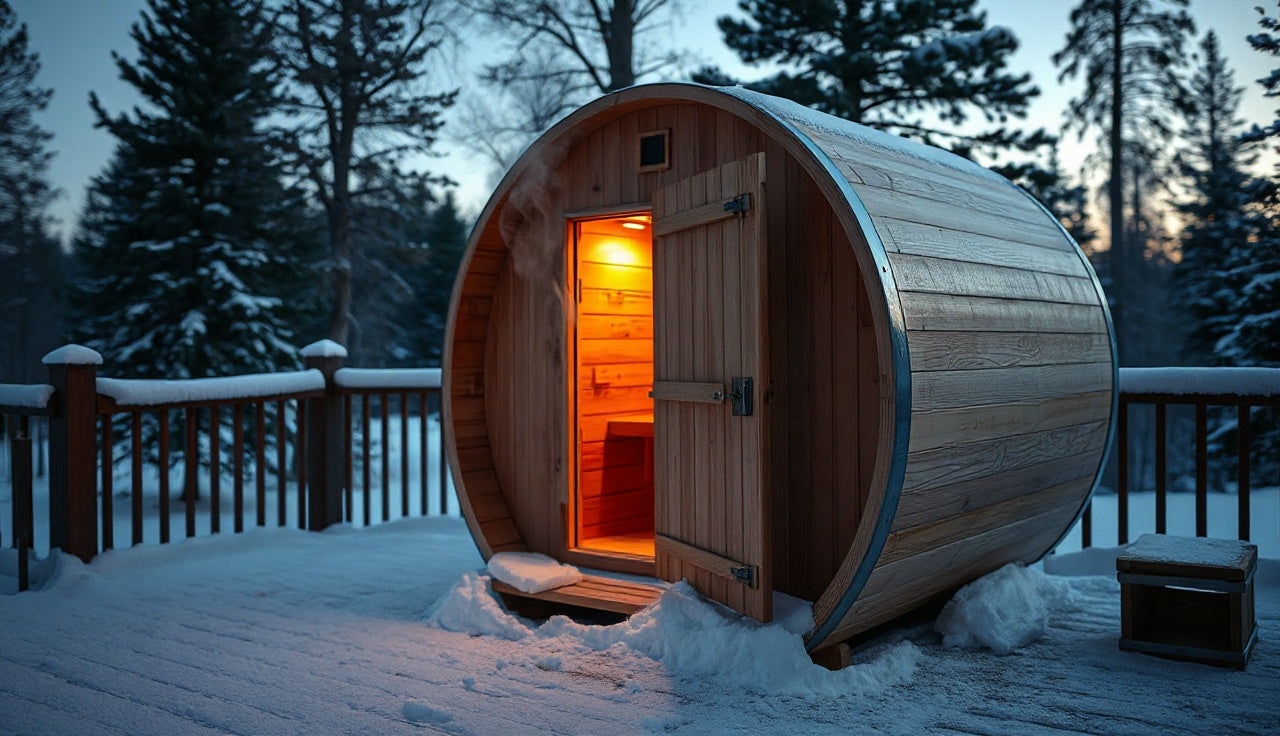
Barrel sauna. Same principle as the Finnish sauna, in a round or oval cedar or pine shell. Usually installed outdoors on a gravel base or deck. Wood-fired models need no electrical connection at all, only a chimney flue. Electric barrel saunas need the 240V circuit. [2]
Infrared cabin. No rocks, no steam. Infrared panels heat your body directly instead of heating the air first. Temperatures run lower, typically 120-150°F (49-65°C). Most 1-2 person infrared cabins run on a standard 120V 15-amp outlet, the same plug as a lamp. Larger 3-4 person models usually need 240V. Zero plumbing in all cases. [3]
Portable tent sauna. A fabric or nylon enclosure with a separate steam generator you fill with water. You sit inside with your head out. These plug into a standard 120V outlet, cost $100-$400, weigh under 10 lbs, and store in a bag. No installation, no permits in most places.
Outdoor prefab sauna. Full prebuilt cabins that arrive in panels or as a complete unit. They install on a level pad with a 240V hookup. Some come with a built-in wood stove option, which skips electrical entirely. No plumbing for any of them. [2]
See our full breakdown of home sauna options for specific brands and sizing guidance.
What steam options work without plumbing at home?
Steam is trickier than sauna because the whole point is saturated water vapor, which means water has to come from somewhere. The only question is whether that water comes from a pipe or a jug you fill yourself.
Personal steam pods and capsules. These look like a reclining capsule or a sitting pod. A built-in reservoir holds 1-3 liters. A heating element boils it into steam inside the sealed shell. You sit inside, steam surrounds your body, your head stays out. No floor drain, no supply line. Most plug into 120V. Cost range is roughly $300-$1,500. They work well for a solo steam session and take up about the space of a recliner.
Portable steam tents. Same idea as the tent sauna above, except the generator makes steam rather than dry heat. You fill the generator reservoir (usually 2-3 liters), and steam floods the tent. Sessions run 15-30 minutes before a refill. These cost $50-$200 and fold flat.
Countertop steam generators (not built into a room). Some people run a small generator next to a sealed bathroom, crack the door, and let steam fill the space. It's informal, humidity control is nonexistent, and it works as a cheap experiment. These units cost $100-$300 and use a hand-fill reservoir. The catch: without waterproof walls, ceiling, and a drain, you're soaking your bathroom finishes over time. I would not do this more than a handful of times.
Steam sauna combos (room-based, still no plumbing). Some makers sell modular acrylic or prefab steam rooms as self-contained kits where the generator has its own internal tank you fill through a small door or port. This is the closest thing to a real steam room without a plumber. The tank holds 1-2 gallons, enough for a 30-45 minute session. These run $3,000-$8,000 installed. You do need a 240V circuit, and the floor where it sits should drain somewhere, so most people put them over a shower drain they already have.
For a side-by-side look at the two heat styles, our sauna vs steam room guide covers the practical details.
| Portable tent sauna | $250 |
| Personal steam pod | $800 |
| 1-2 person infrared cabin | $2,200 |
| 2-3 person traditional electric | $3,500 |
| Barrel sauna (electric) | $5,000 |
| Barrel sauna (wood-fired) | $4,500 |
| Outdoor prefab cabin | $7,000 |
| Prefab steam room (tank-fill) | $5,500 |
Source: Finnish Sauna Society & market pricing, 2024-2026
How much does a home sauna cost without plumbing?
Price swings are wide. Here's an honest range based on real product categories as of mid-2026.
| Type | Low | Mid | High | Plumbing needed? |
|---|---|---|---|---|
| Portable tent sauna | $100 | $250 | $450 | No |
| 1-2 person infrared cabin | $800 | $2,200 | $5,000 | No |
| 2-3 person traditional electric | $1,500 | $3,500 | $7,000 | No |
| Barrel sauna (electric) | $2,500 | $5,000 | $9,000 | No |
| Barrel sauna (wood-fired) | $2,000 | $4,500 | $12,000 | No |
| Outdoor prefab cabin sauna | $3,000 | $7,000 | $15,000+ | No |
| Personal steam pod | $300 | $800 | $1,500 | No |
| Prefab steam room w/ tank | $3,000 | $5,500 | $8,500 | No* |
*Prefab steam rooms with manual-fill tanks need no supply line but do better with an existing floor drain.
The electrician cost is real and people underestimate it constantly. A dedicated 240V/30-amp circuit runs $200-$600 depending on how far the panel is from your install spot and local labor rates. [4] That cost applies to almost any sauna over about 4 kW, which is most barrel and cabin models. Budget for it.
Wood-fired barrel saunas skip the electrical cost but add a chimney, which runs $300-$800 for a basic metal flue kit. If you're in a wildfire-prone area, local fire codes may restrict outdoor wood-burning appliances, so check before you buy. [5]
For a detailed cost analysis of outdoor models, our outdoor sauna guide breaks down site prep costs too.
Do home saunas require permits or inspections?
It depends entirely on where you live and how the sauna is classified. There is no single federal standard. [6]
For indoor saunas, the electrical work almost always needs a permit. The National Electrical Code, adopted by most states, requires a licensed electrician and an inspection for any new 240V circuit. The sauna cabinet itself may or may not need a separate building permit, but the wiring does. [7]
For outdoor saunas, requirements vary by jurisdiction and usually hinge on the structure's footprint and whether it counts as permanent. The International Residential Code, adopted in many states, generally requires a permit for accessory structures over 200 square feet, and sometimes for smaller ones if they carry utilities. Most residential barrel saunas sit well under 200 sq ft. Still, check with your local building department before pouring a concrete pad or running wire underground. [6]
Portable units (tent saunas, plug-in 120V infrared cabins) almost never need permits because they're treated like appliances. The moment you wire a dedicated circuit, that circuit needs a permit even if the sauna itself doesn't.
Homeowner associations are a separate problem. Some HOAs ban outdoor structures outright, regardless of local code. Read your CC&Rs before ordering a 500-pound barrel sauna.
My advice: call your local building department, describe the unit and how it's powered, and ask. A five-minute call can save you an ugly surprise during a home sale inspection.
What electrical connection does a home sauna actually need?
Most people underestimate this part. Here's what's actually required.
Heater wattage sets your circuit size. Sauna heaters are sized by the room's cubic footage, at roughly 1 kW per 45 cubic feet. [1] A standard 2-person sauna is about 200-250 cubic feet, which calls for a 4-6 kW heater. That's a 240V/20-amp circuit minimum. A 4-person sauna might need 8-9 kW, which pushes you to a 240V/40-amp circuit.
Infrared cabins are the exception. Single and 2-person far-infrared cabins usually draw 1,200-1,800 watts, which fits a standard 120V/15-amp household outlet. That one is genuinely plug-and-play. Larger multi-person infrared units step up to 240V.
The NEC (NFPA 70) requires sauna heaters in wet or damp locations to be protected by a ground fault circuit interrupter, and manufacturers typically specify a disconnect switch within sight of the heater. [7] A licensed electrician knows this. A general handyman may not.
A wood-fired sauna needs no electrical connection for heat. You may still want power for lighting, which runs off a standard 120V circuit or even a low-voltage solar setup. It heats up in 45-90 minutes with dry seasoned hardwood.
Budget $300-$700 for electrical if you're buying any electric sauna. That's part of the real cost, not an afterthought.
Is an infrared sauna or a traditional sauna better for home use without plumbing?
Neither wins outright. They give you different experiences and different trade-offs.
Traditional Finnish saunas heat the air to 160-200°F and let you add steam with a water ladle. The high heat is the point for a lot of people. Most of the cardiovascular research comes from studying this style, including a 20-year cohort study from the University of Eastern Finland that found frequent sauna use (4-7 times per week) associated with lower cardiovascular mortality compared to once-weekly use. The authors wrote that the findings "suggest that sauna bathing is a recommendable health habit," though the study was observational and cannot prove cause. [8]
Infrared saunas run cooler (120-150°F). Proponents argue the infrared wavelengths reach tissue more directly, so you sweat at lower air temperatures. A small 2018 trial in Complementary Medicine Research linked infrared sauna use to relaxation and reported gains in sleep and pain, but the samples were tiny (n=18-34 depending on outcome). [9] The honest read: the clinical evidence for infrared is thinner than for traditional sauna.
For home use without plumbing, here's what actually differs.
Heat-up time. A traditional sauna takes 30-60 minutes. An infrared cabin takes 10-20.
Electricity. Many infrared cabins plug into 120V. Almost all traditional electric saunas need 240V.
Space. Infrared cabins have a smaller footprint and some fit in a bedroom corner.
Cost. Entry-level infrared cabins are cheaper at $800-$2,500. Quality traditional electric saunas start around $1,500-$2,000.
Maintenance. Both are low. Traditional saunas need occasional light sanding of benches. Infrared panels can fail over time and may not be serviceable.
Want the classic experience and okay running a circuit? Go traditional. Renting, short on electrical capacity, or after pure convenience? Infrared makes sense. Our guide on sauna benefits covers the research in more detail.
Can a portable or tent sauna actually replace a built-in sauna?
For most people, no. As a starting point or a travel option, absolutely.
Portable tent saunas (also called personal sauna boxes) usually use a separate steam generator you fill with water. The tent is fabric or nylon. You sit inside with your head poking out, and steam heats your body. The inside reaches 100-115°F, below a traditional sauna but enough for a real sweat.
The limits are real. You can't move around or lie down. The fabric holds heat worse than wood, so the experience feels less immersive. Sessions run 15-30 minutes before a refill. There's no social sauna, which is a big part of the Nordic tradition. And the materials wear out faster than a hardwood cabin.
Still, a portable is the only real option if you rent, move often, or want to test the habit before committing $3,000-$8,000 to a built-in. At $100-$400, the downside is small. Plenty of people run one for a year, confirm they actually use it, then buy a proper unit.
Our portable sauna guide covers the models worth buying and the ones to skip.
SweatDecks carries both portable and full-size units if you want to compare specs and prices without digging through dozens of listings.
Where in your home can you install a sauna without plumbing?
More places than you'd think, with a few constraints.
Basement. The most common indoor spot. Basements are usually climate-controlled, close to the electrical panel, and floored in concrete that shrugs off occasional moisture. A 4x6 foot interior sauna fits easily in most finished basements. Cover the concrete with a wooden sauna floor or a removable cedar mat.
Spare bedroom or large closet. Yes, seriously. Prefab interior kits are built for this. A 2-person sauna fits a 6x6 foot footprint, and many spare bedrooms have 10x12 feet or more. You need decent ventilation (a fresh air vent low on one wall and a higher exhaust vent or gap at the door) plus the 240V circuit. No drain, because there's no standing water.
Bathroom. Popular because the existing ventilation and tile floor are already sauna-friendly. A few custom sauna companies build corner units designed for large bathrooms.
Garage. Insulated garages work well. The floor is already concrete, the space usually sits near the panel, and being detached means you don't heat the house during summer sessions. Confirm your garage is insulated well enough or plan to add some, because a leaky garage makes the heater work harder and the session less comfortable in cold months.
Outdoors (deck or yard). Barrel saunas and prefab outdoor cabins sit on a gravel base, concrete pad, or deck. No foundation required in most jurisdictions below a certain square footage. Weatherproof any exposed wood and use a covered or well-sealed electrical connection.
The one constraint that applies everywhere: ventilation. A sauna room needs fresh air intake, ideally near the floor below the heater, and a way for humid air to exit. Skip it and the wood stays wet and grows mold. Most prefab kits include vent kits. On a custom build, plan this first, not last.
What maintenance does a plumbing-free home sauna or steam unit need?
Saunas are low-maintenance by any home appliance standard. Steam pods and portable units ask for a bit more.
For traditional and infrared saunas:
After each session, leave the door open 30-60 minutes to dry the interior. Wipe benches with a damp cloth if needed. Sand them lightly (120-220 grit) once or twice a year if they gray or feel rough. That's most of it.
Heater rocks (in a traditional sauna) need replacement every 3-5 years. Rocks develop micro-fractures from repeated heating and cooling. Swap them when they crumble or when the steam response feels weak. A bag of sauna rocks costs $20-$60. [2]
Infrared panels have no moving parts and generally last 20,000-50,000 hours per most manufacturers, though independent longevity data is thin. Treat the wood cabinet with a sauna-safe oil finish (skip VOC-heavy stains) if it dries out over the years.
For portable steam pods and tent saunas:
This is where maintenance actually matters. Generators fed tap water scale up with calcium and magnesium. Use distilled water every session and descale the reservoir with a diluted white vinegar solution every 4-6 weeks, depending on how often you run it. Neglect this and the heating element dies early.
Dry the tent fabric thoroughly after each use or mildew sets in. Most tent fabrics are not machine washable. A spray of diluted white vinegar and a dry-out in the sun handles most odors.
Storage matters too. Never fold a tent sauna while it's damp. Let it air dry completely before packing.
Can combining sauna and cold plunge work at home without plumbing?
Yes, and you can do both halves with no plumbing at all. This is the contrast therapy protocol that's gotten serious attention in athletic recovery.
The basic loop is alternating heat (15-20 minutes in the sauna) with cold immersion (1-3 minutes in a cold plunge or ice bath), repeated 2-4 times. The research is real but often small-sample. A 2021 review in Sports Medicine found that contrast water therapy (alternating hot and cold) may reduce delayed-onset muscle soreness compared to passive recovery, though effect sizes were modest. [10]
For the cold side, cold plunge tubs and ice bath setups range from a $30 stock tank filled with hose water and ice to a $5,000+ chiller-equipped plunge. The chiller versions run on a standard 120V outlet. They need no floor drain and no supply line beyond your garden hose to fill them the first time.
The setup most people land on: a barrel sauna (electric or wood-fired) outdoors, with a plunge tub next to it. Both sit on a gravel pad. The sauna needs a 240V circuit run out to it. The plunge plugs into 120V. Neither needs a plumber. A mid-range pairing runs roughly $6,000-$15,000 depending on sauna model and chiller quality.
You can start cheaper. A tent sauna plus a chest freezer converted to a cold plunge (a common DIY route) costs under $1,000. Less luxurious, same physiology. See our cold plunge benefits guide for the research rundown.
SweatDecks carries complete contrast therapy setups if you want a matched pair instead of mixing brands.
What are the safety rules for a home sauna or steam unit?
Saunas are safe for most healthy adults used sensibly. The risks are real enough to name plainly.
Dehydration. Twenty minutes in a 180°F sauna can cost you roughly 0.5 kg in sweat. Drink before and after. The Finnish Sauna Society specifically recommends avoiding alcohol in the sauna because it stacks dehydration on top of impaired judgment. [11]
Cardiovascular stress. The American Heart Association notes sauna use appears generally safe for people with stable cardiovascular disease, but those with unstable angina or a recent heart attack should talk to a physician first. Pregnant women should also check with a provider before using saunas. [12]
Carbon monoxide. Wood-fired saunas with a poor chimney draw are a genuine CO hazard. Put a battery-operated CO detector inside any wood-burning sauna, near where people sit. Non-negotiable.
Electrical. GFCI protection on any 240V circuit serving a sauna is required by NEC. Never run sauna heaters or steam generators off an extension cord. [7]
Overheating in children. Kids thermoregulate less efficiently than adults. Many manufacturers and Finnish guidelines recommend limiting children under 7 to brief exposures at lower bench heights, where temperatures are cooler. The lower benches run meaningfully cooler than the upper ones.
Medications. Some drugs (diuretics, certain antihypertensives, sedatives) mix badly with heat stress. If you're on regular medication, talk to your prescriber before starting a routine.
None of these are exotic. They're the same risks managed in public saunas every day. The difference at home is nobody's watching but you, so your own habits carry the load.
Frequently asked questions
Can I install a sauna in my house without any construction work at all?
A plug-in infrared cabin (120V) needs no construction. Unbox it, place it, plug it in. A traditional electric sauna needs a dedicated 240V circuit installed by an electrician, which is wiring work, not major construction. No walls move, no plumbing gets touched. Tent saunas and personal steam pods are true zero-installation options that run on standard outlets and store in a closet.
How long does it take to heat up a home sauna?
Traditional electric saunas take 30-60 minutes to reach 160-190°F, depending on heater size and room insulation. Infrared cabins reach usable temperature in 10-20 minutes because they heat your body, not the air. Wood-fired saunas take 45-90 minutes. Portable steam tent generators reach full steam output in about 10-15 minutes from a cold start.
What is the smallest space that can fit a home sauna?
The smallest practical traditional sauna is about 4x4 feet (16 sq ft interior), enough for one person. Prefab interior kits for 1-2 people commonly start at 4x6 feet. Some upright standing infrared cabins are even smaller. Portable tent saunas collapse to a bag and need no dedicated floor space. For a permanent install, a large walk-in closet or a basement corner is enough.
Do I need a floor drain in a home sauna?
No. A traditional home sauna does not require a floor drain. The water you pour over the rocks is a small amount that evaporates almost entirely as steam. The wood floor wicks up the minor residual moisture and dries between sessions. Built-in commercial steam rooms do need drains, but portable personal steam units and self-contained pod-style capsules do not.
How much electricity does a home sauna use per session?
A 4 kW heater running for 1 hour (30-minute preheat plus a 30-minute session) uses about 4 kWh. At the U.S. average residential rate of around 16 cents per kWh in 2024 (U.S. Energy Information Administration), that's roughly 64 cents per session. A 6 kW heater for a larger sauna runs about 96 cents per hour. Infrared cabins at 1,400 watts cost about 22 cents per hour.
Is a barrel sauna or an indoor prefab sauna better for a backyard?
Barrel saunas handle outdoor weather better because the curved shape sheds rain and snow efficiently and the round design has less surface area to seal. They also look good in a garden. Indoor prefab saunas can go outdoors if the panels are weather-treated, but they're built for sheltered spaces. If weather resistance and looks matter, barrel is the better outdoor pick for most homeowners.
Can I use a home sauna every day?
Daily use is common in Finland, where the tradition started, and Finnish cohort data supports that frequent use (4-7 times weekly) is associated with health benefits rather than harm in healthy adults. The University of Eastern Finland 20-year study tied that pattern to lower cardiovascular mortality. Start with 2-3 sessions per week if you're new, and keep early sessions to 10-15 minutes while your body adapts.
What's the difference between a steam room and a sauna for home use?
A sauna uses dry heat (10-30% humidity) at 160-200°F from heated rocks or infrared panels. A steam room uses 100% humidity at 110-120°F from a steam generator. For home use without plumbing, saunas are easier because they need no water hookup at all. True built-in steam rooms need a supply line and floor drain. Personal steam pods and portable steam tents bridge the gap cheaply.
Will a home sauna add value to my house?
Anecdotally yes, but formal appraisal data is limited. Prefab outdoor structures like barrel saunas are usually classified as personal property or accessory structures and may not show up in a formal appraisal unless permanently affixed. A custom built-in indoor sauna, finished with the rest of the home, is more likely to help resale, especially in cold-climate markets where sauna culture runs strong. Portable units add no home value.
What type of wood is used in home saunas and why?
Western red cedar is the most common because it resists moisture and warping, stays cooler to the touch when hot (it doesn't burn skin the way denser woods can), and smells good. Nordic spruce and white pine are traditional Finnish materials and cost less. Hemlock is common in infrared cabins because it's hypoallergenic and odorless. Avoid treated lumber and formaldehyde-glued plywood in any sauna interior; off-gassing in high heat is a real concern.
Are personal steam pods effective compared to a full steam room?
For sweating, skin warming, and relaxation, personal steam pods produce responses similar to a full steam room, just in a smaller envelope. Your head stays outside the pod, so you breathe room air instead of steam, which some people prefer. The experience is more isolated and less social than a full room. For respiratory benefits (loosening congestion, humidifying airways), the head-out design means you miss the inhaled-steam effect a full room gives you.
Can I build a DIY sauna without plumbing?
Yes, and it's one of the more approachable projects for anyone comfortable with basic carpentry. Walls are typically 2x4 framing with a foil vapor barrier, then tongue-and-groove cedar or spruce boards. The heater is a purchased unit you wire to a dedicated circuit (hire an electrician for that part). Many sauna supply companies sell heater-and-rock packages, bench kits, and vent kits. A basic 4x6 DIY sauna runs $1,500-$3,000 in materials.
What is the best no-plumbing home sauna for a small apartment?
A 1-2 person far-infrared cabin that plugs into a standard 120V outlet is the only real option for an apartment. Models from established makers fit in a corner, need no permanent installation, and can move out when you do. If you rent, confirm your lease allows this type of appliance. Portable tent saunas are even more temporary and cost far less, though the experience is noticeably less comfortable than a wood-panel cabin.
How do I ventilate a home sauna that doesn't have a drain?
Ventilation in a sauna is about fresh air intake and humid air exhaust, not water drainage. The standard approach is a low fresh-air vent (below the heater, near the floor) and a higher exhaust vent or a gap at the door bottom. This creates convection that cycles air through the room. Most prefab kits include vent covers. The goal is enough fresh oxygen for comfortable breathing while moisture-laden air exits so the wood dries between sessions.
Sources
- National Fire Protection Association, NFPA 70 (NEC) Article 424 and sauna heater requirements: Sauna heaters require dedicated 240V circuits; NEC mandates GFCI protection and a disconnect switch within sight of the heater for wet/damp location installations
- Finnish Sauna Society, sauna construction and maintenance guidance: Traditional saunas require no floor drain; rocks should be replaced every 3-5 years; no water supply line is needed for a wood-heated or electric-rock sauna
- U.S. Consumer Product Safety Commission, home appliance electrical safety: Infrared heaters under 1,800W can safely operate on standard 120V 15-amp household circuits
- U.S. Bureau of Labor Statistics, Occupational Employment and Wage Statistics for electricians: Licensed electrician labor costs support the $200-$600 range cited for a dedicated 240V circuit installation
- California Air Resources Board, wood-burning regulation guidance: Some California air quality districts restrict outdoor wood-burning appliances, particularly on Spare the Air days and in designated zones
- International Code Council, International Residential Code (IRC) for accessory structures: IRC generally requires building permits for accessory structures with utilities; thresholds vary by jurisdiction but commonly start at 200 square feet
- NFPA 70 National Electrical Code, Article 680 (special applications) and Article 424: NEC requires GFCI protection for sauna heaters in wet or damp locations and a listed disconnect means within sight of the heater
- Laukkanen et al., JAMA Internal Medicine, 2015: Sauna bathing and cardiovascular mortality: 20-year cohort study from University of Eastern Finland found frequent sauna use (4-7 times/week) associated with significantly lower cardiovascular mortality; researchers stated the findings 'suggest that sauna bathing is a recommendable health habit'
- Masuda et al. / complementary infrared sauna research, Complementary Medicine Research: Small trials on infrared sauna use found associations with relaxation, improved sleep, and reported pain reduction; sample sizes were 18-34 participants
- Bieuzen et al., Sports Medicine, 2021: Contrast water therapy and recovery meta-analysis: Contrast water therapy may reduce delayed-onset muscle soreness compared to passive recovery; effect sizes were modest across studies reviewed
- Finnish Sauna Society, sauna safety and use guidelines: Finnish Sauna Society explicitly recommends avoiding alcohol during sauna use due to combined dehydration and impaired judgment risks
- American Heart Association, cardiovascular considerations for heat therapy: AHA guidance indicates sauna use is generally safe for stable cardiovascular patients but should be avoided by those with unstable angina or recent MI without physician clearance
- U.S. Energy Information Administration, Average Retail Price of Electricity 2024: U.S. average residential electricity rate was approximately 16 cents per kWh in 2024, used to calculate per-session sauna operating cost

Share:
Infrared sauna detox: what the science actually says
Infrared sauna and weight loss: what the evidence actually shows