
Last updated 2026-07-09
TL;DR
Sisu builds barrel and cube saunas designed to pair with matching cold plunge tubs, usually $3,000 to $12,000 depending on size and wood. The units are Finnish-inspired, made for outdoor use, and set up for contrast therapy at home. This guide covers what you get, how Sisu compares to alternatives, and how to run a real sauna-cold plunge protocol.
What is Sisu sauna and what does the brand actually make?
Sisu is a US-based sauna brand that borrows its name from the Finnish word for grit. The company builds barrel saunas, cube saunas, and matching cold plunge tubs aimed at homeowners who want a permanent outdoor setup. The pitch is authenticity: Finnish sauna tradition, thick-stave cedar or hemlock barrels, and proper high-heat dry sessions instead of the watered-down steam most people get at a gym.
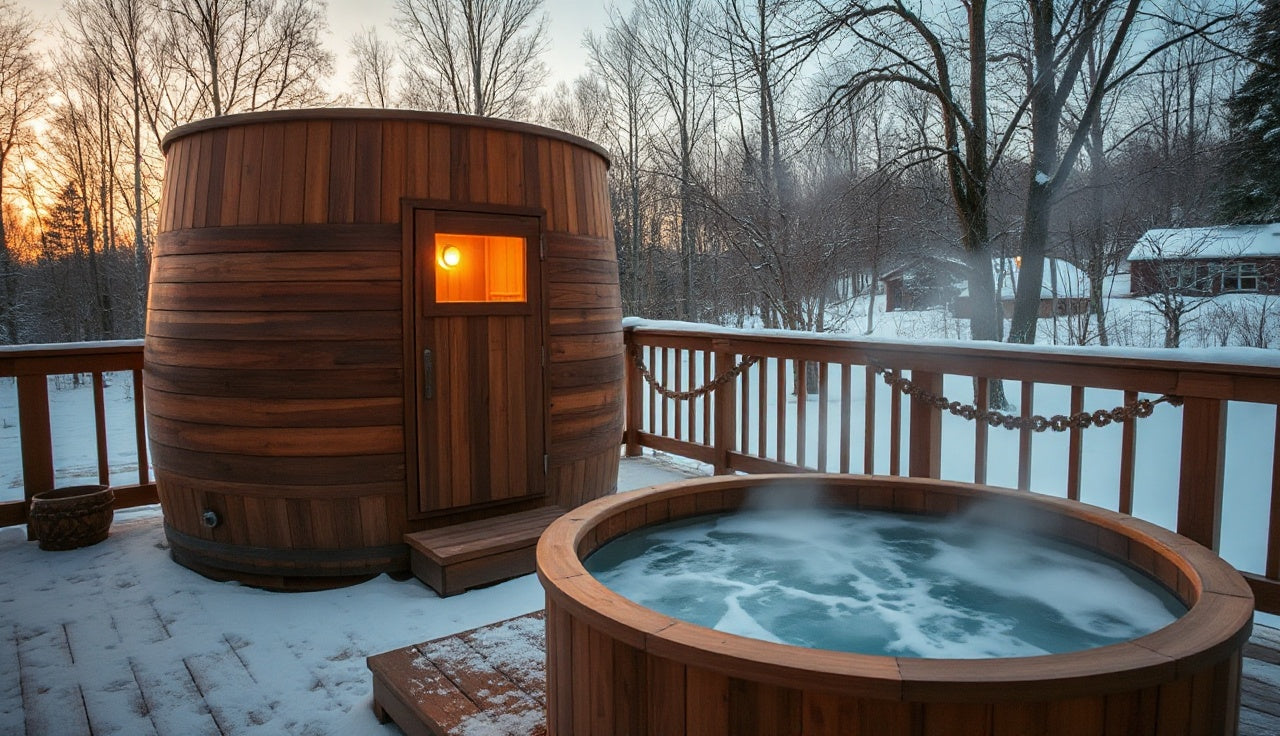
The line splits into a few categories. There's the classic barrel sauna in several diameters (most commonly 5-foot and 6-foot), a pod or cube-style sauna for people who want more headroom, and standalone cold plunge tubs sized to sit next to those units. Accessories include benches, wood-fired heaters (Harvia and Tylo), and electric heater upgrades for buyers who want precise temperature control without splitting wood.
Prices swing hard. Entry-level Sisu barrel kits start around $3,000 to $4,500 for a smaller electric unit. Larger barrels with premium wood, a wood-fired heater, and the matching cold plunge tub can pass $12,000 to $15,000 once you add delivery and basic electrical work [1]. Those numbers move with lumber prices and shipping zone, so confirm current pricing directly.
What separates Sisu from the flood of cheap Amazon barrels is build spec. They use thicker staves (typically 1.5-inch to 1.75-inch) and kiln-dried clear-grade cedar, which matters for longevity in wet climates. Sisu is not the only credible option at this price. Almost Nordic, Finnleo, and several Canadian makers compete directly. Sisu's edge is usually lead time and US-based support.
How does a sauna and cold plunge combo actually work?
The protocol is simple. Heat the sauna to somewhere between 150°F and 195°F, sit for 10 to 20 minutes until you're genuinely sweating, then get out and into the cold plunge at 50°F to 60°F for 1 to 5 minutes. That cycle is contrast therapy, also called contrast hydrotherapy, and it has been studied for decades in athletic recovery and cardiovascular research [2].
The heat phase causes vasodilation. Blood vessels near the skin expand, heart rate climbs, core temperature rises. The cold phase causes vasoconstriction. The rapid shift forces your cardiovascular system to work hard, and the rebound warming after you climb out is the "glow" that keeps people coming back.
Most people run two to four rounds per session. Finnish tradition usually ends on heat, not cold, though plenty of athletes prefer ending cold for the alertness. Neither is wrong.
Proximity is the whole game. If your cold plunge sits 50 feet from the sauna door, you'll shed body heat crossing the yard, and you'll skip the cold round entirely in February. Sisu sizes its tubs so they can sit within arm's reach of the sauna door. That's a real design choice, not marketing language.
The cold plunge itself needs a chiller if you want reliable cold water year-round. Sisu sells tubs with integrated chillers and without. Skip the chiller and you're adding ice or leaning on cold groundwater, which works in cold climates and fails everywhere else. See our full cold plunge after sauna guide for sequencing detail.
What does research say about sauna and cold plunge benefits?
The research is stronger on sauna than on cold plunge, and stronger on each alone than on the two combined. Here's what the data actually shows.
On the sauna side, a Finnish cohort study in JAMA Internal Medicine in 2015 followed 2,315 men over roughly 20 years. Men who used a sauna 4 to 7 times per week had a 40% lower risk of all-cause mortality than once-weekly users [3]. The study was observational, so it doesn't prove causation, but the dose-response held across cardiovascular endpoints. That is the most-cited sauna longevity figure in existence, and it comes from a credible journal.
On cold water immersion, a systematic review in PLOS ONE reviewed 99 studies and found consistent evidence for reduced muscle soreness and perceived fatigue after exercise, with water at 10°C to 15°C for 10 to 15 minutes producing the largest effect on delayed-onset muscle soreness [4]. The authors also flagged that cold water immersion may blunt training adaptations, muscle hypertrophy specifically, if used right after strength work. That caveat matters if you lift.
Contrast therapy on its own has fewer large randomized trials. A 2013 review in the Journal of Strength and Conditioning Research found some evidence for faster perceived recovery versus passive rest, but the effect sizes were modest [5]. Honest summary: the sauna benefits for cardiovascular health are the best-supported claim. Cold plunge for acute soreness has decent evidence. The combined protocol feels great but is studied less rigorously than either half.
Health claims stay in the "associated with" lane. Nobody should buy a sauna because a salesperson said it cures something.
| 1x per week (baseline) | 0% |
| 2-3x per week | 24% |
| 4-7x per week | 40% |
Source: JAMA Internal Medicine, Laukkanen et al., 2015
How does Sisu compare to other sauna and cold plunge brands?
Sisu's real advantage is the matched look between the sauna and the cold plunge tub. Against the main outdoor competitors it lands mid-to-upper range on price with US support and full-kit convenience. The table below is approximate as of mid-2025 and varies by configuration.
| Brand | Entry barrel price | Cold plunge option | Wood type | Heater choices | Ships to |
|---|---|---|---|---|---|
| Sisu | ~$3,500 | Yes (matched tub) | Cedar, Hemlock | Electric, Wood-fired | US, Canada |
| Almost Nordic | ~$4,000 | No (partner brands) | Red Cedar | Electric, Wood-fired | US, Canada |
| Dundalk Leisurecraft | ~$3,000 | No | Red Cedar | Electric, Wood-fired | US, Canada |
| SaunaLife | ~$4,500 | No | Garapa, Cedar | Electric, Wood-fired | US |
| Plunge (cold only) | N/A | ~$4,990 (chiller incl.) | N/A | N/A | US |
If visual cohesion matters, and for a lot of buyers it does, the matched cedar-wrapped tub next to the barrel looks intentional. The Plunge brand makes arguably the most polished standalone cold plunge on the market, but you'd pair it yourself with any sauna.
Dundalk undercuts Sisu on price and has excellent build quality on the Canadian side. SaunaLife has cleaner finish work in some models. Sisu's service reputation reads positive in owner forums, though lead times have stretched to 6 to 12 weeks during peak season.
Want the cheapest path to the same experience? A Dundalk barrel plus a separate Plunge tub, or even a stock tank with a chiller, gets you there for less. Want one vendor, one aesthetic, one matched kit? Sisu is a reasonable pick.
What size sauna and cold plunge should you get?
Size decisions are more important than they look, and most first-time buyers go too small. For a solo user or couple, a 5-foot diameter barrel works. For hosting, jump to 6-foot. For the cold plunge, a 2-person tub is the floor if you'll ever share. You can't add space later, so err large.
A 5-foot barrel seats two adults comfortably and three if everyone's close. The moment you host sauna nights with more than two guests, the 6-foot diameter earns every dollar of the upgrade.
Length matters too. Standard barrel lengths run 4 feet, 6 feet, and 7 feet. A 4-foot barrel is a sit-only experience. A 6-foot to 7-foot barrel lets you lie down for the full lounging session, which is how most Finnish sauna users actually use theirs.
For the cold plunge, a 2-person tub (roughly 80 inches by 35 inches) is the minimum worth buying if you'll ever share sessions. Solo tubs cost less to chill but box you in. Chiller sizing is the spec most buyers ignore: an undersized chiller can't hold 55°F on a 90°F day. Look for at least 1/3 to 1/2 HP for a 300-to-400-gallon tub in warm climates.
Sort out electrical before you buy. A typical 6-kW electric heater needs a 240V, 30-amp dedicated circuit. Many homes need a new circuit run from the panel, which costs $300 to $900 depending on distance [6]. A wood-fired heater skips that electrical cost but adds maintenance and slower heat-up (60 to 90 minutes versus 30 to 45 for electric).
For a home sauna you'll use year-round, plan for weatherproof decking, real drainage for the cold plunge, and a cover for both units. These aren't optional niceties.
What's the best protocol for cold plunge after sauna?
Start with a heat-cold-heat-cold-heat sequence and settle on what feels right. The protocol below holds up across both the athletic recovery literature and traditional Finnish practice.
Round one: enter the sauna at 170°F to 190°F. Sit 10 to 15 minutes. You should be sweating heavily. Get out, rinse briefly if you want, and drop into the cold plunge at 50°F to 59°F. Stay 1 to 3 minutes. Climb out. Rest 5 to 10 minutes. That's one round.
For recovery, two to three rounds is the standard in the athletic literature [4]. For enjoyment, most people do two and call it. Total session usually runs 45 to 90 minutes.
Hydration is not optional. You lose roughly 0.5 to 1 liter of sweat per 10-minute sauna session [7]. Drink water before and between rounds. Electrolytes help on long sessions.
Skip alcohol before and during sauna use. The Finnish Sauna Society warns against mixing alcohol with sauna because of cardiovascular strain, and several studies have tied sauna-related deaths to alcohol [8]. Cold immersion after drinking is doubly risky, since cold shock can trigger cardiac events in vulnerable people.
Don't rush the cold. The first 30 seconds are the hardest. Breathing spikes and the urge to bail is strong. Control your breath through that half-minute and the rest is manageable. Box breathing (four in, hold four, four out) works well.
Consistency beats intensity. A short cold plunge three times a week does more than one heroic ice bath every two weeks. Our cold plunge benefits guide covers the long-term payoff.
What are the health risks of sauna and cold plunge use?
This is where you get honest instead of reassuring. Sauna carries real cardiovascular risk for people with existing heart disease, uncontrolled hypertension, or recent cardiac events. Cold immersion carries its own shock risk. For healthy adults both are manageable. For a lot of others they need a doctor's sign-off first.
Core temperature during a traditional Finnish sauna can rise to 38°C to 40°C (100°F to 104°F), and heart rate can climb to 100 to 150 bpm, close to moderate exercise [9]. Healthy people tolerate this fine. A heart condition changes the calculus.
Cold water immersion triggers the cold shock response in the first 30 seconds: involuntary hyperventilation, a heart rate spike, and a sudden jump in blood pressure [10]. Most people ride it out. For someone with arrhythmia or coronary artery disease, that spike can be dangerous. The UK's National Water Safety Forum has documented drowning deaths tied to cold shock in outdoor swimmers, though the mechanism differs from a controlled plunge tub.
Pregnancy is a contraindication for both high-heat sauna and cold immersion. The American College of Obstetricians and Gynecologists recommends pregnant women avoid raising core temperature above 102.2°F (39°C), which a full traditional sauna can produce [11].
Children under 12 should use sauna at lower temperatures for shorter durations. There's no specific US federal guideline, but most manufacturers follow European practice: lower temperatures and adult supervision.
If you're healthy, the risks are manageable and the practice has centuries of use in Finland with a strong safety record. Don't let enthusiasm outrun common sense early on.
How do you install a Sisu sauna and cold plunge at home?
Installation is where the real cost of any outdoor sauna hides, and it's easy to underestimate. Budget for a foundation, a 240V circuit, and drainage for the plunge before you fall in love with a barrel.
The foundation comes first. A barrel sauna needs a level, stable base: a concrete pad, compacted gravel, a pressure-treated deck, or purpose-built sauna pads. A poured concrete pad runs $4 to $8 per square foot installed [6]. For a 7-foot barrel that's roughly a 10-by-10-foot footprint, so figure $400 to $800 for the pad alone.
Electrical: a 240V circuit is non-negotiable for electric heaters. Get quotes from a licensed electrician before you order the unit. Some areas require a permit for new circuits, and the fee usually runs $50 to $150 by municipality.
Plumbing for the cold plunge means a water supply and a drain. A garden hose bib handles filling. Draining a 400-gallon tub without a proper drain means a submersible pump and a hose to the yard or a sewer cleanout. A plumber can rough in a real drain for $200 to $600 depending on your setup.
Sisu ships most units pre-assembled or as a kit, depending on the model. A barrel kit takes two adults four to six hours with basic tools. Owners generally call the instructions clear, though some report minor mismatches between instruction revisions and current hardware.
Permit rules vary by jurisdiction. Many municipalities classify a freestanding outdoor sauna as an accessory structure and require a permit above a certain footprint (commonly 120 to 200 square feet). Check with your building department before ordering. Some jurisdictions apply specific electrical-code requirements to sauna heaters under National Electrical Code Article 424 [12].
Comparing before you commit? SweatDecks carries a selection of outdoor saunas and cold plunge tubs that ship direct. Worth a look at the lineup before you finalize anything.
How do you maintain a Sisu sauna and cold plunge?
Maintenance is the part most buyers ignore until they're scooping algae out of a cold plunge at 6 AM. The sauna needs periodic wood care and a heater check. The cold plunge needs real water chemistry. Both need covers.
For the sauna, exterior care depends on climate. Cedar resists moisture and insects on its own but benefits from a UV-protective exterior oil or stain every one to three years, more often in high-UV or wet climates. Interior cedar should never be painted or sealed; it needs to breathe. Wipe the interior benches with a damp cloth after each use to keep sweat residue from building up. Sand lightly if the wood roughens or stains after a season.
The heater needs an annual look. Sauna rocks crack and degrade, so check them and plan to replace every three to five years. Inspect the heating element on electric units. Wood-fired heaters need ash cleaned out regularly, and if you burn heavily, get the flue checked yearly for creosote.
For the cold plunge, water chemistry is the whole battle. A raw tub with no chiller or filter turns green in warm weather within days. Even with a chiller, you need a sanitation system (bromine, ozone, UV, or silver ions are common) or very frequent water changes. Bromine is more stable than chlorine at low water temperatures, so it's the usual choice for cold plunges. Test with strips weekly.
With a proper chemistry setup, tub water can go one to three months between changes instead of weekly. Without one, weekly or biweekly changes are the realistic burden.
Covers for both units add years, especially under heavy snow or strong UV. Sisu sells custom covers; third-party spa covers often fit well and cost less.
Is a Sisu sauna and cold plunge worth the money?
Honest answer: it depends almost entirely on how often you'll actually use it. Four-plus times a week and the math works. Twice a week and it's borderline. Not sure? Rent private sessions first.
A Sisu barrel plus matching cold plunge with a chiller is roughly $8,000 to $15,000 installed once you add the foundation, electrical, and assembly. That's real money. The comparison is a gym membership with sauna access and a cold tank, maybe $80 to $200 a month depending on your city.
Use a home setup four or more times a week and the math works over a three-to-five year horizon. Two times a week and it's a coin flip. If you're unsure you'll use it regularly, visit a bathhouse or rent a private sauna a dozen times before you buy anything.
Quality decides whether that math holds. A cheap barrel that leaks, warps, or loses its heater within two years isn't cheaper than a better-built unit. Sisu's build quality reads solid-to-good in woodworking and sauna owner forums. Not top tier (some Scandinavian imports and custom builds beat it) and not the $1,500 Amazon kit either.
The cold plunge adds specific value if you train consistently. Passive recovery is real. If you run, lift, or play competitive sports and you'll actually plunge after sessions, the soreness reduction has evidence behind it [4].
Want to compare options and pricing first? The cold plunge and sauna guides on SweatDecks break down the full market.
Bottom line: Sisu is a reasonable brand for a permanent outdoor contrast therapy setup. Not the only answer, not the cheapest, not the most premium. A solid mid-to-upper-range choice with a matched look that makes the combo feel intentional.
What should you ask before buying a Sisu sauna?
A few questions most buyers don't think of until after the money's gone. Ask about current lead time, warranty splits, permits, panel capacity, chiller coverage, and delivery. None of these disqualify Sisu; they apply to any sauna purchase.
What's the actual lead time right now? Sisu and most quality barrel makers build on custom schedules. Six to twelve weeks is common, longer in fall. Want it by a specific date? Confirm before ordering.
What does the heater warranty cover versus the structure warranty? Heaters often carry shorter terms (one to two years) than the wood structure (five to ten years on some components). Read the actual warranty document.
Does my jurisdiction require a permit for this structure? Call your building department. That ten-minute call can save you a violation, or worse, an order to dismantle a non-permitted structure.
Can my electrical panel handle the load? A 6-kW heater adds about 25 amps of demand. If your panel is near capacity, you may need a panel upgrade before adding the circuit. An electrician can tell you in five minutes.
Does the chiller warranty cover the compressor? Chillers are the most failure-prone part of any cold plunge. A two-year compressor warranty is a reasonable floor.
How is the unit delivered? Sisu ships most units by freight, which usually means curbside drop-off. A 6-foot barrel weighs 400 to 800 pounds assembled, so line up help or ask about white-glove delivery before it arrives.
Frequently asked questions
What temperature should a Sisu sauna run at?
A traditional Finnish-style sauna runs between 150°F and 195°F (65°C to 90°C). Most users settle on 170°F to 185°F for sessions of 10 to 20 minutes. Sisu's electric heaters let you set a precise temperature; wood-fired models need manual management of airflow and wood quantity. Lower temperatures work fine for beginners or longer sessions.
How long should you stay in the cold plunge after a sauna session?
One to three minutes is typical and well-supported for recovery. Most of the physiological response happens in the first 60 to 90 seconds. There's no clear evidence that going past five minutes adds meaningful benefit, and shorter is safer for cold shock when you're starting out. Water temperature matters more than duration: aim for 50°F to 59°F for the strongest vasoconstriction.
Can you use a Sisu sauna in winter?
Yes. Barrel saunas with thick cedar staves handle cold climates well. In sub-freezing weather, electric heaters take longer to reach temperature and wood-fired heaters may need a longer burn to start. The cold plunge may need no chiller at all up north in winter. Protect the exterior wood with a UV oil rated for freeze-thaw cycling, and clear snow off the roof to avoid warping the cradles.
Does a Sisu sauna need a permit?
Usually yes, depending on your jurisdiction. Most municipalities classify a freestanding outdoor sauna as an accessory structure needing a building permit above 120 to 200 square feet (thresholds vary). Electrical work for a 240V circuit almost always needs a separate electrical permit. Call your building department before ordering. Skipping a permit can trigger fines or a removal order.
How much does a Sisu sauna cost compared to a gym with a sauna?
A full Sisu barrel plus cold plunge installed typically runs $8,000 to $15,000 total. A gym membership with sauna access runs roughly $80 to $200 a month depending on location. At $150 a month, break-even on a $12,000 home setup is about six to seven years. Daily use tilts toward owning. If you're unsure of frequency, a gym makes more financial sense short-term.
Is contrast therapy (sauna plus cold plunge) better than just sauna alone?
For acute muscle recovery after exercise, the combination appears to beat sauna alone in existing literature, though head-to-head trials are thin. For cardiovascular and longevity endpoints, the Finnish cohort data is built around sauna use alone, not contrast therapy. Many users report better mood and energy from the contrast sequence than either alone, but that subjective benefit isn't well quantified in controlled studies yet.
What wood type is best for a barrel sauna: cedar or hemlock?
Western red cedar is the traditional pick. It resists moisture and insects naturally, smells good, and stays dimensionally stable for decades. Hemlock is denser, less aromatic, and cheaper. It holds up but has less natural rot resistance. For outdoor use in wet or humid climates, cedar is the better long-term buy. Hemlock is fine for covered installations where the exterior wood is protected.
Can you use a Sisu barrel sauna indoors?
A wood-fired Sisu barrel needs a flue penetration through the ceiling or wall, which is complex and code-sensitive indoors. Electric models are more feasible inside with proper ventilation, a floor drain, and 240V access. Most Sisu models are designed and sold for outdoor use. For a dedicated indoor sauna room, a traditional square or custom indoor unit usually fits better than a barrel.
How do you sanitize a cold plunge tub?
Bromine is the most practical sanitizer for cold plunge tubs because it stays stable at the low water temperatures where chlorine degrades fast. An ozone or UV system paired with lower bromine levels cuts chemical use. Test water weekly with a strip or kit. With no sanitation, water needs changing every few days in warm weather. With a proper system, changes every four to eight weeks are realistic.
Does cold plunge after sauna blunt muscle gains?
Possibly, if done right after strength training. A 2019 study in the Journal of Physiology found cold water immersion suppressed anabolic signaling pathways linked to muscle protein synthesis when performed directly after resistance exercise [13]. Practical advice from most sports scientists: skip the cold plunge within four hours of a hard strength session if muscle growth is the goal. Use it freely after cardio or on rest days.
How long does a Sisu sauna take to heat up?
An electric Sisu sauna typically reaches 170°F in 30 to 45 minutes. A wood-fired model takes 60 to 90 minutes depending on wood type, heater size, and outdoor temperature. Preheating shapes daily use: planning 45 minutes ahead every time makes wood-fired feel less convenient than electric for spontaneous sessions. A smart-plug timer can start an electric heater before you arrive.
What cold plunge temperature is most effective?
The recovery literature clusters around 10°C to 15°C (50°F to 59°F) for muscle soreness outcomes. The PLOS ONE systematic review found this range produced the largest effect on delayed-onset muscle soreness [4]. Colder than 50°F isn't clearly more effective and raises cold shock risk. Warmer than 65°F produces minimal response. For most users, 50°F to 58°F is the practical sweet spot.
Is Sisu a Finnish company?
Sisu Sauna is a US-based company that draws on Finnish sauna tradition for its brand identity and design. The name references the Finnish concept of perseverance. It's not a Finnish manufacturer; it operates as a North American brand. Genuine Finnish manufacturers include Harvia (heaters), Tylo, and Narvi, though most sell heaters rather than complete barrel sauna structures.
Sources
- Sisu Sauna official website, product pricing pages: Sisu barrel sauna and cold plunge combos range from approximately $3,500 to $15,000 depending on size, wood type, and heater configuration
- National Institutes of Health, National Library of Medicine, contrast hydrotherapy overview: Contrast hydrotherapy alternates heat and cold exposure and has been studied for athletic recovery and cardiovascular effects
- JAMA Internal Medicine, Laukkanen et al. 2015, sauna bathing and mortality: Men who used sauna 4 to 7 times per week had a 40% lower risk of all-cause mortality compared to once-weekly users in a 20-year Finnish cohort study of 2,315 men
- PLOS ONE, cold water immersion systematic review: Cold water immersion at 10°C to 15°C for 10 to 15 minutes produced the largest reductions in delayed-onset muscle soreness across 99 studies reviewed
- Angi, cost to install a 240V circuit and concrete pad, national averages: A new 240V dedicated circuit costs $300 to $900 installed; a concrete pad runs $4 to $8 per square foot
- Mayo Clinic, sauna safety and hydration guidance: Users can lose approximately 0.5 to 1 liter of sweat per sauna session; hydration before and after is recommended
- Finnish Sauna Society, sauna safety guidelines: The Finnish Sauna Society warns against combining alcohol with sauna use due to cardiovascular strain; several sauna-related deaths have been linked to alcohol
- Mayo Clinic Proceedings, Laukkanen et al. 2018, cardiovascular and health effects of sauna bathing: During a traditional Finnish sauna, core temperature can rise to 38°C to 40°C and heart rate can reach 100 to 150 bpm, similar to moderate-intensity exercise
- UK National Water Safety Forum, cold water shock research and drowning risk: Cold water immersion triggers cold shock response including involuntary hyperventilation and blood pressure spike in the first 30 seconds of immersion
- American College of Obstetricians and Gynecologists, exercise during pregnancy guidelines: Pregnant women should avoid raising core body temperature above 102.2°F (39°C), which high-temperature sauna sessions can produce
- National Fire Protection Association, National Electrical Code Article 424: NEC Article 424 governs fixed electric space-heating equipment including sauna heaters; local jurisdictions may require permits and inspections
- Journal of Physiology, Fyfe et al. 2019, cold water immersion and muscle hypertrophy: Cold water immersion performed immediately after resistance exercise suppressed anabolic signaling pathways linked to muscle protein synthesis

Share:
Portable sauna blankets: do they actually work?
Portable sauna blankets: do they actually work?