
Last updated 2026-07-09
TL;DR
Serene Life portable saunas are fabric steam tents that cost $80 to $200, reach roughly 110 to 140°F, and set up in under five minutes. They're a real low-cost entry into heat therapy, but they aren't traditional saunas. Want dry heat or a wood-fired session? Look elsewhere. For someone who just wants to sweat at home without spending thousands, they're a fair starting point.
What is the Serene Life portable sauna and how does it work?
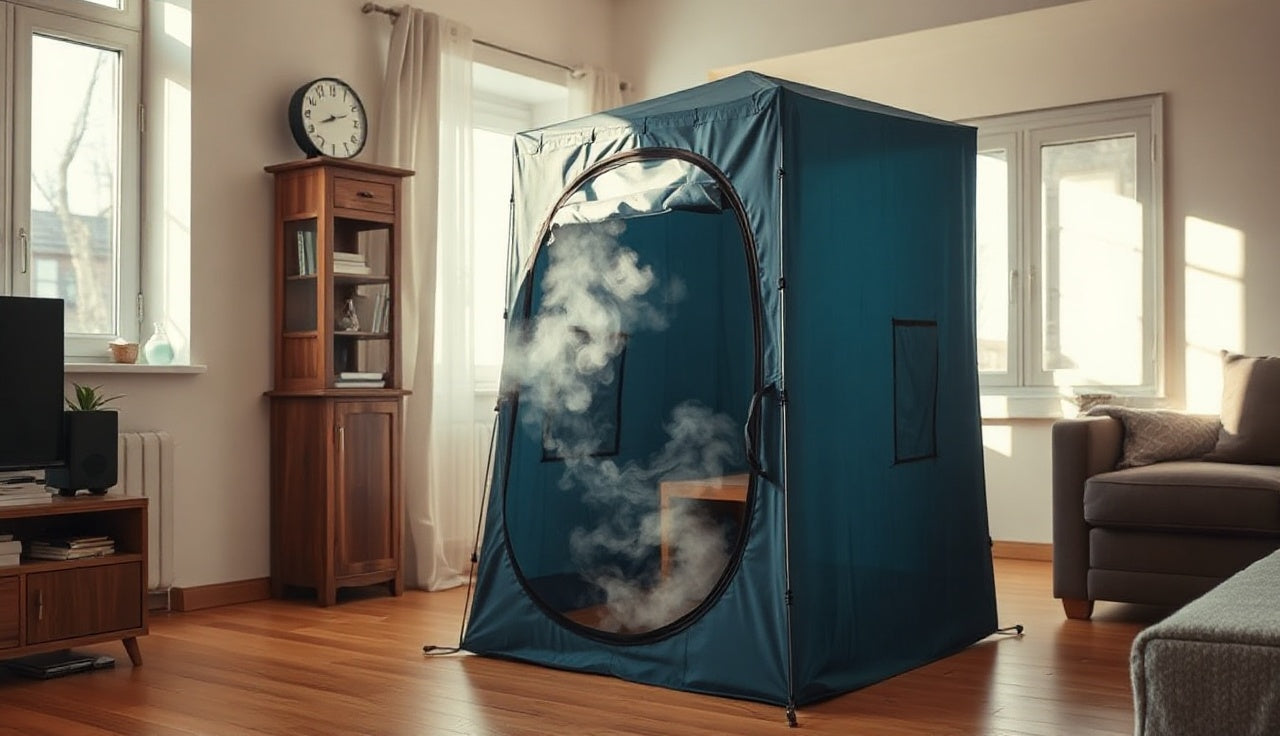
Serene Life makes a line of personal steam saunas that fold flat and fit in a closet. The typical unit is a fabric tent, roughly 35 by 35 by 65 inches, that zips closed around you with a hole for your head. A 1.5- to 2-liter steam generator sits outside the tent, heats water, and pumps steam inside through a hose. You sit on a folding stool, usually included, and the steam brings the interior up to temperature in about 10 minutes.
This is a steam sauna, not a dry sauna. The humidity inside runs near 100%, the opposite of a Finnish-style sauna where relative humidity sits around 10 to 20% [1]. That difference changes everything about how it feels. High humidity makes the same air temperature feel hotter, so 110°F in a steam tent can hit harder than 150°F in a dry barrel sauna.
Serene Life sells these under its brand at Amazon, Walmart, and Costco. Prices run from about $80 for a basic model to around $170, $200 for versions with remote controls, foot massagers, or higher-wattage generators. The brand is owned by Pyle USA, an electronics and lifestyle accessories company, not a dedicated sauna maker. Keep that in mind when you weigh build quality and long-term support.
How hot does a Serene Life portable sauna actually get?
Most Serene Life models list a maximum of 140°F (60°C) in their specs. What the unit actually reaches depends on your room temperature, how well the tent seals, and which steam generator ships with your model. User reports and product Q&As point consistently to real-world temps of 110 to 130°F in average conditions.
For reference, traditional Finnish saunas run 150 to 195°F (65 to 90°C) at low humidity [1]. Infrared saunas, another home option, usually sit at 120 to 140°F with very low humidity [2]. Commercial steam rooms target about 110 to 120°F but at close to 100% humidity. So the Serene Life lives in steam-room territory, not dry-sauna territory.
The steam generator on most models is 800 to 1,000 watts. That number tells you a lot. A typical home infrared sauna pulls 1,400 to 2,400 watts, and a traditional electric sauna heater for home use draws 3,000 to 6,000 watts [2]. More wattage means faster heat and higher sustained temperature. At 800 to 1,000 watts, the Serene Life generator is capped by design.
The honest read on heat: you will sweat. You will feel hot. But if you want a scorching Finnish-style session, this is not the product.
What are the real benefits of using a Serene Life portable sauna?
Heat therapy research is genuinely encouraging, though the strongest studies used traditional high-temperature saunas rather than personal steam tents. The evidence deserves an honest telling.
Regular sauna use links to cardiovascular benefits in population studies. A widely cited Finnish cohort study published in JAMA Internal Medicine followed 2,315 middle-aged men and found those who used saunas 4 to 7 times per week had a 63% lower risk of sudden cardiac death than once-a-week users [3]. That study used traditional saunas at 174°F, not portable steam tents. Whether a 120°F steam tent produces the same cardiovascular stimulus is unknown. Nobody has published that specific comparison.
For muscle recovery, heat raises blood flow to muscles and may reduce delayed-onset soreness. A 2015 study in the Journal of Clinical Medicine Research found moist heat reduced muscle soreness better than dry heat in some conditions [4], which could theoretically favor the humid environment of a steam tent. Again, this exact product category hasn't been studied rigorously.
Relaxation and stress reduction are the most plausible benefits for any heat source. Heat activates the parasympathetic nervous system and raises skin temperature, both tied to lower subjective stress. You don't need a peer-reviewed trial to know sitting in warmth feels good.
Skin benefits from steam show up all over the marketing. Steam can temporarily open pores and hydrate the outer skin layer, though dermatologists treat these claims cautiously. There's no strong evidence that steam sauna use produces lasting skin improvement beyond what plain hydration achieves.
Want the broader picture? Read our sauna benefits guide.
| Serene Life portable steam tent | 125 |
| Infrared sauna blanket | 150 |
| 1-2 person infrared cabin | 135 |
| Traditional electric home sauna | 175 |
| Wood-fired sauna | 185 |
Source: Finnish Sauna Society; U.S. Department of Energy (citations 1, 2)
How does the Serene Life portable sauna compare to other home sauna options?
This is where an honest comparison earns its keep. Home heat therapy breaks into a few categories, and the Serene Life sits at the very affordable end.
| Option | Typical price range | Heat type | Max temp | Setup | Space needed |
|---|---|---|---|---|---|
| Serene Life portable steam tent | $80, $200 | Steam (wet) | ~140°F | 5 min | 4 sq ft |
| Infrared sauna blanket | $150, $600 | Infrared | ~160°F | 2 min | Bed or floor |
| 1-2 person infrared sauna cabin | $800, $3,000 | Infrared | ~140°F | 2 to 4 hrs | 25 to 50 sq ft |
| Barrel or traditional electric sauna | $3,000, $10,000+ | Dry (convective) | 150 to 195°F | Full installation | 40 to 100 sq ft |
| Wood-fired outdoor sauna | $5,000, $20,000+ | Dry (convective) | 150 to 195°F | Full build | Outdoor space |
The portable steam tent wins on price and portability. You can run it in an apartment, store it in a bag, and return it without the friction of a home project. It loses on maximum temperature versus traditional saunas, on the very humid air that some people can't stand, on the head-out design (you're not getting the same full-body heat exposure), and on the fabric-and-plastic build.
Got a dedicated room and a $1,500, $3,000 budget? A two-person infrared cabin gives a meaningfully better experience. Want the closest thing to a real sauna? A home sauna with an electric heater is a different category entirely. Comparing the Serene Life to a portable sauna blanket? The blanket wins on heat penetration and lies flat while you relax, though some people find the tent more comfortable to sit upright in.
For a full breakdown of traditional vs. infrared vs. steam, see our sauna vs steam room comparison.
Is the Serene Life portable sauna safe to use at home?
For most healthy adults, brief sessions in a personal steam sauna carry low risk. Still, a few safety points are worth knowing before you buy.
Heat illness is real. Prolonged exposure to high heat can cause dehydration, heat exhaustion, or in extreme cases heat stroke [9]. The American College of Sports Medicine recommends limiting sauna sessions to 15 to 20 minutes and exiting immediately if you feel dizzy, nauseated, or short of breath [5]. Drink water before and after any session.
Some people should be cautious or check with a doctor first: those with cardiovascular disease, uncontrolled hypertension, or a history of fainting; pregnant individuals (heat exposure in early pregnancy has been associated with neural tube defects in some studies [6]); people on medications that impair sweating or heat regulation, such as anticholinergics or some antipsychotics; and anyone with an active skin condition or open wounds.
The electrical safety question is simple. The steam generator is a plug-in appliance that uses water. Keep the generator away from puddles and standing water. Make sure the outlet has a working ground fault circuit interrupter (GFCI), which the National Electrical Code requires for bathrooms and which you should use near any steam appliance [7], [10]. Don't leave the unit running unattended.
The tent on most Serene Life units is a polyester/nylon blend. At normal operating temperatures it's fine. Don't use the tent if the fabric is damaged, if any electrical component looks damaged, or if the steam hose connection isn't secure.
For children and older users, watch closely and keep sessions short. The evidence base for pediatric sauna use is thin, and thermoregulation in older adults runs less efficient.
What does a Serene Life portable sauna session actually feel like?
Honest answer: warm, humid, and reasonably comfortable if you can handle the slightly awkward posture with your head poking out. Most people sweat within 5 to 10 minutes. The air inside feels thick because the humidity is so high. If you've sat in a gym steam room, it's similar but quieter and more personal.
The head-out design keeps your face at room temperature. Some people love it because they feel less closed in. Others say it breaks the full-body immersion of a traditional sauna. You can't really read or use your phone, since your hands are inside the tent, though some people slip their arms through the zippered sleeves.
Sessions of 15 to 20 minutes are typical. After that, most people feel warm, loose, and sweaty. The tent cools fast once you unzip it. Empty the generator of leftover water after each use to prevent mineral buildup and mold. That takes about two minutes.
One real limitation: the included stool is basic. If you have back trouble or can't sit upright on a plastic folding stool for 15 to 20 minutes, this matters. Plenty of users swap in a wooden stool or a small folding chair for comfort.
The session is genuinely relaxing for most people. It's not a high-performance sauna, but it's far from nothing.
How long does a Serene Life portable sauna last and what breaks first?
This is where the category shows its limits. Fabric personal steam saunas aren't built for years of daily use. Across user reviews on Amazon, Walmart, and other platforms, the parts most likely to fail are the steam generator, the hose connection fittings, and the zipper.
The steam generator is the heart of the system and the hardest to replace. Mineral scale from tap water builds on the heating element over time, cutting efficiency and eventually causing the unit to fail or leak. Filtered or distilled water substantially extends generator life, and most manufacturers recommend it. Serene Life customer service has historically offered replacement units or parts under warranty, though terms vary by retailer and model, typically 1 year.
The zipper on the tent opening takes heavy use every session. Users report zipper failures at the 6-month to 18-month mark under regular use. This is a common failure point across all fabric steam saunas, not something unique to Serene Life.
Realistic lifespan for daily use: 1 to 3 years before a major component fails. For weekly use, 3 to 5 years is plausible. At $80, $200, the cost-per-use math can still beat a gym steam room membership, but go in without expecting a decade-long appliance.
If longevity matters, an infrared sauna blanket or a proper infrared cabin will last longer. If you want something that holds up for years of regular use, look at a permanent home sauna installation.
What do real users say about the Serene Life portable sauna?
We won't manufacture testimonials or composite customer stories. Here's what the public review record shows across major retail platforms, read straight.
Positive themes that repeat: easy setup, genuine warmth and sweating, good value for the price, useful for muscle soreness and relaxation, and the small storage footprint. Many buyers live in apartments, have limited space, or want to test heat therapy before committing to an expensive installation.
Negative themes that repeat: steam generator durability, the stool being uncomfortable for longer sessions, the fabric tent holding moisture and needing to dry out between uses, and in a minority of cases the generator not hitting the advertised temperature in colder rooms.
The Amazon average rating for the most popular Serene Life models sits in the 4.0 to 4.3 out of 5 range across thousands of reviews as of mid-2024. That's a reasonable signal. It's not a five-star product, but for $100, $150, most buyers feel they got fair value.
One pattern stands out. Buyers who expected a traditional sauna experience come away disappointed. Buyers who knew they were getting a budget steam tent are mostly happy. Set your expectations right and the product delivers on them.
Can you use the Serene Life portable sauna for contrast therapy or cold plunge recovery?
Contrast therapy means alternating heat and cold. The protocol has real research behind it. A 2022 meta-analysis in the British Journal of Sports Medicine found contrast water therapy reduced muscle soreness more effectively than passive rest [8]. Athletes, coaches, and recovery-focused people use it regularly.
You can absolutely pair a Serene Life steam session with a cold shower, a cold plunge, or an ice bath. The usual protocol is heat for 10 to 15 minutes, cold for 1 to 3 minutes, repeated 2 to 3 rounds. Plan around the Serene Life's warm-up (about 10 minutes) and its cool-down logistics.
The catch for contrast therapy is the lower temperature ceiling. Traditional contrast studies often use saunas at 170 to 185°F followed by cold water at 50 to 59°F. A steam tent at 120°F creates a smaller thermal gradient. That probably shrinks the effect size, though nobody has published a direct comparison between budget steam tents and traditional saunas for contrast outcomes. The experience still helps. It's just less extreme.
If contrast therapy is your main goal, a high-temperature sauna paired with a cold plunge gives a stronger stimulus. But the Serene Life plus a cold shower is a real step up from doing nothing, and it costs a fraction of the full setup. Learn more about the cold side in our cold plunge benefits guide.
How do you set up and use a Serene Life portable sauna?
Setup is genuinely fast. Here's the real sequence:
1. Unfold the tent frame (typically a collapsible wire or PVC frame). This takes 2 to 3 minutes. 2. Place the folding stool inside the tent. 3. Fill the steam generator reservoir with clean water. Use filtered or distilled water if your tap water is hard; it makes the generator last longer. 4. Connect the steam hose from the generator to the tent's inlet port. 5. Plug the generator into a grounded outlet. A GFCI outlet is strongly recommended near any steam appliance [7]. 6. Set the temperature and timer with the control dial or remote (varies by model). 7. Wait 8 to 12 minutes for the tent to fill with steam and reach temperature. 8. Zip yourself in, head out, and sit for 15 to 20 minutes.
After your session: unplug the generator, empty any leftover water from the reservoir to prevent mold and scale, and leave the tent unzipped to air dry before folding it up. Fold it while damp and you will eventually get mildew on the fabric.
Cleaning is simple. Wipe down the tent interior with a diluted white vinegar solution every few weeks if you use it often. Descale the generator every 1 to 2 months depending on water hardness; most models include instructions, and citric acid or commercial descaling tablets work well.
At SweatDecks, we get asked whether these are genuinely useful for daily recovery routines. They can be, as long as you're realistic about what they are and you maintain them properly.
Is the Serene Life portable sauna worth buying, or should you spend more?
Here's my actual take, not a hedged non-answer.
Buy the Serene Life (or a similar portable steam tent) if: you have under $200 to spend, you live in an apartment or have no permanent installation space, you're curious about heat therapy and want to test it before committing to an infrared cabin or traditional sauna, or you need something that stores in a closet.
Spend more if: you want dry heat (this is a steam unit, full stop), you want a temperature above 140°F, you plan to use it daily for years and don't want to replace it, you have two or more people who'll use it regularly (it's a one-person unit), or the research-backed cardiovascular benefits of high-temperature sauna use are your main goal.
A $1,200, $2,000 two-person infrared cabin gives a meaningfully better experience and lasts longer. A portable sauna blanket in the $200, $400 range is a closer competitor and offers decent infrared heat in a similarly small footprint. For more space and budget, an outdoor sauna or a full indoor installation is a different category of product and experience.
SweatDecks carries options from portable sauna blankets through full cabin units, so you can compare at different price points without committing before you're ready.
The Serene Life is not a bad product. It's a budget steam tent that does what it says. Know what you're buying, and it won't disappoint you.
Frequently asked questions
How long should you sit in a Serene Life portable sauna per session?
Most sources recommend 15 to 20 minutes per session for a personal steam sauna. Start shorter, around 10 minutes, for your first few sessions until you know how your body responds to the heat. Exit immediately if you feel dizzy, lightheaded, or nauseated. Drink water before and after. Two or three sessions per week is a common starting frequency.
Can you use essential oils in a Serene Life portable sauna?
Technically possible but generally not recommended. Adding essential oils to the generator's water reservoir can leave residue on the heating element, speed up scale buildup, and potentially void any warranty. A few drops on a small towel inside the tent, away from the steam inlet, is a safer approach if aromatherapy matters to you. Never add oils directly to the water reservoir.
Does the Serene Life portable sauna help with weight loss?
You will lose weight during a session in the form of sweat, but that is water weight that returns when you rehydrate. There is no credible evidence that portable steam sauna use causes meaningful fat loss. The calorie burn during a heat session is modest. Heat therapy may support recovery and an active lifestyle, but it is not a fat-loss tool on its own.
What is the wattage of the Serene Life portable sauna?
Most Serene Life models use an 800 to 1,000 watt steam generator. That's lower than infrared sauna cabins (1,400 to 2,400 watts) and far lower than traditional electric sauna heaters (3,000 to 6,000 watts). The lower wattage caps the maximum temperature, which in practice lands around 110 to 140°F depending on ambient room temperature and how well the tent seals.
Can two people use the Serene Life portable sauna at the same time?
No. Serene Life portable steam tents are single-person units. The interior fits one person seated on the included stool with their head outside the tent. Two-person portable steam sauna options exist at higher price points, but the standard Serene Life models are not designed for shared use.
How do you clean and maintain a Serene Life portable sauna?
Empty the steam generator reservoir after every use to prevent mineral buildup and mold. Use filtered or distilled water to slow scale accumulation. Descale the generator with citric acid or a commercial descaling solution every 4 to 6 weeks under regular use. Wipe the tent interior with diluted white vinegar periodically. Always air-dry the tent fully before folding it for storage.
Is the Serene Life portable sauna safe for people with high blood pressure?
People with uncontrolled hypertension should consult their doctor before using any sauna or steam product. Heat exposure raises heart rate and temporarily changes blood pressure. Controlled studies in people with well-managed hypertension have generally shown sauna use to be safe, but personal steam tents haven't been specifically studied. Get medical clearance first if blood pressure is a concern.
Where can you buy the Serene Life portable sauna and what does it cost?
Serene Life portable saunas are widely available on Amazon, Walmart.com, and sometimes Costco. Prices range from about $80 for the basic model to $170, $200 for upgraded versions with remote controls, foot massager attachments, or larger steam generators. Prices move with sales and promotions. Buying from a major retailer gives you better return-policy protection than smaller resellers.
How does a portable steam sauna compare to a sauna blanket?
A sauna blanket wraps around your full body including your head (with ventilation) and delivers infrared heat while you lie down. A steam tent leaves your head outside and delivers wet steam heat while you sit. Blankets are generally easier to store, reach similar or higher temperatures, and the infrared wavelength may penetrate tissue differently. Steam tents feel more like a traditional steam room. Both are low-cost entry points.
Does the Serene Life portable sauna have any warranty?
Warranty terms vary by retailer and model, but most Serene Life products carry a one-year limited manufacturer warranty. Coverage typically includes defects in materials and workmanship under normal use. Buying through a major retailer like Amazon or Walmart adds return-window protection. Keep your proof of purchase. Pyle USA, which owns the Serene Life brand, handles warranty claims.
Can you use a portable steam sauna every day?
Daily use is physically possible for most healthy adults. The Finnish population studies that showed cardiovascular benefits used saunas 4 to 7 times per week, though those were traditional high-temperature saunas. For a portable steam tent, daily 15-minute sessions are unlikely to harm healthy people, but take rest days if you feel fatigued, and stay hydrated. There is no strong data on daily steam tent use specifically.
What is the difference between the Serene Life portable sauna and a traditional Finnish sauna?
Traditional Finnish saunas run 150 to 195°F at 10 to 20% relative humidity. The Serene Life is a steam tent that tops out around 110 to 140°F at close to 100% humidity. They are fundamentally different heat experiences. The Finnish sauna has decades of cardiovascular and longevity research behind it; the portable steam tent does not. The cost and space requirements are also dramatically different.
Can you use a Serene Life portable sauna for detoxification?
The liver and kidneys handle detoxification; sweating does not meaningfully speed up the elimination of toxins beyond what normal metabolism handles. Marketing claims around sweat-based detox are not supported by strong clinical evidence. What sweating in a steam sauna does do is raise core temperature, lift heart rate, and produce genuine relaxation. Those are real benefits without needing a detox claim to justify them.
Sources
- Finnish Sauna Society, Sauna Bathing Guide: Traditional Finnish saunas operate at 150–195°F with relative humidity of 10–20%, in contrast to steam rooms at close to 100% humidity
- U.S. Department of Energy, Energy Saver: Home Sauna: Home infrared saunas typically operate at 120–140°F and use 1,400–2,400 watts; traditional electric sauna heaters draw 3,000–6,000 watts
- JAMA Internal Medicine, 'Association Between Sauna Bathing and Fatal Cardiovascular and All-Cause Mortality Events,' Laukkanen et al. 2015: Men who used saunas 4–7 times per week had a 63% lower risk of sudden cardiac death compared to once-a-week users in a cohort of 2,315 middle-aged Finnish men
- Journal of Clinical Medicine Research, 'Moist Heat or Dry Heat for Delayed Onset Muscle Soreness,' 2015: Moist heat application reduced delayed-onset muscle soreness more effectively than dry heat in some measured conditions
- American College of Sports Medicine, Heat and Exercise Position Stand: ACSM recommends limiting sauna sessions to 15–20 minutes and exiting immediately if dizziness, nausea, or shortness of breath occurs
- Centers for Disease Control and Prevention, Folic Acid and Neural Tube Defects: Heat exposure in early pregnancy has been associated with elevated risk of neural tube defects, which is why pregnant individuals are advised to avoid high-heat environments
- National Electrical Code (NFPA 70), Article 210.8 – GFCI Requirements: The National Electrical Code requires ground fault circuit interrupter (GFCI) protection for outlets in bathrooms and near water sources; recommended for any steam-generating appliance
- British Journal of Sports Medicine, 'Contrast Water Therapy and Exercise Induced Muscle Damage: A Systematic Review,' 2022: A 2022 meta-analysis found that contrast water therapy reduced muscle soreness more effectively than passive rest
- National Institutes of Health, MedlinePlus: Heat Illness: Prolonged heat exposure can cause dehydration, heat exhaustion, and heat stroke; hydration before and after heat sessions is recommended
- Consumer Product Safety Commission, Electric Sauna Heater Safety: Electric sauna and steam appliances must be used with proper grounding and electrical protection to prevent shock hazards

Share:
Maximum sauna temperature: what's safe, what's normal, and what's too hot
Maximum sauna temperature: what's safe, what's normal, and what's too hot