
Last updated 2026-07-10
TL;DR
Sauna wood turns gray because UV light and moisture break down lignin, the natural binder in wood. You can restore most gray sauna wood in a weekend: scrub with an oxalic-acid wood brightener, sand lightly, then apply a sauna-safe oil or leave it bare. Painted or sealed wood needs stripping first. Soft, blackened, musty wood is usually mold or decay and follows a different protocol.
Why is my sauna wood turning gray?
Gray sauna wood is almost never a structural problem. What you're seeing is photodegradation, the same process that silvers a cedar fence over a few seasons.
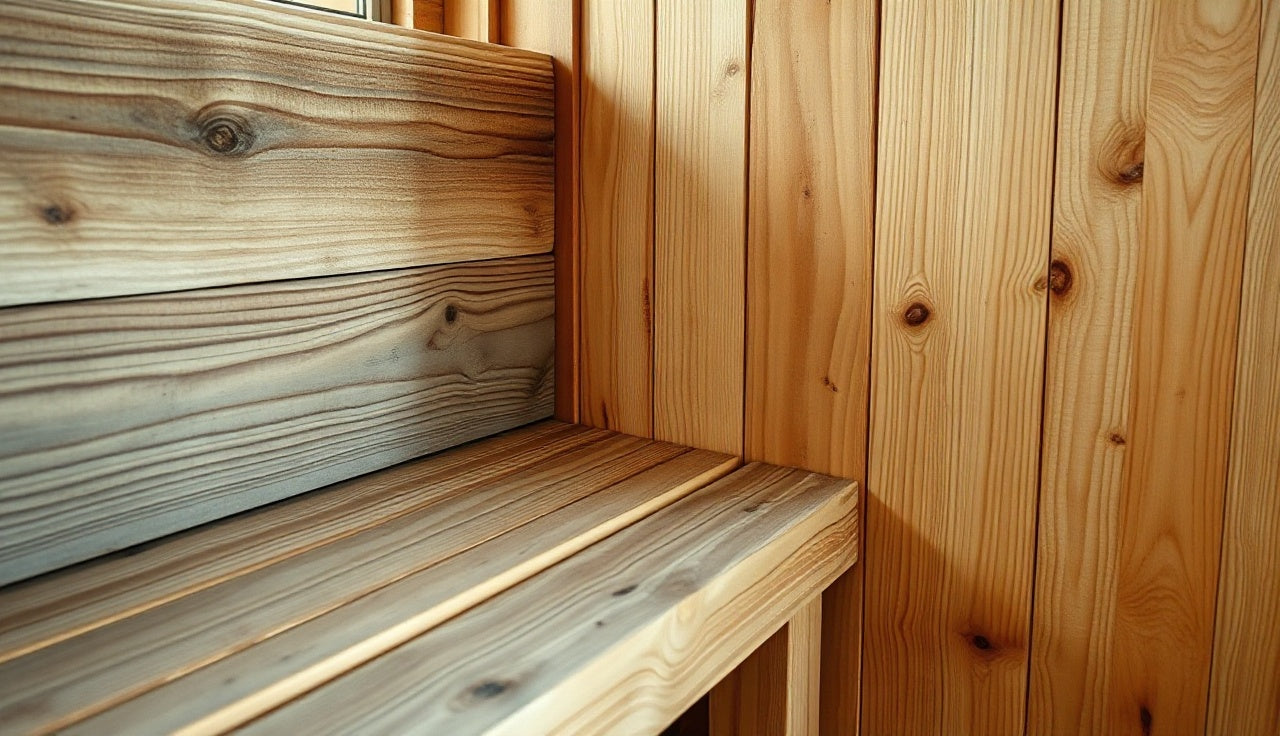
Here's the short version of the chemistry. Wood contains lignin, the polymer that binds cellulose fibers together and gives fresh wood its warm, golden-brown color. UV radiation (even through a window, and especially in outdoor saunas) attacks lignin molecules and breaks them apart. What's left at the surface is mostly pale, unbound cellulose, which reads as gray or silver [1]. Moisture speeds this up. Wet-dry cycles let the degraded surface layer lift slightly, trap dirt, and turn darker or blotchy over time.
Inside a home sauna, the mechanism shifts. UV is usually minimal. Repeated high-humidity steam cycles drive surface oxidation and iron-tannin reactions instead, especially if your water carries minerals. The gray or black streaks around the ladle or bench edges are often tannin stains reacting with trace iron from the water or hardware, not mold.
Actual mold looks different. It's fuzzy, dark green or black in patches, and it smells musty. Pure UV and oxidation gray is flat, even in tone across exposed surfaces, and odorless. Knowing which one you have matters, because the fix is completely different.
Is gray sauna wood still safe to use?
For the most part, yes. Graying from UV and oxidation is cosmetic. The wood is still sound as long as it's hard to the touch and doesn't feel spongy or crumble when you press a fingernail into it [2].
Two scenarios change the answer. If the gray comes with a musty smell and a soft, spongy texture, you're likely looking at fungal decay rather than surface weathering. That wood gets replaced, not restored. And if the gray is inside a sauna that was ever coated with a film-forming finish like polyurethane or a conventional deck stain, the peeling finish traps moisture underneath and speeds up rot. Strip it before you do anything else.
The USDA Forest Products Laboratory notes in its Wood Handbook that surface checks, warping, and graying do not necessarily indicate decay, and that properly dried wood can weather for years before its structure is affected [2]. That's reassuring, but it's not a blank check. Inspect your wood at least once a year and probe any suspicious soft spots.
What causes the black streaks vs the even gray color?
These are two different problems that often show up together, so it helps to tell them apart.
Even, silvery gray across all exposed surfaces is UV and oxidation. You'll see it on benches, backrests, and any wall section that catches light. The surface stays dry and hard, and the grain is still visible.
Dark gray or black in water-contact zones (around the drain, below the ladle, under a bench) is tannin-iron staining. Water pulls tannins out of the wood, they meet iron from hardware or minerals in the water, and the reaction deposits dark iron-tannate compounds. Chemistry, not biology.
Black fuzzy patches with a musty odor are mold or mildew. These turn up most in saunas that don't ventilate well or stay damp between uses.
Brownish-black streaks running with the grain in soft wood point to early decay fungi. That needs replacement, not restoration.
The fix for each is different. UV gray responds to oxalic-acid brighteners and light sanding. Tannin-iron staining also responds well to oxalic acid. Mold needs a dilute bleach or hydrogen peroxide wash before any brightening step. Decay means the boards come out.
What products actually restore gray sauna wood?
Three categories of products do the real work, and each one has a place in the process.
Oxalic acid wood brighteners are the workhorse. Oxalic acid reacts with the iron compounds in tannin-iron stains and with oxidized surface cells, neutralizing the gray and pulling the wood back toward its original tone [3]. You'll find it sold as "wood brightener" or "deck brightener" at any hardware store. Citric-acid brighteners work by a similar mechanism and run slightly milder. Apply either one after cleaning, let it dwell 10 to 20 minutes, scrub with a stiff brush, and rinse hard. Rinse completely every time, because oxalic acid residue left on the surface can irritate skin at sauna temperatures.
Light sanding with 80 or 120 grit removes the top layer of degraded wood cells that no chemical can fully reverse. A palm sander is fine on flat bench surfaces. Sand with the grain, always. After sanding, vacuum the dust and wipe with a barely damp cloth before any treatment. This one step makes the biggest visible difference on UV-grayed wood.
Sauna-safe oils and waxes are the finishing step, if you treat the wood at all. The key phrase is "sauna-safe": you want a food-grade or specifically sauna-rated product, typically paraffin-based sauna oil, natural tung oil, or a linseed-based sauna finish. Not Danish oil, teak oil, or anything carrying solvents or synthetic resins. Those off-gas at sauna temperatures and the fumes are a genuine health concern [4]. Treat the wood after it's clean and dry, wipe away any excess, and let it cure fully before you fire the sauna. Plenty of sauna purists skip the oil entirely and just sand and leave the wood bare. That's a perfectly valid choice.
What about bleach? A dilute bleach solution (roughly 1 part household bleach to 10 parts water) is right for mold, but bleach does nothing for UV gray and it can raise grain and lighten wood unevenly [8]. Use it only for the mold protocol, not as a general restoration step.
Step-by-step: how to restore gray sauna wood over a weekend
This protocol works for UV/oxidation gray and tannin staining on sound wood inside an outdoor sauna or indoor sauna. If you have mold, treat that first (see the mold FAQ below), then pick up at step 3.
What you need: oxalic acid wood brightener, stiff-bristle scrub brush, garden hose or a bucket of clean water, 80-grit and 120-grit sandpaper, palm sander (optional), shop vacuum, rubber gloves, eye protection.
Saturday morning: clean and brighten
1. Remove benches, backrests, and any removable wood panels if you can. Flat surfaces are easier to work and give more even results. 2. Mix the oxalic acid brightener per the package directions. Most products call for roughly 4 ounces of powder per gallon of warm water, but check yours. 3. Wet the wood with plain water first. This helps the brightener spread evenly instead of soaking too fast into dry grain. 4. Apply the solution generously with a brush or sponge. Let it sit 10 to 20 minutes. The gray should start lifting within a few minutes. 5. Scrub with the stiff brush, working with the grain. 6. Rinse completely with clean water. Incomplete rinsing is the most common mistake. Rinse twice. 7. Let the wood dry overnight, at least 8 hours, ideally 24.
Saturday afternoon or Sunday morning: sand
8. Once dry, sand with 80-grit to remove the degraded top layer. Switch to 120-grit for a smoother finish. Keep the sander moving with the grain. 9. Vacuum all dust. Wipe surfaces with a barely damp cloth and let dry again for an hour.
Optional finishing step
10. If you want to treat the wood, brush on a thin coat of sauna-safe paraffin oil or food-grade linseed oil with a clean cloth. Wipe off any excess that hasn't absorbed within 30 minutes. Let it cure at least 24 to 48 hours before using the sauna.
Active working time runs about 3 to 4 hours spread over the weekend. The rest is drying.
A note on portable saunas: the wood frames in fabric or barrel portable units are usually thinner and dry faster, so you can often skip the sander and just do the brightener-and-oil treatment.
How do I know if the wood needs replacing instead of restoring?
Press your thumbnail firmly into the gray wood. If it leaves a clear dent without much effort, the wood has lost real structural integrity and you're looking at early decay [9]. No brightener or sander fixes that.
Other signs a board needs to come out: it feels spongy, it sounds hollow when you knock on it, the grain has collapsed and looks crushed rather than raised, or there are deep cracks running across the grain. Cross-grain cracking is a warning sign. Fine checks that run with the grain are just normal drying movement.
Replacing individual sauna boards is usually simple. Sauna benches are typically built from standard widths of kiln-dried Nordic spruce, western red cedar, or thermally modified aspen (the pale wood you see in many Finnish-style saunas). Match the species, both for looks and for behavior. Some woods make poor bench material: high-resin pine, for one, because the resin gets hot and sticky and can cause contact burns. Cedar and thermally modified wood are the most forgiving replacement options [5].
If more than 30% of a bench or wall surface is soft or decayed, replacing the full section beats patching it.
Does the type of sauna wood affect how fast it grays?
Yes, by a lot. Species differ in lignin content, natural extractives, and density, and all three shape how fast wood oxidizes and how well it takes treatment.
| Wood Species | Gray Rate (Outdoors) | Tannin Staining Risk | Restores Well? |
|---|---|---|---|
| Western red cedar | Moderate (3-5 yrs to silver) | Low-moderate | Yes |
| Nordic spruce | Fast (1-3 yrs) | Low | Yes |
| Thermally modified aspen | Slow (5+ yrs) | Very low | Yes |
| Black locust | Very slow (5-10 yrs) | Low | Yes |
| Hemlock | Fast (1-2 yrs) | Low | Yes |
| Teak | Very slow | High (iron tannate) | Yes, with oxalic acid |
Cedar is the best all-around choice for outdoor sauna surfaces because its natural oils slow both UV degradation and fungal growth [5]. Thermally modified wood (heat-treated to around 400 degrees Fahrenheit, which drives off moisture and breaks down the sugars that feed mold) is increasingly popular and holds up with minimal maintenance [6].
Spruce and hemlock are fine indoors where UV is limited, but they gray fast outdoors and demand more attention. Building new or replacing boards? Spending a bit more on cedar or thermally modified wood stretches the time between restoration cycles a long way.
For more on picking the right setup, the home sauna guide covers wood species in the context of full sauna builds.
| Nordic Spruce | 2 |
| Western Hemlock | 2 |
| Western Red Cedar | 4 |
| Thermally Modified Aspen | 6 |
| Black Locust | 8 |
Source: USDA Forest Products Laboratory, Characteristics and Availability of Commercially Important Woods (Citation 5); species ratings from FPL Wood Handbook
Can I use a pressure washer to clean gray sauna wood?
You can, but with a light hand. A pressure washer moves fast on outdoor sauna exteriors or heavy surface grime before a brightener treatment. The trouble is that too much pressure drives water deep into the wood, raises grain aggressively, and can cause cross-grain checking if the surface dries too fast afterward.
If you use one, keep the pressure under 1,500 PSI and run a fan-tip nozzle (the 40-degree white tip), never a pinpoint stream [7]. Hold it at least 12 inches off the surface and work with the grain direction. After washing, let the wood dry fully, at least 48 hours in warm weather, before sanding or treating.
For interior sauna surfaces, leave the pressure washer in the garage. A stiff scrub brush and the oxalic acid solution do the job without soaking the structure.
Hand scrubbing is slower but more controlled. For most people restoring a single sauna, it's all you need.
How often should I treat or maintain sauna wood to prevent graying?
For outdoor saunas or sauna exteriors in direct sun, an annual inspection and cleaning cycle is a reasonable baseline. The USDA Forest Products Laboratory's Exterior Wood in the South research found that unfinished southern pine showed significant photodegradation within 1 to 2 years of UV exposure [7]. Cedar and thermally modified wood run slower, but no uncoated wood is immune forever.
Inside, the schedule relaxes. Ventilate properly after each session (leave the door cracked 20 to 30 minutes so moisture escapes) and most interior wood stays in good shape for years without any oiling or chemistry. A light sanding every few years is often the whole job.
Practical maintenance checklist:
- After every use: ventilate. This is the single most effective thing you can do.
- Monthly: wipe benches with a clean, dry cloth. Check for soft spots.
- Annually: inspect all wood for decay. Clean with a mild oxalic acid solution if staining shows. Sand lightly if the surface feels rough.
- Every 2 to 3 years (or as needed): a fuller restoration if graying has gotten pronounced.
A sauna-safe paraffin oil treatment is optional. It slows oxidation and makes the wood easier to wipe clean, but it also slightly reduces the wood's ability to buffer humidity by absorbing and releasing moisture. Many Finnish traditionalists run untreated wood and just sand periodically. Both approaches work.
The advice we give most often at SweatDecks is short: ventilate first, treat second. Chemistry fixes visible gray. Air circulation prevents it.
Does gray sauna wood affect heat or performance?
Not meaningfully. The color change from graying doesn't touch the wood's thermal properties or the sauna's ability to heat up and hold temperature. Wood's insulating value (its R-value per inch) comes from cellular structure, and photodegradation doesn't substantially change that structure until decay sets in [11].
One indirect effect is worth a mention. Heavily weathered, checked wood has more surface area exposed to moisture, so it can absorb and release humidity a little differently than smooth wood. In a maintained sauna this is minor and won't noticeably change your experience.
Want the broader picture of how saunas work and why wood choice matters for the heat itself? The sauna benefits article goes deeper on the physiology side, and sauna vs steam room covers how humidity levels in different setups shape wood wear over time.
What should I avoid putting on sauna wood?
This is where people go wrong, often right after finishing a nice restoration job.
Avoid film-forming finishes entirely: polyurethane, varnish, alkyd paint, and most deck sealers. They form a surface film that traps moisture once it cracks, and it will crack, because sauna heat makes wood expand and contract constantly. Trapped moisture is the exact condition that speeds decay [10].
Avoid conventional teak oils, Danish oil, and most hardware-store "wood conditioning" products. Many hold drying oils mixed with solvents and metal dryers that off-gas at high temperatures. The Finnish Sauna Society's care guidance is blunt about it: products containing solvents or synthetic resins do not belong on interior sauna surfaces because they off-gas when heated [4].
Avoid bleach as a routine treatment. It lightens wood unevenly, raises grain, and weakens fibers over repeated use. Save it for actual mold remediation.
Avoid pharmacy mineral oil. It doesn't absorb the way sauna-specific paraffin oil does and can go rancid over time.
What you can use: purpose-formulated sauna oil (paraffin-based), raw food-grade linseed oil (very thin coat, full cure time), or nothing. Nothing is a completely valid long-term choice for interior wood if your ventilation is good.
How do I treat gray wood specifically on a barrel or outdoor sauna?
Outdoor and barrel saunas use the same restoration chemistry as any other sauna wood. The geometry just creates a few practical wrinkles.
Barrel saunas curve, which makes a power sander awkward on the exterior staves. A sanding block or an 80-grit sanding sponge wrapped around a dowel handles the curve better. The interior benches are flat and sand normally.
For outdoor exteriors that take rain and UV, the maintenance rhythm matches any exterior wood structure. USDA Forest Products Laboratory guidance on finishing exterior wood recommends penetrating oil-based finishes over film-forming ones for wood that sees moisture and sun, because penetrating finishes don't trap moisture as they wear [10].
One product category that works reasonably well on outdoor exteriors (not interior heated surfaces) is a penetrating UV-blocking deck oil with added UV stabilizers. It slows the photodegradation that causes graying. It's wrong for interior benches because of the temperature concern, but on the outside of a barrel or cabin sauna it buys more time between restoration cycles.
For the full build-and-maintain picture, the outdoor sauna guide covers construction, drainage, and weatherproofing in more detail.
Frequently asked questions
Can I restore gray sauna wood without sanding?
Yes, to a degree. An oxalic acid brightener alone lifts a good amount of gray, especially tannin-iron staining and light oxidation. But sanding removes the degraded wood cells that brighteners can't fully reverse. If the gray is mild, try brightener-only first. If the result disappoints once the wood dries, sand then. Sanding after brightening gives the best result in one pass.
Is black sauna wood always mold?
No. Dark or black discoloration in water-contact zones is very often a tannin-iron reaction, pure chemistry and not biological. True mold is fuzzy or powdery, patchy, and smells musty. Tannin-iron staining is flat, concentrated where water drips, and odorless. Oxalic acid treats both. If the black wood is soft and smells musty, treat it as mold: dilute bleach wash first, then brightener, then decide whether the board needs replacement.
How do I clean mold off sauna wood?
Mix 1 part household bleach with 10 parts water. Brush it onto the affected area, let it sit 10 to 15 minutes, scrub, and rinse thoroughly. Ventilate during and after. Once the wood dries completely (24 to 48 hours), follow with an oxalic acid brightener to neutralize remaining staining and even out the color. Then fix the ventilation that let mold grow, or it comes back.
What is the best oil for sauna wood?
Purpose-formulated sauna paraffin oil is the most commonly recommended product and what most major sauna makers specify. It absorbs well, doesn't off-gas at sauna temperatures, and applies easily. Raw food-grade linseed oil is a workable alternative, but it cures slower and needs very thin coats. Avoid anything with solvents, dryers, or synthetic resins, including Danish oil and teak oil.
Will sauna wood eventually turn permanently gray no matter what I do?
Uncoated wood always trends toward gray over time under UV and moisture. Restoration reverses the visible graying, but it can't restore lignin that's already photodegraded. With regular maintenance (annual cleaning and sanding, good ventilation), interior wood stays close to new for a very long time. Outdoor wood grays faster and needs more attention, but it can be restored again and again before the board's structural life ends.
Does cedar sauna wood still turn gray?
Yes. Cedar grays more slowly than spruce or hemlock because its natural oils (mainly thujaplicins) slow UV degradation and fungal growth, but it still grays eventually. Outdoor cedar typically takes 3 to 5 years to turn noticeably silver without treatment. Interior cedar takes much longer. The restoration process is identical: oxalic acid brightener, sanding, optional oil. Cedar responds well to brighteners and looks good after treatment.
Can I use a power washer on sauna benches?
On exterior sauna surfaces, yes, with care: keep pressure under 1,500 PSI, use a 40-degree fan tip, and hold it at least 12 inches from the surface. On interior benches, skip it. A scrub brush and brightener solution is enough and won't saturate the wood or the substructure. Interior wood has to dry fully before you use the sauna, and a pressure washer drags that out.
How long does sauna wood restoration last before it turns gray again?
It depends on UV exposure and ventilation. Interior wood that's been cleaned, sanded, and properly ventilated usually stays in good shape for several years before noticeable graying returns. Outdoor exteriors in full sun may start graying again within 1 to 3 years even after a UV-blocking penetrating oil. Annual inspection and spot treatment stretches the gap between full restorations considerably.
Should I replace sauna benches or restore them?
If the wood is hard to the touch, passes the thumbnail press test, and has no mold or musty smell, restoration is almost always worth trying before replacement. A weekend of cleaning and sanding costs very little. Replace boards that are soft, spongy, crumbling, showing cross-grain cracking, or clearly decayed. Replacing one or two problem boards while restoring the rest is the most common outcome.
Is gray sauna wood a sign of poor quality?
No. Graying is a natural weathering process that happens to all uncoated wood regardless of quality. High-end cedar saunas gray just as reliably as budget spruce ones, only slightly slower. It's a cosmetic result of exposure, not a manufacturing defect. Structural quality is what counts, and a well-built sauna with properly dried, straight-grained boards outlasts decades of surface weathering with normal maintenance.
Can thermally modified sauna wood still turn gray?
It can, but far more slowly than conventionally dried wood. Thermal modification (heating wood to around 400 degrees Fahrenheit in a low-oxygen environment) reduces lignin and removes sugars, making the wood more resistant to both UV degradation and fungal attack. Research on thermally modified wood shows much better dimensional stability and lower moisture uptake than unmodified wood [6]. It's not immune to graying, but the timeline stretches out.
Do I need to empty the sauna completely to restore the wood?
Ideally yes, at least for the benches and removable panels. Working on removed, flat pieces gives you better access, more even treatment, and lets you flip them to reach edges and undersides. In practice, many people do a fine job on fixed wall boards in place. The key is rinsing very thoroughly, since brightener residue left on skin-contact surfaces is a problem at sauna temperatures.
What grit sandpaper should I use on sauna benches?
Start with 80-grit to remove the degraded surface layer, then finish with 120-grit for a smooth surface that won't raise splinters. Going finer than 120-grit is usually pointless for bench wood and can make it harder for any oil to penetrate. Always sand with the grain direction. For hand-sanding, a rubber sanding block gives more even pressure than folded sandpaper alone.
Sources
- USDA Forest Products Laboratory, Wood Handbook Chapter 16: Finishing of Wood: UV radiation attacks lignin in wood, causing photodegradation that results in a gray or silver surface color over time
- USDA Forest Products Laboratory, Wood Handbook: Wood as an Engineering Material: Surface checks, warping, and graying do not necessarily indicate decay; properly dried wood can weather for years before structural integrity is affected
- University of Minnesota Extension, Wood Deck Maintenance: Oxalic acid wood brighteners neutralize iron-tannin staining and oxidized wood surface cells, restoring wood closer to its original color
- Finnish Sauna Society, Sauna Care and Maintenance Guidelines: Products containing solvents or synthetic resins should not be used on interior sauna surfaces because they off-gas at elevated temperatures
- USDA Forest Products Laboratory, Characteristics and Availability of Commercially Important Woods: Western red cedar contains natural oils (thujaplicins) that slow UV degradation and fungal growth compared to spruce or hemlock
- VTT Technical Research Centre of Finland, Modified Wood Research Program: Thermally modified wood shows significantly improved dimensional stability and reduced moisture uptake compared to conventionally dried wood
- USDA Forest Products Laboratory, Exterior Wood in the South: Pressure washing outdoor wood should be done at under 1,500 PSI with a fan tip to avoid raising grain and causing surface damage; unfinished pine photodegrades within 1-2 years of UV exposure
- EPA, Mold Remediation in Schools and Commercial Buildings: Dilute bleach solution (1:10 ratio) is appropriate for surface mold remediation on non-porous and semi-porous surfaces including wood
- North Carolina State University Extension: The thumbnail press test (soft indentation under moderate pressure) is a field indicator of structural wood decay and loss of integrity
- USDA Forest Products Laboratory, Finishing of Exterior Wood: Penetrating oil-based finishes outperform film-forming finishes on exterior wood exposed to moisture and UV because they do not trap moisture when they wear
- USDA Forest Products Laboratory, Wood Handbook Chapter 4: Moisture Relations and Physical Properties: Wood's thermal properties and R-value per inch come from cellular structure, which photodegradation does not substantially alter until decay sets in

Share:
Sauna rocks cracking: causes, risks, and when to replace them
Sauna rocks cracking: causes, risks, and when to replace them