
Last updated 2026-07-11
TL;DR
A home sauna project runs 6 weeks to 6 months from first decision to first sweat. Dropping a pre-built unit into a finished room is fastest. A permitted custom outdoor build is slowest. Permits, electrical work, and contractor availability drive almost every delay. This guide walks each phase, with real timelines and where projects actually slip.
What's the overall timeline for a home sauna project?
Six weeks on the short end. Six months on the long end. That's the honest range, and the gap between the two has almost nothing to do with the sauna itself.
The fastest projects are pre-built indoor saunas dropped into a finished room with a 120V or 240V outlet already nearby. You order it, it ships in 2 to 4 weeks, you assemble it in a weekend. Done.
The slowest projects are custom outdoor saunas that need a concrete pad, a subpanel, a permit, a licensed electrician, and a contractor who isn't already booked three months out. Every one of those steps has its own waiting room.
Here's how the phases stack up:
| Phase | Typical Duration |
|---|---|
| Research and budgeting | 1 to 4 weeks |
| Design and contractor quotes | 1 to 6 weeks |
| Permit application and approval | 2 to 10 weeks |
| Site prep and electrical rough-in | 1 to 3 weeks |
| Sauna delivery or prefab build | 2 to 6 weeks |
| Installation and finishing | 1 to 4 weeks |
| Inspection and final approval | 1 to 3 weeks |
| Total | 6 weeks to 6+ months |
Those ranges overlap, and they're supposed to. Your municipality, your contractor's schedule, and whether you hit a wood backorder or a permit revision all decide where you land.
Want a home sauna fast? Start with the permit and the electrician, not with picking cedar planks.
How long does the planning and design phase take?
Most people underestimate this phase. Call it 2 to 6 weeks if you're decisive and have help. Call it 2 to 3 months if you're going it alone, comparing eight brands, and revising your budget twice.
Planning has four real tasks: picking your sauna type, setting your budget, figuring out your space, and deciding DIY or contractor.
Sauna type matters a lot for timeline. A pre-built outdoor sauna kit ships in 4 to 8 weeks after you order. A custom indoor room build starts when your contractor is free, which might be six weeks out. An infrared pre-assembled unit can ship in 2 to 3 weeks. A portable sauna ships next day from stock. Each type opens a completely different project clock.
Budget affects timeline because it affects what's available. Pre-built modular indoor saunas in the $3,000 to $8,000 range are almost always in stock or carry 2 to 4 week lead times. Custom Finnish-style outdoor builds in the $15,000 to $40,000 range need an architect or detailed drawings, structural review in some jurisdictions, and a contractor who does this specific work.
Here's the thing most guides skip: spend real time on ventilation and drainage now. Where does the water go when someone pours it on the rocks? Where does the humidity exhaust? If your sauna room shares a wall with a bedroom or closet, vapor barrier details belong in the design, not in a panic six months later. Get this wrong and you buy mold problems that cost more to fix than the sauna did.
Do you need a permit for a home sauna, and how long does that take?
Almost certainly yes, for anything permanent. Permit timelines are the single biggest wildcard in the whole project.
In most U.S. jurisdictions, a permanent sauna triggers at least a building permit and an electrical permit. Adding a subpanel is a separate electrical permit in many counties. If the sauna is a new structure (detached shed, barrel sauna on a slab), you may also need a zoning review and, in some HOA communities, architectural committee approval.
The International Residential Code (IRC) governs under-floor ventilation and vapor control for permanent structures, and local amendments frequently add requirements for wet rooms and high-humidity spaces [1]. Your local building department is the only authoritative source for what applies to your address.
Approval times swing hard. Some rural counties approve over the counter in a day. Major metros like Los Angeles, Seattle, and New York City routinely run 8 to 12 weeks for a residential permit, sometimes longer. Check your building department's website before you set any other timeline expectation.
One honest tip: hire a permit expediter if you're in a slow-approval city. They usually charge $300 to $800 and can shave weeks off the wait by catching deficiencies before the city reviewer does.
If a contractor tells you your outdoor sauna doesn't need a permit, get that in writing and verify it yourself with the building department. Unpermitted structures cause serious headaches when you sell your home or file an insurance claim.
| Research and budgeting | 3 |
| Design and contractor quotes | 4 |
| Permit application and approval | 6 |
| Site prep and electrical rough-in | 3 |
| Sauna delivery | 4 |
| Installation and finishing | 2 |
| Inspection and final approval | 2 |
Source: SweatDecks editorial estimate based on contractor, permit, and manufacturer lead time data, 2025
What does site preparation involve, and how long does it take?
Site prep is usually 1 to 3 weeks of actual work, but it can sit in a queue for weeks before anyone lifts a tool.
For an indoor sauna room, prep means verifying the subfloor can carry the weight (a fully loaded sauna with stones and occupants can exceed 40 pounds per square foot), installing a vapor barrier, framing the room if it isn't already defined, and running electrical rough-in.
For an outdoor sauna, prep means at minimum a concrete pad or gravel foundation. A 4-inch reinforced slab for a typical 8x10 outdoor sauna takes 2 to 3 days to form and pour, then 7 full days to cure before you set anything heavy on it [2]. If the site slopes or drains poorly and needs grading first, add a few more days.
Electrical rough-in is where delays pile up. Most home saunas need a dedicated 240V circuit, typically 30 to 60 amps depending on heater size. If your main panel is out of capacity, you need a subpanel, which adds $1,200 to $2,500 installed plus a separate inspection in many jurisdictions [9]. Licensed electricians in most U.S. metros are booked 3 to 6 weeks out as of 2024 and 2025 [3]. Book yours before you finalize anything else.
Putting in a steam room instead of or alongside a sauna? The plumbing rough-in adds complexity and another inspection step.
How long does it take for a sauna kit or pre-built unit to arrive?
Lead times swing by product type and time of year. Plan on 2 to 4 weeks for a stock infrared unit and up to 14 weeks for custom-milled outdoor kits.
Pre-assembled indoor infrared saunas from major brands typically ship within 2 to 4 weeks. Barrel sauna kits from North American manufacturers usually run 3 to 6 weeks. Custom-milled outdoor room kits, especially those using thermally modified wood or imported Nordic spruce, can run 8 to 14 weeks. Peak ordering windows (January, when people set wellness goals, and April through June before summer installation season) add 2 to 4 weeks to any of those numbers.
Get written confirmation of the lead time before you lock an install date with a contractor. Sauna lead times and contractor schedules have to sync, and they rarely do on the first try. If the sauna lands 3 weeks before your contractor is ready, you need covered storage. If the contractor shows and the sauna is still on a boat, you're eating a rescheduling fee.
Shipping damage is real. Around 3 to 7 percent of large freight shipments arrive with some observable damage, and sauna kits with glass doors and ceramic heater parts are not the toughest packages [4]. Inspect every pallet before you sign the delivery receipt. Photograph everything. Sign without noting damage and your freight claim gets much harder.
Comparing options? Our sauna guide covers the main unit types and what to check before you order.
How long does sauna installation actually take?
Once materials are on site and the rough-in is done, installation is usually the fastest part of the project. A kit unit goes up in an afternoon; a full custom outdoor structure takes weeks.
A pre-built indoor infrared sauna assembled from a kit takes 2 to 6 hours for two adults with basic tools. Most kits use interlocking tongue-and-groove wall panels and bench systems that go together without carpentry skills.
A traditional Finnish-style indoor room build, where a contractor frames, insulates, installs a vapor barrier, lines the walls in cedar or aspen, builds custom benches, and mounts the heater and controls, takes 3 to 7 days of actual labor. That assumes materials are on site and the subfloor holds no surprises.
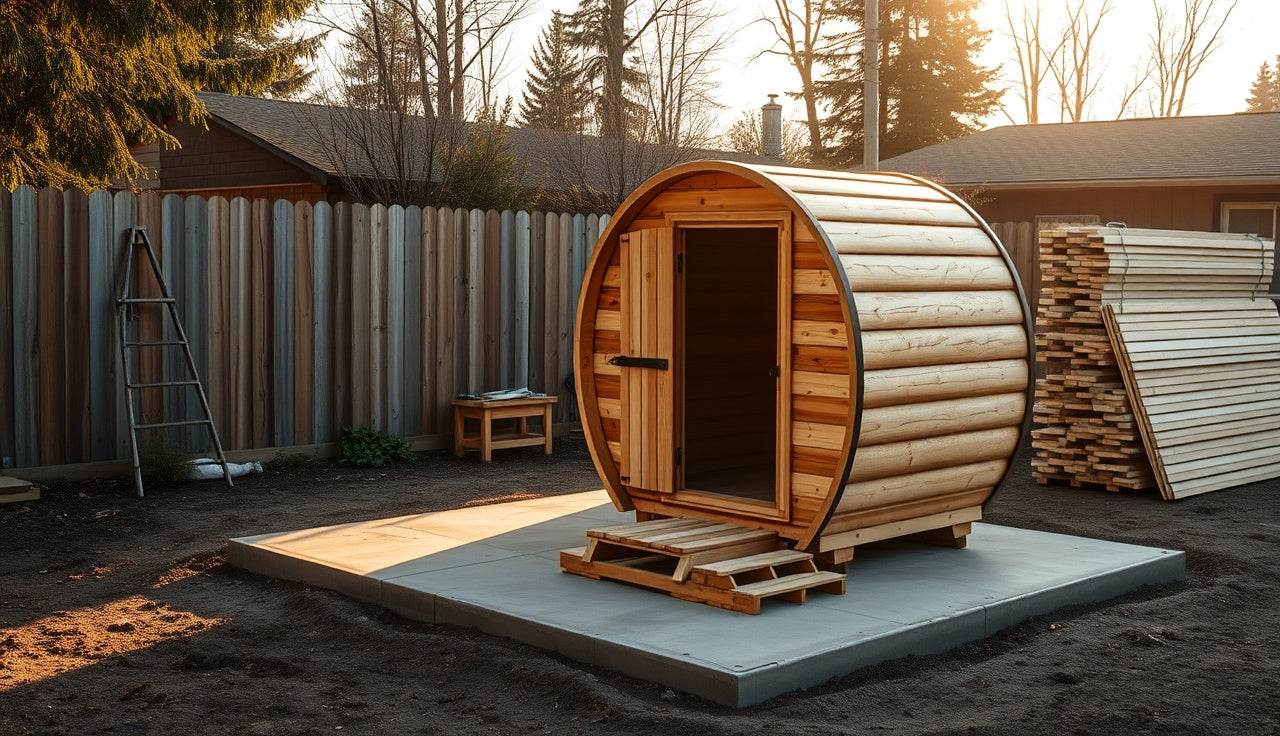
An outdoor barrel sauna on an already-cured pad usually takes 1 to 2 days to assemble from a kit. A full custom outdoor structure with a changing room, porch, and mechanical room takes 1 to 3 weeks depending on complexity.
After installation, the electrical inspector has to sign off on the heater connection and any new circuits before you can legally use the unit. Schedule that inspection at the start of the installation phase, not the end. Inspector availability varies just like contractor availability.
The heater break-in is worth knowing about too. Most manufacturers recommend running the heater at full temperature for 30 to 60 minutes with the door open before the first occupied session, to burn off manufacturing coatings. It's a small step, but build it into your mental timeline so you're not staring at an empty sauna waiting for it to clear.
What causes the most delays in a sauna project?
Permits, electricians, product lead times, contractor schedules, site surprises, and weather. In that rough order, here's what actually blows up timelines.
Permit delays are number one. Slow jurisdictions, incomplete applications, and revision requests from plan checkers push most late projects past the 3-month mark. The fix: submit your permit early, before you've finalized your sauna selection, and use a contractor or expediter who knows your local department.
Electrician scheduling is a close second. You cannot run your sauna without a proper hookup. In markets with heavy construction activity, licensed electricians are scarce. Book early. If yours cancels or runs long on another job, your whole project clock resets.
Product lead time changes. A manufacturer who quotes 4 weeks at order can revise to 8 weeks after a supply disruption. Get a written lead time commitment and ask about the cancellation policy before you pay in full.
Contractor unavailability. Contractors who build saunas specifically, more than general carpenters, are not common in most markets. The good ones are usually booked 4 to 8 weeks out minimum. Hiring in spring for a summer project? Assume they're already full.
Site surprises. Old wiring that can't carry a new circuit, moisture in the subfloor, a pour that reveals bad drainage, a load-bearing wall where you planned the door. Less common, but each one adds 1 to 3 weeks.
Weather. Outdoor projects in northern climates have real weather windows. Concrete can't be poured below 40 degrees F without cold-weather measures [2]. Assembling outdoor kits in rain or extreme heat adds days.
How does timeline differ for different sauna types?
The type you pick is the single biggest lever on your total timeline, from about a week for a portable unit to six months for a custom outdoor build. Here's the honest comparison across the four main types.
Portable infrared sauna: Fastest. Order to first session in 3 to 7 days if it ships from domestic stock. No permits, no electrical work, no contractor. Also the most limited experience, with low temperatures (typically 120 to 140 degrees F versus 160 to 190 degrees F for a traditional sauna) and minimal resale value. Good for testing whether you'll actually use a sauna before committing to something permanent.
Pre-built indoor sauna unit (modular): 3 to 6 weeks total in most cases. Needs a dedicated 240V circuit (2 to 4 weeks to schedule an electrician) and a clean space to sit. Often no permit if it's plug-in or requires no structural changes, but verify locally. This is the sweet spot for most homeowners.
Custom indoor sauna room: 8 to 16 weeks for a well-run project. Needs a permit, electrical rough-in, framing, insulation, vapor barrier, lining, benches, heater, and controls. More chances for delay, but the result adds real value to your home.
Outdoor sauna (barrel or cabin style): 10 to 24 weeks for a full project with a permit, slab, and custom build. Fewer weeks if you're assembling a kit on an existing pad with power nearby. The outdoor sauna experience is genuinely different from indoor, with better air quality and the option to step outside to cool down between rounds.
Thinking about adding a cold plunge for contrast therapy? That's a separate parallel project. Running both at once often makes sense from a contractor and permit standpoint, but it adds complexity to planning.
What does a home sauna project actually cost at each phase?
A mid-range indoor modular sauna with proper electrical runs $5,000 to $12,000 all-in. A full custom outdoor sauna with a slab and dedicated electrical runs $20,000 to $45,000. Here's the phase-by-phase breakdown behind those numbers.
Design and planning: $0 for DIY research, up to $2,000 to $5,000 for an architect or designer on a custom project.
Permitting: Residential sauna building permits typically run $200 to $1,500 depending on jurisdiction and project valuation. Electrical permits add $100 to $400 in most areas. HOA review fees vary.
Site prep and electrical: An 8x10 concrete slab costs $800 to $2,000 depending on region. A subpanel addition runs $1,200 to $2,500 installed. A new 240V dedicated circuit from an existing panel runs $300 to $800 installed [9]. Licensed electrician labor sits at $75 to $150 per hour in most U.S. metros [3].
The sauna unit or materials: Pre-built infrared units run $1,500 to $8,000. Barrel sauna kits run $3,000 to $12,000. Custom indoor room materials (cedar, vapor barrier, heater, stones, controls) run $4,000 to $15,000. Full custom outdoor cabin builds run $15,000 to $50,000 or more depending on size and finish.
Installation labor: Kit assembly runs $300 to $800. Contractor-built rooms run $3,000 to $12,000 in labor depending on complexity and local rates.
SweatDecks carries home sauna options from quick-ship modular units to larger outdoor kits if you want to compare prices at different points.
The sauna benefits research points to a dose response: a 2015 JAMA Internal Medicine study of 2,315 Finnish men found stronger cardiovascular and all-cause mortality associations at 4 to 7 sessions per week than at 2 to 3 [5]. Worth weighing as you decide how much to spend on the quality and permanence of your setup.
When is the best time of year to start a sauna project?
August through November. That's the practical answer for most of the U.S.
Here's why. Most homeowners decide they want a sauna in January, driven by New Year's goals and cold weather that makes heat sound great. So January, February, and March are when contractors, electricians, and manufacturers get hammered with orders. Lead times stretch. Schedules fill. Permit offices back up.
Start in August or September and you're ordering during a shoulder season. Contractors are wrapping up summer outdoor jobs and hunting for indoor work. Manufacturer lead times shrink. Permit offices move faster.
For outdoor projects, late summer or early fall is ideal. You finish construction before winter, you cure a concrete slab in warm weather, and you're ready to use the sauna during the cold months when you'll want it most.
The exception is a northern-climate outdoor project. Miss the fall window and your next realistic outdoor build window is April or May. Pouring concrete or assembling outdoor structures in January in Minnesota or Vermont just adds avoidable problems.
Indoor projects care far less about timing. The work happens inside, so you can start an indoor modular sauna any month without weather touching the timeline.
How do you find and vet contractors for a sauna build?
Start with the sauna manufacturer's installer network. Most established manufacturers keep a list of certified or recommended installers by region who have built their specific products before. These contractors already know the product's quirks and tolerances. They're rarely the cheapest, but they're rarely the slowest either.
Going custom? Look for contractors who explicitly list sauna or spa room experience in their portfolio. General finish carpenters can build a sauna room, but vapor barrier installation and the tolerances of a wet heat environment take experience. A contractor who hasn't done one before learns on your project.
Questions that actually matter when you interview:
How many sauna projects have you finished in the last two years? Ask for references from those projects specifically, more than the general portfolio.
Are you licensed and insured for electrical work, or will you subcontract it? (They should subcontract to a licensed electrician. A general contractor doing his own electrical without a license is a liability problem.)
What's your current lead time to start? Get it in writing as part of the contract, with a completion timeline and milestones.
Who pulls the permit, you or the homeowner? Either can work, but you both need clarity on who owns it.
Get at least three quotes. On a mid-range custom project, quotes often vary 30 to 50 percent between contractors. The lowest isn't automatically wrong, but if one comes in dramatically under the others, find out exactly what it leaves out.
Don't pay more than 30 percent upfront. A 10 to 30 percent deposit, progress payments at defined milestones, and a final payment at inspection sign-off is a reasonable structure for a project this size.
What should you do in the first week after your sauna is installed?
The first week is about dialing the sauna in and building a habit before the novelty wears off. Run the break-in cycle, start your sessions short, and set your maintenance routine from day one.
Day one: Run the heater break-in cycle (30 to 60 minutes at full heat, door open, unoccupied) per the manufacturer's instructions. This clears off-gassing from heater components and sealants. New cedar saunas often carry a slight wood resin smell for the first few sessions. That's normal and fades.
First session: Start conservatively. 15 to 20 minutes at a temperature that feels comfortable, not the maximum. Your body needs to adapt to regular sauna use, and pushing hard on day one before you're heat-adapted just leaves you feeling rough.
Hydration matters. Research from the University of Eastern Finland reports that a single 30-minute session at 80 degrees C causes an average 0.5 kg of body weight loss through sweat, almost all of it water [6]. Drink 16 to 24 ounces before and after each session.
Learn the controls. Most heaters have a timer and a temperature setting. NFPA standards and most heater manufacturers cap the sauna at 194 degrees F (90 degrees C) at bench level [7]. Some manufacturers lock the control below that. Know your unit's ceiling.
Set your maintenance routine now. Wipe down benches after each session. Air the room out by leaving the door cracked for 30 minutes after use. Plan a deeper cleaning of the rocks every 6 to 12 months depending on how often you use it.
Planning to add contrast therapy with an ice bath or cold plunge? Set up that second element now, so the protocol becomes one habit instead of two separate projects.
Frequently asked questions
How long does a home sauna project take from start to finish?
Realistically, 6 weeks for a pre-built modular unit in an existing space with electrical already nearby, up to 5 or 6 months for a permitted custom outdoor build with a new slab and subpanel. Permit timelines and electrician availability drive most delays. Plan for longer than you think, especially in a busy metro area.
Do I need a permit to build a home sauna?
Almost always yes for permanent installations. Electrical permits are required whenever you add a new circuit or panel, which most saunas need. Building permits apply when you construct or modify a room or add a detached structure. A plug-in portable unit in an existing space often skips permits, but verify with your local building department before assuming.
How long does it take to get a permit for a sauna?
Rural counties can approve permits over the counter in a day or two. Major metros like Los Angeles, Seattle, or New York often take 8 to 12 weeks. Submit your application as early in the project as possible, ideally before you finalize your sauna selection. A permit expediter for $300 to $800 can meaningfully shorten the wait in slow-approval jurisdictions.
What is the cheapest and fastest sauna to install at home?
A portable infrared sauna tent ships in days, costs $200 to $600, needs no permit, and runs off a standard outlet. It's a real sauna in the sense that it heats your body, but temperatures top out around 120 to 140 degrees F versus 160 to 190 degrees F for a traditional unit. Good for testing the habit before committing to a permanent install.
How much does a home sauna cost to install in 2025?
A modular pre-built indoor unit with professional electrical hookup typically runs $5,000 to $12,000 all-in. A custom indoor room build adds contractor labor and materials, pushing the total to $12,000 to $25,000. A fully permitted custom outdoor sauna with a slab, subpanel, and custom construction runs $20,000 to $45,000 or more depending on size and region.
Can I build a sauna in my backyard without a permit?
In most U.S. jurisdictions, no. A permanent outdoor structure that requires electrical work almost always triggers a building permit and an electrical permit. Some jurisdictions exempt small accessory structures below a certain square footage, but those exemptions rarely survive once you add 240V electrical. Check with your local building department. Unpermitted structures cause problems when you sell or file an insurance claim.
How long does it take an electrician to wire a sauna?
The actual wiring, running a dedicated 240V circuit from your main panel to the heater, takes 3 to 6 hours for a straightforward install. Need a new subpanel? Add half a day. The bigger issue is scheduling: licensed electricians in most metros are booked 3 to 6 weeks out. Book your electrician before you do anything else in the project.
What is the best time of year to start a sauna project?
August through November for most of the U.S. January and February are peak ordering season, when contractors, manufacturers, and permit offices are busiest. Starting in late summer means shorter lead times, more contractor availability, and time to finish outdoor work before winter. Miss the fall window for an outdoor project and your next realistic window is typically April or May.
What size electrical circuit does a home sauna need?
Most residential sauna heaters need a dedicated 240V circuit sized between 30 and 60 amps depending on heater output in kilowatts. A 6kW heater typically needs a 30-amp circuit; a 9kW heater needs 40 to 50 amps. Your heater manufacturer specifies the exact requirement. It must be a dedicated circuit, not shared with other loads, and the connection must be done by a licensed electrician in virtually all jurisdictions [11].
How long do you have to wait before using a new sauna after installation?
Once the inspector signs off on the electrical work, you can use it. Most manufacturers also recommend a 30 to 60 minute burn-in cycle at full heat with the door open before the first occupied session. New cedar saunas may carry a faint resin smell for the first 2 to 4 sessions. That's normal and fades. Some heater components smell mildly on first use and clear quickly too.
Does a home sauna add value to a house?
It depends on the market and the quality of the install. A permitted, professionally built sauna room that matches the home's finishes can add value where buyers expect wellness features. An unpermitted or poorly installed sauna can create liability and complicate disclosure. There's limited rigorous appraisal research on this specifically, so treat value claims from contractors as marketing rather than data.
How often should I maintain my sauna and what does that involve?
After each session: wipe down benches with a dry or lightly damp cloth and air the room out for 30 minutes with the door cracked. Monthly: check the heater stones for cracks or discoloration. Every 6 to 12 months: replace or restack degraded stones, clean the floor drain if present, and inspect the vapor barrier near the heater for scorching. Cedar benches take an occasional light sanding if they splinter.
Can I pair a sauna with a cold plunge and do them at the same time as a project?
Yes, and it often makes practical sense. Running both projects at once shares the contractor's mobilization cost, one slab can hold both units, and a single permit application may cover both structures. Contrast therapy (alternating heat and cold) is a real protocol used by athletes; a 2021 study in the International Journal of Sports Physiology and Performance found measurable recovery effects from heat-cold alternation [10]. See our cold plunge guide for setup details.
Sources
- International Code Council, International Residential Code (IRC): The IRC governs under-floor ventilation and vapor control for permanent residential structures including high-humidity spaces; local amendments add jurisdiction-specific requirements.
- Portland Cement Association, Concrete Curing Basics: Standard concrete requires 7 days of curing before heavy loads are placed on it; cold-weather concrete placement requires precautions below 40 degrees F.
- U.S. Bureau of Labor Statistics, Occupational Employment and Wage Statistics: Electricians: Licensed electrician hourly wage rates and occupational data; median wages and labor market conditions for electricians in U.S. metro areas.
- BSI Supply Chain Services, Supply Chain Risk and Cargo Damage Reporting: Approximately 3 to 7 percent of large freight shipments arrive with some observable damage; inspection at delivery is recommended before signing.
- JAMA Internal Medicine, Laukkanen et al., 'Association Between Sauna Bathing and Fatal Cardiovascular and All-Cause Mortality Events,' 2015: Study of 2,315 Finnish men found dose-dependent associations between sauna frequency (2-3 vs. 4-7 sessions per week) and cardiovascular and all-cause mortality outcomes.
- University of Eastern Finland, Faculty of Health Sciences, sauna research publications: A single 30-minute sauna session at 80 degrees C causes an average 0.5 kg of body weight loss through sweat, primarily water loss.
- National Fire Protection Association, sauna heater and appliance safety standards: NFPA standards and most sauna heater manufacturers set a maximum recommended sauna air temperature of 194 degrees F (90 degrees C) at bench level.
- U.S. Census Bureau, American Housing Survey: Residential construction and home improvement project data, including typical permit and construction timelines for residential improvements.
- Angi, Electrician Cost Guide: Electrical subpanel installation typically costs $1,200 to $2,500 installed; a new 240V dedicated circuit runs $300 to $800 installed in most U.S. markets.
- International Journal of Sports Physiology and Performance, contrast therapy recovery research: Research found measurable recovery effects from heat-cold alternation protocols in athletes, supporting contrast therapy practice.
- U.S. Department of Energy, Office of Energy Efficiency and Renewable Energy: Residential electrical circuit sizing and safety guidance for high-load appliances including sauna heaters requiring dedicated 240V circuits.

Share:
Sauna heater guard required dimensions: what the codes actually say
Heated walkways for outdoor saunas: how to prevent ice safely