
Last updated 2026-07-11
TL;DR
Magnetic sauna door latches use rare-earth or ceramic magnets to hold the door shut with no moving parts to corrode or warp. Traditional latches rely on wood toggles, barrel bolts, or spring catches. Magnetic latches win in steam-heavy and outdoor saunas because no metal rusts. Traditional latches cost less and are easier to DIY-replace, but they fail faster in wet heat.
What is a sauna door latch, and why does it matter?
A sauna door latch keeps the door closed during a session, holds in heat, and lets you get out fast without fumbling. That last part is not optional. NFPA 101, the Life Safety Code, requires that sauna doors open outward and that the latching mechanism never traps anyone inside. [1] The latch is a safety device before it is a hardware choice.
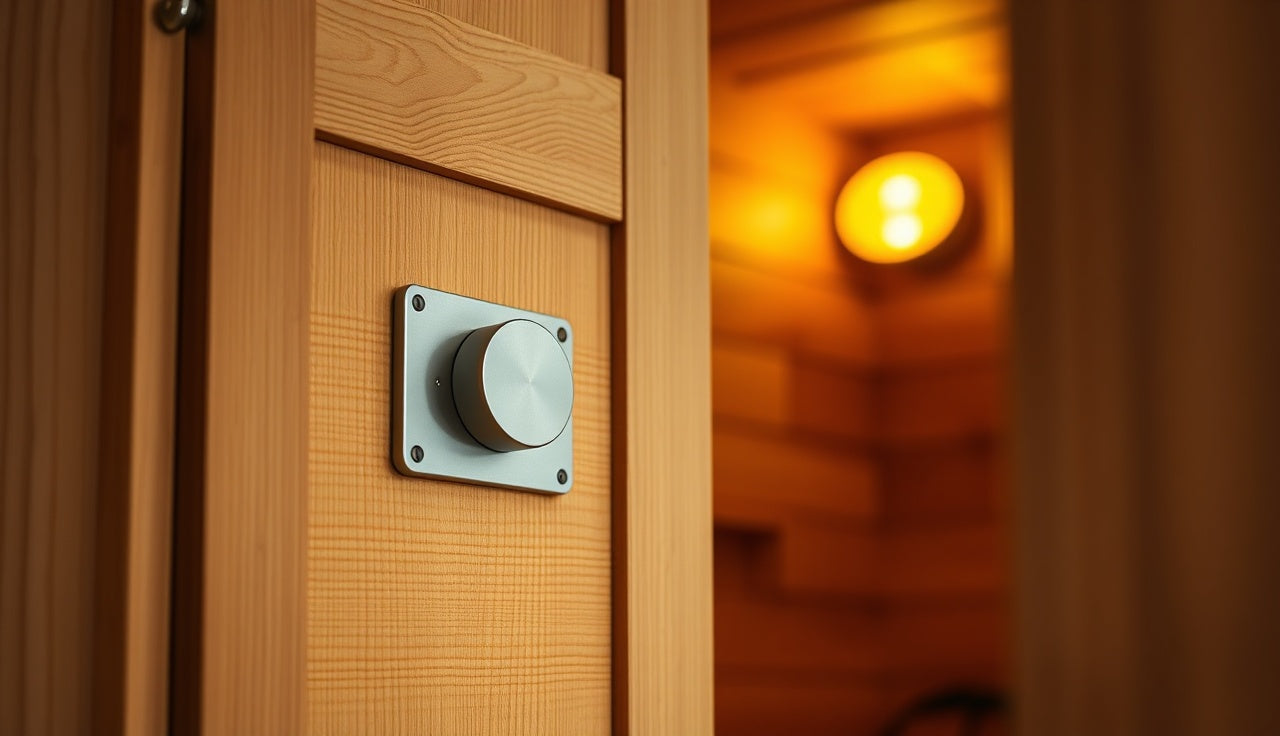
Most home saunas use one of two latch types. The first is a traditional mechanical latch, which covers wooden barrel toggles, wooden turn-blocks, metal spring catches, and thumb latches. The second is a magnetic latch, which uses a permanent magnet in the door frame to grab a steel strike plate on the door (or the reverse). No springs, no metal pins, nothing that can seize.
The distinction matters because sauna air chews up hardware. A Finnish-style dry sauna sits at 80 to 100°C (176 to 212°F) at bench height with 10 to 20% relative humidity. [2] A steam room or wet sauna pushes humidity past 100%, with water vapor condensing on every surface. Metals corrode. Wood swells and warps. Any latch that depends on tight metal tolerances or a snug wood-to-wood fit degrades faster here than it would on a normal interior door.
How does a magnetic sauna door latch work?
A magnetic latch has two parts: a magnet housing that mounts to the door frame or the door, and a steel or magnetic strike plate on the opposing surface. Swing the door shut and the magnet grabs the strike plate and holds. You open it by overcoming the magnetic force, which on typical residential sauna latches runs 10 to 40 pounds of pull depending on the magnet grade.
The magnets are almost always neodymium (rare-earth) or ceramic ferrite. Neodymium is stronger for its size but has one real limit: standard grades start losing magnetic strength above about 80°C, and high-temperature grades (rated to 120°C or 150°C) cost more. [3] Ceramic ferrite has lower pull strength but shrugs off high heat and costs less. Purpose-built sauna latches lean on high-temperature neodymium or ceramic magnets for exactly this reason.
The housing itself is usually wood, food-grade plastic, or stainless steel. All-wood housings look cleanest in a traditional sauna and stay cool to the touch, which you notice when a session ends and you grab the door barehanded.
How does a traditional sauna door latch work?
Traditional latches split into a few types. The simplest is a wooden turn-block or butterfly latch: a piece of wood that rotates on a single screw and presses against the door. Finnish saunas have used these for over a century, and Scandinavian-style builds still favor them because they use no metal, cost almost nothing, and swap out in minutes.
Step up and you get small wooden barrel bolts, spring catches made from stainless or coated steel, and thumb latches with a little lever. Spring catches and thumb latches are reliable in dry conditions but carry metal springs and pivot pins that ride the same heat-and-humidity cycle session after session.
Wooden traditional latches fail by swelling. Kiln-dried sauna lumber (usually western red cedar, Nordic spruce, or basswood) pulls in moisture during heat-up and dries out between sessions, and that cycling causes dimensional change over time. [9] Over months, the wood latch either swells tight against the strike (door won't close easily) or shrinks loose (door drifts open mid-session). Metal traditional latches corrode instead, and the spring inside a spring catch fatigues, loses tension, or seizes.
Magnetic vs traditional sauna latch: head-to-head comparison
Here is how the two stack up for a homeowner deciding between them.
| Factor | Magnetic latch | Traditional (wood or metal) latch |
|---|---|---|
| Typical cost (residential) | $25, $80 for a purpose-built unit | $5, $30 for wood toggle; $10, $45 for metal spring catch |
| Moving parts | None | Yes (wood pivot, metal spring, or pin) |
| Corrosion risk | Low (no exposed metal in wood/plastic housings) | Medium, high for metal types; low for all-wood |
| Warp/swell risk | Minimal (magnets unaffected by moisture) | Medium for wood types |
| Exit ease | Very easy, single pull, no fumbling | Easy for toggle; can stick or seize for spring catch |
| High-temp rating required | Yes (check magnet grade, see [3]) | No special rating needed |
| DIY replacement | Moderate (alignment matters) | Easy (wood toggle is nearly zero-skill) |
| Aesthetics in traditional sauna | Modern look; can feel out of place | Period-correct, natural |
| Best environment | Steam rooms, wet saunas, outdoor saunas | Dry indoor saunas with stable humidity |
Own or shopping for an outdoor sauna? Go magnetic. Outdoor units take rain, freeze-thaw cycles, and long stretches of humidity. A simple wood toggle still works outdoors, but it needs annual inspection and occasional replacement. A quality magnetic latch with a stainless or wood housing just keeps working.
Building a dry indoor home sauna and want the most authentic Scandinavian feel? A well-made wooden turn-block is not a compromise. It is the historically correct choice and the easiest thing in the room to maintain.
| Magnetic latch (dry indoor) | 20 |
| Magnetic latch (outdoor/steam) | 15 |
| Wood toggle (dry indoor) | 12 |
| Wood toggle (outdoor/steam) | 5 |
| Metal spring catch (dry indoor) | 8 |
| Metal spring catch (steam room) | 3 |
Source: Finnish Sauna Society guidelines and Arnold Magnetic Technologies temperature data, cross-referenced with manufacturer specifications
Are magnetic latches safe in a sauna? Can you get locked in?
This is the question that actually matters, and the answer is no, you cannot get locked in by a properly specced magnetic latch. NFPA 101 Section 11.11 covers sauna safety and requires that sauna doors swing outward and cannot be locked or latched from the outside in a way that would prevent egress. [1] A magnetic latch clears that bar naturally: the force to push the door open from inside is the same 10 to 40 pounds of magnetic pull, which any adult or older child overcomes with a single push.
A traditional mechanical latch is where the risk creeps in. A barrel bolt or thumb turn can be locked from outside, which would violate NFPA 101. A simple wood turn-block cannot be locked from outside and so complies. If you want a metal thumb latch, confirm it has no external locking mechanism.
The more practical hazard is a magnet that is too strong. Some industrial rare-earth magnets used in cabinets pull over 100 pounds. Those do not belong on a sauna door. Residential sauna latches are built with lower-force magnets so the door opens easily under stress. If you are sourcing from a cabinet hardware supplier instead of a sauna vendor, keep the pull force under 50 pounds, ideally in the 15 to 30 pound range.
What about heat tolerance? Will a magnet weaken in a sauna?
This is the real engineering question with magnetic latches, and the answer rides entirely on magnet grade. Standard neodymium magnets (grade N35 through N52) start losing magnetization irreversibly above roughly 80°C. [3] The hottest zone in a sauna, right at ceiling level, hits 110 to 120°C in a well-fired Finnish room. A standard neodymium latch mounted at the top of a door frame in that heat will weaken over time.
High-temperature neodymium grades, labeled 33SH, 35EH, or 30AH depending on the maker's system, are rated for continuous operation at 150°C or even 200°C. They cost more and hold their strength across years of sauna use. Ceramic ferrite magnets have a Curie temperature above 450°C and are essentially unaffected by sauna heat, [11] though their pull per unit of size is lower, so the housing needs to be a little larger to match hold force.
The practical read: a latch marketed specifically for saunas should already have the temperature rating handled. Adapting a generic cabinet catch? Check the operating temperature spec before you install it. And mount the latch lower on the door frame rather than at the top when you can, because the temperature gradient means the latch sits 15 to 30°C cooler at handle height than at the ceiling. [2]
Which latch type works best for a steam room or wet sauna?
Steam rooms are the harshest environment for door hardware, and a magnetic latch with a sealed housing is the clear pick. Relative humidity routinely hits 100%, and water condenses on frames, hinges, and latches every single session. [4] Any metal with even minor surface scratches starts to rust within weeks. Even stainless grades below 316 can show surface corrosion under repeated steam exposure. [8]
For a steam room or wet sauna, a magnetic latch with an all-wood or high-density polymer housing and no exposed steel spring is the strongest choice. The magnet, sealed inside the housing, never touches the steam. A wood toggle is acceptable if you pick a species with natural rot resistance (cedar, teak) and check it every season, but the pivot screw will corrode regardless. A metal spring catch in a steam room is almost always a mistake.
The sauna vs steam room distinction matters because buyers sometimes install identical hardware in both. What lasts five years in a dry sauna can fail in one season in a steam room.
How much do sauna door latches cost, and is the price difference worth it?
A basic wooden turn-block runs $5, $15 at a lumber yard or sauna supply shop. A machined stainless or brass thumb latch runs $20, $45. Purpose-built sauna magnetic latches, from vendors who spec high-temperature magnets and sauna-appropriate housings, run $30, $80 depending on finish and pull rating.
The gap between a $10 wood toggle and a $60 magnetic latch is real but small against a home sauna that costs $3,000 to $20,000 to build or buy. [6] If you are spending $8,000 on a home sauna or an outdoor sauna, a $50 latch upgrade is noise.
Longevity is where the math gets interesting. A wood toggle in a dry sauna may last 10 to 15 years before it needs replacing. The same toggle outdoors or in steam may need inspection every year and replacement every 3 to 5 years. A quality magnetic latch in either environment, matched to the right operating temperature, may never need replacing during the sauna's usable life. There is no moving part to wear out.
SweatDecks carries sauna hardware alongside its sauna lineup, so if you are already shopping for a unit, check whether latches are included or need to be sourced separately.
Can you replace a traditional sauna latch with a magnetic one yourself?
Yes, and it is a straightforward job for most homeowners. The one thing that will make or break it is alignment. The magnet and the strike plate need full contact when the door is closed, which means the mounting positions must land within about 3 to 5mm. Most magnetic latch kits include a cardboard or paper template for this.
Tools: a drill, the right bit for your sauna wood, a screwdriver, and a pencil. If your old latch left holes in the door or frame, fill them with wood filler or epoxy before you mount the new latch in a slightly shifted position, so the old holes don't weaken the mount.
Check one thing before you order: door thickness. Sauna doors run 38 to 44mm thick (about 1.5 to 1.75 inches). Most residential magnetic latches are sized for standard interior door thicknesses of 35 to 45mm. Thicker custom doors or thick tongue-and-groove paneling can fall outside that, so verify the latch dimensions before buying.
Not comfortable drilling into the door or frame? Some magnetic latches use adhesive-backed strike plates and need screws only for the magnet housing. They hold fine, but they are slightly less durable over many years of thermal expansion cycles.
What do sauna manufacturers actually install, and what does that tell you?
Entry and mid-range residential saunas, the kits sold in the $2,000 to $6,000 range, almost always ship with a simple wooden toggle or a basic wood-and-metal spring catch. Not because those are technically best, but because they are cheap, ship without damage, and need no alignment calibration. The maker can't know how tightly your frame will be fitted, so they default to a forgiving, adjustable option.
Higher-end Finnish-built saunas and custom jobs more often use either a quality wood butterfly latch (traditional look, higher-grade wood, tighter tolerances) or a magnetic latch as standard. Some luxury units, especially those built for hotel spas, spec magnetic latches because there is no moving part to fail and no maintenance between guests.
Notice the pattern: the harder and more often a manufacturer expects the sauna to run in humid conditions, the more likely they spec a magnetic latch. That is a reasonable signal for your own decision.
Browse the sauna options on the market and you'll see many kit saunas bury hardware as a footnote in the spec sheet. Read that line, especially if you plan to use the sauna daily.
Are there any downsides to magnetic sauna latches?
A few real ones, worth saying plainly.
Alignment sensitivity. A wood toggle forgives a door that has shifted or swollen; you just file the stop a little. A magnetic latch needs the strike plate to meet the magnet within a few millimeters, or hold force drops off a cliff. In an older sauna where the frame has settled, or with a door that warps seasonally, you may re-adjust the strike plate every year or two.
The feel is not for everyone. A magnetic latch does not click shut the way a spring catch does. Some people love the quiet, definitive snap of a magnet. Others find it unsatisfying and wonder whether the door is actually latched. Purely subjective, but worth flagging.
Cost against a wood toggle. If you have a simple dry indoor sauna and you swap the toggle every ten years at $10 a pop, you'll never spend as much as a single $60 magnetic latch over the sauna's life. Magnetic is not automatically the smart money in every case.
Temperature derating of cheap units. A poorly specced magnetic latch, one made for kitchen cabinets and repurposed for heat, can lose hold strength over years of high-temperature cycling. If the door starts drifting open mid-session after a year or two, a magnet weakened by heat is the likely culprit.
What should you actually buy? A direct recommendation.
Here is the honest answer, broken down by situation.
Dry indoor sauna, traditional look, watching the budget: a quality wood butterfly latch or turn-block in cedar or hardwood is the right call. It costs almost nothing, looks period-correct, and outlasts any metal spring in the same room. Replace it when it wears, which may be never in a dry environment.
Outdoor sauna or any sauna in a humid climate: go magnetic. No metal springs and no mechanical tolerances is a real edge in wet or freeze-thaw conditions. Spend the $40, $70 on a purpose-built unit with a high-temperature magnet grade, and confirm the housing is wood or stainless.
Steam room: magnetic, no debate. An all-wood or polymer-housed magnetic latch with no exposed metal fasteners at the strike is the only low-maintenance choice.
Frequent users and commercial or semi-commercial installs: magnetic, for the same reason luxury manufacturers spec them. No wear parts means no failure mode tied to how often the door swings.
Want a zero-compromise setup for a new build? SweatDecks carries sauna packages where you can spec hardware at the time of purchase, which beats sourcing a latch separately after the fact.
Researching the full picture of sauna ownership? The sauna benefits guide and home sauna buyer guide cover the broader context of what you are building toward.
Frequently asked questions
Can a magnetic latch trap you inside a sauna?
No, as long as the pull force is appropriate. Residential sauna magnetic latches need 15 to 40 pounds of force to open, which any adult clears with a single push. NFPA 101 requires sauna doors to open outward and never lock occupants inside, and magnetic latches meet that naturally because there is no locking mechanism at all.
Do magnets lose strength in sauna heat?
Standard neodymium magnets start losing magnetization above about 80°C, which is inside sauna operating range. Purpose-built sauna latches use high-temperature neodymium grades or ceramic ferrite magnets rated to 150°C or more. Buy a latch marketed specifically for sauna use and the temperature rating should be handled. Avoid repurposing cabinet hardware that lists no temperature spec.
What is the cheapest way to latch a sauna door?
A wooden turn-block or butterfly latch costs $5, $15 and installs with a single screw. It has been the Finnish standard for generations. It works well in dry indoor conditions and is the most economical option. In humid or outdoor settings it needs periodic inspection, since swelling and pivot-screw corrosion can make it stick or loosen.
How do I know if my sauna latch is NFPA 101 compliant?
NFPA 101 Section 11.11 requires sauna doors to swing outward and not be lockable from the outside in a way that prevents egress. A latch complies if it opens from inside without tools or special knowledge. Magnetic latches, wood toggles, and most spring catches comply. Barrel bolts or thumb turns that lock from outside do not.
Can I use a regular cabinet magnetic catch in my sauna?
Technically yes, but there are real risks. Cabinet catches use standard neodymium grades that begin losing strength above 80°C, and sauna temperatures at the top of the door frame reach 110 to 120°C. A cabinet catch may hold at first and weaken over months. If you go this route, mount it as low on the door frame as practical, where the air is cooler.
What latch material is best for a steam room?
An all-wood or high-density polymer housing with no exposed metal springs is best for steam rooms. Metal spring catches corrode fast in 100% humidity. Magnetic latches with sealed magnet housings are ideal because the magnet never touches moisture. If you use a wood toggle, choose cedar or teak and plan to inspect the pivot screw every year.
How hard is it to install a magnetic sauna latch yourself?
It is a 20 to 30 minute job for most homeowners. Alignment is the one thing that matters: the magnet and strike plate need to meet within about 3 to 5mm for full hold force. Most kits include a template. You need a drill, the right bit for your sauna wood, and a screwdriver. Fill any existing latch holes before mounting if they fall in the new footprint.
Do outdoor saunas need a different latch than indoor saunas?
Yes, in practice. Outdoor saunas face rain, freeze-thaw cycles, and long humidity exposure that speeds up corrosion and wood warping. A magnetic latch with a stainless or all-wood housing handles outdoor conditions better than a metal spring catch or a wood toggle that sees moisture for months. If you use a wood toggle outdoors, inspect it every season.
How much pull force should a sauna magnetic latch have?
For a residential sauna door, 15 to 35 pounds of pull force is the practical range. Strong enough to hold the door shut against the pressure differential when the room is hot, but light enough that anyone can open it in an emergency. Cabinet or industrial magnets exceeding 50 to 100 pounds are wrong for sauna doors and can create a safety issue.
Does the type of sauna wood affect which latch I should choose?
Somewhat. Denser, more dimensionally stable woods like thermo-treated aspen or Nordic spruce move less across humidity cycles, so a traditional latch holds its tolerances better. Softer, more porous woods like western red cedar move more and can make a wood toggle stick or a spring catch drift out of alignment. In high-movement species, a magnetic latch's tolerance for minor misalignment is a real advantage.
Will a magnetic latch affect electronic sauna controls or temperature sensors?
No. The magnetic field from a residential sauna door latch is weak and very localized, dropping off sharply within a few centimeters. It will not affect a controller, temperature sensor, or timer mounted even a few inches away. If you have a digital panel mounted right next to the latch, move one of them a few inches apart as a simple precaution.
How long does a sauna magnetic latch last compared to a traditional one?
A quality magnetic latch with correctly temperature-rated magnets and a sealed housing has no wear parts and can last the sauna's full lifespan, often 15 to 25 years or more. A wood toggle in dry conditions also lasts many years but may need replacement after 5 to 15 years depending on humidity cycling. Metal spring catches in steam or outdoor conditions often need replacement within 3 to 7 years.
Can I use a magnetic latch on a glass sauna door?
Yes. Glass sauna doors are common in modern builds, and most have a wood or aluminum frame where the magnet housing and strike plate mount. The latch attaches to the frame, not the glass. Verify the frame material takes the latch screws and is thick enough to accept the mounting hardware without cracking.
What is the difference between a barrel bolt and a turn-block latch for saunas?
A barrel bolt is a sliding metal rod that seats in a metal strike. It is mechanically reliable but has several metal parts that corrode in humidity, and it can slide shut from outside, which may break egress rules. A turn-block (or butterfly latch) is a single piece of wood rotating on one screw, has no corrodible parts, cannot be locked from outside, and is the simpler, safer choice for a sauna.
Sources
- National Fire Protection Association, NFPA 101 Life Safety Code, Section 11.11 (Saunas): NFPA 101 requires sauna doors to swing outward and not be lockable from the outside in a way that could trap occupants
- Finnish Sauna Society, Sauna temperature and humidity guidelines: Finnish dry saunas operate at 80 to 100°C at bench height with 10 to 20% relative humidity; temperature at ceiling level can exceed 110°C
- Arnold Magnetic Technologies, Neodymium magnet temperature ratings technical reference: Standard neodymium magnets (N35, N52) begin losing magnetization irreversibly above approximately 80°C; high-temperature grades are rated to 150°C or 200°C
- ASHRAE, Handbook of HVAC Applications, humidity control in specialty spaces: Steam rooms and wet saunas routinely reach 100% relative humidity with water condensing on all surfaces including hardware
- U.S. Consumer Product Safety Commission, Sauna safety guidelines: CPSC guidance addresses sauna enclosure requirements including door operation to prevent entrapment
- National Association of Home Builders, Residential sauna installation guidelines: Residential saunas cost $3,000 to $20,000 depending on size, materials, and installation complexity
- International Code Council, International Building Code, special occupancies including saunas: Building codes governing special occupancy spaces including residential saunas reference egress and door hardware requirements
- NACE / AMPP, Stainless steel grades in high-humidity environments: Stainless steel grades below 316 can show surface corrosion in repeated steam exposure environments
- U.S. Forest Service, Forest Products Laboratory, Wood Handbook: Wood as an Engineering Material (FPL-GTR-282): Kiln-dried lumber absorbs moisture and experiences dimensional change (swelling and shrinking) with humidity cycling
- Lawrence Berkeley National Laboratory, Indoor humidity and material degradation research: Repeated moisture cycling causes dimensional changes in wood components including sauna hardware mounting surfaces
- Master Magnetics (The Magnet Source), Ceramic ferrite magnet temperature characteristics: Ceramic ferrite magnets have a Curie temperature above 450°C and are not meaningfully affected by sauna operating temperatures
- Occupational Safety and Health Administration, OSHA standards for facilities in commercial settings: OSHA references NFPA 101 egress requirements for sauna enclosures in commercial and semi-commercial installations

Share:
Sauna door handle: wood vs metal heat considerations
Sauna ventilation intake and exhaust placement explained