
Last updated 2026-07-11
TL;DR
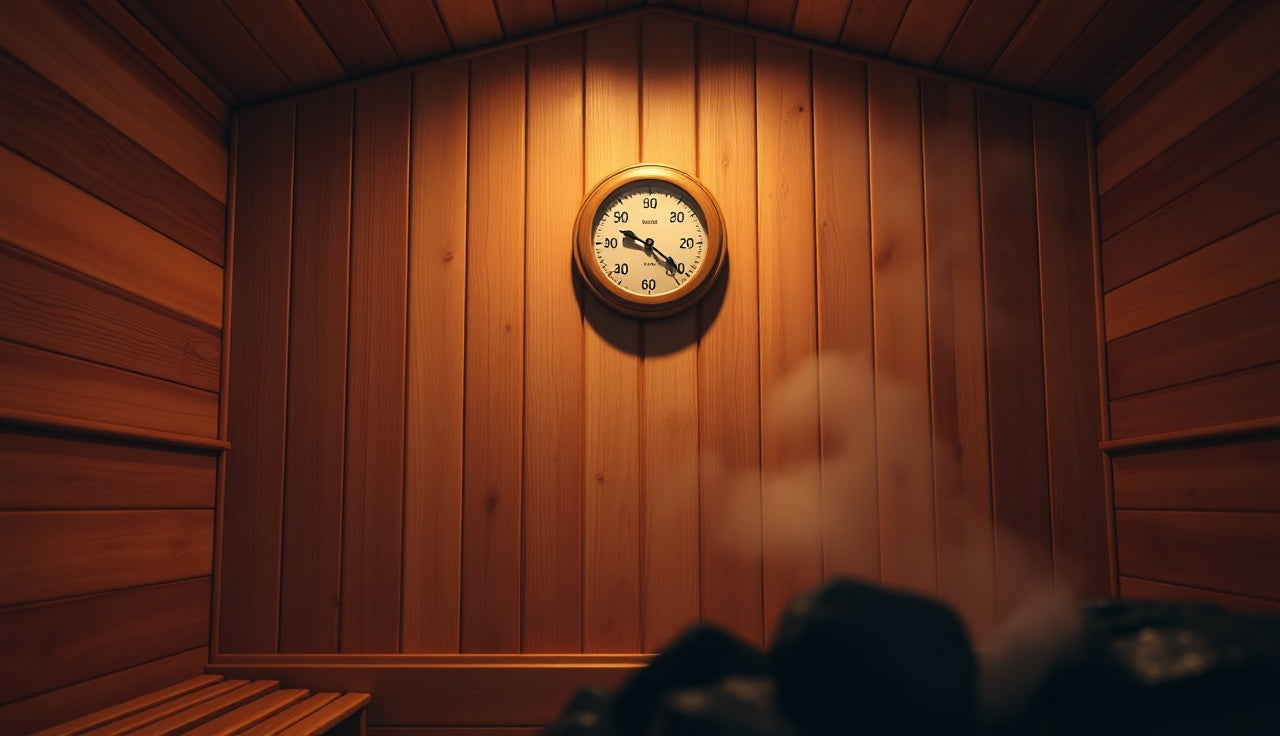
Mount your sauna hygrometer on the wall opposite the heater, 12 to 18 inches below the ceiling, away from direct steam and cold drafts. That spot reads the air your body actually breathes. Readings taken near the heater or down by the floor can differ by 15 to 20 percentage points from the true room average, which makes those locations nearly useless for real control.
Why does hygrometer placement in a sauna matter so much?
A hygrometer is only as good as the air it samples. Inside a sauna, temperature and humidity stack in hard layers. Air near the ceiling can run 20 to 30°F hotter than air at bench level [1], and relative humidity jumps with every ladle you throw on the rocks. Put your sensor in the wrong spot and you read a microclimate that has almost nothing to do with what you feel.
That gap matters for two reasons. If you're chasing a specific humidity target, say 20% for a Finnish dry session or 40 to 60% for something steamier, a misplaced sensor points you the wrong way. And if you rely on the hygrometer to protect the wood, door seals, or electronics, a reading from the wrong zone gives false comfort while the real trouble spot soaks.
Here's the practical cost. A sensor sitting directly above the heater or right beside the steam outlet can read 20 to 30 percentage points higher than the room average [2]. Drop it down by the floor drain and it reads 10 to 15 points lower. Neither number tells you anything you can act on.
Where exactly should you mount a sauna hygrometer?
Short answer: on the wall opposite the heater, 12 to 18 inches below the ceiling line.
Here's the reasoning. Hot, humid air rises and pools just under the ceiling. That upper band is where your bench-level air ends up, and it best represents the room's average condition once steam has mixed. You want to sit close to that band without burying the sensor in the ceiling pocket, where trapped steam and condensation spike readings on their own.
Twelve to eighteen inches below the ceiling hits the mark. You catch well-mixed air without parking the sensor inside a steam cloud. On the wall opposite the heater, you dodge the radiant heat that bakes sensors and skews temperature-dependent humidity readings. You also stay clear of the direct plume off the rocks, which can hit 100% relative humidity for several seconds after a ladle [2].
Got a two-tier bench? Aim for roughly upper-bench breathing height, then apply the ceiling-distance rule above. In a standard 7-foot ceiling room that usually lands around 5 to 6 feet off the floor.
For an outdoor sauna or a portable sauna with odd wall geometry, the principle holds: maximize distance from the heat source, get high on the wall, and stay away from direct steam or cold leak points like the door gap.
What spots should you avoid, and why?
Directly above the heater. The radiant and convective heat here drives the sensor's own temperature well above room average, which corrupts relative humidity since RH depends on temperature. Readings look artificially low because the sensor itself is cooking.
Right next to the door. The door is the coldest surface in the room. Cold air leaks in at the bottom, and the temperature gap causes condensation on nearby surfaces. A sensor there reads high against the room average and jumps every time someone walks in or out.
On the floor or below bench level. The lower third of a sauna runs cooler and holds less moisture by design. Traditional Finnish practice leans on that gradient: fiercer heat up top, relief lower down [3]. A floor-level reading can show 10 to 15% lower RH than bench height, which pushes you to over-ladle the rocks trying to fix a number that was never wrong.
On the ceiling itself. Ceilings collect condensation. The reading almost always sits high, and the sensor wears out faster from repeated wetting.
Inside a cabinet or behind a bench back. Even a small dead-air pocket builds its own microclimate. The reading lags too far behind to help you manage a live session.
| Above heater / rocks | 25% |
| Ceiling surface | 18% |
| Optimal: 12–18" below ceiling, opposite wall | 0% |
| Eye level (5 ft), opposite wall | -8% |
| Near door | 12% |
| Near floor / drain | -14% |
Source: ASHRAE Fundamentals Handbook, Psychrometrics; Finnish Sauna Society guidelines
Does placement differ between dry Finnish saunas and steam rooms?
Yes, and the difference is real.
In a traditional Finnish dry sauna, humidity sits around 10 to 20% between ladles and jumps briefly to 40 to 60% right after [3]. The steam clears in 30 to 60 seconds. Your hygrometer needs to read the resting condition, not the post-ladle burst. The wall-opposite-heater, just-below-ceiling spot works here because it catches the average once steam has mixed.
A steam room or steam hybrid chases sustained high humidity, often 80 to 100% RH at 105 to 120°F [4]. Now the gradient matters less because the room is basically saturated. Durability becomes the problem instead. Most consumer hygrometers aren't rated for continuous 95 to 100% RH. Read your sensor's spec sheet for maximum operating humidity. A unit rated only to 95% RH will die in a steam room sooner than you expect.
For a full breakdown of how the two environments split on temperature and humidity, see the sauna vs steam room guide.
Infrared cabins follow the same opposite-wall, high-on-the-wall logic, but the stakes drop because IR saunas rarely use water. Humidity in a dry infrared cabin is usually just ambient indoor humidity, somewhere around 20 to 40%, with no active steam at all [5].
What's the ideal temperature and humidity range a sauna hygrometer should show?
It depends on the sauna type. Here are the conventional targets:
| Sauna Type | Temp Range (°F) | Target Humidity (%) |
|---|---|---|
| Finnish dry sauna (between ladles) | 170 to 195 | 10 to 20 |
| Finnish dry sauna (just after ladle) | 170 to 195 | 40 to 60 |
| Soft sauna / lower-temp Finnish | 150 to 170 | 30 to 50 |
| Steam room | 105 to 120 | 80 to 100 |
| Infrared sauna | 120 to 150 | 20 to 40 (ambient) |
The Finnish Sauna Society, founded in 1937, describes the traditional experience as temperatures between 80 and 100°C (176 to 212°F) with humidity adjusted by water ladled onto heated stones [3]. High temperature plus periodic steam creates löyly, the steam burst that separates Finnish sauna from plain dry heat.
If your hygrometer keeps reading above 70% in a Finnish-style room even between ladles, either the room isn't ventilating or the sensor sits in a high-humidity pocket. Check placement before you blame the room.
How high should a sauna hygrometer be mounted on the wall?
Height is the single most important variable, ahead of horizontal position.
Mount the sensor so its face sits 12 to 18 inches below the ceiling. In a standard 7-foot ceiling, that's roughly 66 to 72 inches off the floor. In an 8-foot room, 78 to 84 inches. That band keeps you in well-mixed upper air without touching the condensation zone right at the ceiling.
Don't mount at eye level just so it's easy to read. A sensor at 5 feet in a 7-foot room reads noticeably different from one at 6 feet. The convenience isn't worth the error. Most combo thermometer-hygrometers have faces large enough to read from the bench even when they're mounted up high.
A digital wireless unit with a remote display solves the whole problem. Put the sensor element at the high-wall spot and keep the readout at bench level or outside the room. That's the best setup for anyone who wants live monitoring without craning their neck.
For a home sauna build where you're already running wire, pick the hygrometer location before you panel the walls. Retrofitting into tongue-and-groove cedar afterward is a genuine pain.
Does the type of hygrometer (analog vs digital) affect where you place it?
Somewhat, yes.
Analog hygrometers, the bimetal or human-hair type common in Nordic sauna accessories, tolerate high heat and humidity well. They respond slowly, with lag times of several minutes, which smooths out the post-ladle spikes and hands you a running average. Accuracy runs about plus or minus 5 to 10% RH, fine for sauna use but not for precision work [6].
Digital hygrometers use capacitive sensors. They respond faster, often in 10 to 30 seconds, and read more accurately when new, typically plus or minus 2 to 3% RH [6]. Heat tolerance is the catch. Most consumer digital sensors are rated to a maximum operating temperature of 140 to 158°F. In a Finnish sauna running 180°F at the ceiling, a digital sensor mounted too high fails early or drifts after repeated thermal stress.
So: use analog if the sensor lives in the hot zone permanently. Use digital only if you keep it at upper-bench height (not ceiling-adjacent) where temps stay inside its rating, or if you use a remote-probe design where only the probe enters the sauna and the electronics stay outside.
SweatDecks carries combination thermometer-hygrometers built for high-heat sauna use if you want units already vetted for the environment.
How far should a sauna hygrometer be from the heater?
At minimum, put it on a wall that isn't the heater wall. In a typical 6x8-foot room, that means at least 6 feet of horizontal distance from the heater. More is better.
The heater wall is the hottest surface in the room. The air right around the heater is turbulent, full of convective flow, and hit by brief extreme-humidity events every time water lands on the rocks. No reading taken within 2 to 3 feet of the rocks represents the room.
If your sauna is small and the opposite wall sits only 4 to 5 feet from the heater, use a side wall instead of the wall directly across. Get as much angular distance between sensor and heater as the room allows, and put height above everything else.
The Finnish Sauna Society's design guidance is worth reading for traditional context [3]. The same spatial logic that governs bench placement, keeping bathers back from direct heater radiance, applies straight to where the sensor goes.
How do you calibrate a sauna hygrometer, and how often?
For most home users, calibration means a salt test. You seal a saturated sodium chloride (table salt) solution in a container with the sensor for 8 to 12 hours. A saturated NaCl solution settles at roughly 75.3% relative humidity at 77°F (25°C) [7]. If your sensor reads something else, that difference is your offset.
Analog dials with a calibration screw get adjusted to match. Digital units without adjustment: note the offset and apply it in your head. Most digital sensors drift 1 to 3% per year under normal use, and heat cycling in a sauna speeds that up.
Calibrate a new sensor before you install it. After that, check analog units once a year and digital units in high heat every 6 months. A sensor that's been baked repeatedly usually reads persistently low, because heat degrades the hygroscopic element.
NIST has published guidance on humidity sensor calibration for laboratory work [7], and the salt equilibrium values it uses are the same ones that apply at home.
Can you use a regular indoor hygrometer in a sauna?
Usually no, at least not the sensor itself.
A standard indoor hygrometer is typically rated to a maximum of 122°F (50°C) and 95% RH [6]. A Finnish sauna blows past both routinely. The sensor element degrades fast above its rated temperature, and most indoor units use plastics and adhesives that warp or off-gas at sauna heat.
Here's the workaround. Use an indoor-rated digital display with a remote probe built for high temperatures. The probe goes in the sauna; the readout stays in the changing room or outside the door. That lets you run an accurate, calibrated digital sensor without frying the electronics.
For a sensor that lives inside the sauna, buy one explicitly rated for it, usually spec'd to 230°F (110°C) and 100% RH. Those tend to be the traditional analog bimetal dials common in Finnish and German sauna culture, or purpose-built high-temp remote probes made for industrial or food-service humidity monitoring.
The sauna overview covers what makes these rooms mechanically different from ordinary indoor spaces, handy context if you're building a monitoring setup from scratch.
Does hygrometer placement affect sauna safety?
Indirectly, yes, and it's worth taking seriously.
Heat illness risk in saunas is real. A 2018 review in the journal Temperature (Taylor & Francis) reported that cardiovascular and thermoregulatory strain climbs sharply once core temperature passes 38.5°C (101.3°F), and that environmental conditions, especially heat and humidity combined, set how fast the body stores heat [8]. A hygrometer reading lower than the room's actual humidity can nudge someone to push session length or add more steam than their body can handle.
The Consumer Product Safety Commission has logged sauna-related injury reports. Most involve structural or electrical hazards, but heat-related incidents happen [9]. CPSC advises limiting sessions to 15 to 20 minutes and staying out of the sauna when dehydrated or after drinking alcohol [9].
A correctly placed hygrometer that reads true room conditions is one piece of sensible monitoring. It doesn't replace paying attention to your body, which matters more than the dial. But good data beats bad data, and placement decides which one you're looking at.
For the physiological picture, the sauna benefits article covers what the research actually shows, with real study citations.
What about hygrometer placement in a barrel or outdoor sauna?
Barrel saunas have curved ceilings, which shifts the geometry a little but not the principle. The top of the arc collects steam and condensation hardest. Mount the sensor about 80% of the way up the curved wall, on the side opposite the heater.
In most barrel designs the heater sits at one end and benches run lengthwise. Put the hygrometer at the far end from the heater, at the same height proportion you'd use in a rectangular room. Barrels tend to be short (many run 6 feet in interior diameter or less), so you might end up with the sensor only 50 to 60 inches off the floor. That's fine as long as it's the highest reachable point away from the heat.
Outdoor saunas add a variable: ambient outdoor humidity. On a rainy day the room starts wetter than on a dry summer afternoon. That affects how you read the numbers, not where you place the sensor, but know that outdoor hygrometer readings vary more session to session than indoor rooms, which start from a steadier baseline.
For wood protection in an outdoor sauna, a second hygrometer down at the lower wall or near the door tells you whether ventilation is clearing moisture after sessions, which matters for keeping rot and mold out of the structure.
Frequently asked questions
Can I mount a hygrometer on the ceiling of a sauna?
Not recommended. The ceiling is the hottest surface in the room and collects condensation directly on its face. A ceiling-mounted sensor reads artificially high humidity almost constantly, and repeated wetting and drying cycles cut its life short. Stay 12 to 18 inches below the ceiling line on a side or end wall instead.
How do I read a sauna hygrometer accurately when humidity spikes after adding water to the rocks?
Wait 60 to 90 seconds after ladling before you read. The post-ladle spike is a brief local event near the heater, not the room's average. A correctly placed sensor on the opposite wall shows a rise within 30 to 60 seconds, peaks, then settles back toward baseline. The settled number is the one that matters for managing the session.
What humidity level is too high in a sauna?
For a Finnish dry sauna, sustained readings above 70% between ladles point to poor ventilation or a placement problem. For a steam room, 80 to 100% is normal. High sustained humidity in a wood-lined sauna wears out benches, wall panels, and structure. If you sit consistently above 60% between steam events in a dry sauna, check your floor drain and fresh air intake.
Should I use one hygrometer or two in a home sauna?
One is enough for session management. Two helps if you want to watch both the breathing zone (upper bench height) and the structural zone (lower wall near the door or drain) to catch moisture before it damages wood. If your sauna runs larger than roughly 8x10 feet, two sensors give you a fuller picture of how humidity spreads across the space.
Do I need a hygrometer if my sauna has a built-in humidity control system?
Yes. Built-in sensors for automatic steam systems sit where the system needs them, not necessarily where the reading is best. An independent hygrometer lets you check what the control system is actually doing. Many sauna users find the built-in sensor and a separately placed hygrometer disagree by 5 to 15 percentage points, which matters for dialing in the experience.
How long does a sauna hygrometer last?
Analog bimetal or hair-tension hygrometers built for sauna use last 5 to 10 years with annual calibration. Digital capacitive sensors in high heat usually drift noticeably within 2 to 4 years and can fail sooner if temperatures keep passing their rated maximum. Buy a unit rated for sauna temperatures, and plan to calibrate or replace the digital type more often.
Does humidity in a sauna affect how hot it feels?
Yes, a lot. Higher humidity slows evaporative cooling from your skin, so a 170°F sauna at 40% humidity feels much more intense than the same temperature at 10%. That's the point of löyly in Finnish sauna: a brief humidity spike that amplifies perceived heat without raising air temperature. A correctly placed hygrometer lets you control that effect on purpose.
Can I use a Bluetooth or Wi-Fi hygrometer in a sauna?
Only if the electronics stay outside the heat zone. Wireless hygrometers with external probes work well: the probe takes the heat while the transmitter or hub sits in the changing room. All-in-one wireless sensors rated only to 122°F will fail inside a Finnish sauna. Check the operating temperature spec carefully before buying any electronic humidity device.
What is the best material for a hygrometer housing in a sauna?
Wood or metal housings hold up best. Wooden hygro-thermometer sets made from linden or aspen, common in Finnish and German sauna accessories, are traditional for a reason: the material takes the heat, doesn't off-gas like plastic, and suits a wood-lined room. Skip any sensor with a large plastic case if it's going in the upper heat zone.
How is hygrometer placement different in a small 2-person sauna versus a large 6-person sauna?
In a small sauna the wall opposite the heater might be only 4 to 5 feet away. That's still the right wall; just mount as high as the space allows. In a large sauna the air takes longer to mix and humidity varies more between zones. Consider a second sensor at a mid-room location in very large saunas to catch hot spots or stratification.
Does ventilation intake or exhaust placement affect where I should put the hygrometer?
Yes. Keep the hygrometer away from both the fresh air intake (usually low, near the heater) and the exhaust vent (usually high, on the wall opposite the heater). The intake pulls in dry outside air that drops readings locally; the exhaust draws humid air out and can build a low-humidity zone near it. Center the sensor between these airflow points for an average room reading.
What should I do if my hygrometer shows very different readings on different walls?
First rule out placement errors: sensors near the heater, door, intake, or exhaust always read differently from the rest of the room. If both sensors sit in neutral spots and you still see a 10-plus percent spread, the room has stratification or ventilation problems. Check that intake and exhaust are sized for the room volume, and that the heater isn't oversized for the space.
Sources
- University of Eastern Finland, sauna research overview: Temperature stratification in a sauna: the air near the ceiling can be 20 to 30°F hotter than air at bench level in a traditional Finnish sauna
- ASHRAE, Fundamentals Handbook (Psychrometrics chapter): Humidity readings near a steam source or directly above a heater can differ by 20 to 30 percentage points from average room conditions because of localized steam plumes and temperature differentials
- Finnish Sauna Society (Suomen Saunaseura): Traditional Finnish sauna temperatures run 80 to 100°C (176 to 212°F); humidity is adjusted by ladling water onto heated stones to create löyly; between steam events humidity is typically 10 to 20%
- CDC, Healthy Swimming (hot tubs and steam): Steam rooms operate at 105 to 120°F with relative humidity approaching 100%; this distinguishes them physiologically from dry saunas
- NIH MedlinePlus (National Library of Medicine): Infrared saunas do not use water or steam generation; cabin humidity is essentially ambient indoor humidity, typically 20 to 40%
- NIST, humidity measurement guidance: Consumer analog hygrometers have typical accuracy of plus or minus 5 to 10% RH; capacitive digital sensors achieve plus or minus 2 to 3% RH when new; both types degrade with thermal cycling
- NIST, saturated salt humidity reference values: A saturated sodium chloride (NaCl) solution produces an equilibrium relative humidity of approximately 75.3% at 25°C (77°F), used as a reference point for hygrometer calibration
- Temperature journal (Taylor & Francis), 2018 review of cardiovascular and thermoregulatory strain during sauna bathing: Cardiovascular and thermoregulatory strain increases significantly at core temperatures above 38.5°C; combined heat and humidity drive heat accumulation rate in sauna users
- U.S. Consumer Product Safety Commission (CPSC): CPSC recommends limiting sauna sessions to 15 to 20 minutes and warns against use when dehydrated or under the influence of alcohol due to heat illness risk
- EPA, Introduction to Indoor Air Quality: Indoor relative humidity above 60% sustained over time promotes mold growth and structural wood degradation; relevant to monitoring post-session humidity in sauna rooms
- ASHRAE Standard 55, Thermal Environmental Conditions for Human Occupancy: Elevated humidity at a given temperature significantly increases perceived heat stress; the psychrometric relationship between temperature and relative humidity underpins sauna humidity targeting

Share:
Cold plunge thermometer calibration: how to get it right
Where to place a sauna temperature probe for an accurate reading