
Last updated 2026-07-11
TL;DR
A sauna hat insulates your head so it heats up slower than your body, letting you stay in a hot sauna longer without dizziness. Wool felt is the traditional material. Buy one for $15-80 or make one in under an hour from a craft-store felt sheet. They matter most in steam rooms and wood-fired saunas above 80°C (176°F).
What does a sauna hat actually do?
Your head is the one part of you that gains nothing from extra heat during a sauna session. The brain hates getting hot, and the blood vessels in your scalp sit close to the surface, so your head temperature climbs faster than your core. When your head overheats before the rest of you catches up, you get dizzy, queasy, or the sudden urge to bail out well before your body has had enough.
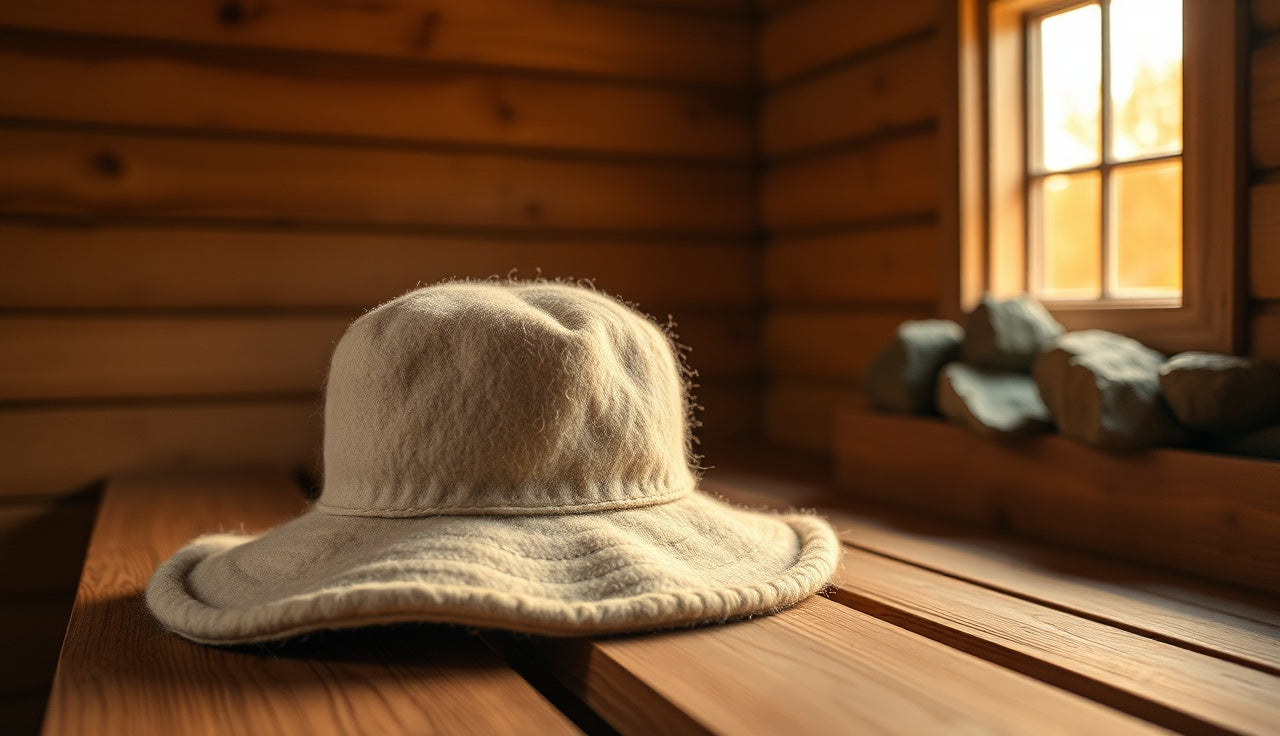
A sauna hat puts an insulating layer between the hot air and your scalp. That layer slows heat transfer to your head, so your body keeps absorbing heat longer before you feel overwhelmed. Finnish sauna tradition has used wool felt hats for over a century for exactly this reason. The hat does not make you bulletproof in high heat. It just stretches the comfortable window.
There is a hair angle too. Repeated exposure to temperatures above 80°C (176°F) dries out and damages hair structure, especially colored or chemically treated hair [1]. A hat limits that direct exposure without you having to leave the bench.
In a traditional Finnish or wood-fired sauna where air temperatures routinely hit 80-100°C (176-212°F), the hat earns its keep fast. In a lower-temperature infrared sauna running at 45-60°C (113-140°F), the payoff is smaller, though some people still wear one for hair protection.
Is there any real science behind wearing a sauna hat?
No large controlled trials have tested sauna hats specifically. What we do have is thermal physiology explaining why the idea works, plus a growing pile of research on how sauna heat affects the body.
The physiology is straightforward. The scalp packs a high density of superficial blood vessels, and the brain guards its own temperature aggressively. When head temperature spikes, the hypothalamus reads it as a signal to cool the whole body, which can cut your session short before your cardiovascular system has felt the full heat stress [2].
A 2018 study in Mayo Clinic Proceedings linked regular sauna bathing at 79°C (174°F) for sessions around 19 minutes with lower cardiovascular and all-cause mortality, with session duration and frequency doing the heavy lifting [3]. If a hat lets you sit comfortably for 15-20 minutes instead of 10, you land closer to the exposure durations in that research. That is the practical argument, even though the hat itself was never the variable being studied.
The Finnish Sauna Society, the main standards body for sauna culture and safety, treats head insulation as normal traditional practice, especially in higher-heat sessions [4].
Nobody has clean data on exactly how many degrees of head protection a hat buys under controlled sauna conditions. The closest evidence is general textile insulation science, which shows a 3-5mm wool felt layer cuts surface heat gain a lot compared to bare skin in convective heat [10].
What materials are sauna hats made from, and which is best?
Wool felt is the classic choice and still the best one. Wool conducts heat poorly, roughly 0.03-0.05 W/(m·K) for dense felt, and it absorbs moisture up to 30% of its own weight without feeling wet [5]. In a steam room, or when löyly (water on the rocks) spikes the humidity, that moisture handling matters a lot. Wool also does not melt or off-gas in high heat the way synthetics can.
Here is how the common materials stack up:
| Material | Thermal insulation | Moisture handling | Durability | Notes |
|---|---|---|---|---|
| Wool felt (100%) | Excellent | Excellent | High | Traditional choice, safe at any sauna temp |
| Wool-blend felt | Good | Good | Medium | Cheaper; check synthetic % |
| Linen | Moderate | Good | High | Breathable, less insulating |
| Cotton terry | Low | Good | Medium | Familiar but not very insulating |
| Synthetic felt (polyester) | Poor | Poor | Low | Avoid: can melt or off-gas above 80°C |
Buying rather than making? Look for hats labeled "100% wool felt" or "boiled wool." Boiled wool is felt that has been washed and agitated in hot water to tighten the fibers, so it comes out denser and tougher. It is a little stiffer but holds its shape better through repeated sessions and hand-washing.
Linen is a fair second choice, mostly in drier saunas. It breathes well and handles heat safely, but it will not insulate your head like thick wool felt.
Skip anything with a high polyester or acrylic content. Synthetics can hit their deformation point in a hot sauna, and some release fumes you do not want in an enclosed room.
| Wool felt (3-5mm) | 0.04 |
| Boiled wool | 0.05 |
| Linen fabric | 0.08 |
| Cotton terry | 0.06 |
| Polyester felt | 0.13 |
Source: USDA Forest Service Forest Products Laboratory & Textile Research Journal natural fiber properties
How much does a sauna hat cost?
Ready-made sauna hats run from about $15 for thin imported wool-blend versions to $70-80 for quality handmade or boiled-wool hats from Finnish and Estonian makers. Most people are best served in the $25-45 band.
At that price you get a genuine 100% wool felt hat thick enough to actually insulate, and it will last several years with basic care. The cheapest options are often thin felt that does little, or wool-blend fabric with more synthetic content than the label admits.
Making your own costs $8-15 in materials (one sheet of craft wool felt, a bit of thread). That is the cheapest route if you are comfortable with basic sewing, or even just cutting and gluing.
If you are outfitting a home sauna for the first time, our home sauna guide covers setups and accessories. A hat is a small add-on that most buyers forget until after their first session at full temperature.
How do you make a sauna hat at home?
A basic sauna hat takes about 30-45 minutes and no special skills. Here is the method.
What you need:
- One sheet of 100% wool felt, at least 30cm x 60cm (12" x 24"), 3-5mm thick. Craft stores sell this. Make sure the label says wool, not polyester.
- A bowl or plate about 22-24cm (roughly 9") across to trace the crown
- Scissors
- A needle and wool or linen thread, or fabric glue rated for high temperatures
- A flexible tape measure
Step 1: Measure your head. Wrap the tape around your head just above your ears. Write the number down. Most adult heads run 54-60cm (21-24") in circumference.
Step 2: Cut the brim strip. Cut a strip of felt about 7cm (roughly 3") wide and 3-4cm (about 1.5") longer than your head circumference. This becomes the brim band.
Step 3: Cut the crown. Trace your bowl or plate onto the felt and cut it out. This is the top of the hat. Want a taller hat with more insulation? Cut a larger circle and gather it slightly when you sew. For a flatter cap, match the circle to the inner circumference of the band.
Step 4: Join the brim. Overlap the two ends of the strip by about 2cm and sew or glue them into a ring. Try it on. It should sit snug but not tight.
Step 5: Attach the crown. Set the crown circle on top of the band ring and sew or glue around the edge. A simple running stitch every 1cm is plenty. Felt does not fray, so skip finishing the edges.
Step 6: Shape and test. Dampen the hat lightly with water and press it into shape while wet. Let it dry in that shape. Wool felt is easy to mold when damp.
That is all there is to it. The result looks homemade, but it works as well as a store-bought one.
Want a cleaner finish? Cut a second identical crown piece and glue or sew it inside the first (double-layer construction). That adds insulation and hides the seam.
Does a sauna hat work in a steam room too?
Yes, and it arguably matters more there. A steam room runs at 100% humidity around 43-50°C (110-122°F). The air is cooler than a Finnish sauna, but saturated steam moves heat into skin and hair far more efficiently than dry hot air does. Hair soaks up moisture and heat quickly, and the feeling of a hot head shows up sooner than you expect.
Wool's moisture handling makes it good in steam. The fibers pull in steam without instantly passing it through to your scalp, which gives you a buffer. Linen works reasonably well too. Avoid anything that just soaks through and sits wet against your head, like thin cotton.
One practical note: steam rooms get a hat wetter than a dry sauna does. Let it dry fully between sessions. Wool felt that stays damp for days will develop a mildew smell and break down faster. A quick cool-water hand rinse after each use, then air-drying flat, is the right routine.
For a side-by-side on the two environments and when to use each, our sauna vs steam room guide covers the differences.
How do you properly use a sauna hat?
Put it on before you enter, not after you start feeling hot. The hat works by keeping heat off your head in the first place, not by cooling it down once you are already cooking.
The hat should sit low enough to cover your ears, or at least the tops of them. Ears overheat the same way the scalp does. If the hat rides high and leaves your ears bare, you throw away a real chunk of the protection.
Dampen the hat with cool water before each session if you are in a steam room or planning to throw a lot of water on the kiuas (sauna stove). The evaporative cooling from a slightly damp hat adds a buffer during heavy steam bursts. In a dry Finnish sauna without much löyly, a dry hat is fine.
If you feel dizzy or overheated at any point, leave the sauna no matter what you are wearing. A hat lowers the risk of head overheating. It does not erase it. Finnish sauna tradition and most sports medicine guidance both say to exit at the first sign of nausea or real discomfort [4].
For session structure, our sauna benefits guide covers research-backed protocols for length and rest periods.
How do you wash and care for a sauna hat?
Hand wash in cool or lukewarm water with a little mild wool wash or baby shampoo. Hot water shrinks wool felt further and can lock in a warped shape. Squeeze out water gently, no wringing or twisting.
Reshape the hat while it is still wet and lay it flat on a clean towel to dry. Never put wool felt in a dryer. Heat plus mechanical agitation shrinks and felts it tighter, and it can end up too small to wear.
How often? If you sauna several times a week, a quick rinse after each session and a full wash every 2-4 weeks is enough. If the hat only gets lightly warm and a bit sweaty, once a month is fine.
Wool felt is naturally antibacterial and fights odor better than cotton or synthetics, so you wash it less than you might guess. A good airing-out in fresh air after each use handles most of the smell.
Are sauna hats safe, and are there any risks?
Sauna hats made from natural materials (wool, linen) are safe. The risk picture around sauna use itself needs more care.
The main safety concern in a sauna is whole-body overheating and cardiovascular stress, not the hat. The hat trims one piece of that risk (head overheating) but does not change the rules about who should and should not use high-heat saunas.
The American College of Sports Medicine and cardiovascular medicine guidance say people with uncontrolled hypertension, certain heart conditions, or pregnancy should check with a physician before using high-heat saunas [6]. That holds with or without a hat.
For healthy adults, a sauna hat carries essentially zero risk as long as it is made from non-toxic material. A synthetic hat with unknown chemical treatments could off-gas above 80°C. That is why sticking to 100% natural materials matters.
One overlooked risk: a very thick or tight hat can hide the early sensation of head overheating. If you stop noticing when your head feels too warm, you might blow past an early warning sign. Keep sessions to reasonable lengths (15-20 minutes is a common guideline) and do not treat the hat as a license to push way past your normal comfort zone [3][9].
Where did sauna hats come from, and who actually uses them?
The sauna hat has deep roots in Finnish and broader Nordic sauna culture, where the sauna has been a social and health fixture for thousands of years. The Finnish Sauna Society, founded in 1937, treats the sauna hat as a traditional accessory tied to higher-temperature public saunas and smoke saunas, where air temperatures get extreme [4]. Finnish sauna culture was inscribed on the UNESCO Representative List of the Intangible Cultural Heritage of Humanity in 2020 [8].
Russia and Eastern Europe have a parallel with the "banya hat," usually wool or felt, worn in the banya (Russian bath house) where birch branch whisking (venik) pushes circulation and temperatures up hard. The Baltic countries keep similar traditions.
In Finland and Estonia, sauna hats are ordinary items you can grab in grocery stores and gas stations near popular sauna spots. They are not a niche wellness gadget there. They are standard equipment.
Outside Scandinavia and the Baltics, sauna hats are less common but catching on as home saunas go mainstream. As more people build or buy outdoor sauna or home sauna setups that run at traditional Finnish temperatures, the hat is working its way into Western wellness habits.
SweatDecks carries wool sauna hats and other accessories if you want a ready-made option alongside the DIY route above.
What other accessories help you stay in the sauna longer?
A sauna hat handles the head. A few other simple tools help with overall comfort and session quality.
A wooden backrest or bench pad lets you lean against the wall without a hot surface burning your back. Wood conducts heat slower than skin against metal or tile would. Most traditional Finnish saunas build these in, but if yours does not, a simple cedar or pine rest makes a real difference.
A bucket and ladle for löyly puts humidity in your hands instead of a fixed setting. Measured water on the rocks gives you steam bursts on your own schedule.
A cotton bench towel under you keeps the bench comfortable and hygienic, which matters in a shared sauna.
Hydration matters a lot. Finnish guidelines and sports medicine both say drink water before and after a session. A 20-minute session in a hot sauna can produce roughly 0.5 liters of sweat [7]. Bring water in.
If contrast therapy interests you, pairing a sauna session with a cold plunge or ice bath afterward is the protocol most supported by current recovery and cardiovascular research. The sauna hat does not change that protocol, but a full setup is worth thinking through if you are investing in home recovery gear.
Frequently asked questions
Do sauna hats actually work, or are they a gimmick?
They work on real thermal physics: wool felt conducts heat poorly, so it slows how fast your head heats up in a hot sauna. That lets most people stay in longer before feeling dizzy. No large controlled trials have tested hats specifically, but the insulation principle is sound and the Finnish Sauna Society treats them as standard equipment in traditional high-heat sessions.
What is the best material for a sauna hat?
100% wool felt, ideally 3-5mm thick. Wool insulates well, absorbs moisture up to 30% of its own weight without feeling soaked, and does not off-gas or degrade at any sauna temperature. Boiled wool is a denser, tougher version of the same material. Avoid polyester or acrylic felt, which can soften, deform, or release fumes above 80°C.
Can I make a sauna hat without sewing?
Yes. Wool felt does not fray, so you can cut the crown and brim band, then join the seams with a high-temperature fabric glue. Press the pieces firmly, let the glue cure fully before using the hat in heat, and check the glue's rated temperature first. Most craft fabric glues are rated to at least 100°C, which covers sauna conditions.
How thick should a sauna hat be?
3-5mm of wool felt is the target. Thinner than 3mm gives noticeable but limited insulation. Thicker than 6mm gets heavy and can trap uncomfortable heat against your scalp over a long session. If you double-layer a homemade hat with two felt sheets, aim for a combined 4-6mm.
Can I use a sauna hat in an infrared sauna?
You can, but the benefit is smaller. Infrared saunas typically run at 45-60°C (113-140°F), well below the range where head overheating becomes a real issue for most people. Some still wear one for hair protection, which is fair. If you get dizzy in an infrared sauna even at lower temps, a hat may help, but check whether the temperature is set too high first.
How do I keep my sauna hat from shrinking?
Wash it in cool or lukewarm water only, by hand. Hot water and agitation are what shrink wool felt. Keep it out of the washing machine and dryer. Reshape it while damp and dry flat. If you buy a pre-made hat, check whether the maker pre-shrank the felt, which is common in boiled wool hats and means the size you buy is the size it stays.
Should a sauna hat cover your ears?
Ideally yes, or at least the upper part of each ear. Ear canals are sensitive to heat and the skin around them warms up fast in a steam-heavy sauna. Traditional Finnish hats are tall and fold down over the ears or have a turned-up brim you can lower. If your hat is a flat cap that leaves ears fully exposed, you miss some protection.
How long do sauna hats last?
A quality 100% wool felt hat, hand-washed and air-dried, lasts several years with regular use. Boiled wool versions are especially durable. Early failure usually comes from machine washing, dryer use, or storing the hat damp, all of which speed up fiber breakdown. A well-kept hat tends to wear at the brim seam first, which you can re-sew easily.
Is a sauna hat necessary for beginners?
Not strictly necessary, but genuinely helpful. Beginners are often more sensitive to head heat and leave the sauna earlier than needed because of it. A hat removes one of the most common sources of early discomfort. If you are building a home sauna or visiting a high-heat public sauna for the first time, a hat costs little and gives you more control.
Can kids wear sauna hats?
Kids can wear sauna hats, but the bigger question is whether children should be in high-heat saunas at all. Finnish practice has historically allowed older children at lower temperatures and shorter durations with adult supervision. A hat does help protect a child's head, but time limits and temperature matter more for safety. Check with a pediatrician if you have specific concerns.
What is a banya hat vs. a Finnish sauna hat?
Same concept, different cultural names. A banya hat comes from Russian bath house tradition, a sauna hat from Finnish tradition. Both are usually wool felt and both insulate the head from intense heat. Russian banya hats sometimes have a wider brim to shield the face from steam blasts during venik (birch branch) whisking. Functionally they are interchangeable.
Can I use a regular winter wool hat in the sauna?
In a pinch, yes, but knitted wool hats are not ideal. Knit fabric has gaps in the weave that let hot air through more readily than dense felt. A knit hat also stretches and deforms fast when repeatedly wetted and dried. A felted wool hat is worth the small cost or effort, but a thick knit wool beanie beats nothing in a very hot sauna.
Does wearing a sauna hat affect how much you sweat?
It cuts sweating from the scalp specifically, since that area stays cooler. Total body sweat is driven mainly by core temperature, which the hat does not change much. Some evidence suggests that by allowing longer sessions, a hat could raise total sweat over a session, but no study has measured this directly. The effect on total sweat is secondary to the comfort and safety benefit.
How do I size a homemade sauna hat?
Measure your head circumference with a soft tape just above your ears. Add 2-3cm (about 1 inch) to that number for the brim strip length, which covers the seam overlap. The crown circle diameter should roughly match the inner diameter of the brim ring. Most adult heads run 54-60cm. When in doubt, cut larger; felt is easy to trim but impossible to add back.
Sources
- National Institutes of Health, National Library of Medicine: Hair Cosmetics - An Overview (Int J Trichology): Repeated high heat exposure dries and damages hair structure, particularly for chemically treated hair
- National Institutes of Health, National Library of Medicine: Thermoregulation during sauna bathing (Ann Clin Res): Scalp blood vessels are superficial, causing head temperature to rise faster than core in hot sauna environments; hypothalamic response to head heat can trigger early session termination
- Mayo Clinic Proceedings: Cardiovascular and Other Health Benefits of Sauna Bathing (2018): Regular sauna bathing at approximately 79°C for average sessions of 19 minutes was associated with significant cardiovascular benefits; session duration and frequency were key variables
- Finnish Sauna Society (Suomen Saunaseura): Finnish Sauna Society considers head insulation a traditional part of sauna practice and recommends exiting at first sign of nausea or significant discomfort
- USDA Forest Service: Forest Products Laboratory (natural fiber thermal and moisture property reference): Wool felt has thermal conductivity of approximately 0.03-0.05 W/(m·K) and can absorb moisture up to 30% of its own weight without feeling wet
- American College of Sports Medicine: People with uncontrolled hypertension, certain cardiovascular conditions, or pregnancy should consult a physician before using high-heat saunas
- National Institutes of Health, National Library of Medicine: Body fluid balance, hydration, and sauna (Ann Clin Res): A 20-minute session in a hot sauna can produce approximately 0.5 liters of sweat; hydration before and after is recommended
- UNESCO Intangible Cultural Heritage: Sauna culture in Finland: Finnish sauna culture was inscribed on the UNESCO Representative List of the Intangible Cultural Heritage of Humanity in 2020
- National Institutes of Health, National Library of Medicine: Health effects of sauna bathing (review): Session lengths of 15-20 minutes are commonly referenced as a practical guideline for healthy adults in research and clinical review contexts
- Textile Research Journal: Thermal and moisture transport properties of wool fabrics: Wool fiber structures absorb moisture vapor and regulate surface heat transfer, providing buffering in humid hot environments compared to synthetic materials
Share:
How to use a sauna whisk (birch bundle): the complete guide
Sauna meditation protocol: how to actually do it right