
Last updated 2026-07-09
TL;DR
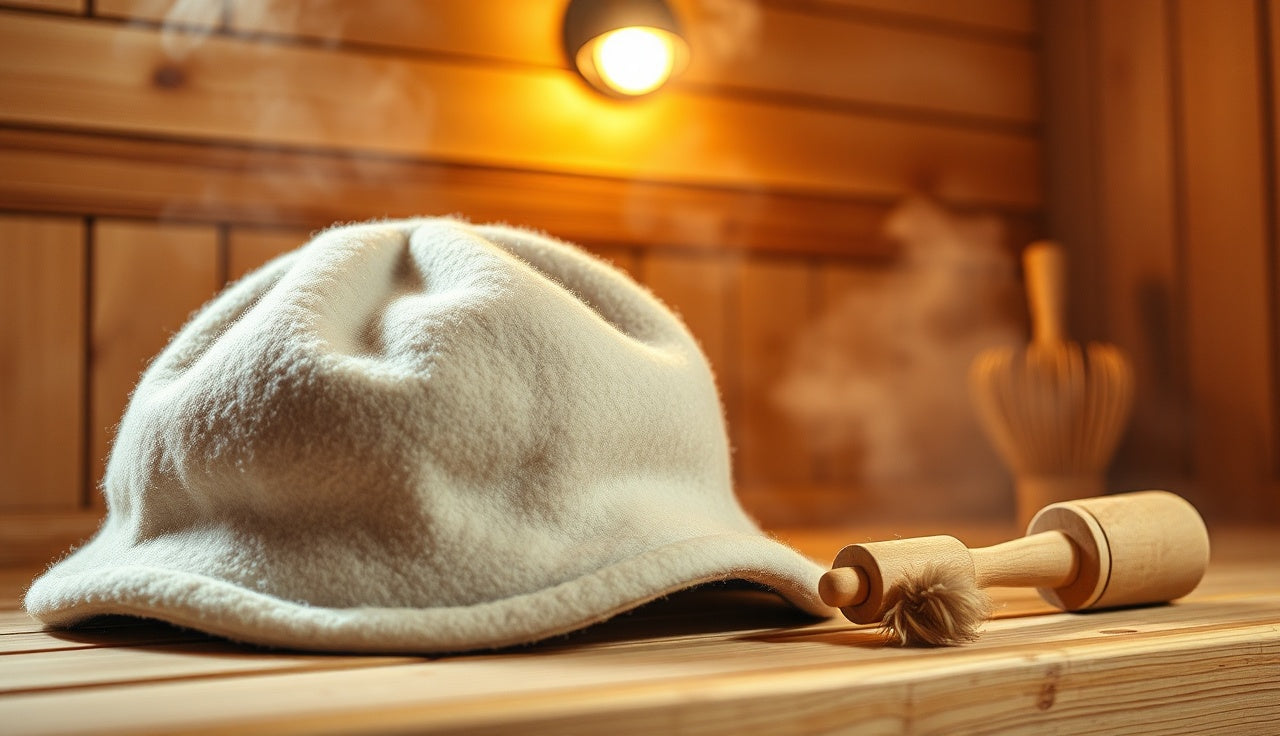
A sauna hat is a thick, insulating cap that slows heat transfer to your scalp so you can sit longer without dizziness or hair damage. Felted wool is the standard, usually 5 to 8mm thick. Nobody needs one, but regular high-heat sauna users find it adds roughly 5 to 15 comfortable minutes per session.
What does a sauna hat actually do?
A sauna hat traps a layer of insulating air between the hot room and your scalp, which slows the heat hitting the most heat-sensitive part of your body. Your head loses and gains heat faster than anywhere else. The scalp is densely vascular, and when the air climbs past 160°F (70°C), which is normal in a Finnish-style sauna, that blood-rich tissue soaks up heat fast.
The practical result: your core and limbs keep sweating at the temperature you want while your head stays cooler. Most experienced sauna users describe it as feeling less flushed in the face and less likely to hit that "I have to leave right now" ceiling before they're ready.
There's a second benefit for anyone with colored, bleached, or chemically treated hair. Repeated high heat degrades the disulfide bonds in hair protein, and hair goes brittle over time. A hat won't fully stop that, but it cuts direct heat contact and keeps some moisture near the scalp instead of flashing off immediately.
One thing a hat does not do: make your head sweat more. Because it slows heat absorption, your scalp actually sweats a little less during the session. If you're chasing maximum sweat output, a hat is neutral at worst. If you're chasing a longer, calmer session, it earns its place.
For the bigger picture on why people sit in saunas at all, the sauna benefits guide covers the cardiovascular and recovery evidence in detail.
Is there real evidence that sauna hats extend session time?
Almost none, specifically. No controlled study has measured hat-wearers against bare-head sauna users in minutes. What exists is thermoregulation research on head insulation, plus a century of practitioner habit. That's the honest state of it.
A 1988 study in Aviation, Space, and Environmental Medicine (Nunneley et al.) found that insulating the head during heat exposure slowed the rate of core temperature rise, because the head handles a disproportionate share of total body heat exchange [1]. That's the mechanism a hat exploits, even though the study wasn't about saunas.
The National Institute for Occupational Safety and Health treats the head and face as priority zones for heat management, since the hypothalamus responds to local scalp temperature as part of its thermoregulatory signaling [2]. Cooler scalp, slightly delayed sense of overheating.
Finland's sauna culture, where the felt cap ("sauna pipo") has been in use for well over a century, treats longer sessions as the obvious reason to wear one. The Finnish Sauna Society, which sets the canonical standards for traditional sauna use, recommends head coverings for high-temperature löyly steam rounds [3].
So the mechanism is solid and the tradition is deep. What's missing is a randomized trial putting a number on it. Be skeptical of any brand claiming a hat adds a precise number of minutes based on their own testing.
What materials are sauna hats made from, and which is best?
Felted wool is the answer for high-heat traditional saunas, full stop. The reasons come down to how each material handles heat when it's wet, which is the state your hat is in five minutes into a session.
| Material | Heat resistance | Moisture handling | Durability | Typical price range |
|---|---|---|---|---|
| Wool felt | Excellent | Good (wicks, holds some water) | High | $20-$60 |
| Linen | Moderate | Very good (dries fast) | Moderate | $15-$35 |
| Terrycloth / cotton | Poor | Excellent (absorbs fast) | Low | $10-$25 |
| Synthetic fleece | Poor (melt risk) | Poor | Low | $5-$20 |
Wool works because felted fiber holds millions of tiny air pockets that insulate without conducting heat well. Wool also has a high ignition point and won't melt or release fumes the way synthetics can at sauna temperatures [4]. A good wool sauna hat is thicker than you'd expect, often 5 to 10mm of compressed felt.
Linen is a legitimate alternative in lower-temperature saunas or steam rooms. It breathes well and dries faster than wool. But it insulates noticeably worse, so in a 190°F Finnish sauna it won't give your head the same buffer.
Cotton terry is what most cheap caps use. It absorbs sweat and water well, but wet cotton is a poor insulator, and wet is exactly its condition minutes into a session. The heat comes through fast.
Synthetics are the one to avoid. At 180 to 200°F some fleeces begin to off-gas, and they have essentially no insulating structure once mashed against your head. Skip the savings.
| Thick wool felt (7-8mm) | 18 |
| Medium wool felt (5mm) | 13 |
| Linen cap | 7 |
| Cotton terrycloth | 4 |
| Synthetic fleece | 2 |
Source: Finnish Sauna Society guidelines and textile heat-transfer properties, 2023
How thick should a sauna hat be?
Aim for 5mm to 8mm of compressed wool felt. That range gives real insulation without turning into a heat trap. Below 4mm you get almost no benefit. Above 10mm the hat gets heavy and starts holding so much heat that the inside becomes uncomfortable in its own way.
The Finnish and Russian traditions both landed here by feel. Russian banya hats ("shapka") tend to run slightly thicker, 7 to 10mm, because banya temperatures can be higher and the steam is more intense. Finnish sauna hats are often 5 to 7mm.
When you shop, "thick felt" with no measurement in the listing is a yellow flag. Pinch the felt between two fingers. It should feel dense and spring back, not floppy.
One practical note on infrared. If you're using a lower-temperature infrared sauna rather than a traditional one, the heat profile is different. Infrared saunas typically run 120 to 140°F versus 160 to 200°F for traditional saunas [5]. At those temperatures even a thin hat covers you, and you may not want one at all. For traditional and wood-fired saunas, thickness earns its keep.
What shape and style should you look for?
The tall conical shape isn't only tradition. The cone holds a pocket of air above your head that acts as an extra insulating layer, heating slowly and buffering the scalp further. For a high-heat traditional sauna, taller is genuinely better.
Flat-topped beanie styles pack easier and look more discreet, but they give up some of that air-gap advantage. If session length is the goal in a hot room, go conical.
Brim width matters if you do banya-style ladle pours straight over the stones. A wider brim deflects some of the steam blast off your face. If you mostly sit still and skip aggressive löyly, brim width is cosmetic.
Fit should be snug without squeezing. A loose hat slides as you sweat and breaks the air gap it's supposed to hold. Most adult hats are one-size-fits-most with a rolled cuff you can adjust, but check the head circumference if the listing gives one. Average adult head circumference runs roughly 54 to 58cm (21 to 23 inches) [6], so a hat marketed to that range fits most people.
Some people in shared saunas pick linen or cotton simply because they wash and dry faster between uses. Wool takes longer to dry and can smell if stored damp. In a home sauna that matters less, since you set the schedule.
How do you use and care for a sauna hat properly?
Put the hat on before you walk in, not after ten minutes of heat. Once your scalp is already hot and flushed, the hat can't undo it. It works by stopping heat from building up in the first place, so timing is the whole point.
Wet it lightly before a steam-heavy session. Slightly damp wool conducts heat even less than dry wool for the first several minutes as the moisture evaporates. Don't soak it. A quick rinse under cold water and a light squeeze is enough.
After your session, let the hat air dry completely before storing it. Wool put away damp will eventually mildew. Hang it upside down on a peg so air moves through the crown.
Washing felted wool takes care. Hand wash in cold water with a wool-safe detergent. Hot water and agitation shrink and tighten felt, which can permanently warp the shape. Lay flat or hang to dry, never a dryer. Treated this way, a quality wool hat lasts years.
One thing to avoid: leaving a wet hat sitting on a wooden bench for hours. Dye from cheaper hats can bleed into cedar or hemlock, leaving a stain that's nearly impossible to lift from untreated wood.
Do sauna hats actually protect your hair from heat damage?
Partly, and the mechanism is real. Hair keratin begins to structurally degrade at sustained temperatures above 140°F (60°C), according to research in the International Journal of Trichology [7]. A traditional sauna at 180°F exposes unprotected hair to air well past that threshold for the whole session.
A wool hat cuts direct air contact and slows heat buildup at the hair shaft. That matters for chemically processed hair, thin hair, or hair already stressed by styling tools. It's not a perfect shield, since heat still conducts through the material, but it's a meaningful drop in exposure.
For the scalp itself, repeated high-heat sessions without cover can trigger temporary follicle inflammation in people with sensitive skin. A barrier layer helps there too, though this is mostly anecdotal and clinical data on sauna-specific scalp effects is thin.
Here's the counterintuitive part. If hair protection is your main goal, linen or cotton can actually beat wool at the contact surface, because they touch the hair and absorb heat rather than trap air against the head. Wool's edge is insulation against the room's air temperature. In a hot traditional sauna, where air temperature is the dominant variable, wool still wins overall. In a mild steam room, an absorbent cap may treat your hair better.
For the broader experience and what regular sessions feel like, see the sauna overview.
Are sauna hats worth it, or are they a gimmick?
Not a gimmick, not essential for everyone. Here's the honest triage.
Regular traditional or wood-fired sauna, especially above 170°F: a good wool hat will almost certainly let you stay in longer and feel more comfortable. It costs $20 to $60 and lasts years. Easy yes.
Infrared sauna at 120 to 140°F: the payoff is small. The temperature gap the hat manages is modest, and you probably won't notice a dramatic difference. It can still help with hair protection if that's your concern.
Casual user, maybe once a month: the benefit is real but low-frequency. You'll get some use, but it's not urgent.
The case where a hat genuinely matters: high-heat banya rounds with aggressive steam, if you're prone to dizziness or headaches in the heat. Heat stress signals show up at the head first, and protecting it can change the whole experience. Endurance athletes and people running long contrast protocols (sauna then cold plunge) often reach for hats because they're deliberately pushing session length.
SweatDecks carries a curated selection of wool sauna hats if you want to see the spec range before buying.
Bottom line: a quality wool sauna hat is one of the cheapest real upgrades for regular sauna users. Not a luxury, not snake oil.
How does a sauna hat compare to just pouring cold water on your head?
They both cool the scalp, but they solve different problems. A hat is passive and continuous. A cold-water pour is active and momentary.
Pouring cold water over your head gives an immediate, dramatic drop at the scalp. It's refreshing and good at resetting your heat tolerance for another round. But it's one and done. In a hot room your scalp reheats within a couple of minutes, so you'd have to pour again and again to hold the effect, which chops up the session.
A hat slows heat absorption across the entire session with zero management. You put it on and sit. That's the whole appeal.
The two aren't rivals. Plenty of Finnish and Russian practitioners do both: wear the hat during the heat phase, then take a cold shower or ice bath between rounds for a full-body reset. That combination is the standard contrast protocol, and it's arguably the best way to manage both session length and recovery.
Building a home sauna? Having both a hat and a cold plunge or shower nearby is the setup serious practitioners actually use. The hat manages in-session comfort. The cold handles the between-round reset.
What should you expect to spend on a sauna hat?
Plan on $25 to $50 for a hat worth owning. That's the range where quality felted wool lives. Below and above it, you're paying for the wrong things.
Budget end ($10 to $20): mostly cotton or thin wool blends, often poorly shaped. Fine for infrared, weak for high-heat traditional use.
Mid range ($25 to $50): where most quality wool felt hats sit. Estonian, Finnish, and Russian-made hats here are typically 5 to 8mm felt, well-shaped, and durable. This is where most people should shop.
Premium ($55 to $100+): handmade, natural dyes, artisan felt work. Sometimes genuinely better, but the thermal gain over a solid $35 hat is marginal. You're paying for craft and looks.
One red flag: hats under $12 sold as "wool" that feel floppy and thin. Felt thick enough to insulate has real material cost. Too cheap usually means a blend or a thin cotton-wool fabric that performs like terrycloth.
For reference, the Finnish Sauna Society lists proper headwear among standard traditional sauna accessories, not a premium add-on [3]. The culture treats it like a towel: basic gear.
If you're outfitting a home sauna or an outdoor sauna, the hat is a last-dollar item. The bucket, ladle, thermometer, and hygrometer come first.
Can children use sauna hats, and are there any safety considerations?
Yes, and if a child is in a sauna at all, head cover is arguably more important for them than for adults. Children's thermoregulatory systems are less mature, and their head-to-body surface area ratio is higher, so proportionally more heat lands at the scalp [8].
That said, kids in saunas is a topic that calls for caution. The American Academy of Pediatrics hasn't issued sauna-specific guidelines for children, but its general heat guidance points toward shorter, lower-temperature sessions and never leaving young children unattended [9]. A hat helps. It does not replace supervision or temperature limits.
For adults with cardiovascular conditions, pregnancy, or anything that affects heat tolerance, the hat is a side issue next to the real question of whether high-heat sauna use is appropriate at all. A hat won't make an unsafe session safe. It trims one of several heat-load variables. Anyone with health questions should talk to a physician before regular sauna use.
On the mechanical side, make sure a child's hat fits. A loose, oversized cap that slides over the eyes in a hot, slippery room is a hazard. Kids' sizes exist. Check head circumference before buying.
Where does a sauna hat fit in a full sauna session routine?
The hat belongs in the heat phase. A traditional session has a rhythm most practitioners follow: heat, cool, rest, repeat.
A structure experienced users converge on: enter with the hat on, sit 10 to 20 minutes depending on your tolerance, exit for a cool-down (cold shower, plunge, or just cooler air), rest 5 to 10 minutes, then go back in. Two to four rounds is standard. Total time including rest often runs 60 to 90 minutes.
The hat's job is that in-sauna stretch. By cutting scalp heat load, it lets you reach the top of your comfortable duration before you feel forced out. Across rounds, that compounds. Add five minutes per round over three rounds and you've banked fifteen more minutes of actual heat exposure.
For contrast therapy with a cold plunge after, more heat time feeds the response you're after. More heat means more core temperature elevation, which means a sharper contrast when you hit the cold. The cold plunge benefits research is largely driven by the size of that thermal swing.
SweatDecks covers the full contrast setup if you want to go deeper. The hat is a small piece of a larger system, but small pieces add up when you're doing this several times a week.
Frequently asked questions
Do you have to wet a sauna hat before using it?
You don't have to, but lightly dampening a wool felt hat before you enter helps for the first few minutes. Wet wool conducts heat more slowly at first as the moisture evaporates. Don't soak it. A quick rinse and squeeze is enough. Once you're in a prolonged session, the hat absorbs sweat naturally and the damp state maintains itself.
What is a sauna hat called in Finnish?
The Finnish term is 'sauna pipo,' or simply a felt cap. The Finnish Sauna Society refers to head coverings as standard sauna accessories, particularly for high-temperature löyly rounds. In Russian banya culture the equivalent is a 'shapka,' or banya hat, usually made from thicker felt to handle a more intense steam environment.
Can I use a regular winter beanie as a sauna hat?
Technically yes, depending on the material. A thick pure-wool beanie gives some insulation. The problem is most winter beanies are knitted rather than felted, so they have much larger air gaps in the weave and heat passes through faster. Synthetic beanies can off-gas at high temperatures. A dense wool knit is a serviceable substitute, but felted wool performs better.
How long does a wool sauna hat last?
A quality felted wool hat, cared for well, lasts three to seven years of regular use. The main failure modes are shrinkage from hot-water washing, mildew from bad drying, and compression thinning from heavy use. Hand wash in cold water, air dry fully, store flat or hung. At $30 to $50, the cost per session over that lifespan is negligible.
Does a sauna hat make you sweat more or less?
Less, from the scalp specifically. Because the hat slows heat absorption at the head, the local sweat response there drops. Your body as a whole keeps sweating normally, since core and limb temperatures aren't affected. If total sweat volume is your metric, the hat barely moves it. If comfort and session length are your metrics, it's a net positive.
Can I use a sauna hat in an infrared sauna?
Yes, though the benefit is smaller. Infrared saunas run 120 to 140°F, well below the 170 to 200°F of a traditional room. The temperature gap the hat manages is modest, so most infrared users don't find one necessary. If hair protection is your main concern, or you run the infrared hot, it's harmless to wear one.
Are sauna hats sanitary in public saunas?
Your own hat is no less sanitary than your own towel. A hat that covers your hair and scalp actually cuts the hair and skin debris you leave on shared benches. Borrowing or renting a hat at a spa is a different question, since wool is hard to fully sanitize between users. For regular public sauna use, owning your own is the practical answer.
What's the difference between a sauna hat and a sauna cap?
The terms are used interchangeably in most markets. Some sellers use 'cap' for lower-profile beanie styles and 'hat' for the taller conical Finnish or Russian shapes. The conical shape holds more air-gap insulation above the scalp. The functional difference between the words is marketing, not standard spec. Focus on material, thickness, and shape rather than the name.
Should I wear a sauna hat during a steam room session?
Steam rooms run at lower air temperature (110 to 120°F) but near 100% humidity. Wool holds moisture well and can feel heavy and waterlogged fast in that environment. Linen or cotton performs better in steam since it dries quicker. A thin linen cap is a reasonable pick. Thick felted wool isn't ideal for steam-room conditions but poses no safety problem.
Do sauna hats help prevent dizziness in the sauna?
They can reduce one contributor: scalp overheating, which signals the hypothalamus to speed up blood redistribution. But sauna dizziness also comes from dehydration, sudden position changes, and systemic vasodilation. A hat handles the head-temperature piece and won't fully prevent dizziness if you're dehydrated or pushing past your tolerance. Hydrate before sessions and stand up slowly on the way out.
How do I know if my sauna hat is too thin to be useful?
The quick test: pinch it between two fingers. Useful felt has density and springs back. If it compresses nearly flat under light pressure and feels more like fabric than a dense pad, it's too thin. Another test: after five minutes in a hot sauna, press the outside. If it already feels very warm, the insulation is overwhelmed. A good hat's outer surface stays cooler than the air for at least 10 minutes.
Can a sauna hat replace a towel for sitting on the bench?
No. They do different jobs. The bench towel is hygiene, a barrier between your skin and shared wood. The hat manages head temperature. In a shared sauna you need both. In your own home sauna you have more leeway, but the hat stays on your head. It's not a substitute for any other accessory.
What size sauna hat should I buy?
Most adult wool sauna hats are one-size-fits-most, built for head circumferences of roughly 54 to 58cm (21 to 23 inches). If a listing gives a range, measure around your head at the widest point, about an inch above your eyebrows. Many hats have a folded cuff you can roll up or down to adjust. When in doubt, size up. You can always roll the cuff wider.
Sources
- Aviation, Space, and Environmental Medicine, 1988 (Nunneley et al.): Insulating the head during heat exposure reduces core temperature rise rate, as the head accounts for a disproportionate fraction of total body heat exchange.
- NIOSH, Criteria for a Recommended Standard: Occupational Exposure to Heat and Hot Environments: The head and face are high-priority zones for temperature management because the hypothalamus responds to local scalp temperature as part of thermoregulatory signaling.
- Finnish Sauna Society (Suomen Saunaseura): The Finnish Sauna Society recommends head coverings as standard accessories for traditional sauna use, particularly during high-temperature löyly steam rounds.
- USDA Forest Service, Fire Behavior of Wool and Synthetic Textiles: Wool has a relatively high ignition point and does not melt or release toxic fumes the way synthetic fibers can at elevated temperatures.
- Harvard Health Publishing, Harvard Medical School, Sauna Health Benefits: Infrared saunas typically operate at 120 to 140°F versus 160 to 200°F for traditional Finnish saunas.
- CDC, Anthropometric Reference Data for Children and Adults: United States (NHANES): Average adult head circumference is approximately 54 to 58 cm (21 to 23 inches) based on U.S. population anthropometric data.
- International Journal of Trichology, Hair Shaft Damage from Heat and Drying: Hair protein (keratin) begins to structurally degrade at sustained temperatures above 140°F (60°C), with disulfide bond disruption occurring with repeated exposure.
- National Institutes of Health, NLM: Thermoregulation in Children: Children have a higher head-to-body surface area ratio and less mature thermoregulatory systems than adults, making head heat exposure proportionally greater.
- American Academy of Pediatrics, Pediatric Environmental Health: General AAP heat exposure guidance recommends limiting young children to shorter sessions in hot environments and never leaving them unsupervised.
- New England Journal of Medicine, Association Between Sauna Bathing and Fatal Cardiovascular and All-Cause Mortality Events (Laukkanen et al., 2015): Regular sauna use at traditional Finnish temperatures (174°F average) is associated with reduced cardiovascular mortality in a 20-year prospective cohort study of 2,315 Finnish men.
- International Journal of Environmental Research and Public Health, Thermal Effects on Human Hair (review): Repeated high-heat exposure degrades hair fiber mechanical properties, with the degree of damage correlating to temperature and exposure duration.
Share:
Cold plunge benefits: what the science actually shows
Red light sauna: what it is, how it works, and whether it's worth it