
Last updated 2026-07-11
TL;DR
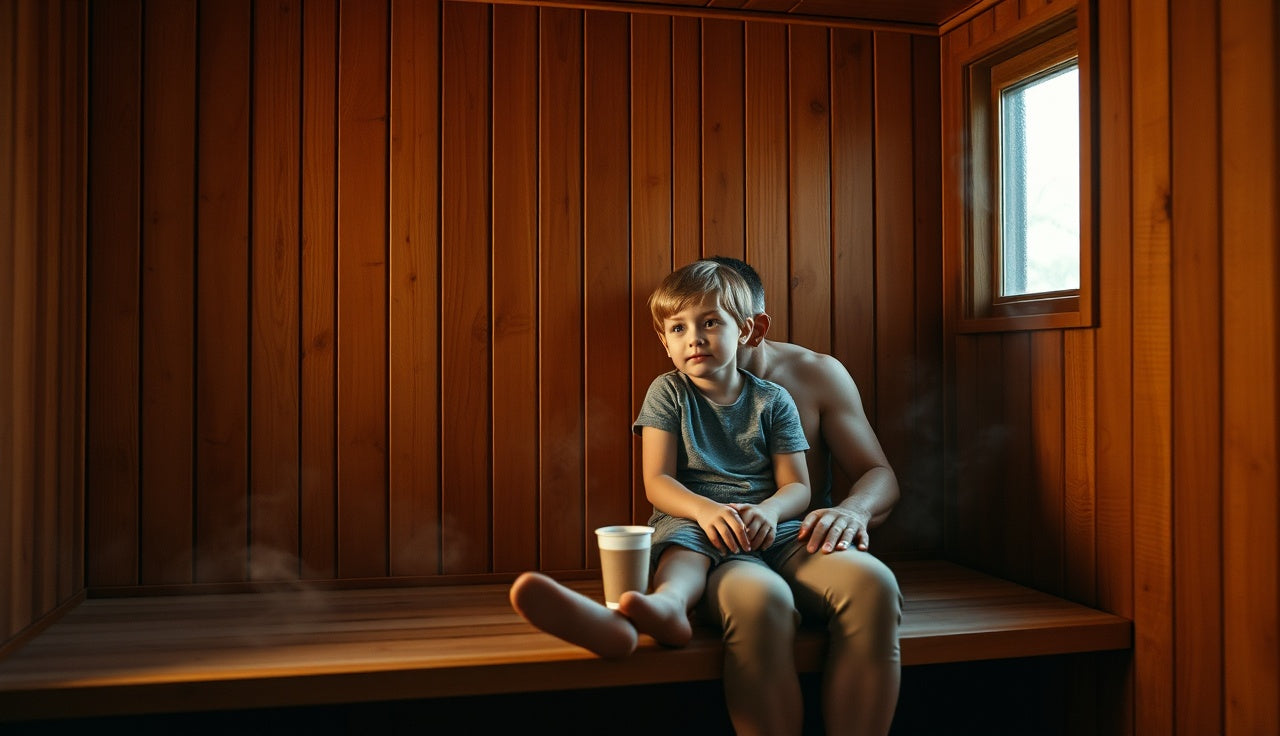
Most pediatricians and national health agencies keep children under 6 out of saunas. Kids 6 to 12 can go in briefly, at 60 to 70°C, on the lowest bench, with an adult beside them the whole time. Teens 13 and up follow modified adult rules. The main dangers are overheating, dehydration, and cardiovascular strain, and all three hit small children faster than adults.
What is the recommended minimum age for sauna use in children?
There is no single universal age. The research base is thinner than most sauna guides admit. But the guidance that exists clusters around age 6 as the practical floor, and most of it comes from Scandinavian medical bodies, the American Academy of Pediatrics (AAP), and a handful of Finnish pediatric studies.
The Finnish Sauna Society, representing the country with the highest sauna density on earth, has historically said children over 3 can enter briefly with a parent. Finnish pediatricians are more cautious, recommending that children under 6 stay out except for very short, low-temperature exposures in a family setting [1]. The AAP has no dedicated sauna guideline, but its heat illness guidance treats any environment above 40°C (104°F) as inappropriate for unsupervised children and notes that infants and toddlers have almost no capacity to handle thermal stress [2].
The biology is the whole point. Children under 6 carry more body surface area relative to their mass, so they absorb heat faster than adults. They sweat less efficiently and hold less total blood volume, so fluid loss hits them harder and sooner. A 4-year-old in a 90°C Finnish sauna is not an adult in miniature. It is a genuinely different physiological situation.
What do medical and government bodies actually say about kids in saunas?
The guidance splits sharply by country, and parents deserve a straight comparison instead of vague reassurance. Finland is the most permissive. Canada is the most protective. Germany sits in between with the most specific numbers.
Finland's National Institute for Health and Welfare (THL) suggests children can join family sauna use from around age 3 to 6 with tight limits: no hotter than 70°C (158°F) at the level where the child sits, sessions of 5 to 10 minutes, and immediate exit at any sign of discomfort [1]. Finnish culture treats the sauna as family space, and that history shapes the numbers.
The AAP addresses hot tubs more directly than saunas, recommending children under 5 avoid hot tubs entirely and that water in any hot environment for children stay below 40°C (104°F) [2]. A sauna gives dry heat rather than immersion, but the thermoregulation concern is the same.
Germany's pediatric societies recommend children under 6 avoid saunas and that children 6 to 12 use lower-temperature rooms (60 to 70°C) for no more than 8 to 10 minutes [3]. That is the most specific English-accessible guidance out there; most agencies simply have not produced a sauna-and-children document.
Canada's federal health resources file saunas under extreme heat exposure and advise against use for children under 12 without medical clearance, the most conservative position of any major agency [4].
| Country / Body | Min. age guidance | Max temp for children | Max session length |
|---|---|---|---|
| Finland (National Institute for Health) | 3-6 with parent | 70°C (158°F) | 5-10 min |
| Germany (pediatric societies) | 6 | 60-70°C (140-158°F) | 8-10 min |
| USA (AAP, inferred from heat/spa guidance) | 5 for hot environments | 40°C water; dry sauna not specified | Not specified |
| Canada (Health Canada) | 12 without clearance | Not specified | Not specified |
The spread is wide. My read: the Finnish numbers reflect generations of family use and cultural familiarity. The Canadian position is the most protective. For a US parent with no cultural baseline, following the German or Canadian framework makes more sense than defaulting to Finnish tradition.
What are the real health risks of saunas for young children?
Three risks dominate the pediatric literature: heat stroke, dehydration, and cardiovascular stress. A fourth, syncope (fainting), matters because a child who faints in a hot room cannot protect themselves.
Heat stroke in children can begin at a core body temperature of 40°C (104°F) [5]. Small children absorb heat faster and shed it less efficiently, so they can reach that threshold inside a conventional 80 to 90°C sauna within minutes. Laukkanen et al. (2018), writing in Mayo Clinic Proceedings, tied adult cardiovascular benefit to gradual acclimation over years of use, not single sessions, and the authors did not extend those findings to children [6].
Dehydration risk climbs per unit of body weight. A 20 kg child can lose a dangerous fraction of blood volume through sweat in far less time than an adult would. The AAP's heat illness guidance notes that children do not voluntarily drink enough during heat stress to replace what they lose [2]. That is a practical problem in any hot room.
Cardiovascular stress is the least quantified risk for children specifically. Adult sauna research shows heart rate climbing to 100 to 150 beats per minute in a standard Finnish session [6]. Pediatric cardiologists advise against intentional heat stress for children with any congenital cardiac condition, and even for healthy children the data on cardiac adaptation is absent. Absent is not the same as reassuring.
There is a behavioral risk too. Young children cannot reliably say they feel unwell, and they may not walk out on their own even under serious thermal load. That gap between what the body signals and what the child reports is itself a reason to keep the youngest kids out.
| Finland (age 6, 70°C max) | 10 |
| Germany (age 6, 70°C max) | 10 |
| USA / AAP (age 5, hot environments) | 5 |
| Canada (age 12, medical clearance) | 15 |
Source: Finnish Institute for Health and Welfare, German Society for Pediatric Medicine, Health Canada, American Academy of Pediatrics, 2023
At what age can children safely use a sauna, and how should it be done?
If you have children between 6 and 12 and want to include them, the framework that emerges from Finnish and German guidance is concrete. Follow all of it, not some of it.
Temperature: 60 to 70°C (140 to 158°F) at bench level. Heat rises hard in a sauna, so floor level might sit at 40°C while the top bench hits 90°C. Children sit on the lowest bench, always.
Duration: 5 to 10 minutes maximum per session. No multiple rounds for children under 12. One short session, then cool down in fresh air or under a lukewarm shower.
Hydration: Water before they go in matters more than water after. The AAP recommends pre-hydration for children before any heat exposure because thirst lags behind actual fluid need [2].
Supervision: A parent or responsible adult stays in the sauna the entire session. No exceptions. Children under 10 cannot be trusted to time their own exit.
Exit criteria: The moment a child says they feel dizzy, sick, or tired, they leave. No waiting. No encouraging them to tough it out. Get them out immediately if they stop sweating, look flushed, or go unusually quiet.
For teens 13 and older, modified adult rules apply: sessions of 10 to 20 minutes at normal Finnish temperatures (80 to 90°C), good hydration, and at least one cooldown. Healthy teenagers can join family sauna use with little beyond common-sense restriction.
If you are building or buying a home sauna with children in the house, temperature control and bench layout matter more than most buyers expect. Lower benches and digital controls are not luxury add-ons when kids are involved. They are basic safety architecture.
Are there specific medical conditions that make saunas more dangerous for children?
Yes, and several are common enough to name outright rather than hide behind a blanket "ask your doctor."
Congenital heart defects affect roughly 1 in 100 children born in the US [7]. Even repaired defects can change how a child's cardiovascular system handles acute heat. The American Heart Association advises patients with certain congenital conditions to avoid activities that sharply raise heart rate without medical clearance, and sauna heat qualifies [8].
Epilepsy matters because heat can lower the seizure threshold in some children. The Epilepsy Foundation lists fever and hyperthermia as recognized seizure triggers in susceptible people [9]. A sauna is a controlled hyperthermia environment by design.
Cystic fibrosis and other conditions that change sweat electrolyte composition make dehydration and salt loss more dangerous. Children with CF can lose sodium through sweat at rates several times higher than normal, and sauna heat speeds that loss.
Children taking stimulant medications (commonly prescribed for ADHD) or antihistamines may have blunted sweating responses, which raises heat accumulation. Any drug that touches thermoregulation, cardiac rate, or fluid balance is a reason to get explicit clearance first.
Fever is an absolute contraindication. A child who is already febrile does not enter a sauna under any circumstances. That sounds obvious until a parent believes saunas "sweat out" illness, a folk belief with no clinical support.
Can babies or toddlers be taken into a sauna at all?
No. Every serious medical source agrees on this even when they argue about older children.
Infants and toddlers under 3 have almost no thermoregulatory defense. Their sweat glands are not fully mature, their hypothalamic temperature control is immature, and their fluid reserves relative to body weight are small. The Finnish Sauna Society itself acknowledges that taking infants into a hot sauna is inappropriate, even inside Finnish tradition [1].
The closest thing to a "safe" sauna moment for a toddler is a barely warmed room at a temperature most adults would not call a sauna, around 50°C or lower, for two to three minutes. That is a warm room, not a sauna experience. There is no documented health benefit for infants from sauna exposure, and the risk profile is entirely negative.
When online advice says sauna is fine for babies because Finnish parents do it, it confuses cultural practice (which varies) with medical safety guidance (which does not). The Finnish pediatric community has grown more cautious about infants even as the cultural tradition holds.
Does a steam room carry the same risks for children as a traditional sauna?
A steam room runs cooler (40 to 50°C versus 80 to 90°C for a Finnish sauna) but at 100% relative humidity, and the humidity is what changes the math. Sweat cannot evaporate in saturated air, so the body's main cooling mechanism is blocked. For children, that can make a steam room more acutely dangerous than a dry sauna at the same air temperature.
A steam room also raises an inhalation concern for children with asthma or a respiratory infection. Warm humid air can ease breathing for a moment, but heavy steam can trigger bronchospasm in susceptible kids.
The rules are the same as for dry saunas: children under 6 stay out, children 6 to 12 go in only briefly with supervision, and any child with a respiratory condition needs explicit medical clearance. For a side-by-side look, see our breakdown of sauna vs steam room.
Commercial steam rooms add a problem. They are harder to monitor, and the temperature and humidity are set for adults. A parent cannot dial those variables back the way they can in a home sauna.
What signs of heat illness should parents watch for in children after sauna use?
Heat exhaustion and heat stroke sit on one spectrum, not in two separate boxes, and children slide through them faster than adults.
Heat exhaustion looks like heavy sweating, cool pale skin, a fast or weak pulse, nausea, muscle cramps, weakness, and headache. Move the child to a cool space immediately, give water if they are conscious, and watch. If symptoms do not ease within 15 minutes of cooling, call emergency services.
Heat stroke is a medical emergency. Signs include a body temperature above 40°C (104°F), hot dry skin (sweating has stopped), a rapid strong pulse, confusion, slurred speech, and loss of consciousness. The CDC classifies heat stroke as life-threatening and requiring immediate emergency care [5]. For a child, do not wait to see if they improve. Call 911 and start active cooling: cool wet cloths, a fan, ice packs to the armpits and neck.
The practical trap is that children in early heat stress often do not complain clearly. They go quiet or seem sleepy instead of saying they feel sick. Any unusual quietness, flushing, or irritability during or after a session is a reason to act, not a reason to wait and see.
After a session: offer water right away, watch for 20 to 30 minutes, and never let a child who seems unwell exercise or go back into heat.
Are there benefits to sauna use for children or is it purely risk?
The honest answer is that the benefit data comes almost entirely from adults, and stretching it to children is guesswork.
The most cited adult findings come from Finnish cohort studies, including the Kuopio Ischemic Heart Disease Risk Factor Study, where men who used a sauna 4 to 7 times per week had a 63% lower risk of sudden cardiac death than once-weekly users [6]. Those are long-term population associations in middle-aged men. They say nothing about children.
For children specifically, some older Finnish research hints that regular mild sauna use may help respiratory health in kids with recurrent airway infections, but the studies are small and dated, and the risk-benefit math still favors caution under age 6 [10].
The benefits people cite in general sauna benefits writing, like cardiovascular adaptation, stress relief, and muscle recovery, are either unstudied in children or rest on developmental biology different enough to make any claim unreliable.
For healthy children who play sports and have parents who want them to experience sauna as recovery or family ritual, brief supervised sessions from age 6 are unlikely to cause harm when the rules above hold. But do not count on specific health payoffs for children the way you might for yourself.
Mid-teen athletes are a different case. A 15-year-old competitive swimmer or wrestler can draw on the same recovery and relaxation mechanisms that help adult athletes, and the risks at that age sit much closer to adult risks than to those of a 6-year-old.
What should parents look for in a home sauna if children will also use it?
When children will use the sauna, a few features matter more than they do in an adults-only house.
Temperature control comes first. A digital thermostat you can set and lock at 60 to 70°C is safer than a wood-burning kiuas (sauna stove), where the temperature is harder to hold and the hot stove surface adds a burn hazard for children. Electric heaters with precise controls are the better family choice.
Bench height and layout: a multi-bench sauna with the lowest bench 40 to 50 cm off the floor lets children sit well below the hottest air layer. A single-level barrel sauna puts a child at the same temperature as an adult, which is not ideal.
Door latches should open from the inside easily, even for a small child. Basic, yes, and not universal in cheaper builds.
Size helps supervision. A sauna big enough for a parent and child to sit together, with the child out of the highest temperature zone, is worth the extra cost.
Infrared saunas run much cooler (typically 45 to 60°C) than traditional Finnish saunas and get marketed as safer for children. The lower air temperature does cut acute overheating risk, but infrared still raises core body temperature, so the same supervision rules apply. No infrared sauna research is specific to children.
SweatDecks carries traditional and infrared models with digital temperature controls, worth a look if you want options that suit both adults and supervised older children. For the full set of purchase decisions, the home sauna guide covers them in detail.
For a stow-away option, a portable sauna keeps children out by default: it needs deliberate setup, which works as a practical safety barrier.
What rules should families set before children use a sauna?
Rules stated clearly before anyone goes in work better than instructions shouted through a hot door.
Set a maximum time before entering, and use a visible timer. Children do not experience time the same way in heat. Ten minutes can feel like two or like twenty depending on their state.
Never let children enter alone, even briefly. Non-negotiable at every age below 14 or 15.
Require water before entering. Make it a ritual, not a suggestion.
Name the exit symptoms in advance: "if your head hurts, if you feel like you might throw up, if you feel like you might fall asleep, we leave right away." Children with a concrete list respond better than children told to "tell me if you feel bad."
Set a cool-down rule. After leaving, sit in the shade or a cool room for at least 10 to 15 minutes before any hard activity. Re-entry is not allowed for children the way it is for adults doing multiple rounds.
No street clothes or heavy towels in the sauna. Fabric traps heat against the skin and speeds overheating.
Lock the sauna when it is not in use. A child who had a good first experience may want to climb back in alone, which is exactly the scenario to prevent.
Frequently asked questions
What is the minimum age for a child to use a sauna?
Most medical guidance points to age 6 as the practical minimum for brief, supervised use. Children under 3 should not enter at all. Infants have immature sweat glands and limited thermoregulatory capacity that make sauna heat genuinely dangerous. Finnish health guidelines suggest age 3 to 6 with strict limits; German pediatric guidance sets age 6 as the floor. Canadian government guidance is the most conservative, recommending age 12 without medical clearance.
Can a 3 year old go in a sauna?
Not safely in a conventional sauna. A 3-year-old absorbs heat faster than it can shed it, and sweat gland maturity is incomplete at that age. Finnish tradition has included very brief, low-temperature exposure around this age, but Finnish pediatricians have grown more cautious over time. For a 3-year-old, a lightly warmed room under 50°C for two to three minutes with immediate adult supervision is the absolute limit, and there is no established health benefit.
How long can a child stay in a sauna?
Children 6 to 12 should stay no longer than 5 to 10 minutes per session at 60 to 70°C. One session, not multiple rounds. Teenagers 13 and older can follow adult modified guidelines of 10 to 15 minutes. Time limits exist because children reach dangerous core temperatures faster than adults, and they do not reliably report feeling unwell until heat stress is already significant. Use a visible timer every time.
What temperature is safe for children in a sauna?
German pediatric guidance and Finnish health recommendations both point to 60 to 70°C (140 to 158°F) at bench level for children 6 to 12. That means the lowest bench, since air near the ceiling in a conventional Finnish sauna can hit 90°C or more while floor level stays cooler. Temperatures above 70°C are not recommended for any child under 12.
Is it safe for a 10 year old to use a sauna?
A healthy 10-year-old can use a sauna safely with the right precautions: 60 to 70°C, maximum 10 minutes, lowest bench, an adult present the whole time, water beforehand, and immediate exit at any sign of dizziness or discomfort. No condition affecting thermoregulation, cardiac function, or fluid balance should be present. One session, not multiple rounds, then a cool-down period before any activity.
Can children use an infrared sauna?
Infrared saunas run at lower air temperatures, typically 45 to 60°C, which cuts the acute overheating risk compared with traditional Finnish saunas. That makes them a more reasonable option for supervised children 6 and older. But infrared still raises core body temperature, so the same supervision rules, session limits, and hydration requirements apply. No infrared sauna research is specific to children; the lower temperature is the main advantage.
Do Finnish children regularly use saunas?
Yes. Finland has roughly 3.3 million saunas for a population of 5.5 million, and sauna use runs deep in family life. Finnish children typically enter the family sauna young, but Finnish pediatric guidance has grown more cautious over time, especially under age 6. The culture of family sauna use shaped the more permissive Finnish age guidelines, though even those include strict temperature and time limits for young children.
What are the signs that a child is overheating in a sauna?
Early signs include flushing, irritability, unusual quietness, complaints of headache or nausea, and weakness. More serious signs of heat stroke include stopping sweating, confusion, a very rapid heart rate, hot dry skin, and loss of consciousness. Heat stroke in children is a medical emergency needing immediate exit to a cool space and emergency services. Children often do not say they feel unwell until heat stress is already significant, which is why continuous adult supervision is essential.
Should children drink water before or after a sauna?
Both, but especially before. The AAP's heat illness guidance notes children do not voluntarily replace fluid losses through thirst quickly enough during heat stress. Give a child at least 1 to 2 cups of water before entering, and offer more right on exit. Skip high-sugar sports drinks as the main fluid; water is enough for short sessions. Children with any ongoing illness or fever should not use a sauna at all.
Can a child with asthma use a sauna?
It depends on the sauna type and the child's asthma severity. Dry Finnish sauna air is tolerated by some children with mild asthma, and small older Finnish studies suggested benefit for recurrent respiratory infections. Steam rooms are more problematic because 100% humidity can trigger bronchospasm. Any child with asthma needs explicit clearance from their pediatric pulmonologist first. Never experiment during an active flare or when the child has a respiratory infection.
Are public gym saunas safe for children?
Public saunas are harder to control than home saunas. The temperature is set for adults (often 85 to 95°C), you cannot adjust it, and the room may include strangers. Many gyms and spas post age restrictions of 16 or 18 for sauna access, which is a reasonable protective policy. If a public sauna is your only option, find one that allows temperature adjustment, use off-peak hours, and apply the same rules on bench level, duration, and supervision.
What medical conditions prevent a child from using a sauna?
Children with congenital heart defects, epilepsy, cystic fibrosis, uncontrolled diabetes, or any fever should not use saunas. Children on stimulant medications, antihistamines, or any drug affecting sweat production or cardiac rate need medical clearance first. These conditions affect either the body's ability to shed heat or its cardiovascular response to it, and the sauna risks are not theoretical. Get pediatrician sign-off before any sauna use for a child with a chronic condition.
Is a cold plunge after a sauna safe for children?
Cold water immersion after heat is a Scandinavian tradition, but it carries its own risks for children. Cold shock response, which includes involuntary gasping and possible cardiac arrhythmia, is a real danger, especially in young children. There is essentially no research on cold plunge or ice bath safety in kids. A cool shower is a safer post-sauna cooldown than full cold immersion for anyone under 14, and even then, a gradual temperature transition beats an abrupt one.
Do saunas help with illness or respiratory infections in children?
Some small Finnish studies from the 1980s and 1990s suggested regular mild sauna use might reduce the frequency of common colds in adults and possibly children. The evidence is not strong enough to recommend sauna as a treatment, and a child who is already sick should not use one. Fever, active infections, and general illness all make heat stress more dangerous. The folk belief that you can "sweat out" a cold is not supported by clinical evidence.
Sources
- Finnish Institute for Health and Welfare (THL) - Sauna health guidelines: Finnish guidance suggests children over 3 to 6 can enter a sauna with a parent at temperatures no higher than 70°C for 5 to 10 minutes; Finnish Sauna Society acknowledges infants should not be in a hot sauna
- American Academy of Pediatrics - Heat illness prevention and hot tub safety guidance: AAP recommends children under 5 avoid hot tubs; advises pre-hydration before heat exposure because children do not voluntarily replace fluid losses quickly enough through thirst alone; water temperatures for children should stay below 40°C
- German Society for Pediatric Medicine (DGKJ) - Environmental heat exposure guidelines: German pediatric guidance recommends children under 6 avoid saunas and that children 6 to 12 use 60 to 70°C rooms for no more than 8 to 10 minutes
- CDC - Heat stress and heat stroke: symptoms and emergency response: Heat stroke begins at a core body temperature of 40°C (104°F) and is classified as a life-threatening emergency requiring immediate care; children are at elevated risk due to thermoregulatory immaturity
- Laukkanen et al. (2018), Mayo Clinic Proceedings - Cardiovascular and other health benefits of sauna bathing: Adult sauna use raises heart rate to 100 to 150 beats per minute; Kuopio cohort data found men using sauna 4 to 7 times per week had 63% lower sudden cardiac death risk vs once-weekly users; children were excluded from benefit extrapolation
- CDC - Data and statistics on congenital heart defects: Congenital heart defects affect roughly 1 in 100 children born in the US
- American Heart Association - Exercise and activity guidance for congenital heart conditions: AHA advises patients with certain congenital cardiac conditions to avoid activities that sharply elevate heart rate without medical clearance
- Epilepsy Foundation - Seizure triggers: fever and hyperthermia: Fever and hyperthermia are recognized seizure triggers in susceptible individuals; heat exposure can lower seizure threshold
- Hannuksela & Ellahham (2001), American Journal of Medicine - Benefits and risks of sauna bathing: Small Finnish studies from the 1980s and 1990s suggested regular mild sauna use may reduce frequency of common colds; evidence not strong enough to support sauna as a treatment for respiratory illness in children
- Finnish Sauna Society - Sauna tradition and family use: Finland has roughly 3.3 million saunas for a population of 5.5 million; sauna is a family tradition; Finnish Sauna Society acknowledges that taking infants into a hot sauna is inappropriate

Share:
Cold plunge after alcohol: is it safe, and how long should you wait?
Sauna and blood thinners: is it safe to use a sauna on anticoagulants?