
Last updated 2026-07-11
TL;DR
Combining sauna heat with grounding (direct skin contact with the earth's surface) is safe, easy to do outdoors, and possibly additive for recovery and inflammation markers. The evidence for each practice on its own is real but modest. The combined protocol has no dedicated clinical trials yet. So the honest answer is: promising, not proven.
What is grounding (earthing) and what does the research actually say?
Grounding, also called earthing, means putting your bare skin in direct contact with the earth's surface: grass, soil, sand, or a body of natural water. The theory is that the earth carries a mild negative electric charge, and direct contact lets free electrons transfer into the body, where they may act as antioxidants by neutralizing positively charged free radicals.
The most-cited foundational paper is a 2012 review in the Journal of Environmental and Public Health by Chevalier et al., which pulled together evidence across many small studies and concluded that earthing "appears to improve sleep, normalize the day-night cortisol rhythm, reduce pain, reduce stress, shift the autonomic nervous system from sympathetic toward parasympathetic activation, increase heart rate variability, speed wound healing, and reduce blood viscosity" [1]. That is a broad list. The honest caveat is that most of the studies in that review were small, unblinded, or industry-funded.
A 2019 randomized pilot study published in Frontiers in Physiology found that grounded athletes recovered faster after intense exercise, with measurable differences in creatine kinase (a muscle-damage marker) and white blood cell counts compared to the non-grounded control group [2]. Sample size was small: 12 subjects per arm. Nobody should hang a protocol on 12 people, but it is real data pointing in a consistent direction.
The biophysical mechanism is not fully settled. Some researchers point to the Schumann resonance (the earth's electromagnetic resonant frequency, roughly 7.83 Hz) as a possible synchronizing signal for biological rhythms, though that link stays speculative [1]. What basic physics does accept: the earth is an electrical conductor with a stable surface charge, and conductive contact allows charge equalization.
What does a sauna actually do to your body, and how long does it take?
A traditional Finnish sauna runs between 80°C and 100°C (176°F to 212°F), and your core temperature rises roughly 1°C per 10 minutes of exposure [3]. Heart rate climbs toward 100 to 150 beats per minute, skin blood flow jumps, and you sweat at roughly 0.5 to 1.0 liters per hour depending on humidity and your own heat acclimation.
The cardiovascular response is the best-studied benefit. A 2018 cohort study published in JAMA Internal Medicine followed 2,315 Finnish men for 20 years and found that those who used a sauna 4 to 7 times per week had a 40 percent lower risk of all-cause mortality compared to once-per-week users [4]. That is observational data, so causation stays murky, but the effect size is large enough to take seriously.
On the recovery side, heat shock proteins (HSPs) are produced during sauna sessions. HSP70 in particular is upregulated by heat stress and has known roles in protecting muscle proteins from oxidative damage [5]. This is one mechanistic overlap with grounding: both practices appear to work through anti-inflammatory and antioxidant pathways. That overlap is exactly why the combination hypothesis is interesting.
For a fuller look at what regular sauna use does to health markers, the sauna benefits guide covers the cardiovascular, cognitive, and recovery evidence in detail. And if you are still deciding what type of unit fits your space, home sauna and outdoor sauna are both worth reading before you buy.
Is there a scientific reason to combine sauna and grounding?
No study has directly tested a combined sauna-plus-grounding protocol as of this writing. That is not an opinion. It is a gap in the literature. What we do have is overlapping mechanisms that make the combination plausible.
Both practices appear to shift the autonomic nervous system toward parasympathetic dominance (rest-and-repair mode). Sauna does this through heat-induced vasodilation and the post-session cooling rebound. Grounding does it through charge-mediated effects on cortisol rhythms and heart rate variability, per the Chevalier review [1]. If both independently push in the same direction, stacking them could produce a larger effect, a longer effect, or both. That is a reasonable hypothesis, not a proven outcome.
Oxidative stress is the second overlap. Intense exercise, illness, and poor sleep all raise reactive oxygen species (free radicals). Heat stress itself produces a transient spike in oxidative stress, which is part of what triggers the hormetic adaptation (the beneficial stress response). Grounding's proposed mechanism is electron donation to quench those free radicals [1]. So the sequence of sauna first, then ground afterward, has a logical biological story: generate the hormetic stress, then supply electron support for cleanup during recovery.
Inflammation markers are a third thread. C-reactive protein, interleukin-6, and white blood cell subsets have all been measured in both sauna studies and grounding studies, with consistent (if modest) reductions in each body of literature [2][4]. Additive effects are plausible. Nobody has measured them together.
The honest summary: the combination is biologically coherent, easy to do, and carries no known risks when each practice is done safely on its own.
| Improved sleep quality | 5 |
| Reduced pain scores | 5 |
| Normalized cortisol rhythm | 4 |
| Increased heart rate variability | 4 |
| ANS shift toward parasympathetic | 4 |
| Reduced blood viscosity | 3 |
| Accelerated wound healing | 3 |
Source: Journal of Environmental and Public Health, Chevalier et al. 2012
How do you actually combine sauna and grounding in practice?
The simplest version needs no special equipment. After your sauna session, walk outside barefoot onto natural ground and cool down there instead of on a deck or indoor floor. Synthetic materials (rubber, vinyl, treated wood) are insulators and break the conductive connection. Natural materials work: bare earth, grass, unsealed concrete (surprisingly, it is mildly conductive), and natural stone. Synthetic turf does not [1].
A typical combined session might look like this: 15 to 20 minutes in the sauna at your preferred temperature, then 10 to 15 minutes standing or sitting barefoot on natural ground outdoors. If you are doing contrast therapy, you can slot a cold plunge between the heat and the grounding phase, or ground during a rest period between sauna rounds. The cold plunge and ice bath guides cover contrast sequencing in depth.
For indoor setups, grounding mats and sheets are sold commercially. These connect via a wire to the ground port of a standard electrical outlet, which is earthed to the building's grounding rod. They do conduct electrons, but the effect is debated because the path to actual earth is indirect and runs through the building's electrical system. The Chevalier review included some indoor grounding mat data with positive results [1], but outdoor barefoot contact is the more direct and better-studied approach.
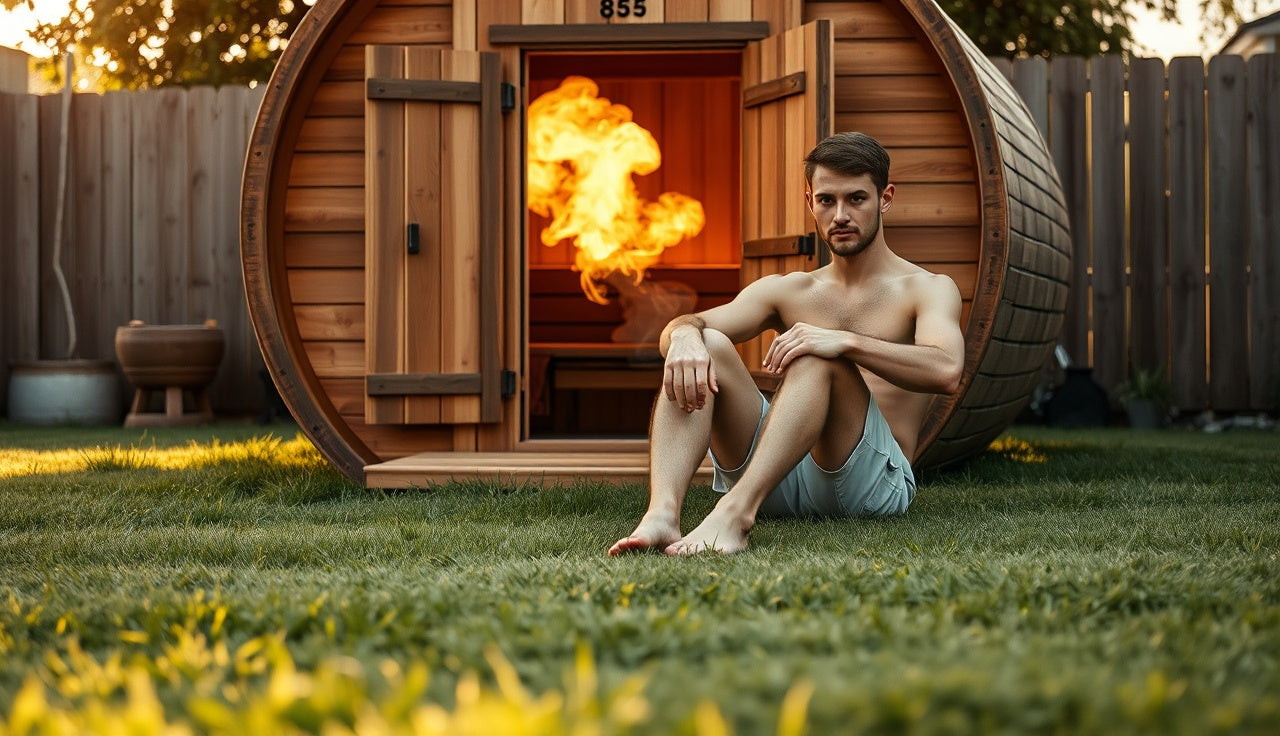
One practical note. If your sauna is outdoors (a barrel sauna or cabin-style unit in your backyard), you can step straight onto the lawn between rounds. This is the easiest possible setup, and it is also the closest to the Finnish tradition of alternating between the sauna and the outdoors.
What are the best grounding surfaces to use after a sauna session?
Not all ground contact is equal. The conductivity of the surface decides how fast and how well charge transfer happens.
| Surface | Conductive? | Notes |
|---|---|---|
| Bare soil (moist) | Yes, high | Moisture improves conductivity significantly |
| Grass (natural) | Yes | Good baseline option |
| Sand (moist) | Yes | Beach or lake edge is ideal |
| Concrete (unsealed) | Mildly | Works, but slower than soil |
| Natural stone | Variable | Depends on mineral content |
| Synthetic turf | No | Plastic fiber, blocks contact |
| Wood decking (treated) | No | Sealants are insulators |
| Rubber mats | No | Complete insulator |
| Grounding mat (indoor) | Yes (indirect) | Connects to outlet ground port |
Moisture matters a lot. Dry sand or dry concrete conducts far less efficiently than the same surface after rain. If you are cooling down post-sauna, sweaty feet actually help: your sweat creates a conductive interface between your skin and the surface [1].
For outdoor saunas, the setup nearly takes care of itself. For indoor or basement saunas, you either walk outside or use a grounding mat. Both are valid. Outdoor contact is simpler, and it gets you fresh air and passive cooling at the same time.
How long should you ground after a sauna session for any measurable effect?
The Chevalier et al. review suggests that even 30 minutes of grounding produces measurable changes in cortisol and pain scores in some studies, while other studies used multi-week protocols of sleeping grounded [1]. For a post-sauna recovery session, 15 to 30 minutes of barefoot outdoor contact is a reasonable target based on the available data.
You do not need to stand rigidly. Sitting in a chair with bare feet on the grass, lying on a blanket with bare arms and legs touching the ground, or walking slowly all qualify as grounding. Contact area matters somewhat: more skin touching the earth may speed charge equalization, though nobody has published a dose-response curve for contact area specifically.
The athletes in the 2019 Frontiers in Physiology study used grounding during sleep via grounding mats for four days post-exercise [2]. That is a longer, more sustained protocol than a 20-minute post-sauna barefoot session. What this means practically: a single combined session probably feels good and may support recovery, but the data's strongest signal comes from consistent, repeated exposure over days to weeks, not one-off use.
Start with 15 minutes barefoot outdoors after each sauna session and judge how you feel over two to four weeks. That is the most honest advice the current evidence supports.
Are there any risks or contraindications to combining sauna and grounding?
Grounding itself has an excellent safety profile. There are no known adverse effects from barefoot contact with natural ground in healthy people. The main practical risks are environmental: cuts from rough terrain, contact with irritants like certain grasses or insects, or slipping on wet surfaces. Real, but minor.
Sauna has a stronger contraindication list. People with poorly controlled cardiovascular disease, low blood pressure, certain skin conditions, pregnancy, or acute illness should talk to a physician before using a sauna regularly [3]. The Finnish Sauna Society and major cardiology guidelines agree on this point.
The combination does not add meaningful risk beyond either practice alone. The main sequencing consideration: you are hot, vasodilated, and your blood pressure is lowered post-sauna. Standing up fast and walking on uneven ground raises fall risk slightly. Walk slowly, hydrate before going outside, and pick a flat, familiar surface for your grounding period.
Electrical grounding mats carry one extra consideration. If you use one indoors, confirm the outlet it plugs into is properly earthed. In older homes, some outlets have no functional ground wire even with a three-prong port. A simple outlet tester (a few dollars at any hardware store) confirms whether the ground circuit works.
Does grounding during or inside the sauna itself work?
This question comes up more than you might expect. The answer is nuanced.
A traditional Finnish sauna sits on the ground, and a wood cabin with a dirt or gravel floor would technically allow grounding through the floor itself. Most modern saunas have wood floors, which are insulators. So sitting inside a typical sauna, even barefoot on a cedar bench, does not count as grounding in the electrical-contact sense.
Some companies sell grounding kits designed for sauna interiors: conductive floor mats, grounding straps, or bench pads wired to a ground line. These exist, but they have no clinical testing specific to the sauna environment, and the extreme heat may change how conductive materials perform over time. There is also the matter of electrical safety in a high-humidity or steam space. Unless a product is specifically rated for sauna use by the manufacturer, I would not put conductive electrical accessories inside a steam or wet sauna.
The simplest, safest, and most evidence-adjacent approach stays the same: do your sauna session, then go outside barefoot. The two practices happen in sequence, not at once, and the logistics become trivial.
How does this compare to other recovery stacks: cold plunge, contrast therapy, red light?
Recovery stacking is popular right now, and it is worth being honest about what each tool actually adds.
Cold plunge after sauna (contrast therapy) has decent evidence behind it for reducing delayed-onset muscle soreness and improving how recovery feels. A 2021 meta-analysis in the British Journal of Sports Medicine covering 99 studies found cold water immersion was more effective than passive rest for reducing muscle soreness and fatigue [6]. The effect is real. The cold plunge benefits guide covers that literature in detail.
Red light therapy (photobiomodulation) has a separate mechanism: specific wavelengths (typically 630 to 850 nm) penetrate tissue and stimulate mitochondrial function via cytochrome c oxidase [7]. Some practitioners combine all three: sauna, cold plunge, and red light, with grounding as the cooldown phase.
Grounding stacks well with any of these because it is passive. It needs no equipment if you are outdoors, no timing precision, and no physiological stress. You are just standing on grass. That is a real practical advantage over contrast therapy, which needs a cold plunge setup, or red light, which needs a device.
SweatDecks has a full product range if you want to compare sauna and cold plunge options side by side before building out your recovery space.
If I were building a recovery protocol from scratch: sauna is the anchor, cold plunge is the most evidence-backed add-on, and grounding costs nothing and takes 15 minutes outdoors. All three together is a reasonable approach for a serious athlete or a health-focused homeowner.
What equipment do you need, and what does it cost?
The cost range for this combination is genuinely wide, because grounding is free if you already go outside.
For grounding specifically: bare feet on natural ground costs zero dollars. Grounding mats for indoor use typically run $30 to $150 depending on size and brand. Grounding bed sheets range from $100 to $300. Grounding footwear (sandals with conductive soles) runs $50 to $150. None of these have strong independent clinical validation beyond what has been published for direct earth contact.
On the sauna side, costs vary by type. A portable infrared sauna blanket starts around $200 to $400. A two-person indoor infrared unit runs $800 to $3,000. A traditional Finnish-style outdoor sauna or barrel sauna starts around $3,000 and can reach $15,000 or more depending on size and finish. A portable sauna tent with a steam generator sits in the $150 to $600 range and is a reasonable entry point.
For a combined protocol on a budget: a portable sauna tent ($200 to $400) plus walking outside barefoot afterward is a complete, working setup for under $500. For a permanent home installation: an outdoor barrel sauna with a lawn or garden for grounding is the cleanest configuration, and the grounding phase adds exactly zero dollars to the purchase.
At SweatDecks, the sauna and cold plunge collections cover setups from portable entry-level to full outdoor installs, which makes it easier to match your space and budget without overbuying.
What does the Finnish sauna tradition actually say about going outside barefoot?
The traditional Finnish sauna ritual did not call it grounding, but stepping outside between rounds was always part of the culture. Walking barefoot on snow, standing in a lake, or sitting on a dock between sauna rounds has been standard Finnish practice for centuries. The Finns were doing contrast therapy and grounding at the same time, just without the modern vocabulary.
The Finnish Sauna Society, which promotes and preserves traditional sauna culture, describes the authentic experience as including outdoor cooling between rounds [8]. In lakeside saunas, bathers walk straight from the sauna to the water's edge on natural ground. That path is barefoot, on soil or grass, and counts as grounding by any reasonable definition.
This history does not prove grounding works, but it does tell you the combination is not a wellness industry invention. It is an old practice getting new scientific attention. Whether the electron-transfer mechanism explains why Finnish sauna culture correlates with such strong health outcomes in the epidemiological data is an open question, and an interesting one.
Frequently asked questions
Can you ground while sitting in a sauna?
Not effectively in most modern saunas. Wood floors and benches are insulators, so there is no conductive path to earth. Some companies sell grounding mats for sauna interiors, but these lack clinical testing in sauna conditions and raise safety concerns in humid environments. The practical solution is to ground outdoors after your session, not during it.
How long should a combined sauna and grounding session last?
A reasonable starting protocol is 15 to 20 minutes in the sauna followed by 15 to 30 minutes barefoot on natural ground outdoors. The Chevalier et al. 2012 review found cortisol and pain effects at 30 minutes of grounding in some studies. You can extend either phase based on comfort and experience. Total time commitment: 30 to 50 minutes.
Is there any published research on sauna and grounding combined?
No dedicated clinical trial has tested the sauna-grounding combination as of this writing. Each practice has its own research base: grounding research is summarized in Chevalier et al. 2012 (Journal of Environmental and Public Health), and sauna research includes a 20-year Finnish cohort study published in JAMA Internal Medicine in 2018. The combined protocol is biologically plausible but not yet clinically validated.
Do grounding mats work as well as outdoor barefoot grounding?
Grounding mats connect to the ground port of an electrical outlet and do transfer electrons, but the path is indirect compared to direct earth contact. The Chevalier 2012 review included indoor mat studies with positive results, so they are not useless. Outdoor barefoot contact on moist natural ground is more direct and better supported by the physics. Both are options; outdoor is simpler.
What surfaces work for grounding after a sauna?
Moist soil, natural grass, sand, and unsealed concrete are all conductive. Synthetic turf, treated wood decking, and rubber mats are insulators and do not support grounding. Moisture improves conductivity a lot. Your feet are already sweaty post-sauna, which creates a better conductive interface with the surface.
Is combining sauna and grounding safe for people with heart conditions?
Sauna use has specific contraindications for cardiovascular conditions including uncontrolled hypertension, unstable angina, and recent cardiac events. Grounding itself has no known cardiovascular contraindications. If you have a heart condition, clear sauna use with your physician first before adding any stacking protocols. The grounding component is not the risk variable here.
Does the sequence matter: should you ground before or after the sauna?
Post-sauna grounding makes more biological sense if you accept the oxidative stress hypothesis: the sauna session generates a hormetic heat stress and a temporary spike in reactive oxygen species, and the grounding phase afterward provides electron donation for antioxidant support during recovery. No study has tested pre- versus post-sauna grounding directly, so this reasoning is mechanistic, not proven by trial data.
Can you combine sauna, cold plunge, and grounding in one session?
Yes, and many practitioners already do this. A common sequence is sauna round, cold plunge, outdoor grounding during the rest period, then repeat. The contrast therapy (sauna plus cold) has the strongest evidence base of the three. Grounding during the outdoor rest period adds no physiological cost and layers in the potential electron-transfer benefit. Practically, this works best with an outdoor sauna setup.
What is the Schumann resonance and does it matter for grounding after a sauna?
The Schumann resonance is the electromagnetic resonant frequency of the cavity between the earth's surface and ionosphere, roughly 7.83 Hz. Some researchers speculate it may synchronize biological rhythms, but this link is not experimentally established in humans. The more accepted mechanism for grounding effects is electron transfer, not electromagnetic entrainment. The Schumann resonance is interesting but should not be a primary reason to choose this protocol.
How does grounding affect cortisol, and does sauna change that picture?
The Chevalier 2012 review found that sleeping grounded normalized the diurnal cortisol rhythm in a small study, with cortisol peaking more clearly in the morning and dropping lower at night. Sauna use acutely raises cortisol during the session and then lets it fall during the cool-down. Whether the two effects compound each other is unknown; the mechanisms are compatible but untested together.
Does walking barefoot on a wood sauna deck count as grounding?
No. Treated or sealed wood is an electrical insulator. Even natural wood is a poor conductor. For grounding to happen, you need direct skin contact with a conductive material connected to the earth: soil, grass, moist sand, or unsealed concrete. A wood deck between you and the ground breaks the connection no matter how natural it looks.
Are there any electrolyte or hydration considerations for combining these practices?
Sauna alone causes meaningful sweat losses: roughly 0.5 to 1.0 liters per hour. Add 15 to 30 minutes of outdoor recovery time in warm weather and total fluid loss climbs. Drink 16 to 24 ounces of water before your sauna session and replace fluids afterward. Electrolyte replacement (sodium, potassium, magnesium) matters more for sessions over 20 minutes or in hot outdoor conditions.
Is this just a wellness trend or is there something real here?
Both practices have real (if modest) evidence behind them individually. Grounding research is limited by small samples and some industry funding. Sauna research includes large observational studies with striking effect sizes. The combination protocol has no direct research. The honest take: grounding is low-cost and low-risk, the evidence is mixed but not fake, and pairing it with sauna is a reasonable thing to try without overclaiming what it will do.
Sources
- Journal of Environmental and Public Health, Chevalier et al. 2012, 'Earthing: Health Implications of Reconnecting the Human Body to the Earth's Surface Electrons': Earthing appears to improve sleep, normalize cortisol rhythm, reduce pain, shift ANS toward parasympathetic activation, and reduce blood viscosity; moist soil and grass are conductive surfaces; indoor grounding mat studies showed positive results
- Frontiers in Physiology, Sokal et al. 2019, 'Differences in Blood Urea and Creatine Kinase of Grounded vs. Ungrounded Exercising': Grounded athletes (n=12 per arm) showed faster recovery in creatine kinase and white blood cell counts after intense exercise compared to non-grounded controls
- Finnish Sauna Society, sauna temperature and physiological effects guidance: Traditional Finnish sauna runs 80 to 100 degrees Celsius; core temperature rises approximately 1 degree Celsius per 10 minutes; sweating rate approximately 0.5 to 1.0 liters per hour
- JAMA Internal Medicine, Laukkanen JA et al. 2018, 'Association Between Sauna Bathing and Fatal Cardiovascular and All-Cause Mortality Events': Finnish men who used a sauna 4 to 7 times per week had a 40 percent lower risk of all-cause mortality compared to once-per-week users over a 20-year follow-up of 2,315 men
- Journal of Applied Physiology, Kregel KC 2002, 'Heat shock proteins: modifying factors in physiological stress responses and acquired thermotolerance': HSP70 is upregulated by heat stress and has roles in protecting muscle proteins from oxidative damage
- British Journal of Sports Medicine, Machado et al. 2021, meta-analysis on cold water immersion and muscle recovery: Meta-analysis of 99 studies found cold water immersion was more effective than passive rest for reducing muscle soreness and fatigue after exercise
- Photomedicine and Laser Surgery, Hamblin MR 2016, 'Mechanisms and applications of the anti-inflammatory effects of photobiomodulation': Red light wavelengths of 630 to 850 nm penetrate tissue and stimulate mitochondrial function via cytochrome c oxidase
- Finnish Sauna Society, traditional sauna bathing practices: Authentic Finnish sauna tradition includes outdoor cooling between rounds; lakeside sauna bathers walk barefoot from sauna to natural water on soil or grass
- JAMA Internal Medicine, Laukkanen JA et al. 2018, 'Association Between Sauna Bathing and Fatal Cardiovascular and All-Cause Mortality Events': Sauna use 4 to 7 times per week associated with 40 percent lower all-cause mortality in Finnish cohort of 2315 men over 20 years
- National Institutes of Health, National Library of Medicine (NCBI): The earth's surface carries a mild negative electric charge; direct conductive contact allows charge equalization between the earth and a conductive object touching it

Share:
PEMF device and sauna combined use: what the research shows
Foam rolling before or after sauna: what the evidence says