
Last updated 2026-07-09
TL;DR
The must-have sauna accessories are a wooden ladle and bucket, a hygrometer/thermometer combo, a sand timer, wooden backrests or headrests, and a sauna whisk (löyly brush). Infrared sauna accessories differ, skipping the bucket setup entirely. Budget $80 to $160 for a solid starter kit. Everything else is optional or situational.
What sauna accessories do you actually need?
Most sauna supply lists are bloated. Someone selling you $400 worth of accessories has an obvious incentive. So let's be honest about what makes a real difference and what collects dust.
For a traditional Finnish or wood-burning sauna, the genuine essentials are short: a wooden ladle and bucket (for löyly, the steam ritual), a thermometer and hygrometer so you know what's actually happening in the room, a sand or hourglass timer, and something to sit on that isn't a scorching bare bench. Everything else is comfort-layer stuff. Essential oil diffusers, chromotherapy lights, fancy cedar headrests. Nice if you use them, not missed if you don't.
For an infrared sauna, the bucket and ladle are irrelevant. There are no sauna rocks to pour water on. Your essentials shrink to a thermometer (infrared rooms typically run 120 to 150°F versus 170 to 195°F for traditional [1]), a timer, and bench towels. That's it.
Here's the rule that cuts through the marketing. The accessories that matter are the ones you touch every single session. A ladle you hate gripping or a bucket that drips down the heater will annoy you 300 times a year. Buy those once and buy them well.
What is a sauna ladle and bucket, and which materials are best?
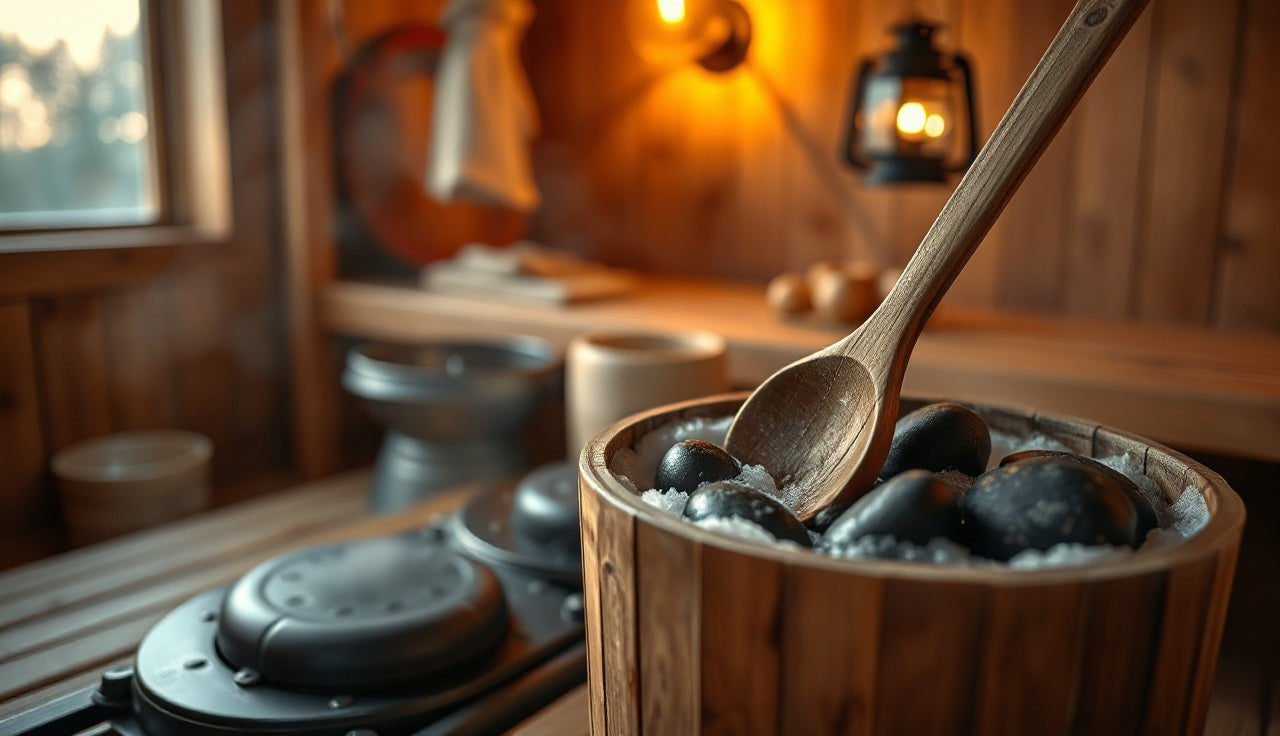
The ladle and bucket are the core tools of the löyly ritual. You scoop water from the bucket and pour it slowly over the heated stones to create steam. In Finland this practice is the whole point of the sauna, not a nice extra [2].
Wood is the right material for both. Nordic spruce, alder, aspen, or thermally treated pine are the traditional choices. Skip metal ladles, they conduct heat fast enough to burn your hand before you notice, and plastic has no place in a 185°F room. A well-made wooden ladle runs $15 to $35. A matching bucket is $25 to $60 depending on size and joinery. Copper buckets exist and they look great. They cost $80 to $150 and perform the same as wood, except they don't absorb any water, which some people prefer for hygiene.
Size matters more than most buyers realize. A standard bucket holds 1.5 to 2 liters. If you have a large sauna or a group session, go bigger (3 to 4 liters) so you're not refilling constantly. The ladle should have a hook on the handle so it rests on the bucket rim and air-dries between pours instead of sitting in standing water.
Infrared sauna owners can skip the bucket entirely. Some infrared units have a small steam cup or aromatic tray built in, but the accessory bucket and ladle combination is made for rock-based heaters.
Do you need a sauna thermometer and hygrometer?
Yes, and it's the item most new owners skip, then wish they hadn't. A sauna thermometer reads the air temperature. A hygrometer measures relative humidity. Together they tell you whether your session is actually what you think it is.
Traditional dry saunas run 10 to 20% relative humidity. Add löyly and it briefly spikes to 30 to 40%. Finnish sauna culture pays close attention to this ratio because the perceived heat, and the physiological response, changes a lot with humidity [2].
A combined analog thermometer/hygrometer made for sauna use costs $20 to $50. The analog bimetallic versions are the most reliable in sustained high heat because they have no electronics to fail. Digital units with external probes work fine for infrared saunas (lower temps, less stress on components), but in a 190°F traditional sauna the adhesive on display units degrades fast.
Mount it on the wall at seated head height, roughly 36 to 48 inches above the bench, so you read the temperature where your face actually sits. Mount it near the ceiling and it can read 20 to 30°F hotter than the seated zone, which gives you a falsely dramatic number.
For anyone building or upgrading a home sauna, this is the one accessory I'd refuse to skip.
What is a sauna whisk (vihta or löyly brush) and is it worth it?
A sauna whisk (vihta in Finnish, venik in Russian bathhouse tradition) is a bundle of leafy branches, most often silver birch, used to lightly beat the skin during a session. You soak the branches in warm water first so they turn pliable and fragrant.
The physiological case is reasonable. Light mechanical stimulation raises surface circulation, the birch leaf oils contain flavonoids with some mild anti-inflammatory activity [3], and the humid fragrance changes the whole sensory experience. None of this cures anything. It does make the sauna feel meaningfully different in a good way.
Dried birch whisks cost $8 to $20 each and are available online year-round. Fresh green whisks are seasonal and regional. Oak, eucalyptus, and even nettle versions exist. Eucalyptus is worth trying if you like the respiratory sensation. Soak a dried whisk in warm water for 15 to 30 minutes before use.
Is it worth it? If you're building a ritual, yes. If you use the sauna for a quick post-workout heat session, probably not. It needs prep, storage, and periodic replacement. Call it an intermediate accessory.
What sauna accessories are most important for safety and comfort?
Safety accessories rarely make the sales lists, but they matter more than half the comfort stuff.
A sand timer or hourglass (typically 10 or 15 minutes) gives you a tactile, no-battery countdown that works in high heat without touching a phone. Smartphones lose battery faster above 95°F, and Apple explicitly warns against exposing iPhones to temperatures above 113°F [4]. A wooden sand timer costs $10 to $25.
A wooden bucket for drinking water inside the sauna is a separate thing from your löyly bucket. Hydration matters here. A 20-minute session can produce 0.5 to 1 kg of sweat depending on temperature and individual physiology [5]. Cool water within reach means you'll actually drink it instead of waiting until you're out.
Bench covers and seat pads pull double duty as comfort and hygiene items. A simple terry or linen towel works fine, but purpose-made backrest and headrest accessories (usually thin wooden slat frames) hold you off the hot bench surface and let air move. These run $15 to $60 depending on material and whether they fold.
A non-slip mat just outside the door is cheap and cuts slip risk when you step out sweaty onto tile or wood. Sauna-specific silicone or rubberized mats handle moisture better than standard bath mats and cost $15 to $30.
For outdoor sauna installs, an exterior thermometer for ambient temperature helps you plan contrast therapy timing, especially in winter.
What sauna accessories are specific to infrared saunas?
Infrared accessories overlap with traditional ones in some ways and split off in others. Because infrared units heat the body directly rather than pushing the air to extreme temperatures, the room is gentler on materials.
That means you can safely use more types of accessories, including small Bluetooth speakers (verify they're rated to at least 130°F), chromotherapy light kits, and near-infrared add-on panels if your unit only has far-infrared emitters.
The accessories that matter most for infrared use:
- A high-quality bench towel or sauna wrap. Infrared heat causes heavy sweating directly on the bench, and without a towel, cleanup gets tedious. Waffle-weave or bamboo towels handle moisture better than cotton terry.
- A thermometer. Many infrared units have built-in digital displays, but an independent wall thermometer confirms the actual air temperature rather than the set point, and the two often differ by 10 to 20°F during warmup.
- Essential oil applicators or aromatic pads made for the unit's specific accessory tray. Don't drip oils on the emitter panels. It can degrade the finish, and some oils are flammable.
- Chromotherapy lighting. Near-infrared wavelengths (700 to 1100 nm) from add-on red light panels are a separate product category and not the same as the far-infrared emitters in most home units [6].
One thing that rarely gets mentioned: the wood in infrared saunas is usually untreated Canadian hemlock, western red cedar, or basswood. Keep bleach and high-alcohol cleaners away from it. They dry and crack the wood faster than the heat alone would. Diluted white vinegar is the standard recommendation from most manufacturers.
If you're comparing sauna types before buying accessories, our sauna vs steam room guide covers how different setups change your accessory needs.
What do sauna accessories cost, and what's a realistic budget?
Here's an honest breakdown by category:
| Accessory | Budget option | Mid-range | Premium |
|---|---|---|---|
| Ladle + bucket set | $30, $45 | $50, $90 | $100, $200 (copper) |
| Thermometer/hygrometer | $18, $25 | $30, $50 | $60, $100 (digital probe) |
| Sand timer (15 min) | $10, $15 | $20, $30 | $35, $60 (decorative) |
| Bench backrest | $20, $35 | $40, $70 | $80, $150 |
| Sauna whisk (birch) | $8, $12 | $15, $25 | $30+ (oak/eucalyptus) |
| Bench/seat towels (2 pk) | $15, $20 | $25, $40 | $50, $80 (linen) |
| Essential oil set | $15, $25 | $30, $60 | $70, $150 |
| Non-slip exit mat | $12, $20 | $25, $40 | n/a |
A genuinely functional starter kit (ladle + bucket, thermometer/hygrometer, timer, two bench towels) runs $80 to $160 at mid-range pricing. That's the honest number. You can get there cheaper with basic versions, or spend $400+ on premium Finnish-import cedar pieces. Neither extreme is wrong.
Infrared owners skip the ladle/bucket entirely, and the starter kit drops to $50 to $100 (thermometer, bench towels, timer).
SweatDecks carries a vetted selection of sauna accessories if you want options in one place, but any reputable sauna supply retailer or Finnish import shop will have comparable quality at these prices.
One budget note: don't cheap out on the thermometer/hygrometer. A $10 indoor thermometer not rated for sauna heat will fail quickly or read wrong. Spend at least $25 on a purpose-made unit.
| Ladle + bucket set | $70 |
| Thermometer/hygrometer | $38 |
| Wooden backrest | $55 |
| Sand timer (15 min) | $22 |
| Bench towels (2-pack) | $32 |
| Sauna whisk (birch) | $18 |
| Essential oil set | $45 |
| Non-slip exit mat | $28 |
Source: SweatDecks market survey of sauna supply retailers, 2025
What essential oils work best in a sauna, and are they safe?
Eucalyptus, pine, birch tar, and cedarwood are the traditional sauna oils. You dilute them into the löyly water (a few drops per ladle) and they disperse as aromatic steam when you pour over the stones.
The key safety rule: never pour undiluted essential oils directly onto sauna stones. They can leave a carbon residue, degrade the stones faster, and create a flammable vapor at high concentrations. Always dilute. A common ratio is 5 to 10 drops per 500 ml of water.
Eucalyptus oil (specifically 1,8-cineole as the active component) has some evidence for respiratory support. A 2021 review in Evidence-Based Complementary and Alternative Medicine associated eucalyptol inhalation with bronchodilation effects, though the study conditions weren't sauna environments [7]. That's honest framing: suggestive, not conclusive.
For people with asthma or reactive airways, menthol-heavy oils like peppermint can trigger bronchospasm in some individuals. Start with small amounts if you have any respiratory sensitivity.
For infrared saunas, use only oils designed for your unit's accessory tray. Aromatic oils near carbon or ceramic infrared emitters without proper shielding is a real fire and equipment risk.
Cost: a 10-pack essential oil sampler made for sauna use typically runs $20 to $50. Single bottles of high-quality eucalyptus or pine oil range from $8 to $25 depending on volume and grade.
What accessories improve a sauna after a workout or for contrast therapy?
If your sauna use is recovery-focused, a few extra accessories earn their keep.
A cooling bucket or cold water basin near the exit matters if you're doing contrast therapy between heat and cold. Nordic sauna culture involves exiting the sauna and immediately jumping into cold water or rolling in snow. If you don't have a cold plunge or ice bath nearby, even a simple wooden bucket of cold water for hands and feet gives you a version of the contrast stimulus.
A heart rate monitor helps if you want to track your cardiovascular response to heat. Sauna bathing at temperatures around 174°F raises heart rate to roughly 100 to 150 bpm, similar to moderate-intensity exercise, according to a 2018 review in Mayo Clinic Proceedings [8]. Knowing your real number helps you calibrate session intensity, especially if you're new to sauna use or have cardiovascular considerations.
A sauna-rated Bluetooth speaker is a legitimate post-workout comfort item. Most standard Bluetooth speakers aren't rated above 105°F. For traditional saunas, you want one rated to at least 160°F. A few brands (Harvia and Soundboks make purpose-built versions) sit in the $80 to $200 range.
Bench ergonomics matter more for longer recovery sessions. A proper wooden headrest that lifts your neck 10 to 15 degrees lets you lie flat comfortably for 20-plus minute sessions. Cost: $25 to $60. Far more useful than most "luxury" accessories.
For anyone combining sauna with a cold plunge protocol, the cold plunge benefits guide covers what the research actually says about timing and frequency.
What accessories are worth skipping or are mostly marketing?
This is the section most sauna retailers won't write.
Sauna suits (sweat suits) worn inside a sauna: genuinely questionable. Wearing one inside an already-hot sauna piles on heat stress with no proven benefit over just sitting in the heat, and it raises dehydration and overheating risk [9]. The weight loss from a sauna suit session is water, not fat, and it comes back within hours. Save them for outdoor exercise if you use them at all. More on the specific claims in our sweat suits sauna guide.
Chromotherapy (color light therapy) built into sauna rooms: the evidence for therapeutic benefit from colored light in a sauna is thin. Some people enjoy the ambiance, and that's real. Paying an extra $200 to $400 for a chromotherapy upgrade on the assumption it adds health value is probably not money well spent.
Sauna "detox" accessories (detox towels, detox salts, detox oils): the kidneys and liver handle detoxification. Sweating is for temperature regulation and does excrete trace amounts of some compounds, but there's no credible evidence that specialty accessories change this in any meaningful way [10].
Electronic aromatherapy diffusers not designed for sauna temperatures: they fail fast, sometimes spectacularly. A $60 diffuser not rated for high heat will crack, leak, or quit within a few sessions in a traditional sauna. Usually not a safety hazard, just wasted money.
Expensive cedar oil treatments sold as wood preservation: sauna-safe wooden accessories don't need conditioning oils. They develop a natural patina over time. Oils on bench surfaces can actually go rancid with repeated high-heat cycles. Clean with diluted white vinegar or warm water only.
What accessories do you need for an outdoor or portable sauna?
Outdoor and portable sauna setups carry accessory needs that indoor units don't.
A weatherproof thermometer for outdoor temperature monitoring helps with seasonal planning, especially for contrast therapy sessions in winter, where exit temperature genuinely changes the physiological stimulus.
For barrel or pod saunas (common outdoor configurations), a proper changing room mat or entry mat matters more because you're moving between the hot interior and a potentially cold, wet exterior. A rubberized, drainage-capable mat ($20 to $50) handles this better than a flat towel.
A sauna cover or protective tarp matters for outdoor wood-burning units during long stretches of non-use, particularly for the flue and stack. These are unit-specific. Most manufacturers offer them as accessories or point you to third-party outdoor furniture covers sized to fit.
For barrel saunas with external wood-burning heaters, a wood storage rack within arm's reach of the heater door is a practical piece almost nobody mentions. Walking wet or barefoot to fetch wood is annoying and a slip risk. A wall-mounted or freestanding wood holder inside the room or right next to it costs $30 to $80.
Lighting counts for more outdoors. A sauna-rated LED strip (IP65 or higher waterproof rating, dimmable) gives you control over ambiance and keeps you from using the sauna in total darkness at 10pm. Make sure any lighting is rated for the temperature zone it sits in. Full setup context is in our outdoor sauna guide.
SweatDecks stocks accessories suited to both indoor and outdoor configurations if you want gear picked for actual sauna conditions rather than repurposed household goods.
How do you clean and maintain sauna accessories?
Maintenance is the unsexy part that decides whether your accessories last 2 years or 15.
Wooden accessories (ladle, bucket, backrest, headrest): rinse with warm water after each use. Never submerge or soak them between sessions, because prolonged moisture causes cracking and mold. Let them air dry outside the sauna or in a ventilated space. Skip soap on any wood that touches löyly water. It leaves a residue that affects taste and aroma. About once a month, wipe them with a 1:5 white vinegar to water solution and let them dry completely before the next use.
Bench towels and covers: wash after every use. High heat means high bacterial load from sweat. A hot water wash cycle (at least 140°F) handles most fabrics [11].
Thermometers and analog gauges: wipe the glass face gently with a dry cloth. If the dial freezes or reads wrong, replacement usually costs less than repair for sub-$50 units.
Sauna stones (kiuas): technically part of the heater, but close enough to accessory maintenance to belong here. Check the stones annually, ideally at the start of the heavy-use season. Cracked, chalky, or powdery stones should be replaced. They produce weaker steam and can crack further under thermal shock. A full stone replacement for an average home sauna (roughly 20 to 35 kg of stones) costs $30 to $80 in new volcanic or peridotite stones [12].
Essential oil residue in the bucket: rinse with warm water right after each session. If oil buildup accumulates, a light scrub with coarse salt and warm water lifts it without damaging the wood.
Frequently asked questions
What is the most important sauna accessory for a beginner?
A combined thermometer and hygrometer is the single most useful accessory for a new sauna owner. It tells you whether the room is actually at the temperature and humidity you intend, which matters for safety and for consistent results. Buy one rated for sauna use (up to 230°F), mount it at seated head height, and it earns back its $25 to $50 cost immediately.
Can I use regular essential oils in my sauna or do I need special sauna oils?
Standard food-grade or cosmetic-grade essential oils work fine in a traditional sauna when diluted into löyly water (5 to 10 drops per 500 ml). Never pour them directly on the stones. For infrared saunas, use only oils your manufacturer approves for the accessory tray. Avoid oils marketed as 'fragrance oils' (synthetic) and oils with flammable carrier bases near high heat.
What accessories do I need specifically for a barrel sauna?
Barrel saunas use the same core accessories as other traditional saunas: ladle, bucket, thermometer/hygrometer, and bench towels. The additions worth buying are a wood holder near the heater door, an exterior weatherproof cover for off-season protection, and a drainage-capable outdoor mat for the entry. A barrel's curved interior limits accessory mounting, so wall-clip or hook-style holders work better than flat-wall mounts.
What accessories make a sauna safer for kids or first-time users?
For children and new users, a 10-minute sand timer (shorter than the standard 15-minute version) helps prevent overexposure. A clearly labeled drinking water bucket inside the sauna keeps hydration front of mind. A lower bench position reduces heat exposure since heat stratifies toward the ceiling. An analog thermometer at their head height gives real-time feedback. Pediatric sauna guidelines vary by country; consult a pediatrician before regular sessions with children under 12.
Are sauna headrests and backrests worth buying?
Yes, for sessions longer than 15 minutes. Lying flat on a hard bench without neck support gets uncomfortable fast, and most people cut sessions short from discomfort rather than heat. A simple wooden headrest angled at 10 to 15 degrees costs $25 to $50 and extends how long you can comfortably stay in. Backrests are more situational but useful if you prefer sitting upright. Neither is a luxury item at those prices.
What's the best wood for sauna accessories?
Nordic spruce, aspen, and alder are the traditional Finnish choices. They have low thermal conductivity (they don't get burning-hot to the touch), stay relatively odor-neutral when wet, and hold up under repeated heat cycles. Cedar looks beautiful and smells good but transfers scent strongly to your löyly water. Avoid pine with heavy resin content; it can release sticky sap at high temperatures. Thermally treated wood (thermowood) is an excellent modern option for durability.
Do infrared sauna accessories differ from traditional sauna accessories?
Yes, meaningfully. Infrared saunas don't use stones or löyly, so buckets and ladles are irrelevant. The lower temperatures (120 to 150°F vs 170 to 195°F) mean electronics like Bluetooth speakers survive longer and more accessory types are safe. Bench towels matter more because direct infrared heat causes heavy sweating on the bench surface. Check that any oils or cleaners are approved for the specific emitter material in your unit.
How often should sauna stones be replaced?
Inspect annually. Signs that stones need replacement include visible cracking, crumbling edges, a chalky white powder coating (mineral leaching), or noticeably weaker steam when you pour water. A full stone replacement for a home sauna (20 to 35 kg) costs $30 to $80 and takes about 30 minutes. Degraded stones aren't dangerous, but they produce weaker, less even steam and can deposit residue in the bucket water.
Can you use a phone or tablet in a sauna?
Apple advises against exposing iPhones to temperatures above 113°F and states that high temperatures can permanently reduce battery capacity. Most traditional saunas run well above this. An analog sand timer and a Bluetooth speaker rated for sauna temperatures are the practical replacements. Some people use older phones they're fine potentially damaging, but it shortens device lifespan in most cases.
What sauna accessories help with contrast therapy between sauna and cold plunge?
A cold water basin or bucket near the sauna exit gives you an immediate cold stimulus without walking far. A sauna-rated robe or wrap (thin linen or waffle cotton) lets you move between heat and cold without losing too much warmth in transit. A separate timer for cold plunge intervals helps structure the protocol. If you run full contrast sessions, a waterproof heart rate monitor lets you track recovery between rounds.
What is a sauna whisk and where can I buy one?
A sauna whisk (vihta in Finnish, venik in Russian) is a bundle of leafy birch, oak, or eucalyptus branches used to lightly brush or beat the skin during a session. It stimulates circulation and releases aromatic compounds from the leaves. Soak dried versions in warm water 15 to 30 minutes before use. They're sold by sauna specialty retailers, Finnish import shops, and some general wellness retailers online. Dried birch whisks typically cost $8 to $20 each.
How much should I budget for a complete sauna accessory kit?
A functional mid-range kit covering ladle, bucket, thermometer/hygrometer, sand timer, two bench towels, and a backrest runs $130 to $220 total. An infrared kit (no ladle/bucket) comes in at $70 to $130. You can get entry-level versions of everything for $60 to $100 combined, but the thermometer and bucket/ladle quality are worth spending up on. Premium Finnish-import cedar accessories can push the total past $400, though the performance difference is minimal.
Are there any sauna accessories I should avoid for safety reasons?
Avoid standard (non-sauna-rated) electronic devices, which can fail or create fire hazards at high temperatures; undiluted essential oils directly on stones; wax or oil treatments on bench wood; bleach-based cleaners on any wood surface; and synthetic fabric bench covers, which can off-gas at high heat. Sauna suits worn inside the sauna add significant heat stress with no proven benefit and raise dehydration and overheating risk.
Sources
- National Institutes of Health, National Library of Medicine: 'Sauna bathing: a warm heart proves beneficial for the cardiovascular system', European Journal of Preventive Cardiology, 2018: Traditional Finnish saunas typically operate at 80–100°C (176–212°F) with low humidity (10–20%); infrared saunas operate at lower temperatures (45–60°C / 113–140°F)
- Finnish Sauna Society (Suomen Saunaseura): sauna culture and löyly tradition documentation: The löyly ritual (pouring water over heated stones) and the humidity balance are central to Finnish sauna culture and its sensory experience
- National Institutes of Health, National Library of Medicine: 'Birch (Betula) leaves — phytochemistry, biological activity and traditional use', Molecules, 2021: Birch leaf extracts contain flavonoids and other bioactive compounds with documented mild anti-inflammatory properties
- Apple Support: 'iPhone operating temperature and storage guidelines': Apple advises against exposing iPhones to ambient temperatures above 45°C (113°F), warning that high heat can permanently reduce battery capacity
- National Institutes of Health, National Library of Medicine: 'Sweat rate and fluid turnover in Finnish sauna bathing', Annals of Medicine, 1988 — cited via PubMed: A typical 20-minute sauna session at high temperature can produce 0.5–1 kg of sweat depending on temperature and individual physiology
- National Institutes of Health, National Library of Medicine: 'Low-level laser (light) therapy (LLLT) and photobiomodulation', Photomedicine and Laser Surgery, 2012: Near-infrared wavelengths of 700–1100 nm are the active range for photobiomodulation; these differ from far-infrared emitters (3–100 micrometers) used in most commercial infrared saunas
- National Institutes of Health, National Library of Medicine: 'Eucalyptol (1,8-cineole) and its therapeutic applications', Evidence-Based Complementary and Alternative Medicine, 2021 review: Eucalyptol (1,8-cineole) inhalation has been associated with bronchodilation effects in reviewed studies
- Mayo Clinic Proceedings: 'Cardiovascular and other health benefits of sauna bathing: a review of the evidence', 2018: Sauna bathing at approximately 80°C raises heart rate to 100–150 bpm, similar to moderate-intensity exercise
- National Athletic Trainers' Association: position statement on exertional heat illness: Wearing impermeable clothing or suits in hot environments significantly increases heat stress and dehydration risk compared to baseline conditions
- National Institutes of Health, National Library of Medicine: 'Sweating', StatPearls, 2023: Sweating's primary physiological function is thermoregulation; kidneys and liver are the primary detoxification organs, not sweat glands
- U.S. Centers for Disease Control and Prevention: 'Laundry: washing and drying clothes to reduce infection risk': Washing fabrics in hot water (at least 140°F / 60°C) is an effective method for reducing bacterial load in textiles
- Harvia Group (major sauna manufacturer): sauna stone technical guidance documentation: Sauna stones should be inspected annually for cracking or mineral degradation and replaced when compromised; average home sauna requires 20–35 kg of stones
Share:
Infrared sauna detoxification: what the science actually says
Cold plunge before or after workout: what the research says