
Last updated 2026-07-09
TL;DR
Sam's Club sells barrel saunas seasonally, usually priced between $1,500 and $3,500 depending on size and heater. Most are Canadian hemlock or spruce kits with electric heaters in the 6 to 9 kW range. They're a reasonable first sauna for budget buyers, but wood grade and after-sale support lag behind specialty retailers. Read this before you order.
What barrel saunas does Sam's Club actually sell?
Sam's Club carries barrel saunas as a seasonal, limited item, usually landing in late winter or early spring when pre-summer outdoor buying picks up. The exact SKUs change year to year. What's on the floor (or website) in February 2025 may be gone by June. That matters because accessories, replacement parts, and extended warranties get hard to source once the product cycles out.
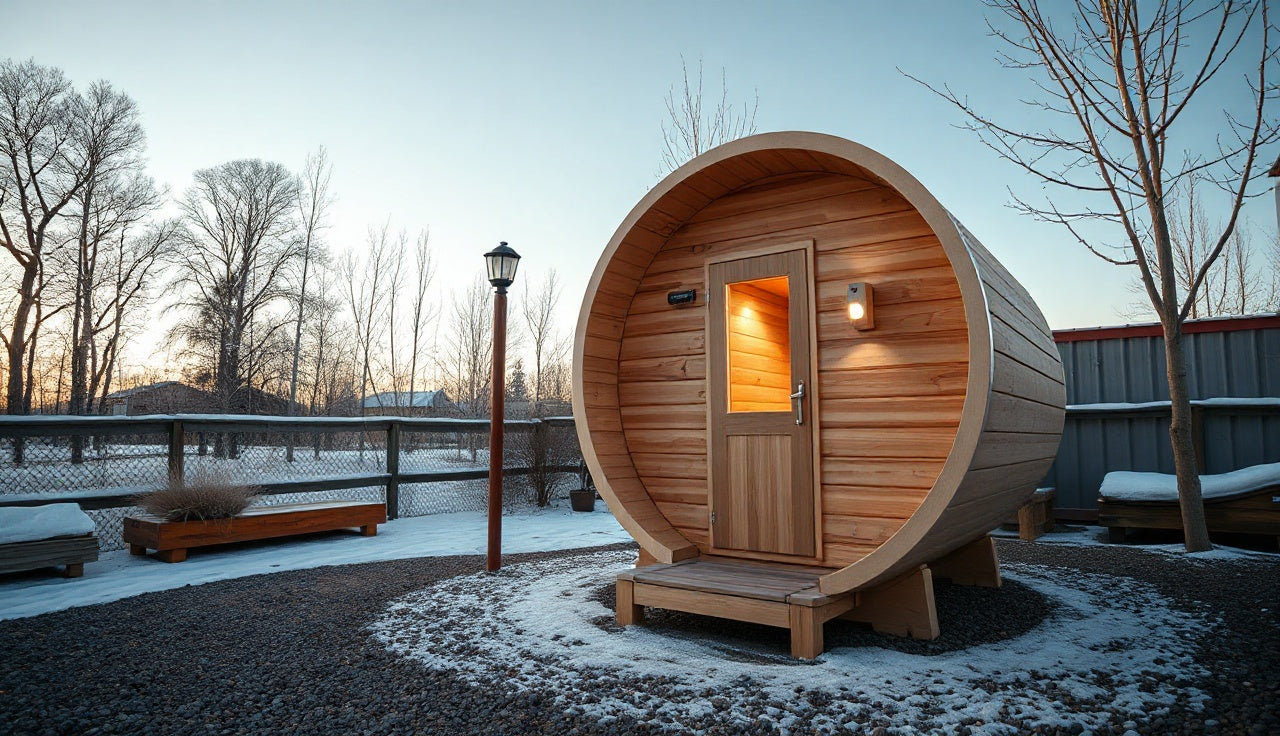
The typical Sam's Club barrel sauna is a pre-cut, flat-pack kit made from Canadian hemlock or Nordic spruce. Sizes run from about 4 feet in diameter and 6 feet long (seats 2 to 3) up to 7-foot-diameter models around 7 to 8 feet long (seats 5 to 6). A 6-foot-diameter, 8-foot barrel in hemlock is the most common setup in their lineup.[1]
Most kits include the pre-cut stave panels, metal cradle bands, a floor grate, a single interior bench, a tempered glass door or acrylic window, and a basic electric heater in the 6 to 9 kW range. Sauna stones are often included, but the stone quality is generic. Exterior wood finish and a thermometer are sometimes bundled, sometimes sold separately depending on the year's specific offering.
What you usually do not get: professional installation, a dedicated 240V circuit (you run that yourself), a ventilation duct, or any real customer support if something warps or cracks during assembly. Keep that in mind when you compare the sticker price to a specialty outdoor sauna from a dedicated builder.
How much does a Sam's Club barrel sauna cost?
Pricing has ranged from roughly $1,500 for a compact 2-person kit to around $3,500 for a larger 4 to 6-person model with a more powerful heater.[1] Sam's Club Plus members sometimes get an extra percentage off or free shipping, which on a 400 to 600 lb crate is real money.
The purchase price is not the total cost. You will also need:
- A licensed electrician to run a dedicated 240V, 30 to 60A circuit to the site. Depending on distance from your panel and local labor rates, that runs $300 to $800 or more.[2]
- A gravel, concrete, or composite base pad. A basic gravel pad with landscape fabric costs roughly $100 to $300 DIY. Poured concrete adds another $500 to $1,500 depending on size and local rates.
- Possibly an exterior sealant or UV wood stain if one is not included. Budget $40 to $80 for a quality exterior wood oil.
So a realistic all-in cost for a mid-size Sam's Club barrel sauna lands between $2,200 and $5,000 before you count your own time. Compare that to entry-level purpose-built home sauna kits from specialty brands, which start around $3,500 but usually include better wood grades, thicker staves, and real post-sale support.
For most buyers, the Sam's Club price is the whole draw. If money is tight and you can handle a multi-hour assembly, it can make sense.
What is the wood quality like on a Sam's Club barrel sauna?
Most Sam's Club barrel saunas use Canadian hemlock. Hemlock is a decent sauna wood. It has low resin content, handles heat cycling reasonably well, and is cheap, which is why it dominates the budget barrel market.[3]
Here's the honest comparison. Nordic spruce and Finnish kiln-dried spruce used in Scandinavian kits tend to be denser and straighter-grained, which helps the staves resist warping and cracking over years of wet-dry thermal cycles. Hemlock is softer and more prone to surface checking (small cracks along the grain). That doesn't make it a bad choice. But if you plan to use this sauna daily for a decade, the wood grade matters.
Stave thickness is the other variable. Better kits use 1.5-inch or thicker staves, which hold heat better and warp less. Budget kits, including some Sam's Club offerings, sometimes use 1-inch staves. Thinner staves mean faster heat loss, more condensation on the interior wood, and a higher chance the barrel deforms over time.
Check the specific product listing carefully. The thickness spec belongs in the product details. If it's not listed, that's a yellow flag worth emailing about before you buy.
| Sam's Club (hemlock kit) | $2,500 |
| Costco (hemlock/cedar kit) | $3,150 |
| Almost Heaven (cedar kit) | $4,400 |
| Dundalk LeisureCraft (cedar kit) | $4,200 |
| Harvia complete barrel unit | $6,500 |
Source: Sam's Club product listings; Dundalk LeisureCraft; Almost Heaven Saunas; Harvia distributor pricing, 2024
How hard is it to assemble a Sam's Club barrel sauna?
Assembly is a real Saturday (or full weekend) project for two adults. The kits are tongue-and-groove stave assemblies where each curved plank fits into the next, held by galvanized or stainless steel banding straps you tighten around the outside of the barrel. In principle, simple. In practice, the fit tolerance on budget kits varies.
Realistic assembly time for two people with basic carpentry skills is 4 to 8 hours for a smaller 2-person unit, 6 to 12 hours for a larger 4 to 6-person model. Door alignment and heater wiring are the two steps where people most often get stuck. The heater connections are straightforward if you're comfortable with basic electrical work, but the final 240V hookup to your panel needs a licensed electrician in most jurisdictions.[2]
One complaint shows up across barrel kits in this price range: inconsistent pre-cut tolerances. Staves that should fit flush sometimes need light sanding or shimming. This isn't unique to Sam's Club. It's common in budget import kits generally. Plan for it.
A rubber mallet, a level, metal strapping clamps (some kits underdeliver on hardware), and a drill all help. Some buyers apply exterior sealant partway through, which means assembling the barrel partially, sealing, letting it dry, then continuing. That adds half a day and meaningfully extends the wood's outdoor life.
What heater does a Sam's Club barrel sauna come with?
The bundled electric heaters range from 6 kW to 9 kW and are generic OEM units without strong brand recognition. A 6 kW heater is adequate for a 2 to 3 person barrel (roughly 100 to 140 cubic feet of interior volume). A 9 kW unit handles a larger 4 to 6 person barrel.[4]
The Finnish Sauna Society recommends roughly 1 kW per 50 cubic feet of sauna volume as a rough guide for electric heaters, though insulation and wood mass also affect heat-up time.[4] A well-sealed barrel sauna reaches 170 to 190 degrees F (77 to 88 C) within 30 to 45 minutes with a properly sized heater.
The main limits of the bundled heaters are build quality and the control interface. Most ship with a basic dial timer capped at a 1-hour runtime, no app control, no precise temperature display. If you want smartphone control or a built-in digital thermostat, you'd upgrade to a Harvia, Finnleo, or similar aftermarket heater, which runs $400 to $1,200 depending on kW and features.[5]
One practical note. These heaters often ship expecting a hardwired connection or a NEMA 6-50 outlet on-site. Confirm the wiring spec before your electrician visit so they install the correct outlet or junction box.
For a deeper look at sauna benefits and why heat output matters for your sessions, that guide is worth reading alongside the spec sheet.
How does a Sam's Club barrel sauna compare to other retailers like Costco?
Sam's Club and Costco run this category the same way. Both offer seasonal barrel kits priced well below specialty retailers, both use mostly hemlock or spruce, and both lean on generic heaters with thin post-sale support. The differences are small.
Costco has historically carried brands with more name recognition in the sauna space, including some Dundalk LeisureCraft kits in past seasons. Dundalk uses Canadian white cedar, which outperforms hemlock outdoors and resists moisture better thanks to its higher natural oil content.[6] Sam's Club offerings have skewed more purely generic-brand.
The Costco sauna guide covers those options in more detail if you're comparison shopping between warehouse clubs.
| Feature | Sam's Club barrel sauna | Costco barrel sauna | Specialty brand (e.g., Almost Heaven, Harvia) |
|---|---|---|---|
| Typical price range | $1,500 to $3,500 | $1,800 to $4,500 | $3,500 to $8,000+ |
| Primary wood | Hemlock / spruce | Hemlock / cedar (varies) | Cedar / Nordic spruce / aspen |
| Heater brand | Generic OEM | Generic / branded (varies) | Harvia, Helo, Finlandia |
| Stave thickness | 1 to 1.5 in | 1 to 1.5 in | 1.5 to 2 in |
| Post-sale support | Warehouse return policy | Warehouse return policy | Manufacturer warranty + parts |
| Assembly included | No | No | No (some offer it) |
If you'll use the sauna three or more times a week year-round for years, the specialty brand's better wood grade and parts availability usually justifies the higher price. If you want to try barrel ownership without a big commitment, the warehouse club route makes sense.
Is a barrel sauna worth it for home use?
A barrel sauna works well as a home unit for reasons that have nothing to do with marketing. The cylindrical shape means the interior air volume is smaller relative to the exterior footprint than a boxy square sauna of the same length. Less air volume means faster heat-up and lower electricity cost per session. A well-sealed 6-foot barrel reaches temperature in about 30 to 45 minutes on a 6 to 9 kW heater, versus 45 to 70 minutes for a square outdoor cabin sauna with similar heater output.[4]
The round shape also channels convective airflow, pushing hot air down and around the bench rather than letting it stratify sharply at the ceiling. You get more even heat at bench level, which is where you sit.
Outdoors, the barrel form has a practical edge. No flat roof to collect water and debris, and the curved surface sheds rain efficiently. In snowy climates, a barrel with good metal banding holds up well as long as the wood is sealed before winter.
The limits are real. Barrel saunas give you less headroom for standing or stretching than a cabin unit. The bench layout is usually one straight bench on each side of the door, which caps how you can use the space. And the round walls make retrofitting anything (shelves, a second heater, a cold-water bucket hook) awkward.
On balance: for most homeowners who want an outdoor sauna mainly for traditional seated heat sessions, a barrel is a smart pick. It's space-efficient, quick to heat, and fits most yards. A Sam's Club kit at $1,500 to $3,500 is a reasonable starting point if you go in with realistic expectations about wood grade and support.
What are the health effects of regular barrel sauna use?
The research on regular sauna use is real and reasonably consistent, though most of the large studies come from Finland using traditional Finnish saunas rather than any specific barrel model. A prospective cohort study published in JAMA Internal Medicine in 2015 followed 2,315 middle-aged Finnish men and found that those who used a sauna 4 to 7 times per week had a 40% lower risk of all-cause mortality compared to once-weekly users over a roughly 20-year follow-up.[7] That's a correlation in an observational study, not a randomized trial, so causation stays contested.
The mechanisms studied include transient increases in heart rate and cardiac output that mimic moderate aerobic exercise, improvements in arterial compliance and endothelial function, and reductions in inflammation markers including C-reactive protein.[7]
A Cochrane systematic review and other analyses suggest regular heat exposure may support modest blood pressure reduction in some populations, though the evidence quality is rated low to moderate.[8]
For recovery, the heat-driven increase in muscle blood flow and the drop in perceived soreness after exercise are the benefits athletes report most. Nobody has good controlled data showing barrel saunas produce different outcomes than any other sauna type at the same temperature.
Conservative health guidance from the American Heart Association notes that brief sauna sessions appear safe for most adults with stable cardiovascular disease, and advises avoiding them right after vigorous exercise, after heavy alcohol use, or during acute illness.[9]
If you're thinking about pairing sauna sessions with a cold plunge, the contrast therapy literature is interesting and thinner than the sauna-alone research.
What electrical and permit requirements do you need before installing one?
Most electric barrel saunas need a dedicated 240V circuit, typically 30 to 60A depending on the heater's kW rating. A 6 kW heater needs a minimum 30A, 240V circuit. A 9 kW heater generally requires a 40 to 50A circuit.[2] The National Electrical Code Article 424 governs fixed electric space heating equipment, and many local inspectors apply it to sauna heaters.[10]
Hiring a licensed electrician is not optional in practice. Beyond safety, unpermitted electrical work can void your homeowner's insurance and create liability if there's a fire. Permit costs for a simple 240V circuit run $50 to $200 in most jurisdictions, and the electrician usually pulls it.
For the structure itself, permit rules vary by municipality. Many jurisdictions treat a freestanding outdoor structure under 200 square feet as exempt from building permits. A typical barrel sauna footprint sits well under that. But some cities and counties require a permit for any structure with an electrical connection, regardless of square footage.[11] Check with your local building department before you set the cradles.
HOA rules are a separate layer. If you live in a community with a homeowners association, get written approval before purchasing. Some HOAs prohibit visible outbuildings, require specific setback distances, or ban wood structures in fire-prone zones.
What are the most common problems people have with Sam's Club barrel saunas?
Based on publicly available buyer reviews and the patterns that show up across budget barrel kits, the common problems cluster into a few groups.
Wood warping and stave gaps. This is the number one complaint. Hemlock staves exposed to repeated wet-dry cycling and outdoor weather can develop gaps within 12 to 24 months if not properly sealed. A small gap lets cold air in and hot air out. Fixing it means retightening the metal bands and sometimes injecting wood filler or replacing individual staves, which gets harder once the kit is fully assembled.
Door alignment and seal. The door frame is a straight rectangle cut into a curved barrel wall. Getting a tight seal on an inward-opening door with that geometry is genuinely tricky, and the hinges and door sweep on budget kits are often underpowered. The result is heat loss around the door, which lengthens heat-up time and drives up electricity cost per session.
Heater longevity. Generic OEM heaters in the $1,500 to $3,500 kit price range aren't built for high-duty-cycle use. Daily users often see heater element failures within 2 to 4 years. Swapping in a brand-name unit (Harvia, Helo, Finlandia) fixes it but adds $400 to $900 to the total cost.[5]
Customer service and warranty. Sam's Club's return window on large outdoor goods is typically 90 days. After that, you're dealing with the manufacturer, who on a generic import kit may have limited US-based support. Before buying, confirm you can identify the actual manufacturer (more than the Sam's Club brand wrapper) and that they have a reachable parts and service channel.
None of these are dealbreakers if you go in knowing about them and plan accordingly. Seal the wood before assembly, spend the extra $50 on better door hardware, and budget for a heater upgrade in year 3 or 4.
How do you maintain a barrel sauna long-term?
Barrel sauna maintenance is light, but it has to be consistent. Here's what actually matters year over year.
Exterior wood sealing. Apply a UV-blocking exterior wood oil or stain every 1 to 2 years depending on your climate and sun exposure. Scandinavian pine tar products are traditional and effective. Products like Sansin or Sikkens also have good track records on softwoods. This is the single highest-payoff maintenance task for outdoor longevity.
Interior wood. Do not seal or stain the interior. The wood needs to breathe, and high temperatures will make most sealants off-gas. Lightly sand any rough spots with 120-grit after the first season. A ladle of water thrown on clean hemlock is fine. Heavy cleaning products are not.
Metal banding. Check the galvanized or stainless straps once a year and retighten if there's any looseness or a visible gap between staves. A barrel with tight bands holds its form far longer.
Heater stones. Replace or rearrange sauna stones every 2 to 3 years. Stones fracture and compact over time, which chokes airflow through the stone bed and dulls the steam (loyly) when you add water. Generic volcanic rocks cost $20 to $40 for a 20 lb bag and are fine for most heaters.[5]
Drainage and ventilation. Keep the floor grate and any floor drain clear. Stagnant water under the bench is where mold starts. A small vent hole near the floor and another near the top of the barrel allow fresh air exchange. Most kits include these, but confirm they aren't blocked.
Winter storage varies. In most of the US, a barrel sauna can stay outdoors year-round. In zones with prolonged sub-zero temperatures or heavy freeze-thaw cycling, loosening the banding straps slightly before the hardest freeze reduces wood stress.
Where can you find better alternatives to a Sam's Club barrel sauna?
If you're still in the research stage, know the full market before you commit.
Almost Heaven Saunas (made in the US, sold direct and through some retailers) uses Canadian white cedar and northern white cedar, offers thicker staves (up to 1.5 inches), and runs genuine US-based customer service. Their barrel models range from roughly $2,800 to $6,000 and are a clear step up in wood quality and fit-and-finish.
Dundalk LeisureCraft (a Canadian manufacturer, also sold through some US retailers) uses white cedar and has a long track record. Their kits turn up at Costco in season but sell year-round through specialty retailers.
Harvia and Finlandia build excellent heaters and also sell complete sauna kits through US distributors, though they tend to price above $5,000 for assembled barrel units.
For a browsable comparison of quality kits across price points, SweatDecks carries a curated selection of home sauna options with clearer spec transparency than warehouse club listings.
If budget is the constraint and Sam's Club is the right call, that's a legitimate choice. Just do the math including the electrician, the pad, and a realistic year-2 maintenance reserve, and compare full costs rather than sticker prices.
Frequently asked questions
Does Sam's Club still sell barrel saunas?
Sam's Club offers barrel saunas seasonally, usually in late winter or spring ahead of summer buying. Availability varies by year and store. Check the Sam's Club website under outdoor living or patio and garden. Inventory often runs out by late spring. If the current season is sold out, the item may reappear the following year or show up in the Sam's Club open-box and clearance section.
How long does a Sam's Club barrel sauna last?
With proper maintenance (exterior sealing every 1 to 2 years, annual band tightening, no pooling water), a hemlock barrel sauna should last 10 to 15 years structurally. The heater is likely to need replacement sooner, often within 3 to 5 years of regular use. Cedar kits from specialty brands generally have longer wood lifespans because white cedar's natural oils resist moisture better than hemlock.
What size Sam's Club barrel sauna do I need for 2 people?
A 4-foot-diameter, 6-foot-long barrel comfortably fits 2 people with a bench on each side. If you want to lie down or stretch during sessions, a 6-foot-diameter, 7 to 8-foot-long model is more comfortable even for 2. Interior headroom in a 4-foot barrel while standing is limited, so if you prefer to stand between sets, size up.
Can I use a Sam's Club barrel sauna outdoors year-round?
Yes, in most US climates. Hemlock and spruce handle outdoor exposure well if properly sealed. In very cold climates with extreme freeze-thaw cycling (USDA zones 3 to 4), loosening the banding straps slightly before the hardest freeze reduces wood stress. Keep the exterior sealed and make sure drainage under the barrel prevents ground moisture from wicking into the end grain.
Do I need a permit for a barrel sauna from Sam's Club?
Structural permits for a freestanding barrel sauna under 200 square feet are often not required, but local rules vary a lot. The electrical connection typically requires a permit and a licensed electrician regardless of jurisdiction. Check with your local building department before installation. HOA communities often have separate approval requirements that apply even when the municipality doesn't require a building permit.
How much does it cost to run a barrel sauna electrically?
A 6 kW heater running for one hour costs roughly $0.72 to $1.20 in electricity depending on local rates (the US average is about $0.17/kWh as of 2024). A 45-minute heat-up plus a 60-minute session totals roughly $1.10 to $1.90 per use at average rates. Daily use over a month runs about $33 to $57 in electricity at average US rates.
What is the difference between a barrel sauna and a cabin sauna?
A barrel sauna has a cylindrical shape that cuts interior air volume relative to its footprint, which means faster heat-up and more even bench-level temperatures. A cabin sauna gives you more headroom, more flexible bench layouts, and easier retrofits for accessories. Cabin saunas suit larger groups or a full changing area. Barrel saunas win on cost and speed-to-heat outdoors.
Can I use loyly (steam) in a Sam's Club barrel sauna?
Yes, as long as the included heater has an exposed stone bed rather than a fully enclosed element. Most barrel heaters at this price point are traditional rock-top electric units designed for ladling water. A cup or two thrown on hot stones raises humidity without harming the heater. Avoid pouring excessive water, which can warp the interior wood and shorten element life.
Is it safe to put a barrel sauna on my deck?
Only if the deck is engineered for the load. A 6-person barrel sauna, empty, can weigh 600 to 1,000 lbs. Add 6 adults and the load climbs by another 1,000-plus lbs. Most residential decks are built to 40 to 60 psf live load, and a loaded large barrel concentrated on cradle contact points can exceed that. Have a structural engineer or qualified contractor assess your deck first.
How does a barrel sauna compare to a steam room?
A traditional barrel sauna runs at 150 to 195 degrees F with 10 to 25% relative humidity. A steam room runs at 100 to 115 degrees F with 95 to 100% relative humidity. Both cause sweating through different mechanisms. Barrel saunas use dry radiant and convective heat. Steam rooms use saturated humid heat. People with respiratory conditions sometimes prefer steam. For wood longevity and simpler construction, dry barrel saunas are easier to maintain outdoors. See our sauna vs steam room guide for the full comparison.
What should I look for on the Sam's Club barrel sauna spec sheet?
Prioritize stave thickness (1.5 inches or more is better), heater kW rating (match it to interior cubic footage), metal banding type (stainless over galvanized), whether the door is tempered glass, and what warranty the manufacturer offers beyond Sam's Club's 90-day return window. Confirm the specific wood species. If the spec sheet says only 'natural wood' without naming the species, clarify that before you buy.
Can I add a cold plunge to complement my Sam's Club barrel sauna?
Yes, and contrast therapy (alternating heat and cold) is one of the most practical ways to get more from a home sauna setup. You don't need a purpose-built cold plunge to start. A large stock tank or a chest freezer conversion works as an entry point. Dedicated cold plunge units offer better temperature control and cleaner looks. Our cold plunge guide walks through the options alongside sauna use.
How long should a Sam's Club barrel sauna session be?
Research on sauna health outcomes generally uses sessions of 15 to 30 minutes at 174 to 212 degrees F (80 to 100 C). Most users find 15 to 20 minutes comfortable to start, especially in the first few weeks. Exit if you feel dizzy, lightheaded, or overheated, and rehydrate before and after. Nobody has good controlled data on optimal session length. The Finnish cohort studies used self-reported 'typical session' data rather than strict protocols.
Sources
- Sam's Club – Outdoor Sauna product listings (current season): Sam's Club barrel saunas are typically priced $1,500–$3,500 depending on size and configuration, sold seasonally
- USDA Forest Service Forest Products Laboratory – Wood Handbook: Wood as an Engineering Material: Canadian hemlock has lower resin content and softer grain than Nordic spruce or white cedar, affecting outdoor durability and thermal cycling performance
- Finnish Sauna Society – Guidelines for Sauna Construction and Heating: Recommended heater sizing is approximately 1 kW per 50 cubic feet of sauna volume; well-sealed barrels reach temperature in 30–45 minutes with properly sized heaters
- Harvia – Electric Sauna Heater Product Range: Brand-name replacement sauna heaters (Harvia, Helo, Finlandia) range from approximately $400–$1,200; replacement sauna stones cost $20–$40 per 20 lb bag
- Dundalk LeisureCraft – Canadian White Cedar Sauna Product Specifications: Canadian white cedar used by Dundalk has higher natural oil content than hemlock, improving outdoor moisture resistance; Dundalk kits are carried by Costco seasonally
- Laukkanen et al., JAMA Internal Medicine 2015 – Association Between Sauna Bathing and Fatal Cardiovascular and All-Cause Mortality Events: Prospective cohort of 2,315 Finnish men found 4–7 sauna sessions per week associated with 40% lower all-cause mortality vs once weekly over 20-year follow-up
- Cochrane Library – systematic reviews on heat therapy and blood pressure: Systematic review found modest blood pressure reduction potential from regular heat exposure; evidence quality rated low to moderate
- American Heart Association – Physical Activity and Cardiovascular Health: AHA guidance states sauna sessions appear safe for most adults with stable cardiovascular disease; advises avoiding use immediately post-vigorous exercise, after heavy alcohol consumption, or during acute illness
- NFPA – National Electrical Code (NEC) Article 424, Fixed Electric Space Heating Equipment: NEC Article 424 governs fixed electric space heating equipment; sauna heaters are typically inspected under this article for wiring and circuit sizing
- U.S. Department of Housing and Urban Development – Local Building Codes and Permit Requirements: Permit requirements for freestanding outdoor structures vary by municipality; structures under 200 sq ft are often exempt from building permits but electrical connections generally still require permits

Share:
Portable saunas: what they actually are and whether they're worth it
Portable saunas: what they actually are and whether they're worth it