
Last updated 2026-07-09
TL;DR
A home sauna costs $150 (portable tent) to $30,000 or more (custom outdoor barrel or cabin). Pre-built indoor infrared units run $1,500 to $8,000. Traditional Finnish-style and custom wood builds land between $8,000 and $20,000 installed. Electricity, permits, and shipping add $500 to $3,000 on top of the unit price.
What is the price range for a home sauna?
You can spend $150 or $25,000 and still technically own a home sauna. That gap isn't a hedge. It's real, because "home sauna" covers four genuinely different product categories that share almost nothing but the name.
Portable fabric or pop-up saunas sit at the bottom, $150 to $500. These are insulated tent bags with a folding chair and a cheap steam generator. They work. They're not a sauna in the traditional sense, but they raise your core temperature and cost almost nothing.
Pre-built infrared cabins are the middle tier most homeowners actually buy, $1,500 to $8,000 for a 1-to-3-person unit you assemble yourself. You get Canadian Hemlock or Basswood panels, 6 to 10 carbon or ceramic heater panels, and a control board. Most ship by freight and go together in 2 to 4 hours.
Traditional Finnish-style units (dry heat, rock heater) cost $3,000 to $12,000 pre-built, depending on size and wood grade. The heater alone adds $500 to $2,000 over an infrared equivalent.
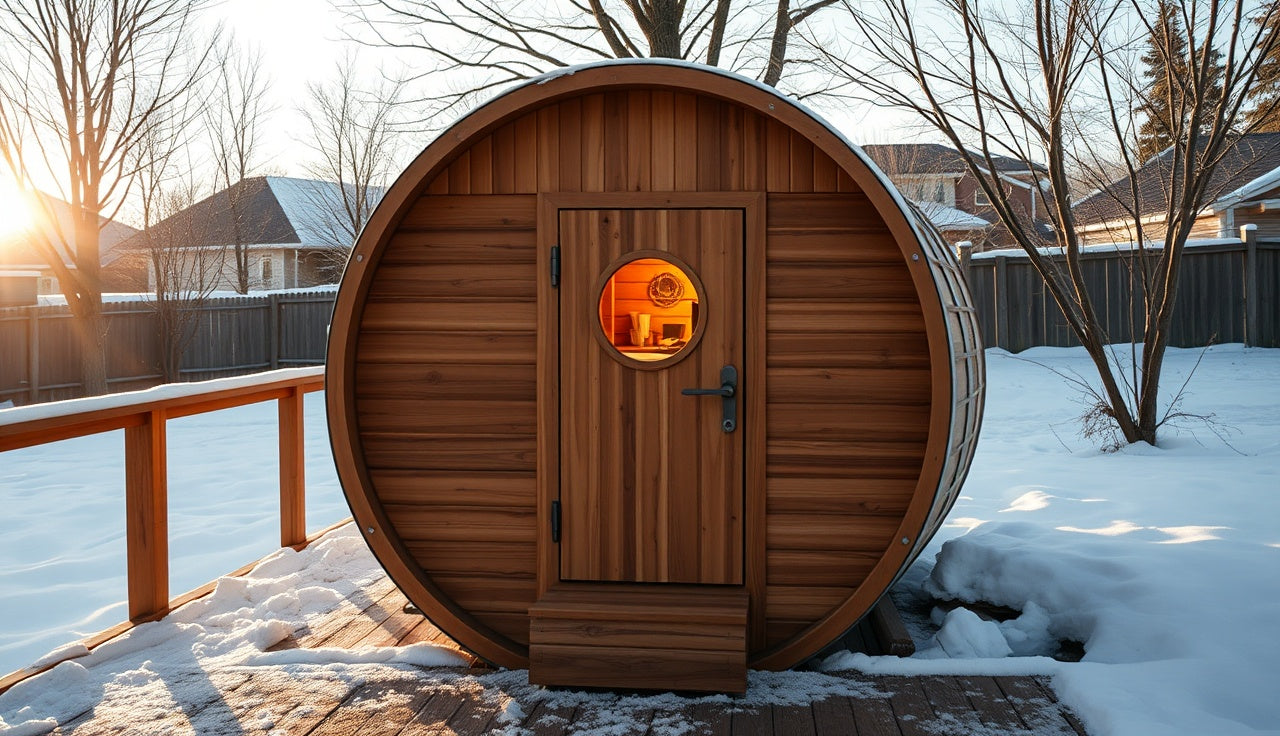
Custom outdoor builds run $8,000 to $30,000 or more. Think barrel saunas, cabin saunas, full detached structures. At this tier you're paying for cedar or thermally treated wood, a full electrical rough-in, a larger heater, and often a concrete pad and permit.
Every number above is the unit only. Add $300 to $1,500 for delivery and setup, $200 to $800 for an electrician if you need a 240V dedicated circuit, and $50 to $500 for a local building permit depending on your municipality. The price-by-type table below lays it out clean.
The home sauna guide covers what separates indoor from outdoor in more detail.
Home sauna prices by type: comparison table
The table below shows typical price ranges by sauna type. Prices are the unit only, before delivery, installation, or electrical work, based on current retail listings across major sauna retailers as of 2025.
| Sauna Type | Unit Price Range | Install Cost (est.) | Typical Size |
|---|---|---|---|
| Portable tent/bag | $150 to $500 | $0 | 1 person |
| Infrared cabin (pre-built) | $1,500 to $8,000 | $0 to $500 | 1 to 4 person |
| Traditional/Finnish (pre-built) | $3,000 to $12,000 | $500 to $2,000 | 2 to 6 person |
| Outdoor barrel sauna | $3,500 to $10,000 | $1,000 to $3,000 | 2 to 6 person |
| Custom outdoor cabin sauna | $8,000 to $30,000+ | $2,000 to $8,000 | 4 to 10+ person |
| Steam room (custom tile) | $5,000 to $20,000 | $3,000 to $10,000 | 2 to 6 person |
Infrared units own the entry-to-mid market for one reason: the 120V models skip the electrician entirely. Anything with a traditional rock heater (kiuas) pulls 4,000 to 9,000 watts and needs a 240V, 40 to 60 amp dedicated circuit, no exceptions [1].
To compare how a traditional sauna stacks up against a steam room on cost and experience, the sauna vs steam room breakdown is worth reading.
What drives the price up? The main cost factors
Wood species is the biggest unit-price lever after size. Cedar (Western Red or Canadian) resists moisture, smells great, and stays cool to the touch at high heat, so it commands a premium. Hemlock and Basswood cost 20 to 40 percent less and are fine for most indoor use. Thermally treated wood sits at the cedar price level but handles outdoor freeze-thaw cycles better.
Heater type matters just as much. Infrared panels (carbon or ceramic) are cheaper to build and run at lower air temperatures, typically 120 to 140 degrees F versus 170 to 195 degrees F for Finnish style. A quality carbon infrared panel like a Clearlight or JNH adds $400 to $1,200 to a unit. A traditional Harvia or Finnleo rock heater adds $600 to $2,500.
Size is obvious but worth quantifying. Going from a 1-person to a 4-person pre-built infrared unit roughly doubles the price, from about $2,000 to $4,500. Each added person means more wall area, more heater output, more bench material.
Controls and extras add up faster than people expect. Chromotherapy lighting, Bluetooth speakers, tempered glass doors, and app-based controls can tack $300 to $1,500 onto a mid-range unit. None of those change the actual sauna experience much. Skip them. Put the money into a better heater or thicker wood.
Shipping is genuinely painful for large units. A 4-person pre-built cabin weighs 400 to 700 pounds and moves by freight truck. Curbside delivery is standard. White-glove delivery to the room you want runs $200 to $500 extra, and it's worth it unless you have four strong people ready to carry panels.
| Portable tent/blanket | $325 |
| Infrared cabin (1-2 person) | $3,000 |
| Traditional pre-built (2-4 person) | $7,500 |
| Outdoor barrel sauna | $6,500 |
| Custom outdoor cabin sauna | $18,000 |
Source: Harvia, Sunlighten, Almost Heaven Saunas retail data; Angi national cost averages (citations 3, 10, 11, 12)
How much does a pre-built infrared sauna cost?
A pre-built infrared sauna costs $1,200 to $7,000 depending on size and brand tier. A 1-person unit from a mid-tier brand like JNH Lifestyles or Dynamic runs $1,200 to $2,500. A 2-person from the same tier is $2,000 to $4,000. Step up to Clearlight, Sun Home, or Sunlighten and a 2-person unit runs $4,000 to $7,000, with the premium buying better carbon panels, thicker wood, and longer warranties [12].
The electrical requirement is why these dominate home use. Many 1-to-2-person units run on a standard 120V, 15-to-20-amp outlet. Zero electrician cost. Larger 3-to-4-person units usually need a 240V circuit, which adds $200 to $600 depending on how far your panel sits from the sauna.
Heat-up is fast too, 15 to 30 minutes to operating temperature versus 30 to 60 minutes for a traditional unit, which saves electricity over time. A 1-to-2-person infrared unit costs $0.50 to $1.50 per session at a national average electricity rate of roughly $0.17 per kWh [2].
For the sub-$1,000 segment, including one-person infrared tents and blankets, the portable sauna guide covers it in more detail.
How much does a traditional Finnish or wood-burning sauna cost?
A traditional Finnish sauna costs $3,000 to $30,000 depending on whether it's a pre-built indoor kit or a custom outdoor cabin. It costs more up front and more to run, and most serious sauna users think it's worth it. The heat profile is different: higher air temperature, lower humidity unless you throw water on the rocks (loyly), and a denser, more enveloping feel that infrared never quite matches.
A pre-built indoor kit, usually 4x4 or 4x6 feet, costs $3,000 to $7,000. That covers pre-cut tongue-and-groove wall panels, a bench system, a door, and lighting. The heater is usually sold separately, adding $500 to $2,000 for a quality electric kiuas from Harvia, Finnleo, or Huum. Harvia's residential heaters range from 3.0 to 9.0 kW and run roughly $500 to $2,500 at retail, with the higher wattages needing a dedicated 240V circuit [11]. Contractor installation runs $500 to $1,500.
Outdoor units cost more because they need weather-sealed construction, a heavier electrical setup, and in most climates a concrete or gravel pad. A barrel sauna kit with heater included runs $3,500 to $9,000 [3]. A custom outdoor cabin with cedar siding, a changing room, and a proper wood-fired or electric heater can hit $15,000 to $30,000 with labor.
Wood-fired saunas (with a wood-burning kiuas) are cheaper to run but need a chimney permit, a sealed firebox, and compliance with local fire codes. Many cities restrict wood-burning appliances in urban zones. Call your local fire marshal before you commit to one.
The outdoor sauna guide breaks down site prep, permits, and wood options if you're leaning outdoor.
What does it cost to install a home sauna?
Installation cost depends entirely on what you already have. Drop a 120V pre-built infrared unit into a spare bedroom with a standard outlet and installation is basically free beyond your own labor, 2 to 4 hours of assembly.
Need a 240V dedicated circuit? Budget $200 to $800 for an electrician. The spread reflects distance from your main panel, whether the panel has capacity, and local labor rates. A 60-amp 240V circuit for a large traditional sauna costs more than a 30-amp 240V circuit for a mid-size infrared unit.
Outdoor changes the picture. Site prep (clearing, grading, laying a concrete or paver pad) runs $500 to $3,000 depending on size and slope. The pad for a barrel sauna, usually around 8x12 feet, costs $400 to $1,200 in materials if you DIY. A weatherproof outdoor 240V run from the house can cost $800 to $2,500 depending on trench length.
Converting an existing bathroom or a room with a floor drain is simpler because drainage is handled. A room without a drain adds $500 to $2,000 for a floor drain rough-in, worth it if you plan to use water on the rocks often.
Contractor labor for a custom build (framing, vapor barrier, cedar tongue-and-groove walls and ceiling, bench system, door) runs $2,000 to $8,000 depending on size and finish. HomeAdvisor puts national contractor labor for a custom sauna room at $3,000 to $10,000, with total installed cost between $6,000 and $20,000 [10]. This is the most variable line in the whole budget.
Do you need a permit for a home sauna?
In most U.S. jurisdictions, a pre-built sauna that plugs into an existing circuit inside your home needs no building permit. It's treated like a large appliance.
You will almost always need a permit for any of these: adding a new 240V circuit (electrical permit), building a new detached outdoor structure (building permit, possibly a zoning review), or installing a wood-burning appliance (fire or mechanical permit).
Permit costs are set locally and vary widely. A simple electrical permit typically runs $50 to $200. A building permit for an accessory structure runs $100 to $800 depending on square footage and local fee schedules [4]. Some counties calculate fees as a percentage of construction value, usually 0.5 to 2 percent.
The International Residential Code, adopted in most states, exempts certain small detached structures from a full permit. Section R105.2 lists as exempt "one-story detached accessory structures used as tool and storage sheds, playhouses and similar uses, provided the floor area does not exceed 200 square feet" [5]. Local amendments change this constantly, so treat the code as a starting point, not the final word.
Call your local building department before you pour a pad or run wire. It's a five-minute phone call, and it can save you a stop-work order.
What is the ongoing cost to run a home sauna?
Electricity is the main ongoing cost, and it's smaller than most people fear. The national average residential rate was about $0.17 per kWh in 2024, per the U.S. Energy Information Administration [2].
A 1-to-2-person infrared sauna drawing 1,500 to 2,000 watts costs roughly $0.25 to $0.50 per hour. A 45-minute session lands around $0.20 to $0.40. Use it five times a week and you're at $4 to $10 a month.
A traditional 4-to-6-person sauna with a 6,000 to 9,000-watt heater costs $1.00 to $1.50 per hour. A 45-minute preheat plus a 30-minute session runs about 1.5 hours, so roughly $1.50 to $2.25 per session. Five sessions a week comes to $30 to $45 a month.
Maintenance stays cheap if you keep up with it. Clean cedar and hemlock benches with a mild sauna-specific cleaner, never household products that off-gas at high heat. A bench cleaning kit runs $20 to $40. Heater rocks on traditional units should be inspected yearly and replaced every 3 to 5 years, at $30 to $80 for a standard set. Infrared panels rarely fail before 10 to 20 years, so maintenance there is mostly wiping down the interior.
Wood-burning units add firewood, roughly $200 to $400 per cord depending on region, plus a yearly chimney cleaning at $100 to $200.
Does a home sauna add value to your house?
The data here is thin and mixed. A sauna is a lifestyle addition, not a high-ROI home improvement, and treating it as an investment sets you up for disappointment.
Real estate agents report that a well-built outdoor sauna appeals strongly to certain buyers, especially in cold-climate markets like Minnesota, Vermont, and the Pacific Northwest where sauna culture runs deep. In those markets, an outdoor cedar sauna might recover 50 to 80 percent of its cost in appraisal value. I've found no clean study that pins that number down with any rigor, so take it as agent lore, not fact.
A pre-built infrared unit in a spare bedroom is generally personal property. You take it with you when you move, and it adds nothing to the appraisal. A built-in custom sauna room with cedar walls and a permanent heater is real property and does add to assessed value, though assessors disagree on how much.
Buy a sauna because you'll use it and enjoy it, not because it'll return dollar-for-dollar at sale. If health is your main motivation, the sauna benefits guide covers the research.
What's the cheapest way to get a home sauna?
The cheapest entry point is a portable sauna tent or blanket, $150 to $400. They work, but they're not a sauna the way most people picture one. You sit in a bag with your head out while a small steam or infrared unit runs. Fine for heat therapy, weak on the full ritual.
The cheapest real sauna experience is a 1-person pre-built infrared cabin from a brand like JNH Lifestyles or Dynamic, typically $1,200 to $2,000 on sale, plugged into a 120V outlet. Assembly takes an afternoon. Zero contractor involvement.
Buying used is underrated. Pre-built units show up on Facebook Marketplace and Craigslist all the time. People buy them, use them six times, and resell at 30 to 50 percent of retail. The risk: infrared heater panels degrade over time and cost $200 to $600 each to replace. Inspect carefully before you hand over cash.
If you're handy, framing your own sauna room in a basement corner around a pre-cut cedar kit is a strong middle path. The kit supplies the tongue-and-groove wood, bench materials, door, and hardware. You handle framing, vapor barrier, and electrical rough-in, then assemble the kit. Total cost can land at $4,000 to $7,000 with a quality heater, versus $8,000 to $15,000 contractor-built.
SweatDecks carries home saunas across every price tier if you want to compare units side by side.
How does home sauna cost compare to gym or spa sauna access?
A gym or spa with sauna access runs $40 to $150 per month. At $80 a month, that's $960 a year. A decent home infrared unit at $3,000 breaks even in about three years if you were paying for gym access mainly for the sauna. After that, it's free.
The math bends on how much you use it. If you sauna twice a week at a gym you'd keep anyway, break-even on a home unit stretches to seven or ten years. If you're doing daily 30-minute sessions and dropping the gym, the home unit pays off fast.
There's a compliance factor the math misses: home access kills the friction of driving somewhere. Most people who buy a home sauna use it more than they did at a gym. That consistency matters for the health outcomes in the research. The Laukkanen et al. study in BMC Medicine (2018) found sauna frequency significantly associated with cardiovascular and all-cause mortality, with 4 to 7 sessions per week showing stronger associations than a single weekly session [6].
If you want to pair heat with cold, the cold plunge guide walks through the contrast protocol and its own cost math.
Are there financing options for home saunas?
Yes. Most mid-to-high-end sauna retailers offer financing through third-party lenders like Affirm, Klarna, or GreenSky. Terms commonly run 12 to 60 months, with promotional 0% APR periods on qualifying purchases. Read the deferred interest clauses carefully. Some 0% offers convert to high-rate deferred interest, often 25 to 30% APR, if you don't clear the balance by the end of the promo window.
Home equity loans and HELOCs are worth a look for custom outdoor builds over $10,000. Rates beat personal loans, and interest may be deductible if the sauna qualifies as a home improvement. The 2017 Tax Cuts and Jobs Act changed the rules on home equity debt deductibility. IRS Publication 936 governs it now, and eligibility depends on how you use the money, so check with a tax professional [7].
Cash is the simplest path. If you're stretching to afford a $6,000 unit, a $2,500 unit you can pay for outright will serve you better than a financed $6,000 unit dragging carrying costs behind it.
Frequently asked questions
How much does a 2-person home sauna cost?
A 2-person infrared sauna costs $2,000 to $5,000 for a quality pre-built unit. A 2-person traditional Finnish kit runs $3,500 to $8,000 with a heater. Add $200 to $800 for a 240V circuit if the unit needs one. Mid-tier brands like JNH and Dynamic sit at the low end; Clearlight and Sunlighten sit at the top with better carbon panels and thicker wood.
How much does it cost to build a sauna in your home from scratch?
A custom interior sauna using a pre-cut cedar kit, professional framing, vapor barrier, and electrical rough-in typically costs $5,000 to $15,000 depending on size and finish. A 4x6-foot 2-person build sits at the low end. A 6x8-foot 4-person build with a quality electric kiuas and glass door lands at $10,000 to $15,000 with contractor labor included.
Does a home sauna use a lot of electricity?
Not much. A 2-person infrared unit at 2,000 watts costs about $0.34 per hour at the U.S. average rate of $0.17 per kWh. A traditional 6,000-watt sauna costs about $1.02 per hour. Daily 45-minute sessions on a mid-size traditional unit add $25 to $45 a month to your bill, roughly a few coffee shop visits.
What is the cheapest type of home sauna?
Portable tents and sauna blankets start at $150 to $400 and need no installation. For a real walk-in sauna, a 1-person pre-built infrared cabin from JNH or Dynamic runs $1,200 to $2,000 on sale and plugs into a standard 120V outlet. Buying a lightly used pre-built unit on Facebook Marketplace can cut the price 30 to 50 percent versus retail.
How much does an outdoor sauna cost?
Outdoor barrel sauna kits cost $3,500 to $9,000 for the unit. Add $500 to $1,500 for a concrete or paver pad, $800 to $2,500 for a weatherproof 240V run from your house, and $50 to $300 for local permits. A full custom outdoor cabin with a changing room and cedar exterior runs $15,000 to $30,000 installed.
Is a home sauna worth the money?
It depends on how often you'd use it. Four or more sessions a week, and the convenience, long-term savings over gym access, and documented cardiovascular and recovery research make it a reasonable buy. Twice a month, and it's hard to justify $3,000 to $8,000. The honest answer: most people use it more than they expect once it's in the house.
Do I need an electrician to install a home sauna?
Only if the unit needs a 240V circuit you don't already have. Many 1-to-2-person infrared saunas run on 120V and plug into a standard outlet, no electrician required. Larger infrared units and all traditional electric saunas need a dedicated 240V circuit, which requires a licensed electrician in most states and costs $200 to $800 depending on panel distance and local rates.
How long does a home sauna last?
A well-maintained cedar or hemlock sauna lasts 15 to 30 years. The heater usually goes first: infrared carbon panels last 10 to 20 years, traditional electric kiuas heaters last 10 to 15 with annual rock inspections. The wood structure can last indefinitely if kept dry and cleaned. Cheap brands with thin wood and poor joinery tend to degrade in 5 to 8 years.
Can a home sauna increase property value?
Possibly, but modestly. A custom built-in sauna room adds to assessed value. A free-standing pre-built unit is usually personal property and adds nothing at appraisal. In cold-climate markets with sauna culture, a quality outdoor cedar sauna may recover 50 to 70 percent of its cost in buyer appeal, but no large-sample study confirms a precise ROI. Treat it as a lifestyle purchase, not a financial one.
What is the difference in cost between infrared and traditional saunas?
For comparable sizes, infrared units cost 20 to 40 percent less than traditional Finnish-style saunas at purchase. A 2-person infrared cabin runs $2,000 to $5,000; a comparable traditional unit runs $3,500 to $8,000, partly because the kiuas heater costs more than infrared panels. Traditional saunas also usually need higher-amp circuits, adding $200 to $600 in electrician cost.
Are there health benefits that justify the cost of a home sauna?
There's genuine research. A 2018 study in BMC Medicine found regular sauna use associated with lower cardiovascular and all-cause mortality risk, with stronger effects at 4 to 7 sessions per week. Separate work supports temporary benefits for muscle recovery and stress. The key word throughout is 'associated': these are observational studies, not randomized controlled trials, so nobody can promise outcomes.
How much does a Costco sauna cost compared to specialty retailers?
Costco periodically sells pre-built infrared units, usually 1-to-3-person cabins, priced $1,500 to $4,500. The value is real, and Costco's return policy cuts your risk. The trade-off is limited model selection, thinner warranty support, and no sauna-specialist guidance. Specialty retailers offer more models, better technical support, and sometimes better heater specs at similar prices. See the full Costco sauna comparison for specifics.
What ongoing maintenance costs should I budget for a home sauna?
Budget $100 to $300 a year. That covers a sauna cleaner ($20 to $40), replacement heater rocks every 3 to 5 years ($30 to $80), occasional bench sanding or re-oiling for outdoor units ($20 to $60 in materials), and a replacement thermometer or hygrometer if yours fails ($15 to $40). Infrared units cost less to maintain since there are no rocks to replace.
Can I pair a home sauna with a cold plunge for contrast therapy?
Yes, and home setups are doing it more and more. A dedicated cold plunge or ice bath adds $500 to $8,000 depending on whether you pick a portable tub, a chest freezer conversion, or a purpose-built unit with a chiller. The contrast protocol (sauna then cold immersion) is well-documented in sports science for perceived recovery. The cold plunge benefits guide covers what the research actually shows.
Sources
- National Fire Protection Association (NFPA), NFPA 70 National Electrical Code Article 424: Sauna heaters drawing 4,000 to 9,000 watts require a dedicated 240V, 40 to 60 amp circuit per NEC requirements for fixed electric space heating equipment.
- U.S. Energy Information Administration, Electric Power Monthly, Average Retail Price of Electricity: National average residential electricity rate was approximately $0.17 per kWh in 2024.
- Almost Heaven Saunas, Barrel Sauna product listings (representative retail pricing): Outdoor barrel sauna kits with heater typically retail for $3,500 to $9,000 depending on size and wood species.
- International Code Council, Building Permit Fee Structures overview: Building permits for accessory structures typically cost $100 to $800 depending on jurisdiction and square footage; some jurisdictions calculate fees as a percentage of construction value.
- International Residential Code (IRC) 2021, Section R105.2, Work Exempt from Permit: The IRC states that 'one-story detached accessory structures used as tool and storage sheds, playhouses and similar uses, provided the floor area does not exceed 200 square feet' are exempt from permit in many adopting jurisdictions, subject to local amendments.
- Laukkanen T et al., BMC Medicine, 2018, Sauna bathing is associated with reduced cardiovascular mortality and improves risk prediction in men and women: Frequency of sauna use was significantly associated with cardiovascular and all-cause mortality, with 4 to 7 sessions per week showing stronger associations than 1 session per week.
- IRS Publication 936, Home Mortgage Interest Deduction: Home equity loan interest deductibility for home improvements is governed by IRS Publication 936 and was modified by the 2017 Tax Cuts and Jobs Act; taxpayers should consult a tax professional for current eligibility.
- Laukkanen JA et al., JAMA Internal Medicine, 2015, Association Between Sauna Bathing and Fatal Cardiovascular and All-Cause Mortality Events: A prospective cohort study of 2,315 Finnish men found sauna bathing frequency inversely associated with cardiovascular and all-cause mortality; men who used saunas 4 to 7 times per week had the lowest risk.
- Consumer Product Safety Commission (CPSC), Portable Electric Spa and Sauna Safety: CPSC guidelines require portable sauna and spa heaters to carry UL or ETL certification and meet grounding and circuit requirements for safe residential use.
- HomeAdvisor (Angi), Cost to Build a Sauna national average data: National average contractor cost to build a custom home sauna room ranges from $3,000 to $10,000 in labor, with total installed costs including materials ranging $6,000 to $20,000.
- Harvia Group, Electric Sauna Heater product specifications and wattage data: Harvia electric kiuas heaters for residential use range from 3.0 kW to 9.0 kW, priced from approximately $500 to $2,500 at retail, requiring dedicated 240V circuits at the higher wattages.
- Sunlighten Infrared Saunas, product pricing and specifications: Premium infrared sauna units from Sunlighten retail for $4,000 to over $10,000 for 2-to-4-person cabins, reflecting higher-grade carbon heater panels and extended warranties.
Share:
How long to stay in an infrared sauna (by session goal and experience level)
DIY steam room: how to build one at home (full guide)