
Last updated 2026-07-10
TL;DR
A portable sauna kit is a compact, plug-in sauna you set up in a bedroom, bathroom, or on a patio in minutes. Most run on a standard 110V outlet and cost $50 to $500. Three forms dominate: tent-style steam saunas, infrared blankets, and pop-up infrared cabins. None hit traditional sauna heat, but all raise core temperature and produce a real sweat.
What is a portable sauna kit and what comes in the box?
A portable sauna kit is a self-contained package that lets you sweat at home without building anything permanent. Simple idea. The category splits into three very different products once you look closely.
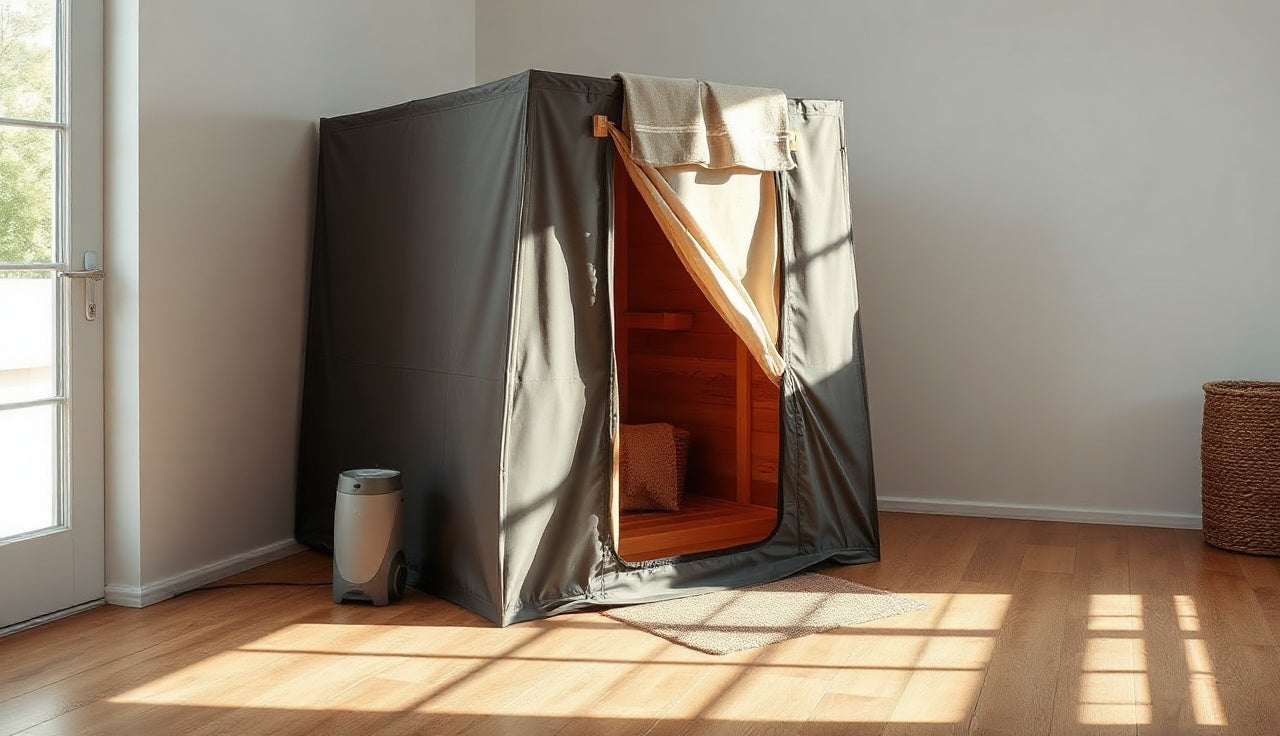
The most common type is the tent-style steam sauna. You get a collapsible fabric or nylon tent (usually zippered, with a hole at the top for your head), a steam generator that looks like a rice cooker, a plastic stool, and a hand controller. The tent folds flat for storage. Setup runs about five minutes. Steam temperature inside reaches roughly 110°F to 130°F (43°C to 54°C), and you sit with your head out in room air. [1]
The second type is an infrared sauna blanket. The "kit" here is literally a blanket you lie inside, sometimes paired with a waterproof mat. Infrared elements sewn into the blanket radiate heat straight into your body. Skin surface temperatures reach 100°F to 120°F, and the enclosed space traps heat fast. No steam, no tent, no stool. Some people love the simplicity. Others feel trapped lying inside a heated bag.
The third type is a portable infrared cabin, sometimes called a pop-up infrared sauna. This sits a clear step above the tent units: a semi-rigid frame with infrared panels on the walls, a proper seat inside, and your head stays inside the enclosure. These cost more and take longer to build (15 to 30 minutes for the first assembly), but they work closer to a real infrared sauna room. [2]
Almost every kit ships with the heating element (steam generator or infrared panels), the enclosure (tent, blanket, or cabin), a stool or seat, and a hand controller or app. Higher-end kits add a foot warmer, a timer, and sometimes a detachable steam wand for aromatherapy. What they almost never include: enough extension cord, a decent thermometer, or any waterproofing for the floor under you.
What are the main types of portable sauna kit and how do they compare?
The three types differ in how they deliver heat, how hot they get, how much fuss they cause, and what they cost. Here is a direct comparison.
| Type | Heat source | Temp range | Wattage | Price range | Head in/out |
|---|---|---|---|---|---|
| Tent steam sauna | Steam generator | 110 to 130°F | 800 to 1000W | $50, $150 | Head OUT |
| Infrared blanket | Carbon or ceramic IR | 100 to 150°F (surface) | 400 to 800W | $100, $400 | Head OUT |
| Portable IR cabin | Carbon/ceramic IR panels | 110 to 150°F | 1000 to 1800W | $250, $600 | Head IN |
Steam tent units are the cheapest way in and, honestly, the messiest. Condensation drips, the fabric interior stays wet between sessions, and the generator wants distilled water to avoid mineral buildup. Temperature accuracy is poor. They work, but the experience lands closer to a hot foggy closet than a Finnish sauna.
Infrared blankets take up the least space. They slide under a bed and weigh 10 to 20 pounds. The heat reaches skin more directly than ambient steam, which some people find more intense per watt. The catch is that you lie still for the whole session. Want to read or stretch? A blanket is the wrong tool.
Portable IR cabins are where the category gets genuinely useful for regular use. You sit upright, your whole body including your head is in the heat, and the panels spread warmth more evenly than a single steam nozzle. The downside is price and footprint. A decent cabin takes up roughly 3 by 3 feet and stands 5 to 6 feet tall. Portable means you can take it apart, not that you carry it to the gym. [2]
For how portable kits stack up against permanent installs, the home sauna guide covers full-size indoor builds, and the portable sauna page breaks down the wider category including barrel and cube designs.
How hot does a portable sauna kit actually get?
This is where the marketing and the thermometer disagree. A traditional Finnish sauna runs 160°F to 200°F (71°C to 93°C) with low humidity. [1] Portable tent saunas peak around 120°F to 130°F. Infrared blankets and cabins target 120°F to 150°F, but measure at body level instead of next to the element and you often find the real air temperature sits 10 to 20 degrees below the stated max.
That gap matters for two reasons. First, the physiological effect is real but softer. Your core temperature still climbs and you still sweat. The 2018 Mayo Clinic Proceedings review linked regular sauna use above 80°C (176°F) to cardiovascular and mortality benefits, but that work studied Finnish saunas at traditional heat, not 120°F tent units. [3] Portable kits at lower temperatures still produce sweat and lift heart rate. The data just does not transfer straight across.
Second, because the air is cooler, sessions run longer to get the same sweat. Most portable protocols suggest 20 to 45 minutes, against the 10 to 20 minute rounds typical in a traditional sauna. That is not a flaw. It is an honest difference to plan around.
Want something near traditional sauna heat at home? The outdoor sauna page covers barrel and shed-style saunas that clear 180°F, and the main sauna guide explains what those temperatures do to your body.
| Budget steam tent (800–1000W) | $100 |
| Mid-range steam tent (900–1000W) | $200 |
| Infrared blanket (400–800W) | $250 |
| Portable IR cabin (1000–1800W) | $425 |
Source: U.S. Consumer Product Safety Commission and market data, 2024
Is a portable sauna kit safe to use?
For most healthy adults, yes. Real risks exist, and they deserve attention.
Burns are the fastest way to get hurt with steam tent models. The nozzle and the generator's exterior reach scalding temperatures. Route the steam hose so it cannot touch bare skin. Most units have a basic auto-shutoff, but treat that as a backup, not a plan.
Electric shock risk climbs when water and electronics share a space. Never run a steam generator on an extension cord not rated for the wattage. Never use one in a wet bathroom without ground-fault circuit interrupter (GFCI) protection. [4] The Consumer Product Safety Commission recommends GFCI outlets anywhere water and electricity sit close together. [4]
Overheating and dehydration are real too. The American College of Sports Medicine recommends drinking about 17 to 20 oz of water in the two hours before heat exposure, then keeping fluids coming afterward. [5] Heat exhaustion shows up as dizziness, nausea, and, oddly, sweating that stops despite the heat. If any of those hit, get out and cool down immediately.
People who should not use portable saunas without a doctor's sign-off first: anyone with cardiovascular disease, uncontrolled hypertension, an active infection, a pregnancy, or any condition that messes with thermoregulation. The lower temperature ceiling of a portable unit is not automatically safer for these groups. It just changes the heat load.
One structural note. An infrared blanket pins you more than a tent does. Make sure you can exit fast. Practice opening the zipper or flap before your first session.
What electrical requirements does a portable sauna kit need?
Most portable kits run on a standard North American 110V/120V, 15-amp outlet. That is by design: it keeps the price down and makes them truly plug-and-play. A typical steam tent generator draws 800 to 1000 watts, well under what a 15-amp circuit handles. Maximum continuous load on a 15-amp/120V circuit is 1440 watts. [6]
Portable IR cabins are the exception. Units with several infrared panels sometimes draw 1200 to 1800 watts. Still within a 15-amp circuit on paper, but stack other appliances on the same circuit and you trip the breaker. Run a portable sauna on a dedicated circuit, or at least one without other high-draw loads.
None of the portable kits here need 220V or 240V. That is the domain of full-size residential infrared rooms and traditional electric heaters (a Harvia or Finnleo, say), which run on the same voltage as an electric dryer. [7] A portable kit that claims to need 240V has left the portable category in any practical sense.
Extension cords are fine if the cord is rated for the wattage and kept short. A 12-gauge cord rated for 15 amps is the floor. Never plug a sauna unit into a thin 16-gauge lamp cord.
How long does a portable sauna kit take to heat up?
Steam tent units heat the fastest. The generator is basically a small boiler: it makes steam in 5 to 10 minutes, and the tent interior reaches usable temperature in 10 to 15 minutes from cold. [1]
Infrared blankets heat quickly too. They warm a tiny volume of air and rely on direct radiant heat instead of convection. Most are ready in 5 to 10 minutes.
Portable IR cabins take longer, usually 15 to 25 minutes to hit target. The bigger interior needs more time to warm, and the elements run a warm-up cycle. Some premium units preheat faster with higher-wattage panels, but that pushes toward 1500W.
One practical note. All these times assume a room-temperature space. Set up a portable kit in a cold garage in January and you add 5 to 10 minutes and get a lower max inside the enclosure. Portable kits are not insulated like a proper sauna room. The room around them matters.
What should you look for when buying a portable sauna kit?
Five things separate a good kit from a frustrating one.
First, steam generator capacity. Cheaper tent units use generators under 1 liter. They run dry in 20 to 30 minutes and force a mid-session refill, which means opening the tent and dumping your heat. Look for at least 1.5 to 2 liters if you plan 30-plus minute sessions.
Second, fabric quality on tent units. The inner lining takes the beating: steam, sweat, and repeated compression. Oxford nylon and double-layer insulated linings hold up. Single-layer polyester molds fast if you skip drying it.
Third, infrared panel type on blankets and cabins. Carbon fiber panels heat more evenly and at lower surface temperatures than ceramic. Ceramic can have hot spots. Carbon is the standard on higher-end units.
Fourth, EMF levels. Infrared units produce electromagnetic fields, and some buyers care about this. Look for units independently tested for EMF output. Reputable brands publish the figures. Many budget units stay quiet.
Fifth, portability in practice. Measure your storage space before you buy. A portable IR cabin that breaks down into a 50-pound duffel is not easy to move. Infrared blankets store flat and are genuinely light. Tent units fold into a bag that fits in a closet.
SweatDecks carries a vetted selection of portable saunas if you want to see specific models. Price ranges swing hard, and what you get for the money scales roughly linearly up to $400 to $500. Past that, you are mostly paying for the badge.
For how these compare to a steam room, the sauna vs steam room breakdown is worth a read before you commit to a steam tent unit.
Do portable sauna kits actually work for recovery and health benefits?
The honest answer: somewhat, with caveats.
The strongest evidence for sauna health benefits comes from studies using traditional Finnish saunas at 80°C to 100°C (176°F to 212°F), usually Nordic populations sitting multiple times a week for years. The Kuopio Ischemic Heart Disease study, published in JAMA Internal Medicine in 2015, found that men who used a sauna 4 to 7 times per week had a 40% lower risk of all-cause mortality than once-weekly users. [8] That study did not involve portable tent saunas.
What portable kits can plausibly do: push heart rate to 100 to 150 BPM (about the level of light aerobic exercise), raise core temperature by 1°C to 2°C, produce a real sweat, and improve how recovered and relaxed you feel. A 2021 study in the International Journal of Environmental Research and Public Health found that even lower-temperature infrared sessions (around 60°C, or 140°F) improved muscle recovery scores compared to passive rest. [9]
The sauna benefits page covers the research in more depth. Here is the short version: portable kits can deliver some of the relaxation, mild cardiovascular stimulus, and recovery you get from sauna use. They probably do not replicate the most dramatic outcomes from high-temperature, high-frequency traditional studies. That is a fair trade-off, not a reason to write them off.
Pairing sauna sessions with cold for contrast therapy? The cold plunge and cold plunge benefits pages cover what the research says about that protocol.
How do you set up and maintain a portable sauna kit?
Setting up a steam tent is fast. Unfold the tent, thread the steam hose through the port, fill the generator with distilled water (tap water speeds mineral buildup and can clog the nozzle within weeks), plug in, and sit down. Most people are ready in under 10 minutes on the first try.
Infrared blanket setup is simpler still. Lay the mat, unfold the blanket over it, lie down, zip or close the flap, and turn it on. If the maker includes a hydration instruction or a saline wipe before use, follow it. You dehydrate faster than you expect inside an IR blanket.
Cleaning is the part people underestimate. Wipe steam tent interiors down and dry them completely after every use. Store the tent folded while damp and mildew shows up quickly. Leave it open and air it out for at least 30 minutes after a session. Descale the generator with a citric acid solution every 10 to 15 uses to keep steam output steady. Some brands sell their own descaling tablets.
Infrared blankets cannot go in a washing machine because of the heating elements. Wipe the interior with a damp cloth and a mild antibacterial cleaner. Let it air dry fully before folding. A dedicated towel or liner inside the blanket during sessions cuts cleaning way down, and most manufacturers recommend it anyway.
Portable IR cabins need the poles and frame wiped and dried, and the panels kept free of dust and moisture. If the cabin has wood seating, treat it with teak or cedar oil now and then, the same way you would a traditional sauna bench.
How much does a portable sauna kit cost, and is it worth it?
Budget steam tent kits start around $50 to $80 on major retailers. That price buys a working product with a short life. The generator usually fails first, often inside a year of regular use.
Mid-range steam tents and basic infrared blankets run $100 to $250. Quality starts to climb here in ways you notice. Generator capacity goes up, fabric improves, and you get real temperature controls instead of a single on-off switch.
Good infrared blankets and portable IR cabins land between $250 and $500. Above $500, you drift toward semi-permanent infrared rooms, which are a different product entirely. Full residential infrared saunas start around $1,500 to $3,000 and need more installation thought. [2]
Worth it? For someone renting an apartment, traveling often, or testing sauna use before a full build, absolutely. The entry cost is low enough that a $150 tent sauna used twice a week for a year costs less per session than a gym sauna membership. For someone with a house, outdoor space, and a budget over $3,000, a permanent outdoor sauna or a full home sauna gives a much better experience and holds some resale value.
One category that gets overlooked: sauna suits and similar wearable heat products sit in a different niche but surface in the same searches. They are no sauna replacement, but they are worth knowing about if portability is your main driver.
Can you use a portable sauna kit outdoors?
Technically yes, with conditions. Steam tent units and portable IR cabins can go on a covered patio or deck. The enclosure shrugs off wind reasonably well because it holds heat inside. The trouble is moisture. In a humid climate, the steam tent struggles to heat as fast because the generator is already fighting ambient moisture.
IR blankets outdoors make no sense. You would lie inside a heated blanket in open air. Unless it is a warm day and you are using the blanket on a lounge chair as an odd heat layer, skip it.
The bigger outdoor concern is the plug. Powering a steam generator or IR cabin from an outdoor outlet requires that outlet to be GFCI-protected, which the National Electrical Code mandates for all outdoor receptacles. [6] Running an extension cord through a window or door gap to power a portable sauna is common and generally fine if the cord rating matches the load, but it is a tripping hazard you have to manage.
If outdoor sauna use is the priority and you have the space and budget, a proper barrel or cube sauna beats any portable kit on heat, experience, and durability. The outdoor sauna guide covers those options.
Frequently asked questions
How long should a session in a portable sauna kit last?
Most sources suggest 20 to 45 minutes for portable steam tent and infrared sessions, longer than the 10 to 20 minutes typical in a traditional sauna because temperatures are lower. Start at 15 to 20 minutes if you are new to heat and build from there. Drink water before and after. If you feel dizzy or stop sweating, end the session immediately and cool down.
Can I use a portable sauna kit every day?
Daily use is generally fine for healthy adults if you stay hydrated and keep sessions reasonable. The Kuopio Heart Disease study found the strongest health associations in men using saunas 4 to 7 times per week, though that involved traditional high-temperature saunas. For portable kits, daily 20-minute sessions are unlikely to harm healthy users, but watch how your body responds and take rest days if you feel worn down.
Do portable sauna kits help with weight loss?
Portable saunas cause water loss through sweat, not fat loss. Any weight drop after a session comes back as soon as you rehydrate. That said, the cardiovascular stimulus from regular heat exposure can complement an exercise and nutrition program. There is no evidence that sauna use alone drops meaningful body fat. Claims to the contrary are marketing, not science.
Are infrared sauna blankets and tent saunas the same thing?
No. Steam tent saunas heat the air with moist steam and you sit inside with your head out. Infrared blankets use radiant panels to warm your body directly without raising air temperature much, and you lie inside the blanket horizontally. The heat mechanisms differ, the experience differs, and the temperature ranges overlap only roughly. Both produce sweat, through different processes.
What is the best portable sauna kit for small apartments?
An infrared sauna blanket fits small apartments best. It stores flat under a bed or in a closet, needs no assembly, weighs 10 to 20 pounds, and runs on a standard outlet. The trade-off is lying down for the session, which feels less like a traditional sauna. For a more sauna-like feel in tight space, a steam tent folds into a carry bag and sets up in about five minutes.
Is steam or infrared better in a portable sauna kit?
Neither wins outright. Steam is cheaper and heats faster, but wants distilled water, drips condensation, and needs more drying afterward. Infrared is drier, easier to maintain, and heats the body more directly, but costs more, and blankets pin you still the whole session. If cost drives the decision, go steam. If convenience and clean storage matter more, go infrared.
Do portable sauna kits help with muscle recovery?
Heat exposure aids muscle recovery. A 2021 study in the International Journal of Environmental Research and Public Health found that infrared sauna sessions around 60°C improved self-reported muscle recovery scores versus passive rest. Portable kits at similar temperatures can plausibly deliver this. Contrast therapy, alternating heat with cold, is another recovery approach worth researching on its own.
Can I put a portable sauna in a bathroom?
Yes, with caveats. The bathroom needs a GFCI-protected outlet, which most modern bathrooms have. A steam tent fits most standard bathrooms if you have clearance around the unit. The steam raises room humidity and can loosen wallpaper or paint over time, so ventilate well after sessions. IR blankets work fine in a bathroom too, laid on the floor or in the tub with a mat underneath.
How do I clean and store a portable sauna tent between uses?
Wipe the inner fabric with a damp antibacterial cloth right after use. Leave the tent open and air it out for at least 30 minutes before folding. Descale the steam generator every 10 to 15 uses with a citric acid solution. Store the tent somewhere dry; damp storage breeds mildew. Running the generator empty for two minutes at the end of a session dries out the internal tubes and extends its life.
What is the difference between a portable sauna kit and a full home sauna?
Temperature is the biggest gap. A portable kit reaches 110°F to 150°F. A full home sauna, traditional or infrared, reaches 160°F to 200°F. Full home saunas use wood construction with insulated walls, proper benches, and dedicated circuits. They cost $1,500 to $10,000 or more installed. Portable kits cost $50 to $500 and need no installation. The experience and health potential differ materially.
Are portable sauna kits safe for people with heart conditions?
Anyone with a cardiovascular condition should talk to their cardiologist before using any sauna, portable kits included. Heat raises heart rate and cardiac output. While some research suggests sauna use benefits cardiovascular health in healthy populations, the lower temperatures in portable kits do not automatically make them safe for people with heart disease. This is a genuine medical question, not a marketing disclaimer.
What wattage outlet does a portable sauna kit need?
Most portable sauna kits draw 800 to 1800 watts and use a standard 110V/120V outlet. A 15-amp/120V circuit handles up to 1440 watts continuously, so IR cabins near the top of that range want a circuit without other high-draw appliances. None of the kits in this category need a 220V/240V outlet. That is the territory of full-size residential saunas with dedicated hardwired connections.
Can you use a portable sauna kit with cold plunge therapy?
Yes, and it is a popular combination. Finish a sauna session, then move to cold immersion, an ice bath or a cold plunge tub. Some people alternate rounds. The research on contrast therapy looks promising but is not settled. The practical home version: run your portable sauna session, then take a cold shower or use a cold plunge tub. Start with 1 to 2 rounds before adding complexity.
Sources
- Finnish Sauna Society, Sauna Temperature and Humidity Guidelines: Traditional Finnish saunas operate at 80°C to 100°C (176°F to 212°F); portable steam tent units reach 110°F to 130°F in practice
- U.S. Consumer Product Safety Commission, Sauna and Spa Safety: Infrared cabin-style portable saunas draw 1000 to 1800 watts and require proper electrical setup; full residential infrared saunas start around $1,500
- Laukkanen T et al., Mayo Clinic Proceedings 2018, Association Between Sauna Bathing and Fatal Cardiovascular and All-Cause Mortality Events: Regular sauna use at temperatures above 80°C (176°F) was associated with reduced cardiovascular and all-cause mortality in the study population
- U.S. Consumer Product Safety Commission, Ground-Fault Circuit Interrupters: CPSC recommends GFCI outlets in any space where water and electricity are in proximity, including bathrooms and outdoor outlets
- American College of Sports Medicine, Exercise and Fluid Replacement Position Stand: ACSM recommends drinking 17 to 20 oz of water in the two hours before heat exposure and rehydrating after
- National Fire Protection Association, NFPA 70 National Electrical Code Article 210 and Article 406: NEC requires GFCI protection for all outdoor receptacles and limits continuous load on a 15-amp/120V circuit to 1440 watts
- U.S. Department of Energy, Residential Electrical Circuits and Wiring: Full-size electric sauna heaters require 220V to 240V dedicated circuits, the same voltage as electric dryers
- Laukkanen JA et al., JAMA Internal Medicine 2015, Association Between Sauna Bathing and Fatal Cardiovascular and All-Cause Mortality Events: Men who used a sauna 4 to 7 times per week had a 40% lower risk of all-cause mortality compared to once-weekly sauna users in the Kuopio Ischemic Heart Disease study
- Mero A et al., International Journal of Environmental Research and Public Health 2021, Far-Infrared Sauna as a Recovery Tool: Infrared sauna sessions at approximately 60°C improved self-reported muscle recovery scores compared to passive rest
- U.S. Consumer Product Safety Commission, Extension Cord Safety: CPSC recommends using extension cords rated for the wattage of the connected appliance; undersized cords are a fire hazard

Share:
How to get a cheap sauna at home: every real option compared
Icebound Essentials Weekender Grande barrel sauna: full review