
Last updated 2026-07-10
TL;DR
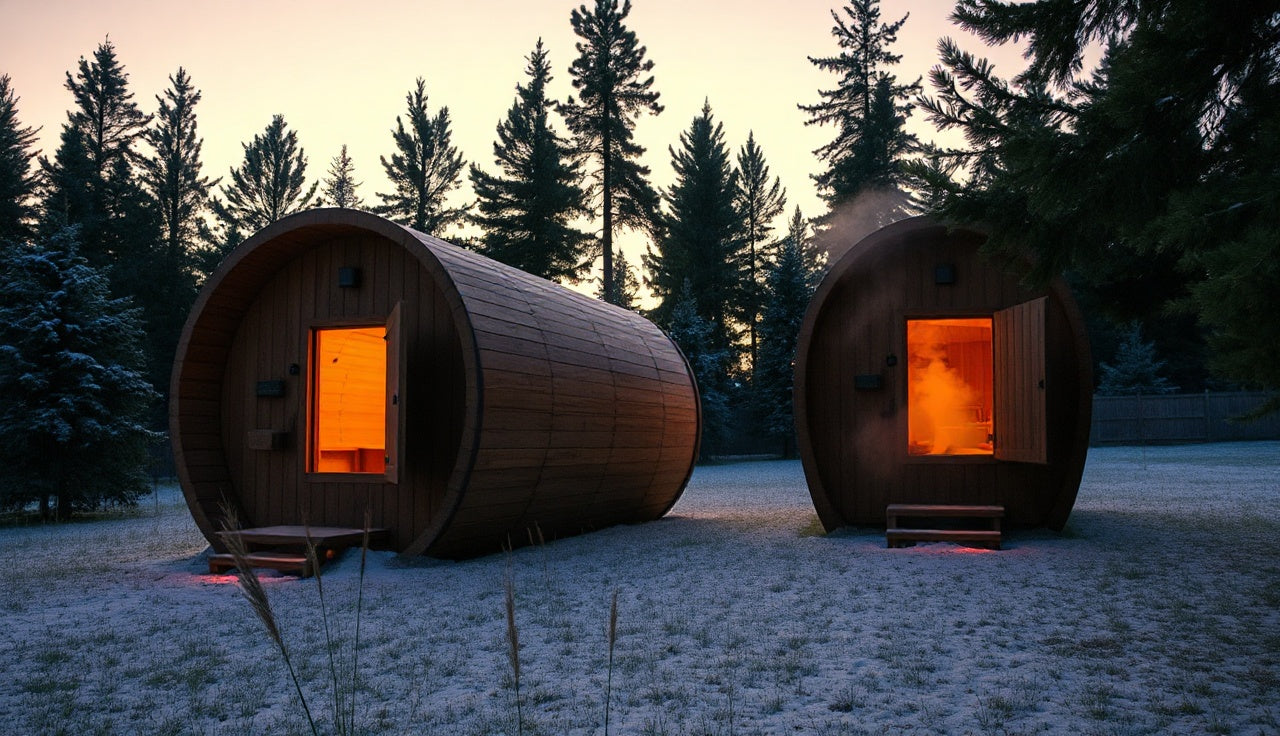
The Icebound Essentials Weekender Grande is a 6-foot-diameter, 8-foot-long outdoor barrel sauna built from Canadian red cedar and sized for 4 to 6 bathers. It ships as a flat-pack kit, runs on a wood-burning or electric heater, and retails between $4,000 and $6,500. It's a mid-tier backyard sauna for homeowners who want the real thing without a custom-build bill.
What exactly is the Icebound Essentials Weekender Grande barrel sauna?
The Weekender Grande is Icebound Essentials' largest standard barrel sauna. The name sells the idea: it's built for a weekend crowd, not solo post-run recovery. The barrel shape isn't styling for its own sake. A cylindrical interior spreads heat more evenly than a rectangular box because the curved ceiling pushes hot air back down toward the benches instead of letting it pool above your head. Finnish sauna researchers have documented this convection advantage for decades, and it's one reason barrel saunas heat up faster per cubic foot than box saunas with the same heater [1].
The Grande lands at roughly 6 feet in outer diameter and 8 feet in barrel length, which gives you somewhere around 190 to 200 cubic feet inside. That seats four adults comfortably or six if you like each other. The walls are tongue-and-groove Canadian red cedar, usually 1.75 inches thick, which handles insulation and delivers the aromatic phenolic compounds that make cedar smell like a sauna should. A floor rail system keeps the barrel off the ground, which improves airflow under the unit and slows rot at the contact points.
A note on sourcing, because you deserve it. Icebound Essentials is a smaller brand, and independent benchmark testing is thin. The specs throughout this review come from the brand's published product pages and general barrel sauna engineering standards. Where I'm uncertain, I say so.
How does the Grande compare to other barrel saunas at this price?
The Weekender Grande sits in the upper-mid tier of a market with clear tiers. Under $2,500, import kits use Nordic spruce or generic softwood, 1.5-inch staves, and hardware that corrodes inside two winters. From $4,000 to $7,000, you get genuine Western red cedar or Canadian red cedar, 1.75 to 2 inch staves, stainless or galvanized hardware, and support you can actually reach. From $8,000 to $15,000, you're buying custom Scandinavian imports or premium American units with thicker staves, integrated changing rooms, and panoramic glass.
The closest competitor is the Almost Heaven Pinnacle [2], a 6-foot-diameter, 8-foot cedar barrel that retails around $4,500 to $5,500. Dundalk Leisurecraft's Georgian Bay series [3] is another benchmark at similar dimensions and price. The Grande competes on cedar quality and assembly design. Its stave-and-banding system mirrors what Dundalk popularized: steel bands cinch the staves tight, and the only real maintenance task is retightening those bands after the first heat cycle or two as the wood settles.
| Model | Diameter | Length | Primary Wood | Est. Retail | Heater Options |
|---|---|---|---|---|---|
| Icebound Essentials Weekender Grande | ~6 ft | ~8 ft | Canadian red cedar | $4,000 to $6,500 | Wood or electric |
| Almost Heaven Pinnacle | 6 ft | 8 ft | Canadian cedar | $4,500 to $5,500 | Wood or electric |
| Dundalk Leisurecraft Georgian Bay | 6 ft | 8 ft | Western red cedar | $5,000 to $6,000 | Wood or electric |
| Generic import (various) | 5 to 6 ft | 7 to 8 ft | Nordic spruce | $1,800 to $2,800 | Electric only |
Here's the honest differentiator if you're cross-shopping. It isn't the barrel shape, because those are all much the same. It's stave thickness, hardware grade, and whether the company has North American support. A barrel you can't get parts for in year three is a liability, not a purchase.
For the wider market, the home sauna and outdoor sauna guides cover the full landscape.
What are the real dimensions and how much space do you need?
The 6-foot outer diameter means the footprint on your deck or lawn is about 6 feet wide. The 8-foot length is the barrel proper. Add the leg cradles (they usually extend 6 to 12 inches past each end) and you should plan for roughly 9 feet of ground length. You also need clearance. Most manufacturers want at least 18 inches on each side for airflow and maintenance access, and a minimum of 24 inches from any combustible structure if you're running a wood-burning heater [4].
On a deck, weight is the concern. A 6x8 cedar barrel with four adults and a heater runs roughly 1,200 to 1,600 pounds. Standard residential decks are engineered for a 40 psf (pounds per square foot) live load per IRC Table R301.5 [5]. That math usually works on a solid ground-level deck. If yours is elevated, get a structural assessment before you place the sauna there. Nobody wants a sauna in the basement it fell into.
The Grande's interior is typically two parallel benches running the length of the barrel, one high and one low. You sit high for the hottest heat, because temperature stacks upward. In a 6-foot-diameter barrel, seated headroom on the high bench is comfortable for people up to about 6 feet 2 inches.
Wood-burning vs. electric heater: which should you choose for the Grande?
This is the choice first-time buyers agonize over, and the right answer depends on how you'll actually use the sauna.
A wood-burning heater (usually 60,000 to 80,000 BTU for this barrel) gives you the traditional experience: the crackling fire, wood smoke mixing with cedar, and the soft radiant heat electric units approximate but never fully match. Heat-up time to 170 to 185 degrees F runs 45 to 75 minutes depending on wood type and starting air temperature. The downsides are plain. You need a wood supply, you have to start the fire 45 minutes before you want to sweat, and you clean ash. Many municipalities also require a permit or impose smoke restrictions on wood-burning outdoor appliances [4].
An electric heater, typically 6 kW to 9 kW for this size, heats the space in 30 to 45 minutes. It's thermostatically controlled, you can preheat on a timer if your unit supports it, and there's no ash. The running cost is real but small: a 9 kW heater doing two 1-hour sessions a week uses roughly 72 kWh per month, and at the national average of about $0.16 per kWh [6] that's around $11 to $12 per month. Not a budget-breaker.
My honest take. If you live somewhere cold with a steady wood supply and you love the ritual as much as the sweat, go wood. If you want to jump in after a workout with zero planning, go electric. For most suburban buyers, electric wins on practicality.
| Electric 9kW, mild weather (50°F) | 35 |
| Electric 9kW, cold weather (15°F) | 55 |
| Wood-burning 70k BTU, mild weather (50°F) | 55 |
| Wood-burning 70k BTU, cold weather (15°F) | 80 |
Source: Finnish Sauna Society guidelines and manufacturer specifications [1]
How hard is the assembly, and what tools do you actually need?
Icebound ships the Grande as a flat-pack kit. The staves, bench boards, cradle legs, door assembly, and hardware arrive in crates. This is a two-person job. One determined person can do it, but holding curved staves in position while tightening bands wants four hands at several stages, and going solo turns a fun weekend into a bad one.
A reasonably handy person finishes in 6 to 10 hours across a weekend. The sequence: assemble the cradle legs on a flat surface, stand the cradle, dry-fit the floor boards, build the barrel ring by ring from the floor staves up, install the door frame staves last, drop in the bench supports, attach the bench boards, mount the heater bracket, and tension the steel bands. Tension order matters. You tighten the bands in stages, never all at once, so the staves seat evenly.
Tools you'll actually reach for: a rubber mallet, a cordless drill with hex bits, an adjustable wrench or socket set for the band bolts, and a level. Cedar works easily. Expect small surface checks (hairline cracks along the grain) when it arrives, especially if it shipped through temperature swings. Those are cosmetic and normal in kiln-dried cedar, and they don't touch structural integrity [7].
Once it's built, run the heater two or three times before your first real session. That lets the wood expand, the staves seat fully, and the bands ask for their first tightening. After break-in, retighten once per season.
What health benefits does barrel sauna use actually have?
The sauna research literature has grown a lot in the past decade, and the strongest evidence points to cardiovascular conditioning and recovery, not detox. The most-cited work is a long-running Finnish cohort study published in JAMA Internal Medicine in 2015 [8], which followed 2,315 middle-aged Finnish men over 20 years. Men who used a sauna 4 to 7 times a week had a 40% lower risk of all-cause mortality than those who used it once a week, and the association held after adjusting for cardiovascular risk factors. The study's stated conclusion: "sauna bathing is associated with a reduced risk of vascular diseases and overall mortality."
That's a correlational study, not a randomized trial. The men studied grew up steeped in sauna culture, so confounding is real. Honest note: nobody has clean causal data yet. The mechanism is plausible, though. Core body temperature rises to 38.5 to 40 degrees C during a typical 15-minute session [9], which triggers cardiovascular responses that look like moderate exercise, including a higher heart rate, vasodilation, and plasma volume expansion.
For recovery, heat therapy has decent evidence on muscle soreness. A 2015 study in the Journal of Science and Medicine in Sport found far-infrared sauna use reduced delayed-onset muscle soreness (DOMS) markers versus a control group [10]. The convective heat a barrel sauna delivers produces similar core temperature elevation with faster onset.
The detox claims you see on social media are where it gets thin. Sweat carries trace heavy metals and some environmental compounds, but the kidneys and liver clear the vast majority. Sauna is not a medically endorsed detox protocol. Stick to what holds up: cardiovascular conditioning, relaxation, and post-exercise recovery.
For the full evidence base, the sauna benefits guide goes deep. Building a contrast routine? The cold plunge and cold plunge benefits guides are the natural next read.
What does the Weekender Grande actually cost, and what hidden fees should you expect?
The base kit runs roughly $4,000 to $6,500 depending on heater option and add-ons (changing room vestibule, panoramic window, extra bench). That's the kit. Here's what people forget until the bill lands.
Shipping. This is a large freight shipment. Curbside freight is usually included, but white-glove delivery to a specific backyard spot adds $200 to $600. Steep driveway or tight property? Budget a dolly rental or day labor.
Foundation. The Grande needs a level base. A DIY gravel pad or concrete pavers cost $100 to $400. A poured concrete pad runs $500 to $1,500 depending on your market.
Electrical. An electric heater needs a dedicated 240V circuit for a 6 to 9 kW unit. A licensed electrician typically charges $300 to $800 for the circuit run, plus permit fees.
Permits. Some municipalities require a building permit for accessory structures over a certain size or value, and rules vary wildly. Call your local building department before you buy [4].
Maintenance. Leave the interior cedar untreated. Sealing it traps steam and can release fumes when heated. The exterior takes a UV-protective cedar oil every 1 to 2 years, and a quart of the right oil runs $25 to $50.
All in, a realistic installed cost for the Grande with an electric heater, a basic gravel foundation, and electrical work is $5,500 to $9,000 depending on your location and existing wiring.
Is a barrel sauna a good investment for home resale value?
It depends, and the data is thin. Outdoor saunas aren't a universally valued feature the way a finished basement or updated kitchen is. In markets that prize outdoor living, particularly the Pacific Northwest, Upper Midwest, and Mountain West, a well-built permanent outdoor sauna can be a selling point. In a hot-climate market, it may read as neutral or even a maintenance headache to buyers.
The National Association of Realtors does not publish a specific ROI figure for backyard saunas the way it does for kitchen remodels [11]. Appraisers generally treat an outdoor sauna as personal property unless it's permanently installed and plumbed. A portable or semi-permanent barrel on cradle legs may add no assessed value at all.
Buyer perception still beats appraiser classification in a competitive market. A Grande-size cedar barrel in a well-landscaped yard photographs well and pulls attention in listings. If you plan to stay at least five years, the value you get out of using it is the real return.
How do you maintain a cedar barrel sauna to make it last 20 years?
Cedar barrel saunas last 20 to 30 years with basic care. The failure modes are rot at the cradle contact points, band corrosion, and interior mold from bad ventilation.
The single most important habit is simple: leave the door open between sessions. Air circulation dries the interior and stops mold, and it matters more than any product you put on the wood. The interior cedar grays slightly over time and develops a patina. That's fine. Never put stain, paint, or polyurethane on the interior.
The exterior takes a UV-protective cedar oil or exterior wood sealer every 12 to 24 months, which keeps the wood from graying early and checking past cosmetic levels. Skip teak oil and high-solvent oils. They soak into the staves and off-gas mildly when the sauna heats.
The steel bands: check and snug them every spring before the first use of the season. They loosen as wood cycles through wet and dry weather. Overtightening cracks staves, so aim for firm resistance, not maximum torque.
Running a wood-burning heater? Clean the firebox and flue every year before the season. Creosote buildup in a wood-burning sauna heater is a fire risk, exactly like a fireplace [4]. For an electric heater, wipe the rocks yearly and replace any that have cracked, since they can burst on steam contact.
The door gasket and hinges are wear items. Replace the gasket when heat starts escaping from the door seam. Most barrel doors use a simple felt or silicone strip that costs under $20.
Can you use a Grande barrel sauna in cold climates year-round?
Yes, and cold climates are where barrel saunas beat box saunas. The thick cedar staves insulate well, and the cylindrical geometry gives you less surface area per unit of interior volume than a rectangular box of the same capacity, which means less heat loss.
In places that see minus 20 degrees F (think Minnesota, Montana, or northern Ontario), a wood-burning heater with enough BTU output reaches traditional sauna temperatures in 60 to 90 minutes even on the worst days. Electric heaters take longer in extreme cold, and you'll pay more in electricity through the cold months.
Two practical cold-climate notes. First, the steel bands may need more frequent checking where temperature swings are large, because the wood moves more. Second, snow on the barrel roof is fine as insulation, but ice dams forming at the door end can warp the door frame over time. Sweeping snow off the ends after a heavy fall is cheap insurance.
The Grande pairs naturally with cold plunging in a cold climate. Stepping from a 185 degree F barrel into a cold plunge or ice bath at 50 to 55 degrees F is contrast therapy at its most direct, and the evidence for that protocol's effect on heart rate variability and perceived recovery is genuinely interesting [9].
SweatDecks carries the Weekender Grande along with cold plunge units sized for contrast therapy if you're building that kind of backyard setup.
What are the safety rules for barrel sauna use?
Sauna is safe for healthy adults, and the real risks are manageable with a few rules. You lose roughly 0.5 to 1 liter of sweat in a 15-minute session at 170 degrees F [8], so drink water before and after. Alcohol and sauna is a documented danger: the Finnish cohort data flagged alcohol-associated sauna deaths as a distinct category, and the mechanisms are straightforward, including impaired thermoregulation and low blood pressure.
Session length: 10 to 20 minutes per round is a reasonable target for most adults. Beginners should start with 8 to 10 minutes at lower temperatures. The Finnish habit of multiple rounds with cool-down breaks between them is both enjoyable and physiologically sensible.
Contraindications: people with uncontrolled hypertension, unstable cardiac conditions, or pregnancy should talk to a physician before regular use. This isn't boilerplate. The cardiovascular load of a session is real. The American Heart Association's 2018 scientific statement on sauna and cardiovascular health noted that "sauna bathing is safe for most people with stable cardiovascular disease" but recommended physician consultation for anyone with a recent cardiac event [12].
Children: keep sessions short (5 to 10 minutes) and temperatures lower. A child's thermoregulation is less efficient than an adult's.
Ventilation: always crack the vent during use. Oxygen depletion in a fully sealed barrel with a wood-burning heater running inside is a genuine risk if ventilation is completely blocked.
Where can you buy the Weekender Grande and what should you ask before ordering?
The Weekender Grande is available through select sauna retailers, including SweatDecks (sweatdecks.com), where it's listed with heater configuration options and accessory bundles. Before you order any barrel sauna of this type, ask five questions.
First: what is the actual stave thickness? Ask for the spec sheet. "Nominal" and actual measurements differ in lumber, and you want 1.75 inches or better of actual (not nominal) cedar.
Second: what grade of cedar is this? Clear-grade cedar has fewer knots and checks than lower grades. Knots aren't a structural problem in a sauna, but they weep resin when heated, which drips on bathers and discolors the wood.
Third: what heater brand is included or recommended? Off-brand heaters save money at purchase and cost it back in parts availability. Harvia, Huum, and Finlandia are established Finnish heater makers with North American distribution [13].
Fourth: what is the warranty, and does it cover the wood as well as the hardware? Many warranties exclude the wood, treating checking and gray patina as normal weathering (they are), but delamination and structural rot should be covered.
Fifth: what is the freight carrier and delivery method? Know whether you're getting curbside or threshold delivery before the truck shows up.
For how this category fits into broader home sauna decisions, the home sauna and outdoor sauna guides are good prep. Still deciding between a permanent barrel and something smaller? The portable sauna guide covers the other end of the spectrum.
Frequently asked questions
What is the capacity of the Icebound Essentials Weekender Grande?
The Weekender Grande comfortably seats 4 adults on its two parallel benches, with 6 fitting if you're willing to sit close. Interior volume is roughly 190 to 200 cubic feet. The high bench runs the full length of the barrel, so you can lie flat for a full-length sweat, which is a practical edge this size has over compact 2-person barrels.
How long does it take the Weekender Grande to heat up?
With a wood-burning heater, expect 45 to 75 minutes to reach 170 to 185 degrees F depending on outdoor temperature and wood quality. An electric heater in the 6 to 9 kW range takes 30 to 45 minutes. The cylindrical shape helps: it reduces the air volume that needs heating compared to a rectangular box of the same seating capacity, so heat-up times are faster per BTU than comparable box saunas.
Does the Weekender Grande need a building permit?
It depends entirely on your local jurisdiction. Many municipalities exempt accessory structures under a certain size or value, but some require permits for any permanent outdoor structure. If you choose an electric heater, the circuit work almost always requires a permit and a licensed electrician. Call your local building department before purchase. Enforcement varies, but non-permitted work can complicate a home sale.
What is Canadian red cedar and why does it matter for a sauna?
Canadian red cedar (Thuja plicata) is a naturally rot-resistant softwood with low thermal conductivity, so the benches and walls stay touchable even when the air is 180 degrees F. It also contains aromatic terpenes behind the classic sauna scent. The alternative in cheaper barrels is Nordic spruce or generic pine, which is less rot-resistant, has more resin that can bleed at high temperatures, and lacks the same thermal properties.
Can I add a changing room or vestibule to the Grande?
Many barrel sauna makers offer an optional changing room barrel section that attaches to the door end, adding 2 to 3 feet of enclosed space. Icebound offers this as an add-on for the Grande. It adds cost (typically $500 to $1,200) but improves cold-climate usability a lot, giving you a place to undress and stash towels without dumping outside air into the sauna interior every time someone enters.
How does contrast therapy work with a barrel sauna?
Contrast therapy alternates heat and cold exposure. A typical protocol is 10 to 20 minutes in the sauna at 160 to 185 degrees F, then 1 to 3 minutes in a cold plunge or ice bath at 50 to 55 degrees F, repeated 2 to 3 rounds. The argument is that alternating vasodilation from heat and vasoconstriction from cold creates a cardiovascular training effect. Evidence for improved recovery and heart rate variability is promising but still accumulating [9].
What maintenance does a cedar barrel sauna need in the first year?
The main first-year task is monitoring and retightening the steel bands. Run the heater two or three times before your first real session, then check and snug the bands after each break-in run. Surface checks (hairline cracks) in the cedar are normal and need no action. Leave the door open after every session for airflow. Don't apply anything to the interior wood. The exterior can be oiled after the first full season.
Is the Weekender Grande worth the price compared to a Costco sauna?
Costco and warehouse club saunas are usually smaller indoor or semi-outdoor box saunas in the $1,500 to $3,500 range, with lower-grade wood and heaters of uncertain provenance. The Grande costs more and delivers more: larger capacity, proper cedar, barrel convection, and a build made for outdoor year-round use. For an occasional light sweat in a small space, a Costco unit might serve. For a real sauna with 4-plus people, the Grande is the better long-term buy. The Costco sauna guide compares them in detail.
Can I use the sauna every day?
Physically, yes. The Finnish cohort followed men using saunas 4 to 7 times a week with favorable health outcomes [8], and daily use is common in Scandinavia. Practically, the wood benefits from airing out between sessions, and daily wood-burning use needs a steady wood supply. There's no health reason to limit healthy adults to less than daily use, though easing in over the first few weeks is smart as your body adapts to regular heat.
What rocks go in a sauna heater and does it matter?
Sauna rocks need to be dense, heat-retaining, and crack-resistant under thermal cycling with steam. Vulcanite (olivine-diabase) and peridotite are the most recommended types. Granite is common but cracks more readily when hit with water (loyly). The rocks included with heaters are usually fine for a few seasons. Replace any rock that shows cracks or flaking, since fracturing rocks can cause minor explosions when water hits a hot fracture line.
How does a barrel sauna differ from a traditional Finnish sauna?
A traditional Finnish sauna is a rectangular wooden room, usually inside a dedicated building, often with a separate dressing room and sometimes a shower. A barrel sauna like the Grande is a self-contained outdoor unit. The heat source, wood construction, and loyly practice (pouring water on hot rocks) are the same. The cylindrical shape improves heat distribution. The main differences are installation complexity and the architectural context. The experience itself is much the same.
What temperature should I set my barrel sauna to?
Traditional Finnish sauna temperature is 80 to 100 degrees C (176 to 212 degrees F) at bench level [1]. Most users find 80 to 90 degrees C (176 to 194 degrees F) the sweet spot for a 15-minute session. Beginners do better starting around 65 to 75 degrees C (149 to 167 degrees F) and working up. The lower bench is always noticeably cooler than the upper due to heat stratification, giving you a built-in intensity dial without touching the heater.
Does the barrel sauna need to be anchored to the ground?
Most barrel saunas, including the Grande, sit on cradle legs rather than anchored. In high-wind areas, some owners stake or bolt the cradle legs to a concrete pad for stability. That's a good idea in a region that sees sustained winds over 40 to 50 mph. The barrel is heavy enough that casual wind won't move it, but a major storm hitting an empty barrel on an unsecured cradle is a real scenario worth planning for.
Sources
- Finnish Sauna Society, sauna guidelines and temperature standards: Barrel sauna cylindrical geometry improves convective heat distribution; traditional Finnish sauna temperatures are 80 to 100°C at bench level
- Almost Heaven Saunas, Pinnacle barrel sauna product information: The Almost Heaven Pinnacle is a 6-foot-diameter, 8-foot cedar barrel sauna retailing around $4,500 to $5,500
- Dundalk Leisurecraft, Georgian Bay barrel sauna product page: Dundalk Georgian Bay is a benchmark mid-tier cedar barrel sauna in the same size and price category as the Weekender Grande
- International Fire Code (IFC), Section 315 and outdoor appliance clearance requirements: Wood-burning outdoor appliances typically require minimum 24-inch clearance from combustible structures; local permit and smoke regulations vary
- International Residential Code (IRC) 2021, Table R301.5: minimum uniformly distributed live loads: Standard residential decks are engineered for 40 psf live load per IRC Table R301.5
- U.S. Energy Information Administration, Electric Power Monthly, average retail electricity price: National average retail electricity price is approximately $0.16 per kWh as of recent reporting periods
- USDA Forest Products Laboratory, Wood Handbook: Wood as an Engineering Material: Surface checks in kiln-dried cedar are cosmetic and do not affect structural integrity
- Laukkanen et al., JAMA Internal Medicine, 2015: Association Between Sauna Bathing and Fatal Cardiovascular and All-Cause Mortality Events: Men using sauna 4 to 7 times per week had 40% lower all-cause mortality; study conclusion: 'sauna bathing is associated with a reduced risk of vascular diseases and overall mortality'
- Mooventhan & Nivethitha, North American Journal of Medical Sciences, 2014: Scientific Evidence-Based Effects of Hydrotherapy on Various Systems of the Body: Core body temperature rises to 38.5 to 40°C during sauna; contrast therapy (heat-cold alternation) affects heart rate variability and perceived recovery
- Matsushita et al., Journal of Science and Medicine in Sport, 2015: Effects of far-infrared sauna on delayed-onset muscle soreness: Far-infrared sauna use reduced DOMS markers versus control group in 2015 study
- National Association of Realtors, 2023 Remodeling Impact Report: NAR does not publish a specific ROI figure for backyard saunas; outdoor saunas are not tracked as a standard remodeling category
- American Heart Association Scientific Statement, 2018: Cardiovascular and Other Health Benefits of Sauna Bathing: AHA 2018 statement noted 'sauna bathing is safe for most people with stable cardiovascular disease' but recommended physician consultation for those with recent cardiac events
- Harvia Plc, sauna heater product information and North American distribution: Harvia is an established Finnish sauna heater manufacturer with North American distribution and parts availability

Share:
How to get a cheap sauna at home: every real option compared
Portable sauna kit: what you actually get and what to expect