
Last updated 2026-07-10
TL;DR
You can get a working sauna at home for as little as $100 with a sauna blanket, or under $500 with a one-person tent. Barrel and cabin saunas with real benches cost $1,500 to $5,000 before install. This guide ranks every option by true total cost, what you give up at each price, and which ones earn the money.
What does a cheap home sauna actually cost, start to finish?
The sticker price is never the whole number. A $300 portable infrared tent sounds cheap until your existing outlets can't handle the load and you're adding a dedicated 20-amp circuit. A $1,800 barrel kit sounds expensive until you realize it includes the wood, the heater, and the hardware, and you skip the contractor at $400 an hour.
Here's the honest breakdown by category:
| Option | Unit price range | Install / setup cost | Realistic total |
|---|---|---|---|
| Sauna blanket | $100, $350 | $0 | $100, $350 |
| Portable tent sauna | $180, $600 | $0, $150 (electrician for dedicated outlet) | $180, $750 |
| One-person indoor infrared cabin | $700, $1,500 | $0, $200 (delivery, assembly) | $700, $1,700 |
| Two-person indoor infrared cabin | $1,200, $2,800 | $100, $400 | $1,300, $3,200 |
| DIY barrel sauna (kit) | $1,500, $4,000 | $500, $2,000 (pad, labor) | $2,000, $6,000 |
| Pre-built outdoor cabin sauna | $3,000, $8,000+ | $500, $3,000 | $3,500, $11,000+ |
The ranges above come from published retail pricing at major sauna retailers as of 2025 and general contractor cost estimates. Your local labor market can move the install numbers a lot. [1]
If your real budget is under $500, you're choosing between a blanket and a tent sauna. Both sweat you out. Neither gives you the sit-upright, hot-wood-room experience. If your budget is $1,000 to $2,500 and you have a spare bedroom corner, a one-person infrared cabin is the sweet spot for real usability at low cost. Above $3,000 you're buying an actual wood room you'll still be using in fifteen years.
What's the cheapest sauna option that actually works?
A sauna blanket is the cheapest thing that genuinely produces a sweat. A blanket like those from HigherDose or MiHigh uses far-infrared elements inside a quilted sleeve. You lie inside it, zip up to your neck, and surface temperatures hit 130 to 160°F. Sessions run 30 to 45 minutes. Name brands cost $200 to $350, and knockoffs sell below $150.
Do they work? For passive heat and sweating, yes. A 2018 study in Complementary Therapies in Medicine found that far-infrared sauna sessions (25 minutes, twice weekly for three months) were associated with reduced fatigue in people with chronic fatigue syndrome. [2] The blanket format hits skin-surface temperatures comparable to a cabin infrared unit, just without the ambient hot air around you.
What you give up: the social side (one person, lying flat), the feel of hot air in your lungs, and any wood aesthetic. Care about any of those? Spend more.
Portable tent saunas are the next rung up, around $180 to $500. You sit upright on a folding stool inside a collapsible fabric tent, arms out through hand holes or tucked in. A standalone steam generator or infrared panel heats the space. They fold flat and live in a closet. Better than a blanket for the seated experience. Worse than a wood cabin in every other way. Learn more about portable sauna options.
Are infrared saunas cheaper to run than traditional saunas?
Yes, and the gap is meaningful. A Finnish-style electric heater draws 4,000 to 9,000 watts and needs a 240-volt dedicated circuit. An infrared cabin usually draws 1,000 to 1,800 watts and often runs on a standard 120-volt outlet, though two-person units frequently need 240V. [3]
At the U.S. average residential rate of 16.3 cents per kilowatt-hour (Q1 2025, per the U.S. Energy Information Administration), a 60-minute traditional session with a 6,000-watt heater costs about $0.98. A 45-minute infrared session at 1,500 watts costs about $0.18. [4] Use it five days a week and that's roughly $5 a week traditional versus about $0.90 a week infrared, or around $215 a year in difference.
Traditional saunas also want a 30 to 45 minute preheat. Infrared units reach usable temperature in 10 to 15 minutes. So the real per-session cost tilts even further toward infrared than the wattage alone suggests.
Here's the tradeoff. The high-humidity, high-temperature Finnish sauna (160 to 195°F, with steam off hot rocks) feels different from the lower-temperature infrared experience (120 to 150°F), and possibly acts differently on the body. The science comparing them head-to-head is thin. A 2018 review in the Journal of Human Kinetics found both modalities produce cardiovascular and thermoregulatory responses but noted direct comparison studies were lacking. [5]
| Sauna blanket | $225 |
| Portable tent sauna | $465 |
| 1-person infrared cabin | $1,200 |
| 2-person infrared cabin | $2,250 |
| DIY barrel sauna (kit) | $4,000 |
| Pre-built outdoor cabin | $7,250 |
Source: Angi cost data and SweatDecks retail ranges, 2025
Can I build a DIY sauna at home to save money?
You can, and it's one of the best routes to a real wood sauna for less. Three approaches: buy a pre-cut kit, build from raw lumber and a bought heater, or convert an existing small room like a bathroom or closet.
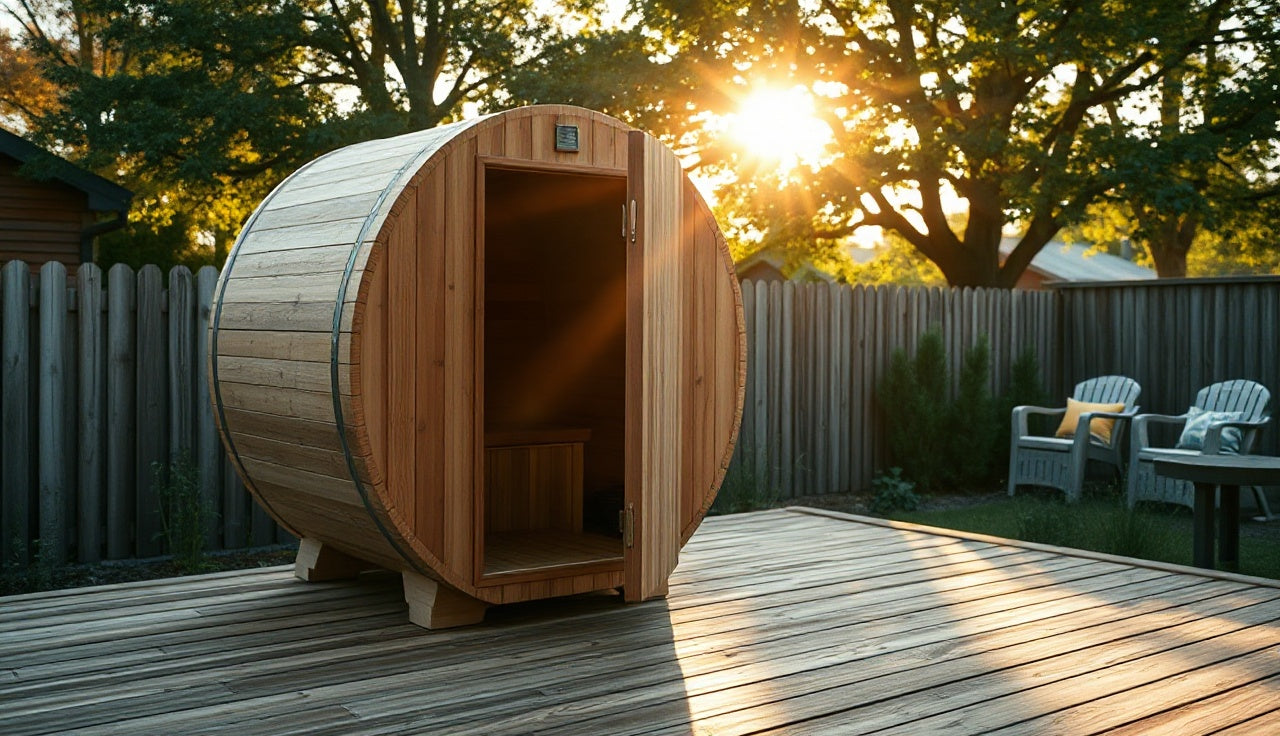
Kit saunas from Almost Heaven, Dundalk Leisurecraft, or Finnleo arrive as pre-cut tongue-and-groove cedar or hemlock with hardware, a heater, and instructions. A 4-person outdoor barrel kit runs $2,500 to $4,500 depending on wood species and heater. If you can read a manual and own basic carpentry tools, a weekend gets you operational. [6]
Building from scratch is cheaper upfront and slower. Materials for a small 4x4-foot interior sauna (kiln-dried western red cedar paneling, framing lumber, foil vapor barrier, heater, controls) run roughly $800 to $1,800 depending on location and heater. A decent entry-level electric heater from Harvia or Finnex starts around $300 to $500. [7]
Room conversion is the sleeper option. If you have a bathroom, small laundry room, or closet that's at least 4x4 feet with a ceiling at or above 7 feet, the walls already exist. Strip them to studs, insulate with foil-faced insulation, line with cedar paneling, install the heater on a dedicated circuit, add a cedar bench. Materials run $600 to $1,500 plus the heater. Hire out the labor and add $500 to $1,500.
Permitting matters. Many jurisdictions require a permit for an electrical subpanel or a new 240V circuit. The National Electrical Code (NEC) Article 424 covers fixed electric space heating, and your local authority having jurisdiction (AHJ) decides enforcement. [8] Check before you start. Unpermitted electrical work can void your homeowner's insurance and blow up a home sale later. See outdoor sauna options if you'd rather build outside.
What's the cheapest barrel or cabin sauna you can actually buy?
For a standalone wood sauna with a real bench, the floor sits around $1,500 for a no-frills two-person barrel kit with a basic electric heater. At that price you get hemlock or spruce (not cedar), a 3kW or 4.5kW heater with minimal controls, and assembly hardware. It works. It won't last as long as a $4,000 cedar barrel in a wet climate.
Almost Heaven's entry-level barrel saunas have historically listed in the $2,000 to $2,800 range. Costco has periodically carried sauna kits (Auroom and similar brands) in the $2,000 to $3,500 range, usually in seasonal batches. See how Costco sauna pricing works.
For indoor pre-built infrared cabins, you can find one-person units under $700 from Radiant Saunas or SereneLife. Quality swings hard. Check three things: EMF emission specs (low-EMF panels are worth the small premium), wood type (hemlock outlasts poplar or basswood), and warranty (two years minimum on the heater).
The practical floor for a unit you'll still want in two years is around $900 to $1,100 for a one-person indoor infrared cabin. Below that, you're gambling on build quality.
What do I need to install a home sauna cheaply?
The electrical requirement is the biggest swing in total cost. Here's what each setup typically needs:
- Sauna blanket: standard 120V, 15-amp outlet. No changes.
- Portable tent sauna (infrared panel, 1,000 to 1,500W): usually 120V, but verify the amperage. A 1,500W unit on a 15-amp circuit leaves almost no headroom. A dedicated 20-amp circuit ($150 to $300 to add) is safer.
- One-person infrared cabin (1,200 to 1,750W): often 120V, 20-amp. Many plug into standard outlets, but a dedicated circuit is better practice.
- Two-person infrared cabin (2,000 to 3,500W): typically 240V, 20-amp dedicated circuit. Expect $200 to $500 for an electrician if you don't have one nearby.
- Traditional electric heater (4,000 to 9,000W): 240V, 30 to 60 amp dedicated circuit. This is the one that forces a real electrical upgrade in most homes. Budget $400 to $1,200 for the wiring alone. [3]
Ventilation is the requirement people skip. A sauna needs a fresh air inlet (usually low, near the floor) and an exhaust or adjustable vent. Skip it and CO2 builds, and the session turns unpleasant fast. Most barrel kit instructions spell this out. For a room conversion, plan at least a 4-inch passive vent through the wall.
Floor prep for outdoor units means a level surface. A gravel pad with compacted base runs $100 to $300 in materials. A concrete pad runs $500 to $1,500 depending on size and your contractor market. A pressure-treated deck works too, but confirm the kit's weight load first. Most two-person barrels run 400 to 700 lbs assembled.
Is a cheap sauna good for your health, or do you need a higher-end model?
The health effects tied to sauna use in the research come from the heat exposure itself, not the brand of the box you sit in. The most-cited work is Finnish. A 2015 JAMA Internal Medicine paper by Laukkanen et al. followed 2,315 middle-aged Finnish men and found frequent sauna use (4 to 7 sessions per week) was associated with a 40% lower risk of all-cause mortality compared to one session per week. [9] That study used traditional Finnish saunas at around 174°F. It says nothing about whether a $300 blanket does the same thing.
The honest answer: nobody has good head-to-head data comparing cheap infrared units against high-end traditional saunas for health outcomes. What the evidence supports is that regular heat exposure raising core body temperature is associated with cardiovascular, mood, and recovery benefits. A cheap unit you use five days a week almost certainly does more for you than an expensive one you fire up twice a month.
Temperature and session length matter more than the price tag. Research-grade traditional saunas ran 80 to 100°C (176 to 212°F). Most infrared cabins run 50 to 65°C (122 to 149°F). Whether the lower temperature produces comparable physiological responses is genuinely unresolved in the literature. [5]
Stay conservative on health claims. A sauna is a tool for heat stress and relaxation. If you have cardiovascular disease, hypertension, or are pregnant, talk to your doctor before starting regular use. The Finnish Heart Association notes most healthy adults tolerate sauna well, but contraindications exist. [10] Learn about the full range of sauna benefits here.
What are the hidden costs of a cheap home sauna?
Three catch people most often.
Electricity and installation, covered above, but worth flagging again because the electrical upgrade alone can cost more than the unit in some homes.
Maintenance and wood treatment. Cedar and hemlock don't need staining, but an outdoor barrel needs its exterior wood treated with a penetrating oil (Sansin or a similar sauna-safe product) every one to two years. A quart runs $25 to $60. Skip it and the wood grays, cracks, and eventually rots at the joints. Never seal or stain the interior wood. It releases fumes when hot.
Replacement heaters and elements. Budget infrared panels use carbon fiber or ceramic rated for 5,000 to 10,000 hours. Forty-five-minute sessions five days a week come to about 195 hours a year, so on paper the elements last 25 to 50 years. In practice, budget build quality varies and real-world failure rates run higher. A replacement panel set for a low-end unit runs $80 to $200 if the company still sells parts. Electric rock heaters last longer, but the rocks need swapping every couple of years ($20 to $60 a bag). [7]
Permit and inspection fees. For a room conversion or a new 240V circuit, electrical permits in most U.S. jurisdictions run $50 to $200. Some cities want a separate building permit for a new outbuilding. Call your local building department before you start.
SweatDecks lists infrared cabin and barrel options with full specs so you can compare heater ratings and warranties side by side, which is worth doing before you buy on price alone.
How does a home sauna compare to a gym membership for the cost?
This is the math that usually closes the deal. A mid-range gym membership with sauna access runs $40 to $80 a month in most U.S. markets, so $480 to $960 a year. A $1,200 one-person infrared cabin used for four or more years drops below $1 per session inside the first 18 months at daily use, even after electricity.
The gym sauna wins on convenience of a sort: it's already there, no maintenance, and you can pair it with a workout. The home sauna wins on friction: no commute, no wait, no shared sweat, and you can step straight into a cold plunge afterward for contrast therapy. See how contrast therapy works with a cold plunge.
For anyone driving to a gym mainly for the sauna, a home unit almost always wins by year two. For someone who uses the gym sauna twice a week while already there lifting, the gym may still be the better value.
One factor people forget: the friction of the drive itself. If a sauna ten feet away means you actually use it more often, that frequency bump probably outweighs the purchase price for most of the benefits linked to regular heat exposure.
What should I look for when buying a cheap sauna to avoid junk?
Five things separate a usable cheap sauna from one you'll regret.
1. Heater wattage per cubic foot. You want roughly 1 kW per 45 to 50 cubic feet for infrared, and closer to 1 kW per 30 cubic feet for a traditional electric heater. A two-person cabin at 120 cubic feet with a 1,000W heater will never get hot enough.
2. Wood species. Western red cedar is the standard for its insulation, smell, and resistance to warping. Hemlock is cheaper and works fine. Poplar and basswood are soft, stain easily, and fade in humid conditions. Avoid anything labeled just 'pine' for interior panels.
3. EMF levels for infrared units. The International Commission on Non-Ionizing Radiation Protection (ICNIRP) publishes reference levels for electric and magnetic field exposure. [11] Reputable brands publish their EMF test results; budget units often don't. Low-EMF or ultra-low-EMF panels are worth the small upcharge when you sit 12 inches from the element for 45 minutes at a stretch.
4. Heater warranty. Two years minimum on the heating element. A company that won't back its heater for two years knows something you don't.
5. Return policy and freight terms. Most saunas ship by freight, not UPS. Inspect the crate for damage before you sign the delivery receipt. Sign without noting damage and you waive most freight claims. A retailer with a clear damage policy stated before purchase is worth a small premium.
For a wider look at what a home sauna setup involves, the home sauna guide covers installation and space planning in more detail.
Are there any tax credits or deductions for a home sauna?
Generally, no. A home sauna does not qualify for the federal energy efficiency tax credit under the Inflation Reduction Act, which covers insulation, heat pumps, windows, and specific HVAC equipment, not wellness appliances. [12]
One narrow exception. If a licensed physician prescribes sauna therapy for a diagnosed condition, the cost may qualify as a deductible medical expense under IRS Publication 502 (Medical and Dental Expenses). The IRS allows deductions for medical equipment prescribed by a doctor when its primary purpose is medical care. The agency has historically been strict about wellness equipment, and the deduction will likely draw scrutiny without solid documentation. [13] Treat this as a consult-your-tax-professional situation, not a reliable strategy.
Some states exempt medical equipment from sales tax, with state-specific rules that usually require a physician's prescription letter. None of this is a reason to buy a sauna. It's worth knowing only if you're already buying one for genuine medical use.
Frequently asked questions
What is the cheapest way to have a sauna at home?
A sauna blanket is the cheapest functional option at $100 to $350. You lie inside a heated infrared sleeve and sweat for 30 to 45 minutes. Portable tent saunas cost $180 to $500 and let you sit upright. Both are real, but neither gives you the sit-in-a-hot-wood-room experience. For that, the floor is roughly $700 for a one-person infrared cabin.
Can I build a sauna at home myself?
Yes. A DIY sauna from a pre-cut kit takes a weekend and basic carpentry skills. Kits include pre-cut wood, hardware, and a heater, and run $2,000 to $5,000 for a barrel or cabin depending on size and wood species. Building from raw materials is cheaper, around $800 to $1,800 in materials plus a heater, but takes more skill. Always permit the electrical work.
How much does it cost to run a home sauna per month?
An infrared cabin at 1,500 watts, used 45 minutes five days a week, costs roughly $3 to $5 a month at the U.S. average electricity rate (16.3 cents per kWh, early 2025). A traditional electric heater at 6,000 watts on the same schedule costs $18 to $25 a month. Electricity is rarely the reason to skip a home sauna.
Is a cheap infrared sauna as good as a traditional sauna?
They produce different experiences. Infrared runs cooler (120 to 150°F) and heats your body directly. Traditional Finnish saunas run hotter (160 to 195°F) with steam and ambient heat. Most published health research used traditional saunas. Whether infrared at lower temperatures delivers comparable benefits is not settled in the literature. For pure sweat and relaxation, both work. To match the research protocols, a traditional sauna is closer.
Do I need an electrician to install a home sauna?
Almost always, for anything larger than a blanket or small tent. A one-person infrared cabin often runs on a 120V, 20-amp dedicated circuit, which most electricians add for $150 to $300. A two-person infrared or any traditional electric heater needs a 240V circuit, running $200 to $800 depending on panel proximity and local labor. DIY electrical on a new circuit without a permit is risky and often illegal.
How long does a cheap home sauna last?
A well-built cedar or hemlock barrel with a quality heater lasts 15 to 25 years with basic maintenance. Budget infrared cabins with poplar wood and off-brand heaters realistically last 3 to 7 years before warping or heater failure. Spending $200 more upfront on better wood and a warrantied heater usually saves money over five years. Outdoor units in wet climates need annual wood treatment to reach their full lifespan.
Can a sauna blanket replace a real sauna?
For solo passive heat, a blanket gets close. You sweat, your core temperature rises, and you get most of the relaxation effect. What you miss is ambient hot air (which changes breathing and the feel of the heat), sitting upright, and any social dimension. No space and $200 to spend? A blanket is a legitimate choice. Space and $700? A cabin is better.
What size sauna do I need for one or two people?
A one-person sauna needs roughly 4x4 feet of floor and a 7-foot ceiling. Two people comfortably want at least 4x6 feet. Most portable tent saunas fit one person in a 3x3-foot footprint. For bench saunas, allow at least 6 linear feet of bench per person to lie down, or 24 inches per person to sit. Going too small makes the experience miserable fast.
Do I need a permit to install a home sauna?
For the electrical work, almost certainly yes. Any new 240V circuit or subpanel needs a permit in nearly all U.S. jurisdictions under local adoption of the National Electrical Code. For the structure itself, a freestanding outdoor unit may need a building permit depending on local zoning and square footage. Check with your local building department before starting.
Is a steam room cheaper than a sauna to install at home?
They have similar entry costs but different ongoing expenses. A steam generator for a home steam room runs $500 to $2,000 for the unit alone, plus waterproofing the enclosure (tile, proper membrane) which can add $1,000 to $3,000. Saunas are easier to build yourself because they don't need fully waterproof walls. For DIY on a budget, a sauna is generally simpler and cheaper to get right.
What's the best cheap sauna for a small apartment?
A sauna blanket or a portable tent sauna. Tents fold to about 20x20x8 inches and store under a bed or in a closet. They plug into a standard outlet, need no installation, and cost $180 to $500. If your building allows a 20-amp circuit or you have a laundry outlet nearby, a small one-person infrared cabin (roughly 33x33 inches) is feasible too, though check your lease first.
Can I use a sauna every day, and does a cheap model handle daily use?
Daily use is well within what most healthy adults tolerate, and the Finnish cohort research showing the strongest associations used 4 to 7 sessions per week. A quality heater, even in a budget unit, is rated for thousands of hours, so daily 30 to 45 minute sessions won't wear it out quickly. The likelier durability issue is wood warping and moisture damage in cheaper models, especially in humid climates.
How do I maintain a cheap outdoor barrel sauna?
Treat the exterior wood with a sauna-safe penetrating oil every one to two years to stop graying and cracking. Leave the door slightly open when not in use so the interior can dry out. Replace sauna rocks every two to three years or when they crumble. Keep the floor drain clear. Wipe the benches with a damp cloth and mild cleaner now and then. None of it is time-consuming or expensive.
Sources
- HomeAdvisor (Angi), Cost to Install a Sauna: General contractor and installation cost estimates for home sauna projects, including pad and electrical work ranges.
- Complementary Therapies in Medicine, far-infrared sauna and chronic fatigue, 2018: Far-infrared sauna sessions twice weekly for three months were associated with reduced fatigue in chronic fatigue syndrome patients.
- U.S. Energy Information Administration, Electric Power Monthly, Average Retail Price of Electricity, Q1 2025: U.S. average residential electricity rate of approximately 16.3 cents per kilowatt-hour as of Q1 2025.
- Journal of Human Kinetics, Podstawski et al. 2018, sauna-induced body mass changes and cardiovascular responses: Review noting both infrared and traditional saunas produce cardiovascular and thermoregulatory responses but head-to-head comparison studies were lacking.
- Harvia, Sauna Heater Product Range and Specifications: Entry-level electric sauna heater pricing and specifications starting around $300 to $500 for residential models.
- JAMA Internal Medicine, Laukkanen et al. 2015, Association Between Sauna Bathing and Fatal Cardiovascular and All-Cause Mortality Events: Frequent sauna use (4 to 7 sessions per week) was associated with 40% lower all-cause mortality risk compared to one session per week in a cohort of 2,315 Finnish men.
- Finnish Heart Association (Sydanliitto): Most healthy adults tolerate sauna well; contraindications exist for certain cardiovascular conditions.
- International Commission on Non-Ionizing Radiation Protection (ICNIRP): ICNIRP sets reference levels for electric and magnetic field exposure used as the basis for low-EMF sauna heater claims.
- IRS, Energy Efficient Home Improvement Credit: Home sauna equipment does not qualify for the federal energy efficiency tax credit under the Inflation Reduction Act.
- IRS Publication 502, Medical and Dental Expenses: Medical equipment prescribed by a licensed physician for a diagnosed condition may qualify as a deductible medical expense; wellness equipment is subject to scrutiny.

Share:
Icebound Essentials Weekender Grande barrel sauna: full review
Portable sauna kit: what you actually get and what to expect