
Last updated 2026-07-09
TL;DR
A portable sauna heater is a self-contained unit, usually electric, that you move between spaces or run inside a tent-style enclosure. Good ones pull 1,000 to 3,000 watts, reach 150 to 195°F, and cost $80 to $600. Heater type, wattage, and whether it needs a dedicated circuit matter far more than the brand name.
What is a portable sauna heater, exactly?
A portable sauna heater is any heating unit small and self-contained enough to move, set up in a temporary enclosure, or install in a space without permanent wiring. That covers a lot of ground: a $90 steam generator you clip to a tent zipper, a 1,500-watt infrared panel you lean against a folding frame, and a proper 3,000-watt electric rock heater you plug into a 240-volt outlet in your garage.
Marketing stretches the word "portable" hard. Some units genuinely travel in a duffel bag. Others weigh 35 pounds and need two people to carry. A more useful mental category is "non-permanently-installed," meaning no hardwired electrical, no structural changes, and no dedicated sauna room.
Three technologies dominate the portable market. Traditional electric rock heaters (also called "kiuas" in Finnish tradition) heat stones that radiate dry heat and accept water for steam bursts. Infrared heaters emit electromagnetic radiation that warms your body directly rather than heating the surrounding air. Steam generators boil water and pipe wet heat into an enclosure. Each has a different feel, a different electrical draw, and a different ceiling temperature, which is why picking one before you understand the differences usually leads to regret.
If you're still sorting out whether a portable unit is the right direction at all, the portable sauna guide covers the full enclosure-plus-heater picture.
What are the main types of portable sauna heaters?
Electric rock heaters (dry/Finnish style). These come closest to a traditional sauna. Heating elements warm a basket of volcanic or igneous rocks. The rocks radiate heat, ambient air climbs to 150 to 195°F, and you ladle water on the rocks for steam bursts ("löyly"). Most portable versions run 1,000 to 3,000 watts. Anything under 1,500 watts struggles to hold temperature in an adequately insulated enclosure.
Infrared heaters (near, mid, or far infrared). Infrared panels do not heat the air to sauna temperatures. They emit radiation your skin and tissue absorb directly. Typical air temperature in an infrared setup is 120 to 150°F, which is why infrared tent systems feel nothing like a traditional sauna. The lower air temperature is easier for some people to tolerate over longer sessions. Power draw is usually 1,000 to 1,800 watts for portable units. Far-infrared is the most common type in consumer products by a wide margin.
Steam generators. A steam generator boils water in a small tank and pipes steam into a tent or enclosed chair. Air temperature runs lower than a dry sauna, but humidity sits near 100%. These are the cheapest units and the most compact, often 1,000 to 1,500 watts. The downside: you refill the water tank (typically 2 to 4 liters), and the enclosures are usually the flimsy one-person tent-chair style. You also cannot pair a steam generator with a rock-style enclosure.
Propane and wood-burning units. These exist mostly for off-grid or outdoor barrel sauna setups. They are genuinely portable in that they need no electricity, but they require ventilation, carbon monoxide awareness, and local fire code compliance. Niche, and they carry higher safety complexity than electric options.
For most people buying a first portable setup, the choice comes down to infrared (lower temp, lower power draw, easy setup) or electric rock (authentic high-heat experience, needs more power). The sauna vs steam room breakdown explains the humidity and temperature differences in more detail if that shapes your decision.
How many watts does a portable sauna heater need?
Wattage is the most misunderstood spec in this category. A rule of thumb that holds up reasonably well: plan for roughly 1 kilowatt (1,000 watts) per 45 to 50 cubic feet of enclosed space for a traditional electric heater [1]. A one-person sauna tent at roughly 30 to 40 cubic feet gets by on 1,000 to 1,500 watts. A two-person tent or small insulated room wants 2,000 to 3,000 watts.
Infrared is different. Because the heater warms your body rather than the air, cubic footage math matters less. Panel wattage is sized to the number of people and the panel-to-body distance, not the room volume.
Here is where people get burned. They buy a 1,000-watt unit for a poorly insulated enclosure in a cold garage and wonder why it never climbs above 130°F. Insulation matters as much as wattage. A well-insulated 3-inch-thick cedar room with the same 1,500-watt heater will hit 175°F easily. A thin nylon tent in a cold basement will not.
Check your electrical circuit too. Most 120-volt household outlets sit on 15-amp or 20-amp circuits. A 1,500-watt heater draws 12.5 amps at 120 volts, right at the edge of a 15-amp circuit when nothing else is running on it. Anything over 1,800 watts at 120 volts needs a dedicated 20-amp circuit at minimum. Units pulling 2,000 watts or more often require 240 volts, which means a dedicated circuit and possibly a licensed electrician.
The U.S. National Electrical Code (NEC) Article 424 covers fixed electric space heating, and while portable units technically fall outside its hardwired scope, the same ampacity math applies to the circuit feeding the outlet [2]. When in doubt, have an electrician look at your panel before you buy.
What temperature does a portable sauna heater actually reach?
This depends almost entirely on heater type and enclosure quality.
Traditional electric rock heaters in a well-insulated enclosure: 150 to 195°F (65 to 90°C). Finnish sauna tradition tends to favor 80 to 90°C at bench level [3]. Most portable enclosures, being less insulated than a permanent room, settle at the lower end, around 150 to 170°F.
Infrared portable units: 120 to 150°F air temperature, though the radiant warmth on your skin feels more intense than the ambient thermometer suggests.
Steam tent units: 110 to 130°F, close to 100% relative humidity.
Those ranges matter for the sauna benefits you're chasing. Several studies on cardiovascular and relaxation effects from sauna use ran at 80 to 90°C, the traditional Finnish range [4]. Infrared studies use different protocols. Mixing up the literature is easy, so check what temperature and humidity a study actually used before drawing conclusions about what your portable unit will do for you.
Nobody has a clean portable-specific dataset here. The closest evidence base comes from studies on traditional saunas run in controlled settings with professional-grade heaters, not consumer tent products.
| Steam generator (tent) | 125 |
| Far-infrared panels | 140 |
| Electric rock heater (1,500W) | 162 |
| Electric rock heater (3,000W) | 185 |
Source: Finnish Sauna Society guidelines and product category benchmarks, 2023
How much does a portable sauna heater cost?
The market breaks into three clear tiers.
| Tier | Price range | What you get |
|---|---|---|
| Budget steam generators | $80 to $150 | 1,000 to 1,500W, plastic build, small water tank, tent-chair enclosure often included |
| Mid-range infrared panels | $150 to $350 | Far-infrared panels, folding frame, 1,200 to 1,800W, better fabric enclosures |
| Electric rock heaters (portable) | $250 to $600 | 1,500 to 3,000W, stainless or steel body, actual sauna stones included, some require 240V |
| Professional/outdoor portable | $400 to $1,000+ | Heavy-duty construction, wood-fired options, designed for barrel or outdoor tent use |
Heater-only prices (without any enclosure) run lower. A decent 1,500-watt portable rock heater without a tent starts around $150 to $250. If you already have an enclosure or a small insulated room, buying just the heater makes sense.
Running cost matters too. At the U.S. average residential electricity rate of roughly 16 cents per kilowatt-hour [5], a 1,500-watt heater running one hour costs about 24 cents. A 3,000-watt unit for 90 minutes runs about 72 cents. These aren't meaningful ongoing costs for most people, but they add up if you sauna daily.
For comparison, a permanent home sauna installation starts around $3,000 to $10,000 including the heater and room, which frames what you're trading off with a $300 portable setup.
Is a portable sauna heater safe to use at home?
Generally yes, with conditions.
Electrical safety is the main concern. Run the heater only on a circuit rated for its amperage. Never use an extension cord with any sauna heater. The resistance and heat in a typical cord create a fire risk at these wattage levels. Keep the unit on a non-combustible surface, hold the clearance distances the manual specifies (usually 6 to 12 inches from fabric walls and ceiling), and never leave it running unattended.
Steam generators and electric heaters should carry a UL listing or another recognized testing laboratory certification (ETL, CE). Those marks mean the unit passed electrical safety testing to a published standard [9]. Products without any safety listing are a real risk, and they're not uncommon in cheap imports.
For propane or wood-fired portable heaters, carbon monoxide is a genuine hazard. The Consumer Product Safety Commission has documented deaths from CO poisoning in enclosed spaces with inadequate ventilation [6]. If you use any combustion-based heater, you need a working CO detector in the space and real fresh-air ventilation, more than a cracked window.
Health safety is a separate question. Saunas are contraindicated for some cardiovascular conditions and should not be used during pregnancy without medical clearance. The American College of Obstetricians and Gynecologists advises pregnant women to avoid raising core body temperature above 102.2°F (39°C) [7]. High-heat sessions aren't appropriate for children or anyone with uncontrolled hypertension. This is not a full medical list. Talk to a physician if you have any doubt.
The sauna industry's own guidance, including from the Finnish Sauna Society, says never lock the sauna door from the inside, keep water within reach for hydration, and limit sessions to 10 to 20 minutes at high temperatures [3].
What should I look for when buying a portable sauna heater?
Start with wattage relative to your intended enclosure, then work through the checklist below.
Safety certification. UL, ETL, or CE listing is non-negotiable for electric units. No listing mark, no buy.
Thermostat and timer. A built-in thermostat prevents overheating and holds a target temperature. A timer sets a session limit, which is a real safety feature and more than a convenience. Cheap units sometimes skip one or both.
Control type. Analog dials are reliable and repairable. Digital controls give you precision but add failure points in a high-heat, high-humidity environment. Either works. Know your preference.
Rock capacity (for electric rock heaters). More rocks mean better heat retention and smoother temperature recovery after you pour water. A heater with 5 to 10 pounds of rocks behaves very differently from one with 20 pounds.
Enclosure compatibility. Buying a heater for an existing tent or room? Check that the enclosure can handle the heat output. Nylon tent fabrics have rated temperature limits, and some cheap enclosures aren't rated for the upper temperature a 2,000-watt heater produces.
Cord length and plug type. Know your outlet type (standard 120V/15A, 120V/20A, or 240V) before ordering. A 240V heater cannot run in a standard household outlet without rewiring.
Weight and portability. If you really want to move the unit often, weight matters. A 35-pound heater with no handle isn't meaningfully portable. Look for carrying handles or a case if true portability is the goal.
SweatDecks carries a curated selection of sauna heaters and accessories if you want to compare specific models side-by-side with specs already vetted.
Can you use a portable sauna heater in a tent or outdoor enclosure?
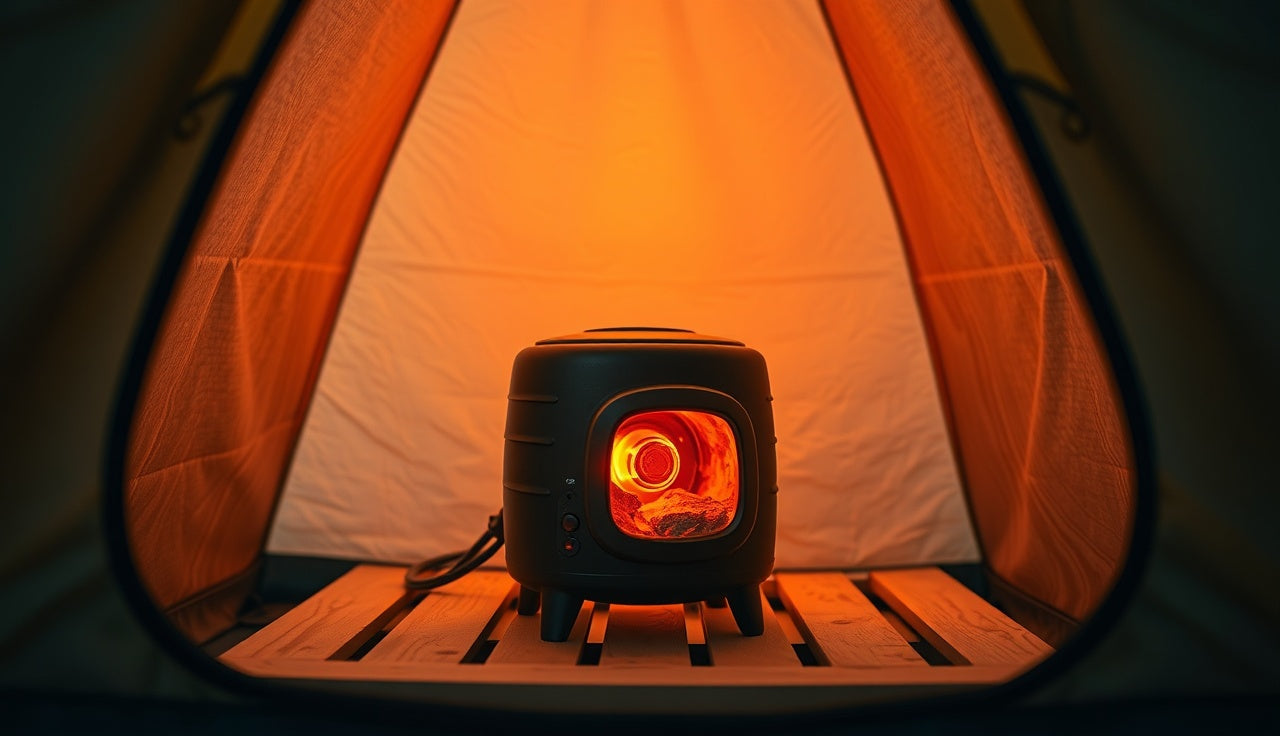
Yes, and it's one of the most popular use cases. Portable tent saunas, the kind with a folding frame and a fabric or mylar enclosure, are built specifically to pair with a portable heater. The heater sits on a heat-safe mat inside or partially inside the tent.
For infrared panels, the tent enclosure ships as part of the kit in most products. The panels fold into the frame, you sit inside, and the tent keeps the radiant heat from dispersing.
For steam generators, the steam hose feeds through a small opening, and the generator itself sits outside the tent. You sit inside in a tent-chair design.
For electric rock heaters used in fabric enclosures, watch the clearance distances closely. Fabric can ignite or melt if it gets too close to a heater running at 175°F and up. Most manufacturers specify minimum distances. Follow them exactly.
Outdoor use adds weather considerations. Portable tent saunas generally aren't designed for rain or snow. The fabric isn't waterproof in a structural sense, and getting moisture inside an enclosure with an electric heater is dangerous. Use these setups in sheltered spots or bring them inside.
If you want something built for permanent outdoor placement, the outdoor sauna guide is a better starting point than a portable heater setup.
How does a portable sauna heater compare to a permanent home sauna heater?
This is a real trade-off, not a case where one option is obviously better.
A permanent home sauna heater, typically hardwired at 240 volts with 4,500 to 9,000 watts for a 2-to-4-person room, beats any portable unit on heat output, temperature stability, and longevity. A quality commercial-grade kiuas can last 20 to 30 years with basic maintenance. Portable units, especially those with thin stone baskets or plastic parts, typically last 2 to 8 years depending on how often you run them.
The permanent setup demands installation: an electrician for the 240V circuit, possibly a permit, and either a prefabricated sauna room or custom-built walls. Total cost for a small permanent home sauna starts around $3,000 and climbs fast.
The portable setup demands none of that. You can own a working sauna heater and enclosure for $200 to $400, set it up in 20 minutes, and store it in a closet. For renters, people without a dedicated room, or anyone who wants to trial sauna before committing, portable is the rational choice.
Temperature ceiling is the real compromise. A portable tent sauna at 150 to 165°F with a 1,500-watt heater is a legitimate sauna experience. It isn't the same as sitting in a properly insulated 6-by-6 cedar room at 185°F, but it's far from nothing.
Home sauna installations are covered in detail if you want the full comparison before deciding.
How long does it take a portable sauna heater to warm up?
Preheat time depends on wattage, enclosure insulation, and ambient temperature.
Steam generators: 10 to 20 minutes to build steam and get the enclosure humid and warm.
Infrared panels: 5 to 15 minutes. They heat fast because they don't need to warm the air first. Many people start their session immediately and let the panels warm up around them.
Electric rock heaters in portable enclosures: 20 to 45 minutes to reach target temperature, sometimes longer in cold conditions. The rocks need to absorb heat before they radiate effectively. A 1,500-watt unit takes longer than a 3,000-watt unit in the same enclosure.
In a cold garage in winter, add 10 to 20 minutes to any of these estimates. Insulation shortens preheat dramatically. If your portable heater takes more than an hour to reach temperature, the enclosure's insulation or the ambient cold is the bottleneck, not the heater itself.
There's no safety reason to rush preheat. Running a heater at full power through the warm-up period is normal and expected. These units are rated for continuous operation during warm-up.
Can you use a portable sauna heater for contrast therapy with cold plunging?
Absolutely, and it's a compelling use case. Heat-cold contrast therapy, alternating sauna sessions with cold immersion, is one of the more popular recovery protocols among athletes and wellness-focused people right now.
The protocol most commonly used in research alternates 10 to 20 minutes of heat with 2 to 5 minutes of cold exposure, repeated 2 to 4 cycles [8]. A portable sauna heater gives you a viable heat source without dedicating a room. Pair it with a cold plunge or ice bath and you have a full contrast setup in a garage or backyard for under $1,000.
The practical wrinkle is recovery time between cycles. A portable heater in a tent may take 5 to 10 minutes to climb back to full temperature after the door opens and heat escapes. That's not necessarily a problem. It just changes your session pacing. A higher-wattage unit recovers faster.
If you want to understand what the research actually says about contrast therapy effects, the cold plunge benefits guide covers the mechanism and the honest state of the evidence.
What maintenance does a portable sauna heater need?
Much less than you might expect, but a few things matter.
Rocks (for electric rock heaters). Sauna stones degrade over time from repeated heating and water exposure. Inspect them every 6 to 12 months. Cracked or crumbling stones can break apart and damage the heating elements. Replace the full set every 2 to 5 years depending on use frequency. Use only stones rated for sauna (peridotite, olivine, or similar dense volcanic rock). Standard landscaping stones can crack explosively.
Heating elements. The elements themselves are low maintenance. Keep them free of debris and mineral deposits. Pour water with high mineral content and scale builds up on rocks and elements over time. Distilled water reduces this.
Steam generator tanks. These need regular descaling, like a kettle. Mineral deposits cut heating efficiency and can damage the heating element. A diluted white vinegar flush every 2 to 3 months (or per the manufacturer schedule) handles it. Always rinse thoroughly before use.
Enclosures and frames. Fabric enclosures collect mold and mildew in humid environments. After each use, let the enclosure air out completely before folding and storing. Wipe down any moisture. Storing a wet tent is the fastest way to ruin it.
Electrical connections. Inspect the power cord and plug before each use for damage, discoloration, or heat marks. See any and you don't use the unit until a qualified electrician checks it.
These steps stretch the life of a portable unit a lot. A well-maintained $300 portable heater can easily run 5 to 7 years of regular use.
Frequently asked questions
Can I use a portable sauna heater in my apartment?
Yes, with caveats. Steam generators and infrared units on 120V standard outlets are the most apartment-friendly options. Electric rock heaters may need a dedicated circuit your apartment lacks. Check your lease for restrictions on heat-producing appliances. Keep the unit on a fire-safe surface, never use an extension cord, and make sure the space has some airflow. Some buildings prohibit space heaters above a certain wattage.
What is the difference between infrared and traditional portable sauna heaters?
A traditional electric rock heater warms the air in an enclosure to 150 to 195°F. An infrared heater emits radiation your skin and tissue absorb directly, with ambient air temperature typically 120 to 150°F. Traditional sauna feels hotter, and you can add steam by pouring water on rocks. Infrared feels less intense but still produces heavy sweating. Neither is objectively better. The experience is genuinely different.
Do I need a special electrical outlet for a portable sauna heater?
It depends on wattage. Units under 1,500 watts typically run on a standard 120V/15-amp outlet. Units 1,500 to 1,800 watts prefer a dedicated 120V/20-amp circuit. Anything above 1,800 to 2,000 watts usually requires 240 volts, which needs dedicated wiring and potentially an electrician. Check the heater's amperage draw, more than its wattage, and compare it to your circuit's rated capacity before buying.
How hot can a portable sauna heater get inside a tent?
In a well-insulated portable tent enclosure, a quality 1,500 to 2,000 watt electric rock heater can reach 150 to 175°F (65 to 80°C). Steam generators peak around 120 to 130°F. Infrared tent setups typically read 120 to 150°F on a thermometer, though felt warmth runs higher due to radiant heat. Cold ambient conditions and poor tent insulation cut these figures substantially.
Are cheap portable sauna heaters safe?
Only if they carry a recognized safety certification: UL, ETL, or CE at minimum. Many inexpensive import units on marketplace sites carry no listing mark and haven't been tested to any electrical safety standard. Those are a fire and shock risk. Price alone doesn't determine safety, but any electric heater without a certification mark should be avoided regardless of cost.
Can I use a portable sauna heater with any sauna enclosure?
Not always. Match the heater type to the enclosure. Electric rock heaters need enclosures rated for 170 to 200°F. Steam generators pair with low-temperature tent-chair enclosures. Infrared panels usually ship as part of a specific enclosure system because panel placement and distance matter. Using an undersized or wrong-type enclosure with a high-output heater is both a safety risk and a performance problem.
How often should I replace the stones in a portable electric sauna heater?
Every 2 to 5 years depending on use frequency, or sooner if you notice cracking, crumbling, or visible deterioration. Degraded stones cut heat output and can damage heating elements if they break apart. Always use stones rated for sauna, typically dense peridotite or olivine rock. Standard gravel or landscaping stones are not safe substitutes and can crack violently when heated and hit with cold water.
Can a portable sauna heater be used outdoors in winter?
It can, but it will struggle. Cold ambient temperatures increase preheat time and drop maximum temperature in a portable enclosure. Most fabric tent enclosures aren't weatherproof, so snow or rain exposure is a problem. To use a portable heater outdoors in cold weather, you need a sheltered location, ideally with wind protection. A higher-wattage unit handles cold conditions better than a low-wattage one.
Is a portable sauna heater worth it compared to a gym sauna membership?
For frequent users, yes. A $250 to $400 portable setup pays for itself quickly against $30 to $60 per month gym sauna access. Home use also saves the commute, the shared space, and scheduling around gym hours. The trade-off is lower peak temperature and a less refined experience than a well-built gym sauna. If you use a sauna 3 or more times a week, ownership usually wins economically within a year.
What size portable sauna heater do I need for a one-person tent?
For a typical one-person sauna tent at 30 to 50 cubic feet, a 1,000 to 1,500 watt electric heater is the baseline. For infrared, 800 to 1,200 watts of panel output usually covers one person. Going higher in wattage than needed isn't dangerous if the unit has a thermostat, but it wastes power. Going lower in a poorly insulated enclosure means you may never reach a satisfying temperature.
Can I use a portable sauna heater if I have high blood pressure?
Speak to your doctor first. Sauna use causes a temporary drop in blood pressure followed by a rebound, and the cardiovascular response to high heat is significant. The European Journal of Preventive Cardiology has published research on sauna and cardiovascular effects [4], but those studies used controlled settings with healthy or well-monitored subjects. Uncontrolled hypertension is commonly listed as a contraindication for high-heat sauna use. This isn't medical advice. Get clearance from your physician.
How do I set up a portable sauna heater for the first time?
Read the manual for required clearances from walls and fabric. Place the heater on a non-combustible mat. Plug directly into a wall outlet rated for the heater's amperage draw, no extension cords. For electric rock heaters, run the unit empty for 30 to 45 minutes before first use to burn off manufacturing residue. Set the thermostat to your target temperature and wait for preheat. Don't enter the enclosure until target temp is reached.
Can I build a DIY sauna room and use a portable heater in it?
Yes, and it's a popular approach. A small insulated room or garden shed with cedar or spruce lining, a properly sized portable electric rock heater, and a direct-to-wall electrical connection can perform very well. Insulation quality determines how close to a real sauna experience you get. Follow NEC guidelines for the electrical setup, use a heater with a thermostat and safety shutoff, and keep a thermometer and timer accessible from inside.
Sources
- Finnish Sauna Society, Sauna Construction Guidelines: Guideline for heater sizing of approximately 1 kW per 1 cubic meter of sauna room volume, which approximates to 1 kW per 45-50 cubic feet
- National Fire Protection Association, NFPA 70 National Electrical Code Article 424: NEC Article 424 covers fixed electric space heating ampacity calculations; same ampacity math applies to the supplying circuit for portable high-wattage heaters
- Finnish Sauna Society, Sauna Health and Safety Guidelines: Traditional Finnish sauna temperatures at bench level are typically 80 to 90°C; guidance includes not locking the door from inside and limiting sessions to 10-20 minutes
- European Journal of Preventive Cardiology, Laukkanen et al. 2018, Sauna bathing and systemic inflammation: Research on cardiovascular and physiological effects of sauna use conducted at 80 to 90°C in controlled settings with traditional sauna protocol
- U.S. Energy Information Administration, Electric Power Monthly, Average Retail Price of Electricity: U.S. average residential electricity rate approximately 16 cents per kilowatt-hour as of recent reported period
- U.S. Consumer Product Safety Commission, Carbon Monoxide Poisoning Hazards: CPSC documentation of deaths from CO poisoning in enclosed spaces with inadequate ventilation including sauna and spa environments with combustion heat sources
- American College of Obstetricians and Gynecologists, Exercise During Pregnancy FAQ: ACOG advises pregnant women to avoid raising core body temperature above 102.2°F (39°C), making high-heat sauna use inadvisable during pregnancy without medical clearance
- Journal of Science and Medicine in Sport, Versey et al. 2013, Water Immersion Recovery for Athletes: Common contrast therapy protocols in research alternate 10-20 minutes of heat with 2-5 minutes of cold exposure for 2 to 4 cycles
- Underwriters Laboratories, UL Standard 499 and Related Heater Safety Standards: UL listing marks indicate a product has been tested to established electrical safety standards including overheating, fire, and shock risk
- U.S. Energy Information Administration, Residential Energy Consumption Survey: Residential electricity consumption and cost data supporting running cost calculations for high-wattage appliances

Share:
Name brand portable saunas: which ones are actually worth buying
4-person barrel sauna: what to know before you buy