
Last updated 2026-07-11
TL;DR
Polyethylene cold plunge tubs degrade when ultraviolet radiation breaks polymer chains, causing brittleness, surface chalking, and eventual cracking. Unstabilized HDPE can lose more than 50% of its tensile strength within 1,000 hours of direct sun exposure. UV stabilizers, protective covers, and shaded placement are the practical defenses. Tubs marketed as UV-stabilized or UV-resistant have added inhibitors that extend outdoor life to several years.
What is UV degradation, and why does it matter for polyethylene?
Polyethylene is a hydrocarbon polymer. That sounds technical, but the practical point is simple: its carbon-hydrogen backbone absorbs ultraviolet radiation, and that absorbed energy breaks chemical bonds. The process is called photo-oxidative degradation, and it starts the moment a polyethylene surface sits under sunlight with no protective additives. [1]
For a cold plunge tub, this is not an abstract problem. Most residential cold plunge setups live outside, on a deck or patio, exposed to the sun for hours every day. The UV index peaks between 10 a.m. and 4 p.m. and varies significantly by latitude, altitude, and season, but even in northern states the cumulative annual UV dose is enough to meaningfully degrade unprotected polyethylene within one to three years. [2]
The degradation shows up in a predictable sequence. First, the surface turns chalky or fades in color. Then the material becomes brittle. Then it cracks, usually starting at stress points like corners, drain fittings, or the rim where you grip the tub. A cold plunge tub that is cracking under your hands or leaking at the base because the plastic has gone brittle is not a minor aesthetic issue. It is a safety and cost problem.
This is why the material formulation inside a polyethylene tub matters more than most buyers realize. Two tubs can look identical on a spec sheet, both labeled "polyethylene," but one might carry UV stabilizer packages worth fractions of a cent per gram that double or triple its outdoor service life.
How does UV light actually break down polyethylene at the molecular level?
The degradation mechanism has three stages, and understanding them helps you predict what to look for before buying or replacing a tub.
First, initiation. UV photons in the 300-400 nm wavelength range carry enough energy to cleave weak points in the polyethylene chain, particularly at carbonyl groups or hydroperoxide impurities left over from manufacturing. Oxygen in the air then reacts with the resulting free radicals. This photo-oxidation reaction is self-propagating: one free radical generates more. [1]
Second, propagation. Chain scission (breaking of the polymer backbone) and cross-linking (formation of new bonds between chains) happen simultaneously and compete. In thin or lightly processed polyethylene, chain scission dominates. The average molecular weight drops, and the material loses tensile strength and elongation at break. The surface feels chalky because those low-molecular-weight fragments migrate to the surface and flake off. [3]
Third, termination. Antioxidants and UV stabilizers work precisely at this stage. Hindered amine light stabilizers (HALS) scavenge the free radicals that drive propagation. UV absorbers like carbon black or benzophenone-based compounds absorb photons before the polymer backbone does, converting that energy to heat instead. [1]
The practical implication: a tub made with 2-4% carbon black (the standard approach for outdoor agricultural and industrial polyethylene tanks) performs dramatically better outdoors than a white or translucent tub with no UV package. Carbon black is cheap and effective. If a manufacturer won't tell you whether the resin contains a UV stabilizer package, assume it does not.
How fast does an unprotected polyethylene cold plunge tub degrade outdoors?
The honest answer is that the timeline varies a lot depending on geographic UV dose, whether the tub holds water (which affects thermal cycling), wall thickness, and resin grade. But we have real data from accelerated weathering studies and field observations on polyethylene tanks.
Accelerated weathering tests using a xenon-arc chamber (which simulates solar UV) found that unstabilized high-density polyethylene (HDPE) lost more than 50% of its elongation at break after roughly 1,000 hours of UV exposure. [3] One thousand hours of xenon-arc exposure corresponds to somewhere between one and three years of real outdoor exposure in temperate climates, depending on the correlation factor used. That correlation is genuinely uncertain, and manufacturers and test labs acknowledge the variability.
Here is the field version. Leave an unstabilized polyethylene tub in full Arizona or Texas sun and you can expect visible surface chalking within six to twelve months and brittle cracking within two to three years. In Seattle or Minneapolis, the same tub might last twice as long before catastrophic cracking, though it will still chalk noticeably.
A UV-stabilized tub with a proper HALS and UV absorber package can extend that service life to ten years or more under the same conditions. Some manufacturers of outdoor polyethylene water tanks (agriculture, aquaculture) routinely quote twenty-year service lives for properly stabilized products. [4] Cold plunge tubs are thinner-walled and see more thermal cycling than a stock tank, so I would discount those claims somewhat for the cold plunge application, but the direction of the effect is clear.
The difference between a stabilized and unstabilized tub is not marginal. It can be the difference between a two-year product and a ten-year product, often at nearly identical upfront cost.
| Unstabilized HDPE (white/natural) | 2 |
| TiO2 pigment only (white, no HALS) | 3 |
| HALS-stabilized HDPE (light color) | 8 |
| Carbon black HDPE (2-3% loading) | 15 |
| XLPE with HALS package | 12 |
Source: Plastics Pipe Institute; Polymer Degradation and Stability (Shah et al.); Polymer Testing journal
What types of polyethylene are used in cold plunge tubs, and which holds up best?
Cold plunge tubs use a few different polyethylene variants. Knowing which one you are buying matters.
HDPE (high-density polyethylene) is the most common for rotationally molded or blow-molded tubs. It is stiff, chemical-resistant, and takes UV stabilizer packages well. Industrial outdoor tanks almost universally use HDPE with carbon black or HALS additives. For cold plunge tubs, HDPE with a proper UV package is the baseline you want.
LLDPE (linear low-density polyethylene) appears in some softer, inflatable-adjacent or flexible tub designs. It is tougher at low temperatures, which matters for a tub sitting outside in winter, but it can be more susceptible to UV degradation if the resin is not stabilized, partly because its lower crystallinity means more amorphous regions available for oxygen diffusion. [3]
HMWHDPE (high molecular weight HDPE) is used in premium tanks. Higher molecular weight means more chain entanglement and better impact resistance, so the tub starts at a higher baseline before UV degradation chips away at properties.
Cross-linked polyethylene (XLPE or PEX) appears in some higher-end tubs. Cross-linking improves chemical resistance and high-temperature performance, and it makes chain scission less catastrophic since the cross-links hold fragments together. UV degradation still occurs, but the structural consequences take longer to become serious. [1]
Here is a quick comparison of the relevant grades:
| Grade | Typical wall stiffness | UV resistance (unstabilized) | UV resistance (stabilized) | Cold temp. toughness |
|---|---|---|---|---|
| HDPE | High | Poor | Good-Excellent | Moderate |
| LLDPE | Moderate | Poor | Good | Good |
| HMWHDPE | High | Poor | Excellent | Moderate |
| XLPE | High | Fair | Excellent | Good |
If a manufacturer lists only "polyethylene" without specifying grade or stabilization, ask. If they cannot answer, that tells you something.
What warning signs tell you UV degradation has already started?
You do not need a lab to spot early degradation. The physical symptoms follow a predictable order.
Chalking is the first visible sign. Run your hand across the outside of the tub. If white or gray powder comes off on your palm, surface chain scission has begun. The low-molecular-weight oxidation products are literally rubbing off. This is cosmetic at first but signals that the structural degradation clock has started.
Color fading happens alongside chalking. A tub that was a deep black or dark green outdoors and is now noticeably lighter in a blotchy pattern has been absorbing UV without adequate inhibition.
Surface microcracking looks like a fine network of shallow cracks, sometimes called "crazing." Under bright light you can see it without magnification. This is a mid-stage sign. The material is still structurally sound but is losing flexibility fast.
Brittle fracture at stress points is the late-stage failure mode. Corners crack. Holes around drain fittings develop spiderweb cracks. The rim chips when you press on it. At this stage the tub is a liability. Brittle HDPE fragments can be sharp, and a tub that cracks under load while filled with water is a practical hazard.
Discoloration of the water, a slightly chemical smell after filling, or a chalky residue inside the tub can indicate that degraded polymer fragments are leaching into the water. This is relatively uncommon in mild UV degradation, but health-conscious users should watch for it. The practical answer is that if your tub smells like degrading plastic or your water turns milky after sitting, the tub needs replacement regardless of structural condition.
Does UV degradation affect cold plunge water quality or safety?
This is a reasonable concern and the honest answer is: it depends on the degree of degradation.
Intact polyethylene, even without UV stabilizers, is generally considered food-safe and chemically inert. The FDA and NSF both have standards that many polyethylene tanks are manufactured to, which means the virgin material does not leach meaningful contaminants into water under normal conditions. [5]
When polyethylene undergoes significant photo-oxidative degradation, however, shorter-chain oxidized fragments form. Some of these fragments can migrate into water, particularly warm water. For a cold plunge specifically, the water is cold (typically 45-60°F), which slows leaching considerably compared to a hot-water storage application. So the risk is lower than it would be in a hot tub or hot water tank.
That said, a heavily degraded tub with visible surface crumbling and chalking is not a product I would want my face and skin in contact with for extended periods. The precautionary approach is to replace a tub showing moderate-to-severe UV degradation rather than trying to extend its life indefinitely.
There is no strong published evidence of acute harm from bathing in a cold plunge tub with mild UV-degraded surfaces, but there is also no long-term safety data specifically on this application. Nobody has good controlled data on this; the closest relevant research is on polyethylene drinking water tanks, which show minimal leaching at ambient temperatures in early degradation stages. [5]
How can you slow UV degradation in a polyethylene cold plunge tub?
You have four real levers. Some cost nothing. Some cost a little.
First, placement. This is the highest-ROI intervention. Placing your tub under a pergola, porch overhang, or shade sail reduces direct UV dose dramatically. A structure that provides 50-70% shade (common for shade sails) can more than double outdoor material life for marginally stabilized polyethylene. You do not need full shade to get meaningful benefit. Even getting the tub out of peak afternoon sun (which carries the highest UV index hours of the day) helps significantly.
Second, a cover. A fitted UV-blocking cover does two things at once: it blocks UV from the tub surfaces when not in use, and it keeps the water cold longer, reducing your chiller's work. Most cold plunge tubs worth owning ship with a cover. If yours did not, a purpose-cut piece of UV-stabilized polyethylene sheeting or a good outdoor equipment cover will work. This is a cheap fix.
Third, UV protectant sprays or coatings. Products designed for plastic outdoor equipment (like 303 Aerospace Protectant, which contains UV absorbers) can be applied to the exterior surfaces of a polyethylene tub. They are not a substitute for built-in stabilizers, but they provide a meaningful supplemental layer. Reapply every three to six months if the tub is in full sun. This approach is more common in boat and RV maintenance but works on polyethylene cold plunge surfaces.
Fourth, choose a tub with documented UV stabilization at purchase. Once the tub is manufactured, you cannot add HALS or carbon black to the bulk resin. You can protect the surface, but you cannot fix the formulation. If you are in the research phase, ask manufacturers specifically: "Does the polyethylene resin include a UV stabilizer package, and if so, what type?" A manufacturer who answers that clearly is giving you a signal about their product quality generally.
If you are still shopping for a cold plunge, the UV stabilization question should be on your list alongside chiller capacity and wall thickness.
How do manufacturers test and certify UV resistance in polyethylene tubs?
The main standards are from ASTM International and ISO. Real UV resistance claims should reference one of these.
ASTM G154 covers fluorescent UV lamp exposure testing. Samples are cycled through UV and condensation phases to simulate outdoor weathering. It is widely used for plastics and coatings. [6]
ASTM G155 covers xenon-arc lamp testing, which better simulates the full solar spectrum including the visible range. Many polymer manufacturers prefer xenon-arc for polyethylene because it more accurately represents real sunlight. [6]
ISO 4892-3 is the international parallel to ASTM G154 for fluorescent UV testing. Some European and Asian manufacturers certify to this standard.
None of these standards automatically tell you how long a tub will last outdoors, because converting accelerated test hours to real-world years requires correlation factors that are application-specific and contested in the literature. When a manufacturer says "tested to 2,000 hours ASTM G154," what that actually means for outdoor life in your backyard depends on your latitude, the tilt angle of the tub surface, local cloud cover, and whether the tub is in shade part of the day.
What you should actually ask: "What is the test result, and what real-world life does the manufacturer warrant based on it?" A warranty that explicitly covers UV degradation (more than manufacturing defects) is more useful than a test number alone. Most tub warranties explicitly exclude UV damage from outdoor exposure, which is itself a red flag.
NSF/ANSI 61 is relevant if water contact safety matters to you. It covers drinking water system components and sets leaching limits. Fewer cold plunge manufacturers certify to this, but it is the most meaningful safety certification for a water-contact polyethylene product. [5]
Does a darker colored polyethylene cold plunge tub resist UV better?
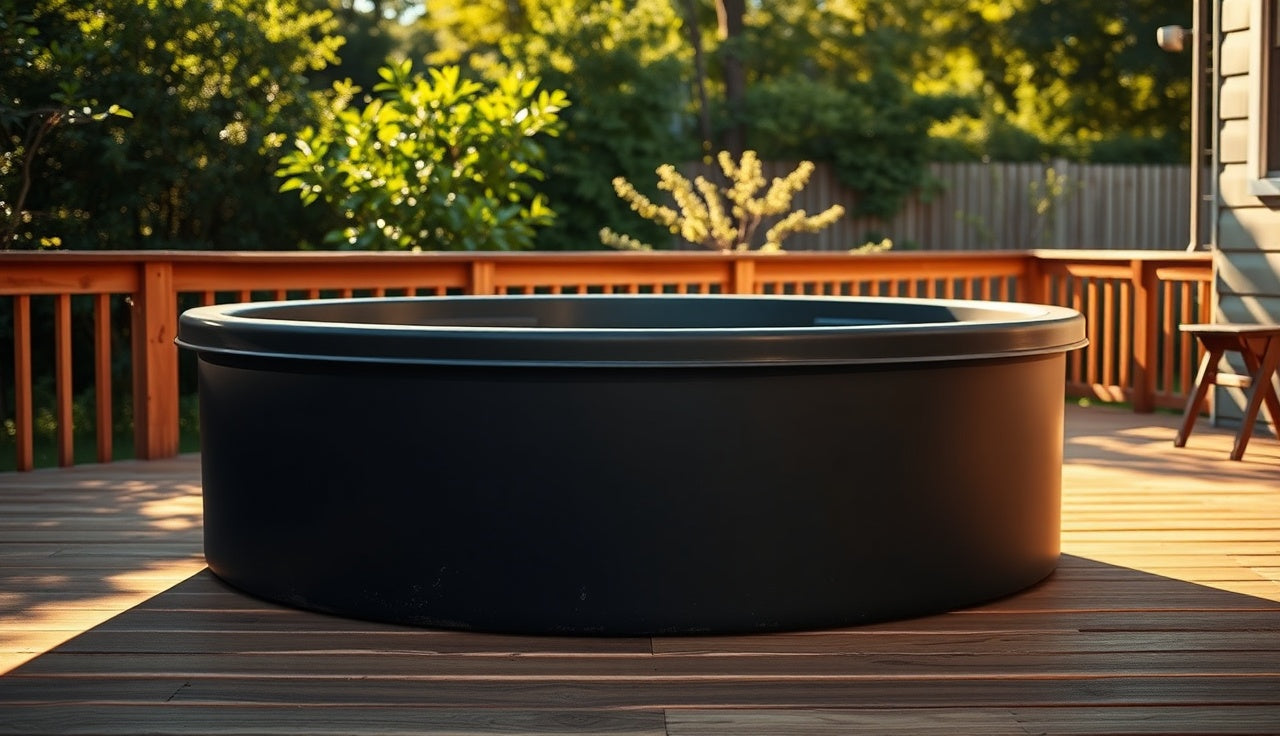
Yes, meaningfully so. Carbon black is the most effective and economical UV stabilizer for polyethylene, and it makes the material black. That is not a coincidence.
Carbon black at 2-3% loading absorbs UV photons across the entire relevant spectrum and converts the energy to heat rather than allowing it to drive photo-oxidation. Studies on polyethylene agricultural pipe and tank material consistently show that black carbon-loaded products significantly outlast white or natural polyethylene outdoors, often by a factor of five to ten under identical conditions. [4]
The catch is purely aesthetic. Many buyers, understandably, want a white, gray, or colored cold plunge tub that looks good on their deck. Manufacturers accommodate this by using HALS (hindered amine light stabilizers) or UV absorber packages that provide meaningful protection in light-colored formulations, though generally not as much as carbon black provides. High-quality white or gray outdoor polyethylene tanks do exist and perform well; the key is that the resin must contain a proper non-black UV package, more than pigment.
Pigment alone (a white tub with titanium dioxide colorant) provides some UV reflection but is not a substitute for a UV stabilizer package. Titanium dioxide does reflect UV in the near-UV range, which helps, but a white tub with only TiO2 pigment and no HALS or UV absorbers will still degrade faster than a carbon-black tub. [1]
If you are choosing between two similarly priced tubs and UV durability is your main outdoor concern, the black one probably wins on longevity. Everything else being equal.
What is the expected lifespan of a polyethylene cold plunge tub kept outdoors?
Honest answer: it varies from two years to fifteen-plus years depending on factors you can partly control.
At the low end: an unstabilized white or translucent polyethylene tub placed in full sun in a high-UV climate (USDA hardiness zones 9-13, or high-altitude locations) will show structural brittleness within two to three years and may crack within four to five. This is not hypothetical. Agricultural poly tanks without UV packages are routinely replaced on this schedule.
At the high end: a properly UV-stabilized rotomolded HDPE tub (with documented HALS and/or carbon black) kept under shade or with a cover when not in use can realistically last ten to fifteen years without structural failure from UV degradation. Industrial polyethylene tanks in outdoor water treatment applications routinely achieve twenty-year service lives. [4]
The middle ground, where most consumer cold plunge tubs sold today probably land, is somewhere between five and ten years for a partially stabilized, UV-labeled tub used outdoors in a moderate climate with reasonable care (meaning a cover used consistently and the tub not baking in direct all-day sun).
Thermal cycling compounds the UV degradation for cold plunge tubs specifically. A tub that goes from 45°F water to 90°F air temperature repeatedly over a summer season is also experiencing mechanical fatigue that accelerates the cracking that UV degradation starts. This is somewhat unique to cold plunge applications versus static outdoor storage tanks.
For people weighing the full picture of cold plunge ownership, including chiller costs, water chemistry, and tub longevity, the cold plunge benefits and ice bath articles on this site cover the broader context well.
Can you repair a polyethylene cold plunge tub damaged by UV degradation?
Partially. The practical ceiling on repair is lower than most people want to hear.
Surface chalking can be cleaned and then treated with a UV protectant to slow further degradation. This is genuinely useful at the early stage. It does not reverse the chain scission that already happened, but it slows the rate going forward.
Small cracks at fittings or non-structural surfaces can sometimes be repaired with polyethylene-compatible plastic welding. Hot-air plastic welding with a HDPE welding rod is the correct approach; epoxy and cyanoacrylate adhesives do not bond reliably to polyethylene because of its low surface energy. [7] A decent plastic welder can produce repairs that last two to three years in non-submerged sections. For water-contact surfaces, the weld must be airtight and tested before returning the tub to service.
Structural brittleness across broad surface areas is not repairable. If the tub flexes stiffly or snaps at multiple points, the polymer matrix has degraded too far. No surface treatment or weld patch can restore the bulk mechanical properties that UV degradation has removed. This is a replace, not repair, situation.
The economic calculus matters here. A $300 repair on a $1,200 tub that is showing early-stage cracking at year three might buy two more years. A $300 repair on a $500 tub that is broadly brittle is almost certainly money wasted. Manufacturer replacement warranties that explicitly cover UV cracking (rare, but they exist) are the better financial hedge at purchase time.
How does polyethylene compare to other cold plunge materials for UV durability?
Polyethylene is one of the better material choices for outdoor UV resistance once properly stabilized. Here is how it stacks up against the alternatives.
Fiberglass is the main competitor at the higher price tier. A properly gel-coated fiberglass tub resists UV degradation well, because the gel coat provides an inherent UV barrier over the structural glass-fiber layer. The risk with fiberglass is gel coat crazing and peeling after years of thermal cycling, which eventually exposes the underlying fiberglass to UV and moisture ingress. Fiberglass tubs done well last a long time outdoors; done cheaply, they have their own failure modes.
Acrylic is common in spa and hot tub construction. Acrylic UV-stabilized sheet stock performs decently, but acrylic is more brittle than polyethylene at baseline, so UV-induced brittleness is more consequential. Acrylic cold plunge tubs designed for outdoor use should always have a UV inhibitor in the formulation.
Stainless steel (typically 304 or 316 grade) has no UV degradation problem at all. The tradeoff is cost and thermal performance. Stainless conducts heat to the environment aggressively, making it harder to hold cold water temperatures. It is also significantly heavier and more expensive than any polyethylene option.
Wood (cedar, teak) is popular aesthetically and is not susceptible to UV degradation in the same way. Wood UV degrades to a gray patina but keeps its structural integrity with basic maintenance. The failure modes for outdoor wood cold plunge tubs are rot, joint failure, and liner integrity, not UV embrittlement.
For most outdoor residential setups, properly UV-stabilized polyethylene hits the best balance of weight, cost, UV durability, and fabrication flexibility. The SweatDecks cold plunge collection includes tubs across material types if you want to compare options side by side.
What questions should you ask a manufacturer about UV protection before buying?
Ask these directly. The quality of the answers tells you more than the marketing copy.
"What polyethylene grade and resin formulation is used?" A manufacturer who knows their product can name the grade (HDPE, LLDPE, XLPE) and ideally the resin supplier.
"Does the resin include a UV stabilizer package, and what type?" You want to hear HALS, carbon black, or a named UV absorber system. "UV-resistant" as a lone adjective without a mechanism behind it is marketing language, not a technical specification.
"What ASTM or ISO weathering test has the tub been subjected to, and what were the results?" If no testing has been done, that is a direct answer. Some smaller manufacturers produce perfectly durable products without formal testing, but you are buying on faith.
"Does the warranty cover UV degradation specifically?" Read the warranty document. Most exclude UV damage as a natural outdoor weathering event. A warranty that explicitly covers UV-related cracking within a defined period is rare and valuable.
"What wall thickness is the tub?" Thicker walls take longer to degrade structurally because more material must lose its mechanical properties before through-thickness failure occurs. A cold plunge tub with walls under 5 mm is genuinely thin for outdoor use; 8-12 mm is more reasonable.
Manufacturers who answer these questions clearly and specifically are generally selling a product they understand and stand behind. Vague answers about "high-quality polyethylene" or "marine-grade materials" without backing deserve skepticism.
Frequently asked questions
How long does a polyethylene cold plunge tub last outdoors before UV damage becomes a problem?
It depends on whether the resin is UV-stabilized. Unstabilized polyethylene can show significant brittleness within two to three years in a sunny climate. A properly UV-stabilized HDPE tub with HALS additives can realistically last ten or more years outdoors. Using a cover when the tub is not in use and keeping it in partial shade extends life further regardless of stabilization level.
What does UV degradation look like on a polyethylene cold plunge tub?
The first sign is surface chalking: a white or gray powder that rubs off on your hand. Color fading follows, then surface crazing (fine crack networks visible in light). Late-stage degradation shows up as brittle fracture at stress points like corners and drain fittings. If the rim chips when pressed or cracks spread from fittings, the tub has advanced UV damage and should be replaced.
Is a black polyethylene cold plunge tub more UV-resistant than a white one?
Usually yes. Black polyethylene gets its color from carbon black, which is one of the most effective UV stabilizers known for polyethylene at 2-3% loading. White tubs can perform comparably if they contain a proper HALS or UV absorber package, but a white tub with only titanium dioxide pigment and no dedicated UV stabilizer package degrades faster than a well-formulated black tub under identical outdoor conditions.
Can I use a UV protectant spray on my polyethylene cold plunge tub?
Yes, and it earns its place for tubs kept in full sun. UV protectant products designed for outdoor plastics (such as those containing benzophenone-based UV absorbers) provide a supplemental surface barrier. They do not fix degradation that has already occurred or replace built-in stabilizers, but they meaningfully slow surface oxidation on moderately stabilized tubs. Reapply every three to six months in high-UV climates.
Does UV degradation affect the safety of the water in a polyethylene cold plunge?
Intact polyethylene is generally considered inert and safe for water contact. With significant UV degradation, oxidized low-molecular-weight fragments can migrate into water, though cold water temperatures slow this process substantially. There is no strong published evidence of acute harm from mildly degraded cold plunge surfaces, but a heavily chalking or crumbling tub is worth replacing on precautionary grounds. NSF/ANSI 61 certification is the relevant safety benchmark for water-contact polyethylene.
What ASTM standard covers UV testing for polyethylene cold plunge tubs?
ASTM G154 covers fluorescent UV lamp weathering tests and is widely used for polyethylene products. ASTM G155 uses xenon-arc lamps, which better simulate the full solar spectrum. A manufacturer claiming UV resistance should ideally reference one of these standards and provide the test duration and property retention results. Without a cited test standard, UV resistance claims are unverifiable marketing language.
Does temperature cycling make UV degradation in polyethylene cold plunge tubs worse?
Yes. Repeated transitions between cold water (45-60°F) and warm ambient air cause thermal expansion and contraction that creates mechanical stress in the polymer. When UV degradation has already reduced molecular weight and increased brittleness, those thermal stresses are more likely to propagate cracks. Cold plunge tubs experience more aggressive thermal cycling than most outdoor polyethylene storage tanks, which shortens service life relative to static-use estimates.
Can you repair UV-cracked polyethylene on a cold plunge tub?
Small cracks can be repaired using hot-air plastic welding with an HDPE-compatible welding rod. Epoxy does not bond reliably to polyethylene. Surface chalking can be treated with UV protectant. However, broad structural brittleness affecting most of the tub's body cannot be repaired; the bulk polymer properties are degraded. For broadly brittle tubs, replacement is the only real solution. Early-stage surface repairs are economically viable; late-stage repairs usually are not.
What is photo-oxidative degradation in polyethylene?
Photo-oxidative degradation is the process where UV photons break carbon-hydrogen bonds in the polyethylene polymer chain, generating free radicals. Oxygen reacts with those radicals in a self-propagating chain reaction. The result is chain scission (shorter polymer chains), loss of tensile strength and flexibility, surface chalking, and eventually brittle fracture. UV stabilizers like HALS interrupt this chain reaction by scavenging the free radicals before they propagate.
How do HALS additives protect a polyethylene cold plunge tub from UV damage?
Hindered amine light stabilizers (HALS) are organic molecules mixed into the polyethylene resin during manufacturing. They scavenge the free radicals generated by UV photo-oxidation, interrupting the chain reaction that leads to chain scission and embrittlement. Unlike UV absorbers that simply intercept photons, HALS regenerate during the scavenging cycle and remain effective long-term. They are the most widely used UV protection approach in outdoor polyethylene applications.
Does keeping a polyethylene cold plunge tub under a pergola or shade structure actually help?
It helps substantially. A pergola or shade sail that delivers 50-70% UV reduction cuts the cumulative annual UV dose on the tub's surface by half or more. Since UV degradation is cumulative and dose-dependent, halving the annual exposure can roughly double the years before structural failure. This is probably the single highest-impact thing you can do if you already own a tub and cannot change its material formulation.
Is HDPE or LLDPE better for an outdoor cold plunge tub?
Both can perform well if properly UV-stabilized. HDPE is stiffer and takes UV stabilizer packages very well; it is the standard material for outdoor industrial poly tanks rated for long outdoor service. LLDPE is tougher at low temperatures, which matters during freeze events, but is somewhat more susceptible to UV degradation if unstabilized due to its higher amorphous content. For most outdoor cold plunge applications in non-extreme climates, UV-stabilized HDPE is the more proven choice.
Are there any certifications that confirm a polyethylene cold plunge tub is safe for water contact after outdoor UV exposure?
NSF/ANSI 61 is the most relevant standard; it certifies that a product does not leach harmful substances into drinking water at or below defined thresholds. Relatively few cold plunge tubs carry this certification, but it is the meaningful benchmark for water-contact safety. ASTM G154 and G155 certify UV weathering performance, not water safety. Asking a manufacturer whether their product meets NSF/ANSI 61 is a reasonable and specific question.
Sources
- Polymer Degradation and Stability, Elsevier (Shah et al., 2008) - 'A review of the weathering and degradation of polyolefins': UV photo-oxidative degradation mechanism in polyethylene: free radical generation, chain scission, and role of HALS and UV absorbers
- U.S. Environmental Protection Agency - UV Index Scale: UV index peaks between 10 a.m. and 4 p.m. and varies by latitude, altitude, and season across U.S. locations
- Polymer Testing, Elsevier - studies on accelerated UV weathering of HDPE and LLDPE: Unstabilized HDPE can lose more than 50% of elongation at break after approximately 1,000 hours of xenon-arc UV exposure; LLDPE susceptibility related to amorphous content
- Plastics Pipe Institute - Engineering and Design of Thermoplastic Water Supply Systems: Carbon black at 2-3% loading in outdoor polyethylene pipe and tank applications provides long-term UV resistance; industrial outdoor polyethylene tanks routinely achieve 20-year service lives when properly stabilized
- NSF International - NSF/ANSI Standard 61: Drinking Water System Components: NSF/ANSI 61 sets leaching limits for water-contact materials including polyethylene; intact polyethylene is generally considered safe for water contact under these standards
- ASTM International - ASTM G154 Standard Practice for Operating Fluorescent Ultraviolet (UV) Lamp Apparatus: ASTM G154 covers fluorescent UV lamp accelerated weathering tests for plastics; ASTM G155 covers xenon-arc lamp testing simulating the full solar spectrum
- Welding Journal, American Welding Society - plastic welding references for polyethylene: Polyethylene's low surface energy means epoxy and cyanoacrylate adhesives do not bond reliably; hot-air welding with compatible PE rod is the correct repair method
- U.S. National Institutes of Health / National Library of Medicine - PubMed search: polyethylene UV degradation: Published peer-reviewed research on polyethylene photo-oxidative degradation mechanisms and carbon black efficacy as UV stabilizer
- Journal of Applied Polymer Science - research on thermal cycling effects combined with UV degradation in HDPE: Thermal cycling combined with UV exposure accelerates crack propagation in UV-degraded polyethylene relative to UV exposure alone

Share:
How to build a concrete cold plunge tub: full DIY guide
Cold plunge pad concrete dimensions: what size do you actually need?