
Last updated 2026-07-09
TL;DR
An outdoor barrel sauna is a cylindrical cedar or Nordic spruce sauna built for year-round backyard use. It heats in 30 to 45 minutes, faster than a box sauna, and its curved floor drains sweat and rain naturally. Kits run $2,000 to $10,000 depending on size and wood grade. Two people can assemble most kits in a weekend with basic tools.
What exactly is an outdoor barrel sauna?
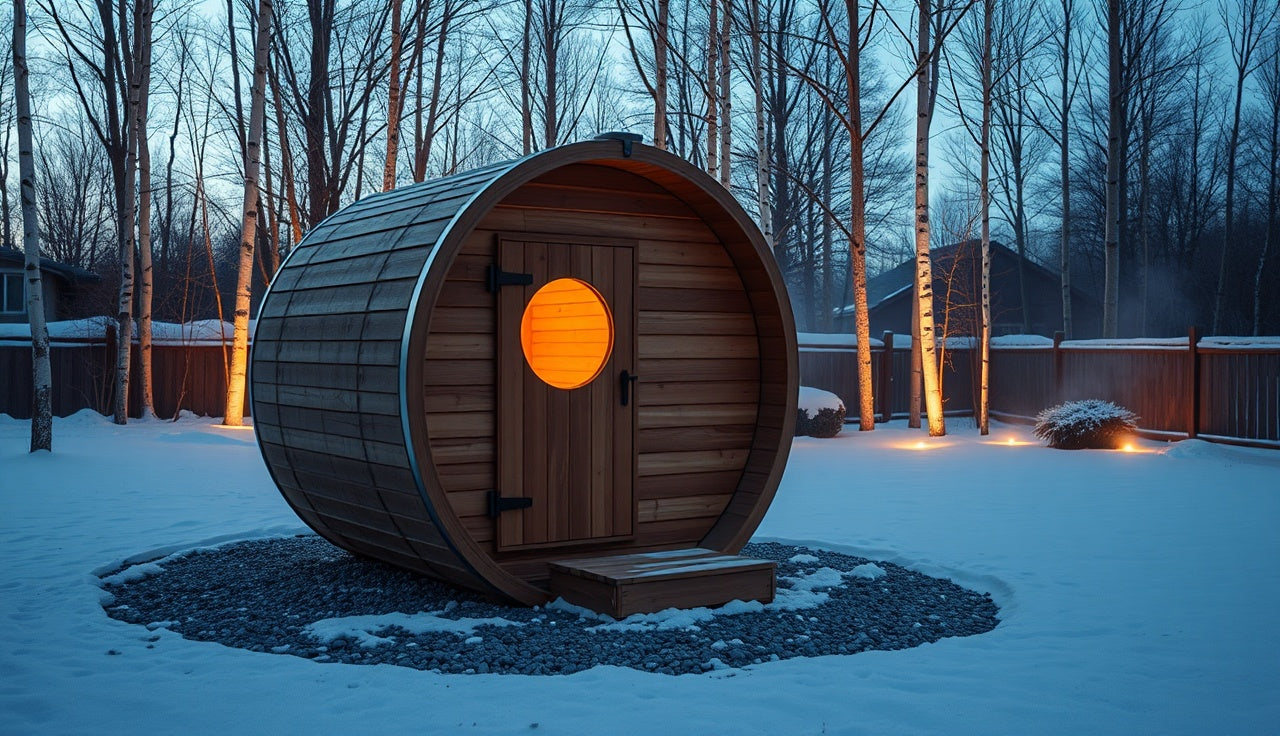
A barrel sauna is a cylindrical wood structure, usually 4 to 8 feet across and 6 to 8 feet long, made from tongue-and-groove staves banded together with steel rings, exactly like a wine barrel. You set it on cradle supports, drop in a sauna heater, and it's ready to run outdoors in almost any climate.
The shape does more work than it looks like it does. A square sauna has dead corner volume that eats energy and never really gets hot. A barrel's curved interior pushes heat toward the benches where bodies actually sit, which is why most barrel owners hit target temperature in 30 to 45 minutes versus 45 to 60 for a comparably sized box sauna [1].
The curved floor also sends rainwater, sweat, and cleaning water straight to the lowest point and out. No water pooling in corners. Outdoors, that's a real durability edge.
Want the wider category first? Start with our outdoor sauna guide, or get the full breakdown of every sauna type in our sauna guide.
What are the real benefits of a barrel sauna outdoors?
The honest case comes down to four things: faster heat-up, better wood longevity outdoors, year-round use, and the experience of sitting in one.
Faster heat-up is the thing people notice on day one. Less air volume means the heater isn't fighting as hard. A 6-foot diameter barrel with a 6 kW electric heater or a mid-sized wood stove usually hits 160 to 185°F (71 to 85°C) in under 45 minutes, even when it's cold out.
Wood longevity outdoors lives and dies by airflow. The barrel shape lets the entire exterior dry after rain instead of trapping moisture under flat eaves. Most quality kits use Western red cedar or Nordic spruce, both naturally rot-resistant [8]. Maintained properly, expect 15 to 25 years.
Year-round use is the actual reason to buy one. Scandinavian barrel saunas run in winter on purpose, because the gap between hot sauna and cold outside air is the whole point. You step into snow or a cold plunge and your body reacts hard. If contrast interests you, our cold plunge guide covers what to look for in an outdoor plunge setup.
On the health side, regular sauna use has real research behind it. A 2018 meta-analysis in Mayo Clinic Proceedings found sauna bathing was associated with lower cardiovascular mortality in prospective cohort studies, though the authors were clear that healthy-lifestyle confounding is hard to fully rule out [2]. Finnish cohort data from Laukkanen and colleagues showed a dose-dependent link between session frequency and reduced cardiovascular and all-cause mortality [10]. We cover the wider evidence in our sauna benefits guide. This isn't a wellness gimmick. There's a legitimate research base, even if causation isn't nailed down.
How much does an outdoor barrel sauna cost?
Barrel saunas run $2,000 to $12,000 depending on size and wood grade, and the heater is a separate line item most of the time. Here's the honest breakdown by tier.
| Tier | Size | Typical Price Range | What you get |
|---|---|---|---|
| Entry-level kit | 4 ft dia, 6 ft long | $2,000 to $3,500 | Pre-cut cedar or spruce staves, basic hardware, no heater |
| Mid-range kit | 5 to 6 ft dia, 7 to 8 ft long | $3,500 to $6,000 | Better wood grade, accessories, sometimes heater included |
| Premium / custom | 6 to 8 ft dia, 8+ ft long | $6,000 to $12,000+ | Clear-grade cedar, upgraded heater, sauna plus change room |
| Installed turnkey | Any size | Add $1,500 to $4,000+ | Contractor labor for site prep, electrical, delivery |
The heater is where budgets slip. A quality electric sauna heater (Harvia, Finnleo, HUUM) runs $400 to $1,200. A wood-burning stove is $300 to $900 for the unit but adds chimney and clearance costs. Electrical for a 240V, 40 to 60 amp circuit typically runs $300 to $800 depending on how far your panel is [3].
One thing to watch. Some kit sellers advertise prices that leave out the heater, the cradle supports, or the interior benches. Read the parts list before you compare anything.
Permit fees are real but usually small. Most jurisdictions charge $50 to $200 for a residential accessory structure permit, though it swings hard by county. Some municipalities exempt structures under a set square footage (commonly 120 to 200 sq ft) from permitting, but confirm that with your building department instead of trusting a retailer [4].
| Fabric portable sauna | $500 |
| Barrel sauna kit (4 ft) | $2,750 |
| Barrel sauna kit (5 to 6 ft) | $4,750 |
| Barrel sauna kit (6 ft, premium) | $9,000 |
| Box/cabin sauna kit | $10,000 |
| Custom built sauna | $32,500 |
Source: Industry retail pricing ranges, 2024 to 2025
What wood species is best for a barrel sauna?
Western red cedar is the most common choice, and it earns it. Cedar resists moisture and rot, stays dimensionally stable through temperature swings, smells good hot, and is soft enough that it won't scorch skin on contact even at high heat [8]. The catch is price. Clear-grade cedar has gotten expensive, and a barrel uses a lot of it.
Nordic spruce (sometimes sold as Finnish spruce) is the traditional Scandinavian pick. It's denser than cedar, holds heat a touch better, and usually costs less per board foot. It lacks cedar's natural oils, so it wants a little more drying attention after each use in very wet climates. Most Scandinavian saunas are spruce, and they last decades.
Thermo-treated wood (heat-modified spruce or pine, sometimes branded as SaunaTherm) is kiln-cooked at high heat to drive out sugars and moisture, which sharply raises rot resistance without chemicals. It's darker, harder to the touch, and increasingly common in higher-end kits. Costs more upfront, may outlast untreated spruce by a wide margin in humid climates.
Hemlock shows up in budget kits. It works, but it's softer and checks (cracks) more readily under repeated thermal cycling. Not a disaster. Not my first pick for something meant to last 20 years.
Skip pressure-treated or painted lumber anywhere inside. Heated, those chemicals off-gas. The interior of your barrel should be untreated, unfinished wood, full stop.
Electric heater or wood-burning stove: which should you choose?
This is a lifestyle question more than a technical one. Electric wins on convenience and code compliance. Wood wins on experience.
Electric heaters are simple. Set the temperature, walk away, come back when it's ready. No fire to manage, and some HOAs and local fire codes require electric for residential use near structures. Most electric heaters for a barrel draw 4 to 9 kW on a 240V circuit, so plan for a dedicated 40 to 60 amp breaker [3]. Running two or three sessions a week is cheap. At the U.S. average residential rate of roughly 16 cents per kWh in 2024, a 6 kW heater running 90 minutes costs about $1.44 a session [5].
Wood-burning stoves are a different animal. Building and tending the fire is the point for a lot of purists. The heat behaves differently too. Wood fires throw bigger humidity swings when you ladle water on the rocks (loyly, in Finnish), and the temperature drifts more naturally. If you're setting up at a cabin or rural property with no easy 240V, wood is the practical answer.
The tradeoffs with wood are honest ones. You need dry firewood on hand, you'll spend 30 to 45 minutes getting the fire right before you go in, and cleanup is real. Check your fire codes too. Plenty of suburban and urban municipalities restrict open-fire appliances on residential lots, and a wood sauna stove often carries the same classification as an outdoor fireplace [4].
For most backyard setups close to the house, I'd go electric. For a cabin or a standalone sauna building set back from the main structure, wood is hard to beat.
What size barrel sauna do you actually need?
Buy by diameter first, then length. A 5-foot diameter is the sweet spot for most people, seating 2 to 3. Go 6-foot if you sauna with family, and never buy smaller than you think you need.
Here's how the common configurations shake out:
4-foot diameter fits 2 people comfortably, or one person lying down. More compact than most people picture. Good for a solo user who wants a small footprint.
5-foot diameter is where most buyers should land. It seats 2 to 3 people on standard benches and hits the overlap between a reasonable footprint and real social space.
6-foot diameter seats 4 to 5 people and sometimes includes a small changing room at one end. This is the size most families want after they've used a smaller one. It heats slower and costs noticeably more.
Length (usually 6 to 8 feet for the sauna room itself) decides whether you can lie flat on a bench, which is the most relaxing position there is. Over 6 feet tall and want to stretch out? You need at least 7 feet of interior length.
The changing room option (an extended barrel with a small anteroom) is worth real thought in a cold climate. A dry spot to peel off wet swimwear or sit with a towel between rounds is genuinely nice, and it adds insulation to the sauna room itself.
Almost everyone who buys a 4-foot barrel wishes they'd gone to 5 once they're using it with another person. Size up.
Do you need a permit to install a barrel sauna in your backyard?
Usually yes for the electrical, sometimes no for the structure itself. Any permanent barrel with a 240V heater almost always needs an electrical permit and inspection, even when the structure is small enough to skip a building permit.
The general rule across most US jurisdictions: any permanent structure with electrical work needs at least an electrical permit. A separate building permit may or may not apply depending on square footage and whether there's a permanent foundation.
Many counties and cities exempt accessory structures under 120 or 200 square feet from building permits, but that exemption rarely covers the wiring inside them. A 5-foot diameter barrel is about 19.6 square feet of floor area, well under most thresholds. The 240V circuit feeding it still needs an electrical permit and inspection in most states [4][9].
HOA rules are a separate fight. If you're in an HOA, read your CC&Rs before you buy anything. Some prohibit outbuildings visible from the street or require architectural review board sign-off.
Setbacks are real too. Most residential zoning codes require accessory structures to sit a set distance from property lines (commonly 3 to 10 feet) and from the main dwelling (often 6 to 10 feet for fire separation). A barrel with a wood stove may carry extra clearance requirements.
The honest move: call your building department before you order. It's a ten-minute call that saves real headaches. The International Residential Code, adopted in some form by most US jurisdictions, sets the baseline, but local amendments are common [4].
How do you assemble and install an outdoor barrel sauna?
Most kits ship as pre-cut, pre-drilled tongue-and-groove staves numbered for assembly, plus steel cradle bands, bench hardware, a door, and instructions. Two people with basic carpentry skills can build one over a weekend.
Site prep comes first. You need a level surface that drains. A gravel pad is the usual and often the best call: it drains freely and won't trap ground moisture against the wood. Concrete piers or a pad work too, though a full slab is overkill for a barrel. Decking is popular but check your deck's load rating first. A fully loaded 6-foot barrel with rocks and heater can weigh 1,200 to 2,000 lbs.
Assembly, in brief: lay the cradle supports, stack the staves layer by layer (most kits go bottom-half first), tighten the steel bands as you go, hang the door frame and door, then install the interior benches, then the heater. Follow the manufacturer's heater clearance instructions to the letter. Minimum clearances between heater and combustible surfaces live in every heater manual, and they're there for a reason.
Hire a licensed electrician for the connection unless you're truly qualified. The 240V feed and the thermostat and control wiring on most electric heaters is not a first-timer job.
Season it before real use. Run the heater low (120 to 140°F) for one or two sessions so the wood acclimates and any manufacturing residue off-gasses before you're sitting in there.
Maintenance is light. Treat the exterior with a UV-protective, water-repellent oil (teak oil, outdoor wood finish) once a year. Leave the interior untreated and unfinished. Clean inside with a soft brush and mild water. No chemical cleaners indoors.
How does an outdoor barrel sauna compare to other outdoor sauna types?
Deciding between a barrel and the alternatives? Here's the honest comparison.
Portable saunas (fabric tent-style) cost $200 to $800 and store in a bag. They heat fast but never get truly hot, feel nothing like a real sauna, and last a few years at most. Fine as a stopgap. Not what you want if you're serious.
Traditional box or cabin saunas are what most people picture, a rectangular shed-style build. They give you more design freedom (windows, a porch, more benches), but they cost more, heat slower, and need more site work. A quality home sauna box build starts around $8,000 to $15,000 installed.
Smoke saunas (savusauna) are the original Finnish style: no chimney, smoke fills the room, you air it out, then bathe. An incredible experience. Completely impractical for most homeowners.
Barrel saunas hit a real middle ground: cheaper than a cabin build, better heat and experience than a fabric tent, faster to assemble, and a shape that looks good in a backyard. The main limit is capacity. Past 6 people the format gets unwieldy.
| Type | Cost Range | Heat-Up Time | Lifespan | DIY Friendly? |
|---|---|---|---|---|
| Fabric portable | $200 to $800 | 15 to 20 min | 2 to 5 years | Yes |
| Barrel (kit) | $2,000 to $10,000 | 30 to 45 min | 15 to 25 years | Yes (2 people, weekend) |
| Box/cabin (kit) | $5,000 to $15,000+ | 45 to 60 min | 20 to 30+ years | Harder |
| Custom built | $15,000 to $50,000+ | 45 to 60 min | 30+ years | No |
Can you use a barrel sauna in cold climates and winter?
Yes, and winter is where barrel saunas perform best. Tight stave construction plus a curved ceiling that channels steam down instead of pooling and dripping means they hold heat well when it's cold out.
In sub-zero temperatures you'll burn more energy heating up and may want to let it run a bit longer before you go in, but it gets hot.
For serious cold-climate use, a barrel with a wood stove almost always feels warmer than the same-size electric setup, because the stove radiates heat directly and the fire responds to demand. A well-insulated electric barrel still does fine through most North American winters.
Draining for winter: if you're leaving it unused for stretches during freezing weather, clear any water from the floor and leave the door slightly open for airflow. There's no plumbing to freeze in most barrels, but standing water near the floor drain can freeze and crack the wood if you ignore it.
The winter experience is the whole reason people love these. Sit at 180°F, step into 20°F air, roll in snow, come back for another round. That's the Scandinavian tradition at its most basic. Pair it with a cold plunge tub or a stock tank of cold water outside the door and you've got a real contrast setup. Our cold plunge benefits guide covers the physiology of that cold immersion.
What are the most common problems with barrel saunas and how do you avoid them?
Wood cracking and checking is the number one issue, and it almost always traces back to moisture getting in and not getting out. Keep the exterior oiled, make sure your cradles hold the barrel off the ground, and leave the door open after each session so interior moisture escapes. Cedar and spruce will check (surface cracks) over time no matter what. That's normal and doesn't hurt structural integrity. Deep splits through a full stave are a problem, and they usually mean a wet foundation or water pooling somewhere.
Band loosening happens as the wood dries and shrinks in its first season. Tighten the steel cradle bands with a wrench after the first month, then again after the first winter. It's a ten-minute job most owners skip, then they wonder why gaps opened in the stave joints.
Heater sizing errors. Too small and you'll never reach real sauna temperature, especially in cold weather. A 4-foot barrel needs at least 4 kW. A 6-foot barrel needs 6 to 9 kW. When in doubt, size up.
Poor site drainage leaves the bottom staves sitting in water after rain. Solve it at install: gravel base, cradles that hold the barrel at least 6 inches off the ground, and a slight slope away from the barrel in all directions if you can manage it.
Interior bench splinters. Rough or unsanded benches grab skin on contact. Before first use, sand every bench surface to 120 grit minimum, or treat with a heat-stable interior finish sold for saunas. Otherwise leave the wood bare and sand it.
Want to see quality-vetted kits? SweatDecks carries a curated selection of outdoor barrel saunas with real specs on heater sizing, wood grade, and exactly what's included.
How do you safely use an outdoor barrel sauna?
Sauna safety matters, not because saunas are unusually dangerous but because heat interacts with hydration, alcohol, and cardiovascular status in ways people underestimate. Skip alcohol, drink water, and don't sauna alone until you know how your body handles it.
Temperature: most barrel saunas run 150 to 195°F (65 to 90°C) with 10 to 20 minute sessions followed by a cool-down. The Finnish Sauna Society recommends 80 to 100°C (176 to 212°F) for traditional use [6]. Higher isn't always better. A well-controlled 160°F with good steam beats a bone-dry 200°F on both enjoyment and effect.
Hydration: drink water before and after. Not during, since it interrupts the sweat, but definitely before. Multiple rounds? Water between them.
Alcohol: sauna heat plus alcohol wrecks thermoregulation and judgment, and it has caused real deaths. The Finnish Institute for Health and Welfare has named alcohol use as a risk factor in sauna-related deaths in Finland [7]. Keep it out of the session.
Cardiovascular considerations: if you have heart disease, uncontrolled high blood pressure, or you're pregnant, talk to your doctor before starting regular sauna use. For healthy adults, most studies put sauna somewhere between cardiovascular-neutral and mildly beneficial [2], but individual situations vary.
Kids: children can use saunas at lower temperatures and shorter sessions, but they thermoregulate differently than adults and always need supervision. Most guidance keeps young children under 5 to 10 minutes.
Never sauna alone if you're new to it or have any cardiovascular concern. Have someone nearby for the first several sessions.
Frequently asked questions
How long does it take to assemble a barrel sauna kit?
Two people with basic carpentry skills can assemble a standard barrel sauna kit in one to two days. Pre-cut staves, pre-drilled hardware, and numbered assembly systems have made this far easier than it used to be. The electrical connection adds time depending on how far your panel sits from the sauna, and it should be done by a licensed electrician.
How long does a barrel sauna take to heat up?
Most 5 to 6 foot diameter barrels with a properly sized heater reach 160 to 185°F in 30 to 45 minutes. Smaller 4-foot barrels can heat in 20 to 30 minutes. Cold outdoor air slows this down, and an undersized heater will struggle to hit temperature in winter. Match heater kilowatts to the barrel's cubic volume per the manufacturer's recommendation.
What is the best wood for an outdoor barrel sauna?
Western red cedar is the most popular: naturally rot-resistant, thermally stable, and pleasant when hot. Nordic spruce is the traditional Scandinavian option, slightly denser and often cheaper. Thermally modified wood (heat-treated spruce or pine) holds up well in wet climates. Avoid pressure-treated wood or any painted lumber inside the barrel, since heated chemicals off-gas.
Do barrel saunas need a foundation?
They don't need poured concrete. A compacted gravel pad, concrete pavers, or pressure-treated timber sleepers all work well and match what most manufacturers recommend. The surface just has to be level and drain freely. The barrel sits on included cradle supports that keep the wood off the ground. A deck works if it's rated for the weight, typically 1,200 to 2,000 lbs loaded.
Can a barrel sauna stay outside all year, including winter?
Yes. Barrel saunas are built for outdoor year-round use. Cedar and Nordic spruce handle freeze-thaw cycles well. After each winter session, leave the door slightly open so residual moisture escapes. If you won't use it for weeks in freezing weather, clear any standing water near the floor drain. The structure itself doesn't need to be stored or covered.
How much electricity does an outdoor barrel sauna use?
A typical 6 kW electric heater running a 90-minute session (heat-up plus use) uses roughly 9 kWh. At the U.S. average residential rate of about 16 cents per kWh in 2024, that's about $1.44 per session [5]. Three sessions a week adds roughly $18 to $22 a month, though your local rate and actual session length will shift that.
Does a barrel sauna add value to a home?
There's limited formal appraisal data on barrel saunas specifically. Agents in markets that prize outdoor living (Pacific Northwest, Minnesota, Colorado) generally say outdoor saunas add perceived value and help a listing stand out. A permanently installed barrel with a dedicated electrical circuit is more likely to be treated as a fixture and appraised as added value than a portable or temporary setup.
What's the difference between a barrel sauna and a traditional Finnish sauna?
The main differences are shape and construction. A traditional Finnish sauna (savusauna or modern equivalent) is usually rectangular, built like a small cabin, sometimes with a built-in changing room. The experience itself, temperature, steam, use of a whisk (vihta), and the heat-cool-rest cycle, stays the same regardless of shape. Barrel saunas are a modern adaptation of that tradition, built for kit assembly and outdoor use.
Can you use a barrel sauna for contrast therapy with a cold plunge?
Yes, and it's one of the most popular combinations. The setup is simple: barrel sauna next to an outdoor cold plunge tub, stock tank, or plunge unit. Do a sauna round (10 to 20 minutes), move to the cold plunge (2 to 5 minutes), rest, repeat. The response includes real cardiovascular adaptation. Our cold plunge and ice bath guides go deeper on protocols and safety.
What maintenance does an outdoor barrel sauna require?
Annual exterior oiling with a UV-protective wood finish, tightening the steel cradle bands once or twice a year (especially in the first season as the wood settles), sweeping out the interior, and light sanding of benches if they roughen. Never oil or stain the interior. With a wood stove, clean the chimney yearly. Budget maybe two to four hours of maintenance per year for most setups.
Is a barrel sauna better than an infrared sauna?
They're different experiences. A barrel sauna uses a convective heater with rocks and steam, reaching 150 to 195°F. An infrared sauna typically runs 110 to 140°F and heats tissue more directly. Most of the stronger cardiovascular research used traditional hot-air temperatures. Want the full Scandinavian experience with steam (loyly)? A barrel wins. Infrared is quieter, cheaper to run, and some people prefer the lower heat.
What permits do I need for an outdoor barrel sauna?
An electrical permit is almost always required for the 240V circuit powering an electric heater, regardless of the structure's size. A building permit may or may not apply depending on your municipality's accessory structure exemption (commonly 120 to 200 sq ft of floor area). Verify with your local building department and check HOA rules before installing. Setbacks from property lines and the main dwelling apply in most zones.
How many people fit in a barrel sauna?
A 4-foot diameter barrel fits 2 people comfortably. A 5-foot diameter fits 2 to 3. A 6-foot diameter with standard benches seats 4 to 5. Length matters for lying down: you need at least 7 feet of interior length to stretch flat if you're 6 feet tall. If you regularly sauna with family or friends, buy one size larger than your first instinct.
Sources
- Finnish Sauna Society, Sauna Design and Use: Barrel sauna shape concentrates heat near occupants and reduces wasted air volume compared to rectangular designs, contributing to faster heat-up times.
- Mayo Clinic Proceedings, 2018 meta-analysis: 'Cardiovascular and Other Health Benefits of Sauna Bathing': Sauna bathing was associated with reduced cardiovascular mortality in prospective cohort studies; authors noted difficulty fully ruling out healthy lifestyle confounders.
- U.S. Department of Energy, Electrical Systems in Homes: Electric sauna heaters require a dedicated 240V, 40 to 60 amp circuit; licensed electrician installation is standard for residential 240V appliance circuits.
- International Code Council, International Residential Code (IRC): Most U.S. jurisdictions have adopted the IRC, which governs accessory structure permitting, electrical permit requirements, and setback provisions for residential outbuildings.
- U.S. Energy Information Administration, Electric Power Monthly (Average Retail Price of Electricity): Average U.S. residential electricity price was approximately 16 cents per kWh as of 2024.
- Finnish Sauna Society, Sauna Temperature Recommendations: The Finnish Sauna Society recommends sauna temperatures of 80 to 100°C (176 to 212°F) for traditional sauna bathing.
- Finnish Institute for Health and Welfare (THL), Sauna Safety: Alcohol use has been identified as a significant risk factor in sauna-related deaths in Finland.
- USDA Forest Service, Wood Handbook: Wood as an Engineering Material: Western red cedar and Nordic spruce have natural rot resistance properties that make them suitable for outdoor and high-moisture applications.
- Consumer Product Safety Commission, Residential Electrical Safety: 240V residential circuits for appliances including sauna heaters require proper grounding, dedicated breaker sizing, and inspection to meet safety standards.
- PubMed, Laukkanen et al. 2018 'Sauna bathing is associated with reduced cardiovascular mortality': Prospective cohort data from Finland showed a dose-dependent association between sauna session frequency and reduced cardiovascular and all-cause mortality.

Share:
HigherDOSE sauna blanket: honest review and what to know before buying
HigherDOSE sauna blanket: honest review and what to know before buying