
Last updated 2026-07-09
TL;DR
NuRecover is an Australian-founded recovery brand known for portable steam sauna tents, far-infrared sauna blankets, and cold plunge tubs. Entry-level steam tents start around $250-$320 USD. They are a reasonable budget pick for portability, but they cannot match the heat retention or lifespan of a purpose-built home sauna. Buy one for apartments and travel, not as a wood sauna replacement.
What is NuRecover and who makes it?
NuRecover is a recovery-equipment brand founded in Australia and now sold in the US, UK, and Europe through its own website plus a few retail partners. The company makes affordable contrast therapy gear: portable steam sauna tents, steam generators, inflatable cold plunge tubs, and bundles that pair heat with cold. Think of it as the brand that made home contrast therapy feel doable for someone with a $500 budget and a spare corner of a bedroom.
NuRecover does not build heavy timber barrel saunas or fixed infrared cabins. Its lane is portable and semi-portable equipment, which means lighter, cheaper, and less permanent than what Finnleo, Finnmark, or Almost Heaven sell. That is a trade-off, not a flaw, and which side you land on depends entirely on your space and goals.
The brand grew fast through social media, mostly among gym-goers and athletes who wanted the physiology of sauna and cold water without dropping $3,000 to $10,000 on a cedar cabin or a commercial plunge tank. Its marketing leans into the Andrew Huberman-era recovery conversation, name-checking heat shock proteins, cortisol, and vagal tone, though NuRecover itself makes no specific medical claims about its products.
If you landed here researching NuRecover, you are probably comparing it to portable brands like SereneLife or Durherm, or weighing tent saunas against a portable sauna cabin or a proper outdoor sauna build. All three are different products with different price tags.
What sauna products does NuRecover actually sell?
NuRecover's sauna lineup splits into three categories as of mid-2025: steam tents, an infrared blanket, and cold plunge hardware. None of them require an electrician.
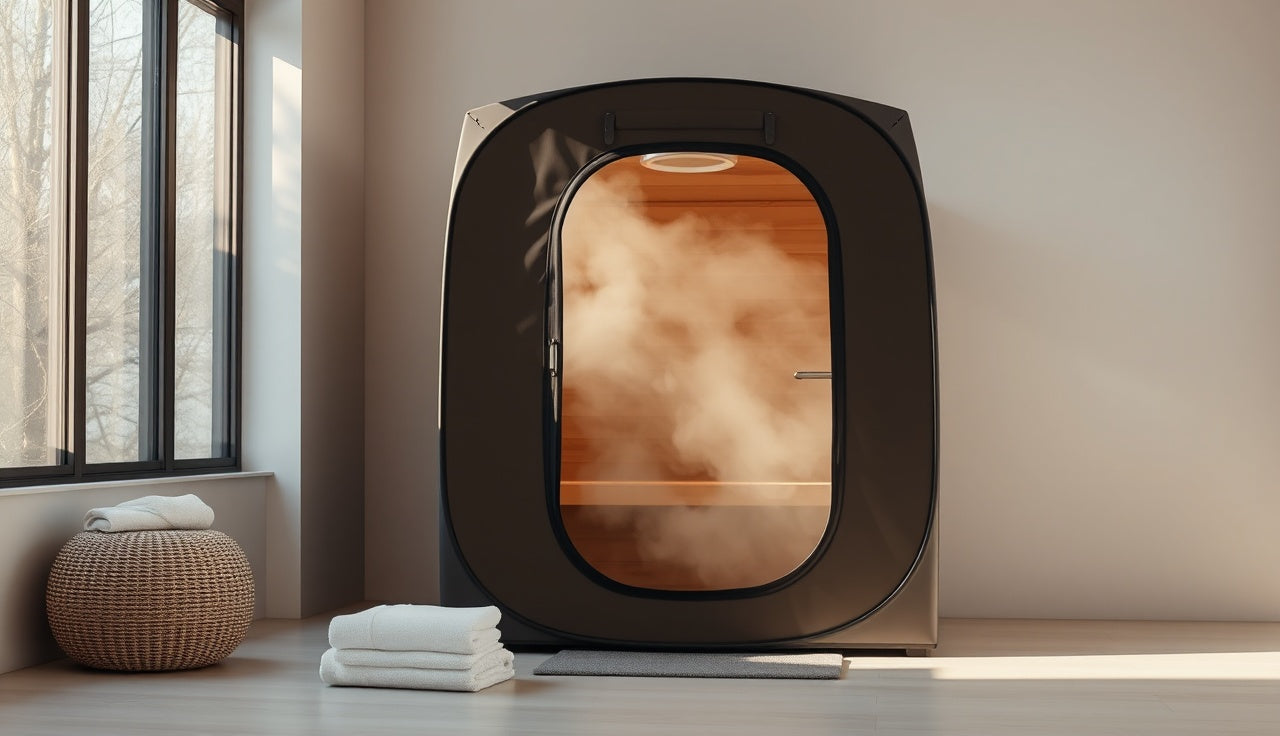
First, the steam sauna tents. These are zippered fabric enclosures big enough for one person to sit inside with their head poking out the top. A separate steam generator (basically a modified steamer pot) sits outside and feeds steam through a tube. You sit on a folding stool, zip the collar around your neck, and the interior climbs into the 104-140 degree F range depending on generator wattage and room temperature. The main steam tent, the Original Portable Sauna, lists around AUD $399 to $499, roughly USD $250 to $320 at mid-2025 exchange rates [1]. US pricing runs slightly different.
Second, the far-infrared sauna blanket. This is a wearable, zippered blanket with embedded heating elements. You lie inside it clothed or in shorts and it warms your body through radiant heat instead of heating the air. These run USD $200 to $350 depending on configuration. A blanket is a genuinely different animal from a tent. Radiant heat penetrates tissue directly, but because your head stays out and airflow is minimal, the cardiovascular load is lower than a full hot room [2].
Third, cold plunge hardware: inflatable tubs, insulated rigid tubs, and chillers. That side of the catalog has grown a lot since 2022, riding the cold plunge boom. Bundling a steam tent with a plunge tub is NuRecover's core contrast therapy pitch.
What they do not make: a wood-panel sauna, a barrel sauna, or anything needing a dedicated 240V circuit. Every sauna product runs on standard household power (120V in the US, 240V in Australia and the UK). For renters and anyone who cannot run a new circuit, that convenience is the whole point.
How hot does a NuRecover portable steam sauna actually get?
Realistically, 110 to 140 degrees F, and the room matters more than the generator. A fabric tent has almost no thermal mass, so it heats fast and loses heat just as fast when the air around it is cold.
NuRecover's steam generators are rated at 800 to 2,000 watts depending on the model. An 800W generator in a 65 degree F room gets the tent interior to roughly 100-115 degrees F within 10 to 15 minutes. A 2,000W generator in the same room can push toward 130-140 degrees F. Run that same setup in an unheated garage in winter and you may never clear 100 degrees F, because the fabric walls bleed heat to the cold as fast as the generator makes it.
For context, a traditional Finnish sauna targets 170-212 degrees F with low humidity, while a commercial steam room runs about 110-120 degrees F at near-100% humidity [3]. NuRecover tents live in the steam room range, not the Finnish dry-heat range. That is a different experience. High humidity at lower temperatures can feel more punishing than the thermometer suggests, because sweat cannot evaporate and cool you when the air is already saturated.
Here is the honest caveat. When the steam stops, the heat stops. Open the zipper and the temperature crashes in seconds. A hemlock or cedar room stores heat in its walls, ceiling, and benches and radiates it back at you. A tent does none of that.
The cardiovascular benefits tied to regular sauna use in research, including the University of Eastern Finland cohort work, show up most consistently at 174 degrees F (79 degrees C) or higher in traditional dry heat [4]. Whether lower-temperature steam sessions deliver the same payoff is genuinely unclear. Nobody has strong randomized data comparing 130 degree F steam tent sessions to 180 degree F traditional sauna on long-term outcomes. The closest evidence is the general steam room literature, which points to real cardiovascular and thermoregulatory effects at a lower intensity than high-heat Finnish sauna.
| Traditional Finnish sauna (170-212°F avg) | 190 |
| Infrared sauna cabin (130-150°F avg) | 140 |
| Commercial steam room (110-120°F avg) | 115 |
| NuRecover tent sauna (110-140°F realistic) | 125 |
| Sauna blanket surface temp (140-158°F) | 149 |
Source: CDC Healthy Water; Laukkanen et al., JAMA Internal Medicine, 2015
Is a NuRecover sauna tent good for recovery and health?
For muscle recovery and calming your nervous system after training, yes, with caveats. A steam tent session at a realistic 120-130 degrees F for 20-30 minutes gives you a meaningful heat dose. You will sweat hard. Your core temperature will rise. You will feel the parasympathetic shift when you cool down after.
Passive heat raises core temperature, triggers heat shock protein expression [5], and relaxes muscle through mechanisms that do not care what the heat source is. A 2021 review in the International Journal of Environmental Research and Public Health found that whole-body passive heat from multiple sources, steam rooms included, helped with muscle recovery, subjective fatigue, and delayed-onset muscle soreness [6]. Total heat dose is the lever that matters: how hot, how long, how often.
What a tent will not give you is high-heat hyperthermic conditioning, the kind behind the most aggressive sauna headlines. Dr. Jari Laukkanen's University of Eastern Finland group, cited constantly in the sauna-and-mortality conversation, studied men using Finnish saunas around 79 degrees C (174 degrees F) four to seven times a week [4]. A fabric tent at 120 degrees F is simply a smaller stimulus.
For daily convenience, stress relief, and mild to moderate heat therapy, a NuRecover tent earns its keep. For chasing the high-heat adaptation benefits, it is probably not enough alone. If you have access to a real sauna, use that a few times a week and fill the gaps with the tent.
The sauna benefits research is real, and it carries real limits. Most long-term studies are observational, run in Finland with people who sauna multiple times a week from childhood, using traditional dry heat, not portable steam tents. Be skeptical of any marketing that maps those outcomes straight onto a $300 fabric enclosure.
How does NuRecover compare to other portable sauna brands?
Here is a straight comparison against the portable sauna brands that show up in the same searches. NuRecover sits mid-tier: pricier than the cheapest imports, cheaper than premium blanket brands.
| Brand | Type | Approx. Price (USD) | Max Temp | Power Draw | Key Trade-off |
|---|---|---|---|---|---|
| NuRecover Original Tent | Steam tent | $250-$320 | ~130-140 degrees F | 800-2,000W | Solid support, good bundle options |
| SereneLife SLSAU35 | Steam tent | $120-$180 | ~120-130 degrees F | 800-1,000W | Cheaper, less reliable generator |
| Durherm Portable Sauna | Steam tent | $130-$200 | ~120-135 degrees F | 800W | Entry-level build quality |
| HigherDOSE Sauna Blanket | IR blanket | $699 | ~158 degrees F (surface) | 1,000-1,200W | Better IR elements, but expensive |
| NuRecover Sauna Blanket | IR blanket | $200-$350 | ~140-158 degrees F | ~1,000W | Better value than HigherDOSE for casual use |
| Sunlighten mPulse (portable) | Full-spectrum IR cabin | $3,000+ | ~150 degrees F | 1,750W | Real wood, proper IR, a different product entirely |
The generator is the part that fails first in any tent sauna, and NuRecover's is generally reported as more reliable than the sub-$150 alternatives. The tents themselves barely differ across brands. They are all polyester or nylon, they all zip around your neck, they all fold flat.
Here is the blunt version. If heat exposure for recovery is your goal and you have the budget and space, a real wood-panel sauna beats every tent on performance, feel, and lifespan. A costco sauna or a basic barrel from a regional supplier at $1,500 to $2,500 will out-heat a tent on every metric. The tent wins on three things only: portability, price, and the ability to run it in an apartment.
What is the NuRecover cold plunge, and how does contrast therapy work?
NuRecover's cold plunge line includes inflatable tubs (sold as the "Ice Bath Tub" and similar names) and insulated rigid models, some chiller-compatible. Inflatable tubs run roughly USD $100 to $200, insulated rigid versions $400 to $700 without a chiller, and chillers add another $500 to $1,000-plus.
The cold side is where NuRecover has drawn more criticism. The inflatable tubs work for immersion but they are not insulated well enough to hold temperature without ice. In a warm room in summer, an uninsulated tub without a chiller drifts from 50 degrees F to 65 degrees F within a couple of hours, which guts the cold stimulus.
Contrast therapy, alternating heat and cold, is the whole point of NuRecover's bundle marketing. The logic is real. Heat causes vasodilation and lifts your heart rate; cold causes vasoconstriction and parasympathetic activation. Bouncing between them creates a vascular pump effect and a distinctive mood shift, often described as feeling wired and calm at once.
A 2016 meta-analysis in the British Journal of Sports Medicine found cold water immersion cut delayed-onset muscle soreness and perceived fatigue compared to passive recovery [7]. The effective water range across those studies was roughly 50-59 degrees F (10-15 degrees C) for 10 to 15 minutes.
The bundle works if contrast therapy is your goal. You will get real physiological responses. The fair question to ask yourself: do you need a branded bundle, or could you pair a budget tent sauna with a chest freezer or stock tank full of cold water for less? For the full picture on the cold plunge category and cold plunge benefits, there are deeper breakdowns worth reading.
One practical note for warm months: budget for bags of ice or a chiller if you want consistent cold. An uninsulated tub in a hot garage will not stay cold on its own.
How do you set up and use a NuRecover sauna tent?
Setup is fast, and that is one of the tent's real advantages. Most NuRecover tents unfold and assemble in 5 to 10 minutes without tools. Put the folding stool inside, connect the steam hose from the generator to the tent port, fill the generator reservoir with water (distilled extends its life), and plug into a standard outlet.
A few notes from the real-world setup:
The generator reservoir usually holds 1.5 to 3 liters, good for roughly 30 to 60 minutes of continuous steam before a refill. For a typical 15 to 30 minute session, that is plenty. For longer sessions, start full.
Place the tent on a water-resistant surface or lay a towel underneath. Condensation drips from the steam vent and the fabric drips when you open it. On tile or in a bathroom this is a non-issue. On hardwood you need a mat.
Wear as little as you comfortably can. Sauna shorts or nothing works best for heat exposure. Some people wear a sweat suit inside the tent to sweat faster, though the evidence that neoprene or compression suits add much over plain passive heat is thin.
On session length: most people start at 10 to 15 minutes and work up to 20 to 30 over a few weeks as tolerance builds. The National Sauna Association recommends not exceeding 15 to 20 minutes per session for traditional saunas [8], which is a sensible starting point for tents too. Never use a tent sauna after drinking alcohol, and hydrate before and after.
Descale the generator every 4 to 8 weeks with a citric acid solution (the same stuff for kettles and coffee machines) to stop mineral buildup, the most common cause of generator failure. That runs about $5 to $10 a year in maintenance.
What are the risks and safety concerns with portable sauna tents?
Portable steam saunas carry real but manageable risks. Overheating is the big one. You cannot fling a tent door open the way you can in a real sauna; getting out means unzipping the collar, which costs a moment. Anyone who might fall asleep inside, or who has a cardiovascular condition, should not use a tent sauna without medical clearance. The American Heart Association notes that heat exposure can temporarily lower blood pressure and raise heart rate, which is a risk for people with uncontrolled hypertension or recent cardiac events [9].
Take electrical safety seriously. The steam generator sits on the floor next to an appliance that makes water. Buy from brands that certify their generators to UL or ETL standards in the US, or CE in Europe. NuRecover units generally ship with certification for their market, but confirm it on the specific product listing before you buy. Do not run a steam generator on an extension cord unless the cord is rated for the wattage.
Dehydration hits fast in a steam tent because the humidity blocks sweat from evaporating. Drink 16 to 24 oz of water before a session and keep water within reach during and after. Children, pregnant women, and people with multiple sclerosis or other heat-sensitive conditions should avoid sauna use or check with a physician first [10].
No confirmed reports of serious structural failure from NuRecover products turned up in public sources as of mid-2025. Still, the tent fabric is not fire-resistant and should never sit near open flames, space heaters, or the generator housing itself.
For older users or anyone using one alone, set a timer or have someone nearby. It is a cheap precaution.
Is NuRecover worth the money, or are there better alternatives?
It comes down to one question: is a tent sauna the right product category for your goals? If yes, NuRecover is a reasonable pick within it. If no, no amount of brand quality fixes that.
For apartment dwellers, people with no room for a permanent install, travelers, or anyone who wants a starter sauna under $400, NuRecover makes sense. The support beats no-name imports, the products are well-documented, and the contrast therapy bundle is genuinely appealing if you want hot and cold in one purchase.
For homeowners with a spare room, a deck, or a backyard who want the real thing, putting $400 into a tent is the wrong allocation. Another $1,000 to $2,000 buys a genuine one-person infrared cabin or a kit-built outdoor barrel that lasts a decade, hits Finnish temperatures, and feels like a different universe. The home sauna and outdoor sauna categories have strong options at $1,500 to $3,500 that are simply better products.
The blanket is a slightly different math problem. For someone who truly cannot set up any tent (tiny space, shared living, frequent travel), the blanket is more convenient. Far-infrared blankets do produce real radiant heat and real sweating. NuRecover's at $200 to $350 competes well with HigherDOSE at $699 for casual users. Doing five blanket sessions a week for years? HigherDOSE build quality might justify the price. A few sessions a week? The NuRecover version is fine.
The SweatDecks editorial view: portable sauna gear fills a real gap for renters, travelers, and people who want a low-commitment start with heat therapy. Frame it as a starter tool or a supplement, not a substitute for a real sauna when a real one is within reach.
For ice bath setups that pair with heat therapy, we have standalone guides that go deeper on tub sizing, chiller requirements, and water chemistry than any single brand page ever will.
What do real users say about NuRecover? (Common praise and complaints)
Pulling from public reviews on Trustpilot, the NuRecover site, and Reddit threads (r/sauna, r/coldplunge, r/biohackers) as of early 2025, here is a fair read without cherry-picking.
Praise: users consistently call out easy setup, better steam output than sub-$100 alternatives, and responsive customer service. The sauna blanket gets specific love for feeling less claustrophobic than the tent and storing easily. Bundle buyers generally feel the hot-and-cold pairing is convenient and good value.
Complaints: the steam tent fabric traps moisture and can turn musty within weeks if you do not dry it after each session. The ceiling on heat frustrates anyone chasing a high-temperature traditional experience. Several reviews say the inflatable cold plunge tubs are hard to clean (algae hides in the seams) and will not stay cold without heavy ice input. Generator longevity is mixed: some report 18-plus months of regular use trouble-free, others report failure inside 6 months, almost always from mineral buildup off tap water.
The pattern is clean. NuRecover over-delivers against sub-$150 competitors and under-delivers against a real wood sauna. That is exactly what the price and category predict.
One r/sauna thread from early 2024 summed it up well: experienced sauna users treat tents as supplemental tools, while beginners who had never sat in a real Finnish sauna often loved their tent right up until they discovered what they were missing. That tracks. If you have regular gym or spa sauna access, a tent is a nice daily add-on. If it is your only heat exposure, you will probably want more eventually.
Does NuRecover ship to the US, and where can you buy it?
Yes. NuRecover ships to the United States, UK, Canada, and several other markets from its direct website (nurecover.com). US pricing is in USD, and shipping is typically free over a set order threshold. Customs duties should not apply on US-to-US orders since the brand runs US warehouse operations.
As of mid-2025, NuRecover is not widely stocked at major US big-box retailers. You will not find it at Home Depot, Costco, or on Amazon the way you find its budget competitors. It is primarily direct-to-consumer. That shapes returns and warranty claims: you deal straight with the brand, which is the upside (generally responsive service) and the downside (no in-store return counter).
Warranty terms, last checked in 2025, ran 12 months on the steam generator and tent fabric. That is standard for the category. Keep your order confirmation email.
If you are comparing NuRecover to what curated recovery retailers carry, SweatDecks stocks a range of portable and permanent sauna options with US-based support, so you can line up specs and pricing before committing to any one brand.
Frequently asked questions
Is NuRecover a legitimate company?
Yes. NuRecover is an established recovery brand founded in Australia, with operations in the US, UK, and other markets. It has publicly verifiable Trustpilot reviews and a documented customer service record. It is not a drop-shipper or white-label Amazon brand. The company sells direct-to-consumer through nurecover.com and has operated since at least 2020.
How long does a NuRecover sauna tent last?
The steam generator, the part most likely to fail, typically lasts 12 to 24 months with regular use, depending on water quality. Descaling every 4 to 8 weeks with citric acid extends its life meaningfully. The tent fabric can last several years if you dry it thoroughly after each session to prevent mildew. NuRecover offers a 12-month warranty on both components.
Can you use a NuRecover sauna every day?
You can, and many people do for 15 to 30 minutes per session. Daily sauna use is well-tolerated in healthy adults based on Finnish population studies. Stay hydrated, cap sessions around 20 to 30 minutes, and skip it if you have consumed alcohol or have a cardiovascular condition without physician clearance. The American Heart Association urges caution with heat exposure for people with uncontrolled hypertension.
What temperature does a NuRecover sauna tent reach?
Realistically 110 to 140 degrees F (43 to 60 degrees C), depending on generator wattage and room temperature. That is steam room range, not traditional Finnish sauna range. A cold starting environment, like an unheated garage in winter, will drop the maximum significantly because the fabric has no thermal mass and sheds heat fast to its surroundings.
What is the difference between the NuRecover sauna tent and the sauna blanket?
The tent uses steam to heat the air inside an enclosure while your head stays outside. The blanket uses far-infrared elements to warm your body directly through radiant heat while you lie inside it. The blanket is more convenient and portable but produces lower overall body heating. The tent creates a more immersive hot, humid environment closer to a steam room.
Does NuRecover make a traditional wood sauna?
No. As of mid-2025, NuRecover does not sell timber-framed saunas, barrel saunas, or infrared wood-panel cabins. Its sauna products are limited to portable steam tents and sauna blankets. For a traditional wood sauna at home, you are in a different category entirely, starting around $1,500 to $2,500 for basic barrel or kit-built models.
Can NuRecover sauna products help with weight loss?
Water weight loss during a session is real and temporary; fluid lost through sweat returns once you rehydrate. Long-term fat loss from sauna use alone is not well-supported by current research. Some studies show modest metabolic effects from repeated heat exposure, but no peer-reviewed data backs sauna use as a standalone weight loss tool. Use it for recovery, stress relief, and heat adaptation.
How does the NuRecover contrast therapy bundle work?
The bundle pairs a steam sauna tent (or blanket) with a cold plunge tub. A typical protocol is 10 to 20 minutes in the sauna, then 3 to 10 minutes in cold water (ideally 50 to 59 degrees F), repeated two to four rounds. Research in the British Journal of Sports Medicine supports cold water immersion for soreness reduction. The heat-to-cold swing is linked to vascular flushing and a mood lift.
Is a NuRecover sauna safe for people with high blood pressure?
The American Heart Association recommends people with uncontrolled hypertension talk to their physician before using saunas or immersive heat. Heat temporarily lowers blood pressure through vasodilation and raises heart rate. For most people with controlled hypertension, brief moderate-heat sessions are tolerated, but this is a conversation to have with your doctor, not a blanket recommendation.
How does NuRecover compare to a gym sauna?
Most gym saunas are traditional dry heat at 160 to 190 degrees F, or steam rooms at 110 to 120 degrees F with near-100% humidity. NuRecover's tent sits in the steam room range but with less temperature consistency. A gym sauna is more controlled and needs no setup or cleanup. The NuRecover edge is unlimited access at home, any hour, with no membership.
What water should you use in the NuRecover steam generator?
Distilled or demineralized water extends generator life by preventing scale buildup. Tap water works but demands more frequent descaling. If tap water is all you have, descale with citric acid every 4 weeks instead of every 8. Mineral buildup is the single most common cause of premature generator failure across every portable steam sauna brand, more than NuRecover.
Can you use a NuRecover sauna tent in a small apartment?
Yes, and this is one of the product's real strengths. The tent folds to about the size of a camping chair bag and sets up in a footprint around 3 feet by 3 feet. A bathroom or bedroom corner does the job. The steam adds humidity to the room temporarily, so ventilate afterward. Most people put a towel or waterproof mat under the tent for condensation.
Is the NuRecover sauna blanket as effective as a tent sauna?
For radiant heat delivered straight to the body, the blanket is comparable or slightly better. For full-room heat and high humidity closer to a steam room, the tent wins. Research on sauna blankets specifically is sparse. They produce measurable core temperature increases and heavy sweating, but blanket sessions at 140 to 158 degrees F surface temperature are not equivalent to 170 to 185 degree F traditional sauna environments.
Where can I find NuRecover saunas for sale in the US?
NuRecover's main US channel is its direct website, nurecover.com, with USD pricing and US warehouse fulfillment. As of mid-2025 it is not sold through Costco, Home Depot, or major US retail chains. A small number of recovery-focused online retailers also carry it. Compare prices across channels before ordering, since brand-site bundles sometimes include accessories you cannot buy separately.
Sources
- NuRecover official website, product pricing page: NuRecover Original Portable Sauna listed at AUD $399 to AUD $499 on the brand's direct website
- Journal of Clinical Medicine, 2021: 'Infrared Sauna in Patients with Rheumatoid Arthritis and Ankylosing Spondylitis': Far-infrared radiant heat in blankets and cabins warms tissue directly rather than heating ambient air, producing lower cardiovascular stress than high-temperature convective saunas
- Centers for Disease Control and Prevention (CDC), Healthy Water: Commercial steam rooms typically operate at 110-120 degrees F with near-100% relative humidity; traditional Finnish saunas operate at 170-212 degrees F with low humidity
- JAMA Internal Medicine, 2015: Laukkanen et al., 'Association Between Sauna Bathing and Fatal Cardiovascular and All-Cause Mortality Events': University of Eastern Finland cohort studies documented sauna sessions at approximately 79 degrees C (174 degrees F); men using sauna 4-7 times per week had significantly lower cardiovascular mortality
- National Institutes of Health, National Library of Medicine (PMC): article on heat shock proteins and heat therapy: Passive heat exposure triggers heat shock protein expression, which supports cellular stress response and muscle repair
- International Journal of Environmental Research and Public Health, 2021: review on passive heat exposure and post-exercise recovery: Whole-body passive heat exposure from multiple sources including steam rooms showed benefits for muscle recovery, subjective fatigue, and DOMS in a 2021 review
- British Journal of Sports Medicine, 2015: Hohenauer et al., 'The Effect of Post-Exercise Cryotherapy on Recovery Characteristics': Cold water immersion at 50-59 degrees F for 10-15 minutes significantly reduced DOMS and perceived fatigue compared to passive recovery in meta-analysis
- North American Sauna Society, sauna use guidance: Recommended guidance is not to exceed roughly 15 to 20 minutes per traditional sauna session
- American Heart Association: Immersive heat exposure can temporarily lower blood pressure and increase heart rate; people with uncontrolled hypertension or recent cardiac events should seek medical clearance before sauna use
- Mayo Clinic, expert answers on sauna health benefits and risks: Children, pregnant women, and people with heat-sensitive conditions such as multiple sclerosis should avoid sauna use or consult a physician first

Share:
Infrared sauna: what it is, how it works, and whether it's worth it
Infrared sauna: what it is, how it works, and whether it's worth it