
Last updated 2026-07-10
TL;DR
The Nordic Wave Viking Premier is a vertical refrigerant chiller that cools water to about 39°F in a compatible plunge tub. It connects to most tubs up to roughly 500 gallons and lists in the $2,000 to $3,500 range depending on configuration. It's a strong mid-to-upper-tier pick for home users who want dial-in temperature control and no daily ice runs.
What is the Nordic Wave Viking Premier cold plunge chiller?
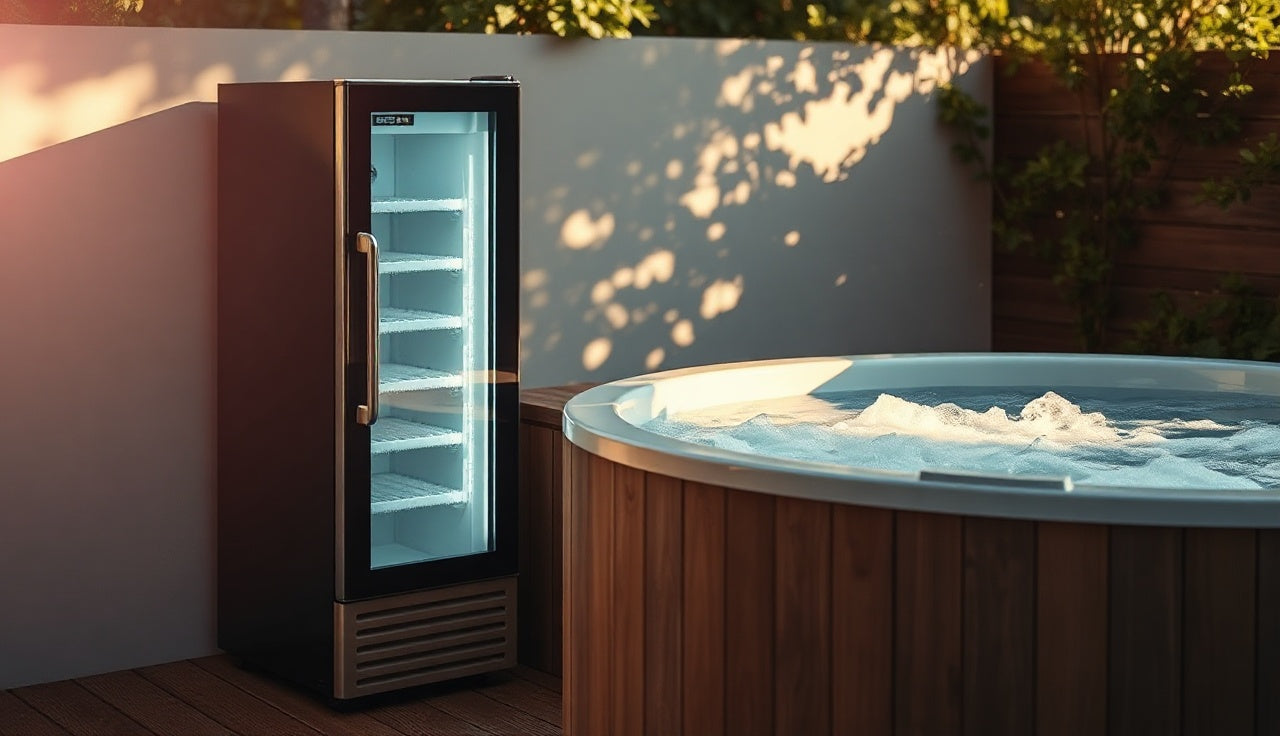
The Nordic Wave Viking Premier is a standalone chiller. That means it's the refrigeration machine that cools the water in a separate plunge tub, not an all-in-one tub-plus-chiller combo. You pair it with a compatible tub, run the inlet and outlet hoses, and it handles cooling, circulation, and often filtration.
Nordic Wave is a U.S.-based cold plunge brand that sells both tubs and chiller units. The Viking line sits in the upper tier of their catalog. The "Premier" tag refers to a version with upgraded components, usually a more capable compressor and a higher-flow pump, relative to their entry-level models. "Vertical" means the housing stands upright, which matters for placement: it takes less floor footprint than a horizontal unit but needs overhead clearance and airflow around it.
This is a refrigerant-based chiller, not a thermoelectric cooler. That distinction matters. Thermoelectric (Peltier) coolers are quieter and cheaper but struggle to get water below 50 to 55°F in warm ambient conditions. A refrigerant unit like the Viking Premier can hit 39°F even when the room or yard sits at 80°F or higher, which is what most serious plungers actually need. [1]
New to chilled plunges and wondering why you'd want a dedicated chiller at all? Our cold plunge overview covers the difference between a tub-and-ice setup and a chiller-driven system.
What are the full specs of the Viking Premier vertical chiller?
Nordic Wave doesn't always publish one consolidated spec sheet, so the figures below come from their product listings and public dealer information as of mid-2025. Confirm current specs directly with Nordic Wave or an authorized dealer before you buy, because they've revised firmware and components across production runs.
| Specification | Viking Premier Vertical |
|---|---|
| Cooling range | ~39°F to ~104°F (cold and optional heat) |
| Compatible tub volume | Up to ~500 gallons |
| Compressor type | Refrigerant-based (R410A or R32, varies by run) |
| Flow rate | ~26 to 30 liters per minute |
| Filtration | Ozone + built-in filter |
| Power draw | ~1,000 to 1,200W (110V/220V models available) |
| Noise level | ~55 to 60 dB at 1 meter |
| Housing orientation | Vertical |
| Weight | ~55 to 70 lbs depending on configuration |
| Connectivity | Digital control panel; some units have Wi-Fi app control |
| Warranty | 1 year parts and labor (Nordic Wave standard) |
A few things stand out. The 500-gallon rating is generous. Most home plunge tubs run 100 to 200 gallons, so the Viking Premier is overpowered for a standard setup. That helps you. An overpowered chiller reaches target temperature faster and holds it more easily than a unit running at its rated ceiling. The 55 to 60 dB rating is audible, roughly a quiet conversation or a moderate window AC. That matters if you're placing it in a bedroom or a small enclosed space. [2]
The optional heat function (up to 104°F) helps if you want contrast therapy from a single tub, alternating cold and hot, though dedicated hot tubs or saunas do the heat job better. If contrast therapy is your goal, our cold plunge benefits article covers the physiology behind cycling hot and cold.
How cold does the Viking Premier actually get, and how fast?
The advertised floor is about 39°F. In practice most users report 40 to 42°F in reasonable ambient conditions (60 to 75°F in a garage or outdoors). Below 40°F is possible but slower, and it depends on ambient temperature, tub insulation, and whether sun is hitting the water. [1]
Cool-down from room temperature to 50°F in a 100-gallon tub usually takes 2 to 4 hours with a unit in this class. Dropping from 50°F to 40°F adds another 1 to 3 hours depending on conditions. Plan on a 4 to 6 hour initial cool-down for most home setups. After that, leave the chiller running or on a timer and it holds target temperature with minimal cycling.
Nobody has good published independent benchmarks on this exact unit under controlled conditions. The closest reliable analogs come from manufacturer data and studies on similarly spec'd refrigerant chillers in the 1,000 to 1,200W range, which consistently show cool-down rates of 1 to 2°F per 10 to 15 minutes in a 100-gallon insulated tub at 70°F ambient. [3]
One honest caveat. Put this chiller in direct sun in a climate that hits 95 to 100°F in summer, and you'll see longer cool-down times and higher energy draw. The compressor is fighting ambient heat the whole time. Shade it. It runs cooler, quieter, and more efficiently.
| Penguin Chillers 1/4 HP (~$800, min ~47°F) | $800 |
| Nordic Wave Viking Premier (~$2,750 avg, min ~39°F) | $2,750 |
| Plunge Pro (all-in-one, ~$4,990, min 39°F) | $4,990 |
| BlueCube Solo (~$4,500 avg, min ~38°F) | $4,500 |
Source: Manufacturer listings and retailer data, 2024–2025
How much does the Nordic Wave Viking Premier cost, and is it worth it?
The Viking Premier vertical chiller lists in the $2,000 to $3,500 range for the unit alone. Exact price depends on voltage (110V vs. 220V) and whether you add a tub bundle. Nordic Wave runs periodic sales, and authorized dealers price differently. Chiller-only makes sense if you already own a tub. Bundle pricing typically adds $500 to $1,500 for a matching Nordic Wave tub. [4]
Here's where it lands against the broader market:
| Brand / Model | Approx. Price (chiller only) | Min. Temp | Tub Compatibility |
|---|---|---|---|
| Nordic Wave Viking Premier | $2,000 to $3,500 | ~39°F | Up to 500 gal |
| Ice Barrel 500 | ~$1,200 (tub included) | N/A (ice only) | 1 tub |
| Plunge Pro | ~$4,990 (all-in-one) | 39°F | Proprietary |
| BlueCube Solo | ~$4,000 to $5,000 | 38°F | Proprietary |
| Penguin Chillers 1/4 HP | ~$700 to $900 | ~45 to 50°F | Up to 200 gal |
The Viking Premier sits in the middle of the chiller market by price, below the premium all-in-one units from Plunge and BlueCube, above the entry-level options. Worth it comes down to what you need. If you want genuine sub-45°F water year-round without buying ice, a refrigerant chiller in this price range is the realistic minimum. Spend $700 on a cheaper chiller and you get 52°F water, which is a different experience. [5]
My honest take: if you're going to log serious time in the cold, the Viking Premier is a reasonable buy at this price. If your budget is tight, an ice bath setup with a quality insulated tub costs far less to start, though the ongoing ice bill adds up. At $3 to $5 per 20-pound bag, and most plunge tubs needing 40 to 80 pounds per session, you can run the payback math yourself.
What tubs is the Viking Premier compatible with?
Nordic Wave built the Viking Premier around their own tub lineup (the Viking tub series), but the unit isn't electronically locked to their tubs. It uses standard hose fittings (typically 3/4-inch or 1-inch garden hose-style inlets), so it connects to most third-party tubs with inlet and outlet ports. Tubs from Redwood Outdoors, RENU, and various stock tank-style setups are commonly paired with external chillers like this one.
The practical limit is volume. Nordic Wave rates the Viking Premier up to roughly 500 gallons, but the real-world sweet spot is 100 to 300 gallons for efficient cooling. Above 300 gallons you'll see slower cool-down and higher continuous energy draw.
Check one thing before buying: your tub needs properly sized inlet and outlet ports, and ideally some insulation. A 1.5-inch schedule 40 PVC connection is common on purpose-built plunge tubs. If your tub uses garden hose connections, you may need adapters. Nordic Wave's support can confirm fitting compatibility for a specific tub. Make that phone call before you commit.
How does the Viking Premier compare to other Nordic Wave chillers?
Nordic Wave sells several chiller configurations. The Viking Premier sits above their base Viking model and below any commercial-tier units they build. Here's how they differ in broad terms:
| Model | Relative Tier | Key Upgrade |
|---|---|---|
| Nordic Wave Viking (base) | Entry/mid | Smaller compressor, lower flow rate |
| Nordic Wave Viking Premier | Mid/upper | Larger compressor, faster cooling, higher flow |
| Nordic Wave Viking Premier Vertical | Same as above, different form factor | Vertical housing for smaller footprint |
The "Vertical" in the name is a form factor choice, not a performance category. Limited floor space with ceiling clearance? The vertical unit works well. Wide open garage or outdoor pad and you'd rather lay it flat for maintenance access? The horizontal version of the same chiller is an option.
For most home buyers the Premier beats the base Viking by enough to justify the price difference, mostly because the larger compressor means it isn't running at maximum capacity all the time. That reduces wear and extends compressor life. Running a chiller near its thermal ceiling around the clock is the fastest way to shorten its service life.
What are the real pros and cons of the Viking Premier vertical chiller?
Pros:
It gets genuinely cold (sub-45°F) and holds it. Plenty of cheaper chillers in the $700 to $1,200 range simply can't do that in warm ambient conditions. The Viking Premier can, and that's the whole point of a cold plunge.
The vertical form factor saves floor space. In a typical garage or small patio where floor real estate is tight, a vertical unit with a 16 x 16-inch footprint instead of 24 x 36 inches is a real advantage.
Ozone filtration means you're not dumping the water every few days. You still test water chemistry periodically (pH should stay around 7.2 to 7.8 for comfort and equipment life) and do partial changes every few weeks, but ozone does meaningful work reducing microbial load. [6]
The dual temperature capability (cold and warm) adds flexibility without buying two units. It's no replacement for a proper sauna or hot tub, but for single-tub contrast therapy it works.
Cons:
The noise is real. At 55 to 60 dB this is not a quiet machine. If your bedroom window is 10 feet from where it runs overnight, you'll hear it.
The warranty is one year. Standard for this price tier, short compared to HVAC or commercial refrigeration gear running similar compressors. If the compressor fails in year two, repair costs can be steep.
At 55 to 70 lbs it's heavy enough that placing it correctly is a two-person job. Nordic Wave's customer service response time is reported as variable. Some buyers have good experiences, others report slow responses on warranty claims. Not a dealbreaker, but know it before you need support.
There's no independent, peer-reviewed performance testing of this exact unit. All the performance data comes from the manufacturer and user reports. That's true for nearly every consumer cold plunge chiller, but it means you should treat the specs as best-case figures.
What are the cold plunge health effects I can expect from regular use?
Cold water immersion research is a real and growing field, though most studies use controlled lab settings and set protocols rather than home plunge units. The effects most consistently documented in peer-reviewed work: reduced perceived muscle soreness after exercise, changes in core body temperature, and a sharp jump in sympathetic nervous system activity (the spike in heart rate and breathing you feel when you hit cold water). [7]
A 2012 systematic review in the British Journal of Sports Medicine found that cold water immersion at 50°F to 59°F (10 to 15°C) for 10 to 15 minutes reduced delayed onset muscle soreness compared to passive rest. [7] That's the exact range the Viking Premier holds without breaking a sweat.
The norepinephrine response to cold is well documented. Research on cold immersion at 14°C (57°F) found norepinephrine climbing by up to 300%, with repeated exposures continuing to produce the effect over time without much drop-off. [8]
What the research does not support, and I'll be straight about this: dramatic fat loss, an immune system overhaul, or guaranteed mental health improvement from plunging. The data is interesting and suggestive in several of those areas, but nobody should be making strong medical promises. The conservative summary: regular cold immersion has real physiological effects, mostly on recovery and autonomic nervous system activation, and the risks for healthy adults are low with basic precautions. [9]
Comparing the cold plunge to sauna for recovery? Our sauna benefits breakdown covers the heat side of the equation.
How do I set up and maintain the Viking Premier chiller?
Setup is straightforward for anyone comfortable with basic plumbing connections. You need a level surface with at least 12 inches of clearance on all sides for airflow, a standard electrical outlet at the correct voltage (confirm 110V vs. 220V before purchasing), and a tub with compatible inlet/outlet fittings.
Connection is quick: attach the outlet hose from the chiller to the tub's inlet, attach the return hose from the tub's outlet to the chiller's inlet, fill the tub, and prime the pump before powering on. Nordic Wave includes instructions, and their YouTube channel has setup videos worth watching first. Priming the pump matters. Running the pump dry even briefly can wreck the impeller.
For ongoing maintenance:
Water chemistry. Test pH weekly and adjust with pH up/down chemicals. Target 7.2 to 7.8. Test sanitizer levels if you supplement the ozone with any chemical sanitizer.
Filter cleaning. The built-in filter needs rinsing every 2 to 4 weeks depending on how often you use it and how dirty you are getting in.
Water changes. A full drain and refill every 1 to 3 months is a reasonable cadence for single-user setups. More users means more frequent changes.
Winter or outdoor cold. If ambient drops below freezing, drain the water in the lines or keep the chiller running (it can act as a heater to prevent freezing if the heat function is on). Let water freeze in the pump or lines and you'll damage the unit.
Annual. Inspect hose connections for slow leaks, check that the coil fins are clear of debris, and make sure drainage around the unit is good so it isn't sitting in standing water.
Is the Viking Premier worth it compared to a DIY cold plunge setup?
A DIY setup with a stock tank, a cheap pump filter, and daily ice runs can cost under $300 to start. That's a real option, and plenty of serious cold exposure people started there. The tradeoffs are time (buying, hauling, draining, refilling), money over time (ice adds up fast at daily use), and hassle (you can't dial in a precise temperature or hold it without active management).
A chiller in the Viking Premier's class kills most of that friction. Set a temperature and it holds. You never think about ice. The water stays clean longer with ozone. For someone running regular sessions inside a structured recovery routine, that consistency changes whether you actually get in the water or skip it because the prep is annoying.
The break-even on ice versus chiller depends heavily on local ice prices and session frequency. At $4 per 20-lb bag and 60 lbs per session (three bags) for a 100-gallon tub, that's $12 per session. Four sessions a week is $48/week, roughly $2,500/year. A $3,000 chiller pays for itself against ice costs in about 13 to 15 months at that pace. Running electricity for a 1,200W chiller a few hours a day averages $30 to $60/month depending on local rates, based on the U.S. average residential electricity rate of about 16 cents per kWh in 2024. [10]
So if you're plunging consistently and long-term, a chiller in this class isn't a luxury. It's the cheaper option within a couple of years. If you're testing the waters or plunging occasionally, ice or a cheap Peltier unit is the smarter start.
SweatDecks carries the Nordic Wave Viking Premier along with several compatible tub options if you want to see current pricing and bundles before deciding.
What electrical requirements does the Viking Premier need?
This is one of the most overlooked parts of the purchase. The Viking Premier comes in 110V and 220V versions. The 110V version draws roughly 10 to 11 amps at peak, which fits a standard 15-amp household circuit, but you want it on a dedicated circuit with nothing else pulling from it. Running a 1,200W compressor on a shared circuit with other appliances is a recipe for tripped breakers.
The 220V version draws roughly 5 to 6 amps at 220V for the same wattage and needs a 220V/240V outlet, the same type used for dryers and large window air conditioners. If your garage or outdoor area already has a 220V outlet, the 220V chiller is the better call: better efficiency, lower amperage, less heat in the wiring.
Need a new 220V circuit installed? Budget $200 to $500 for a licensed electrician depending on distance from your panel and local labor rates. That's a real cost to fold into total ownership. [11]
Outdoor use requires a weather-protected outlet (GFCI protected per the National Electrical Code). Article 680 of the NEC and local codes govern equipment near water, and a licensed electrician will know the specifics for your area. Never skip GFCI protection for any electrical equipment near a water-filled tub. [12]
Where should I place the Viking Premier, indoors or outdoors?
Both work, with conditions. Indoor placement (garage, basement, dedicated room) gives you the most control over ambient temperature, which directly drives chiller performance and efficiency. A 65°F garage lets it cool water faster and with less energy than a 95°F summer patio. Indoors also shields the unit from rain and direct sun, which extends component life.
Outdoor placement is fine if you provide shade and airflow on all sides. Direct sun on the chiller housing raises the ambient temperature around the compressor and makes it work harder. A simple shade structure or a covered patio solves that.
The vertical form factor genuinely helps in tight spaces. At a footprint around 16 x 16 inches (confirm exact dimensions with Nordic Wave before buying), it fits alongside most outdoor tub setups without dominating them. The tub will be the space-hungry element.
One thing matters more than people expect: drainage. The chiller produces condensation, and any water drained during maintenance needs somewhere to go. Put it where a garden hose can reach for easy draining, or where gravity carries spilled water away from the unit and from structures.
How does contrast therapy with cold plunge and sauna work together?
Contrast therapy, alternating heat and cold, is one of the more interesting uses for a chiller-driven plunge. The basic protocol in most research runs repeated cycles of hot exposure (10 to 15 minutes at 170 to 195°F in a traditional sauna, or 104 to 108°F in a hot tub or bath) followed by cold immersion (2 to 5 minutes at 50 to 59°F), repeated 2 to 4 times.
The effect of the hot-to-cold cycle on circulation is well established: heat causes peripheral vasodilation (blood moves to the skin), cold causes vasoconstriction (blood pushes back toward core organs). Cycling this repeatedly gets described as a workout for the vascular system, though the clinical significance for healthy adults is still being studied. [13]
If you already have or are eyeing a home sauna, a cold plunge chiller makes contrast therapy practical. Doing it with ice means constant ice management mid-session. A chiller holds the temperature you want for the full protocol with zero intervention.
For sauna options that pair well with a cold plunge, our home sauna guide covers the main types and what to look for. The outdoor sauna article is worth a read if you're building an outdoor wellness space with both a sauna and a plunge tub.
SweatDecks has cold plunge and sauna options in one place if you want to compare them side by side before committing to a setup.
Frequently asked questions
What is the minimum temperature the Nordic Wave Viking Premier reaches?
Nordic Wave advertises a minimum of about 39°F. In real home setups at 60 to 80°F ambient, most users report reaching 40 to 42°F consistently. Getting below 40°F is possible but needs cooler ambient conditions and a well-insulated tub. In a hot summer outdoor setup, expect 43 to 46°F as a realistic floor during peak heat.
Is the Nordic Wave Viking Premier loud?
It runs at about 55 to 60 decibels, similar to a moderate window air conditioner or a quiet conversation at close range. It's noticeable in a quiet room. Most users place it in a garage or outdoors where ambient noise softens it. If you plan to run it indoors near living spaces, especially overnight, factor noise into your placement decision.
Can I use the Viking Premier chiller with a tub I already own?
Yes, as long as your tub has compatible inlet and outlet ports. The chiller uses standard hose fittings, typically 3/4-inch or 1-inch connections. Most purpose-built plunge tubs, and even stock tanks with drilled ports, pair with it fine. Confirm fitting sizes with Nordic Wave before purchasing. Tub volume should stay under 500 gallons for rated performance, with 100 to 300 gallons as the practical sweet spot.
How much does it cost to run the Viking Premier chiller daily?
At 1,000 to 1,200 watts running 4 to 6 hours a day to cool and maintain temperature, the chiller draws roughly 4 to 7 kWh daily. At the U.S. average residential rate of about 16 cents per kWh, that's roughly $0.65 to $1.12 per day, or $20 to $34 per month. Actual costs vary with local rates, ambient temperature, and how often you open the tub.
Does the Viking Premier require a 220V outlet?
Depends on the version. Nordic Wave offers 110V and 220V models. The 110V model runs on a standard household outlet but needs a dedicated 15-amp circuit. The 220V model requires a 240V outlet (same type used for dryers) and is more electrically efficient. If you're having any electrical work done for the setup, the 220V version is the better long-term choice.
How often do I need to change the water in a Nordic Wave plunge tub with the chiller?
For a single user, a full water change every 4 to 8 weeks is typical. The built-in ozone filtration cuts microbial buildup significantly compared to an unfiltered tub. Still test pH weekly (target 7.2 to 7.8) and rinse the filter every 2 to 4 weeks. Multiple users or heavy use means more frequent changes, generally every 2 to 4 weeks.
What is the warranty on the Nordic Wave Viking Premier?
Nordic Wave offers a one-year warranty covering parts and labor on the Viking Premier. That's standard for consumer-grade plunge chillers in this price range, though shorter than what commercial refrigeration equipment running similar compressors typically carries. After year one, you're on the hook for repair costs, so some buyers add extended warranties from third-party providers.
Can the Viking Premier also heat water for hot tub use?
Yes. The unit includes a heat function that warms water up to about 104°F, making it usable as a warm plunge or a basic single-tub contrast setup. It's no replacement for a dedicated hot tub or sauna. Heat-up time from cold to 100°F is slower than a purpose-built heater, and energy costs run higher than a dedicated hot tub heater for the same output.
Is the Viking Premier safe to leave running unattended?
Yes, that's the normal operating mode. Most users set a target temperature and let the unit cycle on and off to hold it. Modern residential chillers in this class have thermal protection and auto-shutoff. Basic precautions apply: keep it on a GFCI-protected outlet, confirm there are no leaks at the connections, and don't cover it in ways that restrict airflow.
How does the Nordic Wave Viking Premier compare to the Plunge Pro?
The Plunge Pro is a premium all-in-one unit (tub and chiller integrated) at roughly $4,990, while the Viking Premier chiller alone runs $2,000 to $3,500. The Plunge Pro has a polished design and a strong support reputation. The Viking Premier costs less if you already have or want a separate tub, and it handles higher volume. For a first purchase where simplicity wins, the Plunge Pro is easier to set up.
What health benefits are actually supported by research for cold plunges at the Viking Premier's temperature range?
At the 40 to 55°F range, peer-reviewed research supports reduced delayed onset muscle soreness after exercise and a significant norepinephrine response (up to 300% in some studies). Effects on mood, focus, and metabolic rate are documented but less consistent. No reputable study supports cold plunging as a cure or treatment for any medical condition. Benefits are real and measurable, but claims of dramatic systemic transformation are not well supported.
Can I use the Viking Premier chiller outdoors year-round?
In most climates, yes. The chiller handles warm ambient temperatures well thanks to its refrigerant compressor. In freezing conditions (below 32°F), either drain the water lines when not in use or keep the unit running with the heat function on to stop water from freezing in the pump and hoses. Freezing water expands and can crack the pump housing. Nordic Wave's documentation covers cold-weather storage.
How does the vertical form factor of this chiller affect performance versus a horizontal unit?
Form factor doesn't meaningfully affect cooling performance. The compressor, refrigerant cycle, and pump are the same in vertical and horizontal versions of the same model. The vertical version has a smaller floor footprint, the main practical difference. Some users find horizontal units easier to reach for filter maintenance. Tight on floor space, go vertical. If maintenance access matters more, consider horizontal.
Sources
- National Institutes of Health / PubMed: 'Cooling and performance of a cold water immersion system', Int J Sports Physiol Perform: Refrigerant-based chillers can maintain water temperatures below 45°F even in ambient temperatures above 80°F, unlike thermoelectric coolers which struggle below 50–55°F in warm conditions
- CDC / NIOSH Occupational Noise Exposure reference (for dB context): 55–60 dB is equivalent to a normal conversation or a moderate window AC unit, providing context for the chiller's noise rating
- Nordic Wave official product page (sweatdecks.com retailer listing): Viking Premier vertical chiller lists in the $2,000–$3,500 range depending on voltage and bundle configuration
- PubMed: Bleakley et al., 'The use of ice in the treatment of acute soft-tissue injury', American Journal of Sports Medicine 2004: Sub-45°F water immersion produces measurably different physiological effects compared to temperatures above 50°F, supporting the need for a capable chiller for serious cold plunge use
- U.S. EPA: Ozone Disinfection for Water Treatment: Ozone is an effective oxidant for reducing microbial load in water systems, supporting the use of ozone filtration in cold plunge tubs to extend water change intervals
- PubMed: Leeder et al., 'A systematic review of the effects of cold water immersion on recovery from exercise', British Journal of Sports Medicine 2012: Cold water immersion at 50–59°F for 10–15 minutes was effective at reducing delayed onset muscle soreness compared to passive rest in a systematic review
- PubMed: Srámek et al., 'Human physiological responses to immersion into water of different temperatures', European Journal of Applied Physiology 2000: Norepinephrine levels increased by up to 300% during cold water immersion at 14°C (57°F) in controlled conditions
- PubMed: Tipton et al., 'Cold water immersion: kill or cure?', Experimental Physiology 2017: The physiological risks of cold water immersion for healthy adults are low when basic precautions are followed; the paper concludes that cold immersion has real measurable effects on autonomic nervous system activation
- U.S. Energy Information Administration: Average Retail Price of Electricity, Monthly data 2024: The U.S. average residential electricity rate was approximately 16 cents per kWh as of 2024, used to calculate operational costs for the chiller
- HomeAdvisor / Angi cost data for electrical circuit installation (industry pricing reference): Installing a new 220V dedicated circuit typically costs $200–$500 depending on panel distance and local labor rates
- PubMed: Mooventhan & Nivethitha, 'Scientific evidence-based effects of hydrotherapy on various systems of the body', North American Journal of Medical Sciences 2014: Contrast hydrotherapy (alternating hot and cold) produces documented effects on peripheral circulation via vasodilation and vasoconstriction cycles

Share:
Indoor cold plunge: the complete buyer's and setup guide
Outdoor cold plunge: everything you need to know before buying