
Last updated 2026-07-10
TL;DR
An outdoor cold plunge is a dedicated tub or tank kept at 39 to 59°F, placed outside for year-round cold-water immersion. Research supports reduced muscle soreness and better mood. Costs run from about $500 for a chest-freezer conversion to $10,000+ for a chiller-equipped unit. Setup takes 1 to 4 hours. Maintenance is manageable if you stay on top of water chemistry.
What exactly is an outdoor cold plunge?
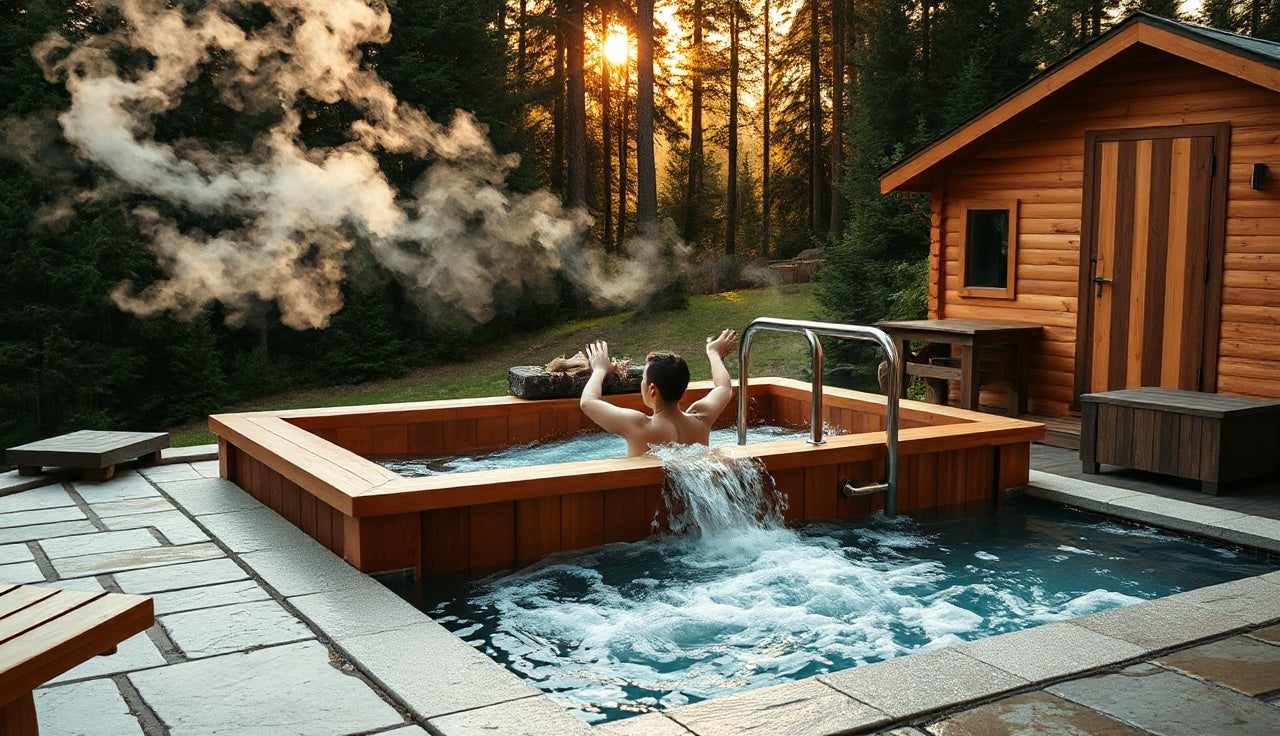
A cold plunge is a purpose-built tub, stock tank, or converted vessel filled with water held cold, usually 39 to 59°F (4 to 15°C), for deliberate immersion. Outdoor versions sit on a deck, patio, or in a yard, exposed to weather. That exposure matters. Ambient temperature, sunlight, and rain all push on your water temperature and set how often you have to touch the maintenance.
Indoor plunges exist too. Most people go outdoors anyway, because the footprint is big, draining is easier out there, and pairing a plunge with an outdoor sauna fits naturally. The heat-then-cold contrast loop drives a lot of outdoor-specific demand.
The category is huge. At one end, a $50 galvanized stock tank and a bag of ice. At the other, a temperature-controlled, filtered, UV-sanitized pod that costs more than a used car. Both get you into cold water. What separates them is convenience, hygiene, and how long you actually keep at it.
What temperature should an outdoor cold plunge be?
Most research on cold-water immersion uses water between 50 and 59°F (10 to 15°C), for 10 to 15 minutes. A 2022 meta-analysis in the International Journal of Environmental Research and Public Health found that range produced the most consistent reductions in perceived muscle soreness after exercise [1]. Colder is not better. It just adds risk.
For home use, 50 to 60°F is where most practitioners land. New users often start near 60°F and work down over several weeks. Water below 50°F raises the odds of cold shock response, an involuntary gasp reflex that can trigger cardiac arrhythmia in vulnerable people [2].
| Water Temp (°F) | Water Temp (°C) | Common Use Case |
|---|---|---|
| 32 to 39 | 0 to 4 | Ice baths (clinical, short duration) |
| 39 to 50 | 4 to 10 | Advanced cold therapy, short sessions |
| 50 to 59 | 10 to 15 | Optimal for most home users |
| 59 to 68 | 15 to 20 | Beginner acclimation range |
| 68+ | 20+ | Cool but not a meaningful cold stimulus |
Outdoor air complicates all of this. In winter, a chiller-free tank drops below target fast. In summer, groundwater and sun can push water past 60°F within hours. A chiller solves both directions but adds $1,500 to $3,500 to the bill [3].
What are the real benefits of a cold plunge?
The evidence is real but narrower than the wellness internet claims. Nobody should expect miracles. Here is what the research actually holds up.
Muscle soreness reduction is the most replicated finding. A Cochrane systematic review of cold-water immersion after exercise found it reduced soreness significantly compared to passive rest, though effect sizes were moderate [4]. Athletes in heavy training blocks get real practical value from that.
Mood and alertness get reported constantly, and the mechanism is plausible. A 2021 study in PLOS ONE found cold-water swimming was tied to lower depression and fatigue scores, though it was observational and can't prove cause [5]. The norepinephrine spike from cold is well documented. What that spike does in your daily life varies person to person.
Cardiovascular adaptation is still open research. Regular cold exposure clearly improves cold-shock habituation over time, blunting that first gasp [2]. Whether that carries into measurable heart-health gains for healthy adults is not settled.
The cold plunge benefits guide goes deeper into individual studies and what each one measured.
What the evidence does not back: weight-loss claims, immune-overhaul promises, longevity guarantees. Those run well ahead of the data.
| Stock tank (manual ice) | $275 |
| Chest freezer conversion | $600 |
| Entry-level purpose-built tub | $2,350 |
| Mid-range chiller unit | $5,000 |
| Premium / custom build | $10,750 |
Source: Industry pricing data, SweatDecks, 2024
How much does an outdoor cold plunge cost?
Cost swings hard depending on how much temperature control and convenience you want.
Chest freezer conversion: $400 to $800 total. A 7 to 10 cubic foot chest freezer, lined with food-safe or marine-grade vinyl, holds roughly 100 gallons. Add a small pump and a basic filter. The catch: shallow depth, awkward entry, and you're using an appliance in a way its maker never intended [3]. Electricity runs low, roughly $20 to $40 a month.
Stock tank (manual): $150 to $400 for the tank, plus ice or a separate chiller. A 100 to 150 gallon galvanized or poly stock tank is the cheapest true plunge vessel. Without a chiller, you're buying ice or waiting on cold weather. Ice costs $3 to $8 per 20-lb bag, and a tank this size needs 40 to 80 lbs to move the temperature meaningfully.
Entry-level purpose-built tubs: $1,200 to $3,500. These usually come with basic insulation and a filter. Some add a modest chiller. Build quality runs from fine to flimsy.
Mid-range chiller-equipped units: $3,500 to $6,500. This is where the market gets genuinely good. Real insulation, a chiller that holds 50°F even in 85°F air, UV or ozone sanitation, and a circulation pump. Most serious home users end up here.
Premium and custom: $6,500 to $15,000+. Stainless or cedar builds, powerful chillers, smart controls, built-in filtration. Many buyers pair these with a home sauna as a full recovery station.
| Setup Type | Upfront Cost | Monthly Running Cost | Temp Control |
|---|---|---|---|
| Stock tank + ice | $150 to 400 | $60 to 120 (ice) | None |
| Chest freezer | $400 to 800 | $20 to 40 | Yes (manual) |
| Entry-level tub | $1,200 to 3,500 | $25 to 60 | Partial |
| Mid-range chiller unit | $3,500 to 6,500 | $30 to 80 | Yes |
| Premium/custom | $6,500 to 15,000+ | $40 to 100 | Yes, precise |
What outdoor cold plunge setup works best in different climates?
Climate is the factor people underestimate most. Your setup has to perform at the extremes of your local weather, not the average.
Hot climates (steady 80°F+ summers) need a chiller. No amount of insulation keeps 50°F water at 50°F when hot air and direct sun fight it all day. Put the tub in shade. A UV-rated cover is essential, both to cut heat gain and to slow the algae that warm water speeds up.
Cold climates flip the problem in winter. Without a heater or circulation, water in an outdoor tub can freeze. Most quality chillers include a freeze-protection mode that holds water just above 32°F to prevent damage. If yours lacks it, you either drain for winter or run a small aquarium heater as backup. Pipes to an external chiller need insulation wrap in hard-freeze climates.
Four-season climates want a unit that handles both ends. That usually means at least $3,500 for a genuine chiller-and-heater combo, more than a cooling-only system.
Ground surface matters too. A plunge tub full of water weighs 800 to 1,500 lbs. A wood deck needs an engineer's sign-off or reinforcement before you load that on it. A concrete pad or compacted gravel base is the safer default for most installs [3].
If you want heat therapy outside as well, building the plunge alongside an outdoor sauna is a natural pairing many people tackle at once.
How do you maintain an outdoor cold plunge?
Maintenance is where first-time buyers get blindsided. Cold water is not self-cleaning. A warm hot tub runs hot enough to slow some bacterial growth. A cold plunge at 50 to 59°F sits in a range where certain bacteria thrive, and skin oils, sweat, and outdoor debris pile up fast.
The basic stack for any outdoor plunge:
Filtration runs continuously or on a timer. A circulation pump pushing water through a sediment filter, plus an optional UV-C sterilizer, handles most of the biological load. UV is worth the extra cost outdoors, because pollen, insects, and debris get in constantly.
Sanitizer is still needed even with UV. Most makers recommend bromine over chlorine for cold plunges, because bromine stays stable at low temperatures. Free bromine should test at 1 to 3 ppm [3]. Chlorine works but degrades faster and smells stronger in a small, tight volume of water.
pH needs weekly testing. Aim for 7.2 to 7.8. Drift outside that and sanitizers lose punch while the water starts irritating skin and eyes. A $15 test-strip kit or a $50 digital tester covers this.
Full water changes depend on use and filtration. With good filtration and clean chemistry, some manufacturers say their systems go 3 to 6 months between drains. Without good filtration, a weekly soak-only setup should swap water every 1 to 2 weeks.
Covers are non-negotiable outdoors. A well-fitting thermal cover cuts evaporation, keeps debris out, drops chiller runtime by 30 to 50%, and keeps the surface safe.
Is an outdoor cold plunge safe to use?
For healthy adults without heart conditions, regular immersion at 50 to 59°F for 5 to 15 minutes carries low risk when done right. The risks that do exist are real, and worth knowing before your first dip.
Cold shock response is the immediate danger. Sudden cold immersion triggers an involuntary gasp and hyperventilation. In open water that's a drowning risk. In a controlled tub it's less dangerous, but it can still set off arrhythmia in people with underlying heart conditions. The American Heart Association warns that cold-water immersion can trigger cardiac events in susceptible people [2]. Any heart condition means you talk to your physician first.
Hypothermia is not a realistic worry over a 10 to 15 minute session in a properly tempered tub. It becomes relevant only below 50°F when you stay in longer than planned. A waterproof timer is a cheap guard against that.
Slipping on entry and exit is the most common actual injury. Wet ground, numb feet, an awkward step over a tub rim. Real fall hazard. Non-slip mats, a grab handle, and a stable step platform fix it.
The CDC advises that anyone pregnant, with a recent wound, or with active infections avoid immersion tubs without medical clearance [6]. Same guidance applies here.
Start conservative. A first session at 60°F for 2 to 3 minutes tells you how your body reacts. Work down in temperature and up in duration over several weeks.
How long should you stay in an outdoor cold plunge?
For muscle recovery, the research clusters around 10 to 15 minutes at 10 to 15°C [1]. Most people can't start there, and you don't need to in order to see benefit.
A sane beginner progression: first two weeks at 60°F, 2 to 4 minutes a session. Weeks three and four, drop to 55°F and stretch to 5 to 8 minutes. After month one, most people settle into 50 to 55°F for 8 to 12 minutes as a comfortable working range.
There is no documented extra benefit past 15 minutes at any temperature in this range. Longer is not better. The cold response fires quickly. The back half of a long session is endurance, not extra payoff.
Frequency is just as understudied in long-term trials. Most practitioners do 3 to 5 sessions a week. Daily is common among the dedicated. Nobody has good data on whether daily versus three-times-weekly changes outcomes over months. The closest evidence is short-term and doesn't answer it.
One timing caution: some researchers ask whether plunging right after strength training blunts hypertrophy signaling. A 2021 paper in the Journal of Physiology suggested post-exercise cold-water immersion may attenuate acute anabolic signaling [7]. If muscle growth is your main goal, waiting 4 to 6 hours after lifting before you plunge is a reasonable hedge.
What permits or regulations apply to outdoor cold plunges?
Most cities treat a backyard cold plunge as a private water feature, not a pool or spa. Rules vary enough that you check your local code rather than assume either way.
The frameworks to check:
Building permits may apply if the vessel holds over a set volume (often 150 gallons in many jurisdictions) or needs a permanent electrical connection. A 240V circuit for a chiller almost always needs a licensed electrician and a permit. The National Electrical Code, specifically Article 680, governs pool, spa, and hot-tub wiring, and in most states covers any outdoor water vessel with electrical equipment within 5 feet [8].
HOA rules are often tighter than city code. An HOA can restrict what you put on a deck or in a yard even when no permit is required. Read your CC&Rs before you buy anything.
Insurance: a cold plunge usually isn't an insurable structure on a homeowners policy, but if someone gets hurt in or around it, your liability coverage may come into play. Mention it to your agent.
For most single-family homes outside HOA territory, a freestanding tub on a concrete pad with a 240V hookup by a licensed electrician is the path of least friction. No inspection, no permit for the vessel itself, just the wiring.
How does an outdoor cold plunge compare to an ice bath?
People swap the terms freely, but in practice they describe different things.
An ice bath is usually a one-off: a bathtub, barrel, or tub filled with water and ice for a single session. You don't maintain it. You drain it after. Temperature is hard to control, landing wherever your ice-to-water ratio takes it. Plenty of athletes tolerate ice baths for acute recovery after competition, but few sustain a daily habit with them, because the ice cost and hassle wear you down.
A cold plunge is a maintained, ready-to-use system. Water sits at target continuously. Walk out, get in, get out. No prep, no ice run. That low-friction access is what actually builds a consistent practice, and consistency is what drives adaptation.
For the muscle-soreness research, the two are functionally the same if you match temperature and duration. The practical gap is that a maintained outdoor plunge is far more likely to become a habit.
Cost-wise, a year of an ice habit at four sessions a week runs $600 to $1,500 in ice alone, hitting the break-even point of a decent chiller unit in two to three years.
What features should you look for in an outdoor cold plunge?
After all of the above, here's what actually matters when you evaluate a specific product.
Chiller capacity is measured in BTUs or horsepower. For a 100 to 150 gallon vessel in a warm climate, you want at least 1/5 HP. For hot climates with 90°F+ summers, go 1/3 HP or higher. An underpowered chiller runs nonstop and still can't hold target on a hot day.
Insulation quality sets your running cost and how hard the chiller works. Closed-cell foam 2 to 3 inches thick in walls and floor is the outdoor minimum. Some makers test R-value. Most don't publish it. Ask.
Filtration should include at least a circulation pump and a replaceable cartridge filter. UV-C sterilization earns its cost outdoors. Ozone is an alternative. You'll touch this daily, so filter access shouldn't need tools.
Entry design matters more than spec sheets suggest. A high-sided vessel with no step and no handle is a fall hazard. Look for a built-in step, a grab rail, or at minimum confirm a third-party step fits the tub dimensions.
Cover fit and material drive heat retention, debris exclusion, and safety. A cover that doesn't seal well is worse than useless outdoors.
SweatDecks carries a curated selection of outdoor cold plunges across the price ranges here, with filter-by-climate and filter-by-chiller-capacity options that make it easier to match a unit to your setup.
If you're building a full heat-and-cold station, review the cold plunge collection and the outdoor sauna pages together.
How do you install an outdoor cold plunge at home?
Install complexity comes down almost entirely to whether you need a new electrical circuit.
Electrical: most chillers draw 240V at 15 to 20A. If you don't have a spare 240V circuit near your spot, budget $300 to $800 for a licensed electrician to run one, depending on distance from your panel [3]. NEC Article 680 for outdoor water-feature wiring requires GFCI protection, a bonding conductor, and specific setback distances from the water surface for any non-submersible equipment [8].
Surface prep: as noted, 800 to 1,500 lbs of loaded tub is not something most wood decks take without reinforcement. A 4-inch reinforced concrete pad is the cleanest fix. Budget $500 to $1,500 for a contractor to pour one. Compacted decomposed granite over a paver base is a cheaper option that works for lighter poly units.
Plumbing: most freestanding plunges are self-contained. You fill from a hose and drain by gravity to a yard or sewer cleanout. No permanent plumbing. If your unit has a floor drain fitting, check whether your local code allows gray-water discharge to the yard. In most residential zones it does for untreated water, but chemically treated water (bromine or chlorine) has to drain to the sewer.
Actual assembly of most purpose-built units takes 1 to 3 hours with two people. The chiller usually mounts on the outside of the tub, hoses connect to fittings, and you fill with a garden hose. Expect the chiller to run 6 to 12 hours to bring a full tank from groundwater temperature to target.
Frequently asked questions
Can I leave an outdoor cold plunge out in winter?
Yes, if your unit has freeze protection mode. Quality chiller units include a setting that keeps water just above 32°F to prevent ice damage to pipes and the vessel. Without freeze protection, you need to either drain the unit before hard freezes or run a small submersible aquarium heater as backup. Always check the manufacturer's minimum operating temperature rating before leaving a unit outdoors year-round.
How often should I change the water in an outdoor cold plunge?
With good filtration, UV sterilization, and proper bromine or chlorine levels, some manufacturers claim water lasts 3 to 6 months. Without a chiller and filter, plan on every 1 to 2 weeks. Test pH and sanitizer at least weekly. When water turns cloudy, smells off, or sanitizer levels won't hold, drain and refill regardless of the schedule.
What is the best temperature for a cold plunge for beginners?
Start at 60°F (15.5°C) for your first few sessions. That's cold enough to produce a real physiological response without the serious cold-shock risk of colder water. After two to three weeks of consistent sessions, most people work down to 55°F, then 50°F over the following month. There is no benefit to rushing colder.
Do outdoor cold plunges need a permit?
Usually not for the vessel itself, but almost always for the electrical work. A 240V circuit for a chiller requires a permit and a licensed electrician under most jurisdictions' adoption of the National Electrical Code. HOA rules may also restrict outdoor installations. Check local building codes and your HOA CC&Rs before purchasing.
Can I use a stock tank as an outdoor cold plunge?
Yes. A 100 to 150 gallon galvanized or polyethylene stock tank is one of the cheapest starting points. Without a chiller, you need ice or cold weather to hit target. A 100-gallon tank needs 40 to 80 lbs of ice to drop from groundwater temperature (typically 55 to 65°F) into the 50 to 55°F range. Add a basic aquarium pump and filter to keep water from going stagnant between sessions.
How much electricity does an outdoor cold plunge chiller use?
A typical 1/5 to 1/3 HP chiller draws 300 to 700 watts. Running 4 to 6 hours a day to hold temperature, that's roughly 1.2 to 4.2 kWh daily. At the US average residential rate of about $0.16/kWh (EIA, 2024), monthly running costs land around $20 to $55. A well-insulated unit in a moderate climate with a good cover runs toward the low end. An undersized chiller grinding away in a hot climate hits the high end.
Is cold plunging safe for people with high blood pressure?
Cold water immersion causes an immediate spike in blood pressure and heart rate. The American Heart Association flags cold-water immersion as a potential cardiac trigger in people with cardiovascular conditions. If you have hypertension, a history of heart disease, or arrhythmia, talk to your physician before starting. This is not a blanket prohibition, but it is a real conversation to have before your first session.
Should I cold plunge before or after a sauna session?
After the sauna. The traditional contrast protocol goes: 10 to 20 minutes of heat in a sauna, then a cold plunge for 2 to 5 minutes, repeated 2 to 3 rounds. Ending on cold is the most common choice and produces the most alert feeling afterward. Some practitioners end on heat for relaxation. Neither order is wrong. Experiment and see what your body prefers.
What is the difference between a cold plunge and a hot tub?
The only structural similarity is that both hold water. A hot tub runs at 100 to 104°F for relaxation. A cold plunge runs at 39 to 59°F for deliberate cold stress. Chemically, cold plunges often use lower sanitizer doses than hot tubs, because lower temperatures slow bacterial growth somewhat. The equipment, insulation goals, and physiological purpose are entirely different.
Can cold plunging help with sleep?
There's plausible biology here: core body temperature drops to initiate sleep, and a temperature rebound after cold exposure may support that. Observational data from cold-water swimming studies shows self-reported sleep improvement. Controlled trial data is thin. Timing matters anecdotally. Most users report better results from afternoon or early-evening sessions than from plunging right before bed.
What size cold plunge do I need?
For a single adult, 60 to 80 gallons is functional but tight. 100 to 125 gallons is comfortable for one person up to 6'2" and lets you submerge your shoulders while seated. Couples sharing a unit want 150 to 200+ gallons. Depth matters too. A 24-inch interior depth lets you sink to shoulder level. Anything shallower makes full immersion awkward.
How do I keep algae out of an outdoor cold plunge?
Three things stop algae: block sunlight with a solid cover, hold proper sanitizer levels (bromine at 1 to 3 ppm or chlorine at 1 to 3 ppm), and run circulation regularly. UV-C sterilizers add a strong second line of defense. Cold temperatures slow algae growth a lot, but they don't prevent it, especially if water warms in summer or the unit sits uncovered in direct sun.
Can children use an outdoor cold plunge?
Not without adult supervision and medical guidance. Cold shock response is more severe in children, their thermoregulation is less developed, and safe exposure thresholds have not been studied in pediatric populations. The tub also presents a drowning hazard and should always be covered and inaccessible to unsupervised kids. Treat it exactly the way you'd treat pool safety.
What is cold plunge contrast therapy and does it work?
Contrast therapy alternates heat (sauna or hot bath) and cold (plunge). The idea is that alternating vasodilation and vasoconstriction improves circulation and speeds recovery. A 2022 review in the Journal of Science and Medicine in Sport found contrast therapy reduced muscle soreness more than cold alone or passive rest in several trials, though effect sizes were modest and methodology varied across studies.
Sources
- International Journal of Environmental Research and Public Health, 2022 meta-analysis on cold-water immersion: Immersion at 10–15°C for 10–15 minutes produced the most consistent reductions in perceived muscle soreness after exercise
- American Heart Association, Cold water and cardiac risk: Cold-water immersion can trigger cardiac events in susceptible individuals and causes an involuntary gasp response; habituation reduces the gasp reflex over repeated exposures
- SweatDecks, Outdoor cold plunge buying and cost guidance: Cost ranges, chiller pricing, bromine target levels, install budgets, and load-bearing recommendations for outdoor cold plunges
- Cochrane Database of Systematic Reviews, Cold-water immersion for preventing and treating muscle soreness after exercise: Cold-water immersion reduced muscle soreness significantly compared to passive rest, with moderate effect sizes
- PLOS ONE, 2021, Cold water swimming and mental health outcomes: Cold-water swimming was associated with lower scores on depression and fatigue measures in an observational cohort study
- CDC, Healthy Swimming / Residential immersion tub guidance: Pregnant individuals, those with open wounds, or those with active infections should avoid immersion tubs without medical clearance
- Journal of Physiology, 2021, Cold-water immersion and post-exercise hypertrophy signaling: Post-exercise cold-water immersion may attenuate acute anabolic signaling relevant to muscle hypertrophy
- NFPA 70, National Electrical Code, Article 680 (pools, spas, and hydromassage equipment): NEC Article 680 governs pool, spa, and hot-tub wiring, requiring GFCI protection, bonding, and setback distances for outdoor water vessels with electrical equipment within 5 feet
- U.S. Energy Information Administration, Average retail electricity prices 2024: US average residential electricity rate approximately $0.16 per kWh in 2024
- Journal of Science and Medicine in Sport, 2022 review, Contrast water therapy and muscle recovery: Contrast therapy reduced muscle soreness more than cold alone or passive rest in several trials, though effect sizes were modest

Share:
Are infrared saunas healthy? What the research actually shows
Are steam rooms healthy? What the research actually says