
Last updated 2026-07-10
TL;DR
Steam rooms have real health benefits: better circulation, a short-term drop in blood pressure, less muscle soreness, and more hydrated skin, all backed by peer-reviewed studies. The risks are real too: dehydration, overheating, and infection from dirty equipment. Most healthy adults do fine at 10 to 20 minutes. People with heart conditions, pregnancy, or weak immunity should ask a doctor first.
What does a steam room actually do to your body?
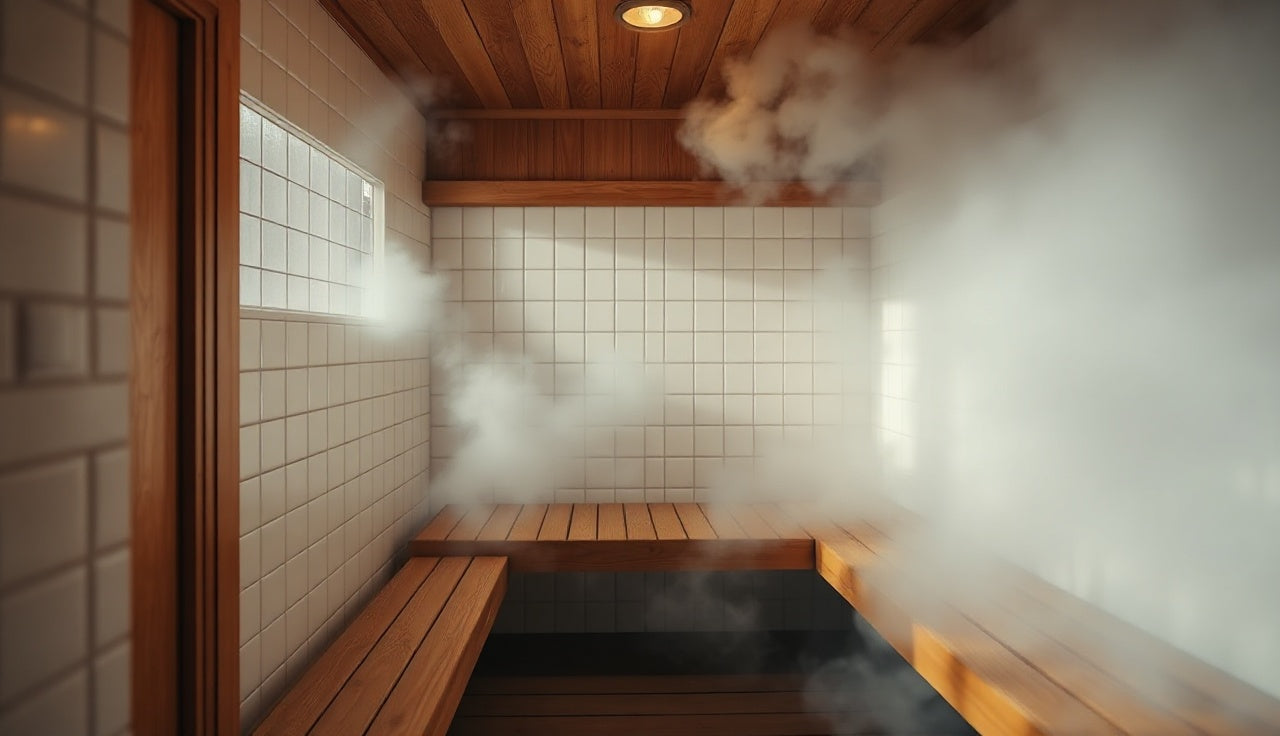
A steam room holds air at 100% relative humidity and 110°F to 120°F (43°C to 49°C). That wet heat treats your body differently than a dry Finnish sauna does. The air is already saturated, so sweat can't evaporate. Your skin stays wet, and your core temperature climbs faster than it would in a sauna at the same air temperature [1].
Your cardiovascular system reacts fast. Heart rate rises to push blood toward the skin for cooling. Cardiac output can jump 50 to 70% during a session, and peripheral blood vessels widen, which drops blood pressure for a while [2]. Call it passive cardio. Your heart works harder while you sit still.
Your airways respond too. Warm, humid air loosens mucus in the sinuses and lungs. That isn't folklore. It's the same mechanism behind the old bowl-of-hot-water-and-a-towel trick for a stuffy nose, just steadier and easier to control. Whether it does anything lasting for chronic respiratory conditions is a separate question, and the evidence there is thin.
One thing a steam room does not do is detoxify your blood. Your liver and kidneys handle that. Sweat carries tiny amounts of some heavy metals, but the quantities are too small to matter clinically [3]. Any claim that a steam session "flushes toxins" is marketing, not physiology.
What are the proven health benefits of using a steam room?
Several benefits hold up well, a few are plausible but under-researched, and some popular claims have nothing solid behind them. Here's the honest sort.
Cardiovascular function. A 2018 review in Mayo Clinic Proceedings looked at sauna bathing broadly and found regular heat exposure tied to lower risk of cardiovascular events and lower all-cause mortality, with more frequent use showing stronger links [4]. Steam rooms and saunas share enough mechanisms that researchers often group them, though steam-specific data is thinner than sauna data.
Blood pressure. A single steam session drops blood pressure briefly as vessels widen. Some studies on repeated heat exposure show small longer-term reductions in resting blood pressure, though the effect sizes are modest and most of that work sits in sauna populations [2].
Muscle recovery. Heat raises blood flow to muscles, which helps clear metabolic waste after exercise. A 2013 study in the Journal of Science and Medicine in Sport found heat therapy after resistance exercise cut delayed-onset muscle soreness compared to no treatment [5]. A steam room is a practical way to get that heat.
Skin hydration. Steam hydrates the outer skin layer (the stratum corneum) and can soften the material inside pores, which may help products applied afterward absorb better. Dermatologists treat this as a real short-term effect, not a cure [6].
Stress and sleep. After the initial heat stress, your body swings toward a parasympathetic response that most people experience as deep calm. Core temperature falls once you leave the heat, and that drop is one of the signals that helps you fall asleep. The sleep data mostly comes from sauna studies, but the mechanism applies to steam rooms just as well.
For a closer look at how dry and wet heat compare on all of this, the sauna vs steam room breakdown covers the distinction in detail.
Are steam rooms good for your lungs and sinuses?
This is where enthusiasm tends to outrun the evidence. Steam thins mucus and gives temporary relief from a stuffy nose. For people with mild upper respiratory symptoms or chronic sinusitis, short sessions often feel helpful, and that feeling has a genuine physiological basis.
Asthma is more complicated. Some people with asthma breathe more easily in warm moist air than in cold dry air. Others find high humidity irritating. No high-quality trial has established steam rooms as a reliable asthma treatment, and the American Lung Association does not list steam therapy in its recommended asthma treatments [7]. If you have reactive airway disease, test cautiously and talk to a pulmonologist before making steam a regular habit.
COPD is harder still. High heat and humidity can make breathing feel more labored when lung function is already reduced. I wouldn't experiment there without medical supervision.
The clearest respiratory downside is infection risk in a poorly maintained steam room. Legionella bacteria grow in warm, stagnant water, and steam generators that aren't cleaned and treated are a real hazard, especially in commercial facilities [8]. In a home unit you control the cleaning schedule, which cuts that risk a lot. More on that below.
| 1x per week (baseline) | 0% |
| 2-3x per week | 22% |
| 4-7x per week | 40% |
Source: Laukkanen JA et al., Mayo Clinic Proceedings, 2018 [4]
What are the real risks of using a steam room?
Steam rooms are safe for most people most of the time. The risks are specific enough to name plainly.
Dehydration. You lose real fluid through sweat even when you can't see it evaporate. Most people lose 0.5 to 1 liter per 30 minutes of heat exposure, depending on body size and temperature. Walk in already mildly dehydrated, or skip water afterward, and the problem compounds fast [1].
Overheating and heat stroke. Your body tolerates only so much core temperature rise. Staying in too long, especially if you doze off or lose track of time, can push core temperature above 104°F (40°C), the threshold for heat stroke [12]. Warning signs include confusion, sudden loss of sweating despite the heat, and nausea. That's a medical emergency. Most incidents happen when people push past discomfort or mix heat with alcohol, which wrecks the body's ability to regulate temperature [12].
Drug and alcohol interactions. Alcohol dilates blood vessels on its own. Stack that on the vasodilation from heat and blood pressure can drop far enough to make you faint. Several sauna and steam room deaths in the research literature involve alcohol. Don't combine them.
Infection from shared facilities. Fungi like the ones behind athlete's foot love warm, wet floors. Bacteria can sit on benches and tile. Flip-flops in a commercial steam room are useful, not paranoid.
Heat-sensitive medications. Some drugs change how your body handles temperature: certain antihypertensives, diuretics, beta-blockers, and psychiatric medications. If you take any of these, ask your prescribing physician before regular steam room use.
Skin conditions. People with rosacea or other heat-and-flush triggered conditions often find steam makes symptoms worse. Eczema is individual. Some people find the moisture soothing, others find the heat irritating.
Who should avoid steam rooms or use them carefully?
A handful of groups should proceed with real caution or skip steam rooms entirely.
Pregnancy is the clearest case. A raised core temperature in the first trimester carries genuine risk. A 2017 review in Birth Defects Research found maternal hyperthermia during early pregnancy tied to increased risk of neural tube defects [9]. Most obstetric guidance says avoid steam rooms, saunas, and hot tubs in the first trimester and stay cautious throughout.
People with uncontrolled hypertension, a recent heart attack or stroke, unstable angina, or severe heart failure should not use a steam room without explicit medical clearance. The cardiovascular load is passive, but it's still a load.
Kidney disease shifts fluid and electrolyte balance, and heavy sweat losses can stress kidneys that are already struggling.
Children and older adults regulate temperature less efficiently and hit dangerous core temperatures faster. If children use a steam room at all, keep sessions short and supervised. Many commercial facilities set a minimum age.
Immunocompromised people face higher infection risk from the Legionella and fungal hazards above, especially in commercial settings.
If you fall into one of these groups and still want heat therapy, a dry sauna at a lower temperature and shorter session may carry a somewhat different risk profile, though the core worries about cardiovascular load and thermoregulation still apply. The sauna benefits piece has more on how researchers have studied heat therapy in cardiac patients specifically.
How long should you stay in a steam room, and how often?
Most heat therapy research uses sessions of 10 to 20 minutes. The Finnish sauna literature, the deepest body of work here, typically runs 2 to 3 rounds of 15 to 20 minutes with cooling breaks, 2 to 4 times a week, as the pattern linked to cardiovascular benefit [4]. Steam room research lacks equally clean dose-response data, but there's no physiological reason that rough framework wouldn't carry over.
Start at 10 minutes. That's plenty for a first timer. The point is to learn how your body responds to that heat and humidity before you extend the clock. Dizzy, lightheaded, or nauseated? Leave right away. That's your body telling you it's done.
On frequency, daily use is probably fine for healthy adults if sessions stay moderate and you rehydrate well. The cardiovascular studies that showed benefit used 2 to 4 sessions a week, so there's no evidence daily beats that. Recovery and skin goals don't need daily sessions either.
Timing around exercise matters. Hitting a steam room right after a hard workout, when you're already low on fluid, calls for extra attention to water intake. A short post-workout steam session for recovery is reasonable as long as you drink enough. Using one before a workout may raise injury risk in some people by lifting core temperature and dulling neuromuscular efficiency, though that's less studied.
Steam room vs sauna: which is healthier?
Neither is healthier across the board. They work through the same core mechanism (passive heat stress) and produce broadly similar responses, with meaningful differences in the details.
Saunas run at 160°F to 200°F (70°C to 95°C) with low humidity (10 to 20%). Steam rooms run at 110°F to 120°F with 100% humidity. The dry sauna is hotter by air temperature, but because sweat can evaporate in dry air, your body regulates core temperature somewhat better there. The steam room's wet heat often feels more intense to newcomers despite the lower air temperature, and core temperature can rise faster per minute.
The sauna research base is bigger, mostly because Finnish sauna culture produced decades of population health data. The Kuopio study followed more than 2,000 middle-aged Finnish men for up to 20 years and found men who used a sauna 4 to 7 times a week had a 40% lower risk of cardiac death than once-weekly users [4]. Steam rooms have no comparable long-term epidemiology.
Steam rooms edge out saunas for respiratory comfort (humidity soothes airways) and skin hydration. Saunas may suit you better if the closed-in feeling of 100% humidity bothers you.
For a side-by-side, see the sauna vs steam room comparison.
| Feature | Steam Room | Dry Sauna |
|---|---|---|
| Air temperature | 110-120°F | 160-200°F |
| Humidity | ~100% | 10-20% |
| Session length (typical) | 10-20 min | 15-20 min |
| Respiratory comfort | High | Moderate |
| Cardiovascular research depth | Moderate | Extensive |
| Skin hydration | Strong | Moderate |
| Home installation complexity | Moderate | Moderate-High |
Does a steam room help with weight loss?
Common question, honest answer: no, not in any lasting way.
You will weigh less right after a steam session. Almost all of it is water. Once you rehydrate, which you should, the number comes back. Athletes in weight-class sports like wrestling and boxing sometimes use steam to cut weight fast, but sports medicine professionals see that as a health risk, not a benefit [10].
Heat does raise metabolic rate a little. Heart rate elevation from passive heat is often compared to a light walk in cardiovascular effort. Some estimates put calorie burn during a sauna or steam session at 1.5 to 2 times resting metabolic rate. But 20 minutes at twice resting metabolism for an average adult adds maybe 40 to 60 extra calories. That is not a weight loss tool.
Anyone selling a steam room, sauna suit, or sweat product mainly on weight loss is selling water weight, not fat loss. The real benefits (heart, recovery, relaxation) don't need the claim.
Are steam rooms good for skin?
Short answer: yes, with limits.
Steam hydrates the stratum corneum, the outermost layer of skin. That's a well-documented physical effect. Hydrated skin looks and feels better, and a temporary rise in skin permeability may help moisturizers absorb more if you apply them soon after a session [6].
The "open pores" line you hear everywhere is imprecise. Pores have no muscles and can't open or close the way the phrase suggests. What steam does is soften the skin and the material inside pores, which can make cleansing work better.
For acne, the evidence is genuinely mixed. Warm steam can loosen sebum and dead skin, which sounds helpful. But heat and sweat can irritate already-inflamed acne, and shared steam room surfaces carry bacteria that can worsen breakouts. Dermatologists treat this as individual, not a blanket recommendation.
For eczema and psoriasis, heat soothes some people and triggers others. These conditions get managed case by case, and sweeping claims that steam rooms help either one aren't backed by clinical evidence.
Rinse with a gentle cleanser after a steam session. Leaving sweat and loosened debris on your face undoes much of what the steam did.
How do you use a steam room safely at home?
Home steam rooms have gotten more reachable as prefab steam shower enclosures and home steam generators have dropped in price. The safety math at home differs from a commercial facility in a few important ways.
The biggest home advantage is that you own the cleaning schedule. The Legionella risk that worries me in commercial steam rooms is manageable at home if you clean the steam generator, drain lines, and room surfaces regularly and never let water sit stagnant in the system. Manufacturers typically recommend flushing the generator after every use and running a full cleaning cycle weekly [8].
Installation needs a waterproof enclosure with no gaps where moisture can reach framing or insulation. Bad waterproofing means mold and structural damage. If you're converting a bathroom, this isn't a DIY job unless you have real tile and waterproofing experience. A licensed contractor who knows wet-area construction is worth the money.
Ventilation outside the steam room itself matters. The room has to seal to hold steam, but the surrounding space needs airflow so moisture doesn't migrate into the walls.
Session safety at home follows the same rules as the gym: set a timer, don't go alone when you're new to it, keep water nearby, and have someone who can check on you. Falling asleep in a steam room is a real risk and a real danger.
If you're weighing home heat options more broadly, compare steam generators against home saunas. A home sauna lets you control temperature and humidity more independently, which some people find more versatile. The costs and space needs differ enough to price out separately.
SweatDecks carries a range of home sauna and steam options if you want to see what configurations work for a residential install.
Can you combine steam rooms with cold plunges for better results?
Contrast therapy, alternating hot and cold exposure, is one of the more interesting corners of recovery research. The theory: cycling between heat-driven vasodilation and cold-driven vasoconstriction creates a pumping effect in the circulatory system that clears metabolic waste and cuts inflammation better than either alone.
The research is early but reasonably consistent. A 2021 review in Sports Medicine found cold water immersion after exercise reduced muscle soreness and perceived fatigue, and that contrast therapy produced similar or better results than cold alone [11]. Whether the steam room specifically beats a warm shower for the hot phase isn't well established, but the mechanism is the same.
The sequence most people use: heat first (10 to 20 minutes in steam or sauna), then cold plunge or cold shower (2 to 5 minutes), then rest. Multiple rounds are common. The contrast drives strong circulatory responses and, anecdotally, a sharp mood lift, probably through endorphin and norepinephrine release.
If cold plunges interest you, the cold plunge benefits article covers the research on cold water immersion, and the ice bath guide gets into temperature and duration protocols.
One practical warning: moving from a 120°F steam room to a 50°F cold plunge is a real cardiovascular event. Healthy adults handle it fine. People with cardiac conditions should not do it without medical clearance, because the swings in blood pressure and heart rate are large.
What does the research still not know about steam room health effects?
It helps to know where the evidence runs thin, because a lot of steam room content oversells its certainty.
Long-term epidemiology on steam rooms specifically (not saunas, not heat exposure in general) barely exists. Most of the strong cardiovascular data comes from Finnish sauna research, and while the physiology overlaps a lot, the two aren't identical.
Optimal dosing (how often, how long, at what temperature) isn't answered for steam rooms the way it's starting to be answered for saunas. "10 to 20 minutes a few times a week" is a reasonable framework borrowed from sauna research, not a steam-specific clinical recommendation.
For specific conditions (autoimmune disease, chronic pain, metabolic syndrome), individual studies show interesting signals, but sample sizes are small and results haven't replicated consistently.
The microbiome angle is untouched in steam room contexts. Warm, humid environments shift skin microbiome composition, and nobody has looked systematically at whether regular steam room use changes the skin's bacterial populations for better or worse.
Nobody has good long-term data on whether home steam room use in healthy adults delivers the mortality and cardiovascular benefits seen in the Finnish sauna cohorts. It's plausible. It hasn't been studied.
Frequently asked questions
Is a steam room healthy to use every day?
Daily use is probably fine for healthy adults if sessions stay in the 10 to 20 minute range and you rehydrate well afterward. The cardiovascular research showing benefit used 2 to 4 sessions a week, so daily isn't proven better, just not proven harmful either. If you notice lingering fatigue, skin irritation, or feel worse after sessions, cutting back frequency is sensible.
How long should you sit in a steam room for health benefits?
Most heat therapy research uses 10 to 20 minute sessions. New users should start at 10 minutes and see how they feel before extending. Benefits seem to build with regular use over weeks, not from one marathon session. Staying past 20 to 30 minutes at steam room temperatures sharply raises dehydration and overheating risk with no matching gain in benefit.
Are steam rooms good for your lungs?
Warm, humid air can temporarily relieve nasal congestion and soothe irritated airways, which is a real physiological effect. For asthma or COPD, responses vary by person, and neither condition has strong clinical trial evidence supporting steam room therapy as a treatment. People with reactive airway disease should test cautiously and check with a pulmonologist before making it a regular practice.
Can steam rooms help with high blood pressure?
A single session drops blood pressure briefly as vessels widen. Some studies on repeated heat exposure show small longer-term reductions in resting blood pressure. But uncontrolled hypertension is a reason for caution, not a reason to self-treat with steam. The cardiovascular load of a session is real, and anyone with hypertension should get medical clearance first.
Are steam rooms bad for your heart?
For healthy adults, regular steam room or sauna use is tied to lower cardiovascular risk, not higher. The Kuopio study linked frequent Finnish sauna use to markedly lower cardiac mortality over a 20-year follow-up. For people with existing heart disease, unstable angina, a recent heart attack, or severe heart failure, the heat stress of a steam room requires medical clearance before use.
Do steam rooms help with muscle recovery?
Heat raises blood flow to muscles, which helps clear metabolic byproducts like lactate after exercise. A 2013 study in the Journal of Science and Medicine in Sport found heat therapy reduced delayed-onset muscle soreness compared to no treatment. Steam rooms are a practical way to deliver post-workout heat exposure, as long as you rehydrate well before and after the session.
Can pregnant women use steam rooms?
Most obstetric guidelines recommend avoiding steam rooms, saunas, and hot tubs, especially in the first trimester. A 2017 review in Birth Defects Research found maternal hyperthermia in early pregnancy tied to increased risk of neural tube defects. The threshold for concern is a core temperature above 101°F. Most ob-gyns advise skipping heat immersion entirely during the first trimester.
Are steam rooms good for skin?
Steam hydrates the outer skin layer (stratum corneum) and softens the material in pores, making cleansing more effective. That's a well-documented physical effect. Some people find it helps moisturizers absorb better when applied after a session. For acne, responses are individual: heat can loosen sebum but also irritate inflamed skin. Rinse with a gentle cleanser after your session.
What is the difference between a steam room and a sauna for health?
Both deliver passive heat stress with similar cardiovascular and recovery effects. Saunas run at 160 to 200°F with low humidity; steam rooms run at 110 to 120°F with 100% humidity. The sauna research base is larger, with multi-decade epidemiology behind it. Steam rooms edge out saunas for respiratory comfort and skin hydration. Neither is universally better; the right pick depends on preference and what you're targeting.
Can you lose weight by using a steam room?
The weight you drop right after a steam session is almost entirely water. Once you rehydrate, it comes back. Steam does raise metabolic rate slightly, but a 20-minute session at roughly twice resting metabolism burns maybe 40 to 60 extra calories for an average adult. Steam rooms are not a weight loss tool. The cardiovascular and recovery benefits are real; fat loss is not among them.
Are home steam rooms safe?
Yes, with proper setup and cleaning habits. The main risks are Legionella growth in a poorly maintained steam generator and mold from bad waterproofing. Home units cut commercial-facility infection risk because you own the cleaning schedule. Flush the generator after every use, run cleaning cycles weekly, and get the enclosure professionally waterproofed. Session safety rules (timer, hydration, no alcohol) apply at home just as much as in a gym.
Should you shower before or after a steam room?
A quick rinse before you enter removes skin products, sweat, and oils, which keeps the steam environment cleaner and may let your skin respond better. After your session, a gentle cool or lukewarm shower rinses away sweat and loosened debris. Applying a moisturizer to slightly damp skin after the rinse takes advantage of the temporary rise in skin permeability that heat produces.
What are the signs you've been in a steam room too long?
Dizziness, nausea, headache, or feeling too hot to stay comfortable are clear signals to leave right away. More serious warnings include confusion, sudden loss of sweating despite the heat (paradoxical anhidrosis), muscle cramps, or heart palpitations. Those point toward heat exhaustion or heat stroke. Leave, cool down gradually, drink water, and seek medical attention if symptoms don't clear quickly.
Is it safe to use a steam room when sick?
It depends on the illness. For mild upper respiratory congestion, a short steam session can give temporary relief. You should not use a commercial steam room when sick, because you expose other people. For systemic illness with fever, a steam room is genuinely dangerous: your body is already fighting to regulate temperature, and adding external heat can push your core temperature to unsafe levels. Stay home.
Sources
- Harvard Health Publishing, Harvard Medical School — Sauna Health Benefits: Heat exposure in wet environments prevents sweat evaporation, raising core temperature faster; fluid losses of 0.5-1 liter per 30 minutes are typical during heat immersion
- American Heart Association — Heat and Cardiovascular Health: Passive heat stress dilates peripheral blood vessels, temporarily reduces blood pressure, and increases cardiac output by 50-70% during a session
- National Institutes of Health, National Library of Medicine — Sweat composition and trace elements: Sweat contains only trace quantities of heavy metals; the volumes involved are not clinically meaningful as a detoxification pathway
- Laukkanen JA et al., Mayo Clinic Proceedings 2018 — Cardiovascular and Other Health Benefits of Sauna Bathing: Regular sauna use was associated with reduced risk of cardiovascular events and all-cause mortality; men using sauna 4-7 times per week had approximately 40% lower risk of cardiac death compared to once-weekly users in the Kuopio cohort
- Vaile J et al., Journal of Science and Medicine in Sport 2013 — Effect of hydrotherapy on recovery from fatigue: Heat therapy after resistance exercise reduced delayed-onset muscle soreness compared to no treatment
- American Academy of Dermatology — Skin care and steam: Steam temporarily hydrates the stratum corneum and may increase skin permeability to topical products applied shortly after exposure
- American Lung Association — Asthma Treatment: Steam therapy is not listed as a recommended treatment for asthma in American Lung Association treatment guidelines
- Centers for Disease Control and Prevention (CDC) — Legionella and Water Systems: Legionella bacteria thrive in warm, stagnant water systems including steam generators; regular cleaning and disinfection are necessary to control risk
- Moretti ME et al., Birth Defects Research 2017 — Maternal hyperthermia and risk of neural tube defects: Maternal hyperthermia during early pregnancy was associated with increased risk of neural tube defects; most obstetric guidelines recommend avoiding steam rooms and hot tubs in the first trimester
- National Athletic Trainers' Association — Fluid Replacement in Sports Position Statement: Rapid sweat-induced weight loss before athletic competition is a recognized health risk; weight lost in steam or heat exposure is water, not fat
- Higgins TR et al., Sports Medicine 2021 — Contrast water therapy and exercise-induced muscle damage: Cold water immersion and contrast therapy (alternating hot and cold) reduced muscle soreness and perceived fatigue after exercise in a 2021 review
- CDC — Extreme Heat and Your Health: Core body temperature above 104°F (40°C) is the threshold for heat stroke, a medical emergency; alcohol combined with heat substantially impairs thermoregulation

Share:
Are infrared saunas healthy? What the research actually shows
Outdoor cold plunge: everything you need to know before buying