
Last updated 2026-07-10
TL;DR
An indoor cold plunge tub holds water between 50°F and 59°F (10 to 15°C), the range where most recovery and cold-shock benefits show up. Setup needs a floor drain or pump-out, a dedicated 15 to 20 amp circuit, and flooring that handles 500 to 1,500 lbs filled. Budget $1,500 to $10,000 for a good unit plus $200 to $2,000 in install work.
What exactly is an indoor cold plunge tub?
A cold plunge tub is an insulated vessel with active chilling that holds water cold enough to trigger a physiological response, usually between 50°F and 59°F (10 to 15°C). A bag of ice in a stock tank on the patio goes warm by afternoon. An indoor unit runs a refrigeration system around the clock, so the water is ready whenever you are.
Active temperature control is the defining feature. A chiller, either built into the tub or plumbed to a separate box, cycles refrigerant through coils that cool a water loop. Most residential units hold within one or two degrees of your setpoint. Some also heat, which makes them useful for contrast therapy when paired with a sauna.
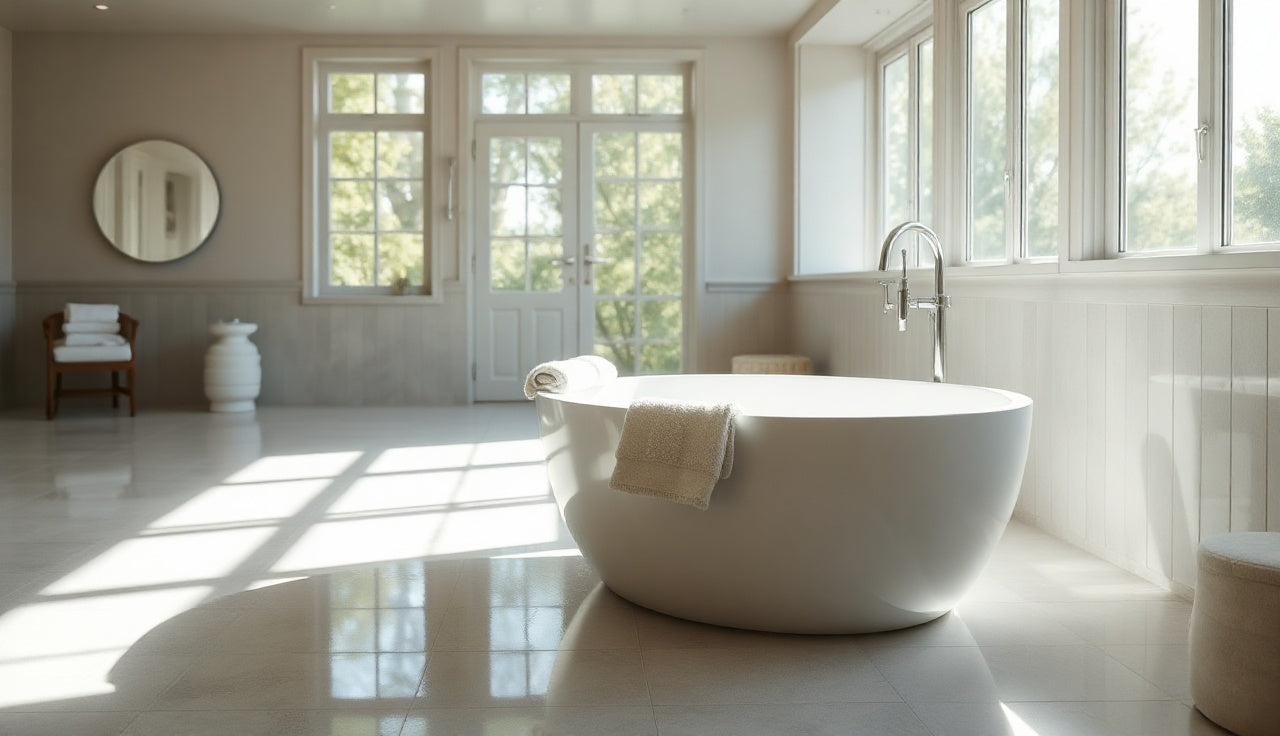
These tubs come in three broad shapes: freestanding acrylic shells that look like a bathtub, barrel-style units, and purpose-built recovery pods with contoured seating. Indoor versions differ from outdoor models in two ways. They need finishes that tolerate humidity without rust or rot, and they add drainage and ventilation demands that come with putting a refrigeration appliance inside your house.
The indoor tub is the premium end of the spectrum. It costs more than an ice bath and demands real installation planning. What you get back is consistent temperature with no ice runs, a cleaner look, and a setup you actually use year-round. If you are early in your research, start with our broader cold plunge guide, then come back here for the indoor specifics.
How cold should a cold plunge tub be?
Set it between 50°F and 59°F (10 to 15°C). That is the band where most of the studied physiological effects show up, and it is cold enough to feel genuinely hard without edging into danger for healthy adults.
A 2016 meta-analysis in the British Journal of Sports Medicine (Machado et al.) covering 52 trials found that cold water immersion in the 10 to 15°C range produced the most consistent reductions in perceived muscle soreness after exercise [1]. The protocols varied a lot, so nobody can hand you one magic number. But 10 to 15°C is the window the research clusters around.
Below 50°F (10°C) you enter territory that the cold shock and hypothermia literature takes seriously. Plenty of experienced cold-water people dip at 45°F safely, but the margin for error shrinks fast. The cold shock response, a gasp reflex plus a fast jump in heart rate, is strongest in that sub-50°F zone [2]. First-timers should start at 59°F and work down.
Above 60°F (15°C) the water still feels cold and may help recovery, but the bigger norepinephrine and cold-shock-protein responses need a colder stimulus. A study of cold-adapted swimmers reported in Soberg et al. (PLOS ONE, 2021) documented large norepinephrine increases with regular cold exposure [3].
My practical pick: set the tub to 55°F to start. That sits in the middle of the evidence, it is honestly cold, and most adults with no contraindications can finish a 2 to 5 minute immersion safely.
| Target | Temp Range | Use Case |
|---|---|---|
| Beginner | 57 to 59°F (14 to 15°C) | First weeks, building tolerance |
| General recovery | 52 to 57°F (11 to 14°C) | Post-workout soreness, daily use |
| Cold exposure training | 50 to 52°F (10 to 11°C) | Experienced users, shorter sessions |
| Advanced / research range | 45 to 50°F (7 to 10°C) | Trained individuals only; caution required |
| Danger zone for most adults | Below 40°F (4°C) | Hypothermia risk rises sharply |
How long should you stay in a cold plunge?
Two to five minutes covers most of the recovery benefit for most people. That is not a guess. It reflects what the protocols in the best-reviewed trials actually used [1].
A widely circulated framework from the cold exposure literature suggests about 11 minutes per week total, split across 2 to 4 sessions, as a rough threshold for meaningful adaptation [3]. Go four times a week and that is roughly 3 minutes a session. You do not need to gut out 15-minute ice baths to get the benefit.
Beginners: start with 60 to 90 seconds and get out. The cold shock reflex fades in the first 30 to 60 seconds, and your body settles. Build toward 3 minutes over a few weeks. If you are plunging for post-exercise soreness, get in within 30 minutes of finishing your session, which is where the best-studied effect sits.
One caveat worth taking seriously. If your goal is muscle size, there is real tension in the data. A 2021 paper in the Journal of Physiology (Roberts et al.) found that post-exercise cold water immersion blunted anabolic signaling compared to passive recovery [4]. Deep in a strength block? Save the plunge for rest days or the off-season, and use active recovery on lifting days instead.
| Danger zone (below) | 40 |
| Advanced / trained users | 50 |
| General recovery (optimal range) | 55 |
| Beginner starting point | 58 |
| Reduced stimulus (above) | 60 |
Source: British Journal of Sports Medicine meta-analysis (Machado et al.) and PLOS ONE (Søberg et al.)
What are the real benefits of a cold plunge?
Four benefits hold up well: less delayed-onset muscle soreness (DOMS), faster perceived recovery, an acute mood lift, and measurable rises in circulating norepinephrine and dopamine [1][3]. The evidence for those is solid enough to call them reliable.
The speculative claims are the ones to watch. Fat loss through brown adipose tissue activation is real as a mechanism, but the effect size in humans doing typical home protocols is small. Nobody has clean data showing a meaningful body composition change from plunging alone. Immune claims often lean on the 2014 Wim Hof study in PNAS (Kox et al.), which is genuinely interesting [5]. But that study combined cold exposure, breathing work, and meditation, so pulling out the effect of cold by itself is hard.
Sleep is the one a lot of practitioners swear by. The physiology is plausible: the core temperature drop after a plunge may speed up the natural pre-sleep cooling process. Good controlled trials on that exact question are thin. Nobody has great data here; the closest work looks at general cold exposure and sleep quality in athletes and finds modest positive signals [1].
For a fuller breakdown, see our guide on cold plunge benefits.
Here is what I would tell a friend. The soreness relief is real and usable. The mood lift is real and immediate. Treat everything else as a bonus you cannot count on.
What installation work does an indoor cold plunge actually need?
This is where buyers get surprised, and where the gap between a smooth setup and a flooded bathroom lives. Five things: drainage, electrical, floor load, ventilation, and water treatment.
Drainage comes first. A filled tub holds 80 to 250 gallons depending on the model, and you need a way to empty it that does not involve buckets. Options: a nearby floor drain, a sump pump setup, or a gravity drain to a utility sink or laundry drain. Most residential codes require a licensed plumber for any fixed connection to a drain. Adding a simple drain tie-in runs $300 to $800 in most markets [6].
Electrical is the second constraint. Chillers pull 1,000 to 2,000 watts during active cooling, so most units want a dedicated 15 to 20 amp, 120V circuit. Some larger or commercial-grade chillers need 240V. Do not share the circuit with other appliances; the continuous draw trips breakers. An electrician adding a dedicated circuit usually costs $150 to $500 depending on the run from the panel [7].
Floor load is the one almost nobody thinks about until it is too late. A 200-gallon tub filled with water plus a 200 lb person can top 1,800 lbs. Residential floor joists are typically designed for 40 lbs per square foot live load under standard building codes, which sounds generous until you run the numbers against the tub's small footprint [8]. If your tub sits on a wood-framed floor above a crawl space or basement, have a contractor check capacity before you fill it. Ground-floor slabs are usually fine.
Ventilation matters more than people expect. The chiller rejects heat into the room, so a refrigeration system in a closed bathroom warms the space. A 1,500W chiller dumps roughly 5,100 BTU per hour into wherever it sits. In a small unventilated spa room, that makes things warm and humid. Plan for an exhaust fan or a small HVAC supply if the room is under 150 square feet.
Water treatment closes the list. Cold, stagnant water grows bacteria faster than a hot tub because you skip the sanitizing heat. You have to maintain a residual sanitizer. Most manufacturers recommend a low level of bromine or chlorine, like a hot tub. Some owners add UV or ozone. Test weekly at a minimum, and change the water every 30 to 60 days depending on use.
How much does an indoor cold plunge tub cost?
The range is wide, and anyone who quotes you one number is guessing. Here is an honest breakdown by tier.
| Tier | Example Units | Tub Price | Installation Estimate | Total Budget |
|---|---|---|---|---|
| Entry / DIY | Stock tank + separate chiller | $500 to $1,200 | $200 to $600 | $700 to $1,800 |
| Mid-range residential | Plunge, Ice Barrel Pro | $2,500 to $5,000 | $400 to $1,200 | $3,000 to $6,200 |
| Premium residential | Solbasium cold plunge tub, Nordic Wave | $5,000 to $8,000 | $500 to $2,000 | $5,500 to $10,000 |
| High-end / commercial-grade | Morozko Forge, Cold Plunge Original | $7,000 to $15,000 | $800 to $2,500 | $8,000 to $17,500 |
The Solbasium cold plunge tub sits in the premium residential tier. Its integrated chiller, clean finish for indoor rooms, and wide temperature range are the reasons it comes up so often in buyer research. It is a real product with real specs. I mention it because people keep asking, not because it is the only option worth a look.
Running costs count too. A chiller holding 55°F in a 68°F room cycles roughly 6 to 10 hours a day during summer in a space that is not climate controlled. At the U.S. average residential electricity rate of about 16.2 cents per kWh [9], a 1,500W chiller costs roughly $1.45 to $2.43 a day, or $43 to $73 a month. An insulated lid cuts that noticeably.
Ice baths look cheaper upfront, then the ice math catches up. A 40 lb bag runs $4 to $6 at most grocery stores. Cooling a 150-gallon stock tank from 65°F tap water to 55°F takes roughly 80 to 100 lbs of ice per fill, so $8 to $15 a session plus your time hauling it. Over a year of daily use that is $3,000 to $5,500 in ice alone. A chiller pays for itself in 12 to 18 months of daily use against that math [9].
What should you look for when buying an indoor cold plunge tub?
Start with temperature range. A unit that only drops to 50°F (10°C) boxes you in. Good units reach 39 to 45°F, giving you headroom even if you run at 55°F most days.
Chiller size relative to tub volume is next. Undersized chillers run nonstop and still lose the fight when the room is warm. A working rule: at least 1/4 HP of chiller capacity per 100 gallons of water. Some makers spec this in BTU per hour instead of horsepower; 1 HP is about 12,000 BTU per hour.
Filtration is the spec buyers underestimate. A cold plunge takes daily use from a sweaty human. You want at least a multi-stage filter, ideally with UV or ozone built in. Cheap units with minimal filtration force water changes every 1 to 2 weeks, which is a pain and a waste.
Indoor finishes have to be different from outdoor. Look for marine-grade stainless steel, high-density polyethylene (HDPE), or fiberglass interiors. Avoid MDF cabinetry or unsealed wood, which swells and rots in a humid bathroom.
Foot well depth is a comfort feature that quietly decides whether you enjoy the thing. If you are 6 feet tall and the tub is 30 inches deep, you will perch on your knees fighting to get your shoulders under. Most purpose-built plunge tubs run 30 to 36 inches deep. Check interior depth, not the exterior.
Warranty separates serious manufacturers from importers moving boxes. Look for at least a 2-year parts and labor warranty on the chiller and a 5-year warranty on the shell. Some premium brands go to 10 years on the shell. Read what voids it. Many warranties void on commercial use or if you plug into anything other than a dedicated circuit.
Where in your home can you actually put an indoor cold plunge?
The four common spots are a basement, a dedicated spa or gym room, a large bathroom, and an attached garage. Each comes with tradeoffs.
Basements are usually the best fit. The room runs cooler year-round so the chiller works less, the concrete slab shrugs off the water load, floor drains are often already there, and a subpanel circuit is usually a short run. The catch is behavioral. If the plunge is in the basement and your gym is upstairs, you might skip it.
Dedicated gym or spa rooms are the next-best choice. They are already built for moisture and often have a floor drain or utility sink. You can set the tub next to a home sauna or ice bath for contrast protocols. The door should be solid and well-sealed to keep the chiller's humidity contained.
Large bathrooms work if the floor is tile over concrete (common on main floors or slabs) and the room has exhaust ventilation. A plunge in a primary bathroom is not crazy; it is turning into a luxury home feature. The snag is that most bathrooms already spoke for their electrical and plumbing load, so a dedicated circuit often means a longer run back to the panel.
Attached garages are fine in mild climates. In a cold winter climate the garage can get cold enough that the chiller barely works in January, which is efficient. But below freezing you risk pipe damage in any unit without freeze protection. Most quality indoor tubs have it. Verify before you install in an unheated space.
One place to avoid: a second-floor wood-framed bathroom with no structural check. The mix of a heavy tub, water, and a vibrating chiller compressor is hard on joists that were never designed for that load.
Indoor vs. outdoor cold plunge: which one makes more sense?
It comes down to where you live and how you actually behave. Climate decides the running cost. Friction decides whether you keep the habit.
An outdoor plunge in a mild climate (coastal California, the Pacific Northwest) often needs no active chilling for six months a year because the ambient air keeps the water cold. That saves money. Outdoor units also drain more simply, a hose to a yard or drain, and you never worry about chiller heat warming a room.
But a real winter changes the math. An outdoor tub in January in Minnesota means brushing snow off the lid at 6am. Some people find that romantic. Most do not keep doing it. An indoor tub strips the friction out, and habit consistency is what actually produces the results you care about.
Outdoor tubs also need UV-resistant materials, weatherproof electrical enclosures, and a shell built for freeze-thaw cycles. The National Electrical Code (NEC) Article 680 governs GFCI protection near water features [10]. Quality outdoor units are built for all of this. Cheap ones are not.
For most homeowners in a cold-winter climate, indoor is the better long-term buy. For someone with an existing deck or backyard setup near a sauna, outdoor makes sense as part of a contrast therapy station. SweatDecks carries both if you want to line the specs up side by side.
How do you maintain an indoor cold plunge tub?
Maintenance is the part people think about least and regret ignoring most. Five habits keep a tub healthy: water chemistry, filter cleaning, water changes, chiller care, and seal checks.
Water chemistry is your first job. Cold water does not sanitize itself. Keep free chlorine at 1 to 3 ppm or bromine at 2 to 4 ppm, and pH between 7.2 and 7.8, the same parameters the CDC recommends for recreational water [11]. Test more often in the first month until you learn how your usage moves the numbers. A test strip kit costs $10 to $15 and takes 30 seconds.
Filters: rinse the cartridge under fresh water every 1 to 2 weeks depending on use, and replace cartridges every 3 to 6 months. A useful tell is the chiller running longer than usual to hold temperature, which often means reduced flow from a dirty filter.
Water changes: do a full drain and refill every 30 to 60 days for solo use, more often if the tub is shared. On refill, run a line flush cleaner (like a hot tub line cleaner) first, circulate for an hour, drain, then refill with fresh water and balance the chemistry before your first soak.
Chiller care is mostly clean coils. Most residential chillers are air-cooled, so the fan pulls room air across the condenser coils and dust builds up. Vacuum or brush the coils every 3 to 6 months. Per the Department of Energy, dirty condenser coils can raise a refrigeration system's electricity use 10 to 15% and shorten compressor life [12].
Check the O-rings and plumbing seals every 6 months. Cold makes rubber contract, so fittings that started snug can work loose. A slow leak inside a cabinet will rot the cabinet and reach your floor before you ever notice it.
Is an indoor cold plunge safe? Who should avoid it?
For healthy adults, brief immersion in the 50 to 59°F range is generally safe. The cold shock response (gasp reflex, hyperventilation, a blood pressure spike) is the main acute risk, and it fades within the first 30 to 60 seconds [2].
The CDC lists cardiovascular disease, hypertension, and Raynaud's disease among conditions that raise risk during cold exposure [13]. Cold urticaria and peripheral artery disease belong on the caution list too. If any of those apply to you, talk to a physician before you start. This is not a legal hedge. The blood flow response to sudden cold immersion is real and significant.
Alcohol and cold plunging is a combination to respect. Alcohol impairs vasoconstriction, one of the body's main protective responses to cold. Royal National Lifeboat Institution drowning data shows alcohol shows up in a large share of cold water drowning cases [2]. Do not plunge after drinking.
Pregnancy: the data is limited, but the physiological stress of cold immersion plus core temperature changes is enough that most practitioners advise against plunging while pregnant. Ask your OB.
For most healthy adults who ease in, start warm, and skip going alone in the early weeks, the risk is low and manageable. The danger is not the cold itself. It is the cold shock response hitting someone unprepared, alone, or carrying an undiagnosed cardiac problem.
Never lock the lid or use anything that keeps you from getting out fast. Keep sessions under 10 minutes until you have months of experience. Have someone nearby for your first few soaks.
Indoor cold plunge installation tips to get right from the start
A few things worth stealing from people who have done this well, and from people who learned the hard way.
Plan your drain path before you buy the tub, not after. Measure the real gravity run from where the tub will sit to where you can tie into a drain. Some units drain by gravity; some need a condensate or utility pump. Know which yours is. A tub that will not drain easily is a tub that stops getting cleaned.
Order the tub, then schedule the trades. Lead times on quality plunge units run 4 to 12 weeks. Use that window to get electrical and plumbing permitted and finished before the unit shows up. You want to drop it in place and be running within a day of delivery.
Protect your floor. Put heavy-gauge HDPE or a rubber mat between the tub base and your flooring. Chiller vibration plus the splash that always happens will chew up hardwood or LVP over time. Tile or concrete under the footprint is ideal.
Run the fill line from cold supply only, and add a shutoff valve within arm's reach. A fill valve that sticks open while you are out has real consequences indoors.
Label the breaker. A dedicated cold plunge circuit should be clearly marked so nobody trips it by accident or loads it with other appliances down the road.
Budget for the surprise. First-time indoor installs almost always hit one: an HVAC register that needs rerouting, a joist that needs sistering, a drain that sits too far away. Keep $500 to $1,000 in reserve.
For pairing a plunge with heat, see our guides on sauna benefits and home sauna setups. If you want tubs filtered by chiller capacity and interior dimensions, the SweatDecks cold plunge collection lets you sort by the specs that matter indoors.
Frequently asked questions
How cold should a cold plunge tub be?
Set your tub to 50 to 59°F (10 to 15°C) for most recovery and cold-shock benefits. That is the range the best-reviewed cold water immersion trials used. Beginners should start at 57 to 59°F and work down over several weeks. Below 50°F (10°C) the cold shock response gets more intense and the margin for error shrinks. Above 60°F (15°C) still feels cold but may not drive the strongest norepinephrine response.
How long should you stay in an indoor cold plunge?
Two to five minutes per session is what most evidence-based protocols use. A commonly cited framework suggests about 11 minutes per week total, split across 2 to 4 sessions. Beginners should start at 60 to 90 seconds and build over a few weeks. Going past 10 minutes raises hypothermia risk for most people and does not produce better outcomes in the research.
Do I need a floor drain for an indoor cold plunge?
You need a way to empty the tub, but it does not have to be a floor drain. A sump or utility pump can discharge to a utility sink, a laundry drain, or outside through a hose bib. A floor drain is the cleanest solution if you can add one. Most residential codes require a licensed plumber for any new drain tie-in. Budget $300 to $800 for a simple drain addition.
What electrical setup does an indoor cold plunge chiller require?
Most residential chillers need a dedicated 15 to 20 amp, 120V circuit. Larger or commercial-grade units may need 240V. Never run a chiller on a shared circuit; the continuous draw trips breakers. Hire a licensed electrician to add the dedicated circuit before your tub arrives. A new circuit typically costs $150 to $500 depending on how far the run is from your panel.
Can I put a cold plunge tub on a second-floor wood-framed floor?
Possibly, but get a structural check first. A 200-gallon tub with water and one person can exceed 1,800 lbs. Residential wood-framed floors are typically designed for 40 lbs per square foot live load, which may not be enough given the tub's footprint and joist span. Concrete slabs and basement floors are almost always fine. Second-floor placement is the one case where a quick contractor visit before you buy is worth every dollar.
How much does it cost to run an indoor cold plunge per month?
At the U.S. average residential rate of about 16.2 cents per kWh, a 1,500W chiller running 6 to 10 hours daily costs roughly $43 to $73 a month. A well-insulated tub in a cool room lands on the low end. A poorly insulated tub in a warm room runs almost constantly and can push past $100. An insulating cover between sessions can cut chiller run time 20 to 30%.
How often do you need to change the water in an indoor cold plunge?
For solo use with proper chemistry (chlorine 1 to 3 ppm, pH 7.2 to 7.8), change the water every 30 to 60 days. With multiple users, or if you skip chemical maintenance, change it every 1 to 2 weeks. Always run a line flush cleaner through the plumbing before each full refill. Cold water grows bacteria faster than heated water, so skipping changes is a real sanitation risk, more than a cosmetic one.
What is the difference between an ice bath and an indoor cold plunge tub?
An ice bath is any cold-water soak, including a filled bathtub or stock tank with ice added. An indoor cold plunge tub uses active refrigeration to hold a set temperature automatically with no ice. Ice baths cost less upfront but can run $3,000 to $5,500 a year in ice for daily users, while a chiller-equipped tub costs $43 to $73 a month in electricity. See our full ice bath guide for a detailed comparison.
Is the Solbasium cold plunge tub good for indoor use?
The Solbasium cold plunge tub is a purpose-built indoor unit with an integrated chiller, a clean finish for spa and bathroom rooms, and a temperature range that drops low enough for serious cold work. It sits in the premium residential tier, roughly $5,000 to $8,000, and is a reasonable pick for buyers who want a polished look and reliable performance. Like any premium unit, its value is in daily consistency over years, not one standout feature.
Can I use a cold plunge for contrast therapy with my sauna?
Yes, and contrast therapy is one of the strongest reasons to own both. A typical protocol alternates 15 to 20 minutes of sauna heat with 2 to 5 minutes of cold immersion, repeated 2 to 3 rounds. Some studies find this pattern speeds cardiovascular recovery and cuts muscle soreness more than either alone. See our sauna benefits guide for how to structure heat and cold together.
Who should not use a cold plunge?
People with cardiovascular disease, hypertension, Raynaud's disease, cold urticaria, or peripheral artery disease should consult a physician before cold plunging. The CDC lists cardiovascular disease, hypertension, and Raynaud's among conditions that raise risk during cold exposure. Pregnancy is another case where most practitioners advise avoiding cold immersion given the physiological stress and core temperature effects. Never plunge alone in your first weeks, and never plunge after drinking alcohol.
What temperature is too cold for a cold plunge?
Below 50°F (10°C) the cold shock response gets more intense and hypothermia risk climbs with sessions longer than a few minutes. Below 40°F (4°C) is where most clinicians draw a clear caution line for recreational use. Some trained practitioners use 45 to 50°F, but they do short immersions with full awareness of the response. For most people at home, 50°F is the practical floor for regular use.
Does cold plunging after a workout hurt muscle gains?
Possibly. A 2021 paper in the Journal of Physiology (Roberts et al.) found that cold water immersion after resistance training blunted anabolic signaling compared to passive recovery, with the clearest effect for hypertrophy-focused training. If building muscle size is your main goal, plunging right after lifting may work against you. Most people in that situation plunge on rest days or before training instead.
How do I keep my indoor cold plunge water clean without a lot of chemicals?
UV and ozone systems cut but do not eliminate the need for chemical sanitizers. With one running, you can hold a lower residual, roughly 0.5 to 1 ppm chlorine instead of 1 to 3 ppm. You still test weekly, maintain pH, and do regular water changes. No system fully replaces chemistry management in a heavily used tub. Shower before each soak to cut the bioload your water has to handle.
Sources
- British Journal of Sports Medicine, Machado et al. 2016 meta-analysis on cold water immersion: Cold water immersion at 10–15°C produced the most consistent reductions in perceived muscle soreness across 52 trials
- Royal National Lifeboat Institution, Cold Water Shock page: Cold shock response includes a gasp reflex and rapid heart rate increase most pronounced below 50°F; alcohol impairs vasoconstriction and appears in a significant proportion of cold water drowning cases
- PLOS ONE, Søberg et al. 2021, Altered Brown Fat Thermoregulation and Enhanced Cold-Induced Thermogenesis: Regular whole-body cold water immersion increased circulating norepinephrine substantially; roughly 11 minutes per week total is cited in cold exposure summaries
- Journal of Physiology, Roberts et al. 2021, Post-exercise cold water immersion attenuates acute anabolic signalling: Post-exercise cold water immersion blunted anabolic signaling response compared to passive recovery, particularly for hypertrophy-focused training
- PNAS, Kox et al. 2014, Voluntary activation of the sympathetic nervous system via the Wim Hof Method: Wim Hof method combining cold exposure, breathing, and meditation affected immune response; isolating cold alone from the combined protocol is methodologically difficult
- Angi (formerly HomeAdvisor) cost guides, plumber rates: Adding a simple residential drain tie-in typically costs $300–$800 depending on market and complexity
- Angi (formerly HomeAdvisor) cost guides, dedicated circuit installation: Adding a dedicated electrical circuit costs $150–$500 depending on distance from panel
- American Wood Council, Span Tables for Joists and Rafters: Residential wood-framed floors are typically designed for 40 lbs per square foot live load under standard building codes
- U.S. Energy Information Administration, Electric Power Monthly, average retail electricity prices: U.S. average residential electricity rate is approximately 16.2 cents per kWh as of recent EIA reporting
- National Fire Protection Association, National Electrical Code (NEC) Article 680: GFCI protection required for electrical outlets near water features including outdoor pools and spas under NEC Article 680
- U.S. Centers for Disease Control and Prevention, Healthy Swimming: Recommended free chlorine 1–3 ppm and pH 7.2–7.8 for recreational water facilities
- U.S. Department of Energy, Energy Saver: Dirty condenser coils can increase refrigeration system electricity consumption 10–15% and reduce compressor lifespan
- U.S. Centers for Disease Control and Prevention, Extreme Cold Guide: CDC guidelines identify cardiovascular disease, hypertension, and Raynaud's disease among conditions that increase risk during cold water or cold air exposure

Share:
Ice bath for sore muscles: does it actually work?
Nordic Wave Viking Premier cold plunge vertical chiller: full review