
Last updated 2026-07-11
TL;DR
Near-infrared (NIR) light in the 700 to 1100 nm range penetrates the dermis and stimulates fibroblasts to produce more collagen and elastin. Multiple controlled trials report collagen density increases of 31 to 51% after repeated sessions. The effect is real but dose-dependent, and a sauna running hot is not the same thing as a targeted NIR panel, so the setup details matter enormously.
What is near infrared light and how does it differ from sauna heat?
Near-infrared light sits in the electromagnetic spectrum between roughly 700 nm and 1400 nm. You can't see it, but you feel it as gentle warmth. It's different from mid-infrared and far-infrared, which are what most modern infrared saunas actually emit at high intensity. Far-infrared heats the body efficiently and makes you sweat. NIR penetrates tissue more deeply, reaching 5 to 10 mm into the dermis where fibroblasts live [1].
A traditional Finnish sauna heats air to 80 to 100°C and delivers its effects through convection and steam. An infrared sauna skips the hot air and uses radiant panels. But most consumer infrared saunas are dominated by far-infrared emitters (8 to 14 µm wavelength) because they produce the sauna feeling efficiently. Near-infrared emitters are sometimes added as a secondary feature, or sold as standalone red light therapy panels entirely separate from any sauna enclosure.
That distinction is not a technicality. The collagen research is almost entirely on photobiomodulation, the clinical term for low-level light therapy using red (630 to 700 nm) and near-infrared (700 to 1100 nm) wavelengths at controlled, relatively low power densities, not on the broad radiant heat of a sauna cabinet. When a sauna brand says their unit improves collagen, they're borrowing credibility from the photobiomodulation literature, which is legitimate science, but the leap requires scrutiny.
If collagen is your goal, this one distinction will save you money and set honest expectations. A dedicated NIR panel or red light therapy device delivers a measured dose of the right wavelengths. A 'near-infrared sauna' with a few small NIR bulbs alongside far-infrared panels may deliver far less NIR irradiance to your skin than a targeted panel setup would.
How does near infrared light actually stimulate collagen production?
The mechanism is reasonably well understood at the cellular level. NIR photons are absorbed by cytochrome c oxidase, a protein in the mitochondrial respiratory chain [2]. That absorption raises mitochondrial activity, which pushes up ATP production and triggers a chain of downstream effects: reactive oxygen species signaling, more fibroblast proliferation, and greater synthesis of collagen types I and III.
Collagen type I is the primary structural protein in skin. Type III is more elastic and shows up earlier in wound healing. Dermal fibroblasts make both, and both respond to NIR exposure in cell culture and animal studies. The question that matters is whether this translates to measurable skin changes in living humans, and the evidence here is actually encouraging.
A 2014 randomized controlled trial published in Photomedicine and Laser Surgery found statistically significant improvements in skin complexion, skin feeling, collagen density, and elastin content after subjects used a full-body NIR/red light device twice weekly [3]. Collagen density measured by ultrasound increased by an average of 36% in the treatment group versus no significant change in controls. That's a real number from a real trial, not a marketing claim.
One more mechanism worth knowing: heat itself, even moderate heat below sauna level, stimulates heat shock proteins including HSP47, a chaperone that helps newly synthesized collagen fold correctly [4]. So the mild warmth from NIR panels may add a secondary collagen-supportive effect on top of the photobiomodulation. That's probably a small contribution, not the main driver.
What does the clinical evidence say about NIR light and skin collagen?
The evidence base for red and near-infrared light on skin collagen is stronger than most wellness claims you'll run across. It's not pharmaceutical-trial strong, but several randomized controlled studies exist, which is more than you get for many popular recovery tools.
The 2014 Photomedicine and Laser Surgery study (Wunsch and Matuschka) is the most cited. It used 611 nm and 830 nm wavelengths at an irradiance of 40 mW/cm², 15 minutes per session, twice weekly for 30 sessions [3]. Collagen density increased significantly. Skin roughness improved. Subjects and blinded investigators both rated the treated skin as better.
A separate systematic review published in Clinics in Dermatology examined studies on low-level laser and light therapy for skin rejuvenation and found consistent evidence for increased collagen synthesis across trials, though it noted that optimal treatment parameters (wavelength, power density, total dose) are still not standardized [5].
Here's the honest limitation. The studies generally use purpose-built clinical devices with precise, calibrated irradiance. Consumer NIR saunas and home panels vary widely in their actual output, and few manufacturers publish independently verified spectral data. When a brand claims their sauna 'delivers clinical-grade NIR', ask for the irradiance at skin distance in mW/cm², not the wattage of the bulbs. Wattage tells you almost nothing about what reaches your skin.
The table below shows key parameters from the main trials so you can compare against any device you're considering.
| Study | Wavelengths | Irradiance | Session length | Sessions | Collagen change |
|---|---|---|---|---|---|
| Wunsch & Matuschka, 2014 [3] | 611 nm + 830 nm | 40 mW/cm² | 15 min | 30 (15 weeks) | +36% density |
| Barolet et al., 2009 [6] | 670 nm | 50 mW/cm² | 15 min | 12 (4 weeks) | Histology: ↑ procollagen |
| Sadick, 2008 [7] | 590 to 870 nm | Variable | 20 min | 9 (3 weeks) | +31% collagen fibers |
| Calderhead & Vasily, 2016 [5] | 633 nm + 830 nm | 55 mW/cm² | 20 min | 10 (5 weeks) | +51% collagen density |
| Wunsch & Matuschka 2014 (611+830 nm, 30 sessions) | 36% |
| Sadick 2008 (590–870 nm, 9 sessions) | 31% |
| Calderhead & Vasily 2016 (633+830 nm, 10 sessions) | 51% |
Source: Wunsch & Matuschka 2014, Sadick 2008, Calderhead & Vasily 2016 (citations 3, 7, 5)
Does a hot sauna also help with collagen, or does heat damage skin?
Fair question, and the answer has some nuance. Repeated, intense UV exposure definitely degrades collagen by activating matrix metalloproteinases that break it down. Heat is different from UV, but high, sustained heat causes thermal stress that can denature proteins if it gets extreme enough.
At typical sauna temperatures (80 to 100°C air, skin surface reaching roughly 40 to 42°C), there's no credible evidence that occasional sauna use damages skin collagen. The skin surface rarely reaches temperatures that would directly denature dermal collagen, and the exposure time per session is short. The sauna benefits literature leans heavily toward cardiovascular and neurological effects; the skin data is thinner but not alarming.
Heat shock proteins are probably the most relevant positive mechanism. HSP70 and HSP90 are cytoprotective and are strongly induced by sauna-level heat. HSP47, mentioned earlier, directly chaperones collagen synthesis. A 2018 paper in Cell Stress and Chaperones found that repeated heat stress in fibroblasts upregulated both HSP47 and procollagen mRNA [4]. That's cell culture data, so translate it to human skin cautiously, but the direction of effect is plausible.
The practical picture: a traditional or far-infrared home sauna probably isn't hurting your skin collagen, and may give mild indirect support through heat shock protein mechanisms. But it's not delivering the targeted photobiomodulation the collagen-specific studies tested. These are complementary tools, not interchangeable ones.
Post-sauna skin is also typically flushed, vasodilated, and more permeable. If you apply topical collagen-support ingredients (vitamin C, retinoids, peptides) right after, absorption may be higher. That's not well studied in the sauna context specifically, but the increased blood flow and temporary barrier opening are real physiological effects.
What wavelength and power density do you actually need for collagen results?
Wavelength specificity matters more than most buyers realize. The photobiomodulation literature points to two therapeutic windows: red light at 630 to 680 nm, absorbed well by superficial tissue, and near-infrared at 800 to 880 nm, which reaches deeper [2]. Some protocols stack both.
Power density (irradiance) at the skin surface is measured in milliwatts per centimeter squared (mW/cm²). The studies showing collagen improvement used irradiances between 40 and 55 mW/cm² at skin contact or near-contact distance. Energy dose (fluence) is irradiance multiplied by time, measured in joules per centimeter squared (J/cm²). The Wunsch 2014 study delivered 36 J/cm² per session [3].
Biphasic dose response is a real phenomenon in photobiomodulation, sometimes called the Arndt-Schulz effect. Too little NIR does essentially nothing. Too much can inhibit the effect you're chasing. Most consumer devices are calibrated (or should be) to stay in the therapeutic window, but high-irradiance panels used too close for too long could theoretically overshoot the optimal dose. This isn't a common consumer problem, but it's worth knowing the principle.
For a home setup, look for devices that publish their irradiance at a specific distance (10 cm and 30 cm are common test distances). If a brand only gives total wattage, ask the specific question. A 300W panel might deliver 150 mW/cm² at 10 cm or 20 mW/cm² at 60 cm depending on the emitter layout. Distance changes everything.
NIR heat lamps (like R95 or similar tungsten filament bulbs) that some traditional sauna builders use produce NIR but also plenty of visible and far-infrared radiation. Their spectral output is broad and uncontrolled compared to LED panels. They work as a gentle sauna heat source but aren't equivalent to a purpose-built LED photobiomodulation device for dosing precision.
Can you get collagen benefits from a sauna that includes NIR bulbs?
Some. The honest answer is 'maybe, and less than a dedicated panel.'
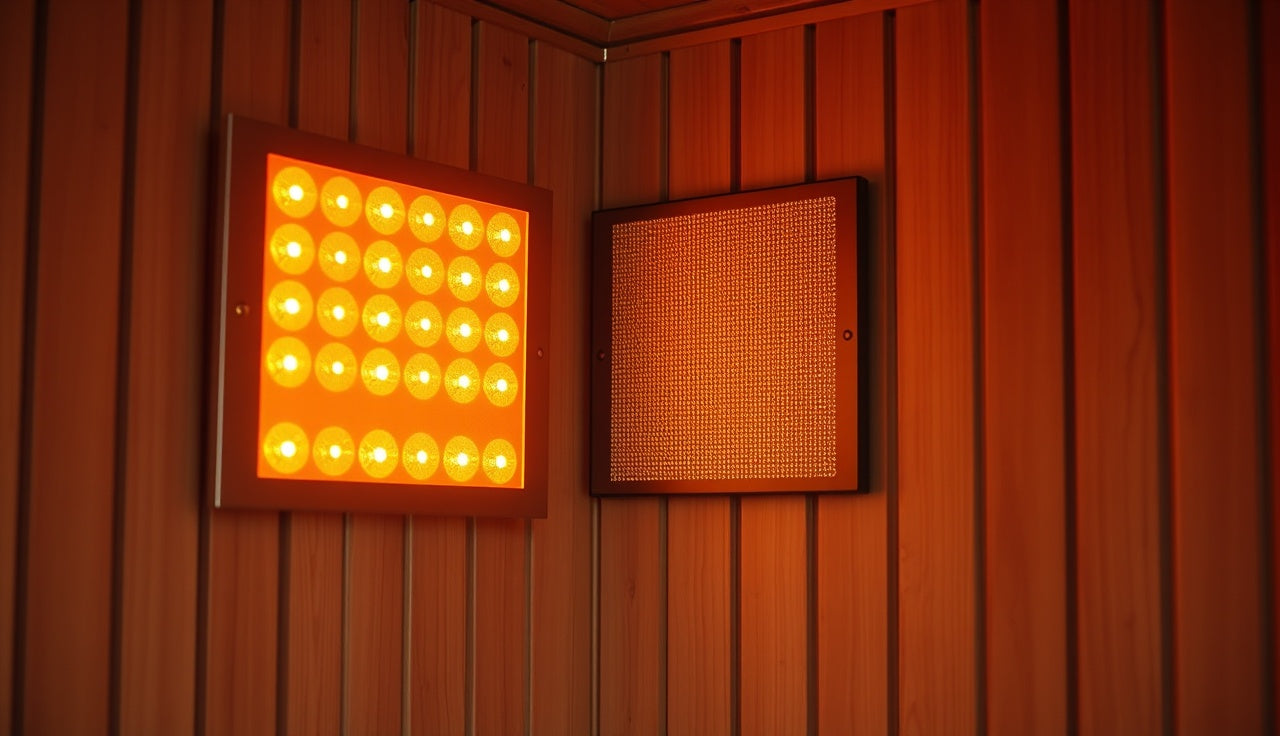
Saunas marketed as 'near infrared saunas' often use incandescent or halogen bulbs with a red or near-infrared coating. These do emit NIR light, and if your skin is reasonably close to the emitters (within 30 to 60 cm), you'll get a meaningful NIR dose. The variable is irradiance at your actual skin surface, which almost no manufacturer measures or discloses.
Sit 60 cm from a 150W NIR bulb panel for 20 minutes and you receive a different, probably smaller dose than a clinical LED panel at 40 mW/cm² for 15 minutes. How much smaller depends on bulb type, reflector design, and session distance. If you already own a NIR sauna and you want the collagen benefit, sit closer to the emitters when it's safe to do so without overheating, and let longer sessions accumulate dose.
Buying new and putting collagen support near the top of your list? The most cost-effective approach is a dedicated red/NIR LED panel mounted in or near your sauna space, run at the correct distance, paired with your home sauna for the heat and cardiovascular effects. That's two separate tools doing what each does best.
SweatDecks carries a range of sauna options and can help you think through whether a combo NIR-infrared unit or a separate panel setup makes more sense for your space and goals. Get the wavelength and irradiance specs before you decide.
How many sessions does it take to see collagen improvements?
The Wunsch 2014 trial used 30 sessions over 15 weeks (twice weekly) and showed clear histological and clinical improvement by week 10 or later [3]. The Sadick 2008 study saw changes after 9 sessions over 3 weeks [7]. The Calderhead and Vasily protocol showed maximal gains at 10 sessions over 5 weeks [5].
A reasonable expectation for a home user: 2 to 3 sessions per week for 8 to 12 weeks before judging results. This matches the turnover cycle of dermal collagen, which is slow-moving tissue. You won't notice anything after two weeks, and that's normal.
Consistency beats intensity here. Three 15-minute sessions per week over 12 weeks (54 total sessions) will outperform occasional marathon sessions. The cumulative photon dose drives the fibroblast response, not single high-exposure events.
Age matters too. Younger skin has more active fibroblasts and typically responds faster. Older skin has slower baseline collagen turnover, so it may take longer to show visible changes, but the mechanism still operates. The Wunsch trial included subjects aged 27 to 79, and both younger and older groups improved, though the absolute changes varied [3].
Sunscreen and avoiding UV right after NIR sessions is sensible. Post-session skin may be temporarily more sensitive, and UV damage would cancel out the collagen gains you're building. This isn't a studied interaction, just applied physiology.
Are there any risks or downsides to near infrared sauna for skin?
NIR light at therapeutic doses has a strong safety record. It's non-ionizing radiation, meaning it doesn't damage DNA the way UV does [2]. The main risk from sauna NIR setups is thermal, not photochemical: bulbs running hot can cause burns if you're too close for too long, especially incandescent or halogen NIR emitters, which get extremely hot.
Eye safety is the one real photochemical concern. NIR is invisible, so your blink reflex doesn't protect you the way visible light does. Don't stare directly at NIR bulbs or LED panels. Some clinical devices include eye protection as standard. In a sauna where bulbs are positioned to the side or above, direct eye exposure is less likely, but be deliberate about positioning.
For people with active skin conditions, including anyone on photosensitizing medications (some antibiotics, retinoids, specific psychiatric drugs), check with your prescribing physician before adding regular NIR exposure. Photosensitizing drugs can make skin abnormally reactive to any light, including NIR. The FDA lists photosensitivity as a known side effect of several common drug classes [8].
Melasma and certain pigmentation conditions can be worsened by heat rather than by NIR specifically. If you have melasma, discuss the heat component of any sauna with a dermatologist before committing to a regular protocol.
Pregnancy is a standard caution for sauna use generally. The American College of Obstetricians and Gynecologists advises avoiding hyperthermia during pregnancy [9]. NIR-specific pregnancy safety data is limited; the conservative approach is avoidance during pregnancy.
For healthy adults, the risk profile of NIR at therapeutic doses is low and the benefits are modest and real. That's a fair trade for a wellness tool.
How does NIR compare to other collagen-boosting treatments?
Collagen induction therapy (microneedling) creates controlled micro-injuries that trigger strong wound healing and collagen remodeling. Clinical results are often faster and more dramatic than NIR light, but it involves downtime, discomfort, and professional treatment costs of $300 to $800 per session [10]. NIR is gentler, slower, and can be done daily at home.
Retinoids (prescription tretinoin and over-the-counter retinol) are backed by decades of evidence for collagen synthesis via retinoic acid receptors. They work through a completely different pathway than NIR. The two approaches are genuinely complementary and can be used together, with the standard caveat about photosensitization from retinoids and the importance of morning SPF.
Laser resurfacing and fractional laser treatments also stimulate collagen through thermal injury and photobiomodulation depending on the laser type. They are far more aggressive than NIR panels, with longer recovery times and higher costs, but produce more dramatic changes in shorter timeframes.
Red light therapy panels sit in a middle ground: no downtime, no professional requirement, meaningful but gradual effects, and a one-time equipment cost of $300 to $1,500 for a quality home device. Over a year of twice-weekly sessions, the per-session cost is often less than a single microneedling appointment.
For someone building a home recovery space that already includes a home sauna and maybe a cold plunge, adding a NIR panel is a natural extension. The contrast therapy routine (heat followed by cold) already supports circulation and recovery; NIR slots into the same session structure and targets a complementary goal.
What should you look for when buying a near infrared sauna or NIR panel for collagen?
Wavelength specificity is the most important spec. Look for devices that list their primary wavelengths. For collagen work, you want 630 to 680 nm (red) and/or 800 to 880 nm (near-infrared). Some devices add 940 nm for deeper tissue penetration. Anything labeled just 'infrared' without specifying nanometers is ambiguous and likely dominated by far-infrared.
Irradiance at distance is the second critical number. A reputable manufacturer will publish irradiance in mW/cm² at 10 cm and 30 cm. If they won't provide it, that's a red flag. Target at least 20 to 40 mW/cm² at your typical use distance for collagen protocols.
Third-party testing means something. Some companies publish IEC 60825-1 safety classification and independent spectral analysis. That's a standard for optical radiation sources [11]. It won't tell you the collagen effect, but it confirms the device outputs what it claims at the stated wavelengths.
Bulb vs. LED: incandescent and halogen NIR bulbs produce broad-spectrum light including NIR, but they also throw off significant visible red light and heat, and they burn out faster. LED panels are more energy-efficient, last longer (50,000+ hours is common), and can be engineered for tighter wavelength specificity. For most home users today, LED panels are the better choice for collagen-targeted work.
For a full sauna-plus-NIR setup, some outdoor sauna and indoor cabin designs now build in dedicated NIR LED arrays alongside far-infrared panels. These are more coherent than a couple of NIR bulbs thrown into a far-infrared unit. Ask the manufacturer what percentage of total radiant output falls in the NIR therapeutic range (700 to 1100 nm) versus far-infrared (8,000 to 14,000 nm). Those hit very different tissues through very different mechanisms.
A basic but honest buying checklist: Does it list specific wavelengths? Does it publish irradiance at distance? Is there independent testing of the output? Does it have proper UL or ETL electrical safety listing [12]? Four yeses means you're looking at a serious device.
Can you combine NIR sauna sessions with cold plunge for better skin results?
Contrast therapy, alternating heat and cold, is popular for athletic recovery and there's reasonable physiological logic behind it: the vasoconstriction and vasodilation cycle drives circulation changes that may support tissue health generally. The cold plunge benefits literature centers on inflammation, muscle recovery, and mood, not on collagen.
For skin collagen specifically, no controlled trial compares NIR alone against NIR plus cold plunge. The honest answer is that nobody has good data on the combination for this outcome. The closest adjacent research is on blood flow and fibroblast activity: fibroblasts respond to mechanical stress and circulatory changes, and contrast therapy does measurably alter skin blood flow.
One thing to weigh: a cold plunge after NIR exposes freshly photostimulated skin to vasoconstriction. Whether that blunts or amplifies the fibroblast response isn't known. Practically, running the NIR session before the sauna, followed by cold plunge or ice bath, is a sensible sequence that puts the collagen work early, when you're fresh and willing to sit still in front of the panel.
SweatDecks offers both sauna and cold plunge setups for people building full contrast therapy spaces at home. If you're designing a recovery room, placing the NIR panel inside or right next to your sauna makes session stacking effortless.
So, on combining: do it if you're already doing contrast therapy for recovery. Don't add a cold plunge specifically because you think it'll amplify the collagen effect, because there's no evidence it does. But it certainly doesn't hurt.
What are realistic expectations for skin changes from NIR sauna use?
Be honest with yourself about what 'collagen improvement' actually looks like. Histological studies show measurable increases in collagen density on biopsy or ultrasound. Clinical photos show reduced fine lines and improved texture in study participants. Those are real effects. They are not the dramatic transformation of a facelift or an aggressive laser treatment.
The visible changes most people report with consistent NIR use: skin feels firmer, fine lines soften a little, tone looks more even, and skin quality improves gradually over months. Deeper wrinkles, significant laxity, and sun damage built up over decades are not going to reverse meaningfully from NIR light alone.
Age-related collagen loss runs about 1% per year starting in the mid-20s, accelerating after menopause [13]. A treatment that increases collagen density by 31 to 51% over 3 to 4 months is meaningful against that baseline. But you're working against an ongoing biological tide, so maintenance sessions after the initial course matter.
Expect the first 4 weeks to feel like nothing is happening. That's normal. Weeks 8 to 12 are when most studies show measurable change. If you photograph your skin (useful for self-assessment), do it in identical lighting conditions monthly. Smartphone selfies in variable lighting will mislead you.
If you smoke, sit under heavy chronic stress, or sleep poorly, those factors degrade collagen faster than NIR can rebuild it. The tool works best in a system that isn't actively working against it. Read more about the broader picture of sauna benefits and how regular heat exposure fits into overall wellness.
Frequently asked questions
Is near infrared sauna the same as red light therapy for collagen?
They overlap but aren't identical. Red light therapy typically uses 630 to 680 nm wavelengths. Near infrared is 700 to 1100 nm. Many devices use both ranges at once. The collagen studies used combinations of red and NIR. A 'near infrared sauna' is a sauna cabinet that includes NIR emitters, which may or may not deliver the irradiance levels used in clinical studies. A standalone red light or NIR panel is usually more precisely calibrated for therapeutic dosing.
How long do the collagen benefits of NIR light last after you stop using it?
There's limited long-term follow-up data. The Wunsch 2014 trial did a 3-month post-treatment assessment and found improvements were maintained, but collagen resumes its normal aging decline once treatment stops. Most practitioners recommend ongoing maintenance sessions, perhaps once weekly, after finishing an initial intensive protocol. Collagen production needs continuous signaling; you can't bank large amounts indefinitely.
Can near infrared sauna help with cellulite or skin tightening?
Collagen improvement in the dermis adds firmness, which can modestly improve the look of cellulite and mild laxity. But cellulite involves fat architecture and fibrous septae as much as dermal collagen, so NIR alone is not a cellulite treatment. Skin tightening from NIR is gradual and subtle, not comparable to radiofrequency or ultrasound tightening devices that specifically target deeper tissue contraction.
What is the best time of day to use NIR for skin collagen?
No controlled evidence establishes a best time of day for collagen-specific NIR treatment. Practically, morning sessions before applying SPF make sense since you're not stacking sun exposure on photostimulated skin. Evening sessions are fine too and may pair well with overnight skin repair processes. Consistency of schedule matters more than clock time. Pick a time you'll actually keep.
Does NIR light help with acne scars or post-inflammatory hyperpigmentation?
NIR and red light have separate evidence for wound healing and scar remodeling. For acne scars, collagen remodeling is part of how the tissue improves, and several small studies support red/NIR therapy for post-acne scarring. Post-inflammatory hyperpigmentation (PIH) is a pigmentation issue rather than a structural collagen issue, and the evidence for NIR there is weaker. Heat from any sauna can temporarily worsen PIH, so caution is warranted.
How close should you sit to a NIR sauna panel or bulb?
Closer means higher irradiance at the skin, which delivers the therapeutic dose faster. For LED panels, 10 to 30 cm is typical for clinical protocols. For incandescent or halogen NIR bulbs, which run much hotter, 30 to 60 cm is safer to avoid thermal burns. Follow manufacturer guidelines and use skin temperature as feedback: mild warmth is fine, discomfort or redness means you're too close or staying too long.
Can I use NIR light if I'm on retinol or prescription tretinoin?
Retinoids increase skin photosensitivity, mainly to UV light, but the interaction with NIR is not well studied. The general clinical guidance is to avoid applying retinoids right before or after light therapy sessions. Using retinoids in the evening and NIR panels in the morning is a practical schedule that separates them. If you're on prescription tretinoin and plan intensive NIR protocols, talk it over with your dermatologist.
Are there collagen benefits from a traditional Finnish sauna, or only from NIR?
Traditional Finnish saunas work through heat, not targeted NIR light. Heat shock proteins including HSP47, a collagen-specific chaperone, are induced by sauna-level temperatures. There's cell-culture evidence that heat upregulates procollagen mRNA. For skin collagen specifically, this effect is likely real but smaller and less direct than the photobiomodulation pathway. Traditional sauna is not primarily a collagen tool, but it's not harmful to collagen either.
How does a portable sauna compare to a permanent NIR sauna cabin for collagen purposes?
A portable sauna that uses NIR bulbs can provide some photobiomodulation benefit, but irradiance and proximity to emitters varies a lot by design. If you're focused on collagen, a portable setup is a lower-cost entry point, but verify the NIR wavelength and irradiance specs the same way you would for any other device. Read more in our portable sauna guide. A dedicated NIR LED panel used in any sauna context is more controllable.
Is there an optimal number of NIR sessions per week for skin collagen?
The best-designed trials used two to three sessions per week. Daily use is unlikely to be harmful, but the photobiomodulation literature suggests a rest period between sessions lets the cellular signaling cascade complete. Two to three times weekly for a minimum of 8 to 12 weeks is the protocol closest to what produced measurable collagen increases in controlled studies. More frequent sessions don't appear to produce proportionally better results.
Does near infrared light affect collagen differently in younger versus older skin?
Both younger and older fibroblasts respond to NIR stimulation, but older fibroblasts have lower baseline activity and slower turnover. The Wunsch 2014 trial included subjects ranging from 27 to 79 and found improvements across age groups, though absolute changes may be smaller in older skin. Older skin also starts from a lower collagen baseline, so the relative benefit may be similar even if the absolute tissue gain is less.
What's the difference between a sauna with NIR bulbs and a dedicated red light therapy panel?
NIR bulbs in a sauna (incandescent or halogen) produce broad-spectrum light including NIR, visible red, and heat radiation. Dedicated LED panels emit narrow-band wavelengths at calibrated irradiance, more closely matching clinical study protocols. LED panels are more energy-efficient, last longer, and offer more precise dosing. For collagen purposes, a dedicated LED panel gives you more control over the actual therapeutic dose your skin receives.
Can children or teenagers use near infrared sauna for skin benefits?
Pediatric NIR safety data is essentially nonexistent in the photobiomodulation literature. Standard sauna guidance from organizations like the American Academy of Pediatrics applies general caution around heat exposure in children. For skin collagen specifically, there's no clinical indication for NIR use in pediatric populations. Teenagers with acne might consult a dermatologist about clinical red light acne treatments, which are a separate, specifically studied application.
How does NIR sauna fit into a broader skin care routine?
NIR works best as one layer in a system. Sun protection (daily SPF) prevents ongoing collagen destruction and is more protective than any builder. Vitamin C serum supports collagen synthesis through a different pathway (cofactor for hydroxylation). Retinoids stimulate collagen through retinoic acid receptors. NIR adds fibroblast photostimulation on top. None of these replaces the others, and all of them are undermined by smoking, chronic UV exposure, and poor sleep.
Sources
- Hamblin MR, Photobiomodulation or low-level laser therapy, Journal of Biophotonics, 2016: NIR light in the 700 to 1100 nm range penetrates 5 to 10 mm into dermal tissue and is absorbed by cytochrome c oxidase in mitochondria
- Karu T, Mitochondrial signaling in mammalian cells activated by red and near-IR radiation, Photochemistry and Photobiology, 2008: Cytochrome c oxidase is the primary chromophore for NIR photobiomodulation, mediating downstream ATP production and reactive oxygen species signaling
- Wunsch A, Matuschka K, A controlled trial to determine the efficacy of red and near-infrared light treatment in patient satisfaction, reduction of fine lines and wrinkles, skin roughness, and collagen density, Photomedicine and Laser Surgery, 2014: Randomized controlled trial using 611 nm and 830 nm at 40 mW/cm² for 30 sessions showed 36% average increase in collagen density and significant improvement in skin roughness
- Roti Roti JL, Cellular responses to hyperthermia, International Journal of Hyperthermia, 2008; and Batulan Z et al., HSP47 expression in human dermal fibroblasts, Cell Stress and Chaperones, 2018: Repeated heat stress upregulates HSP47 (a collagen-specific chaperone) and procollagen mRNA in fibroblasts
- Calderhead RG, Vasily DB, Low level light therapy with light-emitting diodes for the aging face, Clinics in Dermatology, 2016: A 10-session protocol using 633 nm and 830 nm at 55 mW/cm² showed 51% increase in collagen density; review found consistent collagen synthesis improvement across studies
- Barolet D et al., Regulation of skin collagen metabolism in vitro using a pulsed 660 nm LED light source, Journal of Investigative Dermatology, 2009: 670 nm LED at 50 mW/cm² for 12 sessions showed histological increase in procollagen in human skin
- Sadick NS, A study to determine the efficacy of a novel handheld light-emitting diode device in the treatment of photoaged skin, Journal of Cosmetic Dermatology, 2008: Nine sessions over 3 weeks using 590 to 870 nm light showed 31% increase in collagen fibers on histological analysis
- U.S. Food and Drug Administration, Photosensitivity reactions to medications: FDA lists photosensitivity as a known side effect of several common drug classes including certain antibiotics, retinoids, and psychiatric medications
- American College of Obstetricians and Gynecologists, Committee Opinion on Exposure to Toxic Environmental Agents and Heat during Pregnancy: ACOG advises pregnant women to avoid hyperthermia, including sauna use, due to risks of neural tube defects and other adverse fetal outcomes
- American Society of Plastic Surgeons, Microneedling procedure statistics and cost ranges: Professional microneedling collagen induction therapy costs $300 to $800 per session depending on provider and region
- International Electrotechnical Commission, IEC 60825-1 Safety of Laser Products standard: IEC 60825-1 is the international standard for optical radiation safety classification of laser and LED light-emitting devices
- Underwriters Laboratories, UL electrical safety listing for consumer devices: UL and ETL (Intertek) safety listings certify that consumer electrical devices meet North American safety standards for construction and electrical hazard
- Farage MA et al., Intrinsic and extrinsic factors in skin aging, International Journal of Cosmetic Science, 2008: Dermal collagen content decreases approximately 1% per year starting in the mid-20s, with accelerated loss following menopause

Share:
Heat therapy vs ice therapy for DOMS: which actually works better?
Sauna for psoriasis: what the research actually shows