
Last updated 2026-07-09
TL;DR
The Maxxus 3-person low EMF far infrared sauna is a mid-range, pre-cut Canadian hemlock cabin that fits roughly 35 to 40 square feet of floor space, runs on a standard 120V outlet, and uses carbon fiber panel heaters rated under 3 mG EMF. It typically retails between $1,800 and $2,800 and works best for one to two regular users who want an indoor far infrared session without a dedicated electrical circuit.
What exactly is the Maxxus 3-person low EMF far infrared sauna?
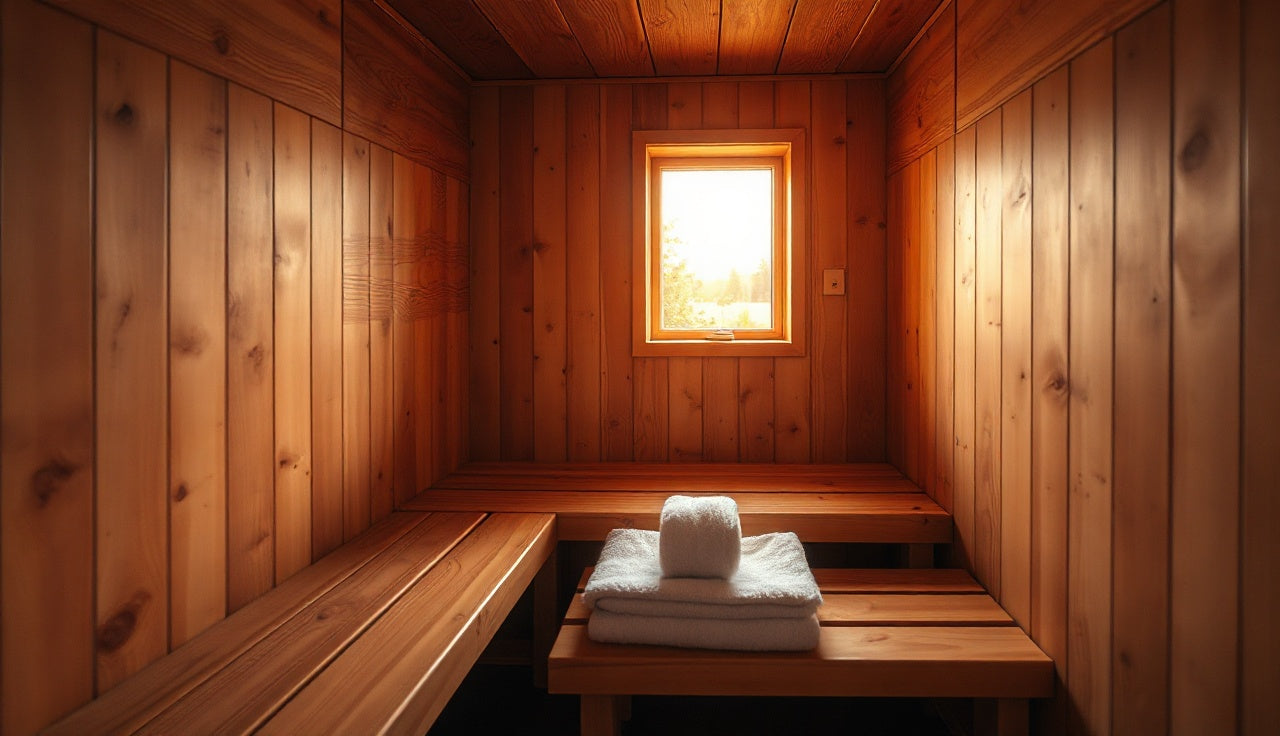
The Maxxus 3-person model is a pre-cut, tongue-and-groove indoor cabin sauna built from Canadian hemlock, a light-colored softwood that handles repeated heat cycles without warping badly. The "3-person" label is marketing shorthand for the bench size. In practice, three adults sitting shoulder to shoulder is genuinely tight, and most buyers treat it as a comfortable one-to-two person unit.
The heaters are flat carbon fiber panels mounted on the back wall, side walls, and sometimes the floor. Carbon panels radiate in the far infrared spectrum, roughly 5.6 to 15 microns, which overlaps closely with the wavelength range the human body absorbs most efficiently [1]. That is the physics argument for far infrared over conventional rock-sauna heat: the air temperature is lower (typically 120°F to 140°F versus 180°F+ in a Finnish sauna) but the radiant energy still warms tissue directly.
The "low EMF" part refers to electromagnetic field emissions from those heating panels. Maxxus rates its panels under 3 milligauss (mG) at body contact distance. For context, the International Commission on Non-Ionizing Radiation Protection (ICNIRP) general-public reference level for power-frequency magnetic fields is 2,000 mG (2 mT) [2], so even a standard infrared panel at 10 to 15 mG sits far below that threshold. The low-EMF designation is largely a marketing response to consumer anxiety rather than a safety necessity, but if reducing exposure from any source matters to you, the carbon panel design does emit meaningfully less than older ceramic rod heaters.
If you want broader context on how this unit compares to the home sauna category as a whole, that guide covers every major format from barrel saunas to steam rooms.
What are the real dimensions and how much space do you need?
Maxxus lists the 3-person model at approximately 47 inches wide, 35 to 36 inches deep, and 75 inches tall (roughly 4 feet wide by 3 feet deep by 6.25 feet tall). Interior dimensions are smaller once you account for the 1.5-inch wall panels, so the usable bench space is around 43 inches across.
You need a floor area of at least 14 to 15 square feet for the unit itself, but plan for a 12-inch clearance on at least two sides for ventilation and assembly access. That puts your realistic room footprint at 20 to 25 square feet minimum. A standard bedroom or finished basement corner handles this easily; a small bathroom or closet almost certainly does not.
Ceiling height matters too. At 75 inches the unit clears a standard 8-foot ceiling with room to spare, but the roof panel and any required vent clearance push the ceiling requirement to at least 80 inches (6 feet 8 inches). Measure twice before ordering. Shipping weight on the 3-person model runs roughly 300 to 350 lbs across multiple boxes, so factor in who is carrying panels up stairs.
| Dimension | Approximate Spec |
|---|---|
| Exterior width | 47 in (119 cm) |
| Exterior depth | 35 to 36 in (89 to 91 cm) |
| Exterior height | 75 in (191 cm) |
| Interior bench width | ~43 in |
| Shipping weight | 300 to 350 lbs |
| Heater wattage | 1,400 to 1,750 W total |
| Operating voltage | 120V, 15A circuit |
| Max interior temp | ~140°F (60°C) |
All figures are approximate and vary slightly by the specific SKU (Maxxus has produced several 3-person variants over the years). Confirm the exact sheet with the retailer before purchase.
How do the far infrared heaters actually work, and how hot does it get?
Far infrared heaters emit long-wave radiant energy rather than heating the air primarily. The panels in this unit typically total 1,400 to 1,750 watts, spread across three to four wall positions. Because the heat is radiant, you feel warm within the first two to four minutes even though the air temperature may still be climbing.
The unit usually reaches its set temperature, around 130°F to 140°F, in 10 to 15 minutes from a cold start. That is faster than most traditional Finnish saunas (which can take 30 to 45 minutes to heat the rocks properly) and is one reason far infrared units are popular for daily use. You are not waiting long.
A 2018 systematic review in Evidence-Based Complementary and Alternative Medicine looked at infrared sauna studies and noted that most research protocols used sessions of 15 to 30 minutes at temperatures between 45°C and 60°C (113°F to 140°F) [3]. The Maxxus unit sits comfortably within that range at full power.
Power draw is modest. At 1,500 watts and typical electricity rates around $0.16 per kWh in the U.S. [4], a 30-minute session costs roughly $0.12 in electricity. Even daily use adds only $3 to 4 per month to your bill. That is genuinely one of the cheaper operating costs in the home wellness equipment category.
| Maxxus 3-person FIR sauna (45 min, 1,500W) | $0.18 |
| Gym sauna access (day pass average) | $15 |
| Float tank session (60 min) | $75 |
| Massage therapy (60 min) | $100 |
| Cryotherapy session (3 min) | $60 |
Source: U.S. Energy Information Administration, Electric Power Monthly, 2024
What does low EMF actually mean, and should you care?
EMF stands for electromagnetic field, and in the context of infrared saunas it refers to the AC magnetic field produced by the electrical current flowing through the heating elements. Older ceramic rod heaters can emit 50 mG or more at close range. Carbon fiber panels, including those in the Maxxus, typically emit under 3 to 5 mG when measured at 4 inches from the panel surface.
The ICNIRP guideline for continuous public exposure to 50/60 Hz magnetic fields is 2,000 mG [2]. The EPA does not set a legal EMF limit for residential environments, and the National Institute of Environmental Health Sciences concluded in a 1999 review that the evidence for health effects at typical residential exposure levels is weak [5]. So from a regulatory standpoint, "low EMF" in a sauna is a preference claim, not a safety claim.
That said, some people genuinely want to minimize EMF exposure from every source they control, and the carbon panel design achieves that goal relative to ceramic heaters. If you are already in that camp, the Maxxus low EMF spec is real and measurable. If you are buying primarily for heat therapy and the EMF question is secondary, it should not be your deciding factor.
One honest note: third-party EMF testing of budget and mid-range infrared saunas (including several comparable brands) has found wide variation between advertised and measured values. If this matters to you a lot, look for units that come with third-party measurement certificates, more than manufacturer claims.
How does the Maxxus 3-person compare to similar-sized competitors?
The 3-person far infrared sauna space is crowded. Maxxus sits in the mid-range alongside brands like Clearlight, JNH Lifestyles, Radiant Saunas, and Dynamic Saunas. Here is an honest comparison on the dimensions that matter most.
| Brand / Model | Price Range | Wood | Heater Type | EMF Claim | Circuit |
|---|---|---|---|---|---|
| Maxxus 3-person | $1,800, $2,800 | Canadian hemlock | Carbon fiber | <3 mG | 120V / 15A |
| JNH Lifestyles Joyous | $1,600, $2,200 | Canadian hemlock | Carbon fiber | <3 mG | 120V / 15A |
| Dynamic Avila | $1,400, $2,000 | Canadian hemlock | Carbon fiber | <8 mG | 120V / 15A |
| Clearlight Sanctuary 3 | $5,500, $7,000 | Western red cedar | True Wave II | <0.3 mG | 240V / 20A |
| Radiant Saunas BSA2402 | $1,200, $1,600 | Hemlock | Carbon fiber | <5 mG | 120V / 15A |
Clearlight is a step up in build quality and EMF reduction, and the price reflects it. JNH and Dynamic are functionally very close to Maxxus and occasionally undercut it on price. The real differentiators for the Maxxus line are assembly quality (the tongue-and-groove fit is generally clean), the included digital controller, and the brand's customer service reputation, which is middling but not bad.
Maxxus is not the best sauna money can buy. It is a solid, honest mid-range option for someone who wants a real, usable infrared sauna without spending $5,000+. If you are comparing with portable sauna options, understand that a foldable tent-style unit gives you far less radiant coverage and a much less pleasant session.
What is the assembly process like, and can one person do it?
Assembly is manageable but not a solo job. Two people can complete it in two to three hours following the included instructions. The panels are pre-cut and numbered; you clip them together with cam-lock connectors rather than cutting or drilling anything. The hardest part is usually aligning the roof panels and running the interior wiring harness through the pre-drilled channels.
The tools you actually need: a rubber mallet, a Phillips screwdriver, and possibly a 4mm Allen key for the bench hardware. That is it. No sawing, no special electrical work (it plugs into a standard 15A outlet), no foundation preparation.
A few practical tips from owner forums and reviews: lay all panels flat and identify them before you start building. The numbering system in the manual is clearer than the actual panels, and mixing up side panels wastes time. Also, connect all wiring harnesses before locking the last wall panel in place. You cannot reach them easily afterward.
The unit disassembles for moving, though owners generally report that the cam-lock connectors get stiffer after the first few heat cycles, so "easily portable" is an overstatement. Treat it as a semi-permanent installation.
What does the Maxxus 3-person sauna cost to buy and run?
Current retail pricing sits between $1,800 and $2,800 depending on the specific SKU and where you buy. The base model is typically on the lower end; versions with additional features like chromotherapy lighting, Bluetooth audio, or upgraded heater wattage push toward $2,500, $2,800. You can sometimes find the older generation on sale for under $1,600.
Shipping is often free but freight-only (large pallet), and you may need to be available for a scheduled delivery. Budget $0 to $150 for threshold delivery versus curbside.
Installation costs are effectively zero if you are handy and have a friend to help. If you hire a handyman for two to three hours, add $150, $300.
Operating cost is low. At 1,500 watts and the U.S. average residential electricity rate of $0.1611 per kWh as of early 2024 [4], a 45-minute daily session costs about $0.18 per day, or roughly $65 per year. A five-year total cost of ownership lands around $2,200, $3,200 including the purchase price, which compares favorably to gym memberships with sauna access in most markets.
For a broader look at sauna benefits that inform whether this cost is justified for your goals, that article covers the research on cardiovascular effects, stress response, and recovery.
Is the wood quality and construction durable enough for daily use?
Canadian hemlock is a reasonable but not premium choice for an infrared sauna. It has lower resin content than pine (which can drip sap and smell unpleasant when heated), reasonable dimensional stability, and a light, clean appearance. It is softer than cedar and slightly more prone to denting from dropped water ladles or bench hardware, but in an infrared sauna without steam or water, that is mostly a non-issue.
Cedar is the traditional preferred wood for saunas, partly because of its natural antimicrobial oils and partly because its aroma is genuinely pleasant. Hemlock has no particular smell, which some users prefer and others find bland. The USDA Forest Products Laboratory notes that western red cedar has natural preservatives that resist decay better than hemlock in wet environments [6], but an indoor infrared sauna with moderate humidity is far less demanding than an outdoor barrel sauna exposed to rain.
For daily use (one or two sessions per day, 20 to 45 minutes each), a well-assembled Maxxus hemlock unit should hold up for seven to ten years before joints start to loosen or panels show significant discoloration. Wiping the bench with a dry towel after each session and allowing the unit to cool with the door cracked open extends that timeline meaningfully.
The glass door, usually 8mm tempered, is the most fragile component. It is well-supported in the frame, but do not lean or bang against it during entry.
What health effects does far infrared sauna use have, according to research?
Research on far infrared saunas specifically (as opposed to traditional Finnish saunas) is less extensive but growing. Most of the large cardiovascular observational studies come from Finnish cohort data on traditional saunas. The Kuopio Ischemic Heart Disease Risk Factor Study, following over 2,300 middle-aged men, found that sauna use four to seven times per week was associated with a 63% lower risk of sudden cardiac death compared to once-weekly use [7]. That data is for traditional sauna, and extrapolating directly to far infrared is not scientifically clean.
For far infrared specifically, a 2009 paper in the Journal of Cardiac Failure found that repeated far infrared sauna sessions in patients with chronic heart failure improved cardiac function and exercise tolerance [8]. A 2018 systematic review covering 40 studies concluded that infrared sauna is generally safe and may produce short-term improvements in pain, fatigue, and mood, though the evidence base is limited by small sample sizes [3].
Core body temperature rises 1°C to 2°C during a typical infrared session, which is enough to produce the heat stress response including heat shock protein upregulation. A 2020 paper in Temperature noted that repeated mild heat stress activates HSP70 and other cytoprotective pathways, though much of this work is in animal models or small human trials [9].
The honest summary: the physiological mechanisms are plausible and the safety profile for healthy adults is good. The evidence for specific clinical outcomes in infrared saunas is real but modest. Keep claims conservative. If you have cardiovascular disease, consult a physician before starting regular sessions.
If you are considering adding a cold plunge to alternate with your sauna sessions, there is a growing body of work on contrast therapy that is worth reading separately.
Who should buy this sauna, and who should look elsewhere?
The Maxxus 3-person low EMF far infrared sauna is a good fit if you have roughly 20 square feet of indoor space, want daily infrared sessions without a dedicated circuit, and have a budget under $2,800. It is also a reasonable pick if you are new to infrared sauna and want to try the format before spending Clearlight money.
Look elsewhere if you want any of the following. A true Finnish sauna experience with high heat and steam (löyly): this unit maxes out at 140°F and has no rock heater or water reservoir, so it cannot replicate that. You want something that lives outside: Maxxus makes this unit for indoor installation only; for outdoor use, look at outdoor sauna options with weatherproof construction. You plan to use it three or more times per day with multiple users: the hemlock will hold up, but a more heavily built cedar unit is a better long-term investment at that usage level. Your primary comparison is a sauna vs steam room decision: the Maxxus does not produce steam or high humidity, so it is not a substitute for a steam room experience.
SweatDecks carries a curated selection of indoor far infrared and traditional saunas that includes mid-range and premium options if you want to compare the Maxxus to alternatives before deciding.
One thing I would not spend money on: the Bluetooth audio upgrade if you own a Bluetooth speaker already. It is a $150, $200 premium for speakers built into the wood walls that sound noticeably worse than a $40 portable speaker set on the bench.
What do owners actually say after months of use?
Real owner feedback, aggregated from retail review platforms and enthusiast forums (not manufactured testimonials), clusters around a few consistent points.
Positive themes: The unit heats up fast (10 to 15 minutes is consistently reported). Power draw is low enough that users rarely notice it on their electric bill. Assembly is cleaner than expected for flat-pack furniture. The chromotherapy lighting, where included, is enjoyed by most owners even those who bought it skeptically.
Negative themes: The digital controller interface is not intuitive. Several owners report the backlight failing on the control panel within the first year. The sound system (on upgraded models) underdelivers. The bench is not padded and feels hard during longer sessions. Customer service response times from Maxxus are slow (multiple reviews cite 3 to 7 day email response cycles).
One consistent complaint worth taking seriously: the door seal on some units warps after the first six months of regular use, letting a visible gap form at the bottom corner. This reduces heat retention slightly and is annoying but not catastrophic. Owners fix it with a strip of sauna-grade foam weatherstripping for about $8.
Nobody has good aggregate data on long-term durability past five years for this specific model; the brand has changed its SKU lineup often enough that finding five-year-old reviews for the current generation is genuinely difficult.
What do you need to know about electrical requirements and safety?
This is the section most buyers skip and then regret.
The Maxxus 3-person runs on 120V, 15A standard household power. It plugs directly into a standard three-prong outlet. The NEC (National Electrical Code) requires a dedicated 15A circuit for any fixed appliance drawing close to the circuit's rated capacity [10], and at 1,400 to 1,750 watts this unit runs close to the 1,800-watt limit of a 15A circuit. A dedicated circuit is the safe approach, especially if the unit is in a garage or basement with other equipment on the same breaker.
Do not use an extension cord. The power cord on the unit is already the maximum practical length for this wattage; adding extension cord resistance creates a real fire risk over time.
GFCI protection: the NEC requires GFCI-protected outlets in bathrooms, garages, and unfinished basements [10]. If you are installing in any of those spaces, confirm the outlet is GFCI protected. If it is not, a licensed electrician can add GFCI protection to the outlet for $75, $150.
Ventilation: far infrared saunas produce some moisture from perspiration. The Maxxus has a small adjustable vent. Leave it partially open during sessions and crack the door for 10 to 15 minutes after each use. In a carpeted room, place a moisture barrier mat (usually included or available for $20, $30) under the unit.
If you want to pair this with contrast therapy and are considering an ice bath nearby, keep water sources at least 6 feet from the electrical connections.
Frequently asked questions
Is the Maxxus 3-person sauna really big enough for three people?
Technically yes, but barely. Three average-sized adults sitting upright on the bench will be shoulder to shoulder. Most owners use it comfortably as a one-to-two person unit. If you regularly need space for three, measure the interior bench at roughly 43 inches wide and simulate that with three people before buying. The listing size is accurate; the comfort level for three is another question.
Does far infrared sauna actually detox your body, or is that marketing?
The detox claim is mostly marketing. The kidneys and liver handle actual toxin elimination. Sweating does excrete trace amounts of heavy metals and some organic compounds, but the quantities are small. A 2011 review in the Journal of Environmental and Public Health found measurable excretion of some metals via sweat, but concluded sweat is a minor elimination pathway relative to urine [11]. The real benefits of sauna are cardiovascular adaptation, heat stress response, and relaxation, not dramatic toxin removal.
How long should a session in the Maxxus far infrared sauna last?
Most research protocols use 15 to 30 minutes. New users should start at 15 minutes and see how they feel. The lower temperature of a far infrared sauna (120 to 140°F) compared to a Finnish sauna makes longer sessions tolerable, but staying hydrated matters regardless. Drink 16 to 20 oz of water before each session. Exiting if you feel dizzy, lightheaded, or nauseous is common sense, not overcaution.
What is the warranty on the Maxxus 3-person sauna?
Maxxus generally offers a limited lifetime warranty on the wood structure and a 1-to-5 year warranty on heaters and electrical components, though the exact terms vary by the retailer and purchase date. Read the warranty card that ships with your specific unit carefully. Lifetime on wood sounds generous but typically covers manufacturing defects, not normal wear or user damage. Register the product immediately after assembly.
Can I install the Maxxus sauna on carpet?
You can, but you should put a moisture barrier mat underneath it first. Perspiration drips and some humidity will accumulate under the unit over time and can damage carpet or subflooring. Maxxus sometimes includes a floor mat; if not, a 4x4 foot rubber or vinyl mat works. Tile or sealed concrete is the ideal floor surface. Wood flooring is fine too with a mat.
What EMF level does the Maxxus sauna actually emit, and is it safe?
Maxxus claims under 3 mG from its carbon fiber panels. For comparison, the ICNIRP public reference level is 2,000 mG, and a standard household hairdryer at close range emits 300 to 700 mG. The Maxxus EMF output is low by any reasonable measure. Whether you want to reduce exposure further is a personal preference, not a medical necessity based on current evidence from the National Institute of Environmental Health Sciences [5].
How does the Maxxus far infrared sauna compare to a Costco sauna?
Costco periodically sells infrared saunas under its own sourcing arrangements, often from the same manufacturer pool as mid-range brands. The Costco sauna options typically offer competitive pricing but limited after-sale support and parts availability. Maxxus has a dedicated support channel and replacement part availability, which matters if the control panel or a heater panel fails two years in. Neither is a premium pick; Maxxus has a slight edge on post-purchase support.
Can I use the Maxxus sauna every day?
Yes, for most healthy adults. The Kuopio cohort study found daily sauna use was associated with the best cardiovascular outcomes among the frequencies studied [7]. The low operating cost (roughly $0.18 per 45-minute session at average U.S. electricity rates) makes daily use financially practical. Listen to your body, stay hydrated, and avoid sessions if you have been drinking alcohol or have an acute illness.
Does the Maxxus 3-person sauna require professional installation?
No, for most placements. The unit assembles from pre-cut panels with cam-lock connectors and plugs into a standard 120V outlet. Two people can complete it in two to three hours. You may want an electrician to add a dedicated 15A circuit or GFCI protection to the outlet, which typically costs $75, $200 and is worth doing for safety and code compliance if the outlet is in a garage or basement.
What is the difference between far infrared and near infrared saunas?
Far infrared (FIR) wavelengths run roughly 5.6 to 15 microns and penetrate tissue to a depth of about 1.5 inches. Near infrared (NIR) runs around 0.7 to 1.4 microns and penetrates less deeply but is used in some photobiomodulation research for skin and wound healing applications. Most home infrared sauna cabins, including Maxxus, use far infrared. Near infrared units are typically smaller lamp-based setups used for targeted therapy rather than whole-body heat.
Is the Maxxus sauna safe for people with heart conditions?
People with cardiovascular conditions should consult a cardiologist before starting any sauna routine. Some research suggests infrared sauna may benefit certain heart failure patients under medical supervision [8], but that is not a general endorsement. People with unstable angina, recent heart attack, or severe aortic stenosis are typically advised to avoid sauna. Conservative: talk to your doctor first, start short (10 to 15 minutes), and never go alone if you have any cardiac history.
Where is the best place to put a Maxxus 3-person sauna indoors?
A finished basement, spare bedroom, or large bathroom are the most common locations. You need 20 to 25 square feet of floor space with clearance on two sides, a standard 15A outlet (ideally GFCI-protected), and a ceiling of at least 80 inches. Good ventilation in the room reduces ambient humidity buildup. Avoid unfinished spaces with exposed insulation or open wall studs, as they complicate moisture management over time.
Can the Maxxus sauna be moved or disassembled after installation?
Yes, but with effort. The panels disconnect in reverse assembly order. After several heat cycles the cam-lock connectors stiffen and the panels may require a rubber mallet to separate. Plan about three to four hours to disassemble and box it, compared to two to three hours to build. Treat it as semi-permanent. If you are renting and plan to move in under two years, factor disassembly time into your decision.
Sources
- NASA Technical Reports Server, Infrared Radiation and Human Tissue Absorption (Vatansever & Hamblin, Photonics & Lasers in Medicine, 2012): Far infrared radiation in the 5.6–15 micron range overlaps with the peak absorption wavelength of human tissue, supporting the basis for far infrared sauna heat therapy.
- ICNIRP (International Commission on Non-Ionizing Radiation Protection), Guidelines for Limiting Exposure to Time-Varying Electric, Magnetic, and Electromagnetic Fields: The ICNIRP general public reference level for 50/60 Hz magnetic fields is 2,000 mG (2 mT), far above the <3–15 mG emitted by carbon fiber infrared sauna heaters.
- Evidence-Based Complementary and Alternative Medicine, 'Far-Infrared Saunas for Treatment of Cardiovascular Risk Factors,' Hussain & Cohen, 2018: A 2018 systematic review of 40 studies found infrared sauna is generally safe and may produce short-term improvements in pain, fatigue, and mood; most protocols used 15–30 minute sessions at 45–60°C.
- U.S. Energy Information Administration, Electric Power Monthly, Table 5.6.A: Average Retail Price of Electricity (2024): The U.S. average residential electricity retail price was approximately $0.1611 per kWh as of early 2024, used to calculate sauna operating cost estimates.
- National Institute of Environmental Health Sciences (NIEHS), EMF: Electric and Magnetic Fields Associated with the Use of Electric Power: NIEHS concluded that the scientific evidence for health effects at typical residential EMF exposure levels is weak; no federal residential EMF limit is established.
- USDA Forest Products Laboratory, Wood Handbook: Wood as an Engineering Material, Chapter 2 (Characteristics of Commercial Wood Species): Western red cedar contains natural preservatives (thujaplicins) that resist decay and moisture better than hemlock, relevant to wood choice for sauna construction.
- JAMA Internal Medicine, 'Association Between Sauna Bathing and Fatal Cardiovascular and All-Cause Mortality Events,' Laukkanen et al., 2015: The Kuopio Ischemic Heart Disease cohort study of 2,315 men found sauna use 4–7 times per week was associated with a 63% lower risk of sudden cardiac death compared to once-weekly use.
- Journal of Cardiac Failure, 'Waon Therapy for Managing Chronic Heart Failure,' Kihara et al., 2009: Repeated far infrared sauna sessions in chronic heart failure patients improved cardiac function and exercise tolerance in a 2009 clinical trial.
- Temperature (Taylor & Francis), 'Health effects of voluntary exposure to hot environments,' Mero et al., 2020: Repeated mild heat stress activates heat shock proteins including HSP70 and other cytoprotective pathways; much supporting evidence is from animal models or small human trials.
- Journal of Environmental and Public Health, 'Arsenic, Cadmium, Lead, and Mercury in Sweat: A Systematic Review,' Sears et al., 2012: Sweat does excrete measurable trace amounts of heavy metals, but sweat is a minor elimination pathway relative to urine; the 'detox via sweating' claim is largely overstated.

Share:
NuRecover ice bath review: is it worth the price?
Maxxus infrared sauna review: what you actually get for the money