
Last updated 2026-07-11
TL;DR
Kiln dried wood (moisture content 6-12%) is the right choice for most sauna builds. It settles before you install it, so it won't gap or cup badly once heat cycles start. Green or air-dried wood above 19% MC is cheaper upfront but shifts hard once it hits sauna heat, causing gaps, nail pops, and joint failure. Use kiln dried for paneling and benches. Framing can run a little wetter.
What does 'kiln dried' vs 'green wood' actually mean?
Moisture content (MC) is the number that decides everything here. It measures the weight of water in wood against the weight of the dry wood, as a percentage. The USDA Forest Products Laboratory defines kiln dried lumber as wood heat-treated in a controlled kiln to a target MC, usually 6-19% depending on species and end use, before it leaves the mill [1]. Green wood is freshly cut. It can sit anywhere from 30% to over 100% MC, meaning it holds more water by weight than dry fiber.
Air-dried lumber lands in between. Left outside under cover, wood slowly settles toward the ambient relative humidity of its region, usually 12-18% MC depending on climate [1]. That sounds close to kiln dried. But the process takes months to years for thick stock, and the result is less consistent than a kiln run.
These numbers have teeth in a sauna. A typical interior runs 160-200°F at bench level, with humidity swinging from near-dry (traditional Finnish) to 50-80% when you ladle water on the rocks [2]. That cycling wants to move wood. The less moisture in the board at installation, the less it moves after the walls go up.
Why does moisture content matter so much in a sauna environment?
Wood moves. Every woodworker knows this, and sauna builders feel it worse than almost anyone. When wood dries it shrinks across the grain (tangentially and radially) but barely at all along the grain. The Forest Products Laboratory puts average tangential shrinkage from green to oven-dry at 6-12% depending on species, and radial shrinkage at 3-7% [1]. Those percentages turn into gapping, warping, and cupping in your wall paneling and bench boards.
A sauna heats and cools every time you use it. In a Finnish-style build, the interior climbs from 60°F to 190°F and back, sometimes inside 90 minutes. That swing drives moisture in and out of any wood that isn't already near its equilibrium MC. Green or high-MC wood sheds moisture fast the first time the heater fires. A 1x4 tongue-and-groove panel installed at 25% MC can lose enough water in the first season to open a gap you can see from the bench.
Gaps aren't only ugly. They give condensation a place to collect on the cold side of the wall, and that's where rot and mold start. A well-built home sauna manages vapor carefully. Using properly dried lumber is one of the cheapest ways to keep that system honest.
What moisture content should sauna wood be at installation?
Aim for 8-12% MC on interior paneling and bench wood. Most finish carpenters target 6-8% for interior millwork in heated spaces [1], and sauna builders sit a touch above that. In that range the wood still cycles a little with humidity, but it won't make dramatic moves.
Lumber grading standards define "kiln dried" as 19% MC or less, but that upper end is meant for structural framing, not finish work [12]. For paneling on ceilings, walls, and bench faces, push for 12% or lower. For framing inside the sauna envelope, up to 19% is workable, because framing carries more fasteners and almost none of it shows.
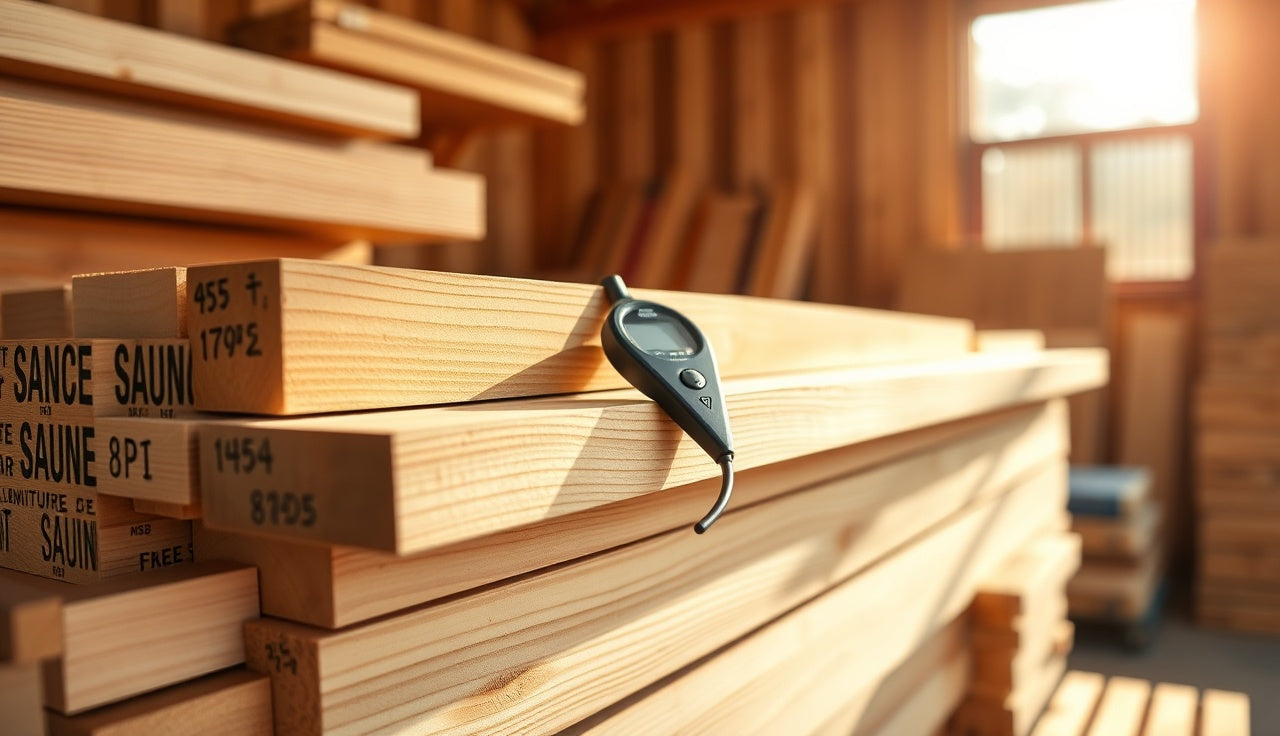
Check MC yourself. A pin-type moisture meter runs $20-50 at any hardware store. Insert the pins across the grain in the middle of a board, never the end (end grain reads high and lies). Take three or four readings across a load and average them. If you're buying from a real supplier, the stamp should read "KD" or "KD-HT" (kiln dried, heat treated), and the grade stamp references the MC target [3].
| Thermally modified lumber | 6% |
| Kiln dried finish lumber (KD) | 11% |
| Kiln dried framing (KD-HT) | 17% |
| Air-dried softwood | 15% |
| Green (freshly cut) softwood | 60% |
Source: USDA Forest Products Laboratory, Wood Handbook (FPL-GTR-282), 2021
What species of wood are typically kiln dried for sauna use?
Species and drying are two separate decisions that both matter. Some species are preferred for sauna interiors no matter how they're dried, and the drying method still counts for whichever one you pick.
The common sauna interior species in North America:
| Species | Typical interior use | Relative heat tolerance | Typical dried MC at retail |
|---|---|---|---|
| Western red cedar | Paneling, benches | Good (low density, cools fast) | 12-19% |
| Nordic spruce / white spruce | Paneling, benches | Good (traditional Finnish) | 8-15% |
| Aspen / poplar | Benches, ceilings | Excellent (very low resin) | 6-12% |
| Hemlock | Paneling, benches | Good | 12-19% |
| Basswood | Benches, backs | Excellent (low resin, low heat) | 8-12% |
| Thermally modified pine/spruce | Any sauna surface | Excellent (treated) | 4-8% |
Aspen and basswood are the best bench species if the budget allows. Their very low resin content means they won't turn sticky or push out irritating oils when hot [4]. Cedar smells great and shrugs off rot in humid air, which makes it a strong wall and ceiling choice. Thermally modified wood (often sold as Thermowood) is kiln dried at very high temperatures, 180-215°C, which changes the cell structure, drops equilibrium MC, and nearly ends resin issues [5].
Keep high-tannin or high-resin species (oak, pine, fir) off bench surfaces. They get sticky and can burn or irritate skin.
How much does kiln dried sauna lumber cost compared to green wood?
The kiln dried premium varies by region, species, and market. As a rough guide, kiln dried western red cedar tongue-and-groove paneling (the most popular U.S. sauna interior) runs $2.50-$5.00 per linear foot for 1x4 stock as of mid-2025, depending on grade and supplier. Green or air-dried cedar from a local mill can run 30-50% cheaper.
A small 4x6 sauna interior needs 400-600 linear feet of paneling. That price gap works out to $200-$600 in savings going green. Then come the callbacks. If green wood warps or gaps after the first season, you're re-doing paneling, and tear-out plus reinstall typically runs $500-$1,500 or more depending on your area. The math favors kiln dried from the start.
Framing is different. Standard framing lumber (SPF, Doug fir) almost always ships at 19% MC or below already, and true kiln dried framing costs only a little more, often $0.10-$0.30 per board foot. Don't overthink the framing. Put the money into kiln dried finish lumber, where it shows and where it moves.
Can you use green wood for sauna framing or structural members?
Yes, with limits. Framing hides behind insulation and a vapor barrier, and it carries enough hardware that small dimensional movement never shows. Green or standard-grade framing at 15-19% MC is fine for stud walls, ceiling joists, and floor framing in a sauna room.
The real risk with wetter framing is nail pop and loosening fasteners as the wood dries and shrinks. Use ring-shank nails or screws instead of smooth-shank nails wherever you can. Ring-shank nails carry roughly 40% more withdrawal resistance than smooth-shank nails of the same diameter, per National Design Specification connection tables [6].
One exception where framing MC does matter: barrel saunas and pre-cut kits with exposed structural pieces that double as the interior finish. There's no separation between structure and finish in those builds, so every piece needs to be kiln dried.
For outdoor saunas specifically, framing near grade or in a damp crawlspace needs to be either pressure-treated (only below-grade or exterior, never inside the sauna room) or a naturally rot-resistant species like cedar or redwood, dried to a reasonable MC.
What happens if you build a sauna with wood that's too wet?
Short version: it moves, and the movement snowballs.
Gapping hits first. Tongue-and-groove paneling installed at 20%+ MC shrinks as the sauna heats and the wood dries. Quarter-inch gaps between boards are common in poorly dried installs. Those gaps aren't only cosmetic. They let vapor push to the cold side of the wall, where it condenses on insulation or sheathing.
Cupping and warping come next. Flat-sawn boards dry unevenly across their width, and the face that loses moisture faster pulls toward itself. In a sauna, the hot interior face dries faster than the cold exterior face. Boards cup toward the room, the wall goes wavy, and fasteners start popping.
Over time, high-MC wood also raises the mold risk. Wood science work at Oregon State University and elsewhere shows that wood above 19-20% MC creates conditions where wood-decay fungi can establish [7]. A wall cavity that traps moisture from wet paneling can rot from the inside for years with no visible sign.
The good news: buy from a real lumber yard and specify kiln dried, and most of what you get already sits in the safe range. Trouble usually comes from grabbing cheap big-box lumber without reading the stamp, or buying locally milled green wood to save a few bucks.
Does thermally modified wood change the kiln dried vs green equation?
Thermally modified lumber is its own category worth understanding. (Thermowood is the best-known brand; Lunawood and Arbor Wood are similar.) It's made by heating wood to 180-215°C in a steam environment, which breaks down hemicellulose in the cell walls [5]. The result: wood with equilibrium MC around 4-8%, well below standard kiln dried stock, plus much better decay resistance and far less movement.
The European standard for thermally modified wood is EN 15679, and research in journals like Wood Science and Technology reports equilibrium MC reductions of 40-50% versus untreated kiln dried equivalents [5]. In a sauna, that means a material that barely moves through the heat cycles and shows almost no resin bleed.
The catch is price. Thermally modified sauna lumber runs roughly 2-4x standard kiln dried cedar or spruce. On a small sauna that gap might be $400-$1,000 in materials. Worth it? Depends on your budget and how much you value never thinking about the wood again. For a high-end permanent build, it's a real upgrade. For a budget build or a portable sauna setup, standard kiln dried is fine.
How should you store and handle kiln dried lumber before the sauna build?
You can undo the kiln drying in a few weeks of bad storage. Wood is hygroscopic. It pulls moisture from the air until it balances with ambient humidity. Store kiln dried lumber outside uncovered, or in a damp garage, and it reabsorbs water. You've paid for KD stock and thrown the benefit away.
Store it inside or under a roof, off the ground (at least 4 inches of air gap under the stack), with stickers (thin spacers) between layers for airflow. In a humid climate, a few weeks of bad storage can push lumber from 10% back to 15-18% MC. Check with your meter again right before installation if there's been any delay.
Acclimate the wood to the room, too. If you're building inside a finished structure, bring the lumber in a week ahead. Sauna interiors usually go in after the shell is weather-tight, so the space is at least partly conditioned. Letting the wood equalize before you fasten it cuts the movement after installation.
Finnish builders historically used well-seasoned spruce, air-dried one to two years, precisely because they understood this movement. Modern kiln drying gets you to the same place faster and more consistently [11].
Is there a building code requirement for wood moisture content in saunas?
No U.S. federal building code sets a moisture content for sauna lumber. The International Residential Code (IRC) and International Building Code (IBC) address wood structural members broadly. IRC Sections R802 and R602 reference moisture content for framing in terms of shrinkage adjustments, but there's no sauna-specific provision [8].
Some local jurisdictions add sauna requirements, mostly around vapor barriers, ventilation, and fire-rated assemblies (sauna heaters are a fire hazard if they aren't separated from combustibles). Check with your building department. Most Authorities Having Jurisdiction defer to the manufacturer's installation instructions for the heater, which spell out minimum clearances to combustible materials.
The National Fire Protection Association's codes and UL-listed heater specifications govern those clearances, and they usually reference the IRC [9]. None of these documents set an MC number for the wood. Using properly kiln dried lumber simply matches good-practice guidance from the Forest Products Laboratory and the North American sauna industry.
For sauna-specific construction guidance, the best North American reference points back to the Finnish Sauna Society (Suomen Saunaseura), which publishes building guidelines that have shaped sauna design worldwide [10]. Their guidance calls for properly dried, low-resin wood, but stops short of a hard MC number.
What's the practical verdict: which wood should you actually buy?
Buy kiln dried. Aim for KD stock stamped at 15% or lower, and for paneling and bench boards, pay for stock closer to 8-12%. The premium over green wood is real but modest, and the risk of rework from wet lumber isn't hypothetical. It happens all the time in DIY builds and kit installs where someone tries to save money on wood.
For framing, standard SPF or Doug fir from a lumberyard is fine. It ships already dried to an acceptable structural level, and hidden framing forgives small movement.
For bench surfaces and anywhere skin touches wood, choose aspen, basswood, or properly dried Nordic spruce. If the budget allows, thermally modified versions of these are worth the premium on a permanent indoor build. For a cedar-lined outdoor sauna, kiln dried western red cedar in a vertical grain (VG) or tight-grain grade performs well and looks great for decades.
SweatDecks carries kiln dried sauna paneling and bench kits sourced to these specs, so if you're shopping materials next to a heater or hardware, it's a reasonable place to compare. Any reputable specialty lumber yard can get you the same, though, if you specify KD, a 12% MC target, and the species you want.
One last thing. Don't treat the wood inside the sauna. No stain, no polyurethane, no sealant on interior surfaces. Finishes off-gas when hot and can release irritating or toxic compounds. Raw, properly dried wood is the correct interior finish. Let it be what it is.
Still planning? Our home sauna and outdoor sauna guides cover the broader build decisions, and the sauna benefits article is worth reading before you lock in a design.
Frequently asked questions
What moisture content should sauna wood be?
For interior paneling and bench boards, target 8-12% MC. For framing, 15-19% is acceptable. Wood sold as kiln dried (KD) at a lumber yard is usually 15% or below. Check it with a pin-type moisture meter before installation, especially if the lumber has sat a while. Anything above 19% in finish sauna lumber is a problem.
Can you use regular construction lumber for a sauna?
For framing, yes. Standard SPF or Douglas fir framing lumber from a hardware store works fine for stud walls and ceiling joists. For interior paneling and benches, no. Regular construction lumber is often pine or fir, which carries high resin. That resin bleeds and turns sticky when hot, and the rough texture isn't comfortable. Use low-resin species like cedar, spruce, aspen, or basswood inside.
Is cedar or spruce better for sauna interior walls?
Both work well. Cedar has natural rot resistance and a pleasant smell, which makes it great for wall and ceiling paneling, especially in outdoor or humid builds. Spruce, particularly Nordic spruce, is the traditional Finnish pick: light, low resin, and cool to the touch. Spruce often costs less. Either one, kiln dried to 8-15% MC, performs well for a sauna interior.
How long does green wood need to air dry before it's safe to use in a sauna?
A rough rule is one year per inch of thickness for air drying under cover. A 1-inch board might need 6-12 months. Thicker bench or structural stock takes longer. Climate matters a lot: dry regions dry faster, humid regions slower. The only way to know for sure is a moisture meter reading. Don't guess. For most builders, buying kiln dried beats air drying it yourself.
What is thermally modified wood and is it worth the cost for a sauna?
Thermally modified wood is heated to 180-215°C in a steam environment, which permanently changes the cell structure, lowers equilibrium moisture content to around 4-8%, kills most resin, and improves rot resistance. It barely moves in heat cycles. The cost runs roughly 2-4x standard kiln dried lumber. For a high-end permanent build, it's a legitimate upgrade. For a budget build, standard kiln dried cedar or spruce is fine.
Does green wood cause mold in a sauna?
High-moisture wood raises the risk. Wood above 19-20% MC can support wood-decay fungi and mold under the right temperatures. In a sauna wall assembly, moisture from high-MC paneling can migrate to the cold side of the vapor barrier and condense on insulation or sheathing. Over time that can cause hidden rot. Properly kiln dried paneling at 8-12% MC cuts the risk sharply when paired with a good vapor barrier.
Should sauna wood be sealed or finished?
No. Do not apply stain, polyurethane, varnish, or any film-forming finish to interior sauna surfaces. Those finishes off-gas when heated and can release irritating or harmful compounds. Raw wood is the correct interior finish. Some builders rub a little pure linseed or tung oil into bench surfaces, but even that is debated. The exterior can be finished normally. Only the interior surfaces need to stay raw.
What wood should you avoid in a sauna?
Keep high-resin softwoods like pine (especially treated pine), fir, and larch off bench and wall surfaces. High-tannin hardwoods like oak can discolor with moisture and heat. Pressure-treated or chemically preserved lumber should never go inside a sauna room; it off-gasses preservatives when heated. MDF and most engineered panels aren't suitable either, since they delaminate and can release formaldehyde at sauna temperatures.
Does the wood species matter more than whether it's kiln dried?
Both matter, for different reasons. Species drives resin content, heat conductivity, and durability. Kiln drying drives dimensional stability after installation. A wrong species (high-resin pine) that's perfectly kiln dried still burns you and bleeds sticky sap. The right species (aspen, cedar, spruce) at poor moisture content still gaps and warps. You need both: the right species at the right MC.
Can you build a barrel sauna with green wood?
Barrel saunas depend on the tension of steel banding holding curved staves together. If those staves are green, they shrink as they dry and the barrel loosens. Most reputable barrel manufacturers use kiln dried cedar or spruce staves for exactly this reason. Building a custom barrel from scratch? Use kiln dried staves. Buying a kit? Verify the MC spec with the manufacturer before you pay.
How do I check if the wood I bought is actually kiln dried?
Look for the grade stamp. A KD or KD-HT stamp means kiln dried (heat treated), and the stamp also shows species and grade. Then verify with a pin-type moisture meter: insert the pins across the grain in the middle of the board, not the end. Read several boards across the stack. If the average is 15% or below, you're fine for framing. For paneling, look for 12% or below.
Is it cheaper to build a sauna with green wood?
The material cost is lower, often 30-50% less for the paneling. But the real cost includes rework risk. Paneling installed at high MC can warp, gap, and eventually let moisture into the wall assembly. Tearing out and replacing paneling in a finished sauna costs $500-$1,500 or more in labor alone. The upfront savings rarely beat the rework risk, especially on interior finish surfaces.
What building codes apply to sauna wood and moisture content?
No U.S. federal code sets an MC for sauna lumber specifically. The IRC addresses wood framing moisture broadly in Sections R602 and R802. Local sauna requirements usually cover heater clearances, vapor barriers, and ventilation, not lumber MC. Even so, using properly dried lumber matches best-practice guidance from the USDA Forest Products Laboratory and is what most professional sauna builders expect.
Sources
- USDA Forest Products Laboratory, Wood Handbook: Wood as an Engineering Material (General Technical Report FPL-GTR-282): Kiln dried lumber definition, moisture content targets, average tangential and radial shrinkage percentages by species, and equilibrium moisture content behavior of wood in service
- Harvard Health Publishing, Harvard Medical School: Typical sauna interior temperature range of 160-200°F and humidity variation in Finnish versus steam sauna sessions
- American Lumber Standard Committee, PS 20-20 American Softwood Lumber Standard: KD and KD-HT grade stamp definitions and moisture content thresholds for kiln dried lumber classifications
- Finnish Sauna Society (Suomen Saunaseura), Sauna Building Guidelines: Aspen and basswood recommended for bench use due to low resin content and low heat conductivity; traditional Nordic spruce use in Finnish saunas
- Wood Science and Technology (Springer), research on thermally modified wood properties: Thermal modification at 180-215°C reduces equilibrium moisture content by 40-50% versus untreated kiln dried equivalents and the EN 15679 standard for thermally modified wood
- American Wood Council, National Design Specification (NDS) for Wood Construction: Ring-shank nails have approximately 40% greater withdrawal resistance than smooth-shank nails of the same diameter per NDS connection tables
- Oregon State University College of Forestry, Wood Science and Engineering: Wood above 19-20% moisture content creates conditions where wood-decay fungi can establish, increasing rot risk in enclosed wall assemblies
- International Code Council, International Residential Code (IRC) 2021: IRC Sections R602 and R802 address moisture content for wood framing members and shrinkage adjustments; no sauna-specific MC mandate exists in the IRC
- National Fire Protection Association, NFPA codes and standards (sauna heater clearances): NFPA codes and UL-listed sauna heater installation specifications govern heater clearances to combustible materials in sauna rooms
- Finnish Sauna Society (Suomen Saunaseura), official guidelines: Finnish Sauna Society publishes sauna building guidelines emphasizing properly dried, low-resin wood that have influenced sauna design internationally
- USDA Forest Products Laboratory, Drying of Wood (Wood Handbook Chapter 13): Air drying rates for softwood lumber approximately one year per inch of thickness under cover; equilibrium MC varies by region and climate
- APA - The Engineered Wood Association, lumber and panel standards: Kiln dried definition under lumber grading standards; 19% MC upper threshold for structural framing applications versus lower targets for finish work

Share:
Sauna wall board expansion gaps: exactly how much space you need
Thermally modified wood for sauna exteriors: is it worth it?