
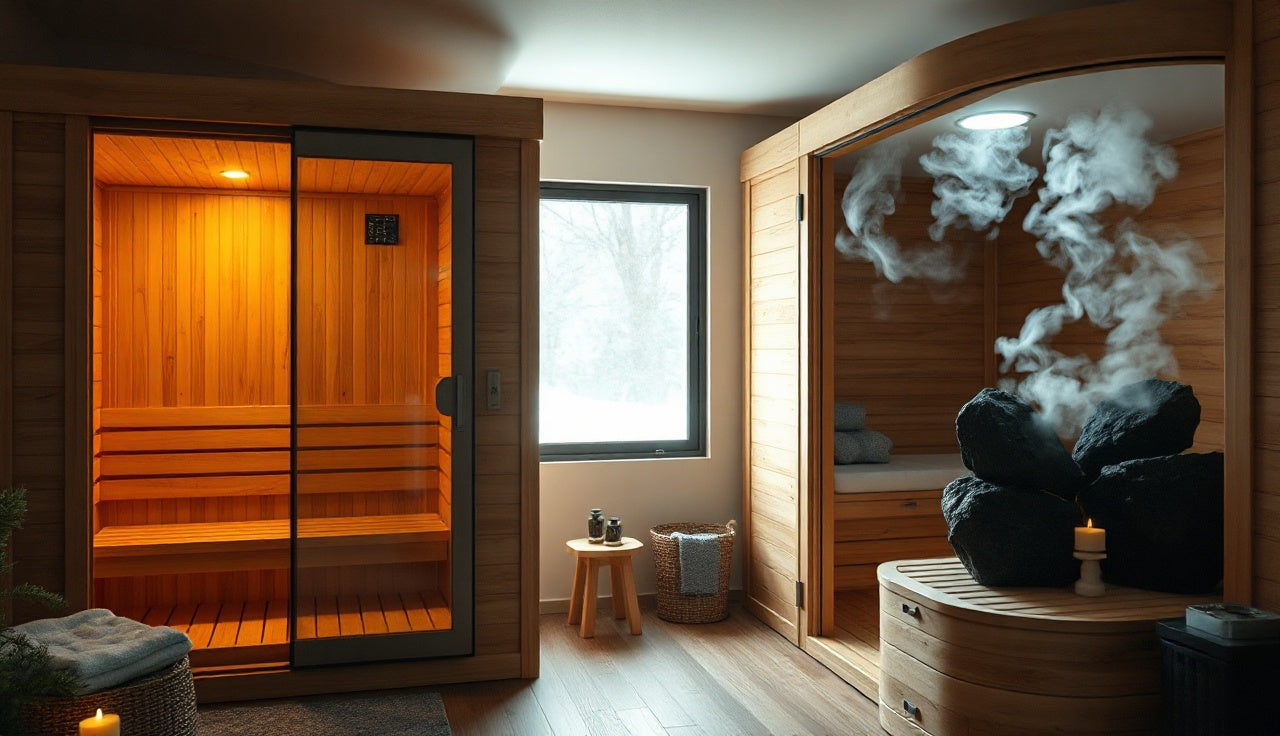
Last updated 2026-07-10
TL;DR
Infrared saunas reach usable temperature in 10 to 15 minutes because they heat your body directly with radiant light, not the air. Traditional saunas need 30 to 60 minutes to warm an insulated room to 160 to 200°F before you feel it. If preheat time decides your purchase, infrared wins cleanly. The two experiences are genuinely different, though, and faster isn't always better.
Why does preheat time differ so much between these two sauna types?
The short answer is physics. A traditional Finnish-style sauna heats the air inside an insulated wooden room. You fire up the heater, it warms the rocks (or the metal elements), the rocks radiate into the air, and the air slowly climbs to 160 to 200°F [1]. That takes time because you're heating a large thermal mass: rocks, wood, and a volume of air that can run 50 to 200 cubic feet or more. Most traditional saunas need 30 to 60 minutes of preheat before you should step inside [2].
An infrared sauna skips most of that chain. The panels emit near-infrared, mid-infrared, or far-infrared radiation, and that electromagnetic energy penetrates your skin directly, warming tissue without hot air as a middleman. The cabin itself feels only moderately warm, usually 120 to 150°F, but your core temperature still rises [3]. The panels only need to warm themselves, not a room full of rocks and dense air, so they're putting out usable radiant heat within minutes of switching on. Most manufacturers claim 10 to 15 minutes. Some owners step in at 10 and feel comfortable by the time they've settled.
The gap is real, not marketing spin. Roughly 10 to 15 minutes for infrared versus 30 to 60 for traditional. If your schedule is tight and a cold plunge is waiting after, that 40-minute difference adds up fast.
What temperature does each type actually reach, and how does that affect heat-up speed?
Traditional saunas target 150 to 195°F (65 to 90°C), and Finnish purists push the top of that range. Hitting those numbers in an insulated 6-by-8 foot room takes a heater rated somewhere between 6 kW and 9 kW for a typical home unit, plus rocks weighing 20 to 40 pounds or more [2]. That thermal mass stores heat well and holds steady temperatures beautifully. It also demands patience upfront.
Infrared saunas run at 110 to 150°F (43 to 65°C) in ambient air [3]. You're not trying to superheat air to 180°F, so the panels reach functional output faster and the insulation requirements drop. Carbon fiber or ceramic panels usually draw 1.5 to 2.5 kW for a one-to-two-person unit, less than half the wattage of most traditional heaters.
Here's the trade-off. The lower ambient temperature of an infrared cabin makes the experience feel different. You don't get that wall-of-heat sensation when the door opens. Some people tolerate infrared longer because of it; others miss the intense enveloping heat of a Finnish room. Neither camp is wrong. These are different products.
| Feature | Infrared Sauna | Traditional Sauna |
|---|---|---|
| Typical preheat time | 10 to 15 minutes | 30 to 60 minutes |
| Ambient air temp | 110 to 150°F | 150 to 195°F |
| Heater wattage (home unit) | 1,500 to 2,500 W | 4,000 to 9,000 W [2] |
| Thermal mass | Very low | High (rocks + wood) |
| Ready-to-enter feel | Near instant once panels warm | Needs full preheat cycle |
Does faster preheat mean lower electricity cost per session?
Not necessarily, and that surprises a lot of buyers. Infrared saunas draw less power per hour, yes. But traditional saunas run hotter, so people stay in for shorter bouts. Infrared users commonly do 30 to 45 minute sessions because the lower temperature is tolerable longer. Traditional users often do three or four rounds of 8 to 15 minutes with cool-down breaks.
Run a 2 kW infrared sauna for 15 minutes of preheat plus a 40-minute session and you're drawing power for about 55 minutes, or roughly 1.8 kWh. At the U.S. average residential rate of about 16 cents per kWh in 2024 [4], that's under 30 cents per session.
A 6 kW traditional sauna running 45 minutes of preheat plus a 30-minute session is 75 minutes, or 7.5 kWh, which is about $1.20 per session at the same rate. Traditional sessions cost more in electricity, but $1.20 won't wreck anyone's budget. The bigger money difference is installation. Traditional saunas almost always need a 240V dedicated circuit [2], while many infrared models plug into a standard 120V outlet, saving several hundred dollars in electrician fees.
If per-session cost is your deciding factor, infrared wins. But if you already have a 240V circuit in the garage or an outdoor shed, the gap narrows a lot.
| Infrared (indoor, room temp) | 13 |
| Infrared (outdoor, cold weather) | 20 |
| Traditional (indoor, well-insulated) | 35 |
| Traditional (indoor, average) | 45 |
| Traditional (outdoor, cold weather) | 68 |
Source: CPSC sauna guidance and manufacturer specifications, cross-referenced with Laukkanen et al. (JAMA Internal Medicine, 2015)
How does preheat time change for outdoor vs. indoor installations?
Cold air adds real time to a traditional sauna preheat. A cabin sitting outside in Minnesota at 20°F takes the upper end of that 45-to-60-minute window, or longer, because the heater fights heat loss through the walls the whole time. Good insulation (minimum R-8 in the walls for most outdoor builds) helps, and so does a properly sized heater [2] [10].
For outdoor infrared saunas, cold weather matters less to preheat because the panels heat radiant output, not air temperature. An infrared cabin in the cold still preheats in 10 to 15 minutes, though the ambient air inside stays lower than in a climate-controlled garage. Some owners find cold-weather infrared sessions less satisfying because the air around them feels chilly even while the panels glow.
For more on outdoor builds, outdoor sauna setups carry considerations well beyond preheat time, including electrical runs, drainage, and weatherproofing. If you want a smaller, portable option with faster setup, portable sauna units are worth a look, though they bring their own compromises.
Live in a cold climate and use your sauna most in winter? Traditional outdoor saunas need extra preheat buffer. Budget 60 to 75 minutes for a cold start in sub-freezing temps.
Does infrared heat your body faster even if the room heats faster?
This is the smarter question. Room readiness and body readiness are two different things.
In an infrared sauna you start sweating fairly quickly after entering, often within 5 to 10 minutes, because the radiant energy acts on your tissue directly. A 2001 study in the Journal of the American College of Cardiology found that repeated far-infrared thermal therapy produced measurable cardiovascular responses in subjects, with sessions structured around roughly 15 minutes of exposure [5]. You don't need the room at full temperature to feel effects.
In a traditional sauna, the intense hot air triggers sweat fast once you're inside a properly preheated room, typically within 2 to 5 minutes of sitting in 180°F air [9]. So the body response in a fully preheated traditional sauna is actually quicker than in an infrared cabin, even though the room took longer to get ready.
The practical result: total time from flipping the switch to a full sweat is roughly comparable. Infrared runs about 10 minutes preheat plus 5 to 10 minutes to sweat, so 15 to 20 minutes total. Traditional runs about 40 minutes preheat plus 2 to 5 minutes to sweat, so 42 to 45 minutes total. Infrared still wins the total-time-to-sweat race, just not by as wide a margin as the preheat numbers alone suggest.
Are there health or wellness differences driven by the temperature gap?
The research here is genuinely thin, and anyone selling you certainty is overselling it. Most of the well-cited evidence on sauna health comes from traditional Finnish sauna studies, especially the large Kuopio Ischemic Heart Disease cohort out of Finland, which tracked thousands of men over decades and found associations between sauna frequency and lower cardiovascular mortality [6]. Those studies used traditional saunas at Finnish temperatures (roughly 176°F / 80°C) and can't be applied straight to infrared use.
The American College of Cardiology's review of the evidence noted that infrared sauna studies are smaller and shorter-term than the Finnish traditional sauna literature, though early results look promising for outcomes like blood pressure and arterial stiffness [7]. The honest summary: traditional sauna has the deeper research backing, infrared is promising but less studied.
The temperature difference does matter for people with heat sensitivity. Infrared's 120 to 150°F ambient air is more accessible for older adults, sauna newcomers, or anyone who finds 185°F suffocating. For general sauna benefits, the current evidence leans toward traditional, but the gap in proof doesn't mean infrared fails. It means we have fewer studies. Core body temperature climbs during any heat exposure, so watch your session time either way [8].
One more thing worth knowing: some people pair sauna sessions with contrast therapy, alternating with a cold plunge or ice bath. There, faster preheat from infrared means more rounds of contrast in a given window, which is practically useful.
Which type of sauna heats up faster if power goes out and you restart it?
Infrared wins this one easily. Restart an infrared sauna that has gone cold and you're back to 10 to 15 minutes. The panels have no thermal mass to recharge.
A traditional sauna that has been off for hours needs the full 30 to 60 minute cycle again. But a traditional sauna still warm from a recent session can be ready in 15 to 20 minutes for a second round because the rocks held their heat. This is why experienced users time back-to-back sessions or top up the heat for guests after the first group finishes. Infrared has no such thermal memory because the panels cool off quickly.
So if you're hosting and running multiple groups through a sauna in an evening, a traditional unit is more efficient for the second and third groups. For a solo daily user, infrared's fast cold-start wins every time.
How does sauna type affect installation, and does that change the 'ready to use' timeline?
Installation timeline is part of the real-world "how fast can I get in" math, especially if you're buying a home sauna for the first time.
Most infrared kits arrive as pre-cut panels and go together in a few hours to a day with one or two people. Many models plug into a standard 15A or 20A 120V outlet, which means zero electrical work if you have a nearby outlet. Some larger two-person infrared units do want a 240V circuit [3]. From purchase to first session, you could realistically be in your infrared sauna within a week of ordering, assuming indoor placement.
Traditional saunas take longer to get running. Even a pre-cut kit needs a 240V dedicated circuit (typically 30A to 60A depending on heater size [2]), proper ventilation design, and in some jurisdictions a building permit. Figure two to four weeks from delivery to first session if electrical work is involved.
SweatDecks carries both types and lists electrical specs clearly on the product pages, so you can compare before calling an electrician. The installation time difference is real and worth building into your planning, especially if you want to be in a sauna by a specific date.
If you're comparing beyond just sauna types, the sauna vs steam room comparison covers a moisture-based heat format with its own installation timeline.
What do actual owners say about preheat times compared to manufacturer claims?
Manufacturer claims tend to hold up in controlled conditions but run optimistic in real-world home installs. A few honest observations pulled from public owner forums and retailer review sections:
Infrared owners generally confirm the 10 to 15 minute claim, though some note the first session on a cold winter day takes closer to 20 minutes to feel fully warm inside. Carbon-panel units seem to reach operating output slightly faster than ceramic-element units, and both types land inside the 15-minute window at room temperature [3].
Traditional owners report more variability. A well-insulated 4-by-6 foot indoor sauna with a 6 kW heater often hits target in 25 to 35 minutes, faster than the upper-end claims. Larger outdoor saunas with older or undersized heaters can crawl to 70 or 80 minutes in cold weather, slower than most manufacturers advertise.
The lesson: if you buy a traditional sauna, don't undersize the heater to save money. A heater too small for the room volume will never fully preheat, or it will take so long it erases the benefits of the thermal-mass design. A common rule of thumb from sauna heater makers is 1 kW per 45 cubic feet of room volume as a minimum [2].
Nobody has clean standardized test data across brands. The closest reliable reference is manufacturer spec sheets cross-referenced with independently measured room volumes, which is imprecise but workable.
Which type is better for a daily-use home sauna given the preheat difference?
If you sauna every day or close to it, preheat time matters less than you'd think. You build it into your routine. The more useful question: which experience do you actually want every day?
For someone who wants a quick recovery session on a weeknight after work, infrared is more practical. You get home, flip it on while changing clothes, and step in within 15 minutes. With a traditional sauna, that same routine means turning it on remotely at work (some heaters have WiFi control) or waiting an extra 30 to 40 minutes.
For weekend ritual users with more time, the preheat difference mostly disappears. You start the sauna, cook dinner or prep, and step in when it's ready. Traditional sauna's deeper heat, higher temperatures, and the option to throw water on the rocks (löyly) give a richer sensory experience that plenty of people prefer once they've tried both.
My honest take: if your life is weeknight sessions and time is tight, buy infrared. If you have a dedicated outdoor space and enough weekend time to do the ritual properly, traditional sauna is more satisfying long-term. The preheat gap is real, but it's far from the only variable that matters day to day.
How do I choose between infrared and traditional sauna for my home?
Here are the decision points that actually matter, beyond preheat time.
Electrical access. Do you have a 240V circuit available? If yes, a traditional sauna is much easier to add. If no, a 120V infrared unit is dramatically cheaper to install.
Space. Traditional saunas need proper ventilation and ideally a drain or at least a water-resistant floor. Infrared units can tuck into a bedroom corner in a pinch, though a dedicated space is better.
Heat preference. Have you used both types? If you've only used one, try both before buying. Many gyms and spas have traditional saunas; infrared-specific studios are showing up more in cities.
Budget. Entry-level infrared units for one to two people start around $1,000 to $2,000. Traditional sauna kits for comparable occupancy start around $2,500 to $5,000 and climb sharply for custom or barrel designs. Electrical installation for a traditional sauna adds $300 to $800 in most regions.
Health goals. If you're chasing cardiovascular or longevity-adjacent research-backed effects, the literature is stronger for traditional sauna [6]. If infrared works for you and you use it consistently, consistency likely matters more than which type you chose.
For the full breakdown of sauna types and options, the sauna overview covers both formats in more depth. And if you want a complete home recovery setup, pairing either type with a cold plunge opens up contrast therapy that both sauna types support.
Frequently asked questions
How long does an infrared sauna take to heat up?
Most infrared saunas reach usable operating temperature in 10 to 15 minutes. The panels produce radiant output almost immediately after startup, and the cabin air typically hits 120 to 140°F within that window. In a cold room or on a very cold day, budget 20 minutes. Many owners step in at 10 minutes and feel comfortable once they've settled in.
How long does a traditional sauna take to heat up?
Traditional saunas need 30 to 60 minutes of preheat to bring the room to 150 to 195°F. Exact time depends on heater size, room volume, insulation quality, and starting ambient temperature. A well-sized 6 kW heater in a properly insulated 4-by-6 foot indoor sauna can be ready in 25 to 35 minutes. An outdoor sauna in cold weather often takes 60 minutes or more.
Can you use an infrared sauna before it fully heats up?
Yes, and many owners do. Because infrared panels heat your body directly rather than heating air, they generate useful radiant output well before the cabin hits maximum ambient temperature. Stepping in at 10 minutes and staying 30 to 40 minutes is a workable routine. You warm from the inside out even if the air around you feels only moderately warm.
Does a traditional sauna stay hot longer than an infrared sauna?
Yes. The rocks in a traditional sauna retain substantial heat and hold the room steady for a good while after the heater dials down or shuts off. An infrared sauna loses its panel temperature quickly once powered off. For back-to-back sessions with multiple users, traditional saunas are more efficient because the second group rides on the stored thermal mass without a full new preheat.
Is infrared or traditional sauna cheaper to run per session?
Infrared is cheaper per session on electricity. A typical infrared sauna draws 1.5 to 2.5 kW versus 4 to 9 kW for a traditional unit. At the U.S. average rate of about 16 cents per kWh, an infrared session costs roughly 20 to 35 cents. A traditional session costs roughly $1.00 to $1.50. The gap widens once you count preheat, since traditional saunas preheat much longer.
Which sauna has better health benefits, infrared or traditional?
The research base is stronger for traditional sauna, mainly from large Finnish cohort studies tracking cardiovascular outcomes over decades. Infrared research shows promising results for blood pressure and arterial stiffness but rests on smaller, shorter studies. Both produce sweating and cardiovascular stress responses. Consistent use of either type likely matters more than the type itself. Stay conservative with health claims and talk to your doctor if you have cardiac conditions.
Do infrared saunas heat your body faster than traditional saunas?
Infrared heats the room faster, but inside a fully preheated traditional sauna (180°F+), your sweat response kicks in within 2 to 5 minutes, faster than the 5 to 10 minutes typical in an infrared cabin. Total time from switch-on to full sweat still favors infrared (15 to 20 minutes) over traditional (40 to 45 minutes), but the body heating rate once you're inside a preheated room favors traditional.
What wattage heater do I need for a traditional sauna?
A common industry guideline is 1 kW per 45 cubic feet of room volume as a minimum. A 6-by-8-foot sauna with 7-foot ceilings is about 336 cubic feet, which works out to roughly a 7 to 8 kW heater. Undersizing the heater is the most common traditional sauna mistake: an underpowered heater stretches preheat time badly and may never reach target temperature in cold weather.
Can I install an infrared sauna without an electrician?
Many single-person and two-person infrared models plug into a standard 120V, 15A to 20A household outlet, needing no electrical work. Larger units (three-person or bigger) often need a dedicated 240V circuit, which requires a licensed electrician. Always check the unit's spec sheet before buying. Traditional saunas almost always require a dedicated 240V circuit regardless of size.
Does outdoor temperature affect infrared sauna preheat time?
Less than it affects traditional saunas. Because infrared panels heat radiant output rather than room air, cold ambient temperatures stretch infrared preheat only modestly, maybe 5 extra minutes in sub-freezing weather. The cabin air stays cooler than in a heated indoor space, but panel output holds fairly consistent. Traditional outdoor saunas are far more sensitive to cold and can take 75 minutes or more in extreme cold.
Is there a sauna type that heats up fast and still reaches traditional sauna temperatures?
No practical option combines both right now. Saunas that reach 175 to 195°F have to heat a significant thermal mass (rocks, air, wood), and that takes time. Some electric heaters with large rapid-heat elements can trim traditional preheat to 20 to 25 minutes with the right room size and insulation, but nothing matches infrared's 10 to 15 minute window while also hitting Finnish-level temperatures.
What is the difference between near-infrared and far-infrared sauna heating?
Near-infrared (NIR) wavelengths penetrate skin more shallowly and connect to some photobiomodulation research. Far-infrared (FIR) reaches deeper into soft tissue and is the more common type in home saunas. Mid-infrared falls between them. Most consumer infrared saunas use carbon fiber panels emitting primarily far-infrared. Preheat times are similar across types, roughly 10 to 15 minutes, with no meaningful difference in heat-up speed between NIR and FIR units.
How does sauna preheat time affect contrast therapy routines with a cold plunge?
For contrast therapy (alternating hot and cold), infrared's faster preheat lets you fit more hot-cold cycles into a given window. A typical protocol runs 10 to 15 minutes of heat followed by 2 to 5 minutes of cold. With a traditional sauna needing 45 minutes of preheat, you spend more total time before your first round. If you plan multiple rounds, infrared's fast restart (versus traditional's cooling rocks between rounds) is a practical advantage.
Which sauna type is better for a beginner who has never used a sauna before?
Infrared is generally easier for first-timers. The lower ambient temperature (120 to 150°F versus up to 195°F) is less intimidating and easier to tolerate for longer. You're less likely to feel claustrophobic or overheated. The faster preheat also makes it more accessible on a daily schedule. Beginners who start with infrared and later try traditional often say the traditional experience feels more intense but also more rewarding once they've built tolerance.
Sources
- Laukkanen JA et al., Annals of Internal Medicine, 2018 — Cardiovascular and Other Health Benefits of Sauna Bathing: Traditional Finnish saunas operate at 150 to 195°F (65 to 90°C) and require substantial preheat time to bring air and thermal mass to target temperature
- National Electrical Code (NFPA 70), Article 680 and 422 — electrical requirements for sauna heaters: Traditional sauna heaters typically require a dedicated 240V circuit; heater sizing guidance of approximately 1 kW per 45 cubic feet of sauna room volume
- U.S. Consumer Product Safety Commission — Sauna and Infrared Sauna Safety: Infrared saunas operate at 110 to 150°F ambient air temperature and many units plug into standard 120V household circuits
- U.S. Energy Information Administration — Average Retail Price of Electricity, Residential, 2024: Average U.S. residential electricity rate approximately 16 cents per kWh in 2024
- Imamura M et al., Journal of the American College of Cardiology, 2001 — Repeated Thermal Therapy Improves Impaired Vascular Endothelial Function in Patients with Coronary Risk Factors: Repeated far-infrared thermal therapy produced measurable cardiovascular responses in subjects, with sessions structured around roughly 15 minutes of exposure
- Laukkanen T et al., JAMA Internal Medicine, 2015 — Association Between Sauna Bathing and Fatal Cardiovascular and All-Cause Mortality Events: The Kuopio Ischemic Heart Disease cohort study tracked thousands of Finnish men over decades and found associations between traditional sauna frequency and reduced cardiovascular mortality
- American College of Cardiology — Sauna Bathing and Cardiovascular Health Review, 2021: Infrared sauna research involves smaller, shorter-term studies compared to the Finnish traditional sauna literature; early results are promising for blood pressure and arterial stiffness outcomes
- National Institute for Occupational Safety and Health (NIOSH) — Heat Stress: Heat Related Illness: Core body temperature rises during heat exposure including sauna use; monitoring heat exposure time is recommended for safety
- Hannuksela ML and Ellahham S, American Journal of Medicine, 2001 — Benefits and Risks of Sauna Bathing: Traditional sauna sessions at Finnish temperatures (approximately 176°F) trigger sweating response within 2 to 5 minutes of entering a fully preheated room
- International Sauna Association — Sauna Construction and Installation Standards: Proper insulation of at least R-8 is recommended for outdoor traditional sauna installations to maintain preheat efficiency in cold climates

Share:
Finnish sauna vs steam room humidity levels: what's actually different
Sauna mold prevention: ventilation gaps and how they actually work