
Last updated 2026-07-09
TL;DR
Infrared saunas run from $200 portable blankets to $6,000-plus cedar cabins. The spec that matters most is emitter type. Carbon fiber panels heat evenly at lower surface temps, while ceramic rods run hotter and uneven. Most peer-reviewed sessions land at 45 to 60 minutes and 120 to 150°F. Your budget picks the format, and the format picks who benefits.
What are the real differences between infrared sauna types?
Three formats are what you'll actually choose between: a full cabin (permanent or semi-permanent), a portable tent or pop-up, and a sauna blanket. These aren't three price points on one ladder. They're three different products for three different lives.
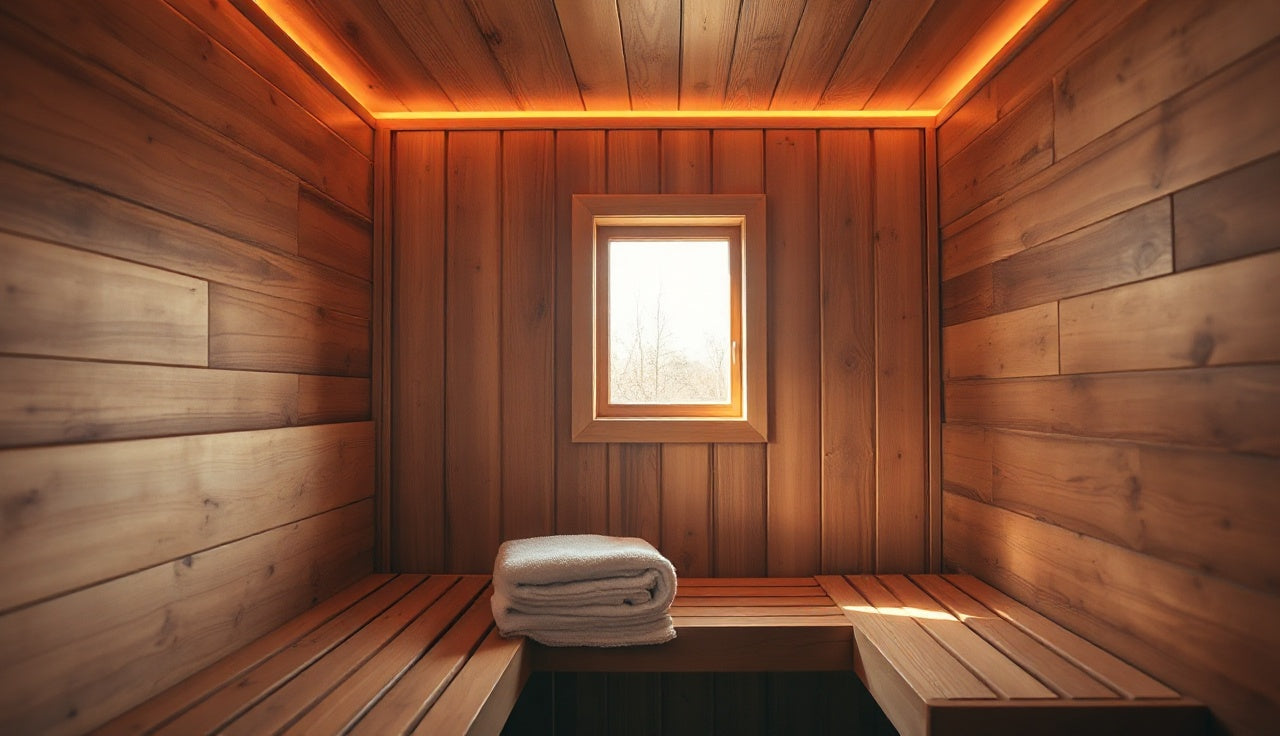
Full cabins look like a traditional sauna box. They sit 1 to 6 people, plug into a 120V or 240V outlet depending on size, and reach operating temperature in 10 to 20 minutes. Most ship as flat-pack kits you assemble with hand tools in an afternoon. Cedar and hemlock dominate because both are naturally antimicrobial and low-resin, which matters once the panels heat up. [1]
Portable tents are fabric or nylon enclosures with a chair inside and a hole for your head. A small heating unit sits under the seat. They fold down to about the size of a large duffel bag. They earn their keep if you rent, travel, or have no dedicated room. They don't get as hot, they don't feel the same, and the experience is noticeably less immersive than a cabin.
Sauna blankets wrap around you like a sleeping bag while you lie flat. Heating elements run along the interior lining and warm you directly. Nothing heats the air first, so the sweat response arrives faster than the ambient temperature suggests. This is where most people start before committing to a cabin. Look at what a full portable sauna setup involves before you decide.
So: cabins are for a real sauna experience at home. Tents are for people who need portability above all. Blankets are for solo use, tight budgets, or anyone who can't spare 30 square feet.
Carbon fiber vs. ceramic emitters: which is actually better?
Emitter type is the single most consequential spec in any infrared sauna, and most buyers walk right past it.
Carbon fiber emitters are large, flat panels covering a big surface area. They run at lower surface temperatures (usually 150 to 175°F at the panel face) and emit far-infrared wavelengths (roughly 7 to 14 micrometers) more evenly across your body. The heat feels gentler because you're not parked next to one concentrated hot spot. Most mid-range and premium cabins use carbon fiber.
Ceramic emitters are rods or tubes. They run hotter at the surface, sometimes past 300°F, and throw a more intense, localized heat. They warm the cabin air faster, which some people prefer for a more traditional feel. The catch is uneven distribution. The spot directly in front of a rod runs much hotter than the gaps between rods.
Some brands sell hybrid systems: ceramic rods for fast heat-up, carbon panels for body-level coverage. The marketing is often fancier than the actual configuration, so read the wattage breakdown instead of the label.
A 2018 review in the Journal of Human Kinetics noted that far-infrared radiation between 3 and 12 micrometers is the biologically relevant range for tissue heating, which means the surface temperature of the emitter matters less than the wavelength it actually puts out. [2] Carbon panels hold that range more consistently than ceramic rods pushed to high settings.
Comparing two cabins at similar prices? Pick carbon fiber over ceramic. The heat spreads more evenly, the surface is cooler if you brush it, and you'll last longer in the seat.
What do infrared sauna reviews say about price ranges?
Here's what your money actually buys, category by category.
| Price Range | Format | Emitter Type | Typical Size | What You Get |
|---|---|---|---|---|
| $200-$500 | Blanket | Carbon or ceramic | 1-person lie-flat | Entry-level construction, basic controller, limited sessions before wear shows |
| $400-$900 | Portable tent | Carbon panels or rods | 1-person seated | Portability, fast setup, head stays outside |
| $1,200-$2,500 | Cabin (small) | Carbon fiber | 1-2 person | Genuine cabin feel, 120V plug-in, thin walls |
| $2,500-$4,500 | Cabin (mid) | Full-spectrum or carbon | 2-3 person | Thicker wood, better EMF shielding, more panel coverage |
| $4,500-$8,000+ | Cabin (premium) | Full-spectrum carbon | 3-6 person | Thick cedar, chromotherapy, audio, near/mid/far IR |
The $1,200 to $2,500 range has the most competition and the widest quality gap. Two units at $1,800 can differ wildly in carbon panel coverage, wood thickness, and EMF levels. Don't buy on price alone there. Look for EMF readings below 3 milligauss at body distance and ETL or UL certification. [3]
Blanket reviews line up on one point: $300 to $500 is where durability actually holds. Below $250, the inner lining degrades faster and temperature calibration drifts. Above $500, you're mostly paying brand margin, not better hardware.
Portable tents tell the same story. The $600 to $900 units from established brands outlast the $350 generics, mostly because the heating element and the seam and zipper construction survive repeated folding.
| Sauna blanket (entry) | $350 |
| Portable tent (1-person) | $650 |
| Cabin 1-2 person (value) | $1,850 |
| Cabin 2-3 person (mid) | $3,500 |
| Cabin 3-6 person (premium) | $6,250 |
Source: SweatDecks market survey of major US infrared sauna retailers, 2025
How hot does an infrared sauna actually get, and does it matter?
Traditional Finnish saunas run 170 to 200°F with low humidity. Infrared cabins typically top out at 120 to 150°F. That gap is the loudest complaint from traditional sauna users, and it's a fair one.
The mechanism is different, though. Infrared heats your body directly instead of warming the air around you first. So you can produce a comparable sweat response at a lower ambient temperature. A 2018 study in Complementary Medicine Research found that a 30-minute infrared session at 130°F produced a core temperature rise and sweat response similar to a 15-minute traditional sauna session. [4] That doesn't make the two equivalent across every outcome, but it does explain why the lower number isn't automatically a weakness.
The practical read: if you want to sit comfortably for 45 to 60 minutes, infrared is easier. If you want the sharp, brief heat shock of a Finnish session, you need a different product. A traditional sauna or steam room gets there. An infrared cabin doesn't.
For most home users, 130 to 140°F for 20 to 45 minutes is where the research clusters. A unit that struggles to hold 120°F is a problem. A unit that hits 150°F evenly with no hot spots is a quality build.
What health benefits does the research actually support?
Here's where an honest review has to slow down. The evidence is real but still thin, and most studies are small.
Cardiovascular effects have the strongest support. A 2018 JAMA Internal Medicine study (n=1,628) found that frequent sauna bathing (4 to 7 times per week) was associated with reduced risk of fatal cardiovascular events compared with once-weekly use. [5] That study used traditional saunas, not infrared, a caveat most marketing quietly drops.
For infrared specifically, a 2015 study in the Journal of the American College of Cardiology found that far-infrared therapy improved endothelial function and reduced arterial stiffness in chronic heart failure patients over 4 weeks of 15-minute daily sessions. [6] These were people with an existing condition under clinical supervision, not healthy adults chasing recovery.
Pain and muscle recovery come up constantly. A 2008 study in the Journal of Alternative and Complementary Medicine found that far-infrared sauna therapy reduced chronic pain scores in fibromyalgia patients. [7] Small sample, specific population, again.
Cognitive and stress claims are everywhere and barely studied in infrared. The heat-shock protein biology and parasympathetic activation are plausible, but anyone promising specific mental health outcomes from an infrared blanket is outrunning the data.
Honest summary: regular infrared use probably supports cardiovascular health and may ease some chronic pain. It's not a substitute for medical care. Anyone with a heart condition, a pregnancy, or an active illness should talk to a doctor first. The sauna benefits page covers the wider evidence if you want more.
What should you look for in full-spectrum infrared saunas?
Full-spectrum is a marketing term that usually means the unit combines near-infrared, mid-infrared, and far-infrared emitters. Near-IR has shorter wavelengths (roughly 0.8 to 1.5 micrometers) tied to skin surface effects and some photobiomodulation research. Mid-IR (1.5 to 5.5 micrometers) reaches subcutaneous tissue. Far-IR (5.5 to 15 micrometers) is what most infrared saunas have produced historically. [8]
The near-IR research on skin and cellular effects is real but mostly lab-based or very small. Mid-IR adds cost without much sauna-specific clinical backing. The premium for full-spectrum, usually $800 to $2,000 over a comparable far-IR-only unit, may not pay off if your goal is cardiovascular support and muscle recovery, where far-IR holds the most data.
If you're eyeing a home sauna at the full-spectrum level, know what you're buying. Near-IR panels do add real manufacturing cost. But the sessions, especially the near-IR LED panels some brands tuck in, run so low-intensity next to clinical photobiomodulation devices that the effective dose is debatable.
My honest take: full-spectrum is worth a look in the $3,500-plus cabin range, where the extra cost is a smaller slice of the total. At $2,000 to $3,000, a well-built far-IR carbon panel cabin from a reputable brand is the better call.
What are the best infrared sauna brands based on real criteria?
I won't rank brands by who paid for placement. Here's what separates the consistently well-reviewed names from the field, based on public owner forums, third-party EMF testing, and warranty records.
The brands that keep showing up in strong long-term reviews share a handful of traits. They run carbon fiber panels as the primary emitter, not ceramic rods. They publish third-party EMF results, ideally below 3 milligauss at 30 cm body distance. They carry UL or ETL electrical certification. They use real wood with tight tongue-and-groove joints, never MDF or particleboard. And they back the heaters with a warranty of at least 5 years.
Names that recur alongside solid owner reviews include Sunlighten (known for full-spectrum SoloCarbon panels), Clearlight (carbon/ceramic hybrid with well-documented EMF shielding), Dynamic Saunas (value segment, carbon fiber, widely available), and HigherDose (the blanket crowd). Costco occasionally stocks Dynamic and other mid-range brands at sharp prices. If that route interests you, the Costco sauna breakdown is worth a read.
Weak reviews almost always cluster around bad customer service after something breaks, not poor build quality out of the box. So ask the direct question: how easy is it to get a replacement heater panel, and what's the turnaround? That answer tells you more than any brochure.
SweatDecks carries a selection of infrared cabins and blankets from brands that clear the EMF, certification, and warranty minimums, so you can compare specs side by side without digging through manufacturer PDFs.
How do infrared sauna blanket reviews compare to cabin reviews?
Blankets and cabins are different products used differently, and most reviews trip over comparing them as points on one quality line rather than two separate categories.
Blanket reviews consistently praise fast setup (under 3 minutes), easy storage, a low price to entry, and surprisingly intense sweating. The recurring complaints: the inside gets wet and needs wiping after every use, the contained feeling bothers some people, the controller is basic, and cheaper units run inconsistent temperature zones.
For a blanket to survive regular use (4 to 5 sessions a week), the inner lining should be PU leather or a similar wipeable surface, not fabric. Fabric-lined blankets pick up odor and break down faster. Independent upper and lower body temperature zones are a genuine quality signal.
The HigherDose infrared blanket is the most-reviewed in the enthusiast space and generally holds up after 18 to 24 months of regular use, per owner reports. Budget options under $250 have mixed durability records past the 12-month mark.
Blankets suit athletes doing daily recovery, people in apartments, or anyone testing infrared before a bigger buy. They don't replace a cabin for environment, relaxation, or the simple ability to sit upright and breathe freely.
What are the EMF and safety concerns with infrared saunas?
EMF (electromagnetic field) exposure is the most-googled infrared sauna worry and the least clearly answered in most reviews.
The relevant standard is the ICNIRP guideline, which sets public exposure limits for low-frequency magnetic fields. The reference level for the general public at 50 to 60 Hz is 200 milligauss. [9] Most third-party tests of quality infrared saunas show 1 to 5 milligauss at body distance, far under that ceiling.
The open question in sauna forums is that low-level EMF from electrical heating elements, over many cumulative hours, hasn't been studied in sauna contexts specifically. That's a legitimate research gap, not evidence of harm. The ICNIRP number is the benchmark the industry uses, and well-built units clear it by a wide margin.
What to actually check: ask the brand for a third-party EMF report, not their own marketing PDF. Reputable brands have one. The test should run at body-level distance from the panels with the unit at operating temperature. A brand that won't produce it is telling you something.
For electrical safety, UL listing (US market) or ETL certification means an independent lab tested the unit against ANSI/UL electrical standards. [10] That's non-negotiable for anything you plug into your home.
Ventilation deserves a mention too. Infrared saunas make no steam, but the wood can release volatile organic compounds (VOCs) at elevated temperatures, especially when new. Run the unit empty for a few sessions before your first real one.
How does an infrared sauna compare to a cold plunge for recovery?
Both are popular recovery tools, but they hit different physiological mechanisms, and the research behind each stands apart.
Infrared sauna raises core temperature, dilates blood vessels, and produces a heat stress that triggers heat shock protein upregulation. Cold plunge does the opposite. It constricts blood vessels, blunts the acute inflammatory response, and in endurance athletes can reduce some training adaptations if used right after exercise. [11]
Contrast therapy, alternating heat and cold, is the most common combination in athletic recovery. The mechanistic logic is sound: repeated dilation and constriction drives blood circulation. The performance-recovery evidence is mixed but leans positive for reducing perceived soreness. [12]
Forced to pick one? It depends on your goal. Training for size means a post-workout sauna probably interferes with adaptation less than a cold plunge does. Managing chronic pain or chasing cardiovascular support means sauna has the more direct evidence. Prioritizing recovery speed between sessions means cold plunge or contrast has more practitioner backing.
Plenty of serious home owners buy both. A cold plunge next to a sauna is the standard high-end gym setup for a reason. For the cold side specifically, the cold plunge benefits and ice bath pages go deeper.
What questions should you ask before buying an infrared sauna?
Most people buy on photos and price. Here's the checklist that actually matters.
First, power. A 1-2 person cabin typically draws 1,400 to 1,750 watts on a standard 120V/15A circuit. A 3-4 person cabin usually needs a dedicated 240V/20A or 30A circuit. Wiring that circuit runs $200 to $600 depending on your panel distance and local labor. Know this before you buy.
Second, floor space including door swing. A 2-person cabin is typically a 47" x 39" footprint. That reads small until you remember the door opens outward and you need clearance to step in and out. Measure twice.
Third, ceiling height. Most cabins stand 75 to 78 inches. A 7-foot basement ceiling clears fine. A finished basement with drop tiles at 7'2" gets tight once a ceiling light fixture is in play.
Fourth, what the warranty actually covers. A "lifetime" warranty on wood means nothing if heater panels are covered for only 2 years. Ask directly about heater panel replacement cost and availability after year 5.
Fifth, return policy. Some brands offer 30-day returns. Others accept no returns on assembled units. Sort this out before a 300-pound box lands on your driveway.
Sixth, assembly. Two adults can put most flat-pack cabins together in 2 to 3 hours. Some brands need a screwdriver and patience. Others need drilling and specialty bits. Watch a real assembly video on YouTube first, not the brand's highlight reel.
Are portable infrared sauna reviews trustworthy, and what should you ignore?
Portable infrared sauna reviews on Amazon and retailer sites have a real signal-to-noise problem. A few ways to calibrate.
Reviews left in the first 30 days tell you almost nothing about durability. Portable units fail at the zipper, the heating element connections at the fold points, or the controller board. None of that shows up in month one.
Hunt for reviews that mention 6-month, 12-month, or 18-month ownership. Those tell you what holds up.
Skip any review describing "detox" outcomes in specific terms. Infrared saunas do make you sweat. Sweat is mostly water, sodium, and trace electrolytes. Your kidneys and liver do the actual detox work. The industry's detox marketing isn't well-supported by toxicology research, and reviews built around it usually echo that marketing rather than any personal measurement. [13]
The useful portable reviews focus on heat-up time at specific room temperatures (relevant if you'll use it in a cool space), zipper quality, whether the chair holds weight at the published limit, and how the cord manages during folding and storage.
For a wider look at portable options beyond the tent format, the portable sauna guide covers the whole category.
Frequently asked questions
How long should an infrared sauna session last?
Most peer-reviewed protocols use 20 to 45 minutes per session. New users should start at 15 to 20 minutes to gauge tolerance, especially with heat sensitivity or blood pressure concerns. The 2018 Complementary Medicine Research study used 30-minute sessions at around 130°F. Hydrating before and after matters more than hitting a specific clock target.
Can I use an infrared sauna every day?
Daily use appears safe for healthy adults based on observational data. The Finnish population studies showing cardiovascular benefit used 4 to 7 sessions per week. There's no established harm from daily infrared use at normal session lengths of 20 to 45 minutes. The practical limit is dehydration. Replace fluids after every session and skip it if training or illness already left you dry.
What is the difference between near, mid, and far infrared in a sauna?
Near-IR (0.8 to 1.5 micrometers) penetrates the skin surface and has some photobiomodulation research behind it. Mid-IR (1.5 to 5.5 micrometers) reaches subcutaneous tissue. Far-IR (5.5 to 15 micrometers) is what most infrared saunas have traditionally used and carries the most sauna-specific clinical research. Full-spectrum units include all three. The evidence base is strongest for far-IR in sauna applications.
Are infrared saunas safe during pregnancy?
No. Raising core body temperature above 102°F during pregnancy, especially in the first trimester, is associated with increased risk of neural tube defects. The CDC and ACOG both advise pregnant women to avoid hot tubs, saunas, and similar heat exposure. An infrared sauna can raise core temperature meaningfully. Don't use one while pregnant without explicit clearance from your OB.
How much does it cost to run an infrared sauna per month?
A typical 1-2 person cabin draws 1,400 to 1,750 watts. At the US average residential rate of about 16 cents per kilowatt-hour (EIA, 2024), a 45-minute daily session costs roughly $0.17 to $0.21, or about $5 to $7 per month. A larger 3-4 person unit at 2,400 watts runs closer to $10 to $15 monthly under the same usage.
What EMF level is safe in an infrared sauna?
The ICNIRP public reference level for 50 to 60 Hz magnetic fields is 200 milligauss. Quality infrared saunas measure 1 to 5 milligauss at body distance in third-party tests, well below that threshold. Ask any brand you're considering for a third-party EMF report tested at operating temperature and body-level distance. If they can't produce one, move on.
Can an infrared sauna help with weight loss?
Infrared sessions produce measurable caloric expenditure through elevated heart rate and sweating, comparable to moderate-intensity exercise in some estimates. But most of the immediate weight loss is water. Fat mass reduction from sauna use alone is not well-supported in clinical literature. It can be a useful add-on to a diet and training program, not a primary weight loss tool.
Do infrared sauna blankets work as well as cabins?
They produce sweat and raise body temperature, so they work mechanistically. The experience differs. You're lying down, your head is outside the blanket, and the environment isn't immersive. For people focused purely on the physiological response, blankets deliver. For people who want the relaxation, the environment, and steam-free heat of a cabin, they don't substitute.
What wood is best for an infrared sauna cabin?
Cedar and hemlock are the most common, and both are good picks. Western red cedar is naturally antimicrobial, low-resin, and very stable under repeated heat cycling. Hemlock weighs a little less, often costs less, and holds up similarly. Avoid MDF, particleboard, or any composite wood, especially in the panel areas near the heaters.
How do I know if an infrared sauna is ETL or UL certified?
Look for the ETL or UL mark on the unit itself and on the nameplate near the power cord. You can verify ETL certification through Intertek's online database and UL through UL's Product iQ database. Certified units carry a file number you can look up. If the listing only shows a certification logo in marketing images with no verifiable file number, treat it skeptically.
What's a realistic budget for a good home infrared sauna cabin?
For a 1-2 person cabin with carbon fiber emitters, ETL/UL certification, EMF shielding documentation, and a 5-year heater warranty, plan on $1,800 to $2,800. Below $1,500 you start making real compromises on panel coverage and wood quality. Above $3,500 you move into full-spectrum, thicker cedar, and premium brands. The sweet spot for most buyers is $2,000 to $2,500.
Can I put an infrared sauna outdoors?
Most infrared cabin kits are built for indoor or covered outdoor use, not direct weather. The wood panels and electronics aren't sealed against rain or snow. For an outdoor setup you need a covered structure (pergola, dedicated outbuilding) or a model explicitly rated for outdoor use. The outdoor sauna guide covers what that takes.
How does infrared sauna compare to steam room for respiratory benefits?
Steam rooms run at high humidity (100% relative humidity, typically 100 to 115°F) and get cited for upper respiratory support, sinus relief, and hydrating mucous membranes. Infrared saunas are dry heat with no steam. If respiratory benefit is your main goal, a steam room is the more direct option. The sauna vs steam room breakdown covers the tradeoffs.
What are the most common complaints in infrared sauna reviews?
The complaints that recur most across owner forums and verified reviews: slow or unresponsive customer service after purchase, heater panels failing after 2 to 3 years with pricey replacements, wood warping or cracking from poor tongue-and-groove fit, inaccurate temperature displays (the cabin reads 150°F but a separate thermometer reads 120°F), and Bluetooth or audio features that quit after firmware updates.
Sources
- Forest Products Laboratory, USDA - Wood Handbook: Western red cedar and hemlock are naturally low-resin, dimensionally stable woods suitable for high-temperature applications
- Journal of Human Kinetics - Far-infrared radiation effects on human tissue (2018): Far-infrared radiation between 3 and 12 micrometers is the biologically relevant range for tissue heating
- Intertek ETL Safety Certification: ETL certification confirms a product has met UL or CSA safety standards through third-party laboratory testing
- Complementary Medicine Research - Infrared sauna vs traditional sauna sweat response (2018): A 30-minute infrared session at 130°F produced a core temperature rise and sweat response similar to a 15-minute traditional sauna session
- JAMA Internal Medicine - Sauna bathing and cardiovascular mortality (2018), Laukkanen et al.: Frequent sauna bathing (4-7 times per week) was associated with reduced risk of fatal cardiovascular events compared to once-weekly use (n=1,628)
- Journal of the American College of Cardiology - Far-infrared therapy and endothelial function (2015): Far-infrared therapy improved endothelial function and reduced arterial stiffness in chronic heart failure patients over 4 weeks of 15-minute daily sessions
- Journal of Alternative and Complementary Medicine - Far-infrared sauna for fibromyalgia pain (2008): Far-infrared sauna therapy reduced chronic pain scores in fibromyalgia patients
- NIH National Cancer Institute - Infrared radiation wavelength definitions: Near-IR is 0.8-1.5 micrometers, mid-IR is 1.5-5.5 micrometers, and far-IR is 5.5-15 micrometers in standard scientific classification
- ICNIRP - Guidelines for limiting exposure to electromagnetic fields (2020): ICNIRP reference level for public exposure to 50-60 Hz magnetic fields is 200 milligauss
- UL Standards - UL Safety Certification overview: UL listing confirms electrical products meet ANSI/UL safety standards through independent laboratory testing
- Journal of Physiology - Cold water immersion and training adaptation (Roberts et al., 2015): Cold water immersion immediately post-exercise attenuated long-term muscle strength and hypertrophy gains compared to active recovery
- International Journal of Sports Medicine - Contrast water therapy and muscle recovery meta-analysis: Contrast water therapy (alternating hot and cold) reduces delayed-onset muscle soreness compared to passive recovery
- CDC - Environmental Health - Sweating and toxin elimination: The kidneys and liver are the primary organs responsible for filtering and eliminating toxins; sweat primarily contains water, sodium, and trace electrolytes
- U.S. Energy Information Administration - Average residential electricity rates (2024): The US average residential electricity rate in 2024 is approximately 16 cents per kilowatt-hour

Share:
Cold plunge machine: what it is, how it works, and what to buy
Do ice baths help you lose weight? What the science says