
Last updated 2026-07-09
TL;DR
Most home infrared saunas are pre-built units that plug into a 120V or 240V outlet and sit on any flat, dry surface. Assembly of a two-person unit takes two to four hours. Costs run $150 to $500 if you do it yourself, or $300 to $1,200 if you hire an electrician and a helper. The electrical circuit is almost always the longest and priciest step.
What does infrared sauna installation actually involve?
Installing an infrared sauna is simpler than most people expect. You are not building a room from scratch. You assemble a pre-manufactured modular cabin, position it, and connect it to power. That is the whole job.
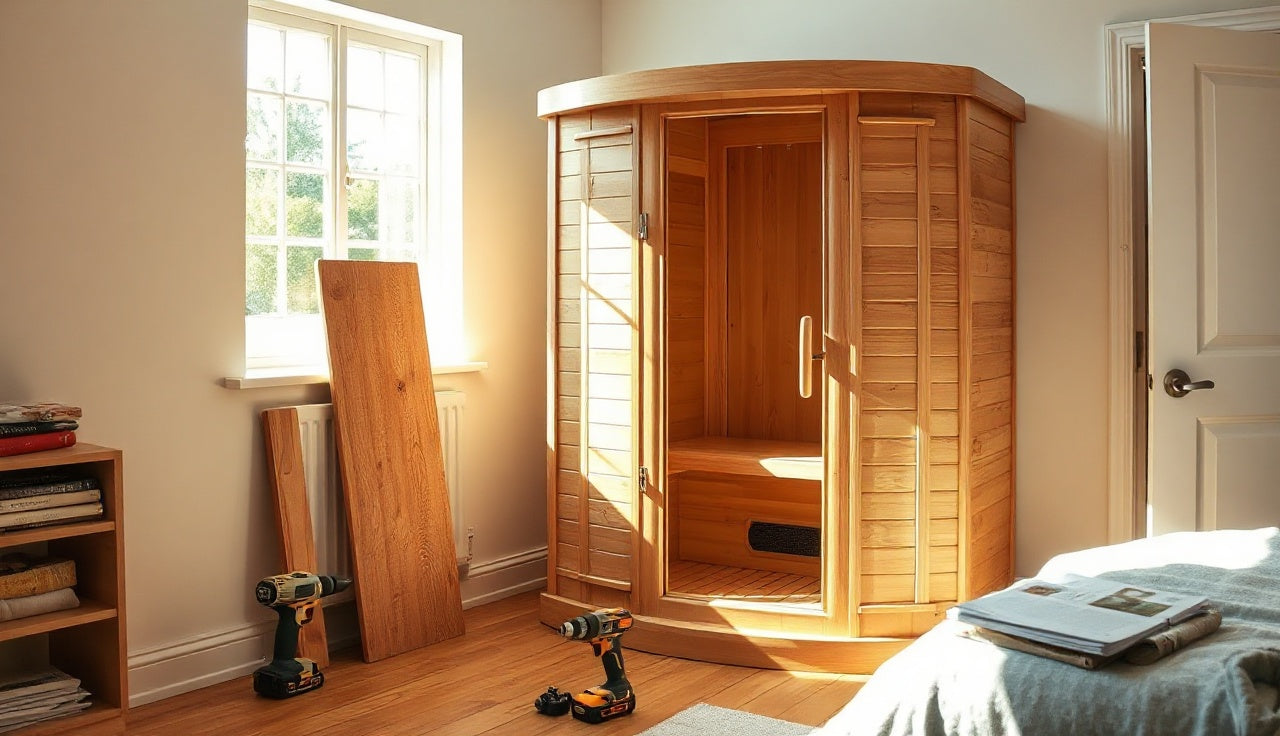
The cabin arrives in flat-pack panels, usually four to eight pieces depending on the model and how many people it seats. Each panel slots into the next with tongue-and-groove joints or a cam-lock system. No special tools. A rubber mallet, a cordless drill, and a level handle ninety percent of the work.
Once the box is together, you connect the internal wiring harness the manufacturer includes, which links the heater panels to the control board. Then you plug the unit into its power source.
The catch is that power source. A one-person unit often runs on 120V and plugs into any 15-amp household outlet, which means zero electrical work. A two-person or larger unit almost always calls for a dedicated 240V circuit, which means new wire, a new breaker, and likely a licensed electrician. That single step is where timelines and budgets expand.
Placement is the other variable. Basements, spare bedrooms, garages, and covered patios all work. Each brings its own flooring, ventilation, and clearance questions. Get placement right before you assemble. Disassembling and dragging a finished unit across the house is a chore nobody enjoys.
What electrical requirements does an infrared sauna need?
This is the question that trips people up more than any other. The answer depends on the heater wattage and the size of the unit, nothing else.
One-person units in the 1,000 to 1,500-watt range typically run on 120V, 15-amp circuits. If the room has a standard outlet, you plug it in like a space heater. No electrical work at all.
Two-person units usually draw 1,500 to 2,000 watts, which sits right at the edge of a 15-amp circuit. Many manufacturers spec them for 120V but recommend a dedicated circuit so you are not resetting breakers mid-session. Read your unit's nameplate data, not the marketing copy.
Three-person and larger units, anything in the 2,000 to 4,500-watt range, almost always need a dedicated 240V, 20-amp or 30-amp circuit. The National Electrical Code (NEC), Article 422 on appliances, requires that fixed appliances drawing more than 50 percent of a circuit's capacity get a dedicated branch circuit [1]. Run a 240V unit on a shared circuit and most manufacturers void the warranty too.
A dedicated 240V rough-in by a licensed electrician typically costs $300 to $800 depending on panel distance and local labor rates, per national cost data compiled by HomeAdvisor [2]. If your main panel is close and you have open breaker slots, expect the low end. If the panel sits on the far side of the house and needs conduit run through finished walls, the cost climbs fast.
One more thing: the NEC and most local codes require GFCI protection on sauna circuits because of the moisture and heat [6]. Some manufacturers build GFCI into the unit itself. Confirm which you have before your electrician buys parts.
Budget both time and money for this step. Get an electrician out for a quote before you order the sauna, not after it lands on your driveway.
What is the best location to install an infrared sauna indoors?
Almost any flat, dry interior surface works. Here is how the common spots compare.
| Location | Typical flooring | Key consideration |
|---|---|---|
| Spare bedroom | Carpet or hardwood | Protect floor from heat; use a mat |
| Basement | Concrete | Moisture barrier needed if the slab sweats; easy to run 240V nearby |
| Garage | Concrete | Temperature swings affect preheat time; check insulation |
| Bathroom | Tile | Handles moisture well; ventilation often already there |
| Dedicated wellness room | Any | Ideal; plan the room around the unit |
The floor under the unit needs no special prep beyond being level and dry. Most manufacturers advise against installing directly on carpet because heat degrades carpet fibers over time and the base loses airflow. A rubber mat or a few wood planks under the base solves it.
Clearance matters. Leave at least two inches on each side and six inches at the rear for air circulation. Most manuals spec this. Follow it or you will cook the wood from the outside in.
Ventilation gets ignored too often. Infrared saunas throw off less ambient heat than traditional saunas (typically 120 to 150 degrees Fahrenheit versus 170 to 200 for a Finnish sauna) [3], but the room still warms over a session. A window that opens, an HVAC return, or a small exhaust fan makes a real difference in comfort and in how fast the room cools afterward.
Basements deserve a note. Concrete slabs suit saunas well, but check for ground moisture first. Tape a sheet of plastic to the slab for 24 hours. If condensation forms on the underside, you need a moisture barrier before the sauna goes in. Simple fix. Skip it and you invite wood rot and electrical problems down the road.
| DIY, existing 120V outlet | $25 |
| DIY assembly + electrician 240V circuit | $575 |
| Pro assembly, existing outlet | $275 |
| Pro assembly + electrician 240V circuit | $825 |
| Outdoor concrete pad (add-on) | $1,250 |
Source: HomeAdvisor, Sauna Installation Cost Guide (Citation 2)
Do you need a permit to install an infrared sauna at home?
It depends on your jurisdiction, and the only reliable answer comes from calling your local building department. Do not rely on the sauna retailer to know your local code.
For the sauna structure itself, most jurisdictions treat a pre-manufactured modular sauna as a plug-in appliance and require no building permit. You are not adding square footage or altering the structure.
Electrical work is different. Permits are almost always required when you add a new circuit or modify an existing one. The NEC, which most states adopt with local amendments, requires inspected permits for new branch circuits [1]. An electrician who pulls a permit is doing you a favor, not piling on paperwork. The inspection catches wiring errors before they turn into fires.
Some municipalities require a permit for any sauna install regardless of type, treating it as a home improvement that touches the certificate of occupancy. The rules vary block to block. Calling is the only way to know.
Skipping a required electrical permit creates real problems at resale. Home inspectors flag unpermitted work, and your homeowner's insurance may deny a fire or water claim if unpermitted wiring turns out to be a contributing cause [6].
Outdoor infrared saunas are a different story. Those almost always need at minimum an electrical permit and sometimes a building permit or zoning variance, especially if the structure sits freestanding on a permanent base. See our guide on outdoor sauna installation for those specifics.
How long does it take to install an infrared sauna?
Plan for two to four hours of actual assembly on a standard two-person pre-built unit if you are reasonably handy and have one helper. Four-person and larger units run four to six hours.
The assembly is not hard. Most people get a two-person unit together in about 90 minutes. Time balloons when you work alone, when access is tight (narrow doorways, cramped stairwells), or when the manual reads like it went through three bad translations, which happens with some manufacturers.
If you need a new circuit, add the electrician's schedule to your timeline. Depending on your area and their workload, that can mean one to three weeks for the appointment. The electrical work itself usually takes two to four hours.
Measure your doorways before the unit ships. A two-person sauna panel is typically 24 to 36 inches wide and 77 to 80 inches tall. Most interior doorways run 32 to 36 inches, close enough that you need to check. Some units ship with panels that clear a 28-inch door. Confirm this with the manufacturer if your access is tight.
All in, from the day the unit arrives to your first session: one to two weeks if you need electrical work, or a single day if the right outlet is already in the room.
Can you install an infrared sauna yourself, or do you need a contractor?
The assembly is a legitimate DIY project. If you can put together flat-pack furniture and run a cordless drill, you can build a pre-built infrared sauna.
The electrical side is where the line sits. If the unit runs on 120V and you have an open dedicated outlet, plug it in yourself and you are done. If you need a new 240V circuit, hire a licensed electrician. This is not about your skill. It is about permits, inspections, and insurance. Most states require a licensed electrician to pull permits for new circuits under their electrical licensing laws, and DIY work on unpermitted circuits becomes a serious liability if anything goes wrong [1].
For the cabinet assembly, a second person is not strictly required but strongly recommended. Panels on larger units run 60 to 80 pounds each. You can wrestle them into place alone, but you will take twice as long and risk cracking the tongue-and-groove joints.
Installing a large unit (four-person or more) in a basement with a narrow stairwell, or building an outdoor structure on a concrete pad, is where a contractor or handyman for the move earns their fee. A 400-pound assembled sauna is not a solo lift.
SweatDecks carries home saunas sized and specced for exactly these real-world install scenarios, with manufacturer specs listed so you know what circuit you need before you buy.
What does it cost to install an infrared sauna in 2025?
Install cost is separate from the unit cost. Here is how the install side breaks down.
DIY assembly with existing 120V outlet: $0 to $50 (rubber mallet, level, a tube of silicone if your floor needs it). You already own the rest.
DIY assembly, new 240V circuit by electrician: $300 to $800 for the rough-in, plus $0 to $50 for tools. Total: $300 to $850.
Professional assembly (handyman or sauna installer) plus existing outlet: $150 to $400 for labor.
Professional assembly plus new 240V circuit: $450 to $1,200 for labor and electrical combined.
National cost data aggregated by HomeAdvisor puts a full sauna install (all types) at $3,000 to $6,000 including the unit, with infrared on the lower end because the electrical is simpler than a steam sauna [2]. That total is dominated by the unit price. The install labor alone stays modest for most homeowners.
One cost people miss: a floor mat or base board if you are installing on carpet or hardwood. Budget $50 to $150 for a proper rubber or teak mat.
Outdoor installs on a new concrete pad add $500 to $2,000 for the pad alone, depending on size and local concrete pricing. Treat that as a separate project.
How does infrared sauna installation compare to a traditional sauna?
This comparison is worth making before you buy anything.
A traditional Finnish-style sauna needs a high-wattage electric heater (typically 4,500 to 9,000 watts), a dedicated 240V circuit every time, proper ventilation with a fresh air intake and exhaust, walls and ceiling rated for 200-degree heat, and in most jurisdictions a building permit for the room itself [4]. Build a custom room and you also add a vapor barrier, a wood species rated for high heat (cedar or Nordic spruce), a proper door with a window, and a floor drain or at least a sloped waterproof floor.
A pre-built infrared sauna needs a flat dry surface, possibly a dedicated circuit, and little else.
Building a traditional sauna room from scratch runs one to three weeks with a contractor. The room construction alone, not counting the heater, runs $2,000 to $8,000 depending on size and finish [2].
A pre-built infrared unit goes up in two to six hours.
The trade-off is real. Traditional saunas deliver a hotter, higher-humidity experience that many enthusiasts prefer, and the frequently cited cardiovascular research, particularly Laukkanen and colleagues, was done on Finnish-style saunas at 175 to 185 degrees Fahrenheit, not infrared units at 130 to 150 degrees [3]. Want the exact protocol the studies used? A traditional sauna is closer. Want something you can install in a spare bedroom this weekend? Infrared wins on every logistical count. Our sauna vs steam room breakdown covers the heat-type differences in detail.
For people deciding what kind of home sauna to buy, this install gap is often the deciding factor.
What type of flooring works under an infrared sauna?
Concrete and tile are the best substrates. They handle heat, do not off-gas, and make it easy to wipe up sweat that drips off the exterior of the unit.
Hardwood and engineered wood work with a protective mat underneath. The main risk is heat discoloration over time from the mild warmth radiating through the base. A 3/8-inch rubber mat, the kind sold for gym equipment, handles it.
Vinyl plank (LVP) can soften and deform under prolonged heat, depending on the product's heat tolerance rating. Check your flooring manufacturer's spec before installing on LVP.
Carpet is the problem case. Most manufacturers explicitly warn against carpet in their warranties. The base loses airflow and traps heat, which can scorch fibers and create a fire risk over years of use. A plywood sheet over the carpet, cut to the sauna footprint with a mat on top, is a workaround some people use. Picking a room with hard flooring is the cleaner move.
The sauna itself needs no finished subfloor or special prep. Level is all it wants. Run a four-foot level across the floor before assembly. Anything more than a half-inch drop over four feet warrants shimming the base.
How do you maintain an infrared sauna after installation?
Maintenance on an infrared sauna is genuinely minimal next to a traditional sauna, which needs regular cleaning of the rocks and occasional re-seasoning.
The interior wood absorbs sweat over time. After every few sessions, wipe the benches and walls with a dry towel while the unit is still warm. Sweat comes off easily at temperature. Once a month, do a light clean with a diluted white vinegar solution (roughly 1:10 vinegar to water) on the wood. Skip soap-based cleaners, which leave residue that stinks when heated.
Do not oil or finish the interior wood. Raw wood is intentional. It breathes and handles the heat cycles properly, and finishes can off-gas VOCs at sauna temperatures [10]. Oils can also smoke and foul the heater elements.
The heater panels need zero maintenance. They are carbon fiber or ceramic depending on the unit, and both are sealed and passive. Nothing to clean, adjust, or replace under normal use for years.
The exterior wipes down with a damp cloth. If the unit sits near a wall, check now and then that the clearance gap stays open and nothing blocks the side ventilation.
Leave the door open after each session so the interior dries fully. This prevents mold and mildew in the wood seams, which is the main long-term problem in neglected units.
Heater elements in quality units typically last 10,000 to 20,000 hours per manufacturer specs. At one hour a day, that is 27 to 55 years. The control board is the likelier failure point. Buy from a manufacturer that stocks replacement boards.
Is an infrared sauna worth installing at home? What does the research say?
Here you deserve an honest answer, not a sales pitch.
The evidence on infrared saunas specifically is thinner than the evidence on traditional high-heat saunas. Most of the cardiovascular and longevity research people cite, including Laukkanen and colleagues' 2018 Mayo Clinic Proceedings review, studied Finnish-style saunas at 175 to 185 degrees Fahrenheit [3]. Infrared units run 120 to 150 degrees. Whether the physiological response is equivalent is not settled.
What infrared saunas reliably produce: a core temperature rise of roughly 1 to 2 degrees Celsius over a session, a heart rate climb to 100 to 150 BPM in most users, and heavy sweating [9]. Those are the same proximate mechanisms proposed in the traditional sauna research. The deeper cardiovascular adaptations may follow. Nobody has proven it head-to-head at scale yet.
A 2020 review in BMC Complementary Medicine and Therapies found some evidence that far-infrared sauna use reduces pain and fatigue in people with rheumatoid arthritis and other chronic pain conditions, but the studies were small and methodologically weak [5]. The authors called the results "promising but preliminary."
On the practical side: regular sauna use requires a sauna you will actually use. An infrared unit in your spare bedroom gets used more than a traditional sauna you have to drive to. That consistency counts for something, even if the per-session physiology differs from what the Finnish studies measured. The American Heart Association also recommends checking with a physician before sauna use if you have a cardiac condition [9].
Pairing regular sauna sessions with cold plunge work is a recovery protocol many athletes use. The contrast therapy evidence is similarly promising but not ironclad. Our sauna benefits breakdown goes deeper on what the research actually supports.
If you are buying this for recovery and wellness, and you will use it consistently, the install cost is modest enough that the real question is habit, not ROI.
Frequently asked questions
Can an infrared sauna plug into a regular outlet?
One-person units rated at 1,000 to 1,500 watts typically run on a standard 120V, 15-amp household outlet. Larger two-person and up units almost always require a dedicated 240V circuit, which means hiring an electrician to run a new breaker. Always check the nameplate wattage on your specific unit, not the marketing spec sheet, before assuming you can plug it in.
Do I need an electrician to install an infrared sauna?
Only if the unit requires a new 240V circuit. Small 120V units plug in like any appliance. For 240V units, most states require a licensed electrician to pull permits for new circuits under their electrical licensing laws. The electrician cost runs $300 to $800 for the rough-in. The cabinet assembly itself is a genuine DIY project with no special skills required.
How much space does an infrared sauna need?
Add at least two inches clearance on each side and six inches at the rear beyond the unit's footprint. A two-person unit is typically 47 to 55 inches wide by 36 to 40 inches deep by 75 to 80 inches tall. Measure your doorways before the unit ships: panels are usually 24 to 36 inches wide, which fits through most 32-inch interior doors, but it is close enough to check.
How long does infrared sauna installation take?
Assembly of a two-person unit takes two to four hours with one helper. Larger four-person units run four to six hours. If you also need a new 240V electrical circuit, add the electrician's scheduling time, usually one to three weeks depending on your area. From unit delivery to first session: as little as one day if you have existing 120V power, or one to two weeks if electrical work is needed.
Can you install an infrared sauna on carpet?
Most manufacturers warn against it and some void the warranty for carpet installs. Carpet restricts airflow under the base and the concentrated heat can scorch fibers over time. A practical workaround is a plywood sheet cut to the sauna's footprint placed over the carpet, topped with a rubber mat. Concrete, tile, or hardwood with a mat is the better setup if you have a choice of room.
Does an infrared sauna installation require a permit?
The sauna cabinet itself usually does not need a building permit in most jurisdictions, since it is a freestanding modular unit. The electrical work almost always does. Any new branch circuit requires an inspected permit under the National Electrical Code and virtually all local adoptions of it. Call your local building department to confirm the rules in your municipality before the electrician starts work.
Can an infrared sauna be installed outdoors?
Some infrared saunas are rated for outdoor installation; most are not. Units built for indoor use have wood and electronics not sealed for weather exposure. If you want an outdoor unit, buy one specifically designed for it, which will have weather-treated wood and sealed electrical components. You will almost certainly need both a building permit and an electrical permit for an outdoor install. Our guide on outdoor sauna covers the full process.
What is the difference between a 120V and 240V infrared sauna?
A 120V unit runs on a standard household outlet and is limited to roughly 1,500 watts of heater power, which suits one-person cabins. A 240V unit can draw 2,000 to 4,500 watts, which heats larger cabins faster and reaches higher temperatures. The trade-off is the 240V circuit requirement, which adds $300 to $800 in electrician cost. For two people or regular family use, the 240V unit is usually worth it.
How hot does an infrared sauna get compared to a traditional sauna?
Infrared saunas typically reach 120 to 150 degrees Fahrenheit. Traditional Finnish saunas run 170 to 200 degrees Fahrenheit. The lower air temperature in infrared units feels more tolerable to many people and allows longer sessions. The physiological response, core temperature rise and elevated heart rate, is similar in direction but the intensity and speed of heat stress differ. Most published cardiovascular sauna research used traditional high-heat saunas.
How do I know what size infrared sauna to buy for my space?
Measure your available floor area first, then subtract two inches per side and six inches at the rear for clearance. A one-person unit typically fits in a 4 by 4-foot footprint. A two-person unit needs roughly 4 by 5 feet. A four-person unit needs 5 by 6 feet or more. Also confirm your doorway and hallway widths for moving panels in; 32 inches clear is the minimum for most panels.
Can infrared saunas cause fires or be a hazard at home?
Pre-manufactured infrared saunas certified by UL, ETL, or CE have been tested to fire and electrical safety standards. The main risks come from improper electrical installation (shared circuits for high-wattage units), blocking clearance gaps so heat builds up on the unit exterior, and installing near flammable materials. Buy a unit with a recognized safety certification, follow clearance specs, and use a permitted dedicated circuit.
What is the best wood for an infrared sauna interior?
Canadian hemlock and clear cedar are the most common and both perform well. Cedar is naturally antimicrobial and smells good but is denser and holds more heat. Hemlock is softer, lighter in color, and has almost no scent, which some people prefer. Avoid any wood with high resin content (pine, for example), which can drip and smoke at sauna temperatures. The wood should be untreated and unfinished on interior surfaces.
Does installing an infrared sauna increase home value?
There is no reliable published data showing a consistent home value premium for infrared sauna installs specifically. Real estate appraisers generally treat built-in wellness features as lifestyle amenities that appeal to certain buyers rather than features that translate to a predictable dollar-for-dollar value increase. A well-installed unit in a dedicated wellness room is more appealing at resale than one crammed in a corner. A portable unit adds no value.
Can I move my infrared sauna if I relocate?
Yes, and this is one of the real advantages over a custom-built traditional sauna. Pre-built modular units disassemble the same way they assemble. A two-person unit can be broken down into panels, moved, and reassembled in a new location in a few hours. The electrical circuit stays behind, so you may need a new one at the new location. Protect the tongue-and-groove joints during transit; they are the most vulnerable part.
Sources
- NFPA / National Electrical Code (NEC), Article 422: Fixed appliances rated at more than 50 percent of a branch circuit's capacity require a dedicated circuit; new circuits require inspected permits under local NEC adoptions.
- HomeAdvisor, Sauna Installation Cost Guide: Installing a sauna including the unit typically costs $3,000 to $6,000 total; electrician circuit rough-in runs $300 to $800 nationally; custom sauna room construction runs $2,000 to $8,000.
- Laukkanen et al., Mayo Clinic Proceedings 2018, 'Cardiovascular and Other Health Benefits of Sauna Bathing': Most cardiovascular sauna research used Finnish-style saunas at 175 to 185 degrees Fahrenheit; infrared units operate at 120 to 150 degrees and have not been studied equivalently at scale.
- International Code Council, International Residential Code (IRC): Traditional sauna rooms built within a home structure require compliance with IRC provisions for wall assemblies, ventilation, and vapor barriers.
- BMC Complementary Medicine and Therapies, review of infrared sauna for chronic fatigue and pain (2020): A 2020 review found promising but preliminary evidence that far-infrared sauna reduces pain and fatigue in chronic pain conditions; studies were small and methodologically limited.
- U.S. Consumer Product Safety Commission (CPSC): Unpermitted electrical work on new circuits creates fire and electrocution risk; GFCI protection is required in areas with heat and moisture exposure.
- Underwriters Laboratories (UL), UL 875 Standard for Electric Dry-Bath Heaters: UL 875 governs safety testing for electric sauna heaters including temperature limits, fire resistance, and electrical safety of components.
- U.S. Department of Energy: Adding high-wattage appliances without a dedicated circuit is a leading cause of residential electrical overload and fire in home renovation projects.
- American Heart Association: Passive heat exposure that raises heart rate to 100 to 150 BPM produces cardiovascular stress similar in mechanism to moderate aerobic exercise; AHA recommends consulting a physician before sauna use in persons with cardiac conditions.
- U.S. Environmental Protection Agency (EPA), Indoor Air Quality: Untreated wood is recommended for sauna interiors; finished or painted wood can off-gas VOCs at elevated temperatures, degrading indoor air quality during sauna sessions.

Share:
Infrared sauna panels: what they are, how they work, and what to buy
Infrared sauna panels: what they are, how they work, and what to buy