
Last updated 2026-07-09
TL;DR
A real home sauna starts at about $150 for a portable infrared tent or $1,500 for a DIY barrel kit. Most homeowners land in the sweet spot: a 1 to 2 person indoor infrared cabinet at $600 to $1,500. Outdoor wood-fired barrels cost more but last decades. Steam tents under $100 make you sweat but aren't real saunas.
What does an inexpensive home sauna actually cost?
It depends entirely on which type you're comparing. The word "sauna" covers at least four different products that share almost nothing except heat.
Portable steam tents (fabric boxes with a personal steamer): $50 to $200. You sit in a tent with your head sticking out. Fine for sweating. Not a real sauna experience.
Portable infrared tent saunas (foldable carbon heater panels in a pop-up frame): $150 to $500. These are legitimate infrared saunas. Small, slow to fold, but they work.
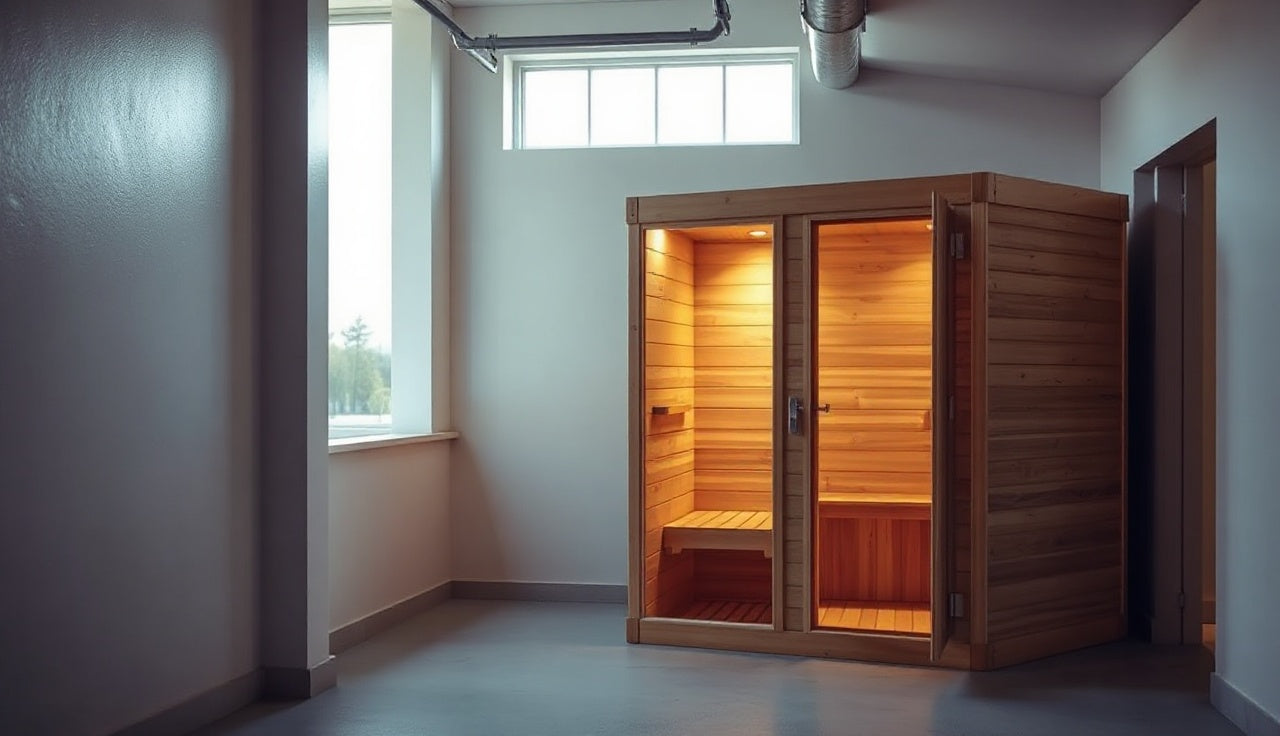
Pre-built indoor infrared cabinets (wood box, carbon or ceramic panels, bench, built-in controls): $500 to $3,000 depending on size and heater quality. The 1-person units start around $500; a 2-person unit with decent panels runs $800 to $1,500 [1].
Outdoor barrel or cabin saunas (wood-fired or electric, cedar or hemlock construction): $1,500 to $6,000+ for a kit you assemble yourself, up to $15,000+ for a pre-built delivered unit [2].
So "inexpensive" is relative. If your reference point is a $20,000 custom outdoor cabin, a $2,000 barrel kit is cheap. If you just want to sweat regularly without spending much, a $300 infrared tent does it.
Here's the framing that helps most: what's the lowest cost per session over 5 years? A $200 tent you use 200 times costs $1 per session. A $1,500 barrel kit you use 500 times costs $3 per session, but it gives you an experience the tent cannot match.
What are the cheapest home sauna options that actually work?
Four real options, ranked by upfront cost, with honest notes on each.
| Option | Upfront cost | Heat type | Space needed | Durability |
|---|---|---|---|---|
| Portable steam tent | $50, $200 | Steam (moist) | 3 sq ft | 1 to 2 years |
| Portable infrared tent | $150, $500 | Far infrared | 4 to 6 sq ft | 2 to 4 years |
| Indoor infrared cabinet (1 to 2 person) | $500, $1,500 | Far infrared | 35 to 50 sq ft | 5 to 10 years |
| Barrel/cabin kit (DIY) | $1,500, $4,000 | Traditional or electric | Outdoor/garage | 15 to 30 years |
Portable infrared tents are underrated. Companies like Serenelife, HigherDose, and Radiant Saunas sell units in the $150 to $400 range that reach 140 to 160°F and run on a standard 110V outlet [1]. You fold them up and put them in a closet. The sessions feel different from a wood box, but the infrared exposure and the sweat are real.
Indoor infrared cabinets in the $800 to $1,200 range are the best value for most people who have a spare corner of a bedroom, bathroom, or garage. You don't need a permit for most of them (they run on 110V or 120V), assembly takes 2 to 4 hours, and you're using it within a day of delivery. The difference between a $900 unit and a $2,500 unit is mostly cosmetic and heater count, not whether the thing gets hot.
The portable sauna option is worth a closer look if you rent, move often, or want to test whether you'll actually use a sauna before spending more.
Barrel kits are the budget path to a traditional sauna. At $1,500 to $2,500 for a kit with staves, hoops, a heater mount, and a door, you get something that outlasts most appliances in your house. You need to be comfortable with basic carpentry (or willing to watch a lot of YouTube), and you need a level outdoor space. Operating cost with a wood-burning heater is essentially free if you have access to wood.
Is a cheap infrared sauna actually good for you?
The sauna research is stronger than most wellness categories. The catch: almost all the good human studies used traditional Finnish-style saunas at 80 to 100°C (176 to 212°F), not infrared cabinets [3].
A widely cited 2018 review in Mayo Clinic Proceedings found that regular sauna bathing was associated with reduced risk of cardiovascular events, and the authors described the evidence base as "growing" though not yet at the level of large randomized controlled trials [3]. The effect comes mainly from heat exposure, elevated heart rate (similar to moderate exercise), and the sweating response.
Infrared saunas heat the body differently. The air temperature is lower (typically 120 to 150°F versus 170 to 200°F for traditional), but the infrared wavelengths reach the skin directly and raise core temperature without heating all the air around you. A small study in the Journal of the American College of Cardiology reported acute hemodynamic improvements in heart failure patients after infrared sauna sessions, though the sample was tiny [4].
The honest position: a cheap infrared sauna makes you sweat, raises your core temperature, and feels relaxing. Whether it delivers the same physiological benefits as a 90°C Finnish sauna is unknown, because nobody has run a direct comparison at scale. Want the benefits specifically studied in the literature? A traditional sauna is more defensible. Want affordable, regular heat exposure you can start tonight? Infrared works.
For a fuller look at what the research says, the sauna benefits guide covers the cardiovascular, mental health, and recovery literature in detail.
| Portable steam tent | $210 |
| Portable infrared tent | $370 |
| Infrared cabinet (1-person) | $990 |
| Infrared cabinet (2-person) | $1,590 |
| DIY barrel kit (electric) | $2,260 |
| Pre-built outdoor barrel | $5,200 |
Source: US Energy Information Administration, 2024; Consumer Reports Sauna Guide
What's the difference between a cheap infrared sauna and a traditional sauna?
This one shapes your whole buying decision.
Traditional saunas (Finnish style) heat the air to 170 to 210°F using an electric heater or wood fire with rocks. You can pour water on the rocks for steam and humidity spikes. The experience is intense, social, and rooted in Nordic culture. The sauna vs steam room piece covers the humidity side in more detail.
Infrared saunas run at 120 to 150°F. The heaters emit far-infrared radiation (wavelengths of roughly 5.6 to 1000 microns) that the body absorbs directly. The lower air temperature means you tolerate longer sessions, you don't heat as much air (cheaper to run), and the units can be built cheaply in a plain wood cabinet without complex ventilation.
For a budget buyer, the practical differences:
Installation: Infrared cabinets need nothing but a standard outlet. Traditional electric saunas typically need a dedicated 240V circuit [5], which means an electrician and $200 to $600 in wiring costs.
Session style: Traditional saunas run hotter and can add steam, so they feel more intense. Many people find them harder to sit in for long. Infrared lets you stay 30 to 45 minutes reading or watching something.
Cost to operate: An infrared 1 to 2 person cabinet uses roughly 1 to 1.6 kWh per session. At the US average electricity rate of about $0.16/kWh in 2024, that's $0.16 to $0.26 per session [6]. A traditional electric sauna heater (typically 4 to 9 kW) running an hour uses 4 to 9 kWh, so $0.64 to $1.44 per session.
For a first home sauna, infrared removes almost every barrier: no permit usually needed, no special wiring, no contractor, lower operating cost, and a smaller footprint.
Do you need a permit to install a home sauna?
Usually not for a plug-in infrared unit. Always check for a traditional electric sauna.
Portable infrared tents and most infrared cabinets that run on 120V draw under 15 to 20 amps and get treated like any other appliance. You generally don't need a building permit for an appliance [7].
The moment you hardwire a heater to a dedicated 240V circuit, you're doing electrical work that requires a permit in most US jurisdictions under the National Electrical Code (NEC) Article 424, which governs fixed electric space heating equipment [5]. The permit isn't a bureaucratic nuisance. It means an inspector confirms the circuit is sized right and the install is safe.
Outdoor structures pull in local zoning and building codes too. A pre-built outdoor barrel sauna on a gravel pad usually counts as a structure, and setback requirements (how far it must sit from property lines, fences, and the main house) vary widely by municipality. Some jurisdictions exempt structures under 120 square feet from permit requirements; others don't [7].
The practical path: call your local building department before you order anything over $1,000. Ask two questions. Does this unit (describe it) require a permit? Does an outdoor accessory structure of X square feet require a permit here? The call takes 10 minutes and saves real headaches at resale.
For an outdoor sauna install specifically, permitting and site prep deserve their own planning session before you spend money.
What should you look for in a budget infrared sauna cabinet?
There's a lot of garbage under $500. Here's what separates a decent unit from one you'll regret.
Heater type matters more than brand name. Carbon fiber panel heaters spread heat evenly across a large surface and run cooler to the touch than ceramic rod heaters. Ceramic rods get very hot at the source, which can feel intense in one spot rather than warmly surrounding you. Most serious reviews recommend carbon over ceramic for comfort. Carbon heaters also use slightly less power for equivalent output.
Low-EMF claims deserve skepticism. Every cheap sauna on Amazon claims "low EMF." EMF (electromagnetic field) emissions from sauna heaters are real, but the health significance at these levels is genuinely unclear. The reference point for comparison is the ICNIRP guideline of 2 mT (milliTesla) for the general public [8]. Some manufacturers publish third-party test reports; most don't. If low EMF matters to you, demand the actual test data rather than the marketing line.
Wood quality: Canadian hemlock and basswood are common in the $700 to $1,500 range and are fine. Solid wood throughout beats particleboard or MDF, which can off-gas when heated. Confirm the interior is untreated solid wood. The exterior finish can be whatever.
Warranty: Anything under one year on parts and heaters is a red flag at this price. Good brands offer 3 to 5 years on heaters.
Amperage and your outlet: Confirm the unit's amperage draw before ordering. A 120V, 15-amp circuit handles roughly 1,440 watts continuously. Many 1-person units draw 1,200 to 1,400W and are fine. A 2-person unit often draws 1,600 to 2,000W and needs its own 20-amp circuit or a 240V connection.
Skip the cheapest possible unit from a brand with no US customer service. The $450 option that breaks in 18 months and has no reachable support costs more in the end than a $900 unit with a real warranty.
Can you build a DIY sauna to save money?
Yes, and it's one of the better money decisions in this category if you're handy.
A basic indoor DIY sauna using a pre-made 4kW electric heater kit, tongue-and-groove cedar boards, and standard framing lumber can be built for $800 to $1,800 depending on material costs and local prices. You're essentially building a well-insulated closet with a heater, a vent, and cedar lining. Plenty of plans exist online through university extension programs and building publications.
A barrel sauna kit from Almost Heaven, Dundalk LeisureCraft, or similar runs $1,500 to $3,500 and includes all the milled cedar staves, hardware, and door. You still supply the foundation (gravel or concrete pad) and the heater (wood-burning adds $200 to $400 for a simple firebox; electric adds the heater and wiring cost). Assembly for a 6-foot barrel takes one capable person a full day or two people half a day.
The math works. A comparable pre-built outdoor sauna delivered and installed runs $8,000 to $20,000. You're saving $5,000 to $15,000 in exchange for a weekend of work and some planning.
What goes wrong in DIY saunas: bad ventilation (the room never fully heats, or you get CO buildup with a wood fire), wrong insulation (standard fiberglass batts off-gas at sauna temperatures, so use mineral wool or Roxul plus a foil-faced vapor barrier), and undersized heaters. For a properly heated traditional sauna, figure roughly 1 kW of heater capacity per 50 cubic feet of space, though the specific heater manufacturer's guidelines should override that rule of thumb [9].
If you want an outdoor setup without the full DIY build, a Costco sauna kit or similar big-box option lands in between: pre-kitted parts, simpler assembly, and a lower price than specialty brands.
What are realistic running costs for a cheap home sauna?
Running costs are where cheap upfront can mislead you, or where the math actually favors a budget unit.
Infrared cabinet (1 to 2 person, 1,200 to 1,600W): At the US average of roughly $0.16/kWh, a 45-minute session at 1.2 kWh costs about $0.19 per session [6]. Use it 4 times a week for a year, that's $39.52 in electricity.
Traditional electric sauna (6kW heater, 1-hour session including preheat): Uses about 6 kWh, costs about $0.96 per session. Same 4x weekly schedule: about $200/year in electricity.
Wood-fired barrel sauna: Essentially free if you have a woodpile. Plan on 4 to 8 pieces of dry hardwood per session.
Maintenance costs get ignored too often. Cedar interior boards need occasional sanding and no stain or sealant (sealed wood holds bacteria and can off-gas when hot). The door gasket on a prefab unit may need replacement every few years, usually $20 to $50. Infrared heater panels have a typical lifespan of 3,000 to 5,000 hours [1]; at 4 sessions a week at 45 minutes each, that's 156 hours a year, so the panels last 19 to 32 years at that rate. Electric heater elements in traditional units last a similar span with normal use.
The real cost surprise for most people is the dedicated electrical circuit, not the ongoing electricity. If you need a 240V circuit run from your panel to a garage or outdoor spot, budget $300 to $800 for an electrician depending on distance and local rates.
How does a cheap home sauna compare to a gym membership for recovery?
A real question worth doing the math on.
A gym membership with sauna access in a mid-tier US city runs $40 to $80 per month, so $480 to $960 a year [10]. Most gym saunas are crowded, nobody's pouring water, you can't control the temperature, and it's nothing like a private sauna. If you want 4+ sessions a week, you're driving, waiting, and sharing a small hot room with strangers.
A $900 infrared cabinet that lasts 8 years costs $112.50 a year in capital cost, plus $40/year in electricity at 4 sessions a week. Total: about $152/year, or roughly $13/month. Against a $60/month gym membership, you break even in under 2 years.
The calculus shifts if you'd also use the gym for other equipment, or if you genuinely won't use a home sauna consistently. Convenience cuts both ways. The gym is out of the house, which some people need in order to actually go. A home sauna at 10pm, when you'd never drive to a gym, is a different kind of value.
For people already running cold plunge and heat therapy as a recovery protocol, the cold plunge and sauna combination at home is genuinely hard to replicate at a gym. Most gyms don't have cold plunges, and even those that do rarely let you alternate freely between the two.
What's the best inexpensive home sauna setup for a small space?
Most apartments and small homes have at least one workable option. Here's how to think it through.
Under 50 square feet free: A portable infrared tent is your only real choice. Set it up in a bedroom or bathroom, fold it away after use. These cost $150 to $500 and take up about 4 square feet when deployed. Not perfect, but real infrared saunas.
50 to 80 square feet: A 1-person infrared cabinet fits in a corner of a bedroom, a large closet, or a section of a bathroom. Typical footprint is 36" x 36" to 40" x 48". You want at least 12 to 18 inches of clearance around the exterior for heat dissipation and access. Some people put them in large walk-in closets, which works if there's enough ventilation to the room.
80 to 150 square feet: A 2-person cabinet or a compact traditional sauna. At this size you start hitting units that may need a 240V connection, so confirm your electrical situation first.
Garage: Often the best spot for a budget setup. You have the space, you can run a 240V circuit to an existing subpanel relatively cheaply, and the concrete or wood floor is already appropriate. Insulate the walls around the sauna area if the garage is uninsulated; you'll heat it faster.
Basement: Good for temperature stability. Watch moisture management. Infrared cabinets generate less humidity than traditional saunas, so they're easier to site in a finished basement without worrying about condensation damage.
Nobody talks enough about ventilation. Whatever space you put a sauna in needs fresh air exchange, or the room gets uncomfortably hot and humid over repeated sessions. A simple passive vent duct or a bathroom exhaust fan running in the room is usually enough.
SweatDecks stocks home sauna options across the full price range if you want to compare specific cabinet dimensions against your available space.
Should you pair a cheap sauna with a cold plunge?
Contrast therapy, alternating heat and cold, is arguably the strongest argument for investing in a home sauna at any price.
Alternating sauna and cold water immersion has deep roots in Finnish tradition (jumping between the sauna and snow or a cold lake) and is now studied for recovery. A 2021 paper in the International Journal of Environmental Research and Public Health found that contrast water therapy reduced delayed-onset muscle soreness and perceived fatigue compared to passive recovery, though the literature uses a range of protocols and the optimal temperatures and durations aren't settled [11].
You don't need an expensive cold plunge for this. A chest freezer conversion, a stock tank with ice, or even a cold shower works when you're starting out. But if you're spending $800 to $1,500 on a sauna, a purpose-built cold plunge in the $1,000 to $3,000 range starts to make sense as the next step. The cold plunge benefits guide covers what the research actually supports on the cold side.
The typical protocol: 10 to 20 minutes in the sauna, 2 to 5 minutes in cold water (50 to 60°F), repeated 2 to 3 rounds. It produces a strong cardiovascular and mood response, driven mainly by norepinephrine release from cold exposure [12], and it's one of the few wellness practices where the anecdotal reports roughly match what the physiology predicts.
If contrast therapy is the goal, budget for both units. A $700 sauna plus $500 for a basic cold setup is a more complete system than a $1,200 sauna alone.
What are the biggest mistakes people make buying a cheap home sauna?
Buying too small. A 1-person unit seems fine until you want a longer session with your partner or you feel cramped every time. If you have the space, size up by one person-capacity.
Ignoring heater wattage. The most common reason cheap saunas disappoint is a heater that can't actually get the unit hot. A 1-person cabinet at 165 cubic feet needs at least 1,200W of infrared heater capacity, or the temperature plateaus at 110°F and stays there. Check the manufacturer's claimed maximum temperature and look for independent reviews that confirm it.
Buying a steam tent and expecting a sauna. Cheap steam tents are not saunas. They work for sweating, and some people find them useful, but the experience and the physiology are different. Want a sauna? Buy a sauna.
Not accounting for total cost. A $600 sauna plus $500 for an electrician to run a 240V circuit is an $1,100 purchase. Know what you're actually spending.
Ordering without measuring. Prefab cabinets often have to navigate doors, hallways, and stairwells to reach the install spot. Measure the cabinet's assembled dimensions, measure every doorway between the delivery point and the install location, and check the ceiling height. This sounds obvious and it still trips people up constantly.
Skipping the assembly instructions. Pre-built infrared cabinets are designed for one person following directions. Most mistakes involve reversing panels or misrouting the heater wiring. The instructions are usually good. Read first, assemble second.
For deeper context on how cheap options compare to fully featured traditional saunas, the sauna guide covers the full landscape.
Frequently asked questions
What is the cheapest home sauna that actually works?
A portable infrared tent sauna in the $150 to $400 range is the cheapest option that delivers genuine infrared heat and real sweat sessions. Brands like Serenelife and Radiant Saunas make units that run on a standard 110V outlet and reach 140 to 160°F. They're not luxurious, but they work. Anything below $100 is generally a steam tent, which is a different product entirely.
How much does it cost to run a home sauna per month?
An infrared cabinet (1 to 2 person, ~1,400W) used four times a week for 45-minute sessions costs roughly $3 to $5 per month in electricity at the US average rate of $0.16/kWh. A traditional electric sauna running a 6kW heater on the same schedule costs about $15 to $20 per month. Wood-fired units cost almost nothing to operate if you supply your own wood.
Can I put a cheap sauna in my apartment?
A portable infrared tent sauna works in most apartments. It folds away after use, runs on a standard outlet, and creates no structural concerns. Permanent infrared cabinets technically fit in a large bedroom or spare room, but check your lease and confirm the electrical circuit can handle the draw before ordering. Most apartments don't allow modifications for a 240V circuit, which rules out traditional saunas.
Do I need an electrician to install a home sauna?
For plug-in infrared units under 15 amps on 120V, no electrician is needed. For units that require a dedicated 240V circuit, yes. Running a 240V line from your panel typically costs $300 to $800 depending on distance and local rates, and it requires a permit under the National Electrical Code in most jurisdictions. Factor this into your total budget before you buy.
Is a cheap infrared sauna as good as a traditional Finnish sauna?
They're different, not directly comparable. Traditional saunas have more research supporting cardiovascular benefits at 80 to 100°C. Infrared cabinets run at 50 to 65°C but heat the body directly, so core temperature still rises meaningfully. For most people, a cheap infrared sauna used regularly beats an expensive traditional sauna used rarely. Consistency matters more than the exact type.
How long do cheap home saunas last?
Portable infrared tents: 2 to 5 years with regular use. Infrared cabinets in the $700 to $1,500 range: typically 7 to 12 years with normal use, longer if you replace heater panels as needed. Carbon fiber heater panels are rated for 3,000 to 5,000 operating hours. DIY or kit barrel saunas built with cedar last 20 to 40 years with basic maintenance. Cheap steam tents under $150 often fail within 1 to 2 years.
What size home sauna do I need?
For solo use, a 1-person unit (roughly 3' x 3' footprint) is adequate. If two people will use it or you want to stretch out, go 2-person (roughly 4' x 4'). Most people who buy 1-person units wish they'd gone bigger. If you have the space and a budget above $900, start at 2-person. The size difference in operating cost is minimal but the comfort difference is significant.
Can a cheap sauna help with weight loss?
Sauna sessions cause significant sweat loss, but the weight you lose during a session is water weight that returns when you rehydrate. There's no credible evidence that regular sauna use produces meaningful fat loss on its own. Heart rate elevation during sessions is roughly equivalent to a brisk walk. Any calorie burn is real but modest, typically 150 to 300 calories per session, similar to light exercise.
What wood is best for a budget home sauna?
Canadian hemlock and basswood are the most common in budget infrared cabinets and both perform well. Cedar is the traditional choice for traditional saunas because it resists moisture and bacterial growth and tolerates high temperatures without warping. At the budget end, hemlock is fine. Avoid particleboard, MDF, or any treated or stained wood inside the sauna, since these can off-gas harmful compounds when heated.
Is contrast therapy (sauna plus cold plunge) worth doing at home?
For recovery and mood, it's one of the better investments in the category. Alternating 10 to 20 minutes of sauna heat with 2 to 5 minutes of cold water at 50 to 60°F produces significant norepinephrine release and cardiovascular response. You don't need an expensive cold plunge to start. A stock tank with ice or a cold shower works. If you're already buying a sauna, adding a basic cold setup extends the value considerably.
What's the difference between far infrared and near infrared saunas?
Far infrared (FIR) saunas use wavelengths of roughly 5.6 to 1000 microns, which penetrate the body about 1.5 inches and raise core temperature efficiently at lower air temperatures. Near infrared (NIR) uses shorter wavelengths (0.75 to 1.4 microns) and shows up more in light therapy applications. Budget saunas almost universally use FIR. Most sauna research used traditional heat, not FIR, so the specific benefits of FIR panels versus other heating methods remain under-studied.
How do I maintain a cheap home sauna?
Wipe down the interior benches with a damp cloth after each session and let the unit air out with the door open for 15 to 30 minutes. Sand the wood lightly every 6 to 12 months if it feels rough or discolored. Never apply stain, paint, or sealant to the interior wood. Check heater connections annually. For traditional saunas, clean the rocks every 1 to 2 years and replace cracked ones. Simple maintenance extends life significantly.
Are there sauna options at Costco or big-box stores worth buying?
Yes, with caveats. Costco periodically sells barrel sauna kits and infrared cabinets at competitive prices, typically $1,500 to $3,500, with their standard return policy providing some protection. Quality is generally mid-range. You won't get the heater quality or wood grade of a specialty brand, but for a first sauna it's a reasonable value. Check current availability since Costco's sauna selection rotates. The Costco sauna guide on this site covers specific models and current value in more detail.
Sources
- Consumer Reports, Sauna Buying Guide: Infrared cabinet saunas for home use typically range from $500 for 1-person units to $3,000 for larger models; carbon fiber heater panels are rated for approximately 3,000–5,000 operating hours
- This Old House, Outdoor Sauna Cost Guide: Pre-built outdoor barrel and cabin sauna kits range from approximately $1,500 to $6,000; professionally installed units can reach $15,000 or more
- Mayo Clinic Proceedings, Cardiovascular and Other Health Benefits of Sauna Bathing (2018): "Regular sauna bathing" was associated with reduced cardiovascular events; authors noted the evidence base was "growing" though not yet at the level of large randomized controlled trials
- Journal of the American College of Cardiology, Infrared Sauna in Heart Failure: Infrared sauna sessions showed acute hemodynamic improvements in heart failure patients in a small study; sample size limitations noted
- National Fire Protection Association, NFPA 70 National Electrical Code Article 424: NEC Article 424 governs fixed electric space heating equipment including sauna heaters hardwired to a dedicated circuit, requiring permit and inspection in most US jurisdictions
- US Energy Information Administration, Electric Power Monthly (2024): Average US residential electricity retail price was approximately $0.16 per kWh in 2024
- US Department of Housing and Urban Development: Permit requirements for residential accessory structures vary by municipality; many jurisdictions exempt structures under 120 square feet from building permit requirements
- International Commission on Non-Ionizing Radiation Protection (ICNIRP), Guidelines for Limiting Exposure to Electromagnetic Fields: ICNIRP guideline for general public exposure to static magnetic fields is 2 mT (milliTesla); this is the reference used for evaluating low-EMF sauna claims
- National Institutes of Health, MedlinePlus (heat exposure and safety guidance): Prolonged heat exposure raises core body temperature and heart rate; hydration and session-length precautions are advised, especially for people with cardiovascular conditions
- Statista, Average Monthly Gym Membership Cost US (2023): Average monthly gym membership cost in the United States ranges from approximately $40 to $80 per month for mid-tier facilities
- International Journal of Environmental Research and Public Health, Contrast Water Therapy and Exercise Induced Muscle Damage (2021): Contrast water therapy reduced delayed-onset muscle soreness and perceived fatigue compared to passive recovery; optimal protocol temperatures and durations remain unsettled
- European Journal of Applied Physiology (Springer): Cold water immersion at low temperatures produced large increases in circulating norepinephrine in human subjects, supporting the physiological basis for mood and alertness effects from cold exposure

Share:
Auroom Baia 2-person home sauna kit: full review and buying guide
Sunlighten home sauna review: models, prices, and what to know before you buy