
Last updated 2026-07-09
TL;DR
Indoor cold plunge tubs give you year-round access, no weatherproofing hassle, and easier plumbing tie-ins, but they eat floor space and force drainage planning. Outdoor tubs fit a backyard, pair well with a sauna for contrast therapy, and often cost less to install, but they need freeze protection below 32°F and sometimes a permit. Water temperature drives the benefit, not location.
What actually separates an indoor from an outdoor cold plunge tub?
The core difference is exposure. An indoor tub lives in a climate-controlled space: a bathroom, a basement, a garage, a dedicated wellness room. An outdoor tub sits in the weather year-round or gets moved with the seasons. That one variable cascades into every other decision. Insulation. Materials. Drainage. Electrical code. And how cold you can get the water without paying a fortune to chill it.
Indoor tubs are usually acrylic, fiberglass, or stainless steel. They look finished, they shrug off humidity, and they tie into your home's drain if you planned the plumbing right. Outdoor tubs lean on high-density polyethylene (HDPE), cedar, or marine-grade stainless because those materials survive UV, freeze-thaw cycles, and rain without falling apart.
Neither category wins on paper. The right answer depends on your climate, your available space, how often you actually plunge, and whether you want the tub next to a sauna for contrast therapy. Those four things matter more than any spec sheet.
How do indoor and outdoor cold plunge costs compare?
Costs swing wider than most buyers expect, and the sticker price is rarely the whole bill. Below are real market ranges as of mid-2025, pulled from manufacturer and retailer pricing across several brands.
| Category | Entry-level | Mid-range | Premium |
|---|---|---|---|
| Indoor cold plunge (tub only) | $500, $1,500 | $3,000, $6,000 | $8,000, $15,000+ |
| Outdoor cold plunge (tub only) | $300, $1,200 | $2,500, $5,000 | $7,000, $12,000+ |
| Indoor installation (drain, electrical) | $200, $1,000 | $1,000, $3,000 | $3,000, $6,000 |
| Outdoor installation (pad, electrical, permit) | $500, $2,000 | $1,500, $4,000 | $2,000, $5,000+ |
| Chiller unit (both) | $1,000, $2,000 | $2,500, $4,000 | $5,000, $8,000 |
Your actual number lands somewhere in there depending on features, finish, and local labor rates.
A few line items push the total up fast. The chiller is the biggest variable: a basic compressor chiller that pulls water down to 39°F (4°C) runs $1,000 to $2,000, while a dual-stage unit that hits 34°F costs roughly twice that [1]. Outdoor tubs in sub-freezing climates need either a built-in heating element (to keep the chiller coil from cracking) or a good insulated cover, adding $200 to $600. Indoor tubs in homes without a floor drain need a pump-out system or a fresh drain run, which is a plumber visit you did not budget for.
The cheapest way into this hobby is an outdoor tub on a plain concrete pad, filled with a garden hose and a bag of ice. Sometimes under $500 all in. It gets cold. It just does not hold a precise temperature or do anything automatically. Once you add a chiller for set-it-and-forget-it control, indoor and outdoor land in a similar price band.
Which location gives you colder, more consistent water temperature?
Indoor wins on consistency, full stop. Research protocols target 10 to 15°C (50 to 59°F) for cold water immersion [2]. Some people go down to 5°C (41°F), but the evidence thins out fast below that.
Indoor tubs have one thermal advantage that matters: stable ambient temperature. Your chiller is not fighting a 95°F Texas afternoon or a sub-zero Minnesota morning. It just holds the set point and sips power. In a climate-controlled room, a mid-grade chiller sits at 50°F all year with no fuss.
Outdoor tubs work against the weather. Summer heat makes the chiller run harder. Winter cold can drive the water below your target and crack the chiller coil or the shell if it freezes solid. Most quality outdoor chillers have a freeze-protection mode that runs a small heat cycle near 32°F, and that costs extra electricity.
Mild climates flip the math, though. In coastal California, the Pacific Northwest, or much of the South in winter, an outdoor tub often needs zero freeze protection and picks up free cooling from chilly nights, which cuts chiller run time and your power bill.
Indoor is more consistent no matter the season. Outdoor is easy in mild climates and workable anywhere with the right hardware.
| Outdoor tub, mild climate, no chiller | $1,200 |
| Outdoor tub, mild climate, with chiller | $5,500 |
| Outdoor tub, cold climate, with chiller + freeze kit | $7,200 |
| Indoor tub, existing drain + circuit | $5,000 |
| Indoor tub, new drain + dedicated circuit | $8,500 |
Source: Compiled from manufacturer and retailer published pricing, mid-2025
What are the space and installation requirements for each?
Indoor cold plunges need a floor that can hold the weight, and this is where people get surprised. A 100-gallon tub full of water weighs about 834 pounds before you count the shell, since water runs 8.34 pounds per gallon [3]. Standard residential floors are built to a minimum 40 pounds per square foot live load under the International Residential Code [4]. A concentrated load like that on four tub feet is a genuine structural question on upper floors or older homes. Ground-floor slabs handle it without a thought. A structural engineer consult costs $200 to $500 and is money well spent if you have any doubt.
Indoor tubs also need a drain in reach. Gravity drain means a floor drain or a nearby standpipe. No drain means a submersible pump and a hose run to a utility sink or toilet connection. Plan the power too. Most chillers pull 15 to 20 amps on 120V or want a dedicated 240V circuit, which means an electrician if you do not have a spare circuit nearby.
Outdoor tubs keep the structural side simple because they sit on grade. A 4-inch residential concrete slab handles the load with no issues [5]. You still need a GFCI-protected outdoor outlet within reach of the chiller, and NEC Article 680 governs the clearances around water features for exactly this scenario [6]. Fill and drain can be a garden hose in and a drain valve out to a permeable spot, though your municipality may have rules about dumping chlorinated or treated water.
Permits are the wild card. Most jurisdictions skip the permit for a freestanding outdoor tub below a gallon threshold (often 5,000 gallons, so cold plunges almost always clear it), but electrical work needs a permit almost everywhere. Call your building department before you dig or wire anything.
How does each setup handle maintenance and water quality?
Both tubs need water sanitation. Cold, still water is not magically clean. The CDC notes that recreational water illnesses can result from contaminated water in any vessel, not only warm pools [7].
The good news: cold water slows most microbial growth compared to a hot tub, so the sanitation load is lighter. Owners generally pick one of three routes: UV sterilization (built into many chillers), ozone injection, or small doses of chlorine or bromine (1 to 3 ppm is the usual target, same as a pool). Some people just swap the water every week or two, which skips the chemistry but wastes water.
Outdoor tubs face a rougher environment. Leaves, insects, bird droppings, and pollen all find their way in. A tight-fitting cover is not optional outdoors. UV also breaks down some tub materials and cover foam over the years. Plan to replace covers every 2 to 4 years outside versus longer inside.
Indoor tubs collect less debris but can add humidity to a closed room. A 40°F open tub evaporates far less than a hot tub, but condensation on walls and floors builds up over time. Good ventilation, already required by code in most indoor bathrooms, takes care of it.
Water testing takes 5 minutes with a strip and should happen 2 to 3 times a week if you plunge daily. Neither location is much harder than the other, though outdoor setups need a check after any rain or windstorm.
Can you pair a cold plunge with a sauna, and does indoor or outdoor work better for that?
Outdoor usually wins for contrast therapy, mostly because of placement. Contrast therapy, alternating heat and cold, is one of the main reasons people install both a sauna and a cold plunge at home. The rationale is vasodilation in the heat followed by vasoconstriction in the cold. A 2021 review in the International Journal of Environmental Research and Public Health reported that contrast water therapy shows promise for reducing muscle soreness and perceived fatigue after exercise, though the authors called for larger randomized trials before drawing firm conclusions [8].
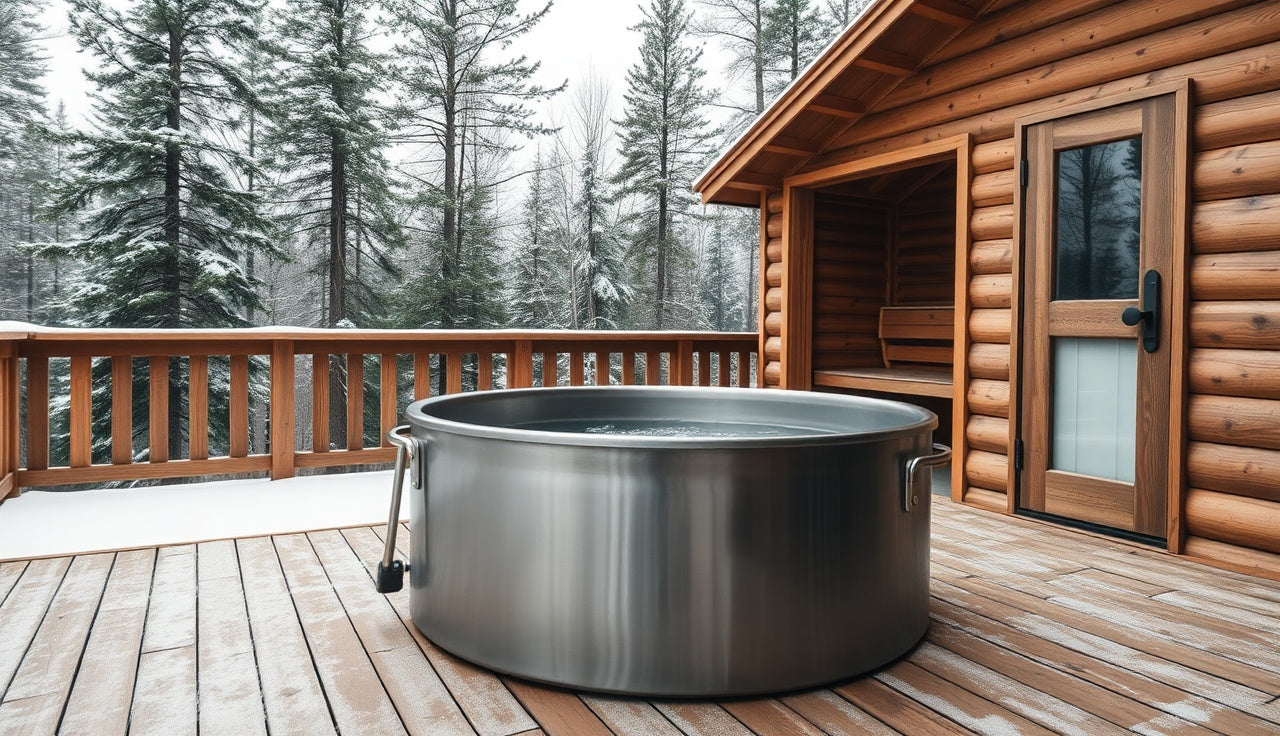
For the flow to work, the sauna and the plunge need to sit close together. A 60-second walk between them is fine. A 10-minute march through a cold house kills the ritual. Outdoor setups have the edge here if you already have an outdoor sauna in the backyard. Plenty of people build a simple deck platform with the sauna at one end and the plunge at the other, and it works beautifully.
Indoor contrast therapy works too, especially in a dedicated wellness room or a big bathroom. The payoff is complete weather independence. Rain, snow, and 100°F afternoons never touch the experience. The catch is that fitting both a sauna and a cold plunge inside a home takes serious square footage and planning.
Starting from scratch with contrast therapy as the goal? Most people find the outdoor-sauna-plus-outdoor-plunge combo easier to build and cheaper to finish, assuming the yard is there. Browse the cold plunge and outdoor sauna collections at SweatDecks to see what fits your space.
What are the privacy, weather, and experience differences between the two?
This is where preference takes over, and honesty matters: stepping out of a hot sauna into cold winter air and then into cold water is a genuinely different experience from plunging in a basement. Both work. They just feel different.
Outdoor plunging gives you fresh air, natural light, and the reset of being outside. A 2019 study in the International Journal of Environmental Health Research found associations between time in natural outdoor environments and better mental wellbeing, though the causal mechanisms are still debated [9]. Nobody has run a rigorous head-to-head of outdoor versus indoor cold plunging, so this part is honest opinion, not settled data.
Privacy outdoors is a real concern. If your yard faces the neighbors, you may not love standing in a plunge tub in minimal clothing at 6 AM. A privacy fence or some strategic landscaping fixes it and adds cost. Indoor tubs have no privacy problem at all.
Weather cuts both ways. Plunging outside during a light snowfall is one of those experiences that hooks people on cold therapy for good. Plunging outside when it is 95°F and humid is miserable, and your chiller is grinding. Indoor spaces hold a steady, comfortable air temperature year-round, which some people find easier for building a daily habit.
Habit follows the path of least friction. If your outdoor tub means unlocking a gate, pulling a cover, checking the chemistry, and crossing a wet deck barefoot in February, you will skip it. If your indoor tub is 20 steps from the bedroom, you will use it. Location is partly a bet on your own discipline.
Are there permit or code requirements specific to indoor or outdoor cold plunges?
It depends on your local jurisdiction, and you should check before you install anything. Freestanding cold plunge tubs (not permanently plumbed into the home in a structural sense) often fall outside permit scope, the same way portable hot tubs do. But the moment you wire a dedicated circuit, run new plumbing, or build a structure like a surround deck, permits enter the picture.
Electrical work is the most reliable trigger. NEC Article 680 sets clearance rules for electrical outlets and fixtures near water: outlets must be GFCI-protected and, in most configurations, at least 6 feet from the tub edge [6]. That applies indoors and out. Your local code may be tighter than the NEC minimum.
Indoor installations in some states or cities trigger plumbing permits for new drain runs. Outdoor structures in HOA communities may need HOA sign-off even when the city requires no building permit.
The Consumer Product Safety Commission (CPSC) publishes safety guidance for spas and hot tubs (Publication 362) that, while not written for cold plunges, covers drain entrapment and electrical safety standards that apply to any residential water vessel [10]. Read it before you finalize the design.
Call your building department and ask one plain question: "I am installing a freestanding cold plunge tub with an external chiller. Do I need permits for the tub, the electrical, or the plumbing?" It takes 10 minutes and can save you a $500 stop-work order.
Which cold plunge setup is better for cold therapy and recovery?
Neither location changes the therapy itself. What matters is water temperature and time in the water, not whether the tub sits indoors or out.
A 2022 meta-analysis in PLOS ONE found that cold water immersion at 10 to 15°C for 10 to 15 minutes was associated with reductions in muscle soreness markers in athletes, with the caveat that study quality varied and effect sizes were moderate [2]. Water temperature is the active ingredient. Location is not.
Where location does move the needle is consistency. A tub you get into every day builds adaptation and habit. A tub you dodge because it is a pain does nothing at all. So the best setup for cold therapy is the one you will actually use, which loops right back to friction, climate, and personal preference.
For a deeper look at what regular cold exposure does to the body, the cold plunge benefits guide walks through the evidence. The ice bath guide covers protocol details like timing and temperature targets.
What should you actually buy: a decision framework
Here is how I would think this through if it were my money.
Start with climate. Hard winters (USDA Zones 5 and below) do not rule out an outdoor tub, but you will need a quality insulated cover, a freeze-protection system, and a bigger power bill from December through February. Zone 7 or warmer? Outdoor is easy and usually the better value.
Next, your space. Do you have a backyard or patio that fits a 4x4-foot tub footprint with room to step in and out safely? Is there an outdoor GFCI outlet within 25 feet, or are you running new wire? Indoors, do you have a ground-floor spot with a drain, decent ventilation, and a free dedicated circuit? Honest answers cut half the options right away.
Then the sauna pairing. If you own or plan to buy a home sauna, think hard about placement. An outdoor sauna makes an outdoor plunge far more appealing. An indoor sauna (a portable sauna in a spare room, say) pairs naturally with an indoor tub.
Finally, your routine. Plunge first thing before work? Indoor wins almost every time on weather independence. Plunge after evening workouts and love the outdoor sensory hit? Outdoor may keep you more motivated.
There is no universally correct answer. For most people in mixed climates who care about daily use and simplicity, I lean indoor for the main plunge, with an outdoor option only if the sauna layout demands it. SweatDecks carries both once you have narrowed your criteria.
Here is a quick decision matrix:
| Factor | Lean indoor | Lean outdoor |
|---|---|---|
| Climate | Cold winters (Zone 1 to 5) | Mild year-round (Zone 6 to 10) |
| Sauna pairing | Indoor sauna or no sauna | Outdoor sauna planned |
| Daily habit priority | High (rain or shine) | Moderate (experience-driven) |
| Budget for installation | Lower (existing drain/circuit) | Lower (existing outdoor outlet) |
| Space available | Basement, bathroom, garage | Backyard or patio |
| Privacy | Not a concern | Need fence or screening |
Frequently asked questions
Can I put a cold plunge tub on a wood deck outdoors?
Yes, but the deck has to be engineered for the weight. A 100-gallon tub holds roughly 830 to 930 pounds of water plus 100 to 200 pounds of shell. Standard residential decks are built to 40 to 60 psf live load under IRC guidelines. Have a structural engineer or licensed contractor confirm the deck can take the concentrated load before you fill the tub.
How cold does an outdoor cold plunge get in winter without a chiller?
Where nighttime temps drop below 40°F, an unheated outdoor tub can passively reach 38 to 45°F, which sits within or below the typical target range of 50 to 59°F. You may need a small heating element or a timer to keep water from freezing solid, since a full freeze can crack the tub shell and wreck the plumbing fittings.
Do I need a permit to install a cold plunge tub at home?
Freestanding tubs usually do not need a permit, but electrical work almost always does. NEC Article 680 governs GFCI protection and clearance distances for outlets near water vessels. New plumbing drain runs typically require permits too. Check with your local building department first. HOA communities may have separate approval requirements on top of any city permit.
What is the best temperature for a cold plunge?
Most research uses 10 to 15°C (50 to 59°F) as the target for cold water immersion. A 2022 PLOS ONE meta-analysis found reductions in muscle soreness markers at those temperatures with 10 to 15 minutes of immersion. Going below 10°C is not proven to add benefit and raises cold shock risk, especially for new users. Colder is not automatically better.
How long does an outdoor cold plunge last before needing replacement?
Quality outdoor tubs in HDPE or marine-grade stainless can last 10 to 20 years with proper maintenance. Cedar tubs typically go 7 to 12 years before the wood degrades badly. UV exposure and freeze-thaw cycles are the main lifespan killers. Covers usually need replacing every 2 to 4 years outdoors. Indoor tubs in stable rooms often run 15 years or more.
Can I use a chest freezer as a cold plunge instead of buying a dedicated tub?
Many people do, and it works. A 7 to 15 cubic foot chest freezer holds enough water for full immersion and chills to 34 to 40°F cheaply. The downsides: liner durability against salted or treated water, no built-in filtration, and a compressor never designed to refrigerate water continuously. Expect 2 to 4 years before problems show up.
Is an indoor cold plunge bad for home humidity or air quality?
Cold water evaporates far less than hot water, so a cold plunge adds much less humidity than a hot tub or indoor pool. Keeping a cover on when the tub is idle cuts evaporation further. Standard bathroom ventilation (per IRC, at least a 50 CFM exhaust fan) handles most indoor setups. Watch for wall and floor condensation during the first few weeks of use.
How much does it cost to run a cold plunge chiller per month?
A typical residential chiller pulling 1,000 to 1,500 watts and cycling 8 to 12 hours a day costs roughly $20 to $60 per month at the U.S. average rate of $0.16 per kWh (EIA, 2024). Hot-climate outdoor units run more. Good insulation and a tight cover cut run time a lot. Some owners report under $15 per month in mild climates with insulated tubs.
What materials are best for an outdoor cold plunge tub?
HDPE (high-density polyethylene) is the most practical: UV-resistant, freeze-thaw stable, easy to clean, and affordable. Marine-grade 316 stainless is the premium pick, nearly corrosion-proof and long-lasting, but pricey. Cedar looks great but needs regular sealing and eventually rots. Acrylic is common indoors but can crack in freeze-thaw cycles if left outside without protection in cold climates.
Does cold plunging improve recovery after workouts?
The evidence is promising but not settled. A 2022 PLOS ONE meta-analysis linked cold water immersion (10 to 15°C for 10 to 15 minutes) to reduced muscle soreness in athletes. The same body of research warns it may blunt some hypertrophy adaptations if used right after resistance training. Many practitioners suggest waiting 4 to 6 hours post-lifting before immersion if muscle building is the goal.
Can I install an indoor cold plunge in an apartment?
Technically possible in a ground-floor unit with landlord permission, but the practical hurdles are steep. Upper floors need structural verification for the weight. Apartment drain connections are often buried behind walls. Chiller compressor noise can bother neighbors. Most apartment dwellers use a commercial cold plunge facility or a portable ice bath instead of a permanent tub.
How often should I change the water in a cold plunge tub?
With proper sanitation (UV, ozone, or 1 to 3 ppm chlorine/bromine), water in a well-maintained cold plunge can last 1 to 3 months before a full change. Without sanitation, weekly changes are the safe floor. Testing chemistry 2 to 3 times a week takes 5 minutes and flags drifting pH or sanitizer levels. Outdoor tubs need an immediate test after heavy rain or wind.
Sources
- U.S. Department of Energy, Office of Energy Efficiency and Renewable Energy: Chiller and heat pump energy characteristics for residential water temperature control applications
- PLOS ONE 2022 meta-analysis on cold water immersion and muscle soreness: Cold water immersion at 10-15°C for 10-15 minutes was associated with reductions in muscle soreness markers in athletes; effect sizes were moderate and study quality varied
- USGS Water Science School - Water Density and Weight: Water weighs approximately 8.34 pounds per gallon, so 100 gallons is about 834 pounds
- International Code Council - International Residential Code (IRC), floor live load requirements: Standard residential floors are designed to a minimum 40 psf live load per IRC structural requirements
- American Concrete Institute (ACI 332 residential concrete standards): A 4-inch residential concrete slab on grade handles typical imposed loads from freestanding water vessels
- NFPA - National Electrical Code (NEC) Article 680, pools, spas, hot tubs, and fountains: NEC Article 680 requires GFCI protection and minimum clearance distances for electrical outlets and fixtures near residential water vessels
- Centers for Disease Control and Prevention - Healthy Swimming and recreational water illnesses: Recreational water illnesses can result from exposure to contaminated water in any vessel including cold water tubs and pools
- International Journal of Environmental Research and Public Health 2021 review of contrast water therapy: Contrast water therapy shows promise for reducing muscle soreness and perceived fatigue after exercise; authors called for larger randomized trials
- White MP et al., International Journal of Environmental Health Research 2019, time in nature and wellbeing: Associations found between time in outdoor natural environments and improved mental wellbeing; causal mechanisms remain under study
- U.S. Consumer Product Safety Commission - Publication 362, safety barrier guidelines for home pools and spas: CPSC Publication 362 covers drain entrapment hazards and electrical safety standards applicable to residential water vessels including spas and hot tubs
- U.S. Energy Information Administration - Electricity Monthly Update, residential retail prices: U.S. average residential electricity rate was approximately $0.16 per kWh as of 2024

Share:
Genix Pro cold plunge tub: honest review and buyer's guide
Cold plunge tubs for sore muscles: do they actually work?